North America : Market Leader in Actuators
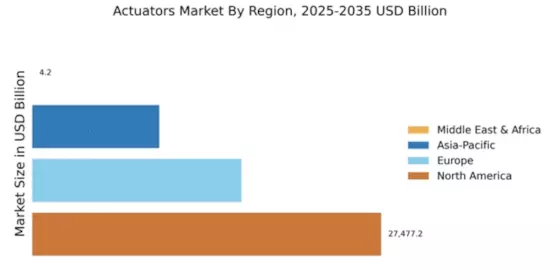
North America is poised to maintain its leadership in the actuators market, holding a significant share of approximately 40% in 2024. The region's growth is driven by increasing automation across industries, stringent regulatory standards, and a focus on energy efficiency. The demand for advanced actuators in sectors like manufacturing, automotive, and aerospace is expected to surge, supported by government initiatives promoting technological innovation.
The competitive landscape in North America is robust, featuring key players such as Siemens, Parker Hannifin, and Honeywell. These companies are investing heavily in R&D to enhance product offerings and meet the evolving needs of various industries. The presence of established firms and a strong supply chain further solidify North America's position as a manufacturing hub for actuators, ensuring sustained growth in the coming years.
Europe : Innovation and Sustainability Focus
Europe's actuators market is projected to reach $16,473 million by 2025, driven by a strong emphasis on sustainability and innovation. The region is witnessing a shift towards smart manufacturing and Industry 4.0, which is catalyzing the demand for advanced actuators. Regulatory frameworks, such as the EU's Green Deal, are pushing industries to adopt energy-efficient solutions, further boosting market growth. The integration of IoT technologies is also enhancing the functionality of actuators, making them more appealing to manufacturers.
Leading countries in Europe, such as Germany, France, and the UK, are at the forefront of this market evolution. Major players like Schneider Electric and Bosch Rexroth are actively involved in developing cutting-edge actuator technologies. The competitive landscape is characterized by a mix of established firms and innovative startups, fostering a dynamic environment for growth. As industries adapt to new regulations and technological advancements, the actuators market in Europe is set for significant expansion.
Asia-Pacific : Emerging Market Potential
The Asia-Pacific actuators market is expected to grow significantly, reaching $10,000 million by 2025. This growth is fueled by rapid industrialization, urbanization, and increasing investments in automation technologies. Countries like China and India are leading this transformation, with government initiatives aimed at enhancing manufacturing capabilities and infrastructure.
The rising demand for smart devices and automation in various sectors is also contributing to the market's expansion, making it a key area for future investments. China stands out as a dominant player in the region, with numerous local and international companies vying for market share. Key players such as SMC Corporation and Yaskawa Electric are expanding their operations to meet the growing demand. The competitive landscape is evolving, with a focus on innovation and cost-effective solutions. As the region continues to embrace automation, the actuators market is poised for substantial growth, driven by both domestic and foreign investments.
Middle East and Africa : Niche Market Development
The Middle East and Africa actuators market is relatively small, valued at $4.25 million, but it presents unique opportunities for growth. The region is gradually adopting automation technologies, driven by increasing investments in infrastructure and industrial projects. Governments are recognizing the importance of modernizing their industries, which is expected to create demand for actuators in various sectors, including oil and gas, manufacturing, and utilities. However, the market remains challenged by economic fluctuations and regulatory hurdles.
Countries like the UAE and South Africa are leading the way in adopting advanced technologies, with local firms and international players exploring opportunities. The competitive landscape is characterized by a mix of established companies and new entrants, focusing on niche applications. As the region continues to develop its industrial base, the actuators market is likely to see gradual growth, supported by strategic investments and partnerships.