Advanced Persistent Threat Protection Market
Advanced Persistent Threat Protection Market Summary
As per Market Research Future analysis, the Advanced Persistent Threat Protection Market Size was estimated at 15.59 USD Billion in 2024. The Advanced Persistent Threat Protection industry is projected to grow from 17.29 USD Billion in 2025 to 48.55 USD Billion by 2035, exhibiting a compound annual growth rate (CAGR) of 10.88% during the forecast period 2025 - 2035
Key Market Trends & Highlights
The Advanced Persistent Threat Protection Market is experiencing robust growth driven by technological advancements and increasing security demands.
- The integration of AI and Machine Learning is transforming threat detection and response capabilities in the market.
- North America remains the largest market, while Asia-Pacific is emerging as the fastest-growing region for advanced persistent threat protection solutions.
- Network Security continues to dominate the market, whereas Endpoint Security is witnessing the fastest growth due to evolving cyber threats.
- Increasing cybersecurity threats and regulatory compliance requirements are key drivers propelling the demand for advanced persistent threat protection solutions.
Market Size & Forecast
| 2024 Market Size | 15.59 (USD Billion) |
| 2035 Market Size | 48.55 (USD Billion) |
| CAGR (2025 - 2035) | 10.88% |
Major Players
CrowdStrike (US), Palo Alto Networks (US), FireEye (US), McAfee (US), Symantec (US), Check Point Software (IL), Cisco (US), Fortinet (US), Trend Micro (JP)
Advanced Persistent Threat Protection Market Trends
The Advanced Persistent Threat Protection Market is currently experiencing a notable evolution, driven by the increasing sophistication of cyber threats and the growing need for robust security measures. Organizations across various sectors are recognizing the necessity of implementing advanced solutions to safeguard their sensitive data and critical infrastructure. This market appears to be characterized by a shift towards integrated security frameworks that combine threat intelligence, machine learning, and automated response capabilities. As cyber adversaries become more adept at evading traditional defenses, the demand for innovative protection strategies intensifies, prompting vendors to enhance their offerings and adapt to emerging challenges.
Moreover, the landscape of the Advanced Persistent Threat Protection Market is influenced by regulatory pressures and compliance requirements that compel organizations to adopt comprehensive security protocols. The rise of remote work and digital transformation initiatives further complicates the security environment, as organizations must protect their assets across diverse platforms and locations. Consequently, the market is likely to witness a surge in investments aimed at fortifying defenses against advanced threats. This evolving scenario suggests that stakeholders must remain vigilant and proactive in their approach to cybersecurity, as the stakes continue to rise in an increasingly interconnected world. This shift toward intelligent cybersecurity frameworks is accelerating demand for next generation persistent threat monitoring, enabling organizations to detect, analyze, and neutralize sophisticated attacks in real time. The market’s persistent forecast reflects sustained enterprise investment in proactive cybersecurity architectures designed to combat evolving advanced threats.
Integration of AI and Machine Learning
The integration of artificial intelligence and machine learning technologies into threat protection solutions is becoming increasingly prevalent. These advanced technologies enable organizations to analyze vast amounts of data in real-time, identifying patterns and anomalies that may indicate potential threats. This trend suggests a shift towards more proactive security measures, allowing for quicker detection and response to sophisticated attacks.
Focus on Regulatory Compliance
As regulatory frameworks evolve, organizations are placing greater emphasis on compliance with data protection laws and cybersecurity standards. This trend indicates that businesses are not only investing in advanced threat protection solutions but are also ensuring that these solutions align with legal requirements. Consequently, compliance-driven initiatives are likely to shape the development and deployment of security technologies.
Rise of Managed Security Services
The demand for managed security services is on the rise as organizations seek to leverage external expertise in threat detection and response. This trend reflects a growing recognition that maintaining in-house security capabilities can be resource-intensive and complex. By outsourcing these functions, businesses can focus on their core operations while benefiting from specialized knowledge and advanced tools.
Advanced Persistent Threat Protection Market Drivers
Increasing Cybersecurity Threats
The Advanced Persistent Threat Protection Market is experiencing a surge in demand due to the escalating frequency and sophistication of cyber threats. Organizations are increasingly targeted by advanced persistent threats, which are characterized by their stealthy and prolonged nature. According to recent data, the number of reported cyber incidents has risen significantly, prompting businesses to invest heavily in advanced threat protection solutions. This trend is likely to continue as cybercriminals adopt more sophisticated techniques, making it imperative for organizations to enhance their security postures. The need for robust protection mechanisms is underscored by the potential financial and reputational damage that can result from successful attacks, thereby driving growth in the Advanced Persistent Threat Protection Market.
Adoption of Cloud-Based Solutions
The shift towards cloud computing is significantly impacting the Advanced Persistent Threat Protection Market. As organizations increasingly migrate their operations to the cloud, the need for advanced threat protection solutions tailored for cloud environments becomes paramount. Cloud-based services offer scalability and flexibility, but they also introduce unique security challenges that must be addressed. The market for cloud security solutions is projected to grow substantially, with estimates suggesting a compound annual growth rate (CAGR) of over 20% in the coming years. This trend indicates a growing recognition of the importance of advanced persistent threat protection in safeguarding cloud infrastructures, thereby driving demand within the Advanced Persistent Threat Protection Market.
Regulatory Compliance Requirements
The Advanced Persistent Threat Protection Market is also influenced by the increasing regulatory compliance requirements imposed on organizations across various sectors. Governments and regulatory bodies are enacting stringent data protection laws, necessitating that businesses implement effective cybersecurity measures. For instance, regulations such as the General Data Protection Regulation (GDPR) and the Health Insurance Portability and Accountability Act (HIPAA) mandate that organizations safeguard sensitive information against unauthorized access. Failure to comply with these regulations can result in hefty fines and legal repercussions, thereby incentivizing organizations to invest in advanced persistent threat protection solutions. This compliance-driven demand is expected to bolster the growth of the Advanced Persistent Threat Protection Market as organizations strive to meet regulatory standards.
Integration of Artificial Intelligence
The integration of artificial intelligence (AI) and machine learning technologies is transforming the Advanced Persistent Threat Protection Market. AI-driven solutions enable organizations to detect and respond to threats more efficiently by analyzing vast amounts of data in real-time. These technologies can identify patterns and anomalies that may indicate a potential attack, allowing for proactive measures to be taken. The market for AI in cybersecurity is expected to witness substantial growth, with projections indicating a significant increase in investment in AI-driven security solutions. This technological advancement is likely to enhance the effectiveness of advanced persistent threat protection, making it a critical driver of growth in the Advanced Persistent Threat Protection Market.
Rising Demand for Managed Security Services
The increasing complexity of cybersecurity threats has led to a rising demand for managed security services within the Advanced Persistent Threat Protection Market. Organizations are increasingly outsourcing their security needs to specialized providers who can offer expertise and resources that may not be available in-house. Managed security service providers (MSSPs) are equipped to deliver comprehensive threat protection solutions, including monitoring, detection, and response capabilities. This trend is expected to continue as businesses seek to enhance their security posture while managing costs. The growth of the managed security services market is indicative of the broader demand for advanced persistent threat protection solutions, further propelling the Advanced Persistent Threat Protection Market.
Market Segment Insights
By Type: Network Security (Largest) vs. Endpoint Security (Fastest-Growing)
In the Advanced Persistent Threat Protection Market, the segment distribution reveals that Network Security stands as the largest segment, attributed to its extensive adoption among organizations to protect their premises and hybrid environments from relentless threats. Conversely, Endpoint Security is swiftly emerging as a formidable competitor, gaining traction due to the rise in remote work and the increasing prevalence of endpoint devices within corporate networks.
Network Security: Dominant vs. Endpoint Security: Emerging
Network Security dominates the Advanced Persistent Threat Protection Market by providing robust defenses for organizational infrastructures against unauthorized access and cyber threats. It encompasses various strategies and technologies designed to safeguard networks from breaches, making it integral for businesses today. On the other hand, Endpoint Security is rapidly becoming an essential part of security strategies, driven by the expanding use of mobile devices and IoT. This segment focuses on protecting individual devices connected to the network, offering solutions such as antivirus software and intrusion prevention systems. While Network Security remains pivotal, Endpoint Security is stepping into the spotlight, driven by its relevance in increasingly decentralized workplaces.
By Deployment Mode: On-Premises (Largest) vs. Cloud-Based (Fastest-Growing)
The Advanced Persistent Threat Protection Market showcases a diverse landscape in terms of deployment modes, with 'On-Premises' holding the largest share. This segment is favored by organizations that prioritize control over their infrastructure and data security. In contrast, 'Cloud-Based' solutions are rapidly gaining traction among businesses looking for scalability and cost-efficiency, indicating a shift in preferences towards more modern deployment modes that cater to dynamic operational needs. Growth trends reveal a pronounced shift towards Cloud-Based solutions, fueled by the increasing reliance on remote working environments and the demand for flexible security solutions. Organizations are moving away from traditional On-Premises setups that require significant investment in hardware and maintenance. Factors such as ease of updates, broad accessibility, and improved integration capabilities with other cloud services are driving the adoption of cloud-based APT protection.
Deployment Mode: On-Premises (Dominant) vs. Cloud-Based (Emerging)
On-Premises deployment in the Advanced Persistent Threat Protection Market is characterized by organizations that prefer comprehensive control and security customization, enabling them to tailor the security framework specific to their operational needs. This traditional model is dominant in industries such as government and finance, where regulatory requirements dictate stringent security measures. Conversely, Cloud-Based APT solutions are emerging as a game-changer for many organizations, driven by the need for agility and cost-effectiveness. These solutions support a flexible security posture conducive to modern businesses. As cyber threats evolve, Cloud-Based models are designed to quickly adapt to new threats, an attractive feature for enterprises facing increasingly sophisticated APTs.
By Service Type: Managed Services (Largest) vs. Professional Services (Fastest-Growing)
In the Advanced Persistent Threat Protection Market, the service type segment is primarily dominated by Managed Services, which hold the largest market share. These services provide comprehensive solutions, including monitoring and analysis, to enterprises looking to defend against sophisticated cyber threats. Professional Services, while growing rapidly, currently represent a smaller proportion of the market but are gaining traction as organizations seek specialized expertise in threat detection and response.
Service Type: Managed Services (Dominant) vs. Professional Services (Emerging)
Managed Services play a critical role in the Advanced Persistent Threat Protection Market by offering clients a robust defense mechanism against advanced threats. These services combine technology and personnel to deliver continuous monitoring, threat intelligence, and incident response. Conversely, Professional Services are emerging as vital contributors, providing consulting, implementation, and training tailored to specific security needs. The demand for Professional Services is driven by organizations striving to enhance their cybersecurity posture while navigating complex threat landscapes, highlighting their growing importance in complementing managed offerings.
By End User: BFSI (Largest) vs. Healthcare (Fastest-Growing)
In the Advanced Persistent Threat Protection Market, the BFSI sector stands out as the largest end user, reflecting the critical need for robust cybersecurity measures amidst increasing financial fraud and data breaches. The healthcare segment, while smaller, is rapidly gaining traction as organizations prioritize protecting sensitive patient data, particularly with the rise of telemedicine and electronic health records. The IT and Telecom sector follows closely, driven by a significant reliance on data integrity and security.
BFSI: Dominant vs. Healthcare: Emerging
The BFSI sector remains dominant in the Advanced Persistent Threat Protection Market due to its stringent regulatory requirements and the high value of financial data. As a result, financial institutions invest heavily in advanced security solutions to mitigate risks associated with cyber threats. Meanwhile, the healthcare sector is labeled as an emerging segment, gaining momentum as virtual healthcare services proliferate. Healthcare organizations are recognizing the necessity of securing sensitive patient information amidst growing cyberattacks. Together, these sectors underscore the diverse applications of advanced threat protection solutions.
Regional Insights
North America : Cybersecurity Leadership and Innovation
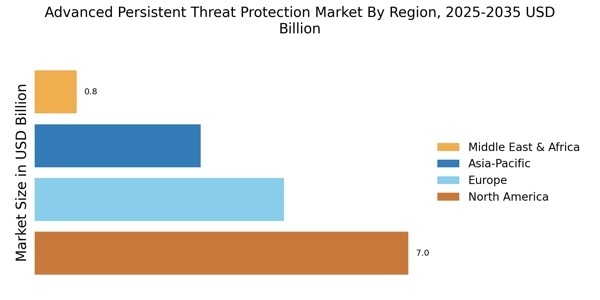
North America is the largest market for Advanced Persistent Threat Protection Market (APTP), holding approximately 45% of the global market share. The region's growth is driven by increasing cyber threats, stringent regulatory requirements, and a robust technological infrastructure. The demand for advanced security solutions is further fueled by the rise in remote work and digital transformation initiatives across various sectors. The United States leads the APTP market, with significant contributions from Canada. Major players like CrowdStrike, Palo Alto Networks, and FireEye are headquartered here, fostering a competitive landscape that emphasizes innovation and rapid response to emerging threats. The presence of these key players enhances the region's capability to address complex cybersecurity challenges effectively.
Europe : Regulatory Framework and Growth
Europe is the second-largest market for Advanced Persistent Threat Protection Market, accounting for approximately 30% of the global market share. The region's growth is propelled by stringent regulations such as the General Data Protection Regulation (GDPR) and increasing awareness of cybersecurity risks among businesses. The demand for APTP solutions is expected to rise as organizations seek to comply with these regulations and protect sensitive data from advanced threats. Leading countries in this market include the United Kingdom, Germany, and France, where the presence of key players like Check Point Software and Cisco enhances competition. The European market is characterized by a mix of established firms and innovative startups, driving advancements in threat detection and response capabilities. The competitive landscape is further supported by government initiatives aimed at bolstering cybersecurity resilience across the region.
Asia-Pacific : Emerging Market with High Potential
Asia-Pacific is witnessing rapid growth in the Advanced Persistent Threat Protection Market, holding approximately 20% of the global market share. The region's expansion is driven by increasing digitalization, a surge in cyberattacks, and growing investments in cybersecurity infrastructure. Countries like China and India are at the forefront, with governments implementing policies to enhance national cybersecurity frameworks and protect critical information assets. The competitive landscape in Asia-Pacific is evolving, with a mix of local and international players such as Trend Micro and Fortinet. The region's diverse market demands tailored solutions to address specific threats, leading to innovation in APTP technologies. As organizations prioritize cybersecurity, the market is expected to grow significantly, supported by rising awareness and regulatory initiatives aimed at safeguarding digital assets.
Middle East and Africa : Growing Awareness and Investment
The Middle East and Africa (MEA) region is emerging as a significant player in the Advanced Persistent Threat Protection Market, accounting for approximately 5% of the global market share. The growth is driven by increasing cyber threats, government initiatives to enhance cybersecurity, and rising investments in technology. Countries like the UAE and South Africa are leading the charge, with national strategies aimed at improving cybersecurity resilience and protecting critical infrastructure. The competitive landscape in MEA is characterized by a mix of global and regional players, with companies like Cisco and local firms expanding their offerings. The region's unique challenges, including geopolitical tensions and varying levels of technological maturity, necessitate customized APTP solutions. As awareness of cybersecurity risks grows, organizations are increasingly prioritizing investments in advanced threat protection technologies.
Key Players and Competitive Insights
Key Companies in the Advanced Persistent Threat Protection Market include
Industry Developments
The Global Advanced Persistent Threat Protection Market has witnessed several notable developments, especially within major companies like Fortinet, Palo Alto Networks, and CrowdStrike. Recently, Fortinet announced a significant expansion of its cloud security offerings to enhance protection against advanced threats. Palo Alto Networks continues to enhance its threat detection capabilities through the acquisition of innovative cybersecurity startups, further solidifying its position in the market. On the other hand, McAfee's strategic partnerships with cloud service providers aim to improve threat visibility and response times.
Merger and acquisition activity remains prominent, with FireEye acquiring a smaller firm to bolster its threat intelligence capabilities, while Check Point Software also secured a strategic partnership aimed at expanding its operational footprint in Europe. Market valuation has been on a positive trajectory, driven by increasing demand for robust cybersecurity solutions among enterprises as organizations grapple with the increasing sophistication of cyber threats. Companies like IBM and Microsoft are investing heavily in AI and machine learning applications, leading to enhanced threat detection and mitigation capabilities, which are proving invaluable in the evolving landscape of cyber threats.
Future Outlook
Advanced Persistent Threat Protection Market Future Outlook
The Advanced Persistent Threat Protection Market is projected to grow at a 10.88% CAGR from 2025 to 2035, driven by increasing cyber threats, regulatory compliance, and technological advancements.
New opportunities lie in:
- Development of AI-driven threat detection systems Expansion of managed security service offerings Integration of threat intelligence platforms with existing security frameworks
By 2035, the market is expected to be robust, reflecting substantial growth and innovation.
Market Segmentation
Advanced Persistent Threat Protection Market Type Outlook
- Network Security
- Endpoint Security
- Email Security
- Cloud Security
Advanced Persistent Threat Protection Market End User Outlook
- BFSI
- Healthcare
- IT and Telecom
- Government
Advanced Persistent Threat Protection Market Service Type Outlook
- Managed Services
- Professional Services
Advanced Persistent Threat Protection Market Deployment Mode Outlook
- On-Premises
- Cloud-Based
Report Scope
| MARKET SIZE 2024 | 15.59(USD Billion) |
| MARKET SIZE 2025 | 17.29(USD Billion) |
| MARKET SIZE 2035 | 48.55(USD Billion) |
| COMPOUND ANNUAL GROWTH RATE (CAGR) | 10.88% (2025 - 2035) |
| REPORT COVERAGE | Revenue Forecast, Competitive Landscape, Growth Factors, and Trends |
| BASE YEAR | 2024 |
| Market Forecast Period | 2025 - 2035 |
| Historical Data | 2019 - 2024 |
| Market Forecast Units | USD Billion |
| Key Companies Profiled | CrowdStrike (US), Palo Alto Networks (US), FireEye (US), McAfee (US), Symantec (US), Check Point Software (IL), Cisco (US), Fortinet (US), Trend Micro (JP) |
| Segments Covered | Solution Type, Deployment Mode, Service Type, End User, Regional |
| Key Market Opportunities | Integration of artificial intelligence enhances threat detection in the Advanced Persistent Threat Protection Market. |

| Key Market Dynamics | Rising cyber threats drive demand for advanced persistent threat protection solutions, influencing competitive dynamics and technological innovation. |
| Countries Covered | North America, Europe, APAC, South America, MEA |
Market Highlights
FAQs
What is the projected market valuation of the Advanced Persistent Threat Protection Market by 2035?
The market is projected to reach a valuation of 48.55 USD Billion by 2035.
What was the market valuation of the Advanced Persistent Threat Protection Market in 2024?
In 2024, the market valuation was 15.59 USD Billion.
What is the expected CAGR for the Advanced Persistent Threat Protection Market during the forecast period 2025 - 2035?
The expected CAGR for the market during this period is 10.88%.
Which segment is projected to have the highest valuation in the Advanced Persistent Threat Protection Market by 2035?
The Cloud-Based deployment mode is projected to reach 29.82 USD Billion by 2035.
What are the key players in the Advanced Persistent Threat Protection Market?
Key players include CrowdStrike, Palo Alto Networks, FireEye, McAfee, Symantec, Check Point Software, Cisco, Fortinet, and Trend Micro.
How does the Endpoint Security segment perform in terms of valuation?
The Endpoint Security segment is projected to grow from 4.0 USD Billion to 12.0 USD Billion by 2035.
What is the projected valuation for Managed Services in the Advanced Persistent Threat Protection Market?
Managed Services is expected to grow from 6.23 USD Billion in 2024 to 19.05 USD Billion by 2035.
Which end-user segment is anticipated to show significant growth in the Advanced Persistent Threat Protection Market?
The IT and Telecom sector is projected to grow from 4.67 USD Billion to 14.01 USD Billion by 2035.
What is the expected growth trajectory for the Email Security segment?
The Email Security segment is projected to increase from 3.0 USD Billion to 9.0 USD Billion by 2035.
How does the On-Premises deployment mode compare to Cloud-Based in terms of market valuation?
The On-Premises deployment mode is expected to grow from 6.23 USD Billion to 18.73 USD Billion, while Cloud-Based is projected to rise from 9.36 USD Billion to 29.82 USD Billion by 2035.
Research Approach
Secondary Research
The secondary research process involved comprehensive analysis of cybersecurity frameworks, threat intelligence databases, regulatory compliance repositories, and authoritative technology publications. Key sources included the US Cybersecurity and Infrastructure Security Agency (CISA), National Institute of Standards and Technology (NIST), European Union Agency for Cybersecurity (ENISA), UK National Cyber Security Centre (NCSC), MITRE Corporation (ATT&CK Framework), Common Vulnerabilities and Exposures (CVE/NVD) database, Verizon Data Breach Investigations Report (DBIR), IBM X-Force Threat Intelligence, INTERPOL Cyber Fusion Centre, FIRST (Forum of Incident Response and Security Teams), Cloud Security Alliance (CSA), (ISC)² Global Information Security Workforce Study, SANS Institute Reading Room, and national CERTs (Computer Emergency Response Teams) from key markets. These sources were used to collect threat landscape statistics, regulatory compliance requirements (GDPR, NIS2 Directive, HIPAA, PCI-DSS, SOX), incident response data, patent filings for detection algorithms, and competitive intelligence for AI/ML-based threat detection technologies.
Primary Research
Qualitative and quantitative insights were obtained by interviewing supply-side and demand-side stakeholders during the primary research process. CEOs, Chief Technology Officers (CTOs), Chief Information Security Officers (CISOs), Vice Presidents of Product Development, heads of threat intelligence/research, and commercial directors from APT protection platform vendors, cybersecurity OEMs, and managed security service providers (MSSPs) comprised supply-side sources. BFSI institutions, healthcare systems, government agencies, telecommunications operators, and critical infrastructure operators comprised demand-side sources, which included CISOs, Chief Information Officers (CIOs), IT Security Directors, Security Operations Center (SOC) Managers, network security architects, and procurement leads. Primary research verified market segmentation across solution types, confirmed product roadmap timelines for zero-day detection capabilities, and collected insights on enterprise adoption patterns, pricing strategies for subscription-based models, and procurement cycles for security infrastructure.
Primary Respondent Breakdown:
• By Designation: C-level Primaries (40%), Director Level (25%), Manager/Specialist Level (35%)
• By Region: North America (40%), Europe (25%), Asia-Pacific (28%), Rest of World (7%)
Market Size Estimation
Global market valuation was derived through software revenue mapping and enterprise deployment analysis. The methodology included:
• Identification of 50+ key cybersecurity vendors across North America, Europe, Asia-Pacific, Latin America, and Middle East & Africa
• Product mapping across network security, endpoint detection and response (EDR), email security, cloud workload protection platforms (CWPP), deception technology, and threat intelligence platforms
• Analysis of reported annual recurring revenue (ARR) and license revenue specific to APT protection portfolios, including both on-premises perpetual licenses and cloud-based SaaS subscriptions
• Coverage of vendors representing 75-80% of global market share in 2024
• Extrapolation using bottom-up (enterprise seat count × average selling price by deployment mode) and top-down (vendor revenue validation adjusted for MSSP margins) approaches to derive segment-specific valuations for solution types, service categories, and vertical industry adoption rates
Kindly complete the form below to receive a free sample of this Report
Customer Stories
“This is really good guys. Excellent work on a tight deadline. I will continue to use you going forward and recommend you to others. Nice job”
“Thanks. It’s been a pleasure working with you, please use me as reference with any other Intel employees.”
“Thanks for sending the report it gives us a good global view of the Betaïne market.”
“Thank you, this will be very helpful for OQS.”
“We found the report very insightful! we found your research firm very helpful. I'm sending this email to secure our future business.”
“I am very pleased with how market segments have been defined in a relevant way for my purposes (such as "Portable Freezers & refrigerators" and "last-mile"). In general the report is well structured. Thanks very much for your efforts.”
“I have been reading the first document or the study, ,the Global HVAC and FP market report 2021 till 2026. Must say, good info! I have not gone in depth at all parts, but got a good indication of the data inside!”
“We got the report in time, we really thank you for your support in this process. I also thank to all of your team as they did a great job.”