×
Request Free Sample ×

Kindly complete the form below to receive a free sample of this Report

* Please use a valid business email

Leading companies partner with us for data-driven Insights

clients tt-cursor
Hero Background

Aerospace Flight Control System Market

ID: MRFR/AD/2370-CR
134 Pages
Sejal Akre
October 2019

Aerospace Flight Control System Market Research Report Information by Platform (Fixed-Wing and Rotary-Wing), Application (Commercial, Military and Business Aviation), Technology (Fly-by-Wire, Power-by-Wire, Hydro-Mechanical Systems and Digital Fly-by-Wire), Component [Cockpit Controls, Actuators, Flight Control Computers (Primary FCC and Secondary FCC) and Standby Attitude), End-Use (Line-fit and Retrofit) and Region (North America, Europe, Asia-Pacific, Middle East Africa and Latin America) - Forecast till 2035

Share:
Download PDF ×

We do not share your information with anyone. However, we may send you emails based on your report interest from time to time. You may contact us at any time to opt-out.

Aerospace Flight Control System Market Infographic
Purchase Options

Aerospace Flight Control System Market Summary

As per MRFR analysis, the Aerospace Flight Control System Market Size was estimated at 71.5 USD Million in 2024. The Aerospace Flight Control System industry is projected to grow from 76.2 in 2025 to 144.4 by 2035, exhibiting a compound annual growth rate (CAGR) of 6.6 during the forecast period 2025 - 2035.

Key Market Trends & Highlights

The Aerospace Flight Control System Market is poised for substantial growth driven by technological advancements and increasing demand for UAVs.

  • The integration of Artificial Intelligence is transforming flight control systems, enhancing operational efficiency and safety.
  • North America remains the largest market, while the Asia-Pacific region is emerging as the fastest-growing area for aerospace flight control systems.
  • Commercial aviation continues to dominate the market, whereas the unmanned aerial vehicles segment is experiencing rapid growth.
  • Technological advancements and rising demand for unmanned aerial vehicles are key drivers propelling market expansion.

Market Size & Forecast

2024 Market Size 71.5 (USD Million)
2035 Market Size 144.4 (USD Million)
CAGR (2025 - 2035) 6.6%

Major Players

Honeywell (US), Rockwell Collins (US), Thales Group (FR), Northrop Grumman (US), BAE Systems (GB), Safran (FR), Moog Inc. (US), L3Harris Technologies (US), General Dynamics (US)

Aerospace Flight Control System Market Trends

The Aerospace Flight Control System Market is currently experiencing a transformative phase, driven by advancements in technology and increasing demand for enhanced safety and efficiency in aviation. The integration of automation and artificial intelligence into flight control systems appears to be reshaping the landscape, enabling more precise maneuverability and improved operational performance. Furthermore, the growing emphasis on reducing environmental impact is prompting manufacturers to innovate and develop systems that optimize fuel consumption and minimize emissions. As a result, the market is likely to witness a surge in the adoption of eco-friendly technologies, which could redefine industry standards. In addition to technological advancements, the Aerospace Flight Control System Market is influenced by regulatory changes and evolving consumer expectations. Governments and aviation authorities are increasingly mandating stricter safety protocols, which may drive the demand for advanced flight control systems that comply with new regulations. Moreover, the rise of urban air mobility and the development of unmanned aerial vehicles are expected to create new opportunities for market players. This evolving landscape suggests that stakeholders must remain agile and responsive to emerging trends to maintain a competitive edge in this dynamic environment.

Integration of Artificial Intelligence

The incorporation of artificial intelligence into flight control systems is becoming more prevalent. This trend suggests that AI can enhance decision-making processes, improve predictive maintenance, and facilitate autonomous operations, thereby increasing overall safety and efficiency.

Focus on Environmental Sustainability

There is a growing emphasis on developing flight control systems that prioritize environmental sustainability. This trend indicates that manufacturers are exploring technologies that reduce fuel consumption and emissions, aligning with global efforts to combat climate change.

Regulatory Compliance and Safety Enhancements

As aviation regulations evolve, there is a heightened focus on compliance and safety enhancements within the Aerospace Flight Control System Market. This trend implies that companies are investing in advanced systems to meet stringent safety standards and ensure operational reliability.

Aerospace Flight Control System Market Drivers

Market Growth Projections

The Global Aerospace Flight Control System Industry is projected to experience substantial growth over the coming years. With a market value expected to reach 8.87 USD Billion in 2024 and further increase to 13.2 USD Billion by 2035, the industry is poised for a promising trajectory. The compound annual growth rate (CAGR) of 3.66% from 2025 to 2035 indicates a steady expansion, driven by factors such as technological advancements, increasing demand for fuel efficiency, and military modernization initiatives. These projections highlight the dynamic nature of the market and the various drivers contributing to its growth.

Technological Advancements

The Global Aerospace Flight Control System Industry is experiencing rapid technological advancements, particularly in the areas of automation and digitalization. Innovations such as fly-by-wire systems and advanced avionics are enhancing aircraft performance and safety. For instance, the integration of artificial intelligence and machine learning in flight control systems is streamlining operations and improving decision-making processes. This trend is likely to drive market growth, as the industry anticipates a market value of 8.87 USD Billion in 2024, with projections indicating a rise to 13.2 USD Billion by 2035. Such advancements suggest a robust CAGR of 3.66% from 2025 to 2035.

Growth in Commercial Aviation

The Global Aerospace Flight Control System Industry is benefiting from the robust growth in commercial aviation. As global air travel demand continues to rise, airlines are expanding their fleets and upgrading existing aircraft with advanced flight control systems. This trend is particularly evident in emerging markets, where increasing disposable incomes and urbanization are driving air travel. The International Air Transport Association (IATA) forecasts a significant increase in passenger numbers, which in turn fuels the demand for modern flight control systems. This growth in commercial aviation is expected to contribute positively to the market's expansion, aligning with the projected values of 8.87 USD Billion in 2024 and 13.2 USD Billion by 2035.

Military Modernization Initiatives

The Global Aerospace Flight Control System Industry is also influenced by military modernization initiatives across various nations. Governments are investing heavily in upgrading their military aircraft with advanced flight control systems to enhance operational capabilities and maintain strategic advantages. This includes the integration of cutting-edge technologies such as autonomous flight systems and enhanced navigation aids. Countries are prioritizing defense spending, which is likely to drive demand for sophisticated flight control systems. As military modernization continues to gain momentum, it is anticipated that this segment will significantly contribute to the overall growth of the market.

Increasing Demand for Fuel Efficiency

The Global Aerospace Flight Control System Industry is witnessing a growing emphasis on fuel efficiency, driven by rising fuel costs and environmental concerns. Airlines and manufacturers are increasingly adopting flight control systems that optimize fuel consumption, thereby reducing operational costs. For example, advanced flight management systems enable precise navigation and altitude management, which can lead to significant fuel savings. This focus on efficiency is expected to contribute to the market's growth trajectory, as the industry aims to meet the projected market value of 8.87 USD Billion in 2024 and 13.2 USD Billion by 2035, reflecting a CAGR of 3.66% from 2025 to 2035.

Regulatory Compliance and Safety Standards

The Global Aerospace Flight Control System Industry is heavily influenced by stringent regulatory compliance and safety standards. Governments and aviation authorities worldwide are implementing rigorous regulations to enhance flight safety and operational reliability. This has led to increased investments in advanced flight control systems that meet or exceed these standards. For instance, the Federal Aviation Administration (FAA) and the European Union Aviation Safety Agency (EASA) have established guidelines that necessitate the adoption of state-of-the-art technologies in flight control systems. Consequently, this regulatory landscape is likely to propel market growth, as stakeholders seek to align with evolving safety requirements.

Market Segment Insights

By Application: Commercial Aviation (Largest) vs. Unmanned Aerial Vehicles (Fastest-Growing)

The Aerospace Flight Control System Market showcases a diverse application landscape, where Commercial Aviation emerges as the largest segment, significantly contributing to the overall market share. This is primarily driven by the increasing demand for air travel, advancements in aircraft technologies, and the global aviation industry's recovery. Meanwhile, Unmanned Aerial Vehicles (UAVs) are gaining traction, representing a rapidly emerging category within the market as innovations in drone technology and operational capabilities unfold. The military sector remains a vital player, while space exploration continues to carve out a niche in the segment.

Commercial Aviation (Dominant) vs. Space Exploration (Emerging)

Commercial Aviation is characterized by its extensive use of sophisticated flight control systems that ensure safety, efficiency, and enhanced performance of passenger and cargo aircraft. The segment benefits from established manufacturers and a robust supply chain. In contrast, Space Exploration represents an emerging segment where innovations in flight control systems are vital for mission success. This segment is increasingly influenced by public and private investments in space technologies, with companies striving to enhance their autonomous guidelines, ultimately leading to enhanced operational effectiveness for missions.

By End Use: Original Equipment Manufacturers (Largest) vs. Aftermarket (Fastest-Growing)

The aerospace flight control system market is primarily segmented into three key end-use categories: Original Equipment Manufacturers (OEMs), Aftermarket services, and Maintenance Repair and Overhaul (MRO). Among these segments, OEMs hold the largest share, as they provide the essential flight control systems required for new aircraft. The aftermarket segment is experiencing significant growth, driven by the increasing demand for retrofitting and upgrading existing systems as airlines strive to enhance operational efficiency and safety. The growth trends in the aerospace flight control system market are shaped by various factors, including advancements in technology, increasing air travel demand, and the rise of unmanned aerial vehicles (UAVs). OEMs benefit from stable demand as new aircraft continue to be produced, while the aftermarket is gaining traction due to an aging fleet and the need for regular maintenance and upgrades. The MRO segment also plays a critical role, supporting the operational longevity of flight control systems in service.

OEMs (Dominant) vs. Aftermarket (Emerging)

The Original Equipment Manufacturers (OEMs) segment is dominant in the aerospace flight control system market, as these manufacturers are responsible for producing advanced flight control systems that are integral to new aircraft designs. This segment benefits from ongoing advancements in technology and innovation, which enhance the capabilities and efficiency of flight control systems. Major OEMs invest heavily in research and development to stay competitive and meet evolving regulatory standards. On the other hand, the aftermarket segment is emerging rapidly, fueled by a growing need for maintenance, repair, and updates as fleets age. The aftermarket services provide significant opportunities for companies to offer spare parts, upgrades, and retrofitting solutions, thereby extending the life cycle of existing systems, making them critical for operational continuity and performance enhancements.

By Technology: Fly-by-Wire (Largest) vs. Autonomous Control Systems (Fastest-Growing)

The aerospace flight control system market is witnessing a significant distribution of market shares among various technologies, notably Fly-by-Wire, Fly-by-Light, Autonomous Control Systems, and Digital Fly-By-Wire. Fly-by-Wire technology remains the largest segment, dominating the market due to its established reliability and efficiency in modern aircraft. In contrast, Autonomous Control Systems are becoming increasingly relevant, tapping into the growing demand for unmanned aerial vehicles and advanced automation in aviation. Growth trends in the aerospace flight control system market indicate a clear inclination toward advanced control technologies. The rise in adoption of Fly-by-Light systems, driven by the need for lighter and more efficient control methods, complements the shift toward autonomous solutions. Factors such as increasing air traffic, the need for enhanced safety and automation, and regulatory approvals are paving the way for rapid development and deployment of autonomous control systems, which are expected to reshape the industry in the coming years.

Technology: Fly-by-Wire (Dominant) vs. Autonomous Control Systems (Emerging)

Fly-by-Wire technology, characterized by its use of electronic controls to replace traditional mechanical systems, has established itself as the dominant force in the aerospace flight control market. Its proven reliability and efficient performance in both commercial and military aircraft make it a preferred choice for manufacturers and operators. On the other hand, Autonomous Control Systems are emerging as a game-changing segment within the market, driven by technological advancements in artificial intelligence and machine learning. These systems are designed to operate with minimal human intervention, offering significant potential for reducing operational costs and improving safety. As industries gravitate towards automation, the demand for Autonomous Control Systems is increasing, positioning them as a critical area for future growth and innovation in aerospace.

By Component Type: Actuators (Largest) vs. Sensors (Fastest-Growing)

In the Aerospace Flight Control System Market, the component type segment is diversified among various product categories. Actuators currently hold the largest market share, driven by their critical role in the movement and positioning of control surfaces. Sensors follow closely behind, indicating a substantial market presence while also being identified as the fastest-growing segment due to advancements in technology and the increasing demand for more precise and reliable measurements in modern aircraft systems. The growth trends in this segment can be attributed to several factors. Firstly, the continuous advancement in aerospace technologies has enhanced the efficiency and performance of both actuators and sensors, catering to the evolving demands of aircraft manufacturers. Furthermore, the increasing incorporation of automation and digitalization within flight control systems is propelling the adoption of high-tech sensors, thereby fueling their rapid growth as airlines aim to ensure safety, efficiency, and reliability in their flight operations.

Actuators (Dominant) vs. Control Surfaces (Emerging)

Actuators are recognized as the dominant component in the Aerospace Flight Control System Market due to their essential function in enabling flight control surfaces to respond accurately and efficiently during operations. They are responsible for converting electrical signals into mechanical motion, playing a pivotal role in the stability and maneuverability of aircraft. On the other hand, control surfaces, while classified as an emerging segment, are gaining traction due to the increased focus on aerodynamics and performance optimization. The evolution of design and materials used in control surfaces, complemented by advancements in actuator technologies, enhances their effectiveness. As aerospace manufacturers strive for improved operational efficiency and reduced maintenance costs, control surfaces are becoming increasingly integral to modern aircraft design.

By System Type: Primary Flight Control Systems (Largest) vs. Stability Augmentation Systems (Fastest-Growing)

In the Aerospace Flight Control System Market, primary flight control systems are currently the largest segment, holding a significant market share. These systems are critical for the essential functionalities of aircraft, including stabilization and maneuverability. On the other hand, secondary flight control systems and stability augmentation systems play increasingly important roles, enhancing safety and operational efficiency. While secondary systems support the primary controls, stability augmentation systems are gaining traction due to advancements in technology and increased emphasis on automated flight features.

Primary Flight Control Systems (Dominant) vs. Stability Augmentation Systems (Emerging)

Primary flight control systems are crucial for managing the aircraft's fundamental flight dynamics. These systems ensure safe and efficient control during various flight operations, making them a dominant force in the market. In contrast, stability augmentation systems are emerging rapidly, driven by innovation and advancements in automation technologies. As airlines and manufacturers adopt more reliable and efficient flight technologies, the demand for these systems has surged. The advent of autonomous and semi-autonomous aircraft features is particularly propelling the need for stability augmentation, creating opportunities for growth in this segment.

Get more detailed insights about Aerospace Flight Control System Market

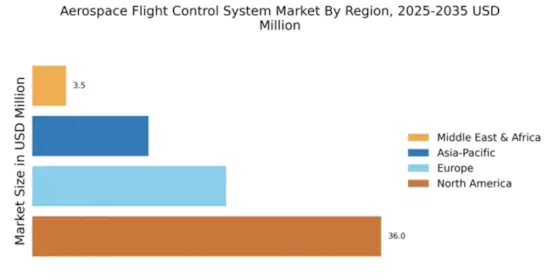
Regional Insights

North America : Market Leader in Aerospace Systems

North America continues to lead the Aerospace Flight Control System market, holding a significant share of 38.0% in 2024. The region's growth is driven by advancements in technology, increasing defense budgets, and a robust aerospace manufacturing sector. Regulatory support from agencies like the FAA fosters innovation and safety standards, further propelling market demand. The rising need for modernized aircraft systems and automation is also a key driver of growth. The competitive landscape in North America is characterized by the presence of major players such as Honeywell, Rockwell Collins, and Northrop Grumman. These companies are at the forefront of technological advancements, focusing on R&D to enhance flight control systems. The U.S. remains the leading country, with significant investments in both commercial and military aviation sectors. This strong presence of key players ensures a dynamic market environment, fostering continuous innovation and competition.

Europe : Emerging Market with Growth Potential

Europe holds a market share of 20.0% in the Aerospace Flight Control System sector, driven by increasing demand for advanced aviation technologies and stringent regulatory frameworks. The European Union's focus on enhancing air safety and environmental sustainability has led to investments in innovative flight control systems. Additionally, the rise in air travel and the need for modernization of existing fleets are significant growth catalysts in the region. Leading countries such as France, Germany, and the UK are pivotal in shaping the competitive landscape. Major players like Thales Group and BAE Systems are investing heavily in R&D to develop cutting-edge solutions. The European market is characterized by collaborations between government and industry, aimed at fostering innovation and maintaining competitiveness in the global aerospace sector. "The European aviation sector is committed to achieving the highest safety standards while promoting sustainable growth," stated the European Aviation Safety Agency.

Asia-Pacific : Rapidly Growing Aerospace Sector

The Asia-Pacific region is witnessing rapid growth in the Aerospace Flight Control System market, with a share of 10.0% as of 2024. This growth is fueled by increasing air travel demand, rising disposable incomes, and government initiatives to enhance aviation infrastructure. Countries like China and India are investing significantly in their aerospace sectors, driven by both commercial and defense needs. Regulatory support and partnerships with The Aerospace Flight Control System expansion. China is leading the charge in the region, with substantial investments in domestic aircraft manufacturing and modernization of existing fleets. The competitive landscape features both established players and emerging companies, creating a dynamic environment. Key players like Moog Inc. and L3Harris Technologies are focusing on strategic partnerships and technological advancements to capture market share. The region's potential for growth is immense, making it a focal point for future investments in aerospace technologies.

Middle East and Africa : Niche Market with Growth Opportunities

The Middle East and Africa region represents a niche market in the Aerospace Flight Control System sector, with a market share of 3.5% in 2024. Growth in this region is driven by increasing investments in aviation infrastructure and a rising number of air travelers. Countries like the UAE and South Africa are focusing on enhancing their aerospace capabilities, supported by government initiatives aimed at boosting local manufacturing and attracting foreign investments. Regulatory frameworks are evolving to support these developments. The competitive landscape is characterized by a mix of local and international players, with companies like Safran and General Dynamics establishing a presence in the region. The focus on modernization and safety in aviation is leading to increased demand for advanced flight control systems. As the region continues to develop its aerospace sector, opportunities for growth and collaboration with global firms are expected to expand, fostering a more robust market environment.

Key Players and Competitive Insights

The Aerospace Flight Control System Market is currently characterized by a dynamic competitive landscape, driven by technological advancements and increasing demand for automation in aviation. Key players such as Honeywell (US), Rockwell Collins (US), and Thales Group (FR) are strategically positioned to leverage innovation and partnerships to enhance their market presence. Honeywell (US) focuses on integrating advanced software solutions into its flight control systems, while Rockwell Collins (US) emphasizes the development of next-generation avionics. Thales Group (FR) is actively pursuing collaborations with aerospace manufacturers to expand its product offerings, thereby shaping a competitive environment that prioritizes technological sophistication and operational efficiency.

In terms of business tactics, companies are increasingly localizing manufacturing to reduce costs and enhance supply chain resilience. The market appears moderately fragmented, with several key players exerting influence through strategic partnerships and technological innovations. This collective approach enables companies to optimize their operations and respond effectively to evolving customer demands, thereby reinforcing their competitive positions.

In November 2025, Honeywell (US) announced a partnership with a leading aerospace manufacturer to develop a new suite of flight control systems that incorporate artificial intelligence (AI) for enhanced decision-making capabilities. This strategic move is likely to position Honeywell at the forefront of the market, as AI integration is becoming a critical differentiator in flight control technology. The collaboration not only enhances Honeywell's product portfolio but also aligns with the industry's shift towards smarter, more autonomous systems.

In October 2025, Rockwell Collins (US) unveiled a new digital platform designed to streamline the integration of flight control systems with existing aircraft architectures. This initiative reflects Rockwell Collins' commitment to digital transformation, enabling customers to achieve greater operational efficiency and safety. The platform's launch is expected to strengthen the company's competitive edge by providing a comprehensive solution that meets the growing demand for interconnected aviation systems.

In September 2025, Thales Group (FR) secured a contract with a major airline to supply advanced flight control systems for its new fleet of aircraft. This contract underscores Thales' strategic focus on expanding its market share through targeted partnerships. By aligning with key industry players, Thales is likely to enhance its visibility and influence within the aerospace sector, further solidifying its position as a leader in flight control technology.

As of December 2025, the competitive trends in the Aerospace Flight Control System Market are increasingly defined by digitalization, sustainability, and AI integration. Strategic alliances are playing a pivotal role in shaping the current landscape, as companies seek to combine their strengths to innovate and enhance product offerings. The shift from price-based competition to a focus on technological advancement and supply chain reliability is evident, suggesting that future competitive differentiation will hinge on the ability to deliver innovative solutions that meet the evolving needs of the aerospace industry.

Key Companies in the Aerospace Flight Control System Market market include

Industry Developments

  • Q2 2024: Lockheed Martin Demonstrates Smart Adaptive Flight Control Environment (SAFE) System in Fixed-Wing Aircraft Lockheed Martin announced the successful demonstration of its Smart Adaptive Flight Control Environment (SAFE) system, advancing adaptive flight control technologies for fixed-wing aircraft to improve responsiveness and handling.
  • Q2 2024: Sikorsky Conducts Flight Tests of Scalable Rotor Blown Wing UAS for DARPA Sikorsky completed flight tests of a scalable rotor blown wing unmanned aerial system (UAS) for DARPA, showcasing advanced flight control technologies for rotary-wing platforms.

Recent News in Aerospace Flight Control Systems

NASA's X-59 Quiet SuperSonic Technology (QueSST) Aircraft Achieves Major Milestone

  • What happened: The X-59 QueSST, a revolutionary aircraft designed to break the sound barrier without the sonic boom, has successfully completed a series of ground tests. These tests focused on evaluating the aircraft's flight control systems, including its ability to maintain stability and control at supersonic speeds.
  • Significance: This is a major step forward for the X-59 program, as it demonstrates the viability of the aircraft's flight control systems and brings it closer to its first flight. The X-59 is expected to revolutionize air travel by allowing supersonic flight over land, which is currently prohibited due to the sonic boom.

Artificial Intelligence (AI) Revolutionizes Flight Control Systems

  • What happened: Researchers at the Massachusetts Institute of Technology (MIT) have developed a new AI-powered flight control system that can adapt to unexpected situations in real-time. The system uses machine learning to analyze sensor data and make adjustments to the aircraft's flight path, even in the presence of turbulence or other disturbances.
  • Significance: This technology has the potential to significantly improve the safety and efficiency of aircraft, as it can react to changing conditions more quickly and effectively than traditional flight control systems.

New Flight Control System for Unmanned Aerial Vehicles (UAVs)

  • What happened: A team of engineers at the University of California, Berkeley, has developed a new flight control system for UAVs that allows them to fly autonomously in complex environments. The system uses a combination of sensors, including GPS, cameras, and lidar, to create a 3D map of the environment and plan a safe flight path.
  • Significance: This technology could have a major impact on the future of UAVs, as it would allow them to operate more safely and efficiently in a variety of applications, such as delivery, surveillance, and search and rescue.

The key players of the aerospace-flight control system market are

  • Liebherr Group (Switzerland)
  • Honeywell International, Inc. (US)
  • Woodward, Inc. (US)
  • Safran (France)
  • General Dynamics Corporation (US)
  • Moog, Inc. (US)
  • Lockheed Martin Corporation (US)
  • United Technologies Corporation (US)
  • BAE Systems plc (UK)
  • Saab AB (Sweden)
  • Parker Hannifin Corporation (US)

Recent developments 

  • Lockheed Martin is contracting with the US army to acquire more deals to deploy the flight control systems.
  • The key players of the market are receiving new contracts from the army sector for the production of a new range of flight control system. 
  • The unmanned aerial vehicle sector is offering new partnership deals for the flight control system market. 


Future Outlook

Aerospace Flight Control System Market Future Outlook

The Aerospace Flight Control System Market is projected to grow at a 6.6% CAGR from 2024 to 2035, driven by advancements in automation, demand for fuel efficiency, and increasing air traffic.

New opportunities lie in:

  • Development of AI-driven predictive maintenance solutions
  • Integration of advanced avionics for enhanced flight safety
  • Expansion into emerging markets with tailored flight control systems

By 2035, the market is expected to achieve robust growth, reflecting evolving technological demands and increased global air travel.

Market Segmentation

Aerospace Flight Control System Market End Use Outlook

  • Original Equipment Manufacturers
  • Aftermarket
  • Maintenance Repair and Overhaul

Aerospace Flight Control System Market Technology Outlook

  • Fly-by-Wire
  • Fly-by-Light
  • Autonomous Control Systems
  • Digital Fly-By-Wire

Aerospace Flight Control System Market Application Outlook

  • Commercial Aviation
  • Military Aviation
  • Unmanned Aerial Vehicles
  • Space Exploration

Aerospace Flight Control System Market System Type Outlook

  • Primary Flight Control Systems
  • Secondary Flight Control Systems
  • Stability Augmentation Systems

Aerospace Flight Control System Market Component Type Outlook

  • Actuators
  • Sensors
  • Control Surfaces
  • Flight Control Computers

Report Scope

MARKET SIZE 202471.5(USD Million)
MARKET SIZE 202576.2(USD Million)
MARKET SIZE 2035144.4(USD Million)
COMPOUND ANNUAL GROWTH RATE (CAGR)6.6% (2024 - 2035)
REPORT COVERAGERevenue Forecast, Competitive Landscape, Growth Factors, and Trends
BASE YEAR2024
Market Forecast Period2025 - 2035
Historical Data2019 - 2024
Market Forecast UnitsUSD Million
Key Companies ProfiledHoneywell (US), Rockwell Collins (US), Thales Group (FR), Northrop Grumman (US), BAE Systems (GB), Safran (FR), Moog Inc. (US), L3Harris Technologies (US), General Dynamics (US)
Segments CoveredApplication, End Use, Technology, Component Type, System Type
Key Market OpportunitiesIntegration of artificial intelligence in Aerospace Flight Control System enhances operational efficiency and safety.
Key Market DynamicsTechnological advancements and regulatory changes drive innovation and competition in the Aerospace Flight Control System market.
Countries CoveredNorth America, Europe, APAC, South America, MEA

Market Highlights

Author
Sejal Akre
Senior Research Analyst

She has over 5 years of rich experience, in market research and consulting providing valuable market insights to client. Hands on expertise in management consulting, and extensive knowledge in domain including ICT, Automotive & Transportation and Aerospace & Defense. She is skilled in Go-to market strategy, industry analysis, market sizing, in depth company profiling, competitive intelligence & benchmarking and value chain amongst others.

Leave a Comment

FAQs

What is the expected CAGR of the global Aerospace Flight Control Market?

The global aerospace control market is expected to expand at a CAGR of 3.66% by 2035.

What is the anticipated market value of the global Aerospace Flight Control Market?

The global aerospace control market is anticipated to acquire a market value of USD 13.2 billion by 2035.

Which commercial segment is projected to dominate the global Aerospace Flight Control Market?

Based on the application, the market is segmented into military, commercial, and business aviation. The commercial segment is expected to witness the highest CAGR during the forecast period.

What are the significant factors driving the global Aerospace Flight Control Market?

The growing demand for unmanned aircraft and lightweight aircraft is anticipated to drive the global aerospace control market.

Who are eminent players of the global Aerospace Flight Control Market?

Lockheed Martin Corporation (U.S.), Safran (France), United Technologies Corporation (U.S.), and Liebherr Group (Switzerland) are some eminent players in the global aerospace control market.

Download Free Sample

Kindly complete the form below to receive a free sample of this Report

Compare Licence

×
Features License Type
Single User Multiuser License Enterprise User
Price $4,950 $5,950 $7,250
Maximum User Access Limit 1 User Upto 10 Users Unrestricted Access Throughout the Organization
Free Customization
Direct Access to Analyst
Deliverable Format
Platform Access
Discount on Next Purchase 10% 15% 15%
Printable Versions