
×
Hero Background
English
Chinese
French
Japanese
Korean
German
Spanish

Aerospace Parts Manufacturing Market Analysis

ID: MRFR/AD/8137-HCR
200 Pages
Sejal Akre
October 2025

Aerospace Parts Manufacturing Market Research Report By Application (Commercial Aviation, Military Aviation, Space Exploration, Unmanned Aerial Vehicles), By Type of Parts (Structural Components, Engine Components, Electrical Components, Interior Components), By Material (Aluminum, Titanium, Composite Materials, Steel), By End-use (Original Equipment Manufacturer, Aftermarket), and By Regional (North America, Europe, South America, Asia Pacific, Middle East and Africa)-Forecast to 2035

Share:
Download PDF ×

We do not share your information with anyone. However, we may send you emails based on your report interest from time to time. You may contact us at any time to opt-out.

Aerospace Parts Manufacturing Market Infographic
Purchase Options

Market Analysis

In-depth Analysis of Aerospace Parts Manufacturing Market Industry Landscape

The Aerospace Parts Manufacturing Market operates within a dynamic and intricate ecosystem shaped by various interrelated market dynamics that significantly influence its growth, direction, and competitiveness.

Technological advancements are at the forefront of driving market dynamics in aerospace parts manufacturing. The continuous evolution of aerospace technology demands components that are not only precise but also lightweight, durable, and capable of meeting stringent performance requirements. As aircraft designs advance to become more efficient and technologically sophisticated, aerospace parts manufacturers are under constant pressure to innovate and develop cutting-edge components that align with the industry's technological advancements.

Market demand dynamics play a pivotal role in shaping the aerospace parts manufacturing landscape. The growth of the global aviation sector, propelled by rising air travel demand and the need for new, more fuel-efficient aircraft, fuels the demand for aerospace parts. Commercial airlines seek more cost-effective operations through fuel efficiency, leading to increased demand for parts that contribute to reduced emissions and improved fuel economy. Similarly, the defense sector's modernization programs and the development of advanced military aircraft drive the demand for specialized aerospace parts catering to defense applications.

Economic factors exert a significant impact on the aerospace parts manufacturing industry. Fluctuations in fuel prices, global economic conditions, and geopolitical tensions influence airlines' and defense entities' investment decisions in new aircraft and aerospace systems. Economic shifts can affect the demand for aerospace parts, impacting manufacturing volumes and OEM orders.

Regulatory standards and environmental considerations significantly shape the aerospace parts manufacturing market. The aerospace industry operates under stringent safety regulations and quality standards, necessitating aerospace parts to undergo rigorous certification processes to ensure compliance with safety and performance standards. Additionally, the industry's increasing focus on environmental sustainability drives the demand for parts that contribute to fuel efficiency and reduced emissions, aligning with global efforts to mitigate the environmental impact of aviation.

Supply chain dynamics and geopolitical factors significantly influence the Aerospace Parts Manufacturing Market. The availability of raw materials, geopolitical stability, trade policies, and supply chain disruptions impact the manufacturing process and cost structures within the industry. Any disruptions or uncertainties in the supply chain can impact production schedules and affect manufacturers' ability to meet demand.

Furthermore, technological disruptions, particularly in manufacturing methods like additive manufacturing or 3D printing, are reshaping the market dynamics. Additive manufacturing allows for the production of intricate parts with enhanced design possibilities and reduced lead times. Aerospace parts manufacturers leveraging this technology gain a competitive advantage by offering innovative solutions that meet specific customer needs and industry demands.

However, challenges persist within these market dynamics. Balancing technological advancements with cost-effectiveness remains a challenge for manufacturers. Innovations often come with increased production costs, impacting market adoption. Additionally, navigating complex regulatory landscapes, ensuring reliable supply chains, and addressing geopolitical uncertainties pose ongoing challenges for aerospace parts manufacturers.

In conclusion, the Aerospace Parts Manufacturing Market operates within a multifaceted framework influenced by technological advancements, market demand, economic fluctuations, regulatory standards, supply chain dynamics, and technological disruptions. Successfully navigating these market dynamics requires adaptability, innovation, stringent quality adherence, and a deep understanding of industry trends. Aerospace parts manufacturers that effectively navigate these factors position themselves for sustained growth and competitiveness in this ever-evolving industry.


Author
Sejal Akre
Senior Research Analyst

She has over 5 years of rich experience, in market research and consulting providing valuable market insights to client. Hands on expertise in management consulting, and extensive knowledge in domain including ICT, Automotive & Transportation and Aerospace & Defense. She is skilled in Go-to market strategy, industry analysis, market sizing, in depth company profiling, competitive intelligence & benchmarking and value chain amongst others.

Leave a Comment

FAQs

What is the current valuation of the Aerospace Parts Manufacturing Market?

As of 2024, the Aerospace Parts Manufacturing Market was valued at 85.53 USD Billion.

What is the projected market valuation for the Aerospace Parts Manufacturing Market in 2035?

The market is projected to reach a valuation of 120.56 USD Billion by 2035.

What is the expected CAGR for the Aerospace Parts Manufacturing Market from 2025 to 2035?

The expected CAGR for the Aerospace Parts Manufacturing Market during the forecast period 2025 - 2035 is 3.17%.

Which segments are included in the Aerospace Parts Manufacturing Market?

The market includes segments such as Commercial Aviation, Military Aviation, Space Exploration, and Unmanned Aerial Vehicles.

What are the projected valuations for the Commercial Aviation segment by 2035?

The Commercial Aviation segment is projected to grow from 40.0 USD Billion to 55.0 USD Billion by 2035.

How do the valuations of Engine Components compare to Structural Components in 2035?

By 2035, Engine Components are expected to range from 20.0 USD Billion to 30.0 USD Billion, whereas Structural Components are projected to reach 25.0 USD Billion to 35.0 USD Billion.

What materials are primarily used in aerospace parts manufacturing?

Key materials include Aluminum, Titanium, Composite Materials, and Steel, with Aluminum projected to grow from 30.0 USD Billion to 42.0 USD Billion by 2035.

Who are the key players in the Aerospace Parts Manufacturing Market?

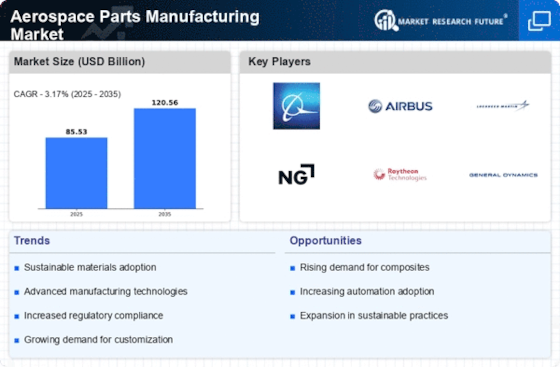
Key players include Boeing, Airbus, Lockheed Martin, Northrop Grumman, and Raytheon Technologies, among others.

What is the expected growth for the Aftermarket segment by 2035?

The Aftermarket segment is projected to grow from 35.53 USD Billion to 50.56 USD Billion by 2035.

How does the Aerospace Parts Manufacturing Market's growth potential compare across different applications?

The market shows varied growth potential across applications, with Military Aviation expected to grow from 20.0 USD Billion to 30.0 USD Billion by 2035.

Market Summary

As per MRFR analysis, the Aerospace Parts Manufacturing Market Size was estimated at 85.53 USD Billion in 2024. The Aerospace Parts Manufacturing industry is projected to grow from 88.24 USD Billion in 2025 to 120.56 USD Billion by 2035, exhibiting a compound annual growth rate (CAGR) of 3.17 during the forecast period 2025 - 2035.

Key Market Trends & Highlights

The Aerospace Parts Manufacturing Market is poised for growth driven by technological advancements and sustainability initiatives.

  • North America remains the largest market for aerospace parts manufacturing, reflecting robust demand in commercial aviation.
  • Asia-Pacific is emerging as the fastest-growing region, fueled by increasing investments in unmanned aerial vehicles.
  • The commercial aviation segment continues to dominate, while the engine components segment is experiencing rapid growth.
  • Key market drivers include increased air travel demand and regulatory compliance, which are shaping industry dynamics.

Market Size & Forecast

2024 Market Size 85.53 (USD Billion)
2035 Market Size 120.56 (USD Billion)
CAGR (2025 - 2035) 3.17%
Largest Regional Market Share in 2024 North America

Major Players

<p>Boeing (US), Airbus (FR), Lockheed Martin (US), Northrop Grumman (US), Raytheon Technologies (US), General Dynamics (US), Safran (FR), Thales (FR), Leonardo (IT), Rolls-Royce (GB)</p>

Market Trends

The Aerospace Parts Manufacturing Market is currently experiencing a dynamic evolution, driven by advancements in technology and increasing demand for lightweight materials. Manufacturers are focusing on enhancing production efficiency and reducing costs through automation and innovative manufacturing techniques. This shift towards modernization is not only improving the quality of aerospace components but also enabling companies to meet stringent regulatory standards. Furthermore, the growing emphasis on sustainability is prompting manufacturers to explore eco-friendly materials and processes, which could reshape the industry landscape in the coming years. In addition, the Aerospace Parts Manufacturing Market is witnessing a surge in collaboration between traditional manufacturers and technology firms. This partnership aims to leverage cutting-edge technologies such as additive manufacturing and artificial intelligence, which may enhance design capabilities and streamline supply chains. As the market continues to evolve, it appears that adaptability and innovation will be crucial for companies seeking to maintain a competitive edge. The future of this sector seems promising, with potential growth driven by both technological advancements and a shift towards more sustainable practices.

Technological Advancements

The Aerospace Parts Manufacturing Market is increasingly influenced by technological innovations. Automation, robotics, and advanced manufacturing techniques are being integrated into production processes, enhancing efficiency and precision. This trend suggests that manufacturers are likely to invest in new technologies to remain competitive.

Sustainability Initiatives

There is a growing focus on sustainability within the Aerospace Parts Manufacturing Market. Companies are exploring eco-friendly materials and processes to reduce their environmental impact. This trend indicates a potential shift towards greener practices, which may become a standard in the industry.

Collaborative Partnerships

The Aerospace Parts Manufacturing Market is seeing an increase in collaborations between traditional manufacturers and technology firms. These partnerships aim to harness advanced technologies, such as additive manufacturing and artificial intelligence, to improve design and production capabilities. This trend may lead to more innovative solutions in the sector.

Aerospace Parts Manufacturing Market Market Drivers

Technological Innovations

Technological advancements play a pivotal role in shaping the Aerospace Parts Manufacturing Market. Innovations such as additive manufacturing, advanced materials, and automation are revolutionizing the production processes. For instance, the adoption of 3D printing technology allows for the creation of complex parts with reduced waste and shorter lead times. Furthermore, the integration of artificial intelligence and machine learning in manufacturing processes enhances efficiency and precision. Data indicates that the aerospace sector is expected to invest over 20 billion dollars in research and development by 2026, focusing on these cutting-edge technologies. As a result, the Aerospace Parts Manufacturing Market is likely to witness a transformation in how parts are designed, produced, and maintained, ultimately leading to improved performance and safety in aviation.

Increased Air Travel Demand

The Aerospace Parts Manufacturing Market is experiencing a surge in demand due to the rising number of air travelers. As more individuals opt for air travel, airlines are compelled to expand their fleets, thereby increasing the need for aircraft parts. According to recent data, the commercial aviation sector anticipates a growth rate of approximately 4.5% annually over the next decade. This growth translates into a heightened demand for various aerospace components, including engines, avionics, and structural parts. Consequently, manufacturers are likely to ramp up production to meet this escalating demand, which could lead to innovations in manufacturing processes and materials. The Aerospace Parts Manufacturing Market must adapt to these trends to remain competitive and responsive to the evolving needs of the aviation sector.

Emerging Markets and Globalization

The Aerospace Parts Manufacturing Market is witnessing a shift as emerging markets become increasingly integral to the global supply chain. Countries such as India, Brazil, and China are investing heavily in their aerospace sectors, leading to a rise in local manufacturing capabilities. This trend is likely to create new opportunities for collaboration and partnerships between established manufacturers and emerging players. Data suggests that the Asia-Pacific region is expected to account for a significant share of the aerospace market, with a projected growth rate of around 5% annually. As these markets develop, the Aerospace Parts Manufacturing Market may experience a diversification of suppliers and a more competitive landscape, prompting innovation and efficiency improvements across the board.

Sustainability and Environmental Concerns

Sustainability has emerged as a critical driver in the Aerospace Parts Manufacturing Market. With increasing awareness of environmental issues, manufacturers are under pressure to adopt sustainable practices. This includes the development of eco-friendly materials and processes that minimize waste and reduce carbon footprints. The aerospace sector is projected to invest approximately 30 billion dollars in sustainable technologies by 2030, reflecting a commitment to environmental stewardship. Additionally, airlines are increasingly seeking suppliers who prioritize sustainability in their operations. As a result, the Aerospace Parts Manufacturing Market is likely to see a shift towards greener manufacturing practices, which could enhance brand reputation and attract environmentally conscious customers.

Regulatory Compliance and Safety Standards

The Aerospace Parts Manufacturing Market is significantly influenced by stringent regulatory compliance and safety standards. Regulatory bodies impose rigorous guidelines to ensure the safety and reliability of aerospace components. Manufacturers must adhere to these standards, which often necessitate substantial investments in quality control and testing processes. The Federal Aviation Administration (FAA) and the European Union Aviation Safety Agency (EASA) are among the key organizations that set these regulations. As the industry evolves, there is a growing emphasis on compliance with environmental regulations as well. This focus on safety and sustainability is likely to drive innovation in the Aerospace Parts Manufacturing Market, as companies seek to develop parts that not only meet regulatory requirements but also contribute to a more sustainable aviation future.

Market Segment Insights

By Application: Commercial Aviation (Largest) vs. Unmanned Aerial Vehicles (Fastest-Growing)

<p>The aerospace parts manufacturing market is significantly influenced by various applications, with commercial aviation holding the largest market share. This segment has consistently dominated due to the high demand for air travel and the ongoing expansion of global air transportation. Following commercial aviation, military aviation also plays a crucial role in the market, supported by continual investment in defense and modernization programs. Space exploration and unmanned aerial vehicles (UAVs) also contribute meaningful portions to the market, with UAVs showing considerable potential for growth in recent years due to advancements in technology and increasing interest in autonomous systems. The growth trends in this market segment are largely driven by technological advancements and increased investment across commercial aviation and military sectors. As challenges in climate change and sustainability grow, there is a heightened focus on developing eco-friendly aircraft and efficient manufacturing processes. The rapid evolution of UAV technology is also paving the way for innovative applications in logistics, surveillance, and agricultural sectors, positioning it as the fastest-growing segment. The continued exploration of space and commercial endeavors in this realm further amplifies the demand for specialized parts in the aerospace manufacturing market.</p>

<p>Commercial Aviation (Dominant) vs. Space Exploration (Emerging)</p>

<p>Commercial aviation remains a dominant player in the aerospace parts manufacturing market, significantly bolstered by the increasing global air traffic and a surge in air passenger numbers. The sector requires a wide range of parts, from airframes to intricate electronic systems, driving continued demand and innovation in manufacturing processes. In contrast, space exploration, while emerging, is witnessing a rapid transformation propelled by governmental and private sector investments, technological innovations, and the rising interest in satellite deployments and space tourism. The growing collaboration between private aerospace companies and governments is creating new opportunities for manufacturers, enhancing the need for advanced materials and components specific to space missions. As such, while commercial aviation offers stability as a mature sector, space exploration presents exciting prospects for growth and advancement.</p>

By Type of Parts: Structural Components (Largest) vs. Engine Components (Fastest-Growing)

<p>The Aerospace Parts Manufacturing Market is witnessing a varied distribution of demand across its segment types. Structural components hold the largest market share due to their fundamental role in aircraft integrity and safety. Engine components, while constituting a smaller share, are gaining traction as advancements in engine efficiency and performance become paramount in aerospace manufacturing. This dynamic suggests a healthy diversity in preferences that emphasize safety and innovation. In recent years, the demand for engine components has surged, making it the fastest-growing segment within the aerospace parts market. As airlines and manufacturers focus on enhancing fuel efficiency and reducing emissions, the development of next-generation engine technologies is propelling this growth. Additionally, growing environmental regulations are driving investment into more efficient engine parts, thus supporting a trend towards sustainability in aerospace production.</p>

<p>Structural Components (Dominant) vs. Electrical Components (Emerging)</p>

<p>Structural components in the Aerospace Parts Manufacturing Market are characterized by their essential function in maintaining aircraft durability and safety. These components include airframes, wings, and fuselage sections, which demand high strength-to-weight ratios to enhance overall aircraft performance. As this segment remains dominant due to ongoing innovations and stringent safety regulations, manufacturers are continuously improving materials and design processes. In contrast, electrical components represent an emerging market that is quickly gaining momentum. With the rise of advanced avionics, smart systems, and electrical propulsion technologies, this segment is seeing increased interest from manufacturers. Innovations in lightweight electronics and safer, reliable power management systems are positioned to support substantial growth in electrical components, signaling a shift towards more technologically advanced aircraft.</p>

By Material: Aluminum (Largest) vs. Composite Materials (Fastest-Growing)

<p>In the Aerospace Parts Manufacturing Market, the distribution of market share among materials reveals that Aluminum remains the dominant force due to its lightweight characteristics and cost-effectiveness. This metal is widely used in the manufacture of aircraft components, offering a crucial balance of strength and weight for various aerospace applications. On the other hand, Composite Materials are gaining traction rapidly, driven by their enhanced performance properties such as resistance to corrosion and fatigue, making them ideal for advanced aerospace structures.</p>

<p>Aluminum: Dominant vs. Composite Materials: Emerging</p>

<p>Aluminum's dominance in the aerospace sector can be attributed to its excellent machinability and a good strength-to-weight ratio, allowing manufacturers to build efficient and reliable aircraft. It is established in both commercial and military aviation sectors, making it a nearly ubiquitous choice for structural components. Conversely, Composite Materials are emerging as a vital part of innovation, primarily due to their ability to reduce weight while maintaining structural integrity. They are increasingly used in modern aerospace applications, including fuselage and wing structures, where reducing weight leads to improved fuel efficiency and performance. This trend highlights a shift towards lightweight design and advanced manufacturing methods.</p>

By End-use: Original Equipment Manufacturer (Largest) vs. Aftermarket (Fastest-Growing)

<p>In the Aerospace Parts Manufacturing Market, the Original Equipment Manufacturer (OEM) segment holds the largest share, driven by the continuous demand for new aircraft and advancements in aerospace technology. OEMs play a crucial role in supplying manufacturers with essential components, ensuring compliance with stringent regulatory standards. Meanwhile, the Aftermarket segment is steadily gaining traction, fueled by the rising need for maintenance, repair, and overhaul (MRO) services, emphasizing the importance of aftermarket parts in the lifecycle of aerospace equipment.</p>

<p>Aerospace Parts Manufacturing Market: OEM (Dominant) vs. Aftermarket (Emerging)</p>

<p>The Original Equipment Manufacturer (OEM) segment represents the backbone of the Aerospace Parts Manufacturing Market, characterized by high initial production volumes and the provision of state-of-the-art components directly to aircraft manufacturers. OEMs typically focus on innovation, adhering to strict quality controls and compliance to meet safety regulations. Conversely, the Aftermarket segment is becoming increasingly significant, as aircraft operators seek to extend their fleet's lifespan and reduce operational costs through MRO services. This growing emphasis on after-sales support and spare parts availability positions the Aftermarket as an emerging segment, gaining more market share as airlines and operators invest in maintaining existing fleets.</p>

Get more detailed insights about Aerospace Parts Manufacturing Market Research Report - Global Forecast till 2035

Regional Insights

North America : Aerospace Innovation Leader

North America remains the largest market for aerospace parts manufacturing, holding approximately 40% of the global market share. Key growth drivers include advanced technology adoption, increased defense spending, and a robust supply chain. Regulatory support from agencies like the FAA fosters innovation and safety standards, further propelling market growth. The region's demand is also bolstered by a resurgence in commercial air travel post-pandemic, leading to increased production rates. The competitive landscape is dominated by major players such as Boeing, Lockheed Martin, and Raytheon Technologies, which are headquartered in the U.S. Canada also plays a significant role, with companies like Bombardier contributing to the market. The presence of these key players ensures a strong supply chain and innovation pipeline, making North America a hub for aerospace manufacturing excellence.

Europe : Regulatory Framework and Growth

Europe is the second-largest market for aerospace parts manufacturing, accounting for approximately 30% of the global market share. The region benefits from a strong regulatory framework, with the European Union Aviation Safety Agency (EASA) playing a crucial role in ensuring safety and compliance. Demand is driven by increasing investments in sustainable aviation technologies and a growing focus on reducing carbon emissions, which are supported by EU regulations aimed at promoting greener aviation solutions. Leading countries in this region include France, Germany, and the United Kingdom, with major players like Airbus and Rolls-Royce leading the charge. The competitive landscape is characterized by a mix of established firms and innovative startups focusing on advanced materials and manufacturing techniques. This dynamic environment fosters collaboration and technological advancements, positioning Europe as a key player in The Aerospace Parts Manufacturing Market.

Asia-Pacific : Emerging Market Potential

Asia-Pacific is witnessing rapid growth in the aerospace parts manufacturing market, holding approximately 20% of the global market share. Key drivers include increasing air travel demand, government investments in defense, and the expansion of local manufacturing capabilities. Countries like China and India are focusing on enhancing their aerospace industries, supported by favorable government policies and initiatives aimed at boosting domestic production and reducing reliance on imports. China is the largest market in the region, with significant investments in aerospace technology and infrastructure. India is also emerging as a competitive player, with a growing number of startups and collaborations with global aerospace firms. The competitive landscape is evolving, with both established companies and new entrants vying for market share, making Asia-Pacific a vibrant hub for aerospace innovation and manufacturing.

Middle East and Africa : Strategic Growth Opportunities

The Middle East and Africa region is gradually emerging in the aerospace parts manufacturing market, holding about 10% of the global market share. Growth is driven by increasing investments in aviation infrastructure, rising air travel demand, and government initiatives aimed at diversifying economies. Countries like the UAE and South Africa are leading the charge, with strategic investments in aerospace manufacturing capabilities and partnerships with global players to enhance local production. The competitive landscape is characterized by a mix of established firms and new entrants, with a focus on developing local supply chains. The presence of key players such as Emirates and Safran highlights the region's potential for growth. As governments prioritize aerospace as a key sector for economic development, the Middle East and Africa are poised for significant advancements in aerospace manufacturing.

Key Players and Competitive Insights

The competitive landscape of the Aerospace Parts Manufacturing Market is characterized by a dynamic interplay of various factors, including technological advancements, regulatory compliance, and shifting consumer demands. As the aerospace industry experiences significant growth driven by the increasing global air travel, the demand for aviation parts and components continues to escalate.

This has resulted in a market that is not only competitive but also rapidly evolving, with key players leveraging innovation as a cornerstone of their strategies. Collaboration and strategic partnerships have become integral, allowing manufacturers to enhance their product offerings and streamline operations while adapting to changing market conditions.

The landscape features both established enterprises with strong brand equity and emerging contenders aiming to carve out their niche in this lucrative market. Analyzing the competitive insights offers a glimpse into how different players are positioning themselves to capitalize on current trends and meet the global demands effectively.

Lockheed Martin holds a prominent position in the Aerospace Parts Manufacturing Market, showcasing a solid presence characterized by technological expertise and innovation. The company's strengths lie in its extensive capabilities in defense and aerospace, which position it favorably in an increasingly competitive environment.

Lockheed Martin's well-established reputation for reliability and cutting-edge technology fosters trust among clients and enhances its competitive edge. The company actively invests in research and development, enabling it to stay ahead by optimizing product designs and manufacturing techniques.

This focus on innovation and superior engineering not only heightens its product offerings but also solidifies its place as a leader in the aerospace sector. Lockheed Martin's strategic partnerships and collaborations further bolster its market stance, allowing it to navigate the complexities of the Aerospace Parts Manufacturing Market with both agility and foresight.

General Electric is a significant player in the Aerospace Parts Manufacturing Market, known for its diverse portfolio and innovative solutions tailored to the aviation industry. The company offers a broad range of products, including jet engines, avionics, and other advanced aerospace components, positioning itself as a key contributor to global aviation.

General Electric's market presence is strengthened by its commitment to research and innovation, continuously upgrading its offerings to enhance performance and efficiency. The company has engaged in strategic mergers and acquisitions that enrich its capabilities and expand its technological horizons, further consolidating its market share.

Through targeted investments in emerging technologies and sustainable practices, General Electric not only addresses current market demands but also anticipates future trends in the aerospace sector.

This proactive approach, alongside its established reputation for high-quality products, plays a vital role in General Electric's sustained success in the competitive landscape of the Aerospace Parts Manufacturing Market.

Key Companies in the Aerospace Parts Manufacturing Market market include

Industry Developments

The Aerospace Parts Manufacturing Market has seen several significant developments recently. Lockheed Martin and General Dynamics continue to expand their supply chains, while General Electric is focusing on enhancing its Aviation segment by investing in sustainable technology.

Airbus announced its partnership with Bombardier for advanced manufacturing techniques, reinforcing their competitive edge in the market. In October 2023, it was highlighted that Raytheon Technologies is actively pursuing innovations in aerospace materials, aiming to boost efficiency in production.

Recent months have also seen Thales and Northrop Grumman receiving government contracts worth billions to supply military aerospace components, reflecting a growing demand for defense-related parts. Furthermore, in September 2023, Honeywell announced the acquisition of an aeronautical parts manufacturer to strengthen its portfolio.

Safran and MTU Aero Engines are collaborating on engine components to meet the rising demand for fuel-efficient engines in both commercial and military aircraft.

The market continues to evolve, particularly with the rising interest in electric and hybrid aerospace solutions, indicating a shift towards more sustainable practices within the industry as companies increasingly focus on Research and Development to adapt to these changing demands.

Future Outlook

Aerospace Parts Manufacturing Market Future Outlook

<p>The Aerospace Parts Manufacturing Market is projected to grow at a 3.17% CAGR from 2024 to 2035, driven by technological advancements, increased air travel demand, and sustainability initiatives.</p>

New opportunities lie in:

  • <p>Investment in additive manufacturing technologies for lightweight components.</p>
  • <p>Development of advanced supply chain management systems to enhance efficiency.</p>
  • <p>Expansion into emerging markets with tailored aerospace solutions.</p>

<p>By 2035, the market is expected to be robust, driven by innovation and strategic growth initiatives.</p>

Market Segmentation

Aerospace Parts Manufacturing Market End-use Outlook

  • Original Equipment Manufacturer
  • Aftermarket

Aerospace Parts Manufacturing Market Material Outlook

  • Aluminum
  • Titanium
  • Composite Materials
  • Steel

Aerospace Parts Manufacturing Market Application Outlook

  • Commercial Aviation
  • Military Aviation
  • Space Exploration
  • Unmanned Aerial Vehicles

Aerospace Parts Manufacturing Market Type of Parts Outlook

  • Structural Components
  • Engine Components
  • Electrical Components
  • Interior Components

Report Scope

MARKET SIZE 202485.53(USD Billion)
MARKET SIZE 202588.24(USD Billion)
MARKET SIZE 2035120.56(USD Billion)
COMPOUND ANNUAL GROWTH RATE (CAGR)3.17% (2024 - 2035)
REPORT COVERAGERevenue Forecast, Competitive Landscape, Growth Factors, and Trends
BASE YEAR2024
Market Forecast Period2025 - 2035
Historical Data2019 - 2024
Market Forecast UnitsUSD Billion
Key Companies ProfiledMarket analysis in progress
Segments CoveredMarket segmentation analysis in progress
Key Market OpportunitiesIntegration of advanced materials and automation technologies enhances efficiency in the Aerospace Parts Manufacturing Market.
Key Market DynamicsTechnological advancements and regulatory changes drive innovation and competition in the Aerospace Parts Manufacturing Market.
Countries CoveredNorth America, Europe, APAC, South America, MEA

FAQs

What is the current valuation of the Aerospace Parts Manufacturing Market?

As of 2024, the Aerospace Parts Manufacturing Market was valued at 85.53 USD Billion.

What is the projected market valuation for the Aerospace Parts Manufacturing Market in 2035?

The market is projected to reach a valuation of 120.56 USD Billion by 2035.

What is the expected CAGR for the Aerospace Parts Manufacturing Market from 2025 to 2035?

The expected CAGR for the Aerospace Parts Manufacturing Market during the forecast period 2025 - 2035 is 3.17%.

Which segments are included in the Aerospace Parts Manufacturing Market?

The market includes segments such as Commercial Aviation, Military Aviation, Space Exploration, and Unmanned Aerial Vehicles.

What are the projected valuations for the Commercial Aviation segment by 2035?

The Commercial Aviation segment is projected to grow from 40.0 USD Billion to 55.0 USD Billion by 2035.

How do the valuations of Engine Components compare to Structural Components in 2035?

By 2035, Engine Components are expected to range from 20.0 USD Billion to 30.0 USD Billion, whereas Structural Components are projected to reach 25.0 USD Billion to 35.0 USD Billion.

What materials are primarily used in aerospace parts manufacturing?

Key materials include Aluminum, Titanium, Composite Materials, and Steel, with Aluminum projected to grow from 30.0 USD Billion to 42.0 USD Billion by 2035.

Who are the key players in the Aerospace Parts Manufacturing Market?

Key players include Boeing, Airbus, Lockheed Martin, Northrop Grumman, and Raytheon Technologies, among others.

What is the expected growth for the Aftermarket segment by 2035?

The Aftermarket segment is projected to grow from 35.53 USD Billion to 50.56 USD Billion by 2035.

How does the Aerospace Parts Manufacturing Market's growth potential compare across different applications?

The market shows varied growth potential across applications, with Military Aviation expected to grow from 20.0 USD Billion to 30.0 USD Billion by 2035.

  1. SECTION I: EXECUTIVE SUMMARY AND KEY HIGHLIGHTS
    1. EXECUTIVE SUMMARY
      1. Market Overview
      2. Key Findings
      3. Market Segmentation
      4. Competitive Landscape
      5. Challenges and Opportunities
      6. Future Outlook
  2. SECTION II: SCOPING, METHODOLOGY AND MARKET STRUCTURE
    1. MARKET INTRODUCTION
      1. Definition
      2. Scope of the study
    2. RESEARCH METHODOLOGY
      1. Overview
      2. Data Mining
      3. Secondary Research
      4. Primary Research
      5. Forecasting Model
      6. Market Size Estimation
      7. Data Triangulation
      8. Validation
  3. SECTION III: QUALITATIVE ANALYSIS
    1. MARKET DYNAMICS
      1. Overview
      2. Drivers
      3. Restraints
      4. Opportunities
    2. MARKET FACTOR ANALYSIS
      1. Value chain Analysis
      2. Porter's Five Forces Analysis
      3. COVID-19 Impact Analysis
  4. SECTION IV: QUANTITATIVE ANALYSIS
    1. Aerospace & Defense, BY Application (USD Billion)
      1. Commercial Aviation
      2. Military Aviation
      3. Space Exploration
      4. Unmanned Aerial Vehicles
    2. Aerospace & Defense, BY Type of Parts (USD Billion)
      1. Structural Components
      2. Engine Components
      3. Electrical Components
      4. Interior Components
    3. Aerospace & Defense, BY Material (USD Billion)
      1. Aluminum
      2. Titanium
      3. Composite Materials
      4. Steel
    4. Aerospace & Defense, BY End-use (USD Billion)
      1. Original Equipment Manufacturer
      2. Aftermarket
    5. Aerospace & Defense, BY Region (USD Billion)
      1. North America
      2. Europe
      3. APAC
      4. South America
      5. MEA
  5. SECTION V: COMPETITIVE ANALYSIS
    1. Competitive Landscape
      1. Overview
      2. Competitive Analysis
      3. Market share Analysis
      4. Major Growth Strategy in the Aerospace & Defense
      5. Competitive Benchmarking
      6. Leading Players in Terms of Number of Developments in the Aerospace & Defense
      7. Key developments and growth strategies
      8. Major Players Financial Matrix
    2. Company Profiles
      1. Boeing (US)
      2. Airbus (FR)
      3. Lockheed Martin (US)
      4. Northrop Grumman (US)
      5. Raytheon Technologies (US)
      6. General Dynamics (US)
      7. Safran (FR)
      8. Thales (FR)
      9. Leonardo (IT)
      10. Rolls-Royce (GB)
    3. Appendix
      1. References
      2. Related Reports
  6. LIST OF FIGURES
    1. MARKET SYNOPSIS
    2. NORTH AMERICA MARKET ANALYSIS
    3. US MARKET ANALYSIS BY APPLICATION
    4. US MARKET ANALYSIS BY TYPE OF PARTS
    5. US MARKET ANALYSIS BY MATERIAL
    6. US MARKET ANALYSIS BY END-USE
    7. CANADA MARKET ANALYSIS BY APPLICATION
    8. CANADA MARKET ANALYSIS BY TYPE OF PARTS
    9. CANADA MARKET ANALYSIS BY MATERIAL
    10. CANADA MARKET ANALYSIS BY END-USE
    11. EUROPE MARKET ANALYSIS
    12. GERMANY MARKET ANALYSIS BY APPLICATION
    13. GERMANY MARKET ANALYSIS BY TYPE OF PARTS
    14. GERMANY MARKET ANALYSIS BY MATERIAL
    15. GERMANY MARKET ANALYSIS BY END-USE
    16. UK MARKET ANALYSIS BY APPLICATION
    17. UK MARKET ANALYSIS BY TYPE OF PARTS
    18. UK MARKET ANALYSIS BY MATERIAL
    19. UK MARKET ANALYSIS BY END-USE
    20. FRANCE MARKET ANALYSIS BY APPLICATION
    21. FRANCE MARKET ANALYSIS BY TYPE OF PARTS
    22. FRANCE MARKET ANALYSIS BY MATERIAL
    23. FRANCE MARKET ANALYSIS BY END-USE
    24. RUSSIA MARKET ANALYSIS BY APPLICATION
    25. RUSSIA MARKET ANALYSIS BY TYPE OF PARTS
    26. RUSSIA MARKET ANALYSIS BY MATERIAL
    27. RUSSIA MARKET ANALYSIS BY END-USE
    28. ITALY MARKET ANALYSIS BY APPLICATION
    29. ITALY MARKET ANALYSIS BY TYPE OF PARTS
    30. ITALY MARKET ANALYSIS BY MATERIAL
    31. ITALY MARKET ANALYSIS BY END-USE
    32. SPAIN MARKET ANALYSIS BY APPLICATION
    33. SPAIN MARKET ANALYSIS BY TYPE OF PARTS
    34. SPAIN MARKET ANALYSIS BY MATERIAL
    35. SPAIN MARKET ANALYSIS BY END-USE
    36. REST OF EUROPE MARKET ANALYSIS BY APPLICATION
    37. REST OF EUROPE MARKET ANALYSIS BY TYPE OF PARTS
    38. REST OF EUROPE MARKET ANALYSIS BY MATERIAL
    39. REST OF EUROPE MARKET ANALYSIS BY END-USE
    40. APAC MARKET ANALYSIS
    41. CHINA MARKET ANALYSIS BY APPLICATION
    42. CHINA MARKET ANALYSIS BY TYPE OF PARTS
    43. CHINA MARKET ANALYSIS BY MATERIAL
    44. CHINA MARKET ANALYSIS BY END-USE
    45. INDIA MARKET ANALYSIS BY APPLICATION
    46. INDIA MARKET ANALYSIS BY TYPE OF PARTS
    47. INDIA MARKET ANALYSIS BY MATERIAL
    48. INDIA MARKET ANALYSIS BY END-USE
    49. JAPAN MARKET ANALYSIS BY APPLICATION
    50. JAPAN MARKET ANALYSIS BY TYPE OF PARTS
    51. JAPAN MARKET ANALYSIS BY MATERIAL
    52. JAPAN MARKET ANALYSIS BY END-USE
    53. SOUTH KOREA MARKET ANALYSIS BY APPLICATION
    54. SOUTH KOREA MARKET ANALYSIS BY TYPE OF PARTS
    55. SOUTH KOREA MARKET ANALYSIS BY MATERIAL
    56. SOUTH KOREA MARKET ANALYSIS BY END-USE
    57. MALAYSIA MARKET ANALYSIS BY APPLICATION
    58. MALAYSIA MARKET ANALYSIS BY TYPE OF PARTS
    59. MALAYSIA MARKET ANALYSIS BY MATERIAL
    60. MALAYSIA MARKET ANALYSIS BY END-USE
    61. THAILAND MARKET ANALYSIS BY APPLICATION
    62. THAILAND MARKET ANALYSIS BY TYPE OF PARTS
    63. THAILAND MARKET ANALYSIS BY MATERIAL
    64. THAILAND MARKET ANALYSIS BY END-USE
    65. INDONESIA MARKET ANALYSIS BY APPLICATION
    66. INDONESIA MARKET ANALYSIS BY TYPE OF PARTS
    67. INDONESIA MARKET ANALYSIS BY MATERIAL
    68. INDONESIA MARKET ANALYSIS BY END-USE
    69. REST OF APAC MARKET ANALYSIS BY APPLICATION
    70. REST OF APAC MARKET ANALYSIS BY TYPE OF PARTS
    71. REST OF APAC MARKET ANALYSIS BY MATERIAL
    72. REST OF APAC MARKET ANALYSIS BY END-USE
    73. SOUTH AMERICA MARKET ANALYSIS
    74. BRAZIL MARKET ANALYSIS BY APPLICATION
    75. BRAZIL MARKET ANALYSIS BY TYPE OF PARTS
    76. BRAZIL MARKET ANALYSIS BY MATERIAL
    77. BRAZIL MARKET ANALYSIS BY END-USE
    78. MEXICO MARKET ANALYSIS BY APPLICATION
    79. MEXICO MARKET ANALYSIS BY TYPE OF PARTS
    80. MEXICO MARKET ANALYSIS BY MATERIAL
    81. MEXICO MARKET ANALYSIS BY END-USE
    82. ARGENTINA MARKET ANALYSIS BY APPLICATION
    83. ARGENTINA MARKET ANALYSIS BY TYPE OF PARTS
    84. ARGENTINA MARKET ANALYSIS BY MATERIAL
    85. ARGENTINA MARKET ANALYSIS BY END-USE
    86. REST OF SOUTH AMERICA MARKET ANALYSIS BY APPLICATION
    87. REST OF SOUTH AMERICA MARKET ANALYSIS BY TYPE OF PARTS
    88. REST OF SOUTH AMERICA MARKET ANALYSIS BY MATERIAL
    89. REST OF SOUTH AMERICA MARKET ANALYSIS BY END-USE
    90. MEA MARKET ANALYSIS
    91. GCC COUNTRIES MARKET ANALYSIS BY APPLICATION
    92. GCC COUNTRIES MARKET ANALYSIS BY TYPE OF PARTS
    93. GCC COUNTRIES MARKET ANALYSIS BY MATERIAL
    94. GCC COUNTRIES MARKET ANALYSIS BY END-USE
    95. SOUTH AFRICA MARKET ANALYSIS BY APPLICATION
    96. SOUTH AFRICA MARKET ANALYSIS BY TYPE OF PARTS
    97. SOUTH AFRICA MARKET ANALYSIS BY MATERIAL
    98. SOUTH AFRICA MARKET ANALYSIS BY END-USE
    99. REST OF MEA MARKET ANALYSIS BY APPLICATION
    100. REST OF MEA MARKET ANALYSIS BY TYPE OF PARTS
    101. REST OF MEA MARKET ANALYSIS BY MATERIAL
    102. REST OF MEA MARKET ANALYSIS BY END-USE
    103. KEY BUYING CRITERIA OF AEROSPACE & DEFENSE
    104. RESEARCH PROCESS OF MRFR
    105. DRO ANALYSIS OF AEROSPACE & DEFENSE
    106. DRIVERS IMPACT ANALYSIS: AEROSPACE & DEFENSE
    107. RESTRAINTS IMPACT ANALYSIS: AEROSPACE & DEFENSE
    108. SUPPLY / VALUE CHAIN: AEROSPACE & DEFENSE
    109. AEROSPACE & DEFENSE, BY APPLICATION, 2024 (% SHARE)
    110. AEROSPACE & DEFENSE, BY APPLICATION, 2024 TO 2035 (USD Billion)
    111. AEROSPACE & DEFENSE, BY TYPE OF PARTS, 2024 (% SHARE)
    112. AEROSPACE & DEFENSE, BY TYPE OF PARTS, 2024 TO 2035 (USD Billion)
    113. AEROSPACE & DEFENSE, BY MATERIAL, 2024 (% SHARE)
    114. AEROSPACE & DEFENSE, BY MATERIAL, 2024 TO 2035 (USD Billion)
    115. AEROSPACE & DEFENSE, BY END-USE, 2024 (% SHARE)
    116. AEROSPACE & DEFENSE, BY END-USE, 2024 TO 2035 (USD Billion)
    117. BENCHMARKING OF MAJOR COMPETITORS
  7. LIST OF TABLES
    1. LIST OF ASSUMPTIONS
    2. North America MARKET SIZE ESTIMATES; FORECAST
      1. BY APPLICATION, 2025-2035 (USD Billion)
      2. BY TYPE OF PARTS, 2025-2035 (USD Billion)
      3. BY MATERIAL, 2025-2035 (USD Billion)
      4. BY END-USE, 2025-2035 (USD Billion)
    3. US MARKET SIZE ESTIMATES; FORECAST
      1. BY APPLICATION, 2025-2035 (USD Billion)
      2. BY TYPE OF PARTS, 2025-2035 (USD Billion)
      3. BY MATERIAL, 2025-2035 (USD Billion)
      4. BY END-USE, 2025-2035 (USD Billion)
    4. Canada MARKET SIZE ESTIMATES; FORECAST
      1. BY APPLICATION, 2025-2035 (USD Billion)
      2. BY TYPE OF PARTS, 2025-2035 (USD Billion)
      3. BY MATERIAL, 2025-2035 (USD Billion)
      4. BY END-USE, 2025-2035 (USD Billion)
    5. Europe MARKET SIZE ESTIMATES; FORECAST
      1. BY APPLICATION, 2025-2035 (USD Billion)
      2. BY TYPE OF PARTS, 2025-2035 (USD Billion)
      3. BY MATERIAL, 2025-2035 (USD Billion)
      4. BY END-USE, 2025-2035 (USD Billion)
    6. Germany MARKET SIZE ESTIMATES; FORECAST
      1. BY APPLICATION, 2025-2035 (USD Billion)
      2. BY TYPE OF PARTS, 2025-2035 (USD Billion)
      3. BY MATERIAL, 2025-2035 (USD Billion)
      4. BY END-USE, 2025-2035 (USD Billion)
    7. UK MARKET SIZE ESTIMATES; FORECAST
      1. BY APPLICATION, 2025-2035 (USD Billion)
      2. BY TYPE OF PARTS, 2025-2035 (USD Billion)
      3. BY MATERIAL, 2025-2035 (USD Billion)
      4. BY END-USE, 2025-2035 (USD Billion)
    8. France MARKET SIZE ESTIMATES; FORECAST
      1. BY APPLICATION, 2025-2035 (USD Billion)
      2. BY TYPE OF PARTS, 2025-2035 (USD Billion)
      3. BY MATERIAL, 2025-2035 (USD Billion)
      4. BY END-USE, 2025-2035 (USD Billion)
    9. Russia MARKET SIZE ESTIMATES; FORECAST
      1. BY APPLICATION, 2025-2035 (USD Billion)
      2. BY TYPE OF PARTS, 2025-2035 (USD Billion)
      3. BY MATERIAL, 2025-2035 (USD Billion)
      4. BY END-USE, 2025-2035 (USD Billion)
    10. Italy MARKET SIZE ESTIMATES; FORECAST
      1. BY APPLICATION, 2025-2035 (USD Billion)
      2. BY TYPE OF PARTS, 2025-2035 (USD Billion)
      3. BY MATERIAL, 2025-2035 (USD Billion)
      4. BY END-USE, 2025-2035 (USD Billion)
    11. Spain MARKET SIZE ESTIMATES; FORECAST
      1. BY APPLICATION, 2025-2035 (USD Billion)
      2. BY TYPE OF PARTS, 2025-2035 (USD Billion)
      3. BY MATERIAL, 2025-2035 (USD Billion)
      4. BY END-USE, 2025-2035 (USD Billion)
    12. Rest of Europe MARKET SIZE ESTIMATES; FORECAST
      1. BY APPLICATION, 2025-2035 (USD Billion)
      2. BY TYPE OF PARTS, 2025-2035 (USD Billion)
      3. BY MATERIAL, 2025-2035 (USD Billion)
      4. BY END-USE, 2025-2035 (USD Billion)
    13. APAC MARKET SIZE ESTIMATES; FORECAST
      1. BY APPLICATION, 2025-2035 (USD Billion)
      2. BY TYPE OF PARTS, 2025-2035 (USD Billion)
      3. BY MATERIAL, 2025-2035 (USD Billion)
      4. BY END-USE, 2025-2035 (USD Billion)
    14. China MARKET SIZE ESTIMATES; FORECAST
      1. BY APPLICATION, 2025-2035 (USD Billion)
      2. BY TYPE OF PARTS, 2025-2035 (USD Billion)
      3. BY MATERIAL, 2025-2035 (USD Billion)
      4. BY END-USE, 2025-2035 (USD Billion)
    15. India MARKET SIZE ESTIMATES; FORECAST
      1. BY APPLICATION, 2025-2035 (USD Billion)
      2. BY TYPE OF PARTS, 2025-2035 (USD Billion)
      3. BY MATERIAL, 2025-2035 (USD Billion)
      4. BY END-USE, 2025-2035 (USD Billion)
    16. Japan MARKET SIZE ESTIMATES; FORECAST
      1. BY APPLICATION, 2025-2035 (USD Billion)
      2. BY TYPE OF PARTS, 2025-2035 (USD Billion)
      3. BY MATERIAL, 2025-2035 (USD Billion)
      4. BY END-USE, 2025-2035 (USD Billion)
    17. South Korea MARKET SIZE ESTIMATES; FORECAST
      1. BY APPLICATION, 2025-2035 (USD Billion)
      2. BY TYPE OF PARTS, 2025-2035 (USD Billion)
      3. BY MATERIAL, 2025-2035 (USD Billion)
      4. BY END-USE, 2025-2035 (USD Billion)
    18. Malaysia MARKET SIZE ESTIMATES; FORECAST
      1. BY APPLICATION, 2025-2035 (USD Billion)
      2. BY TYPE OF PARTS, 2025-2035 (USD Billion)
      3. BY MATERIAL, 2025-2035 (USD Billion)
      4. BY END-USE, 2025-2035 (USD Billion)
    19. Thailand MARKET SIZE ESTIMATES; FORECAST
      1. BY APPLICATION, 2025-2035 (USD Billion)
      2. BY TYPE OF PARTS, 2025-2035 (USD Billion)
      3. BY MATERIAL, 2025-2035 (USD Billion)
      4. BY END-USE, 2025-2035 (USD Billion)
    20. Indonesia MARKET SIZE ESTIMATES; FORECAST
      1. BY APPLICATION, 2025-2035 (USD Billion)
      2. BY TYPE OF PARTS, 2025-2035 (USD Billion)
      3. BY MATERIAL, 2025-2035 (USD Billion)
      4. BY END-USE, 2025-2035 (USD Billion)
    21. Rest of APAC MARKET SIZE ESTIMATES; FORECAST
      1. BY APPLICATION, 2025-2035 (USD Billion)
      2. BY TYPE OF PARTS, 2025-2035 (USD Billion)
      3. BY MATERIAL, 2025-2035 (USD Billion)
      4. BY END-USE, 2025-2035 (USD Billion)
    22. South America MARKET SIZE ESTIMATES; FORECAST
      1. BY APPLICATION, 2025-2035 (USD Billion)
      2. BY TYPE OF PARTS, 2025-2035 (USD Billion)
      3. BY MATERIAL, 2025-2035 (USD Billion)
      4. BY END-USE, 2025-2035 (USD Billion)
    23. Brazil MARKET SIZE ESTIMATES; FORECAST
      1. BY APPLICATION, 2025-2035 (USD Billion)
      2. BY TYPE OF PARTS, 2025-2035 (USD Billion)
      3. BY MATERIAL, 2025-2035 (USD Billion)
      4. BY END-USE, 2025-2035 (USD Billion)
    24. Mexico MARKET SIZE ESTIMATES; FORECAST
      1. BY APPLICATION, 2025-2035 (USD Billion)
      2. BY TYPE OF PARTS, 2025-2035 (USD Billion)
      3. BY MATERIAL, 2025-2035 (USD Billion)
      4. BY END-USE, 2025-2035 (USD Billion)
    25. Argentina MARKET SIZE ESTIMATES; FORECAST
      1. BY APPLICATION, 2025-2035 (USD Billion)
      2. BY TYPE OF PARTS, 2025-2035 (USD Billion)
      3. BY MATERIAL, 2025-2035 (USD Billion)
      4. BY END-USE, 2025-2035 (USD Billion)
    26. Rest of South America MARKET SIZE ESTIMATES; FORECAST
      1. BY APPLICATION, 2025-2035 (USD Billion)
      2. BY TYPE OF PARTS, 2025-2035 (USD Billion)
      3. BY MATERIAL, 2025-2035 (USD Billion)
      4. BY END-USE, 2025-2035 (USD Billion)
    27. MEA MARKET SIZE ESTIMATES; FORECAST
      1. BY APPLICATION, 2025-2035 (USD Billion)
      2. BY TYPE OF PARTS, 2025-2035 (USD Billion)
      3. BY MATERIAL, 2025-2035 (USD Billion)
      4. BY END-USE, 2025-2035 (USD Billion)
    28. GCC Countries MARKET SIZE ESTIMATES; FORECAST
      1. BY APPLICATION, 2025-2035 (USD Billion)
      2. BY TYPE OF PARTS, 2025-2035 (USD Billion)
      3. BY MATERIAL, 2025-2035 (USD Billion)
      4. BY END-USE, 2025-2035 (USD Billion)
    29. South Africa MARKET SIZE ESTIMATES; FORECAST
      1. BY APPLICATION, 2025-2035 (USD Billion)
      2. BY TYPE OF PARTS, 2025-2035 (USD Billion)
      3. BY MATERIAL, 2025-2035 (USD Billion)
      4. BY END-USE, 2025-2035 (USD Billion)
    30. Rest of MEA MARKET SIZE ESTIMATES; FORECAST
      1. BY APPLICATION, 2025-2035 (USD Billion)
      2. BY TYPE OF PARTS, 2025-2035 (USD Billion)
      3. BY MATERIAL, 2025-2035 (USD Billion)
      4. BY END-USE, 2025-2035 (USD Billion)
    31. PRODUCT LAUNCH/PRODUCT DEVELOPMENT/APPROVAL
    32. ACQUISITION/PARTNERSHIP

Aerospace Parts Manufacturing Market Segmentation

  • Aerospace Parts Manufacturing Market By Application (USD Billion, 2019-2035) 
    • Commercial Aviation
    • Military Aviation
    • Space Exploration
    • Unmanned Aerial Vehicles


  • Aerospace Parts Manufacturing Market By Type of Parts (USD Billion, 2019-2035) 
    • Structural Components
    • Engine Components
    • Electrical Components
    • Interior Components


  • Aerospace Parts Manufacturing Market By Material (USD Billion, 2019-2035) 
    • Aluminum
    • Titanium
    • Composite Materials
    • Steel


  • Aerospace Parts Manufacturing Market By End Use (USD Billion, 2019-2035) 
    • Original Equipment Manufacturer
    • Aftermarket


  • Aerospace Parts Manufacturing Market By Regional (USD Billion, 2019-2035) 
    • North America
    • Europe
    • South America
    • Asia Pacific
    • Middle East and Africa


Aerospace Parts Manufacturing Market Regional Outlook (USD Billion, 2019-2035)


  • North America Outlook (USD Billion, 2019-2035)
    • North America Aerospace Parts Manufacturing Market by Application Type
      • Commercial Aviation
      • Military Aviation
      • Space Exploration
      • Unmanned Aerial Vehicles
    • North America Aerospace Parts Manufacturing Market by Type of Parts Type
      • Structural Components
      • Engine Components
      • Electrical Components
      • Interior Components
    • North America Aerospace Parts Manufacturing Market by Material Type
      • Aluminum
      • Titanium
      • Composite Materials
      • Steel
    • North America Aerospace Parts Manufacturing Market by End Use Type
      • Original Equipment Manufacturer
      • Aftermarket
    • North America Aerospace Parts Manufacturing Market by Regional Type
      • US
      • Canada
    • US Outlook (USD Billion, 2019-2035)
    • US Aerospace Parts Manufacturing Market by Application Type
      • Commercial Aviation
      • Military Aviation
      • Space Exploration
      • Unmanned Aerial Vehicles
    • US Aerospace Parts Manufacturing Market by Type of Parts Type
      • Structural Components
      • Engine Components
      • Electrical Components
      • Interior Components
    • US Aerospace Parts Manufacturing Market by Material Type
      • Aluminum
      • Titanium
      • Composite Materials
      • Steel
    • US Aerospace Parts Manufacturing Market by End Use Type
      • Original Equipment Manufacturer
      • Aftermarket
    • CANADA Outlook (USD Billion, 2019-2035)
    • CANADA Aerospace Parts Manufacturing Market by Application Type
      • Commercial Aviation
      • Military Aviation
      • Space Exploration
      • Unmanned Aerial Vehicles
    • CANADA Aerospace Parts Manufacturing Market by Type of Parts Type
      • Structural Components
      • Engine Components
      • Electrical Components
      • Interior Components
    • CANADA Aerospace Parts Manufacturing Market by Material Type
      • Aluminum
      • Titanium
      • Composite Materials
      • Steel
    • CANADA Aerospace Parts Manufacturing Market by End Use Type
      • Original Equipment Manufacturer
      • Aftermarket
    • Europe Outlook (USD Billion, 2019-2035)
      • Europe Aerospace Parts Manufacturing Market by Application Type
        • Commercial Aviation
        • Military Aviation
        • Space Exploration
        • Unmanned Aerial Vehicles
      • Europe Aerospace Parts Manufacturing Market by Type of Parts Type
        • Structural Components
        • Engine Components
        • Electrical Components
        • Interior Components
      • Europe Aerospace Parts Manufacturing Market by Material Type
        • Aluminum
        • Titanium
        • Composite Materials
        • Steel
      • Europe Aerospace Parts Manufacturing Market by End Use Type
        • Original Equipment Manufacturer
        • Aftermarket
      • Europe Aerospace Parts Manufacturing Market by Regional Type
        • Germany
        • UK
        • France
        • Russia
        • Italy
        • Spain
        • Rest of Europe
      • GERMANY Outlook (USD Billion, 2019-2035)
      • GERMANY Aerospace Parts Manufacturing Market by Application Type
        • Commercial Aviation
        • Military Aviation
        • Space Exploration
        • Unmanned Aerial Vehicles
      • GERMANY Aerospace Parts Manufacturing Market by Type of Parts Type
        • Structural Components
        • Engine Components
        • Electrical Components
        • Interior Components
      • GERMANY Aerospace Parts Manufacturing Market by Material Type
        • Aluminum
        • Titanium
        • Composite Materials
        • Steel
      • GERMANY Aerospace Parts Manufacturing Market by End Use Type
        • Original Equipment Manufacturer
        • Aftermarket
      • UK Outlook (USD Billion, 2019-2035)
      • UK Aerospace Parts Manufacturing Market by Application Type
        • Commercial Aviation
        • Military Aviation
        • Space Exploration
        • Unmanned Aerial Vehicles
      • UK Aerospace Parts Manufacturing Market by Type of Parts Type
        • Structural Components
        • Engine Components
        • Electrical Components
        • Interior Components
      • UK Aerospace Parts Manufacturing Market by Material Type
        • Aluminum
        • Titanium
        • Composite Materials
        • Steel
      • UK Aerospace Parts Manufacturing Market by End Use Type
        • Original Equipment Manufacturer
        • Aftermarket
      • FRANCE Outlook (USD Billion, 2019-2035)
      • FRANCE Aerospace Parts Manufacturing Market by Application Type
        • Commercial Aviation
        • Military Aviation
        • Space Exploration
        • Unmanned Aerial Vehicles
      • FRANCE Aerospace Parts Manufacturing Market by Type of Parts Type
        • Structural Components
        • Engine Components
        • Electrical Components
        • Interior Components
      • FRANCE Aerospace Parts Manufacturing Market by Material Type
        • Aluminum
        • Titanium
        • Composite Materials
        • Steel
      • FRANCE Aerospace Parts Manufacturing Market by End Use Type
        • Original Equipment Manufacturer
        • Aftermarket
      • RUSSIA Outlook (USD Billion, 2019-2035)
      • RUSSIA Aerospace Parts Manufacturing Market by Application Type
        • Commercial Aviation
        • Military Aviation
        • Space Exploration
        • Unmanned Aerial Vehicles
      • RUSSIA Aerospace Parts Manufacturing Market by Type of Parts Type
        • Structural Components
        • Engine Components
        • Electrical Components
        • Interior Components
      • RUSSIA Aerospace Parts Manufacturing Market by Material Type
        • Aluminum
        • Titanium
        • Composite Materials
        • Steel
      • RUSSIA Aerospace Parts Manufacturing Market by End Use Type
        • Original Equipment Manufacturer
        • Aftermarket
      • ITALY Outlook (USD Billion, 2019-2035)
      • ITALY Aerospace Parts Manufacturing Market by Application Type
        • Commercial Aviation
        • Military Aviation
        • Space Exploration
        • Unmanned Aerial Vehicles
      • ITALY Aerospace Parts Manufacturing Market by Type of Parts Type
        • Structural Components
        • Engine Components
        • Electrical Components
        • Interior Components
      • ITALY Aerospace Parts Manufacturing Market by Material Type
        • Aluminum
        • Titanium
        • Composite Materials
        • Steel
      • ITALY Aerospace Parts Manufacturing Market by End Use Type
        • Original Equipment Manufacturer
        • Aftermarket
      • SPAIN Outlook (USD Billion, 2019-2035)
      • SPAIN Aerospace Parts Manufacturing Market by Application Type
        • Commercial Aviation
        • Military Aviation
        • Space Exploration
        • Unmanned Aerial Vehicles
      • SPAIN Aerospace Parts Manufacturing Market by Type of Parts Type
        • Structural Components
        • Engine Components
        • Electrical Components
        • Interior Components
      • SPAIN Aerospace Parts Manufacturing Market by Material Type
        • Aluminum
        • Titanium
        • Composite Materials
        • Steel
      • SPAIN Aerospace Parts Manufacturing Market by End Use Type
        • Original Equipment Manufacturer
        • Aftermarket
      • REST OF EUROPE Outlook (USD Billion, 2019-2035)
      • REST OF EUROPE Aerospace Parts Manufacturing Market by Application Type
        • Commercial Aviation
        • Military Aviation
        • Space Exploration
        • Unmanned Aerial Vehicles
      • REST OF EUROPE Aerospace Parts Manufacturing Market by Type of Parts Type
        • Structural Components
        • Engine Components
        • Electrical Components
        • Interior Components
      • REST OF EUROPE Aerospace Parts Manufacturing Market by Material Type
        • Aluminum
        • Titanium
        • Composite Materials
        • Steel
      • REST OF EUROPE Aerospace Parts Manufacturing Market by End Use Type
        • Original Equipment Manufacturer
        • Aftermarket
      • APAC Outlook (USD Billion, 2019-2035)
        • APAC Aerospace Parts Manufacturing Market by Application Type
          • Commercial Aviation
          • Military Aviation
          • Space Exploration
          • Unmanned Aerial Vehicles
        • APAC Aerospace Parts Manufacturing Market by Type of Parts Type
          • Structural Components
          • Engine Components
          • Electrical Components
          • Interior Components
        • APAC Aerospace Parts Manufacturing Market by Material Type
          • Aluminum
          • Titanium
          • Composite Materials
          • Steel
        • APAC Aerospace Parts Manufacturing Market by End Use Type
          • Original Equipment Manufacturer
          • Aftermarket
        • APAC Aerospace Parts Manufacturing Market by Regional Type
          • China
          • India
          • Japan
          • South Korea
          • Malaysia
          • Thailand
          • Indonesia
          • Rest of APAC
        • CHINA Outlook (USD Billion, 2019-2035)
        • CHINA Aerospace Parts Manufacturing Market by Application Type
          • Commercial Aviation
          • Military Aviation
          • Space Exploration
          • Unmanned Aerial Vehicles
        • CHINA Aerospace Parts Manufacturing Market by Type of Parts Type
          • Structural Components
          • Engine Components
          • Electrical Components
          • Interior Components
        • CHINA Aerospace Parts Manufacturing Market by Material Type
          • Aluminum
          • Titanium
          • Composite Materials
          • Steel
        • CHINA Aerospace Parts Manufacturing Market by End Use Type
          • Original Equipment Manufacturer
          • Aftermarket
        • INDIA Outlook (USD Billion, 2019-2035)
        • INDIA Aerospace Parts Manufacturing Market by Application Type
          • Commercial Aviation
          • Military Aviation
          • Space Exploration
          • Unmanned Aerial Vehicles
        • INDIA Aerospace Parts Manufacturing Market by Type of Parts Type
          • Structural Components
          • Engine Components
          • Electrical Components
          • Interior Components
        • INDIA Aerospace Parts Manufacturing Market by Material Type
          • Aluminum
          • Titanium
          • Composite Materials
          • Steel
        • INDIA Aerospace Parts Manufacturing Market by End Use Type
          • Original Equipment Manufacturer
          • Aftermarket
        • JAPAN Outlook (USD Billion, 2019-2035)
        • JAPAN Aerospace Parts Manufacturing Market by Application Type
          • Commercial Aviation
          • Military Aviation
          • Space Exploration
          • Unmanned Aerial Vehicles
        • JAPAN Aerospace Parts Manufacturing Market by Type of Parts Type
          • Structural Components
          • Engine Components
          • Electrical Components
          • Interior Components
        • JAPAN Aerospace Parts Manufacturing Market by Material Type
          • Aluminum
          • Titanium
          • Composite Materials
          • Steel
        • JAPAN Aerospace Parts Manufacturing Market by End Use Type
          • Original Equipment Manufacturer
          • Aftermarket
        • SOUTH KOREA Outlook (USD Billion, 2019-2035)
        • SOUTH KOREA Aerospace Parts Manufacturing Market by Application Type
          • Commercial Aviation
          • Military Aviation
          • Space Exploration
          • Unmanned Aerial Vehicles
        • SOUTH KOREA Aerospace Parts Manufacturing Market by Type of Parts Type
          • Structural Components
          • Engine Components
          • Electrical Components
          • Interior Components
        • SOUTH KOREA Aerospace Parts Manufacturing Market by Material Type
          • Aluminum
          • Titanium
          • Composite Materials
          • Steel
        • SOUTH KOREA Aerospace Parts Manufacturing Market by End Use Type
          • Original Equipment Manufacturer
          • Aftermarket
        • MALAYSIA Outlook (USD Billion, 2019-2035)
        • MALAYSIA Aerospace Parts Manufacturing Market by Application Type
          • Commercial Aviation
          • Military Aviation
          • Space Exploration
          • Unmanned Aerial Vehicles
        • MALAYSIA Aerospace Parts Manufacturing Market by Type of Parts Type
          • Structural Components
          • Engine Components
          • Electrical Components
          • Interior Components
        • MALAYSIA Aerospace Parts Manufacturing Market by Material Type
          • Aluminum
          • Titanium
          • Composite Materials
          • Steel
        • MALAYSIA Aerospace Parts Manufacturing Market by End Use Type
          • Original Equipment Manufacturer
          • Aftermarket
        • THAILAND Outlook (USD Billion, 2019-2035)
        • THAILAND Aerospace Parts Manufacturing Market by Application Type
          • Commercial Aviation
          • Military Aviation
          • Space Exploration
          • Unmanned Aerial Vehicles
        • THAILAND Aerospace Parts Manufacturing Market by Type of Parts Type
          • Structural Components
          • Engine Components
          • Electrical Components
          • Interior Components
        • THAILAND Aerospace Parts Manufacturing Market by Material Type
          • Aluminum
          • Titanium
          • Composite Materials
          • Steel
        • THAILAND Aerospace Parts Manufacturing Market by End Use Type
          • Original Equipment Manufacturer
          • Aftermarket
        • INDONESIA Outlook (USD Billion, 2019-2035)
        • INDONESIA Aerospace Parts Manufacturing Market by Application Type
          • Commercial Aviation
          • Military Aviation
          • Space Exploration
          • Unmanned Aerial Vehicles
        • INDONESIA Aerospace Parts Manufacturing Market by Type of Parts Type
          • Structural Components
          • Engine Components
          • Electrical Components
          • Interior Components
        • INDONESIA Aerospace Parts Manufacturing Market by Material Type
          • Aluminum
          • Titanium
          • Composite Materials
          • Steel
        • INDONESIA Aerospace Parts Manufacturing Market by End Use Type
          • Original Equipment Manufacturer
          • Aftermarket
        • REST OF APAC Outlook (USD Billion, 2019-2035)
        • REST OF APAC Aerospace Parts Manufacturing Market by Application Type
          • Commercial Aviation
          • Military Aviation
          • Space Exploration
          • Unmanned Aerial Vehicles
        • REST OF APAC Aerospace Parts Manufacturing Market by Type of Parts Type
          • Structural Components
          • Engine Components
          • Electrical Components
          • Interior Components
        • REST OF APAC Aerospace Parts Manufacturing Market by Material Type
          • Aluminum
          • Titanium
          • Composite Materials
          • Steel
        • REST OF APAC Aerospace Parts Manufacturing Market by End Use Type
          • Original Equipment Manufacturer
          • Aftermarket
        • South America Outlook (USD Billion, 2019-2035)
          • South America Aerospace Parts Manufacturing Market by Application Type
            • Commercial Aviation
            • Military Aviation
            • Space Exploration
            • Unmanned Aerial Vehicles
          • South America Aerospace Parts Manufacturing Market by Type of Parts Type
            • Structural Components
            • Engine Components
            • Electrical Components
            • Interior Components
          • South America Aerospace Parts Manufacturing Market by Material Type
            • Aluminum
            • Titanium
            • Composite Materials
            • Steel
          • South America Aerospace Parts Manufacturing Market by End Use Type
            • Original Equipment Manufacturer
            • Aftermarket
          • South America Aerospace Parts Manufacturing Market by Regional Type
            • Brazil
            • Mexico
            • Argentina
            • Rest of South America
          • BRAZIL Outlook (USD Billion, 2019-2035)
          • BRAZIL Aerospace Parts Manufacturing Market by Application Type
            • Commercial Aviation
            • Military Aviation
            • Space Exploration
            • Unmanned Aerial Vehicles
          • BRAZIL Aerospace Parts Manufacturing Market by Type of Parts Type
            • Structural Components
            • Engine Components
            • Electrical Components
            • Interior Components
          • BRAZIL Aerospace Parts Manufacturing Market by Material Type
            • Aluminum
            • Titanium
            • Composite Materials
            • Steel
          • BRAZIL Aerospace Parts Manufacturing Market by End Use Type
            • Original Equipment Manufacturer
            • Aftermarket
          • MEXICO Outlook (USD Billion, 2019-2035)
          • MEXICO Aerospace Parts Manufacturing Market by Application Type
            • Commercial Aviation
            • Military Aviation
            • Space Exploration
            • Unmanned Aerial Vehicles
          • MEXICO Aerospace Parts Manufacturing Market by Type of Parts Type
            • Structural Components
            • Engine Components
            • Electrical Components
            • Interior Components
          • MEXICO Aerospace Parts Manufacturing Market by Material Type
            • Aluminum
            • Titanium
            • Composite Materials
            • Steel
          • MEXICO Aerospace Parts Manufacturing Market by End Use Type
            • Original Equipment Manufacturer
            • Aftermarket
          • ARGENTINA Outlook (USD Billion, 2019-2035)
          • ARGENTINA Aerospace Parts Manufacturing Market by Application Type
            • Commercial Aviation
            • Military Aviation
            • Space Exploration
            • Unmanned Aerial Vehicles
          • ARGENTINA Aerospace Parts Manufacturing Market by Type of Parts Type
            • Structural Components
            • Engine Components
            • Electrical Components
            • Interior Components
          • ARGENTINA Aerospace Parts Manufacturing Market by Material Type
            • Aluminum
            • Titanium
            • Composite Materials
            • Steel
          • ARGENTINA Aerospace Parts Manufacturing Market by End Use Type
            • Original Equipment Manufacturer
            • Aftermarket
          • REST OF SOUTH AMERICA Outlook (USD Billion, 2019-2035)
          • REST OF SOUTH AMERICA Aerospace Parts Manufacturing Market by Application Type
            • Commercial Aviation
            • Military Aviation
            • Space Exploration
            • Unmanned Aerial Vehicles
          • REST OF SOUTH AMERICA Aerospace Parts Manufacturing Market by Type of Parts Type
            • Structural Components
            • Engine Components
            • Electrical Components
            • Interior Components
          • REST OF SOUTH AMERICA Aerospace Parts Manufacturing Market by Material Type
            • Aluminum
            • Titanium
            • Composite Materials
            • Steel
          • REST OF SOUTH AMERICA Aerospace Parts Manufacturing Market by End Use Type
            • Original Equipment Manufacturer
            • Aftermarket
          • MEA Outlook (USD Billion, 2019-2035)
            • MEA Aerospace Parts Manufacturing Market by Application Type
              • Commercial Aviation
              • Military Aviation
              • Space Exploration
              • Unmanned Aerial Vehicles
            • MEA Aerospace Parts Manufacturing Market by Type of Parts Type
              • Structural Components
              • Engine Components
              • Electrical Components
              • Interior Components
            • MEA Aerospace Parts Manufacturing Market by Material Type
              • Aluminum
              • Titanium
              • Composite Materials
              • Steel
            • MEA Aerospace Parts Manufacturing Market by End Use Type
              • Original Equipment Manufacturer
              • Aftermarket
            • MEA Aerospace Parts Manufacturing Market by Regional Type
              • GCC Countries
              • South Africa
              • Rest of MEA
            • GCC COUNTRIES Outlook (USD Billion, 2019-2035)
            • GCC COUNTRIES Aerospace Parts Manufacturing Market by Application Type
              • Commercial Aviation
              • Military Aviation
              • Space Exploration
              • Unmanned Aerial Vehicles
            • GCC COUNTRIES Aerospace Parts Manufacturing Market by Type of Parts Type
              • Structural Components
              • Engine Components
              • Electrical Components
              • Interior Components
            • GCC COUNTRIES Aerospace Parts Manufacturing Market by Material Type
              • Aluminum
              • Titanium
              • Composite Materials
              • Steel
            • GCC COUNTRIES Aerospace Parts Manufacturing Market by End Use Type
              • Original Equipment Manufacturer
              • Aftermarket
            • SOUTH AFRICA Outlook (USD Billion, 2019-2035)
            • SOUTH AFRICA Aerospace Parts Manufacturing Market by Application Type
              • Commercial Aviation
              • Military Aviation
              • Space Exploration
              • Unmanned Aerial Vehicles
            • SOUTH AFRICA Aerospace Parts Manufacturing Market by Type of Parts Type
              • Structural Components
              • Engine Components
              • Electrical Components
              • Interior Components
            • SOUTH AFRICA Aerospace Parts Manufacturing Market by Material Type
              • Aluminum
              • Titanium
              • Composite Materials
              • Steel
            • SOUTH AFRICA Aerospace Parts Manufacturing Market by End Use Type
              • Original Equipment Manufacturer
              • Aftermarket
            • REST OF MEA Outlook (USD Billion, 2019-2035)
            • REST OF MEA Aerospace Parts Manufacturing Market by Application Type
              • Commercial Aviation
              • Military Aviation
              • Space Exploration
              • Unmanned Aerial Vehicles
            • REST OF MEA Aerospace Parts Manufacturing Market by Type of Parts Type
              • Structural Components
              • Engine Components
              • Electrical Components
              • Interior Components
            • REST OF MEA Aerospace Parts Manufacturing Market by Material Type
              • Aluminum
              • Titanium
              • Composite Materials
              • Steel
            • REST OF MEA Aerospace Parts Manufacturing Market by End Use Type
              • Original Equipment Manufacturer
              • Aftermarket


Infographic

Free Sample Request

Kindly complete the form below to receive a free sample of this Report

Get Free Sample

Customer Strories

Compare Licence

×
Features License Type
Single User Multiuser License Enterprise User
Price $4,950 $5,950 $7,250
Maximum User Access Limit 1 User Upto 10 Users Unrestricted Access Throughout the Organization
Free Customization
Direct Access to Analyst
Deliverable Format
Platform Access
Discount on Next Purchase 10% 15% 15%
Printable Versions