Aesthetic Devices Market Summary
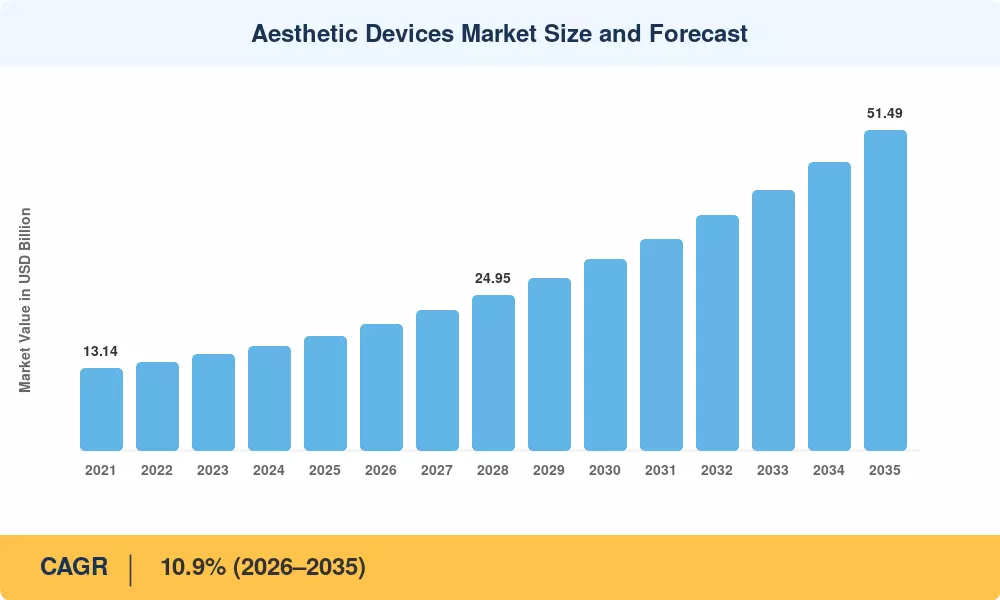
The global Aesthetic Devices Market was valued at USD 18.30 billion in 2025 and is projected to reach USD 20.29 billion in 2026 before climbing to USD 51.49 billion by 2035, registering a CAGR of 10.9% during the forecast period. A convergence of demographic tailwinds and regulatory momentum is powering this expansion. The U.S. FDA's streamlined 510(k) pathway for energy-based platforms has cut average clearance timelines by nearly four months since 2023, while the European MDR framework — though more onerous — has raised quality benchmarks that ultimately boost consumer confidence and procedure volumes [1][2].
Legacy standalone lasers and single-modality devices are giving way to multi-platform workstations that integrate radiofrequency, intense pulsed light, and ultrasound into a single console. Device manufacturers invested an estimated USD 2.8 billion in R&D during 2024 alone, with AI-guided treatment protocols and real-time skin-mapping sensors emerging as headline innovations. These advances shorten procedure times, reduce recovery windows, and broaden the treatable patient pool — all of which accelerate clinic throughput and revenue per device hour.
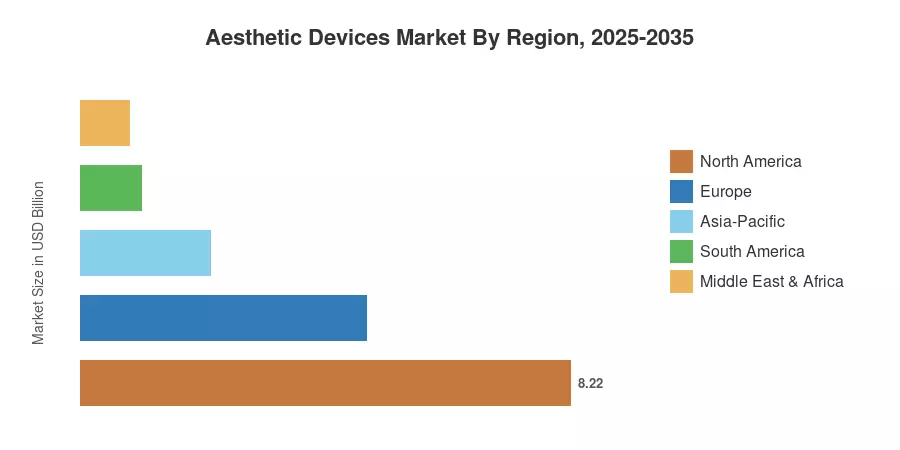
North America leads the Aesthetic Devices Market with a 44.9% revenue share, underpinned by high per-capita discretionary spending and a mature network of dermatology offices and medical spas. Asia-Pacific is the fastest-growing region at an estimated 11.9% CAGR through 2035, driven by rising middle-class demand in China, India, and South Korea. Europe holds the second-largest share at 26.2%, anchored by strong demand in Germany, the UK, and France. The next decade will be defined by platform consolidation, AI personalization, and the continued blurring of medical and cosmetic boundaries.
Key Report Takeaways
• By Device Type
- Energy-based aesthetic platforms commanded 55.8% of total revenue in 2025, reflecting the dominance of laser, radiofrequency, and ultrasound systems across clinical settings.
- Non-energy-based devices — including injectables delivery systems and implantable products — are forecast to grow at a 13.2% CAGR through 2035 as patient preference shifts toward minimally invasive options.
• By Procedure Type
- Non-surgical and minimally invasive treatments represented 58.9% of the Aesthetic Devices Market in 2025, led by demand for dermal fillers and neurotoxin delivery platforms.
- Surgical procedures are projected to expand at an 11.7% CAGR as advanced body-contouring technologies attract a broader patient demographic.
• By Region
- North America contributed USD 8.21 billion in 2025 revenue, maintaining its position as the largest regional market for the Aesthetic Devices Market.
- Asia-Pacific is set to deliver an 11.9% CAGR, outpacing all other regions through 2035.
Aesthetic Devices Market Size and Forecast (2021–2035)
Market Research Future's sizing methodology combines bottom-up revenue modeling from device-level shipment data, procedure volume analysis from clinical registries (ISAPS, ASAPS), and top-down validation against public financial disclosures from major manufacturers. Historical figures (2021–2024) are based on reported revenues; 2025 is the base year; and the 2026–2035 forecast applies a calibrated 10.9% CAGR.