AI Enabled Translation Services Market Size, Share and Trends Analysis Report By Type (Online Service, Offline Service), By Application (Large Enterprises and SMEs) And By Region (North America, Europe, Asia-Pacific, and Rest of the World) –Market Forecast Till 2035.
As per Market Research Future analysis, the AI-Enabled Translation Services Market was estimated at 1141.34 USD Million in 2024. The AI-Enabled Translation Services industry is projected to grow from 1336.74 USD Million in 2025 to 6491.8 USD Million by 2035, exhibiting a compound annual growth rate (CAGR) of 17.12% during the forecast period 2025 - 2035
Key Market Trends & Highlights
The AI-Enabled Translation Services Market is experiencing robust growth driven by technological advancements and increasing demand for multilingual solutions.
The demand for multilingual content is surging, particularly in North America, which remains the largest market for AI-enabled translation services.
Integration of AI with human expertise is becoming a prevalent trend, enhancing the quality and accuracy of translations across various sectors.
Real-time translation solutions are gaining traction, especially among large enterprises that require immediate communication across global markets.
Rising global trade and communication, alongside the increased adoption of e-learning platforms, are key drivers propelling market growth in both North America and the rapidly expanding Asia-Pacific region.
Market Size & Forecast
2024 Market Size
1141.34 (USD Million)
2035 Market Size
6491.8 (USD Million)
CAGR (2025 - 2035)
17.12%
Major Players
Google (US), Microsoft (US), Amazon (US), IBM (US), SDL (GB), iFLYTEK (CN), Baidu (CN), SYSTRAN (FR), Lingmo (AU)
AI Enabled Translation Services Market Trends
The AI-Enabled Translation Services Market is currently experiencing a transformative phase, driven by advancements in artificial intelligence and machine learning technologies. These innovations are enhancing the accuracy and efficiency of translation processes, allowing businesses to communicate seamlessly across linguistic barriers. As globalization continues to expand, the demand for reliable translation services is likely to grow, with organizations seeking to reach diverse audiences. This market appears to be characterized by a blend of traditional human expertise and cutting-edge AI capabilities, creating a hybrid model that optimizes both speed and quality.
Moreover, the integration of AI in translation services is fostering new applications, such as real-time translation in various contexts, including customer service and content localization. This evolution suggests a shift towards more personalized and context-aware translation solutions, which may cater to specific industry needs. As companies increasingly recognize the value of effective communication, the AI-Enabled Translation Services Market is poised for further growth, potentially leading to innovative service offerings that enhance user experience and engagement.
Increased Demand for Multilingual Content
The rise of global commerce is driving a heightened need for multilingual content. Businesses are recognizing the importance of reaching diverse markets, which necessitates effective translation services. This trend indicates a shift towards creating content that resonates with local audiences, thereby enhancing customer engagement.
Integration of AI with Human Expertise
There is a noticeable trend towards combining AI technologies with human translators. This hybrid approach aims to leverage the strengths of both, ensuring high-quality translations while maintaining efficiency. Such integration appears to enhance the overall service delivery in the AI-Enabled Translation Services Market.
Focus on Real-Time Translation Solutions
The demand for real-time translation solutions is growing, particularly in sectors like customer support and international business meetings. This trend suggests a move towards instantaneous communication, which could significantly improve user experience and operational efficiency in various industries.
AI Enabled Translation Services Market Drivers
Technological Advancements in AI
The rapid advancements in artificial intelligence technologies are significantly influencing the AI-Enabled Translation Services Market. Innovations in machine learning, natural language processing, and neural networks are enhancing the accuracy and efficiency of translation services. For instance, the implementation of deep learning algorithms has improved the contextual understanding of languages, resulting in more nuanced translations. As of 2025, the market for AI technologies is expected to grow substantially, with investments pouring into research and development. This technological evolution not only streamlines the translation process but also reduces turnaround times, making AI-enabled solutions more appealing to businesses seeking to optimize their communication strategies.
Rising Global Trade and Communication
The AI-Enabled Translation Services Market is experiencing a surge due to the increasing volume of international trade and cross-border communication. As businesses expand their operations into new markets, the need for accurate and efficient translation services becomes paramount. In 2025, the estimated value of international trade is projected to reach trillions of dollars, necessitating the use of AI-driven solutions to facilitate seamless communication. Companies are increasingly relying on AI-enabled translation services to overcome language barriers, enhance customer engagement, and improve operational efficiency. This trend indicates a growing recognition of the importance of multilingual capabilities in fostering global partnerships and driving economic growth.
Growing Need for Localization in Marketing
The AI-Enabled Translation Services Market is witnessing a heightened focus on localization as businesses strive to connect with diverse consumer bases. Localization goes beyond mere translation; it involves adapting content to resonate with local cultures and preferences. As companies expand their marketing efforts internationally, the demand for AI-enabled translation services that offer localization capabilities is increasing. In 2025, the localization market is projected to grow significantly, driven by the need for tailored marketing strategies. This trend suggests that businesses recognize the value of culturally relevant content in enhancing brand loyalty and customer engagement across different regions.
Increased Adoption of E-Learning Platforms
The proliferation of e-learning platforms is driving demand within the AI-Enabled Translation Services Market. As educational institutions and organizations embrace online learning, the need for translated educational content has escalated. In 2025, the e-learning market is anticipated to reach a valuation of several billion dollars, with a significant portion requiring multilingual support. AI-enabled translation services play a crucial role in making educational resources accessible to diverse audiences, thereby enhancing learning experiences. This trend underscores the importance of effective communication in education and highlights the potential for AI-driven solutions to bridge language gaps in the learning environment.
Regulatory Compliance and Global Standards
The AI-Enabled Translation Services Market is also influenced by the need for regulatory compliance and adherence to global standards. As businesses operate in multiple jurisdictions, they must ensure that their communications, documentation, and marketing materials comply with local laws and regulations. This necessity drives the demand for accurate translation services that can navigate complex legal and regulatory frameworks. In 2025, the emphasis on compliance is expected to intensify, particularly in industries such as finance, healthcare, and technology. Consequently, AI-enabled translation services that can provide precise and contextually appropriate translations will be essential for organizations aiming to mitigate risks and maintain operational integrity.
Market Segment Insights
By Type: Online Service (Largest) vs. Offline Service (Fastest-Growing)
In the AI-Enabled Translation Services Market, the segment is primarily dominated by Online Services, which account for a significant share of the market. This is largely due to the increasing reliance on digital platforms for communication and global business operations. Online services leverage advanced AI algorithms to provide real-time translations, making them the preferred choice for businesses looking for efficiency and accuracy in their translations. Conversely, Offline Services, though currently smaller in market share, are witnessing heightened interest, especially in niche sectors requiring high specificity and localized content.
Online Service (Dominant) vs. Offline Service (Emerging)
The Online Service segment is characterized by its ability to provide quick, scalable, and cost-effective translation solutions using cloud-based technologies. These services are widely adopted across various industries, given their accessibility and range of supported languages. In contrast, Offline Services are emerging as a viable alternative for specific industries that prioritize personalized and contextually rich translations. This segment caters to businesses requiring tailored solutions, such as legal or medical documentation, that demand a human touch alongside AI capabilities. As businesses increasingly recognize the importance of customized translation, the Offline Service market is expected to experience robust growth.
By Application: Large Enterprises (Largest) vs. SMEs (Fastest-Growing)
In the AI-Enabled Translation Services Market, the 'Large Enterprises' segment holds a significant market share, driven by the increasing adoption of AI technologies for seamless communication across global operations. These enterprises leverage advanced translation services to enhance productivity and improve customer engagement. Conversely, small and medium-sized enterprises (SMEs) are emerging as a crucial player in the market, benefiting from affordable AI-driven translation tools that enable them to compete on a global scale.
Market Presence: Large Enterprises (Dominant) vs. SMEs (Emerging)
Large Enterprises typically dominate the AI-Enabled Translation Services Market owing to their substantial resources and capability to invest in cutting-edge technology solutions. They utilize comprehensive translation systems to meet their multilingual needs, offering customized services to clients and improving operational efficiencies. However, SMEs are rapidly transforming the landscape as they adopt AI translation services to streamline communication and expand their reach without significant investment. This emerging segment reflects the growing trend of digital transformation, where SMEs prioritize efficiency and agility to thrive in competitive markets.
Get more detailed insights about AI Enabled Translation Services Market
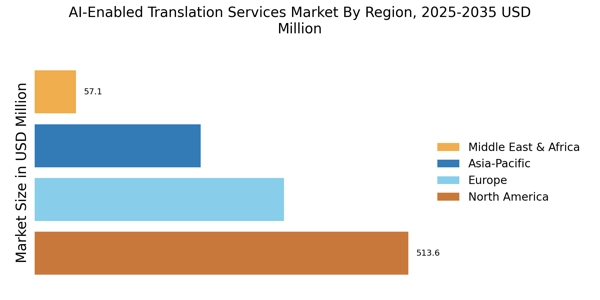
By region, the study provides the market insights into North America, Europe, Asia-Pacific and Rest of the World. The North America AI-Enabled Translation Services Market dominated this market in 2022 (45.80%). In North America, educational institutions and research facilities are leading the way in holographic communication adoption for improved learning experiences and cutting-edge research. This covers projects including collaborative research, scientific visualization, and STEM education. Further, the U.S. AI-Enabled Translation Services market held the largest market share, and the Canada AI-Enabled Translation Services market was the fastest growing market in the North America region.
Further, the major countries studied in the market report are The U.S., Canada, German, France, the UK, Italy, Spain, China, Japan, India, Australia, South Korea, and Brazil.
Figure 3: AI-ENABLED TRANSLATION SERVICES MARKET SHARE BY REGION 2022 (USD Billion)
Europe AI-Enabled Translation Services market accounts for the second-largest market share. Holographic communication technologies are advantageous to Europe's tourism sector and rich cultural legacy. Holographic displays are used in museums, historical sites, and tourist destinations to give guests immersive and interactive experiences. Further, the German AI-Enabled Translation Services market held the largest market share, and the UK AI-Enabled Translation Services market was the fastest growing market in the European region.
The Asia-Pacific AI-Enabled Translation Services Market is expected to grow at the fastest CAGR from 2023 to 2032. The region has a burgeoning entertainment and media industry. Holographic communication technologies are used in theme parks, live events, and virtual concerts, enhancing the entertainment experience for audiences. Moreover, China’s AI-Enabled Translation Services market held the largest market share, and the Indian AI-Enabled Translation Services market was the fastest growing market in the Asia-Pacific region.
Key Players and Competitive Insights
Leading market players are investing heavily in research and development in order to expand their product lines, which will help the AI-Enabled Translation Services market, grow even more. Market participants are also undertaking a variety of strategic activities to expand their global footprint, with important market developments including new product launches, contractual agreements, mergers and acquisitions, higher investments, and collaboration with other organizations. To expand and survive in a more competitive and rising market climate, AI-Enabled Translation Services industry must offer cost-effective items.Manufacturing locally to minimize operational costs is one of the key business tactics used by manufacturers in the global AI-Enabled Translation Services industry to benefit clients and increase the market sector. In recent years, the AI-Enabled Translation Services industry has offered some of the most significant advantages to medicine. Major players in the AI-Enabled Translation Services market, including AppTek, Global Tone Communication, Language I/O, Lilt, MemSource, ModelFront, RWS, SYSTRAN, Tarjama, Translated, TransPerfect, Unbabel, XTM International and others, are attempting to increase market demand by investing in research and development operations.RWS Holdings PLC (RWS), a company based in the UK, provides services to support intellectual property. The company provides a variety of services, including data services for AI, consultancy services, infrastructure and cloud services, internet of things (IOT), and language services for life sciences. RWS provides services to a variety of businesses, including those in manufacturing, energy, chemicals, media, retail, e-commerce, telecom, managed care, insurance, legal, finance, marketing communications, medical device documentation, automotive, and training and e-learning. The company conducts business in North America, South America, Australia, Asia, and Europe. RWS's main office is in Chalfont St.Peter, Buckinghamshire, in the UK.SYSTRAN has been a leader in machine translation technology since its founding in 1968. With a variety of ground-breaking inventions and solutions that are now widely used by businesses and consumers, the company is the industry leader. Innovating more than ever after 50 years, SYSTRAN places a major emphasis on research and development. The possibilities of neural translation are now available to corporate users thanks to SYSTRAN's introduction of its Neural Machine Translation enterprise solution.
Key Companies in the AI Enabled Translation Services Market include
Industry Developments
Feb 2023: RWS has announced the launch of its TrainAI brand, which will provide clients with full, end-to-end data collection, annotation, and validation services for all types of AI data - in any language, at any scale. TrainAI will also offer machine translation and AI training data services to enhance the quality of machine learning models and AI applications for the biggest organizations in the world.
Sept 2022: A language services provider in the MENA region created Tarjama, an Arabic machine translation (AMT) website called Tarjama Translate, with a focus on companies who want quick access to translation in order to reach Arabic-speaking customers.
Future Outlook
AI Enabled Translation Services Market Future Outlook
The AI-Enabled Translation Services Market is projected to grow at a 17.12% CAGR from 2025 to 2035, driven by globalization, technological advancements, and increasing demand for multilingual content.
New opportunities lie in:
Development of industry-specific translation tools for legal and medical sectors.
Integration of AI-driven real-time translation in customer service platforms.
Expansion of cloud-based translation services for remote collaboration.
By 2035, the market is expected to be robust, reflecting substantial growth and innovation.
Market Segmentation
AI Enabled Translation Services Market Type Outlook
Online Service
Offline Service
AI Enabled Translation Services Market Application Outlook
Large Enterprises
SMEs
Report Scope
MARKET SIZE 2024
1141.34(USD Million)
MARKET SIZE 2025
1336.74(USD Million)
MARKET SIZE 2035
6491.8(USD Million)
COMPOUND ANNUAL GROWTH RATE (CAGR)
17.12% (2025 - 2035)
REPORT COVERAGE
Revenue Forecast, Competitive Landscape, Growth Factors, and Trends
BASE YEAR
2024
Market Forecast Period
2025 - 2035
Historical Data
2019 - 2024
Market Forecast Units
USD Million
Key Companies Profiled
Google (US), Microsoft (US), Amazon (US), IBM (US), SDL (GB), iFLYTEK (CN), Baidu (CN), SYSTRAN (FR), Lingmo (AU)
Segments Covered
Type, Application, Region
Key Market Opportunities
Integration of advanced neural networks enhances accuracy and efficiency in the AI-Enabled Translation Services Market.
Key Market Dynamics
Rising demand for real-time translation solutions drives innovation and competition in AI-Enabled Translation Services.
What is the current valuation of the AI-Enabled Translation Services Market?
The market valuation was 1141.34 USD Million in 2024.
What is the projected market size for AI-Enabled Translation Services by 2035?
The projected valuation for 2035 is 6491.8 USD Million.
What is the expected CAGR for the AI-Enabled Translation Services Market from 2025 to 2035?
The expected CAGR during the forecast period is 17.12%.
Which companies are considered key players in the AI-Enabled Translation Services Market?
Key players include Google, Microsoft, Amazon, IBM, SDL, iFLYTEK, Baidu, SYSTRAN, and Lingmo.
How do online and offline services compare in terms of market valuation?
In 2024, online services were valued at 3890.0 USD Million, while offline services were valued at 2601.8 USD Million.
What is the market segmentation based on application for AI-Enabled Translation Services?
The market is segmented into Large Enterprises, valued at 3841.8 USD Million, and SMEs, valued at 2650.0 USD Million.
How has the market for AI-Enabled Translation Services evolved from 2024 to 2025?
The market continues to grow, with expectations of reaching new heights as it approaches 2035.
What role do large enterprises play in the AI-Enabled Translation Services Market?
Large Enterprises represent a substantial portion of the market, with a valuation of 3841.8 USD Million.
What factors contribute to the growth of the AI-Enabled Translation Services Market?
The growth appears driven by advancements in AI technology and increasing demand for translation services.
How does the performance of SMEs compare to large enterprises in this market?
SMEs are valued at 2650.0 USD Million, indicating a significant but smaller share compared to large enterprises.
Author
Author
Nirmit Biswas
Senior Research Analyst
With 5+ years of expertise in Market Intelligence and Strategic Research, Nirmit Biswas specializes in ICT, Semiconductors, and BFSI. Backed by an MBA in Financial Services and a Computer Science foundation, Nirmit blends technical depth with business acumen. He has successfully led 100+ projects for global enterprises and startups, including Amazon, Cisco, L&T and Huawei, delivering market estimations, competitive benchmarking, and GTM strategies. His focus lies in transforming complex data into clear, actionable insights that drive growth, innovation, and investment decisions. Recognized for bridging engineering innovation with executive strategy, Nirmit helps businesses navigate dynamic markets with confidence.
read more
Co-Author
Aarti Dhapte
AVP - Research
A consulting professional focused on helping businesses navigate complex markets through structured research and strategic insights.
I partner with clients to solve high-impact business problems across market entry strategy, competitive intelligence, and opportunity assessment. Over the course of my experience, I have led and contributed to 100+ market research and consulting engagements, delivering insights across multiple industries and geographies, and supporting strategic decisions linked to $500M+ market opportunities.
My core expertise lies in building robust market sizing, forecasting, and commercial models (top-down and bottom-up), alongside deep-dive competitive and industry analysis. I have played a key role in shaping go-to-market strategies, investment cases, and growth roadmaps, enabling clients to make confident, data-backed decisions in dynamic markets.
Research Methodology – Global AI ENABLED TRANSLATIONAL SERVICES Market
Purchased Database:
IncludescompanydatabasessuchasHoover’s:Thishelpsusidentifyfinancialinformation, industry competitive landscape, structure of the market Also, it serves as an important step in market sizing, especially in case of commodity-flowtechniques.
Industry databases, e.g., Factiva. helps us gain access to industry statistics, and KoL opinions & formulate
Other sources include SME journals, and pertinent databases from third-party vendors to gain insights into:
Procedure statistics
Potential market related statistics
Information on unmet needs
Regional expenditure pattern
Investment information or opportunity-based statistics
Following databases were used but are not limited to,
Euromonitor
Factiva
Bloomberg
Statista
Hoovers
Dun & Bradstreet
CrunchBase
ZoomInfo
Pitchbook
Tofler
Tracxn
MRFR’s Internal Database
Includes ourinternaldatabaseofdatapoints,collectedbecauseofpreviousresearch& studies andinformationmadeavailableviaourdatabasemanagement
Also includes internal audit reports &
Secondary Sources:
A list of secondary sources along with the information extracted from them will beavailableinthefinal
Notable examples include white papers, government statistics published by organizations like IRU, NGOs etc., KoL publications, company filings, investor documents etc.
Some of the sources used in the report include,
IEEE
ResearchGate
ScienceDirect
Forbes
McKinsey
International Data Corporation
Artificial Intelligence and Translation Technology
American Translators Association
Translator Competences in the Era of AI
International Association for Machine Translation (IAMT)
Asia-Pacific Association for Machine Translation (AAMT)
Machine Translation Organizations
ThirdPartyPerspective:
Primary Research
Figure 1 PRIMARY RESEARCH PATTERN
The primary interviews and surveys derive directions from extensive secondary research. Secondary research is a continuous process and is conducted at each level along the value chain.
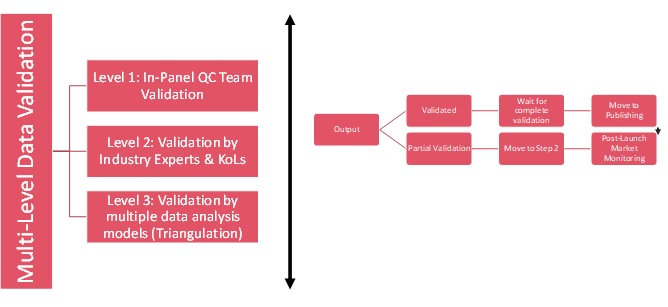
The final market estimates& forecasts are then alignedandsentto industry experts in-panelqualitycontrolmanagersforvalidation
Thisstepalsoentailsthe finalization of the report scope and data representation pattern
The process entails multiple levels of validation. All these steps are run in parallel, and the study is forwarded for publishing only if all three levels re
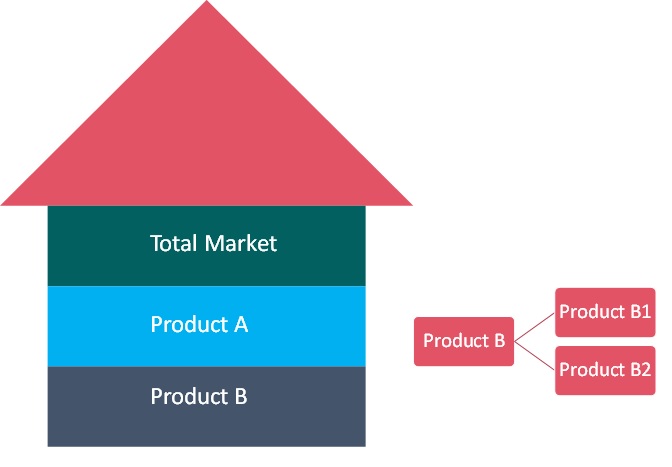
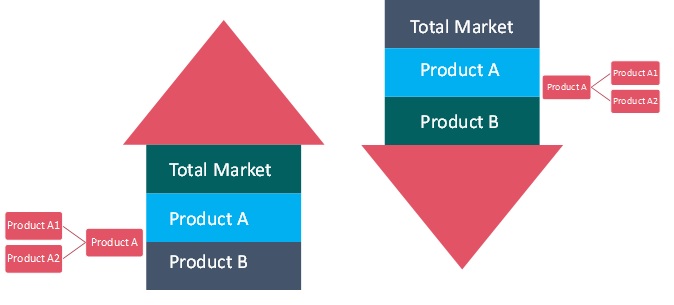
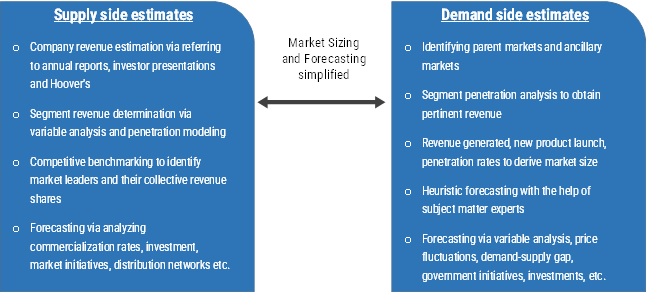
Figure 2: MARKET RESEARCH APPROACHES
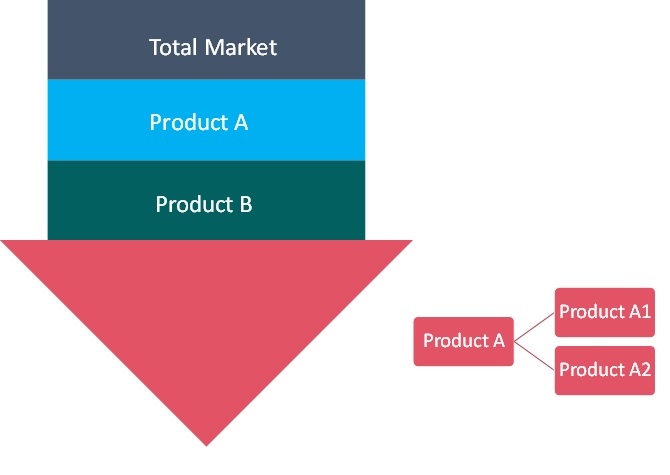
Bottom-up Demand Approach
Demand estimation of each product across countries/regions summed to form the total market
Variable analysis for demand forecasting
Demand estimation via analyzing paid databases, and company financials either via annual reports or paid databases
Primary interviews for data revalidation and insight collection
Top-Down Approach
Used extensivelyfornewproductforecastingoranalyzingpenetrationlevels
Primary interviewsand vendorbasedprimaryresearch for userpreferences
Combined Approach
Figure 3: VALUE CHAIN BASED SIZING & FORECASTING
Penetrationmodeling for products
Determining and forecasting penetration via analysing product features, availability of internal and external substitutes
Heuristic estimation of year-on-year sales by conducting primary interviews with:
Server operating system providers
Industry experts & KoLs
QFD modelling for market share assessment (an example cited in the figure below)
Referring to historic data to establish base estimates
Analysing current needs and determining penetration to estimate market size or
Using unmet needs and capitalization rates to determine growth
Trend analysis (based on year-on-year trending models)
Table 1: QFDMODELINGFORMARKETSHAREASSESSMENT
Scores derived via QFD
Price
Efficacy rates
Current Penetration
Future Prospects
Consumer preference index
Product A
10
9
7
9
6
Product A
8
9
4
6
5
Product A
10
7
1
7
9
Product A
4
8
10
9
4
Product A
8
6
6
3
1
Weightage in terms of %
Price
25%
Efficacy Rates
25%
Current Penetration
25%
Future Prospects
10%
Consumer
Preference Index
15%
100%
Market Shares as calculated for initial research
purposes
Avg. Score
Related Market Share
Product A
8.3
24.48%
Product B
6.6
19.47%
Product C
6.6
19.32%
Product D
7.0
20.65%
Product E
5.5
16.08%
33.9
Note: The above-illustrated figure is for representation purposes only. Attribute selection and score rendering is an extensive process involving rigorous primary and secondary research
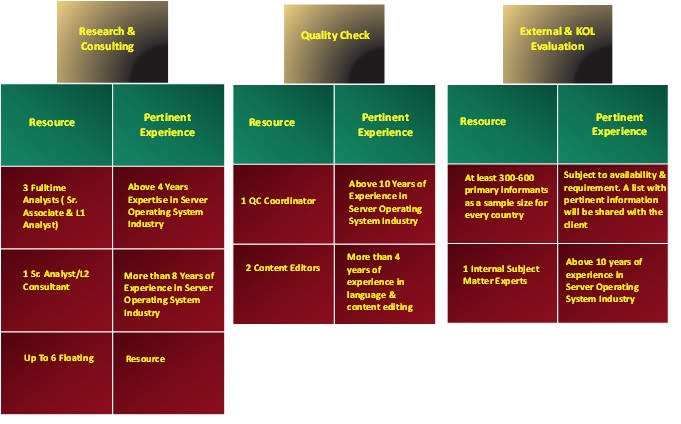
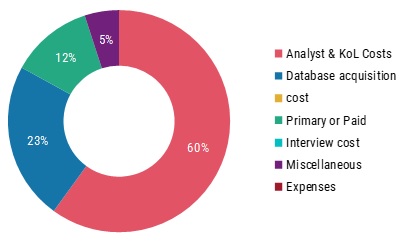
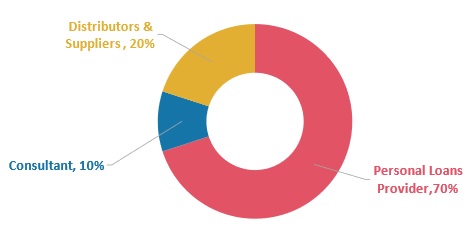
ResourceAllocation&CostStructure
Figure 4: RESOURCE ALLOCATION
Figure 5: COST STRUCTURE
Download Free Sample
Kindly complete the form below to receive a free sample of this Report
“This is really good guys. Excellent work on a tight deadline. I will continue to use you going forward and recommend you to others. Nice job”
Noah MalgeriCo-Founder
“Thanks. It’s been a pleasure working with you, please use me as reference with any other Intel employees.”
Joseph AguayoSales Operations & Pricing Manager
“Thanks for sending the report it gives us a good global view of the Betaïne market.”
Peter Groot koerkampAccount and Business Manager
“Thank you, this will be very helpful for OQS.”
La Terria DoddProgram Support Specialist
“We found the report very insightful! we found your research firm very helpful. I'm sending this email to secure our future business.”
Younghwan ChoiSenior Retail Manager
“I am very pleased with how market segments have been defined in a relevant way for my purposes (such as "Portable Freezers & refrigerators" and "last-mile").
In general the report is well structured. Thanks very much for your efforts.”
Mark IrwinManagement Consultant
“I have been reading the first document or the study, ,the Global HVAC and FP market report 2021 till 2026. Must say, good info! I have not gone in depth at all parts, but got a good indication of the data inside!”
Rob KooikerGroup Product Manager HVAC & Fire Protection GMA
“We got the report in time, we really thank you for your support in this process. I also thank to all of your team as they did a great job.”
Akif MorogluStrategy & Business Development Director
“The Automotive 48V ECU Components Procurement Intelligence Study” was a complex project, but the Market Research Future (MRFR) team handled it with quality, agility, and customer-centricity. They delivered all requested data on time and within the agreed scope. The team, including Shubhendra Anand and Rahul Gotadki, was always readily available to clarify questions and swiftly implement necessary adjustments, driving the project to a successful conclusion within a very demanding timeframe.
I would also like to specifically commend Akshay Agarwal for his responsiveness and support at every stage—from our initial inquiry on May 6th through to final delivery on June 18th. His dedication made the entire process seamless.”
Guilherme Gomes MartinsProduct Management Director