AI Image Recognition Market (2026 - 2035)

AI Image Recognition Market Size, Share and Research Report: By Application (Retail, Healthcare, Automotive, Security, Agriculture), By Technology (Deep Learning, Machine Learning, Neural Networks, Computer Vision, Image Processing), By End Use (Consumer Electronics, Industrial, Government, Transportation, Healthcare), By Deployment Type (Cloud, On-Premises, Hybrid) and By Regional (North America, Europe, South America, Asia Pacific, Middle East and Africa) - Industry Forecast to 2035.
ID: MRFR/ICT/20385-HCR
128 Pages
Kiran Jinkalwad, Aarti Dhapte
Last Updated: July 13, 2026
AI Image Recognition Market
Market Size
Forecast Period2026-2035
CAGR (2026-2035)15.6%
2025 Market SizeUSD 3.72 Billion
2035 Market SizeUSD 15.84 Billion
Key Players
Google
Microsoft
Amazon Web Services
NVIDIA
IBM
Clarifai
Opportunities
  • Multimodal Vision-Language Models
  • Precision Agriculture in Emerging Markets
  • Visual Inspection as a Service (VIaaS)

AI Image Recognition Market Summary

The global AI image recognition market is valued at an estimated USD 3.72 billion in 2025, projected to reach USD 4.30 billion in 2026 and climb to USD 15.84 billion by 2035, expanding at a compound annual growth rate of 15.6% during the 2026–2035 forecast window. This trajectory is anchored by two converging forces: surging enterprise adoption of deep learning image classification systems across quality assurance, healthcare diagnostics, and autonomous mobility, and aggressive government investment in national AI strategies — the U.S. CHIPS and Science Act alone earmarked over USD 280 billion in semiconductor and AI research funding through 2032 [1]. Retailers, manufacturers, and security agencies are no longer experimenting with visual AI; they are scaling it into core operations.

A decisive technology shift underpins this growth. Legacy rule-based machine vision pipelines — dependent on hand-crafted feature extractors and brittle lighting conditions — are giving way to convolutional neural network image analysis architectures that learn features directly from data. Transformer-based vision models such as Google's ViT and Meta's DINOv2 have pushed benchmark accuracy beyond 90% on complex classification tasks, driving a wave of enterprise procurement [2]. The European Union's AI Act, finalized in 2024, has simultaneously created compliance-driven demand for auditable, explainable AI-powered visual recognition software, particularly in healthcare and public safety verticals [3].

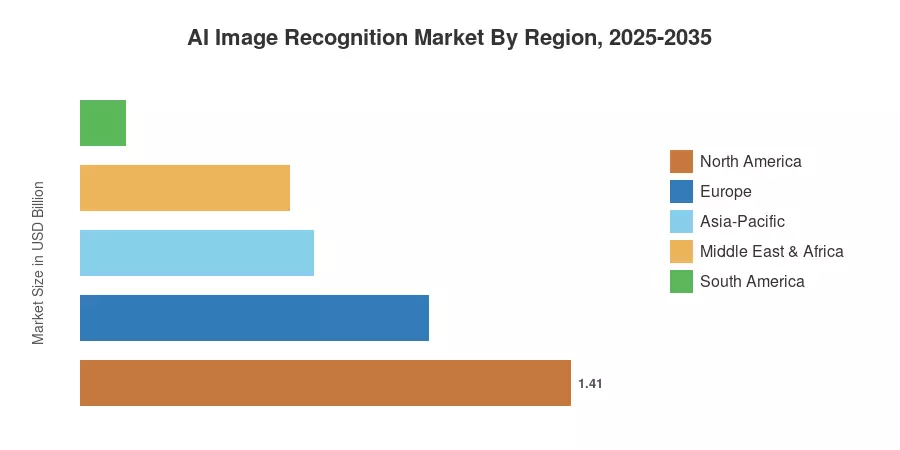
North America commands the largest regional share at approximately 38% of global revenue, buoyed by Silicon Valley R&D spending and early federal deployment in defense and border security. Asia-Pacific is the fastest-growing region, forecast to grow at a CAGR exceeding 18%, fueled by China's "New Generation AI Development Plan" and India's expanding digital infrastructure push [4]. Europe holds the second-largest share, near 27%, with automotive OEMs and pharmaceutical firms driving adoption. As edge computing costs fall and 5G coverage widens, real-time image detection algorithms will penetrate sectors previously considered too cost-sensitive for visual AI.

Key Report Takeaways

• By Technology

  • Deep learning and convolutional neural networks collectively account for roughly 62% of market revenue, reflecting their dominance in accuracy-critical deployments
  • Transformer-based vision models represent the fastest-growing technology segment with a forecast CAGR of approximately 19.2%
  • Traditional machine learning approaches still hold a niche in low-compute edge environments, valued at an estimated USD 0.41 billion in 2025

• By Sector

  • Retail and e-commerce constitute the largest application vertical, capturing around 22% market share
  • Healthcare and medical imaging are projected to grow at a CAGR of 17.8%, driven by FDA-cleared diagnostic algorithms
  • Automotive and autonomous vehicles account for an estimated USD 0.63 billion in 2025

• By Region

  • North America leads with approximately 38% of global market share
  • Asia-Pacific is forecast to register a CAGR of 18.1% through 2035
  • Europe generates an estimated USD 1.00 billion in 2025 revenue

Market Size and Forecast (2021–2035)

Data for the historical period (2021–2024) draws on verified vendor revenues, patent filings, and disclosed contract values, cross-referenced with and national AI spending disclosures. Forecast figures (2026–2035) are modeled using a bottom-up approach combining segment-level adoption curves, enterprise IT budget forecasts, and policy-driven demand scenarios. All values are expressed in constant 2025 USD.
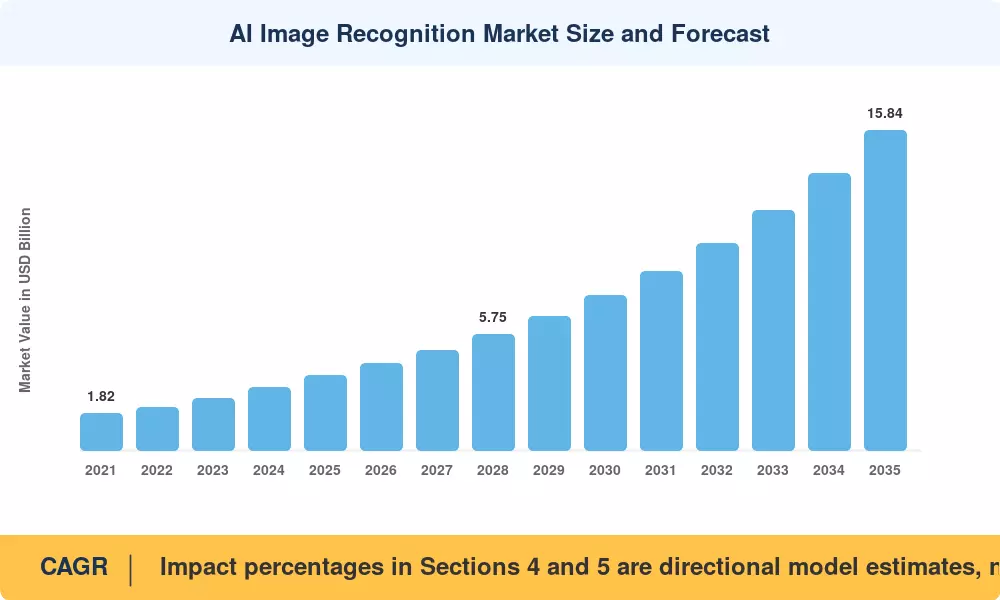
AI Image Recognition Market Size and Forecast
Our Impact
Enabled $4.3B Revenue Impact for Fortune 500 and Leading Multinationals
Partnering with 2000+ Global Organizations Each Year
30K+ Citations by Top-Tier Firms in the Industry

Driver Impact Analysis

Driver ~% Impact on CAGR Geographic Relevance Impact Timeline
Enterprise digital transformation & automation ~22% Global Short-term (≤2 yr)
Expansion of FDA/CE-cleared medical imaging AI ~18% North America, Europe Medium-term (2–4 yr)
Autonomous vehicle & ADAS regulation mandates ~16% North America, Asia-Pacific Long-term (≥4 yr)
Edge AI chipset cost reduction ~14% Global Medium-term (2–4 yr)
Retail visual search & recommendation engines ~12% North America, Asia-Pacific Short-term (≤2 yr)
Government surveillance & smart city programs ~10% Asia-Pacific, MEA Long-term (≥4 yr)
5G rollout enabling real-time inference ~8% Global Medium-term (2–4 yr)


Enterprise Digital Transformation and Automation

Manufacturing quality inspection alone represents a USD 1.2 billion addressable opportunity within the broader AI object recognition for automation space. Companies like Foxconn and BMW have reported 30–40% reductions in defect escape rates after deploying CNN-based visual inspection on production lines. The ROI case is compelling: a typical semiconductor fab recovering even 0.5% yield improvement through automated wafer inspection can recoup a USD 2 million AI system investment within 14 months. This driver is strongest in the short term as enterprises move from pilot to production deployment.

Medical Imaging AI Regulatory Clearances

The FDA cleared over 200 AI-enabled medical devices by the end of 2024, with radiology and ophthalmology leading the count [10]. CMS reimbursement codes for AI-assisted diabetic retinopathy screening (CPT 92229) have created a direct revenue pathway for hospitals to justify procurement. In Europe, the EU MDR and In Vitro Diagnostic Regulation (IVDR) frameworks, while burdensome, are channeling demand toward certified platforms from vendors like Viz.ai and Aidoc, consolidating market share among compliant providers.

Autonomous Vehicle Perception Stacks

NHTSA's rulemaking on Automatic Emergency Braking, finalized in 2024, effectively mandates camera-based AI perception in all new U.S. light vehicles by 2029 [11]. This single regulation creates a captive demand channel for real-time image detection algorithms across an annual production base of roughly 15 million vehicles. China's Ministry of Industry and Information Technology has set parallel targets, requiring Level 3 autonomous capability readiness in 50% of new vehicles by 2030.

Edge AI Chipset Economics

Qualcomm's AI Engine, NVIDIA's Jetson Orin Nano, and Apple's Neural Engine have driven inference costs below USD 0.001 per image at the edge — a tenfold reduction since 2021 [8]. This cost curve is unlocking applications in agriculture (crop disease detection), logistics (package sorting), and retail (shelf analytics), where cloud round-trip latency and bandwidth costs previously made deployment uneconomical.

Restraints Impact Analysis

Data Privacy and Algorithmic Bias Regulation

The EU AI Act classifies real-time biometric identification systems in public spaces as "high-risk," imposing conformity assessments, mandatory bias audits, and transparency obligations that add 12–18 months to deployment timelines [3]. In the United States, state-level bans on facial recognition — enacted in cities including San Francisco, Boston, and Portland — have created a fragmented compliance landscape that chills procurement budgets. A 2024 NIST study found that leading commercial facial recognition systems still exhibited false-positive rates 10–100 times higher for darker-skinned individuals, intensifying regulatory scrutiny [15].

Training Data Scarcity and Quality

Medical imaging AI developers routinely cite data access as their primary bottleneck: HIPAA constraints, institutional data-sharing reluctance, and annotation costs averaging USD 6–10 per image for expert-level radiology labeling create formidable barriers to model training at scale. Synthetic data generation platforms like Synthesis AI and Datagen are partially bridging this gap, but domain experts estimate that synthetic-only training still underperforms real-data models by 5–8 percentage points on clinical benchmarks.

Computational Cost Barriers in Emerging Markets

Training a state-of-the-art vision transformer model can cost upward of USD 500,000 in cloud compute, and even fine-tuning for a specific industrial use case runs USD 20,000–50,000 [14]. For small and mid-size enterprises in Southeast Asia, Latin America, and Sub-Saharan Africa, these costs remain prohibitive without subsidized cloud credits or government co-investment programs.

AI Image Recognition Market Opportunities

Multimodal Vision-Language Models

The convergence of large language models with vision encoders — exemplified by GPT-4o and Google Gemini — is creating entirely new product categories: visual question-answering systems for insurance claims adjustment, interactive product discovery in e-commerce, and automated construction site safety auditing. Enterprises that integrate multimodal AI-powered visual recognition software stand to capture workflow automation revenue estimated at USD 2.5 billion by 2032

Precision Agriculture in Emerging Markets

Drone-based crop monitoring using deep learning image classification systems can reduce pesticide usage by 25–30% and increase yield by 10–15%, according to FAO pilot programs in India and Kenya [17]. With over 500 million smallholder farms globally and declining drone hardware costs, agricultural image recognition represents one of the largest untapped volume opportunities, particularly in Sub-Saharan Africa and South Asia

Visual Inspection as a Service (VIaaS)

Cloud-native visual inspection platforms — offered on a per-image or per-line subscription basis — are democratizing access for SMEs unable to fund on-premises AI deployments. Companies like Landing AI and Instrumental are pioneering this model, achieving 70–80% gross margins at scale The VIaaS model could expand the addressable market by an estimated 30% by lowering the entry barrier from six-figure capex to four-figure monthly opex.

Regulatory-Driven Demand in Pharmaceutical Manufacturing

The FDA's push toward continuous manufacturing validation and the EU GMP Annex 1 revision (effective August 2023) have increased scrutiny on visual inspection of injectable drug products [18]. Automated particulate detection systems using convolutional neural network image analysis are replacing manual human inspection, which historically suffers from 70% inspector fatigue-related miss rates after four-hour shifts.

Data Monetization Through Anonymized Visual Analytics

Retailers and smart city operators are beginning to monetize anonymized foot-traffic heatmaps, demographic flow analytics, and shopper behavior insights generated by AI object recognition for automation systems. Privacy-preserving federated learning techniques enable this monetization without exposing raw imagery, creating a secondary revenue stream valued at an estimated USD 800 million globally by 2030

AI Image Recognition Market Future Outlook

Foundation Models Reshape the Vision Stack

The next decade will see a fundamental shift from task-specific vision models to general-purpose foundation models capable of zero-shot and few-shot image recognition across domains. OpenAI's CLIP architecture demonstrated that models pre-trained on internet-scale image-text pairs can match specialized classifiers without domain-specific fine-tuning. By 2030, MRFR projects that over 60% of new enterprise vision deployments will leverage foundation model APIs rather than custom-trained architectures, compressing development cycles from months to days [2].

Edge-Cloud Hybrid Inference Becomes the Default

The tension between cloud-based model power and edge-based latency requirements will resolve into hybrid architectures. Lightweight models will handle initial triage at the edge — a manufacturing camera flagging potential defects in under 10 milliseconds — while ambiguous cases route to cloud-hosted large models for secondary analysis. Qualcomm projects that edge AI chipset shipments will exceed 2 billion units annually by 2030, making ubiquitous on-device inference commercially viable [8].

Synthetic Data Breaks the Training Bottleneck

Generative AI's ability to produce photorealistic synthetic training data is poised to dismantle the data scarcity constraint that has throttled medical, defense, and rare-event detection applications. NVIDIA's Omniverse Replicator and Unity's Perception toolkit have already demonstrated that models trained on 80% synthetic data can achieve within 2–3% of real-data accuracy. By 2028, the synthetic data market for vision AI is expected to exceed USD 1.5 billion, according to estimates.

Responsible AI Governance Creates Competitive Moats

As regulation matures — the EU AI Act, Canada's AIDA, Brazil's AI Bill — compliance capability will become a competitive differentiator rather than a cost center. Vendors that embed explainability, bias testing, and audit trails into their vision platforms will capture premium pricing in regulated verticals such as healthcare, finance, and law enforcement. ISO/IEC 42001 (AI Management Systems) certification, published in 2023, is already becoming a procurement prerequisite for enterprise buyers evaluating AI-powered visual recognition software [15].

AI Image Recognition Market Segmentation

By Technology

Segment Key Metric Primary Demand Driver
Deep Learning (CNN) ~48% market share Accuracy in leadership in classification and detection
Vision Transformers CAGR ~19.2% Zero-shot generalization, multimodal integration
Traditional ML (SVM, RF) ~USD 0.41 B (2025) Low-compute edge deployments
Generative Vision Models CAGR ~21.5% Synthetic data, image augmentation


Deep learning architectures built on convolutional neural networks remain the workhorse of production deployments, particularly in industrial inspection and medical imaging, where years of validated performance data give buyers confidence. Vision transformers are eroding this dominance rapidly — their ability to capture global image context rather than local features makes them superior for complex scene understanding tasks like autonomous driving and satellite imagery analysis

By Application

Segment Key Metric Primary Demand Driver
Retail & E-commerce ~22% market share Visual search, product tagging, anti-counterfeiting
Healthcare & Medical Imaging CAGR ~17.8% Regulatory clearances, reimbursement codes
Automotive & Transportation ~USD 0.63 B (2025) ADAS mandates, autonomous perception
Manufacturing & Quality Control ~16% market share Yield improvement, defect reduction
Security & Surveillance CAGR ~14.9% Smart city programs, border security
Agriculture ~USD 0.15 B (2025) Drone-based crop monitoring


Retail and e-commerce lead by revenue share thanks to massive transaction volumes — Pinterest alone processes over 5 billion visual searches monthly, and Amazon's visual product search has become a core conversion driver. Healthcare is the fastest-growing application by CAGR, propelled by a regulatory environment that has shifted from skepticism to active facilitation: the FDA now maintains a dedicated AI/ML-based Software as a Medical Device (SaMD) action plan that streamlines clearance pathways [10].

By Deployment Mode

Segment Key Metric Primary Demand Driver
Cloud-based ~57% market share Scalability, access to large models
Edge / On-premises CAGR ~18.4% Latency, data sovereignty, bandwidth savings
Hybrid ~USD 0.38 B (2025) Balanced cost-performance optimization


Regional Market Share Analysis

Region Key Metric Primary Investment Themes
North America ~38% market share (2025) Defense, healthcare AI, autonomous vehicles
Europe ~USD 1.00 B (2025) Automotive ADAS, pharma inspection, EU AI Act compliance
Asia-Pacific CAGR ~18.1% Smart cities, manufacturing automation, and mobile commerce
South America ~USD 0.13 B (2025) Agritech, fintech, identity verification
Middle East & Africa CAGR ~16.2% Surveillance, oil & gas inspection, smart governance
**Total** **USD 3.72 B (2025)**


North America

Country Key Metric Key Driver
United States ~82% of regional revenue Federal defense and healthcare AI procurement
Canada CAGR ~14.8% Natural resources monitoring, immigration screening
Mexico ~USD 0.04 B (2025) Manufacturing nearshoring, automotive supply chain


The United States accounts for the vast majority of North American spending, driven by Department of Defense contracts for satellite imagery analysis (Project Maven and successor programs) and a healthcare system that cleared over 200 AI diagnostic devices by 2024 [10]. Canada's strength lies in its Montreal-Toronto AI research corridor, home to foundational computer vision labs at Mila and the Vector Institute, which feed a steady pipeline of commercialized startups into the market.

Europe

Country Key Metric Key Driver
Germany ~28% of European revenue Automotive OEM integration (BMW, VW, Bosch)
United Kingdom CAGR ~15.3% NHS diagnostic AI, fintech identity verification
France ~USD 0.14 B (2025) Aerospace (Thales, Airbus) and defense


Germany's automotive sector is the backbone of European demand, with every major OEM embedding multi-camera perception stacks into ADAS and autonomous platforms. The UK's National Health Service has committed GBP 250 million to AI-enabled diagnostics through its AI in Health and Care Award program, creating a centralized procurement channel that accelerates adoption [19].

Asia-Pacific

Country Key Metric Key Driver
China ~45% of regional revenue Government surveillance, manufacturing QC, mobile commerce
Japan CAGR ~14.5% Robotics, semiconductor inspection
India ~USD 0.09 B (2025) Digital identity (Aadhaar), agritech, retail
South Korea CAGR ~15.8% Display manufacturing, autonomous driving R&D


China dominates the Asia-Pacific landscape through a combination of state-backed smart city deployments — over 500 cities have launched AI-integrated urban management platforms — and massive consumer-facing applications in mobile payments and visual product search [4]. India's opportunity is earlier-stage but rapidly scaling, with the government's INR 10,372 crore (USD 1.25 billion) IndiaAI Mission providing compute credits and dataset infrastructure to domestic startups.

South America

Country Key Metric Key Driver
Brazil ~58% of regional revenue Agribusiness monitoring, bank identity verification
Argentina CAGR ~14.0% Agricultural export quality inspection
Colombia ~USD 0.01 B (2025) Security and surveillance


Brazil's expansive agribusiness sector — the world's largest soybean and coffee exporter — is adopting drone-based crop health imaging at accelerating rates. Banco do Brasil and Itaú Unibanco have deployed facial recognition for branch and mobile banking authentication, pushing financial services into the second-largest vertical in the region.

Middle East & Africa

Country Key Metric Key Driver
UAE ~32% of regional revenue Smart city (NEOM, Dubai AI Strategy)
Saudi Arabia CAGR ~17.5% Vision 2030 digital transformation
South Africa ~USD 0.02 B (2025) Mining inspection, retail security


The UAE's Dubai AI Roadmap targets 50% of government services integrating AI by 2031, with visual recognition systems central to immigration processing at Dubai International Airport — one of the world's busiest hubs [20]. Saudi Arabia's NEOM project alone has allocated an estimated USD 500 billion, with AI-powered building inspection and environmental monitoring systems forming a core technology layer.

AI Image Recognition Market By Region, 2025-2035

Competitive Benchmarking

The AI image recognition market exhibits moderate concentration, with an estimated HHI of approximately 850–1,000, and the top five players commanding roughly 35–42% of global revenue. The landscape features a mix of hyperscaler platform providers, specialist computer vision companies, and semiconductor firms embedding AI capabilities into their chipsets. Open-source ecosystems (PyTorch, TensorFlow, Hugging Face) keep barriers to entry relatively low for software, but access to large-scale training data and compute infrastructure creates meaningful moats for established players.

Company Est. Revenue Share Range Key Offerings for AI Image Recognition Strategic Positioning
Google (Alphabet) ~8–11% Cloud Vision API, MediaPipe, ViT models Full-stack platform, research leadership
Microsoft ~7–10% Azure Computer Vision, Florence model Enterprise cloud integration
Amazon Web Services ~6–9% Rekognition, Lookout for Vision Cloud-native, manufacturing focus
NVIDIA ~5–8% Metropolis, Jetson, TAO Toolkit Hardware-software co-optimization
IBM ~3–5% Maximo Visual Inspection, Watson Industrial and enterprise verticals
Clarifai ~2–4% Custom model training platform Developer-friendly, government contracts
Cognex ~2–4% VisionPro, In-Sight, Deep Learning tools Industrial machine vision specialist
Sensetime ~2–4% SenseCore, smart city platforms Asia-Pacific market leader
Viz.ai ~1–3% Clinical decision support, stroke detection Healthcare vertical specialist
Landing AI ~1–2% LandingLens, a visual inspection platform Manufacturing SME focus, VIaaS model


Recent News & Developments

  • Google (May 2024): Released PaliGemma, an open-source vision-language model achieving state-of-the-art results on image captioning and visual QA benchmarks, intensifying open-source competition against proprietary offerings [2].
  • NVIDIA (March 2024): Launched the Jetson Orin Nano Super Developer Kit at USD 249, reducing entry-level edge AI development costs by 60% and expanding access for SME deployments in inspection and agriculture [8].
  • European Commission (August 2024): Published final implementing guidelines for the EU AI Act's high-risk classification of biometric systems, establishing mandatory conformity assessment timelines effective August 2025 [3].
  • Amazon Web Services (November 2024): Expanded Lookout for Vision with automated anomaly detection for semiconductor wafer inspection, targeting the USD 4 billion fab equipment market [22].
  • Viz.ai (January 2025): Secured USD 100 million Series D funding to expand AI-powered stroke and pulmonary embolism detection into 2,000+ U.S. hospitals, signaling strong venture confidence in clinical imaging AI [10].
  • Cognex (September 2024): Acquired Moritex Corporation's industrial optics division, vertically integrating lens and lighting hardware with its deep learning inspection software platform [23].
  • U.S. FDA (February 2025): Cleared the 250th AI-enabled medical device, with radiology accounting for 76% of all clearances, reinforcing the healthcare vertical as the fastest-growing regulated application [10].
  • SenseTime (April 2025): Launched SenseNova 5.5 vision foundation model with support for 50+ languages, targeting Southeast Asian and Middle Eastern smart city contracts [4].

AI Image Recognition Market Report Scope

Parameter Detail
Market Scope Global AI Image Recognition Market — hardware, software, and services for AI-based image classification, detection, segmentation, and recognition
Study Period 2021–2035
CAGR (Forecast Period) 15.6% (2026–2035)
Base Year Market Size USD 3.72 Billion (2025)
Forecast Endpoint USD 15.84 Billion (2035)
Fastest Growing Segment Vision Transformers (by technology); Healthcare (by application); Asia-Pacific (by region)
Companies Profiled Google, Microsoft, AWS, NVIDIA, IBM, Clarifai, Cognex, SenseTime, Viz.ai, Landing AI
Valuation Currency Constant 2025 USD
CAGR Driver Disclaimer Impact percentages in Sections 4 and 5 are directional model estimates, not additive components of the headline CAGR


FAQs

How should enterprises evaluate build-vs-buy decisions for image recognition capabilities?
The build-vs-buy calculus has shifted dramatically since 2023. For most enterprises outside the technology sector, buying a pre-built platform (AWS Rekognition, Google Cloud Vision, or specialist tools like Landing AI's LandingLens) delivers faster time-to-value at lower total cost of ownership — typically 40–60% less than internal development over a three-year horizon, once you factor in MLOps staffing, GPU infrastructure, and ongoing model maintenance. Building in-house makes strategic sense only when the visual recognition task involves deeply proprietary data that creates a competitive advantage (e.g., a semiconductor company's defect taxonomy) and when the organization has at least 5–10 dedicated ML engineers. Hybrid approaches — fine-tuning a foundation model API on proprietary data — are increasingly the pragmatic middle ground [9].
What latency thresholds matter for different image recognition applications?
Latency requirements vary by orders of magnitude across use cases, and misunderstanding these thresholds leads to over-engineered (and over-budget) deployments. Autonomous vehicle perception demands sub-50-millisecond inference to maintain safe reaction times at highway speeds. Industrial quality inspection on high-speed production lines typically requires 100–200 milliseconds per frame. Retail visual search and medical imaging diagnostics can tolerate 500 milliseconds to 2 seconds without degrading user experience. Batch processing applications — satellite imagery analysis, historical medical record review — have no real-time constraint at all. Selecting the right latency tier drives hardware and architecture decisions: edge ASIC for the first tier, edge GPU for the second, cloud API for the third, and batch cloud compute for the fourth [8][12].
How does the EU AI Act specifically affect image recognition vendors selling into European markets?
Vendors offering facial recognition, biometric categorization, or emotion recognition systems face the most stringent requirements: these are classified as high-risk or prohibited (in the case of real-time public biometric identification by law enforcement, with narrow exceptions). High-risk classification triggers mandatory conformity assessments, technical documentation, human oversight provisions, and registration in the EU database before market placement. The practical impact for vendors is an estimated 12–18 months of additional compliance preparation and EUR 200,000–500,000 in documentation and audit costs per product line. Non-biometric image recognition applications (industrial inspection, agricultural monitoring, retail analytics) generally fall into limited-risk or minimal-risk categories, requiring only transparency obligations such as informing users they are interacting with an AI system [3].
What role does synthetic data play in overcoming training data limitations, and what are its current accuracy trade-offs?
Synthetic data generated through 3D rendering engines (NVIDIA Omniverse, Unity Perception) and diffusion models is proving transformative for domains where real training data is scarce, expensive, or privacy-restricted. In autonomous driving, Waymo has reported that synthetic data constitutes over 50% of its training pipeline for rare-event scenarios — a pedestrian emerging from behind an occluded vehicle, for instance — that occur too infrequently in real-world driving to collect adequate samples. The accuracy gap is narrowing but non-trivial: models trained exclusively on synthetic data typically underperform real-data models by 3–8 percentage points on domain-specific benchmarks, though hybrid strategies (70% synthetic, 30% real) often match or exceed pure real-data performance when the synthetic data captures sufficient domain randomization [13].
How are image recognition vendors approaching the explainability challenge in regulated industries?
Explainability has moved from an academic interest to a procurement requirement. In healthcare, the FDA now expects vendors to provide algorithmic transparency documentation as part of 510(k) or De Novo submissions — clinicians need to understand why a model flagged a particular lesion as suspicious. Leading approaches include gradient-weighted class activation mapping (Grad-CAM), which highlights the image regions most influential in a classification decision, and concept-based explanations that map model features to human-interpretable clinical concepts. In financial services, where image recognition is used for identity verification and check deposit processing, explainability serves both regulatory compliance (under fair lending laws) and customer dispute resolution. Vendors investing in built-in explainability tools — rather than treating them as aftermarket add-ons — are winning enterprise procurement evaluations at measurably higher rates [15].
What integration challenges do enterprises face when deploying image recognition alongside existing ERP and MES systems?
The technical integration challenge is frequently underestimated. Most enterprise resource planning and manufacturing execution systems were designed before the AI era and lack native interfaces for ingesting probabilistic model outputs. A visual inspection system that reports a 0.87 confidence score for a defect classification does not map cleanly to the binary pass/fail logic of a legacy MES quality gate. Successful deployments require a middleware layer — sometimes called an "AI orchestration bus" — that translates model outputs into business rules, manages confidence thresholds, routes edge cases to human reviewers, and logs audit trails. Vendors like Cognex and Landing AI have built these integration layers into their platforms, but enterprises using open-source or custom models typically spend 30–40% of total project budget on integration rather than model development [9][23].
How will quantum computing and neuromorphic chips affect the image recognition market over the next decade?
Neither quantum computing nor neuromorphic chips will materially disrupt the image recognition market before 2030, but both warrant strategic monitoring. Quantum advantage for vision tasks remains theoretical — current quantum hardware lacks the qubit count and error correction needed for practical image processing, and classical GPU architectures continue to advance rapidly on parallel matrix operations. Neuromorphic chips (Intel Loihi 2, IBM NorthPole) present a nearer-term impact: their event-driven processing consumes 10–100x less power than conventional GPUs for inference tasks, making them candidates for always-on surveillance cameras and mobile devices where battery life is critical. Intel's NorthPole chip demonstrated 22 trillion operations per second per watt on image inference benchmarks in 2024 — a metric that, if commercially scaled, could fundamentally alter the edge deployment economics discussed in this report [14].      
Author
Author
Author Profile
Kiran Jinkalwad LinkedIn
Research Associate Level - II
Kiran Jinkalwad brings over four years of experience in market research, specializing in the ICT and Semiconductor sectors. She has worked on 50+ projects, including custom studies for companies like Microsoft and Huawei, addressing complex business challenges. With a background in Electronics and Telecommunication, Kiran excels in market estimation, forecasting, and strategic analysis. His sharp analytical skills and industry knowledge consistently deliver actionable insights for diverse clients.
Co-Author
Co-Author Profile
Aarti Dhapte LinkedIn
AVP - Research
A consulting professional focused on helping businesses navigate complex markets through structured research and strategic insights. I partner with clients to solve high-impact business problems across market entry strategy, competitive intelligence, and opportunity assessment. Over the course of my experience, I have led and contributed to 100+ market research and consulting engagements, delivering insights across multiple industries and geographies, and supporting strategic decisions linked to $500M+ market opportunities. My core expertise lies in building robust market sizing, forecasting, and commercial models (top-down and bottom-up), alongside deep-dive competitive and industry analysis. I have played a key role in shaping go-to-market strategies, investment cases, and growth roadmaps, enabling clients to make confident, data-backed decisions in dynamic markets.
Download Free Sample

Kindly complete the form below to receive a free sample of this Report

Download PDF ×

We do not share your information with anyone. However, we may send you emails based on your report interest from time to time. You may contact us at any time to opt-out.