Air Filters Market Summary
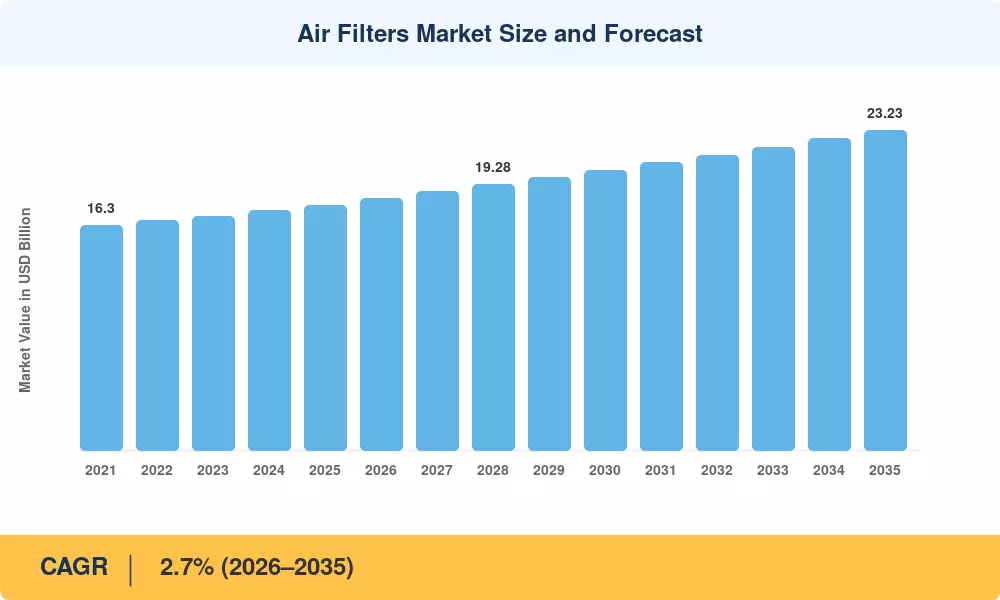
The global Air Filters Market reached an estimated USD 17.80 billion in 2025 and is projected to grow from USD 18.28 billion in 2026 to USD 23.23 billion by 2035, registering a CAGR of 2.7% during the forecast period (2026–2035). This steady expansion is anchored in two converging forces: tightening emission-control regulations across both developed and emerging economies, and an unprecedented wave of automobile production in Asia and Latin America. China's National VI emission standards and the European Union's Euro 7 framework have compelled automakers and facility operators alike to invest in higher-grade filtration systems [1][2].
A quiet technology shift is reshaping the Air Filters Market from the inside out. Legacy fiberglass panel filters—once the default across residential and light-commercial HVAC systems—are giving way to synthetic media and pleated designs that deliver higher dust-holding capacity at lower pressure drops. The U.S. Department of Energy's 2024 Commercial Building Energy Code update pushed minimum ventilation-filter efficiency to MERV 11 for new constructions, a policy change expected to redirect roughly USD 1.2 billion in annual procurement spend toward upgraded media [3]. Industrial end users, meanwhile, are retrofitting aging baghouse collectors with pulse-jet cartridge units that cut compressed-air consumption by up to 30%.
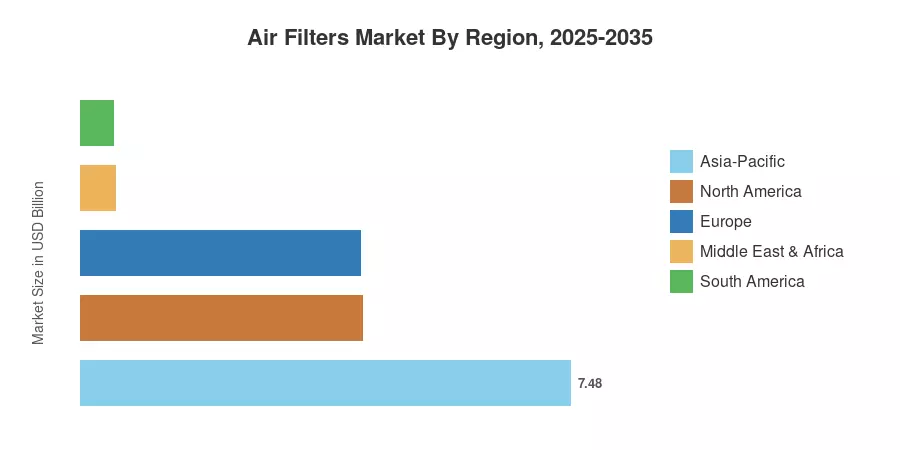
Asia-Pacific commands the largest share of the Air Filters Market at approximately 42% of global revenue, driven by rapid urbanization in India and sustained manufacturing output in China and South Korea. Europe holds the second-largest position with roughly a 24% share, supported by stringent indoor-air-quality directives. North America, while mature, remains a high-value region thanks to replacement-cycle demand across its vast commercial building stock. The fastest growth through 2035 will come from Asia-Pacific, where the Air Filters Market is expected to register a CAGR above 3.1% [4][5].
Key Report Takeaways
• By Type
- Cartridge filters accounted for approximately 28% of the Air Filters Market in 2025, propelled by their dominance in industrial dust-collection applications.
- HEPA filters are the fastest-growing type segment, projected to expand at a CAGR of 3.8% through 2035 as cleanroom and healthcare demand intensifies.
- Baghouse filters represented an estimated USD 3.4 billion in 2025, reflecting ongoing demand from cement, power, and metals processing facilities.
• By End User
- The industrial segment led the Air Filters Market with the largest revenue contribution in 2025, valued at roughly USD 7.5 billion.
- Residential end users are expected to post the highest segment CAGR of 3.2% through the forecast window, fueled by air-quality awareness and smart-home integration.
• By Region
- Asia-Pacific held around 42% of global Air Filters Market revenue in 2025.
- North America generated approximately USD 4.3 billion in 2025, with replacement-cycle economics sustaining stable demand.
- The Middle East & Africa region is forecast to grow at a CAGR of 3.0%, the second-fastest pace globally.
Air Filters Market Size and Forecast (2021–2035)
Market Research Future's sizing methodology triangulates bottom-up revenue estimates from manufacturer disclosures, distributor sell-through data, and trade-association production statistics with top-down demand modeling anchored to macroeconomic indicators such as vehicle production volumes, commercial construction starts, and industrial output indices. Historical figures (2021–2024) rely on audited annual reports and customs-trade databases; the base year (2025) blends preliminary company filings with channel-check data; forecast values (2026–2035) apply a calibrated CAGR of 2.7% validated against end-use demand drivers and policy trajectories.





















.webp?v=1787579649)
