Download Free Sample
Kindly complete the form below to receive a free sample of this Report
Aircraft Cabin Environmental Systems Repair Services Market Research Report By Application (Commercial Aviation, Military Aviation, Business Aviation, Cargo Aviation), By System Type (Air Conditioning Systems, Pressurization Systems, Heating Systems, Ventilation Systems), By Service Type (Maintenance Services, Repair Services, Overhaul Services, Inspection Services), By Aircraft Type (Narrow-Body Aircraft, Wide-Body Aircraft, Regional Aircraft, Freighter Aircraft) And By Region (North America, Europe, Asia-Pacific, And Rest Of The World) – Market Forecast Till 2035.
As per MRFR analysis, the Aircraft Cabin Environmental Systems Repair Services Market was estimated at 1.5 USD Billion in 2024. The Aircraft Cabin Environmental Systems Repair Services industry is projected to grow from 1.59 USD Billion in 2025 to 2.8 USD Billion by 2035, exhibiting a compound annual growth rate (CAGR) of 5.84% during the forecast period 2025 - 2035.
The Aircraft Cabin Environmental Systems Repair Services Market is poised for growth driven by technological advancements and a focus on sustainability.
| 2024 Market Size | 1.5 (USD Billion) |
| 2035 Market Size | 2.8 (USD Billion) |
| CAGR (2025 - 2035) | 5.84% |
Honeywell International Inc. (US), United Technologies Corporation (US), Airbus S.A.S. (FR), Boeing Company (US), Safran S.A. (FR), Rockwell Collins (US), Thales Group (FR), Lufthansa Technik AG (DE), MTU Aero Engines AG (DE)
Our Impact
Enabled $4.3B Revenue Impact for Fortune 500 and Leading Multinationals
Partnering with 2000+ Global Organizations Each Year
30K+ Citations by Top-Tier Firms in the Industry
The Aircraft Cabin Environmental Systems Repair Services Market is currently experiencing a notable evolution, driven by advancements in technology and increasing regulatory requirements. As airlines and aircraft operators prioritize passenger comfort and safety, the demand for efficient and reliable repair services for cabin environmental systems has intensified. This market encompasses a range of services, including air conditioning, pressurization, and humidity control systems, which are essential for maintaining optimal cabin conditions. The growing emphasis on sustainability and energy efficiency further propels the need for innovative repair solutions that align with environmental standards. In addition, the competitive landscape of the Aircraft Cabin Environmental Systems Repair Services Market is becoming increasingly dynamic. Companies are investing in research and development to enhance service offerings and improve operational efficiency. Collaborations between manufacturers and service providers are also on the rise, aiming to create integrated solutions that address the complexities of modern aircraft systems. As the aviation industry continues to recover and expand, the Aircraft Cabin Environmental Systems Repair Services Market is poised for growth, with opportunities for both established players and new entrants to capitalize on emerging trends and technologies.
The Aircraft Cabin Environmental Systems Repair Services Market is witnessing a surge in technological innovations. Enhanced diagnostic tools and predictive maintenance technologies are being integrated into repair processes, allowing for more accurate assessments and timely interventions. This trend not only improves service efficiency but also reduces downtime for aircraft, thereby increasing operational reliability.
There is a growing emphasis on sustainability within the Aircraft Cabin Environmental Systems Repair Services Market. Companies are increasingly adopting eco-friendly practices and materials in their repair services. This shift is driven by regulatory pressures and consumer demand for greener aviation solutions, prompting service providers to innovate and align their offerings with environmental standards.
Collaborative partnerships are emerging as a key trend in the Aircraft Cabin Environmental Systems Repair Services Market. Service providers are forming alliances with aircraft manufacturers and technology firms to enhance service capabilities. These collaborations aim to streamline repair processes and develop comprehensive solutions that address the evolving needs of the aviation sector.
The Aircraft Cabin Environmental Systems Repair Services Market is experiencing a surge in demand due to the rising number of air travelers. As more individuals opt for air travel, airlines are compelled to enhance their cabin environments to ensure passenger comfort and safety. This trend is reflected in the projected growth of the aviation sector, which anticipates a compound annual growth rate of approximately 4.5% over the next decade. Consequently, the need for efficient repair services for cabin environmental systems becomes paramount, as airlines strive to maintain high operational standards and meet passenger expectations. The increasing air travel demand not only drives the market for new aircraft but also necessitates the upkeep and repair of existing cabin systems, thereby bolstering the Aircraft Cabin Environmental Systems Repair Services Market.
The Aircraft Cabin Environmental Systems Repair Services Market is witnessing a shift towards sustainability initiatives as airlines aim to reduce their environmental footprint. This trend is prompting airlines to invest in eco-friendly repair services and technologies that minimize energy consumption and waste. For instance, the implementation of energy-efficient cabin systems not only enhances environmental performance but also reduces operational costs. Market analysis indicates that airlines are increasingly prioritizing sustainability, with a projected 7% increase in investments in green technologies over the next few years. This focus on sustainability is likely to drive demand for specialized repair services that align with environmental goals, thereby shaping the future of the Aircraft Cabin Environmental Systems Repair Services Market.
The Aircraft Cabin Environmental Systems Repair Services Market is increasingly driven by a heightened focus on passenger comfort and overall experience. Airlines are recognizing that a comfortable cabin environment is crucial for customer satisfaction and loyalty. This realization has led to investments in the repair and maintenance of cabin environmental systems, such as air conditioning and humidity control. Market data suggests that airlines are allocating approximately 10% of their operational budgets to enhance cabin comfort, which directly impacts the demand for repair services. As competition intensifies among airlines, the emphasis on providing superior cabin environments is likely to fuel growth in the Aircraft Cabin Environmental Systems Repair Services Market, as airlines strive to differentiate themselves through enhanced passenger experiences.
The Aircraft Cabin Environmental Systems Repair Services Market is significantly influenced by stringent regulatory compliance and safety standards imposed by aviation authorities. These regulations mandate that airlines maintain optimal cabin air quality and temperature control systems to ensure passenger safety and comfort. As a result, airlines are increasingly investing in repair services to adhere to these regulations, which are expected to become even more rigorous in the coming years. The market is projected to grow as airlines prioritize compliance, with an estimated increase in repair service expenditures by 6% annually. This focus on regulatory adherence not only enhances the safety of air travel but also drives the demand for specialized repair services within the Aircraft Cabin Environmental Systems Repair Services Market.
Technological advancements are reshaping the Aircraft Cabin Environmental Systems Repair Services Market, as innovative repair techniques and tools emerge. The integration of advanced diagnostic tools and predictive maintenance technologies allows for more efficient and effective repairs, reducing downtime and operational costs for airlines. For instance, the adoption of IoT-enabled systems enables real-time monitoring of cabin environmental conditions, facilitating timely repairs and maintenance. This trend is expected to propel the market forward, with a projected growth rate of 5% in the adoption of such technologies over the next five years. As airlines seek to optimize their operations and enhance passenger experiences, the demand for technologically advanced repair services will likely increase within the Aircraft Cabin Environmental Systems Repair Services Market.
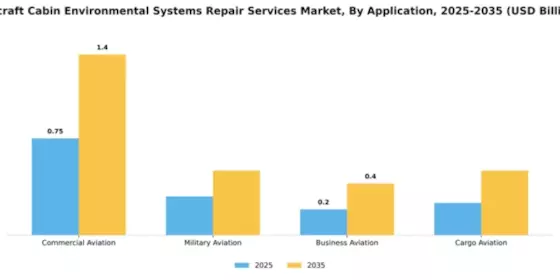
In the Aircraft Cabin Environmental Systems Repair Services Market, Commercial Aviation holds the largest share among the various segments. This sector is primarily driven by the substantial demand for passenger flights and the growing global fleet of commercial aircraft. Additionally, maintenance, repair, and overhaul (MRO) organizations are increasingly investing in advanced technologies to ensure cabin environmental systems operate efficiently and effectively. Military Aviation, on the other hand, is rapidly expanding due to increased defense budgets and a focus on enhancing the operational capabilities of military fleets, all of which require reliable and effective cabin environments for troop comfort and aircraft performance. As the market progresses, the growth trends indicate a robust increase in demand for repair services within Military Aviation. The rising complexity of aircraft cabin systems, complemented by technological advancements, presents opportunities for specialized repair services. Factors such as the rise in air travel, the necessity for fuel-efficiency, and the heightened focus on sustainability are propelling advancements in Commercial Aviation, while Military Aviation's focus on upgraded systems tailored to defense mechanisms and mission readiness further boosts its growth trajectory. With the anticipated rise in both sectors' activity levels, the Aircraft Cabin Environmental Systems Repair Services Market is set for dynamic evolution in the coming years.
Commercial Aviation (Dominant) vs. Military Aviation (Emerging)
In the context of the Aircraft Cabin Environmental Systems Repair Services Market, Commercial Aviation remains a dominant force, driven by the continuous increase in global air travel and accompanying maintenance needs. The segment benefits from established infrastructure and a wide customer base necessitating regular repairs and upgrades to cabin climate systems. Features such as comfort, safety, and enhanced passenger experience are pivotal in this sector. Conversely, Military Aviation is emerging as a significant player due to the increasing focus on modernization and the necessity of ensuring operational effectiveness in challenging environments. Military aircraft demand higher performance specifications, where efficient cabin environmental systems are crucial for mission success. The contrasting nature of these segments highlights the range of services offered within the market, catering to distinct operational requirements, from the high-volume demands of commercial airliners to specialized service contracts for military aircraft.
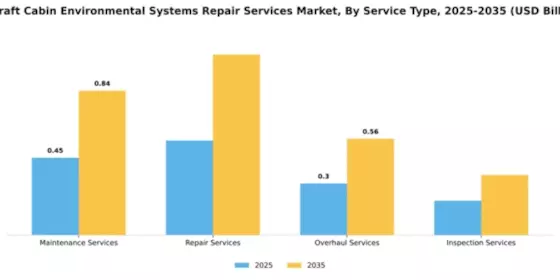
In the Aircraft Cabin Environmental Systems Repair Services Market, the distribution of market share among the service types reveals that Maintenance Services holds the largest portion, reflecting its critical role in sustaining aircraft performance and safety. This service type is essential for compliance with regulatory standards and to ensure the optimal operation of cabin environmental systems, thus commanding a substantial share of the overall market.On the other hand, Repair Services is noted as the fastest-growing segment within this market. This surge can be attributed to increasing operational demands and the need for efficient turnaround solutions. As airlines seek to enhance service reliability and minimize downtime, the focus on repair capabilities is intensifying, driving significant growth in this sector.
Maintenance Services (Dominant) vs. Overhaul Services (Emerging)
Maintenance Services is the dominant force in the Aircraft Cabin Environmental Systems Repair Services Market, providing essential upkeep for aircraft environmental systems. This service is characterized by routine checks, servicing tasks, and preventive measures designed to maintain system integrity and performance. Airlines prioritize maintenance to uphold safety and efficiency, hence establishing a strong competitive edge in the market. Conversely, Overhaul Services, while still emerging, focus on comprehensive renovations and upgrades of cabin environmental systems, ensuring compliance with evolving regulatory standards and technology advancements. As airlines seek to extend the lifespan of their aircraft and enhance their operational readiness, overhaul services are becoming more relevant, appealing to operators seeking long-term value through significant system improvements.
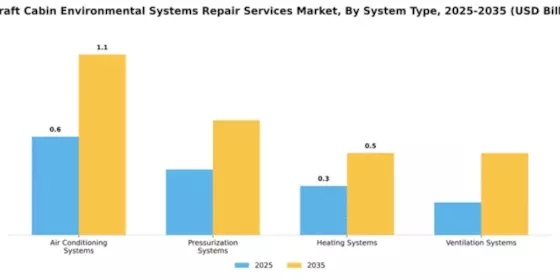
In the Aircraft Cabin Environmental Systems Repair Services Market, Air Conditioning Systems hold the largest market share due to their critical role in maintaining passenger comfort and safety during flights. Following closely, Pressurization Systems show significant market traction as they ensure the cabin remains pressurized despite the varying altitude changes, becoming increasingly important in modern aircraft design. Other segments like Heating Systems and Ventilation Systems also contribute, but their shares are notably smaller compared to the leading two.
Air Conditioning Systems (Dominant) vs. Ventilation Systems (Emerging)
Air Conditioning Systems dominate the Aircraft Cabin Environmental Systems repair services landscape, primarily due to the high demand for maintaining optimal climate conditions for passengers and crew. These systems require specialized repair services to ensure longevity and efficiency, particularly in the face of increasing air travel demands. On the other hand, Ventilation Systems are emerging as a crucial component in cabin air quality management, driven by growing passenger concerns regarding health and comfort in enclosed spaces. While still smaller in market share, innovations and regulatory standards promoting better air quality are propelling Ventilation Systems into a more prominent role within the market.
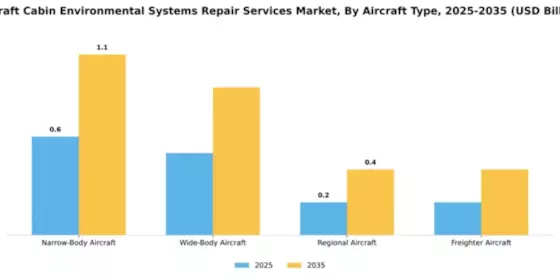
In the Aircraft Cabin Environmental Systems Repair Services Market, Narrow-Body Aircraft hold the largest share, benefiting from their widespread use in regional and short-haul flights. Their high demand creates a robust market for repair services tailored to their specific environmental systems. On the other hand, Wide-Body Aircraft, primarily employed in long-haul international flights, are rapidly gaining ground due to increasing global travel and the need for advanced cabin systems. This competition between segments highlights a diverse market landscape.
Narrow-Body Aircraft: Dominant vs. Wide-Body Aircraft: Emerging
Narrow-Body Aircraft dominate the Aircraft Cabin Environmental Systems Repair Services Market due to their extensive operational base and longevity in service. These aircraft are pivotal for regional transportation networks, thus generating ongoing demand for specialized repair services tailored to their cabin comfort and air quality systems. Conversely, Wide-Body Aircraft are an emerging segment, rapidly expanding with the globalization of air travel. Their requirement for complex cabin environmental systems and strict regulatory standards drives innovation and attracts investment into repair facilities, making them a significant focus for future market growth.
Get more detailed insights about Aircraft Cabin Environmental Systems Repair Services Market Request Free Sample
North America holds a commanding 75% share of the Aircraft Cabin Environmental Systems Repair Services market, driven by a robust aviation sector and stringent regulatory standards. The region's growth is fueled by increasing air travel demand and the need for advanced cabin systems to enhance passenger comfort and safety. Regulatory bodies are emphasizing compliance with environmental standards, further propelling market growth. The United States is the primary player, hosting major companies like Honeywell International Inc. and Boeing Company. The competitive landscape is characterized by innovation and strategic partnerships among key players. With a focus on technological advancements and customer service, North American firms are well-positioned to maintain their market leadership in the coming years.
Europe accounts for 40% of the Aircraft Cabin Environmental Systems Repair Services market, supported by a strong regulatory framework and increasing investments in aviation infrastructure. The region is witnessing a rise in air travel, prompting airlines to enhance cabin environments. Regulatory initiatives aimed at improving energy efficiency and reducing emissions are also driving demand for advanced repair services. Leading countries like Germany and France are home to key players such as Airbus S.A.S. and Lufthansa Technik AG. The competitive landscape is marked by collaborations and technological innovations. European firms are focusing on sustainability and customer satisfaction, positioning themselves to capture a larger market share as demand continues to grow.
Asia-Pacific represents 25% of the Aircraft Cabin Environmental Systems Repair Services market, driven by a booming aviation industry and increasing passenger traffic. The region's growth is supported by rising disposable incomes and a growing middle class, leading to higher demand for air travel. Regulatory bodies are also focusing on enhancing safety and environmental standards, which is expected to boost repair service requirements. Countries like China and India are at the forefront, with significant investments in aviation infrastructure. The competitive landscape includes both local and international players, with companies striving to innovate and meet the evolving needs of airlines. As the market expands, the presence of key players is expected to strengthen, enhancing service offerings in the region.
The Middle East and Africa account for only 5% of the Aircraft Cabin Environmental Systems Repair Services market, reflecting a nascent aviation sector. However, the region is witnessing growth due to increasing air travel and investments in airport infrastructure. Regulatory frameworks are gradually evolving, focusing on safety and environmental compliance, which is expected to drive demand for repair services in the future. Countries like the UAE and South Africa are leading the way, with investments in aviation and partnerships with global players. The competitive landscape is still developing, with opportunities for growth as airlines expand their fleets. Key players are beginning to establish a presence, aiming to capture market share as the region's aviation sector matures.
The Aircraft Cabin Environmental Systems Repair Services Market is characterized by a dynamic competitive landscape, driven by technological advancements and increasing demand for enhanced passenger comfort. Key players such as Honeywell International Inc. (US), United Technologies Corporation (US), and Lufthansa Technik AG (DE) are at the forefront, each adopting distinct strategies to solidify their market positions. Honeywell International Inc. (US) emphasizes innovation in environmental control systems, focusing on developing energy-efficient solutions that align with sustainability goals. Meanwhile, United Technologies Corporation (US) has been actively pursuing mergers and acquisitions to expand its service capabilities and geographic reach, thereby enhancing its competitive edge. Lufthansa Technik AG (DE) is leveraging its extensive experience in aircraft maintenance to offer tailored repair services, which further strengthens its operational focus on customer-centric solutions.The market structure appears moderately fragmented, with several players competing for market share. Key business tactics include localizing manufacturing to reduce costs and optimize supply chains, which is crucial in maintaining competitive pricing. The collective influence of these major players shapes the market dynamics, as they continuously adapt to evolving customer needs and regulatory requirements.
In November Honeywell International Inc. (US) announced the launch of a new suite of advanced cabin air quality systems designed to enhance passenger comfort and safety. This strategic move underscores the company's commitment to innovation and positions it favorably in a market increasingly focused on health and wellness. The introduction of these systems is likely to attract airlines seeking to improve their service offerings, thereby potentially increasing Honeywell's market share.
In October United Technologies Corporation (US) completed the acquisition of a leading cabin environmental systems provider, significantly expanding its service portfolio. This acquisition is strategically important as it not only enhances United Technologies' technological capabilities but also allows for greater integration of services, which could lead to improved operational efficiencies and customer satisfaction. The move reflects a broader trend of consolidation within the industry, aimed at creating more comprehensive service offerings.
In September Lufthansa Technik AG (DE) entered into a strategic partnership with a prominent technology firm to develop AI-driven predictive maintenance solutions for cabin environmental systems. This collaboration is indicative of the growing trend towards digital transformation in the industry, as it aims to reduce downtime and enhance service reliability. By integrating AI into its operations, Lufthansa Technik is likely to improve its competitive positioning by offering more proactive and efficient repair services.
As of December the competitive trends in the Aircraft Cabin Environmental Systems Repair Services Market are increasingly defined by digitalization, sustainability, and the integration of AI technologies. Strategic alliances are becoming more prevalent, as companies recognize the value of collaboration in driving innovation and enhancing service offerings. The shift from price-based competition to a focus on technological advancement and supply chain reliability is evident, suggesting that future competitive differentiation will hinge on the ability to innovate and adapt to changing market demands.




The Aircraft Cabin Environmental Systems Repair Services Market is projected to grow at a 5.84% CAGR from 2025 to 2035, driven by technological advancements and increasing air travel demand.
New opportunities lie in:
By 2035, the market is expected to be robust, reflecting sustained growth and innovation.
| MARKET SIZE 2024 | 1.5(USD Billion) |
| MARKET SIZE 2025 | 1.59(USD Billion) |
| MARKET SIZE 2035 | 2.8(USD Billion) |
| COMPOUND ANNUAL GROWTH RATE (CAGR) | 5.84% (2025 - 2035) |
| REPORT COVERAGE | Revenue Forecast, Competitive Landscape, Growth Factors, and Trends |
| BASE YEAR | 2024 |
| Market Forecast Period | 2025 - 2035 |
| Historical Data | 2019 - 2024 |
| Market Forecast Units | USD Billion |
| Key Companies Profiled | Honeywell International Inc. (US), United Technologies Corporation (US), Airbus S.A.S. (FR), Boeing Company (US), Safran S.A. (FR), Rockwell Collins (US), Thales Group (FR), Lufthansa Technik AG (DE), MTU Aero Engines AG (DE) |
| Segments Covered | Application, Service Type, System Type, Aircraft Type |
| Key Market Opportunities | Integration of advanced monitoring systems enhances efficiency in the Aircraft Cabin Environmental Systems Repair Services Market. |
| Key Market Dynamics | Technological advancements and regulatory changes drive demand for efficient aircraft cabin environmental systems repair services. |
| Countries Covered | North America, Europe, APAC, South America, MEA |
The projected market valuation for 2035 is 2.8 USD Billion.
The overall market valuation was 1.5 USD Billion in 2024.
The expected CAGR during the forecast period 2025 - 2035 is 5.84%.
Key players include Honeywell International Inc., United Technologies Corporation, Airbus S.A.S., Boeing Company, and Safran S.A.
The main segments by application include Commercial Aviation, Military Aviation, Business Aviation, and Cargo Aviation.
The Repair Services segment is projected to grow from 0.55 USD Billion in 2024 to 1.05 USD Billion by 2035.
The valuation range for Air Conditioning Systems is projected to be between 0.6 and 1.1 USD Billion.
Narrow-Body Aircraft is expected to grow from 0.6 USD Billion in 2024 to 1.1 USD Billion by 2035.
Repair Services is anticipated to have the highest valuation, projected at 1.05 USD Billion by 2035.
The projected valuation for Inspection Services is expected to reach between 0.2 and 0.35 USD Billion by 2035.



Kindly complete the form below to receive a free sample of this Report

“This is really good guys. Excellent work on a tight deadline. I will continue to use you going forward and recommend you to others. Nice job”


“Thanks. It’s been a pleasure working with you, please use me as reference with any other Intel employees.”


“Thanks for sending the report it gives us a good global view of the Betaïne market.”


“Thank you, this will be very helpful for OQS.”


“We found the report very insightful! we found your research firm very helpful. I'm sending this email to secure our future business.”


“I am very pleased with how market segments have been defined in a relevant way for my purposes (such as "Portable Freezers & refrigerators" and "last-mile"). In general the report is well structured. Thanks very much for your efforts.”


“I have been reading the first document or the study, ,the Global HVAC and FP market report 2021 till 2026. Must say, good info! I have not gone in depth at all parts, but got a good indication of the data inside!”


“We got the report in time, we really thank you for your support in this process. I also thank to all of your team as they did a great job.”


“The Automotive 48V ECU Components Procurement Intelligence Study” was a complex project, but the Market Research Future (MRFR) team handled it with quality, agility, and customer-centricity. They delivered all requested data on time and within the agreed scope. The team, including Shubhendra Anand and Rahul Gotadki, was always readily available to clarify questions and swiftly implement necessary adjustments, driving the project to a successful conclusion within a very demanding timeframe.
I would also like to specifically commend Akshay Agarwal for his responsiveness and support at every stage—from our initial inquiry on May 6th through to final delivery on June 18th. His dedication made the entire process seamless.”



