×
Request Free Sample ×

Kindly complete the form below to receive a free sample of this Report

* Please use a valid business email

Leading companies partner with us for data-driven Insights

clients tt-cursor
Hero Background

Aircraft Crash Tender Market

ID: MRFR/AD/32143-HCR
128 Pages
Sejal Akre
October 2025

Aircraft Crash Tender Market Research Report By Application (Airport Fire Fighter, Aircraft Rescue Operations, Crash Response), By Vehicle Type (Rapid Intervention Vehicle, Fire Fighting Vehicle, Combination Vehicle), By Power Source (Internal Combustion Engine, Electric, Hybrid), By End User (Airport Authorities, Military, Private Aviation) and By Regional (North America, Europe, South America, Asia Pacific, Middle East and Africa) - Forecast to 2035.

Share:
Download PDF ×

We do not share your information with anyone. However, we may send you emails based on your report interest from time to time. You may contact us at any time to opt-out.

Aircraft Crash Tender Market Infographic
Purchase Options

Aircraft Crash Tender Market Summary

As per MRFR analysis, the Aircraft Crash Tender Market Size was estimated at 1.178 USD Billion in 2024. The Aircraft Crash Tender industry is projected to grow from 1.22 in 2025 to 1.735 by 2035, exhibiting a compound annual growth rate (CAGR) of 3.58 during the forecast period 2025 - 2035.

Key Market Trends & Highlights

The Aircraft Crash Tender Market is poised for growth driven by technological advancements and increasing safety standards.

  • Technological advancements are enhancing the capabilities of aircraft crash tenders, leading to improved response times and efficiency.
  • Sustainability initiatives are becoming increasingly important, with manufacturers focusing on eco-friendly materials and fuel-efficient designs.
  • Collaborative partnerships among manufacturers and airports are fostering innovation and enhancing service delivery in the market.
  • The growing air traffic and regulatory compliance are major drivers, pushing investments in airport infrastructure and safety standards.

Market Size & Forecast

2024 Market Size 1.178 (USD Billion)
2035 Market Size 1.735 (USD Billion)
CAGR (2025 - 2035) 3.58%

Major Players

Rosenbauer (AT), Oshkosh Corporation (US), Ziegler (DE), Gimaex (FR), Firesafe (GB), Mack Defense (US), Daimler AG (DE), E-ONE (US), Magirus (DE)

Aircraft Crash Tender Market Trends

The Aircraft Crash Tender Market is currently experiencing a notable evolution, driven by advancements in technology and increasing safety regulations. Manufacturers are focusing on enhancing the capabilities of crash tenders, integrating innovative firefighting systems and improved maneuverability. This shift appears to be influenced by the growing demand for efficient emergency response solutions at airports worldwide. Furthermore, the emphasis on sustainability is prompting companies to explore eco-friendly materials and fuel-efficient designs, which may reshape product offerings in the near future. In addition, The Aircraft Crash Tender Market is characterized by heightened competition among key players. This competitive environment encourages continuous improvement and innovation, as companies strive to differentiate their products. Collaborations and partnerships between manufacturers and airport authorities are becoming more common, suggesting a trend towards tailored solutions that meet specific operational needs. As the market evolves, it is likely that regulatory frameworks will also adapt, potentially impacting the design and functionality of crash tenders in the years to come.

Technological Advancements

The Aircraft Crash Tender Market is witnessing a surge in technological innovations, particularly in firefighting systems and vehicle design. Enhanced automation and smart technologies are being integrated into crash tenders, improving response times and operational efficiency. This trend indicates a shift towards more sophisticated equipment that can better handle emergencies.

Sustainability Initiatives

There is a growing focus on sustainability within the Aircraft Crash Tender Market, as manufacturers seek to develop eco-friendly solutions. This includes the use of alternative materials and energy-efficient designs, which may reduce the environmental impact of crash tenders. Such initiatives reflect a broader commitment to environmental responsibility in the aviation sector.

Collaborative Partnerships

The trend of forming strategic partnerships between manufacturers and airport authorities is becoming increasingly prevalent. These collaborations aim to create customized solutions that address specific operational challenges faced by airports. This approach not only enhances product relevance but also fosters innovation in the Aircraft Crash Tender Market.

Aircraft Crash Tender Market Drivers

Regulatory Compliance

Regulatory compliance is a significant driver influencing the Aircraft Crash Tender Market. Governments and aviation authorities worldwide impose stringent safety regulations that mandate the presence of specialized crash tenders at airports. These regulations are designed to ensure that airports are equipped to handle emergencies effectively. For instance, the International Civil Aviation Organization (ICAO) sets forth guidelines that require airports to maintain a certain level of firefighting capability. As a result, airports are compelled to invest in modern crash tenders that meet these regulatory standards. The need for compliance not only drives the demand for new vehicles but also encourages upgrades to existing fleets. This regulatory landscape creates a robust market environment for the Aircraft Crash Tender Market, as stakeholders seek to align with evolving safety requirements.

Increasing Air Traffic

The rise in air traffic is a pivotal driver for the Aircraft Crash Tender Market. As more airlines expand their fleets and routes, the demand for enhanced safety measures becomes paramount. According to recent data, air traffic is projected to grow at a compound annual growth rate of approximately 4.5% over the next decade. This growth necessitates the deployment of advanced crash tenders at airports to ensure rapid response capabilities in emergencies. Consequently, airports are investing in modernized crash tenders equipped with cutting-edge technology to meet regulatory standards and enhance passenger safety. The increasing frequency of flights and the corresponding need for effective emergency response systems underscore the importance of the Aircraft Crash Tender Market in maintaining operational safety and efficiency.

Technological Innovations

Technological innovations play a crucial role in shaping the Aircraft Crash Tender Market. The integration of advanced technologies such as automated firefighting systems, enhanced communication tools, and improved vehicle design significantly enhances the effectiveness of crash tenders. Recent advancements have led to the development of tenders that can operate autonomously, allowing for quicker response times during emergencies. Furthermore, the incorporation of real-time data analytics enables better decision-making during crisis situations. As airports strive to enhance their emergency response capabilities, the demand for technologically advanced crash tenders is expected to rise. This trend indicates a shift towards more efficient and effective firefighting solutions, thereby propelling the Aircraft Crash Tender Market forward.

Growing Focus on Safety Standards

The growing focus on safety standards is a driving force in the Aircraft Crash Tender Market. With increasing awareness of safety protocols and the potential risks associated with air travel, stakeholders are prioritizing the implementation of robust safety measures. This heightened focus has led to the establishment of more rigorous safety standards for aircraft operations and emergency response. Airports are now more inclined to invest in high-performance crash tenders that can meet these evolving safety requirements. The emphasis on safety not only enhances passenger confidence but also ensures compliance with international safety regulations. As a result, the Aircraft Crash Tender Market is likely to experience sustained growth as airports seek to bolster their safety infrastructure.

Investment in Airport Infrastructure

Investment in airport infrastructure is a key driver for the Aircraft Crash Tender Market. As governments and private entities allocate funds for airport expansions and upgrades, the need for modern crash tenders becomes increasingly apparent. Enhanced airport facilities require advanced firefighting capabilities to ensure passenger safety and operational efficiency. Recent reports indicate that airport infrastructure investments are expected to reach unprecedented levels, with billions allocated for modernization projects. This influx of capital not only facilitates the acquisition of new crash tenders but also encourages the refurbishment of existing fleets. Consequently, the Aircraft Crash Tender Market stands to benefit significantly from these infrastructure investments, as airports prioritize safety and emergency preparedness in their development plans.

Market Segment Insights

By Application: Airport Fire Fighter (Largest) vs. Aircraft Rescue Operations (Fastest-Growing)

In the Aircraft Crash Tender Market, the application segment showcases distinct distributions among key values. The Airport Fire Fighter category dominates the market, reflecting crucial investments from airports in enhancing safety measures. This dominance not only underscores the necessity of advanced fire-fighting solutions but also reveals the prioritization of passenger safety and asset protection in airport operations. Meanwhile, Aircraft Rescue Operations represents a rapidly growing segment, fueled by ongoing innovations in rescue technologies and an increasing number of rescue missions undertaken annually. The growth trends within the Aircraft Crash Tender Market indicate a strategic shift towards specialized crash response capabilities. Factors driving this growth include regulatory changes that mandate higher safety standards and the rising count of global air travel leading to increased aircraft incidents. Furthermore, advancements in materials and design for crash tenders are enhancing operational efficiency, making these vehicles more adaptable to various emergency scenarios, thereby solidifying their position in rescue operations.

Airport Fire Fighter (Dominant) vs. Aircraft Rescue Operations (Emerging)

The Airport Fire Fighter segment serves as the backbone of fire safety at airports, equipped with advanced extinguishing agents and specialized equipment designed to tackle aircraft fires effectively. This segment's dominance stems from the stringent safety protocols imposed on airports, ensuring rapid response times and proficient fire management during emergencies. Conversely, the Aircraft Rescue Operations segment is emerging robustly, primarily driven by advancements in rescue tools and tactics designed for quicker and more efficient recovery of personnel and assets post-accident. This segment is characterized by its focus on versatility and technological integration, positioning it to cater to the ever-evolving needs of aviation safety. As air traffic continues to rise, the synergy between these two segments is likely to enhance overall aviation safety and operational readiness.

By Vehicle Type: Rapid Intervention Vehicle (Largest) vs. Combination Vehicle (Fastest-Growing)

The Aircraft Crash Tender Market is notably influenced by its primary vehicle types, with Rapid Intervention Vehicles commanding a significant share due to their essential function in urgent response scenarios. These vehicles are designed for quick deployment and effective firefighting, making them the preferred choice among airport authorities. Combination Vehicles, while currently smaller in market share, are rapidly gaining traction due to their multipurpose capabilities, appealing to a broad range of operational needs across various airports.

Vehicle Type: Rapid Intervention Vehicle (Dominant) vs. Combination Vehicle (Emerging)

Rapid Intervention Vehicles are characterized by their speed and efficiency, crafted to respond within critical moments of an aircraft incident. They often incorporate advanced firefighting technologies and equipment, ensuring effective fire suppression and rescue operations at the scene. Meanwhile, Combination Vehicles are designed to merge multiple functions, catering to firefighting and rescue needs along with other emergency services. Their versatility is becoming increasingly important as airports seek to optimize resources while enhancing safety protocols. This trend has positioned Combination Vehicles as an emerging segment in the Aircraft Crash Tender Market, promising substantial growth and innovation.

By Power Source: Internal Combustion Engine (Largest) vs. Electric (Fastest-Growing)

In the Aircraft Crash Tender Market, the power source segment is predominantly driven by Internal Combustion Engines, which hold the largest market share. This traditional power source has been favored by industry players due to its superior performance in terms of rapid response times and reliability under demanding conditions. On the other hand, Electric power sources are gaining traction, making significant inroads as technologies advance and organizations seek environmentally sustainable solutions. While Internal Combustion Engines continue to dominate, the dichotomy of power sources is a defining characteristic of the market landscape.

Internal Combustion Engine (Dominant) vs. Electric (Emerging)

The Internal Combustion Engine remains the dominant power source in the Aircraft Crash Tender Market due to its established infrastructure, proven reliability, and robust performance in emergency situations where timing is critical. Its versatility allows it to operate effectively in various terrains and conditions. Conversely, Electric power sources, though currently emerging, are being recognized for their potential in enhancing operational efficiency and reducing emissions. The shift towards Electric power is fueled by advancements in battery technology and growing regulatory support for sustainable aviation practices, positioning it as a future-driven choice that operators are increasingly considering.

By End User: Airport Authorities (Largest) vs. Military (Fastest-Growing)

The Aircraft Crash Tender Market is primarily segmented by end users, including Airport Authorities, Military, and Private Aviation. Among these, Airport Authorities account for the largest share, given their substantial investments in safety and emergency response capabilities at airports worldwide. Military applications also hold a significant portion of the market, while Private Aviation is a smaller segment, yet still essential to the overall landscape.

Airport Authorities (Dominant) vs. Military (Emerging)

Airport Authorities play a dominant role in the Aircraft Crash Tender Market due to their critical need for robust emergency response capabilities to handle potential aircraft accidents. They prioritize investing in advanced crash tenders to ensure passenger safety on the ground. Conversely, the Military segment is emerging rapidly, with increasing government budgets allocated to enhancing air defense and emergency response mechanisms. As military applications evolve, they demand sophisticated crash tenders equipped with cutting-edge technology to meet operational requirements and improve safety.

Get more detailed insights about Aircraft Crash Tender Market

Regional Insights

North America : Market Leader in Innovation

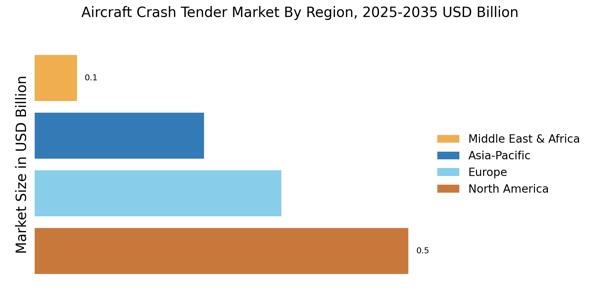
North America is the largest market for aircraft crash tenders, holding approximately 45% of the global market share. The region's growth is driven by stringent safety regulations, increasing air traffic, and advancements in firefighting technology. The U.S. and Canada are the primary contributors, with a rising demand for modernized firefighting equipment in airports. Regulatory bodies are pushing for enhanced safety measures, further fueling market expansion. The competitive landscape in North America is robust, featuring key players like Oshkosh Corporation and Rosenbauer. These companies are at the forefront of innovation, developing advanced crash tenders equipped with cutting-edge technology. The presence of established manufacturers and a focus on R&D are pivotal in maintaining market leadership. The region's commitment to safety and efficiency continues to attract investments, ensuring sustained growth in the aircraft crash tender market.

Europe : Emerging Market with Regulations

Europe is witnessing significant growth in the aircraft crash tender market, accounting for approximately 30% of the global share. The region's expansion is driven by increasing airport infrastructure investments and stringent EU regulations aimed at enhancing safety standards. Countries like Germany and France are leading the market, with a focus on modernizing their firefighting capabilities to meet regulatory requirements and improve response times. The competitive landscape in Europe is characterized by established players such as Ziegler and Gimaex, who are innovating to meet the evolving demands of the market. The presence of regulatory bodies ensures that manufacturers adhere to high safety standards, fostering a culture of innovation. As airports expand and modernize, the demand for advanced crash tenders is expected to rise, positioning Europe as a key player in the global market.

Asia-Pacific : Rapid Growth and Development

The Asia-Pacific region is emerging as a significant player in the aircraft crash tender market, holding about 20% of the global share. The growth is fueled by increasing air travel, airport expansions, and a rising focus on safety regulations. Countries like China and India are leading the charge, investing heavily in airport infrastructure and modern firefighting equipment to enhance safety measures and operational efficiency. The competitive landscape in Asia-Pacific is evolving, with both local and international players vying for market share. Companies are increasingly focusing on technological advancements to meet the growing demand for efficient and effective crash tenders. The region's commitment to improving safety standards and infrastructure development is expected to drive further growth in the aircraft crash tender market, making it a focal point for future investments.

Middle East and Africa : Emerging Market with Potential

The Middle East and Africa (MEA) region is gradually emerging in the aircraft crash tender market, holding approximately 5% of the global share. The growth is primarily driven by increasing investments in airport infrastructure and a rising emphasis on safety standards. Countries like the UAE and South Africa are leading the market, focusing on enhancing their firefighting capabilities to meet international safety regulations and improve emergency response times. The competitive landscape in MEA is characterized by a mix of local and international players, with opportunities for growth as airports expand. The presence of key manufacturers is limited, but there is a growing interest in modernizing firefighting equipment. As the region continues to develop its aviation sector, the demand for advanced crash tenders is expected to rise, presenting significant opportunities for market players.

Aircraft Crash Tender Market Regional Image

Key Players and Competitive Insights

The Share Aircraft Crash Tender Market has been experiencing significant growth, driven by a surge in air travel and the consequent need for enhanced safety measures at airports. As aircraft incidents can pose substantial risks to both individuals and infrastructure, the demand for specialized emergency response vehicles, notably aircraft crash tenders, is on the rise. Key players in this competitive landscape are focused on innovative design, technology integration, and compliance with international safety standards. These factors have resulted in a highly competitive market where distinguishing features such as performance, reliability, and cost-effectiveness play crucial roles in determining market share.

As the sector evolves, both established and emerging companies are vying for position, seeking to leverage advancements in engineering and technology to meet the growing demands of airport firefighting services.In the realm of the Share Aircraft Crash Tender Market, WISB stands out with its exceptional track record and robust presence. The company is well-regarded for its state-of-the-art crash tenders that feature advanced firefighting technologies and superior maneuverability.

WISB's commitment to quality and innovation allows it to cater effectively to a diverse range of airport environments, ensuring that its products are not only compliant with regulatory standards but also exceed client expectations in performance. The strength of WISB lies in its integrated approach, combining research and development with real-world testing, which results in vehicles that are reliable under critical circumstances.

Furthermore, the company's strong relationships with key stakeholders within the aviation industry bolster its market presence, enabling it to capture a significant share of the Share demand for aircraft crash tenders.Rosenbauer International AG has carved a niche for itself within the Share Aircraft Crash Tender Market due to its comprehensive range of firefighting vehicles and equipment specifically designed for airport emergency services. The company leverages its extensive experience in producing firefighting technology to deliver crash tenders that meet the specific operational needs of firefighting teams at airfields.

Rosenbauer International AG is known for its innovative features that enhance the effectiveness and efficiency of fire response operations, such as aerial fire suppression systems and robust chassis design for off-road capabilities, which cater to diverse geographical conditions. Moreover, with a Share network of service and support, Rosenbauer International AG maintains a competitive edge by ensuring that clients have access to ongoing training and maintenance solutions, ultimately fortifying its stature in the aircraft crash tender sector. The company's dedication to advancing safety and operational readiness helps it to continually adapt to the evolving demands of the aviation industry.

Key Companies in the Aircraft Crash Tender Market market include

Industry Developments

Recent developments in the Share Aircraft Crash Tender Market indicate a growth trajectory influenced by increased investment in aviation safety and modernization of airport infrastructure. Companies like Rosenbauer International AG and Oshkosh Corporation are at the forefront, enhancing their product offerings to meet the growing demand for advanced crash tenders equipped with firefighting technology. The recent collaboration between Gimaex and Fire Eagle has resulted in the introduction of improved fire suppression systems, which are gaining attention in international markets. Current affairs also spotlight ongoing advancements in the automation and efficiency of these vehicles, catering to evolving international aviation safety standards.

In terms of mergers and acquisitions, there has been heightened interest; however, no significant recent transactions involving the specified companies have been disclosed. Notably, the market valuation of firms such as Daimler AG and Zodiac Aerospace continues to escalate, driven by sustained demand for high-performance crash tenders. This growth is reflective of a broader trend where increased regulatory pressures are prompting airport authorities to invest in enhanced emergency response capabilities, ultimately shaping a more competitive landscape within the sector.

Future Outlook

Aircraft Crash Tender Market Future Outlook

The Aircraft Crash Tender Market is projected to grow at a 3.58% CAGR from 2024 to 2035, driven by technological advancements, increasing safety regulations, and rising air traffic.

New opportunities lie in:

  • Development of advanced foam dispensing technologies for enhanced fire suppression.
  • Integration of IoT for real-time monitoring and predictive maintenance solutions.
  • Expansion into emerging markets with tailored crash tender solutions for regional airports.

By 2035, the market is expected to solidify its growth trajectory, reflecting robust demand and innovation.

Market Segmentation

Aircraft Crash Tender Market End User Outlook

  • Airport Authorities
  • Military
  • Private Aviation

Aircraft Crash Tender Market Application Outlook

  • Airport Fire Fighter
  • Aircraft Rescue Operations
  • Crash Response

Aircraft Crash Tender Market Power Source Outlook

  • Internal Combustion Engine
  • Electric
  • Hybrid

Aircraft Crash Tender Market Vehicle Type Outlook

  • Rapid Intervention Vehicle
  • Fire Fighting Vehicle
  • Combination Vehicle

Report Scope

MARKET SIZE 20241.178(USD Billion)
MARKET SIZE 20251.22(USD Billion)
MARKET SIZE 20351.735(USD Billion)
COMPOUND ANNUAL GROWTH RATE (CAGR)3.58% (2024 - 2035)
REPORT COVERAGERevenue Forecast, Competitive Landscape, Growth Factors, and Trends
BASE YEAR2024
Market Forecast Period2025 - 2035
Historical Data2019 - 2024
Market Forecast UnitsUSD Billion
Key Companies ProfiledMarket analysis in progress
Segments CoveredMarket segmentation analysis in progress
Key Market OpportunitiesIntegration of advanced firefighting technologies enhances safety in the Aircraft Crash Tender Market.
Key Market DynamicsTechnological advancements and regulatory changes drive innovation and competition in the Aircraft Crash Tender Market.
Countries CoveredNorth America, Europe, APAC, South America, MEA

Leave a Comment

FAQs

What is the projected market valuation of the Aircraft Crash Tender Market by 2035?

The projected market valuation for the Aircraft Crash Tender Market is 1.735 USD Billion by 2035.

What was the overall market valuation of the Aircraft Crash Tender Market in 2024?

The overall market valuation of the Aircraft Crash Tender Market was 1.178 USD Billion in 2024.

What is the expected CAGR for the Aircraft Crash Tender Market during the forecast period 2025 - 2035?

The expected CAGR for the Aircraft Crash Tender Market during the forecast period 2025 - 2035 is 3.58%.

Which application segment had the highest valuation in 2024?

In 2024, the Airport Fire Fighter application segment had the highest valuation at 0.688 USD Billion.

What are the key vehicle types in the Aircraft Crash Tender Market?

The key vehicle types include Rapid Intervention Vehicle, Fire Fighting Vehicle, and Combination Vehicle.

Which power source segment is projected to grow the most by 2035?

The Internal Combustion Engine segment is projected to grow the most, with a valuation of 0.999 USD Billion by 2035.

Who are the leading players in the Aircraft Crash Tender Market?

Leading players in the market include Rosenbauer, Oshkosh Corporation, Ziegler, and Gimaex.

What is the valuation range for the Military end-user segment in 2024?

The valuation range for the Military end-user segment was between 0.35 and 0.5 USD Billion in 2024.

How does the projected valuation of the Electric power source segment compare to the Internal Combustion Engine segment by 2035?

By 2035, the Electric power source segment is projected to reach 0.487 USD Billion, significantly lower than the Internal Combustion Engine segment at 0.999 USD Billion.

What is the valuation of the Crash Response application segment in 2024?

The valuation of the Crash Response application segment was 0.352 USD Billion in 2024.

Download Free Sample

Kindly complete the form below to receive a free sample of this Report

Compare Licence

×
Features License Type
Single User Multiuser License Enterprise User
Price $4,950 $5,950 $7,250
Maximum User Access Limit 1 User Upto 10 Users Unrestricted Access Throughout the Organization
Free Customization
Direct Access to Analyst
Deliverable Format
Platform Access
Discount on Next Purchase 10% 15% 15%
Printable Versions