Request Free Sample ×

Kindly complete the form below to receive a free sample of this Report

* Please use a valid business email

Leading companies partner with us for data-driven Insights

clients tt-cursor
Hero Background

Aircraft Electrical Systems Market

ID: MRFR/AD/9083-HCR
174 Pages
Abbas Raut, Swapnil Palwe
Last Updated: May 28, 2026
Aircraft Electrical Systems Market Size, Share, Industry Trend & Analysis Research Report Information By System (Power Generation, Power Distribution, Power Conversion, Energy Storage, Power Management & Control), By Component (Generators & Starter-Generators, Converters (AC/DC DC/DC), Battery Packs & BMS, Wiring Harnesses & Connectors, Solid-State Power Controllers), By Platform (Commercial Aviation, Military Aviation, General Aviation, Business Aviation), By Application (Power Generation Management, Cabin Systems Electrification, Flight Control Electrification, Environmental Control Systems, Landing Gear & Braking) -Forecast 2035
Download PDF ×

We do not share your information with anyone. However, we may send you emails based on your report interest from time to time. You may contact us at any time to opt-out.


Aircraft Electrical Systems Market Summary

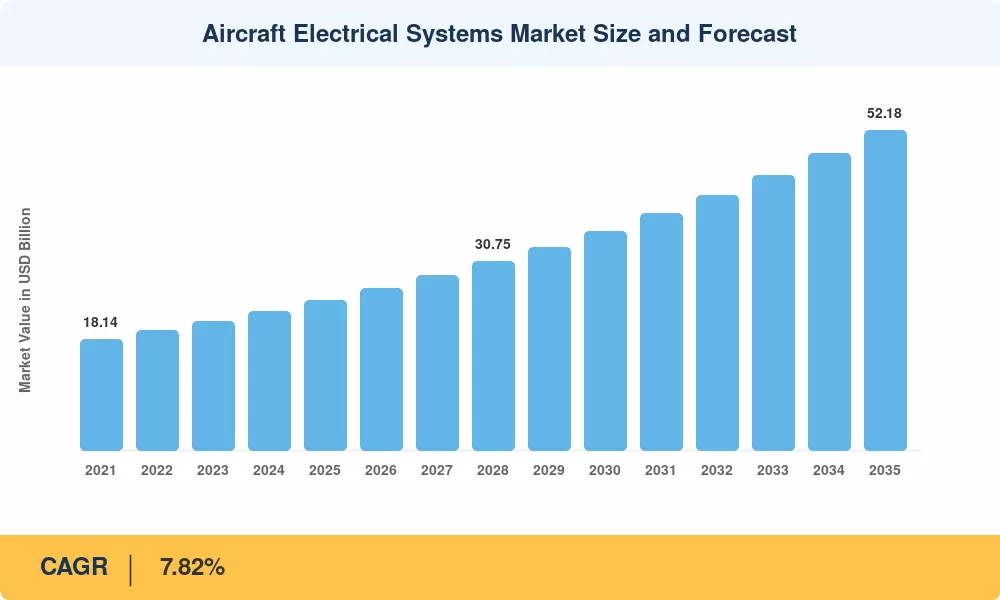
The Aircraft Electrical Systems Market stood at USD 24.52 billion in 2025 and is projected to reach USD 27.68 billion by 2026 before climbing to USD 52.18 billion by 2035, registering a CAGR of 7.82% during the 2026–2035 forecast window. Two catalysts anchor this trajectory: commercial OEM backlogs exceeding 14,000 aircraft at Airbus and Boeing, and the accelerating shift toward more electric aircraft MEA architectures that swap legacy pneumatic and hydraulic subsystems for lighter, electrically driven alternatives[2]. Government-backed clean-aviation mandates — including the EU's Clean Aviation Joint Undertaking and NASA's Electrified Powertrain Flight Demonstration — are channeling billions into aircraft power distribution systems and high-voltage conversion hardware.

A fundamental technology transformation is reshaping how aircraft generate, route, and consume electrical power. Legacy 115 V AC bus architectures are giving way to 270 V-plus DC distribution networks, cutting copper harness weight by roughly 35–40% and enabling silicon-carbide (SiC) semiconductor-based converters rated above 200 °C junction temperatures [3]. Aircraft electrical load management complexity has increased in parallel: next-generation widebodies now support cabin power budgets exceeding 1 MW, driving demand for intelligent load-shedding controllers and solid-state power-distribution units. Hybrid-electric propulsion demonstrators — such as Airbus's E-Fan X successor programs — validate high-power starter-generators and advanced avionics wiring harness architectures capable of handling megawatt-class loads safely.

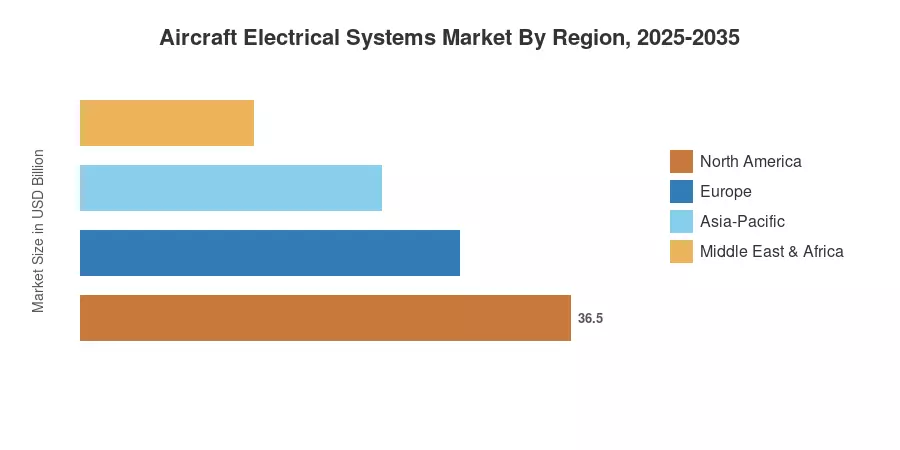
North America commands a 44.76% revenue share in the Aircraft Electrical Systems Market, anchored by U.S. defense electrification programs and Boeing's commercial production ramp Asia-Pacific is the fastest-growing region at an 8.53% CAGR, propelled by COMAC's C919 production scale-up and India's expanding MRO infrastructure. Europe holds the second-largest share at approximately 27%, driven by Airbus linefit demand and Safran's converter and generator programs. These regional dynamics position the Aircraft Electrical Systems Market for sustained double-digit growth pockets through the mid-2030s.


Key Report Takeaways

• By System

  • Power distribution led with a 36.48% revenue share in 2025, reflecting growing adoption of solid-state aircraft power distribution systems across narrowbody platforms
  • Energy storage is forecasted to post a 10.15% CAGR through 2035, driven by lithium-ion and next-generation battery demand for more electric aircraft MEA designs

• By Component

  • Generators and starter-generators held a USD 5.46 billion share in 2025 as aircraft AC DC power systems transitioned to high-power integrated drive generators
  • Battery packs and battery management systems are projected to expand at an 8.87% CAGR through 2035, fueled by eVTOL prototyping and cabin backup-power requirements

• By Platform

  • Commercial aviation accounted for 67.71% of the Aircraft Electrical Systems Market in 2025
  • General aviation is expected to grow at a 9.78% CAGR through 2035, supported by Part 23 aircraft electrification and personal air-mobility vehicle certification

• By Region

  • North America commanded a 44.76% share in 2025
  • Asia-Pacific is projected to register the fastest CAGR of 8.53% from 2026 to 2035


Market Size and Forecast (2021–2035)

MRFR's market-sizing methodology combines bottom-up revenue modeling from OEM and tier-1 supplier filings with top-down cross-validation against IATA fleet delivery forecasts, MRO spend databases, and trade-association production data. Historical figures (2021–2024) are derived from audited financial disclosures; the base-year 2025 estimate blends preliminary shipment data with channel-check interviews. Forecast values (2026–2035) apply segment-level CAGR assumptions stress-tested against fleet growth scenarios.
Market Size Chart
Our Impact
Enabled $4.3B Revenue Impact for Fortune 500 and Leading Multinationals
Partnering with 2000+ Global Organizations Each Year
30K+ Citations by Top-Tier Firms in the Industry
 

Driver Impact Analysis

Driver ~% Impact on CAGR Geographic Relevance Impact Timeline
More Electric Aircraft MEA Adoption ~22% Global Medium-term (2–4 yr)
Commercial Backlog Fulfillment ~18% North America, Europe Short-term (≤2 yr)
SiC Semiconductor Integration ~15% North America, Asia-Pacific Medium-term (2–4 yr)
eVTOL / Urban Air Mobility Certification ~14% Global Long-term (≥4 yr)
Widebody Cabin Power Upgrades ~12% Europe, Middle East Short-term (≤2 yr)
Defense Electrification Programs ~10% North America Medium-term (2–4 yr)
Hybrid-Electric Propulsion R&D ~9% Europe, Asia-Pacific Long-term (≥4 yr)


More Electric Aircraft MEA Architecture Transition

The shift toward more electric aircraft MEA configurations represents the single largest demand catalyst in the Aircraft Electrical Systems Market. Airbus's A320neo family already derives over 40% of secondary power from electrical systems — up from roughly 25% on legacy A320ceo variants — and the forthcoming A321XLR pushes that ratio higher with electrically driven environmental control systems and wing-ice protection [2]. Boeing's 787 Dreamliner set the benchmark with a no-bleed architecture consuming approximately 1 MW of electrical power, and next-generation widebody programs are targeting 1.5 MW-plus electrical loads. The result is a cascading demand increase for generators, converters, avionics wiring harness assemblies, and aircraft electrical load management controllers across both linefit and retrofit channels.

Commercial Fleet Backlog and Production Acceleration

Airbus and Boeing collectively held backlogs exceeding 14,200 aircraft at the close of 2024, translating into roughly eight years of production at current delivery rates [5]. Each narrowbody delivery contains USD 1.2–1.8 million in electrical-system content, while widebodies carry USD 3.5–5.0 million per aircraft. The production-rate trajectory — Airbus targeting 75 A320-family units per month by 2027 and Boeing pursuing 38 737 MAX units per month — directly amplifies tier-1 revenue for aircraft power distribution systems, generators, and power-conversion equipment.

Silicon-Carbide Power Electronics Adoption

SiC-based converters and inverters reduce weight by 30–50% compared with silicon-IGBT equivalents while operating at junction temperatures above 200 °C, enabling tighter thermal packaging in nacelle and fuselage bays [7]. Collins Aerospace and Safran Electrical & Power have both announced SiC-based transformer-rectifier units entering qualification testing for next-generation aircraft AC DC power systems. The U.S. Department of Energy's ARPA-E program has allocated over USD 45 million to wide-bandgap semiconductor research relevant to aerospace power conversion, accelerating the commercialization timeline.

eVTOL and Urban Air Mobility Certification

Over 700 eVTOL concepts are in varying stages of development globally, with Joby Aviation, Archer Aviation, and Lilium targeting FAA and EASA type certification between 2025 and 2028 [8]. Each eVTOL platform requires bespoke high-voltage distribution architecture, battery management systems, and aircraft electrical load management software — opening a new addressable segment within the Aircraft Electrical Systems Market that did not exist a decade ago.


Restraints Impact Analysis

The restraint impacts below are directional drag estimates on growth momentum and are not linearly subtracted from the headline CAGR. MRFR derives these weightings from supply-chain bottleneck modeling and regulatory-delay scenario analysis.

Restraint ~% Drag on CAGR Geographic Relevance Impact Timeline
Aerospace-Grade Supply-Chain Constraints ~–8% Global Short-term (≤2 yr)
Certification Lead Times for New Architectures ~–6% North America, Europe Medium-term (2–4 yr)
Copper and Rare-Earth Material Price Volatility ~–5% Global Short-term (≤2 yr)
Cybersecurity Compliance Costs ~–4% North America, Europe Medium-term (2–4 yr)
Skilled Workforce Shortages in Avionics Manufacturing ~–3% North America, Europe Long-term (≥4 yr)


Aerospace-Grade Supply-Chain Bottlenecks

The aircraft electrical systems supply chain remains capacity-constrained at the forging, casting, and specialty-connector tiers. Lead times for aerospace-grade electrical connectors stretched to 52–78 weeks through 2024, forcing OEMs to dual-source and hold safety stock [15]. Amphenol and TE Connectivity have announced capacity expansions, but new cleanroom connector lines require 18–24 months to qualify under AS9100 and DO-160 standards. These bottlenecks directly slow the ramp of aircraft power distribution systems and avionics wiring harness production, tempering near-term revenue growth in the Aircraft Electrical Systems Market.

Certification Timelines for Novel Power Architectures

Transitioning from 115 V AC to 270 V DC or ±270 V DC distribution introduces arc-fault risks that existing DO-160G test protocols were not designed to address. The FAA's ongoing rulemaking for high-voltage DC aircraft systems (14 CFR Part 25 Amendment 64+) has extended certification timelines by 12–18 months for programs incorporating new aircraft AC DC power systems [16]. EASA's CS-25 special conditions for lithium-ion energy storage add further delays for energy-storage-heavy designs.

Raw-Material Price Exposure

Copper constitutes 35–45% of the bill of materials for conventional avionics wiring harness assemblies, and LME copper prices surged 28% between mid-2023 and early 2025 [17]. Rare-earth elements used in permanent-magnet generators — particularly neodymium and dysprosium — face supply concentration risk, with China controlling over 60% of refined output.


Opportunities

Retrofit Programs for Widebody Cabin Power Budgets

The retrofit market for updated aircraft power distribution systems and solid-state load controllers is USD 2.8 billion up to 2032 Airlines with aged 777 and A330 fleets are facing rising passenger demand for in-seat power and high-bandwidth connectivity.


eVTOL and Advanced Air Mobility Supply Chain

The eVTOL industry is driving a whole new income stream in the Aircraft Electrical Systems Market with its dependence on high voltage battery packs, small converters and redundant distribution buses. Tier-1 suppliers achieving design-lock positions on systems targeted for 2026-2028 certification will be well-positioned to generate recurring aftermarket revenue for the next two decades


Predictive Analytics and Digital-Twin Monetization

Flight-data recorders and real-time bus-monitoring systems capture aircraft electrical load management data that can be fed into digital-twin platforms that can predict wiring degradation, connection corrosion, and generator-brush wear. Airlines that are ready to exchange anonymised fleet data can unlock condition-based maintenance contracts that would command an estimated 15-20% premium vs standard time-based MRO agreements [see Section 8].


Emerging-Market MRO Expansion in Southeast Asia and the Middle East

Southeast Asian airlines are anticipated to add more than 1,400 aircraft by 2035, while regional MRO centers in Singapore, Malaysia and the UAE lack sufficient avionics wiring harness repair capacity [10]. Investing in localized electrical-systems MRO workshops offers a high-return opportunity for global tier-1 suppliers to acquire aftermarket share outside of their typical North American and European bases.


Hydrogen-Electric Hybrid Power Systems

Hydrogen fuel-cell-to-electric drivetrain architectures — under development at ZeroAvia and Universal Hydrogen — require entirely new power-conditioning and distribution hardware, expanding the addressable scope of the Aircraft Electrical Systems Market into propulsive electrical systems for regional turboprops


Future Outlook

Electrification Supercycle and Megawatt-Class Aircraft Power

By 2030, next-generation single-aisle aircraft programs are expected to require 1.5–2.0 MW of onboard electrical power — roughly triple the A320ceo baseline. This electrification supercycle will transform aircraft power distribution systems from passive bus architectures into actively managed, software-defined power networks. MRFR projects that power-distribution software alone could constitute 8–12% of total Aircraft Electrical Systems Market revenue by 2035, up from under 3% in 2025 [6].

AI-Driven Predictive Maintenance and Autonomous Load Management

Machine-learning algorithms trained on flight-data-recorder archives are already demonstrating 85–90% accuracy in predicting generator-brush wear and connector-pin degradation 500 flight-hours in advance [18]. Airlines adopting AI-driven aircraft electrical load management platforms report 12–18% reductions in unscheduled electrical-system removals, translating into measurable dispatch-reliability improvements.

Sustainability Reporting and ESG-Linked Procurement

ICAO's Carbon Offsetting and Reduction Scheme for International Aviation (CORSIA) and the EU's Fit for 55 aviation mandates are pushing airlines to quantify the emissions impact of electrical-system weight savings. Every kilogram of copper replaced by aluminum or SiC-optimized power electronics yields roughly 100 kg of lifetime CO₂ savings on a narrowbody platform, making more electric aircraft MEA adoption a direct ESG lever [9].

Hybrid-Electric and Hydrogen-Electric Propulsion Integration

NASA's EPFD program and the UK's ATI FlyZero study have validated hydrogen fuel-cell power architectures producing 1–2 MW of electrical output for regional aircraft. Integration of these propulsive electrical systems into existing aircraft AC DC power systems frameworks will require new certification paradigms, creating both risk and opportunity for established tier-1 suppliers in the Aircraft Electrical Systems Market through 2035 [9][11].


Market Segmentation

By System

Segment Metric Primary Demand Driver
Power Generation USD 6.72 Billion (2025) Integrated drive generator upgrades for more electric aircraft MEA
Power Distribution 36.48% share (2025) Solid-state power controllers; aircraft power distribution systems growth
Power Conversion 7.45% CAGR (2026–2035) SiC-based converters replacing legacy transformer-rectifier units
Energy Storage 10.15% CAGR (2026–2035) Li-ion battery packs for eVTOL and cabin backup
Power Management & Control USD 2.18 Billion (2025) Aircraft electrical load management software platforms


The Aircraft Electrical Systems Market by system is led by power distribution, which captured a 36.48% revenue share in 2025 as OEMs transitioned from electromechanical circuit breakers to solid-state power controllers capable of sub-millisecond fault isolation. Aircraft power distribution systems increasingly incorporate software-defined load-priority algorithms that dynamically allocate power across flight-critical, essential, and non-essential buses. Energy storage is the fastest-growing system segment, driven by lithium-ion and emerging solid-state battery qualification for both primary propulsion (eVTOL) and emergency backup applications.

By Component

Segment Metric Primary Demand Driver
Generators & Starter-Generators 24.72% share (2025) High-power IDG and variable-frequency generators
Converters (AC/DC, DC/DC) USD 4.14 Billion (2025) SiC adoption in aircraft AC DC power systems
Battery Packs & BMS 8.87% CAGR (2026–2035) eVTOL and auxiliary power unit replacement
Wiring Harnesses & Connectors USD 3.89 Billion (2025) Avionics wiring harness weight-reduction programs
Solid-State Power Controllers 9.32% CAGR (2026–2035) Replacing legacy electromechanical relays


Generators and starter-generators remain the revenue backbone of the Aircraft Electrical Systems Market, with integrated-drive generators on widebody platforms carrying unit values exceeding USD 120,000. The transition to variable-frequency generators eliminates the constant-speed drive, saving 25–30 kg per channel and improving dispatch reliability. Avionics wiring harness assemblies — the circulatory system of aircraft electrical architectures — face competing pressures: weight-reduction mandates push aluminum and fiber-optic substitution, while increasing electrical loads demand larger conductor cross-sections.

By Platform

Segment Metric Primary Demand Driver
Commercial Aviation 67.71% share (2025) Narrowbody backlog fulfillment; widebody power upgrades
Military Aviation USD 5.38 Billion (2025) F-35, NGAD, Tempest electrical-system content
General Aviation 9.78% CAGR (2026–2035) Part 23 electrification; personal air mobility
Business Aviation USD 1.47 Billion (2025) Ultra-long-range cabin power demands


Commercial aviation dominates the Aircraft Electrical Systems Market, driven by the sheer volume of narrowbody deliveries and the growing electrical content per aircraft as more electric aircraft MEA designs enter service. General aviation registers the highest growth rate as light-aircraft OEMs adopt fully electric propulsion — Pipistrel's Velis Electro became the first type-certificated electric aircraft in 2020, and multiple four-seat electric trainers are targeting certification before 2028.

By Application

Segment Metric Primary Demand Driver
Power Generation Management 30.94% share (2025) Generator control units; bus-tie management
Cabin Systems Electrification 9.18% CAGR (2026–2035) IFE, galley, and seat-power upgrades
Flight Control Electrification USD 3.62 Billion (2025) Fly-by-wire actuator power demands
Environmental Control Systems 7.56% CAGR (2026–2035) Electric bleedless ECS on more electric aircraft MEA
Landing Gear & Braking USD 1.24 Billion (2025) Electric taxi and electric braking systems


Regional Market Share Analysis

Region Share / Metric (2025) Primary Investment Themes
North America 44.76% share Defense MEA programs; Boeing production ramp; avionics wiring harness capacity expansion
Europe ~27.14% share Airbus linefit demand; Safran & Thales converter programs; Clean Aviation JU R&D
Asia-Pacific 8.53% CAGR (2026–2035) COMAC C919; India MRO growth; ASEAN fleet additions
South America USD 0.78 Billion (2025) Embraer E2 production; Brazilian defense modernization
Middle East & Africa USD 0.92 Billion (2025) Widebody retrofit demand; UAE aerospace industrial strategy
Total USD 24.52 Billion

The Aircraft Electrical Systems Market displays distinct regional dynamics shaped by OEM production footprints, defense budgets, and fleet-growth trajectories. North America and Europe collectively account for over 72% of global revenue, while Asia-Pacific's share is expanding rapidly on the back of indigenous aircraft programs and fleet acquisitions.


North America

Country Metric Key Driver
United States 78.3% of regional share F-35 and NGAD electrical-system content; Boeing 737/787 linefit
Canada 7.64% CAGR Pratt & Whitney Canada generator programs
Mexico USD 0.41 Billion Aerospace manufacturing nearshoring; avionics wiring harness assembly


North America's dominance in the Aircraft Electrical Systems Market reflects the combined weight of U.S. defense procurement — the F-35 program alone consumes over USD 600 million in electrical-system content annually — and Boeing's commercial production base in Washington, South Carolina, and Missouri [13]. Canada's Pratt & Whitney division and Safran subsidiary CEV contribute significant starter-generator and converter manufacturing, while Mexico's Querétaro and Chihuahua aerospace clusters are absorbing avionics wiring harness assembly work previously concentrated in the United States.

Europe

Country Metric Key Driver
Germany 23.5% of regional share Liebherr and Diehl power electronics
United Kingdom USD 1.58 Billion Rolls-Royce electrical propulsion R&D
France 28.1% of regional share Safran Electrical & Power; Thales avionics
Italy 6.92% CAGR Leonardo aircraft AC DC power systems
Spain USD 0.34 Billion Airbus A320 final-assembly electrical integration
Nordic Countries 5.8% of regional share Scandinavian electric-aviation initiatives
Russia USD 0.29 Billion MC-21 program electrical content
Rest of Europe USD 0.44 Billion Tier-2 connector and harness suppliers


Europe's strength in the Aircraft Electrical Systems Market centers on the Airbus final-assembly ecosystem and Safran Electrical & Power's global leadership in generators and power-distribution equipment. The EU Clean Aviation Joint Undertaking has committed EUR 1.7 billion through 2030 for hybrid-electric and more electric aircraft MEA demonstrators, directly funding SiC converter development and high-voltage aircraft power distribution systems qualification [2].

Asia-Pacific

Country Metric Key Driver
China 38.7% of regional share COMAC C919/C929 electrical-system localization
India 9.84% CAGR HAL Tejas Mk2; MRO hub expansion
Japan USD 0.82 Billion Mitsubishi Heavy Industries; Shimadzu power systems
South Korea 8.21% CAGR KAI KF-21 electrical content; Korean Air fleet growth
ASEAN USD 0.67 Billion Singapore/Malaysia MRO hubs; fleet procurement
Rest of Asia-Pacific USD 0.31 Billion Emerging carrier growth


Asia-Pacific represents the fastest-growing region in the Aircraft Electrical Systems Market, propelled by China's strategic push to localize electrical-systems content for the COMAC C919 and the upcoming C929 widebody [10]. India's defense offset policy mandates 30–50% indigenous content on military aircraft programs, creating openings for aircraft electrical load management and avionics wiring harness joint ventures.

South America

Country Metric Key Driver
Brazil 72.4% of regional share Embraer E2 family electrical systems; OGMA MRO
Argentina USD 0.07 Billion FAdeA military aircraft maintenance
Rest of South America 6.14% CAGR Regional carrier fleet expansion


Brazil anchors South America's share of the Aircraft Electrical Systems Market through Embraer's E-Jet E2 family, which features advanced aircraft power distribution systems and integrated power-management controllers supplied by Collins Aerospace and Thales [14].

Middle East & Africa

Country Metric Key Driver
Saudi Arabia 28.3% of regional share Vision 2030 aerospace industrialization
UAE USD 0.31 Billion Emirates/Etihad widebody retrofit demand
South Africa 7.18% CAGR Denel aviation; regional MRO capacity
Egypt USD 0.06 Billion Military fleet modernization
Rest of MEA USD 0.12 Billion Emerging defense procurement


The Middle East & Africa region's growth in the Aircraft Electrical Systems Market is led by Gulf carrier widebody fleets requiring cabin power upgrades and Saudi Arabia's USD 100 billion aviation infrastructure investment under Vision 2030 [12].


Regional Market Share
 

Competitive Benchmarking

The Aircraft Electrical Systems Market exhibits medium concentration, with the top five players accounting for an estimated 48–55% of global revenue. The Herfindahl–Hirschman Index (HHI) falls in the 800–1,200 range, indicating a moderately competitive landscape where tier-1 incumbents hold design-lock positions on major platforms but face increasing pressure from SiC-focused entrants and eVTOL-native suppliers.

Company Est. Revenue Share Range Key Offerings for Aircraft Electrical Systems Market Strategic Positioning
Safran Electrical & Power ~12–15% Generators, wiring systems, power distribution Vertically integrated; Airbus primary supplier
Collins Aerospace (RTX) ~10–13% Power management, aircraft electrical load management, generators Broad portfolio across commercial & defense
GE Aerospace ~8–11% Integrated power systems, converters Engine-to-electrical integration advantage
Thales Group ~6–9% Avionics power supplies, cockpit electrical systems European defense & commercial dual-use
Honeywell Aerospace ~5–8% APU-integrated generators, power electronics Cross-platform aftermarket strength
Ametek Inc. ~4–6% Power conversion, aircraft AC DC power systems Niche high-reliability power electronics
Astronics Corporation ~3–5% Cabin power, EmPower seat systems Cabin electrification specialist
Liebherr-Aerospace ~3–5% Electrical ECS, power distribution Integrated systems for Airbus programs
Moog Inc. ~2–4% Electric actuation power, flight control electronics Precision motion-control expertise
Meggitt (Parker Hannifin) ~2–4% Power conditioning, thermal management Acquired by Parker; expanding SiC portfolio


Recent News & Developments


  • Astronics Corporation (April 2024): Received STCs for next-generation EmPower cabin power systems on Boeing 737 MAX and Airbus A320neo platforms, expanding aircraft electrical load management capabilities at the seat level [22].


Report Scope

Parameter Details
Market Scope Aircraft electrical power generation, distribution, conversion, storage, and management systems across commercial, military, general, and business aviation
Study Period 2021–2035
Historical Period 2021–2024
Base Year 2025
Forecast Period 2026–2035
CAGR (2026–2035) 7.82%
Market Size (2025) USD 24.52 Billion
Market Size (2035) USD 52.18 Billion
Fastest Growing Segments Energy Storage (by system); General Aviation (by platform)
Companies Profiled 10 (Safran, Collins Aerospace, GE Aerospace, Thales, Honeywell, Ametek, Astronics, Liebherr, Moog, Meggitt/Parker)
Valuation Currency USD Billion


FAQs

How does 270 V DC distribution change wiring certification for retrofit programs?

Retrofit programs adopting 270 V DC must address arc-fault detection gaps in legacy DO-160G protocols, often requiring supplemental type certificates and additional flight-test hours. Airlines should budget 18–24 months for STC approval on widebody conversions [16].

What procurement strategy helps airlines minimize sole-source risk for power-generation hardware?

Airlines can dual-qualify generator suppliers by leveraging the integrated-drive-generator-to-variable-frequency-generator transition, since new VFG designs create competitive openings at both Safran and Collins Aerospace [20].

How do SiC-based converters compare with GaN alternatives for aircraft power conversion?

SiC dominates above 10 kW due to superior thermal resilience at junction temperatures exceeding 200 °C, while GaN suits lower-power avionics loads below 5 kW where switching frequency advantages outweigh thermal constraints [7].

What cybersecurity standards apply to networked aircraft electrical load management systems?

RTCA DO-326A and its European equivalent ED-202A mandate security risk assessments for any networked airborne system, including power-management controllers connected to aircraft data networks [18].

Which battery chemistry leads for eVTOL energy-storage certification?

High-nickel NMC lithium-ion cells currently lead eVTOL certification programs due to energy densities above 250 Wh/kg, though solid-state cells targeting 400 Wh/kg could enter qualification testing by 2028 [8].

How does the Aircraft Electrical Systems Market address obsolescence management for legacy platforms?

Tier-1 suppliers offer form-fit-function replacement units that upgrade legacy silicon-based converters to SiC equivalents without airframe modification, extending platform service life by 15–20 years [15].

What role do digital twins play in reducing aircraft electrical systems maintenance costs?

Digital twins fed by real-time bus-voltage and current-sensor data can predict connector degradation and generator-brush wear 500-plus flight-hours ahead, reducing unscheduled removals by 12–18% [18].


Author
Author
Author Profile
Abbas Raut LinkedIn
Research Analyst
Abbas Raut is a Senior Research Analyst with 5+ years of experience delivering data-driven insights and strategic recommendations across the Automotive and Aerospace & Defense sectors. He specializes in emerging technologies, industry value chains, and global market dynamics shaping the future of mobility and defense. In automotive, Abbas has led studies on EVs, charging stations, BMS, superchargers, and more, guiding stakeholders through electrification and regulatory shifts. In Aerospace & Defense, he has analyzed markets for military electronics, drones, radars, and electronic warfare solutions, supporting procurement and investment strategies. With expertise in market sizing, forecasting, benchmarking, and technology adoption, Abbas is known for transforming complex datasets into actionable insights that drive strategy, innovation, and growth.
Co-Author
Co-Author Profile
Swapnil Palwe LinkedIn
Team Lead - Research
With a technical background as Bachelor's in Mechanical Engineering, with MBA in Operations Management , Swapnil has 6+ years of experience in market research, consulting and analytics with the tasks of data mining, analysis, and project execution. He is the POC for our clients, for their consulting projects running under the Automotive/A&D domain. Swapnil has worked on major projects in verticals such as Aerospace & Defense, Automotive and many other domain projects. He has worked on projects for fortune 500 companies' syndicate and consulting projects along with several government projects.

Research Approach


Secondary Research

The secondary research process entailed an exhaustive examination of regulatory aviation databases, aerospace engineering journals, technical publications, and reputable aviation and defense organizations. Key sources included the Federal Aviation Administration (FAA), European Union Aviation Safety Agency (EASA), International Civil Aviation Organization (ICAO), International Air Transport Association (IATA), US Department of Transportation (DOT), Bureau of Transportation Statistics (BTS), Flight Global Database, Aviation Week & Space Technology, National Aeronautics and Space Administration (NASA) Aeronautics Research, US Department of Defense (DoD), NATO Maintenance and Supply Agency (NAMSA), EUROCONTROL, Airbus Global Market Forecast, Boeing Commercial Market Outlook, DEFENSE & AEROSPACE REPORTS, and national aviation authorities from key aerospace markets. These sources were utilized to collect aircraft delivery statistics, type certification data, airworthiness directives, fleet expansion projections, More Electric Aircraft (MEA) technology trends, and military procurement data for power generation systems, battery management systems, and electrical distribution architectures across commercial and military aviation platforms.


Primary Research

During the primary research process, both supply-side and demand-side stakeholders were interviewed to gather qualitative and quantitative data. Supply-side sources included CEOs, VPs of Engineering, chief technology officers, and program directors from manufacturers of aircraft electrical systems, tier-1 aerospace suppliers, and power electronics OEMs. Fleet directors and technical procurement heads from commercial airlines, defense procurement officials from military aviation authorities, MRO facility managers, and electrical systems engineers from aircraft OEMs (Airbus, Boeing, Dassault, etc.) and helicopter manufacturers were all part of the demand side. Primary research confirmed the timelines for technology roadmaps for hybrid-electric and full-electric aircraft programs, as well as market segmentation across power generation, distribution, conversion, and energy storage systems. It also gathered information on procurement strategies, certification pathways, and the dynamics of aftermarket service.

Primary Respondent Breakdown:

By Designation: C-level Primaries (30%), Director Level (35%), Others (35%)

By Region: North America (32%), Europe (30%), Asia-Pacific (28%), Rest of World (10%)


Market Size Estimation

Global market valuation was derived through revenue mapping and aircraft delivery cycle analysis. The methodology included:

Identification of 50+ key manufacturers across North America, Europe, Asia-Pacific, and Latin America specializing in aviation electrical power systems

Product mapping across power generation (generators, alternators), power distribution (bus bars, contactors), power conversion (inverters, converters), and energy storage (battery systems, management systems) categories

Analysis of reported and modeled annual revenues specific to aircraft electrical systems portfolios

Coverage of manufacturers representing 75-80% of global market share in 2024 (including Safran, Honeywell, GE Aviation, Thales, Amphenol, AMETEK, Astronics, Meggitt)

Extrapolation using bottom-up (aircraft delivery forecasts × electrical system content value by platform type) and top-down (OEM procurement budget validation) approaches to derive segment-specific valuations across commercial aviation, military aviation, and business/general aviation sectors

Download Free Sample

Kindly complete the form below to receive a free sample of this Report














