×
Request Free Sample ×

Kindly complete the form below to receive a free sample of this Report

* Please use a valid business email

Leading companies partner with us for data-driven Insights

clients tt-cursor
Hero Background

Albumin Market

ID: MRFR/HC/5973-HCR
200 Pages
Rahul Gotadki
October 2025

Albumin (as Excipient) Market Research Report By Application (Pharmaceuticals, Biotechnology, Diagnostics, Research), By Formulation Type (Injectables, Lyophilized, Oral Solids, Topicals), By Source (Human Serum Albumin, Bovine Serum Albumin, Recombinant Albumin), By End Use (Hospitals, Diagnostic Laboratories, Pharmaceutical Companies, Research Institutions) and By Regional (North America, Europe, South America, Asia Pacific, Middle East and Africa) - Forecast to 2035

Share:
Download PDF ×

We do not share your information with anyone. However, we may send you emails based on your report interest from time to time. You may contact us at any time to opt-out.

Albumin Market Infographic
Purchase Options

Albumin Market Summary

As per MRFR analysis, the Albumin Market Size was estimated at 1006.24 USD Million in 2024. The Albumin industry is projected to grow from 1065.81 USD Million in 2025 to 1894.4 USD Million by 2035, exhibiting a compound annual growth rate (CAGR) of 5.92 during the forecast period 2025 - 2035.

Key Market Trends & Highlights

The Albumin Market is experiencing robust growth driven by therapeutic applications and technological advancements.

  • The demand for albumin in therapeutic applications continues to rise, particularly in North America, which remains the largest market.
  • Asia-Pacific is emerging as the fastest-growing region, driven by increasing healthcare investments and rising disease prevalence.
  • The therapeutic segment dominates the market, while the diagnostic segment is witnessing rapid growth due to advancements in testing technologies.
  • Key market drivers include the increasing prevalence of chronic diseases and the expansion of healthcare infrastructure, which support the demand for albumin therapies.

Market Size & Forecast

2024 Market Size 1006.24 (USD Million)
2035 Market Size 1894.4 (USD Million)
CAGR (2025 - 2035) 5.92%

Major Players

Grifols (ES), Baxter International (US), Octapharma (CH), CSL Behring (AU), Shire (IE), Kedrion (IT), LFB (FR), Biotest (DE), Hualan Biological Engineering (CN)

Albumin Market Trends

The Albumin Market is currently experiencing a notable transformation, driven by various factors that influence its dynamics. The increasing prevalence of chronic diseases and the growing demand for therapeutic proteins are pivotal in shaping the landscape of this market. Furthermore, advancements in biotechnology and the rising awareness regarding the benefits of albumin in medical applications contribute to its expanding utilization. As healthcare systems evolve, the need for effective treatment options continues to rise, thereby enhancing the relevance of albumin in clinical settings. In addition, the Albumin Market is witnessing a shift towards more sustainable production methods. This trend is likely influenced by the global emphasis on environmental responsibility and the need for ethical sourcing of biological materials. Companies are exploring innovative techniques to produce albumin, which may lead to improved efficiency and reduced costs. Overall, the Albumin Market appears poised for growth, with a focus on both therapeutic applications and sustainable practices, indicating a promising future for stakeholders involved in this sector.

Rising Demand for Therapeutic Applications

The Albumin Market is increasingly driven by the need for therapeutic applications, particularly in the treatment of various medical conditions. This trend suggests a growing recognition of albumin's role in enhancing patient outcomes, leading to its wider adoption in clinical practices.

Sustainable Production Practices

There is a noticeable shift towards sustainable production practices within the Albumin Market. Companies are exploring eco-friendly methods to source and produce albumin, reflecting a broader commitment to environmental stewardship and ethical considerations.

Technological Advancements in Biotechnology

Technological advancements in biotechnology are significantly impacting the Albumin Market. Innovations in production techniques and purification processes are likely to enhance the quality and availability of albumin, thereby expanding its applications in healthcare.

Albumin Market Drivers

Market Growth Projections

The Global Albumin Market (as Excipient) Market Industry is projected to experience substantial growth in the coming years. The market is anticipated to reach 1.01 USD Billion in 2024 and expand to 1.9 USD Billion by 2035, reflecting a robust CAGR of 5.91% from 2025 to 2035. This growth trajectory indicates a strong demand for albumin as an excipient, driven by factors such as the rising prevalence of biopharmaceuticals and advancements in drug formulation technologies. The market's expansion is indicative of the increasing reliance on albumin in pharmaceutical applications, solidifying its position as a critical excipient in the industry.

Regulatory Support for Biologics

Regulatory support for biologics significantly impacts the Global Albumin Market (as Excipient) Market Industry. Governments and regulatory bodies are increasingly facilitating the approval processes for biologics, which often utilize albumin as an excipient. This supportive regulatory environment encourages pharmaceutical companies to invest in biologics, thereby driving demand for albumin. As the market evolves, the emphasis on safety and efficacy in biologics will likely enhance the role of albumin in formulations. Consequently, the Global Albumin Market (as Excipient) Market Industry is poised for growth as regulatory frameworks adapt to support the burgeoning biologics sector.

Rising Demand for Biopharmaceuticals

The Global Albumin Market (as Excipient) Market Industry experiences a notable surge in demand due to the increasing prevalence of biopharmaceuticals. As biopharmaceuticals often require stabilizers and carriers, albumin serves as a critical excipient in formulations. The market is projected to reach 1.01 USD Billion in 2024, driven by the growing number of therapeutic proteins and monoclonal antibodies. This trend indicates a robust need for effective excipients, with albumin playing a pivotal role in enhancing drug stability and efficacy. Consequently, the Global Albumin Market (as Excipient) Market Industry is positioned for substantial growth as biopharmaceutical innovations continue to expand.

Growing Awareness of Personalized Medicine

The Global Albumin Market (as Excipient) Market Industry is influenced by the growing awareness of personalized medicine. As healthcare shifts towards tailored therapies, the demand for excipients that enhance drug delivery and efficacy becomes paramount. Albumin Market, known for its biocompatibility and ability to improve drug solubility, is increasingly recognized as a vital component in personalized medicine formulations. This trend is likely to drive the market forward, as pharmaceutical companies seek to develop innovative therapies that cater to individual patient needs. The emphasis on personalized medicine is expected to create new opportunities within the Global Albumin Market (as Excipient) Market Industry.

Technological Advancements in Drug Formulation

Technological advancements in drug formulation significantly influence the Global Albumin Market (as Excipient) Market Industry. Innovations in formulation techniques, such as microencapsulation and nanotechnology, enhance the functionality of albumin as an excipient. These advancements improve the solubility and bioavailability of drugs, making albumin an attractive choice for pharmaceutical companies. As a result, the market is expected to grow at a CAGR of 5.91% from 2025 to 2035, reflecting the increasing adoption of sophisticated formulation technologies. This growth trajectory underscores the importance of albumin in modern drug development, positioning the Global Albumin Market (as Excipient) Market Industry as a key player in the evolving pharmaceutical landscape.

Increasing Investment in Research and Development

The Global Albumin Market (as Excipient) Market Industry benefits from increasing investments in research and development across the pharmaceutical sector. Companies are allocating substantial resources to explore novel applications of albumin in drug delivery systems and formulations. This trend is evident as the market is projected to expand to 1.9 USD Billion by 2035, driven by innovative research initiatives. The focus on developing targeted therapies and personalized medicine further propels the demand for effective excipients like albumin. As R&D efforts intensify, the Global Albumin Market (as Excipient) Market Industry is likely to witness significant advancements and opportunities for growth.
Market Segment Insights

By Application: Therapeutic (Largest) vs. Diagnostic (Fastest-Growing)

In the Albumin Market, the application segments of Therapeutic, Diagnostic, Research, Nutritional, and Industrial form the backbone of overall demand. Among these segments, Therapeutic applications hold the largest share, as albumin is extensively used in treating various medical conditions. Diagnostic applications, while smaller in share, are witnessing rapid growth due to the increased focus on diagnostics and testing, driving innovation and raising the demand for albumin-based solutions.

Therapeutic (Dominant) vs. Diagnostic (Emerging)

The Therapeutic segment of the Albumin Market continues to be dominant, primarily due to the increasing prevalence of diseases that require albumin-based treatments, ranging from liver disorders to burn victims. Its well-established applications in critical care settings contribute significantly to its stability. In contrast, the Diagnostic segment is emerging rapidly, fueled by advancements in laboratory technologies and a surge in health awareness. This segment benefits from albumin's role in various diagnostic tests, reflecting a growing trend towards preventive healthcare. Together, these segments represent the dynamic interplay of demand within the Albumin Market.

By End Use: Pharmaceuticals (Largest) vs. Biotechnology (Fastest-Growing)

The Albumin Market displays varied end-use applications, with pharmaceuticals dominating the landscape, reflecting the essential role albumin plays in drug formulations, intravenous therapies, and as a stabilizer for pharmaceuticals. Biotechnology follows closely, leveraging albumin for various biopharmaceutical manufacturing processes, indicating its widespread applicability. The healthcare segment also holds a significant share, driven by its use in diagnostics and therapeutic applications, while the food and beverage, cosmetics, and other industries further contribute to the versatility of albumin across diverse sectors.

Pharmaceuticals (Dominant) vs. Biotechnology (Emerging)

Pharmaceuticals maintain a dominant position in the albumin market due to their critical reliance on albumin in numerous therapeutic applications. This segment benefits from robust demand for drug formulation, as albumin enhances the stability and efficacy of various pharmaceutical products. In contrast, biotechnology represents an emerging segment, rapidly growing as it adopts albumin in innovative biopharmaceutical processes, including cell culture and protein production. The synergy between these two segments showcases the integral role albumin plays in transforming healthcare solutions, translating into significant investments and advancements within the biotechnology landscape.

By Source: Human Plasma (Largest) vs. Recombinant (Fastest-Growing)

In the Albumin Market, the source segment showcases a diverse array of options, with Human Plasma commanding the largest market share. This source is preferred due to its natural properties and effectiveness in various therapeutic applications. Recombinant albumin, although a smaller portion of the market, has been gaining traction rapidly owing to increased preferences for sustainable and ethically produced options. Over recent years, the distribution of market shares has become more competitive, with both Human Plasma and Recombinant segments vying for the attention of stakeholders.

Human Plasma (Dominant) vs. Recombinant (Emerging)

Human Plasma remains the dominant source in the Albumin Market, appreciated for its rich content of natural proteins and its established role in clinical treatments. On the other hand, Recombinant albumin is emerging as a compelling alternative, driven by advancements in biotechnology and a growing demand for products with fewer ethical concerns. Recombinant options not only offer a more consistent and reliable supply but also appeal to specific market segments looking for non-human-derived products. As healthcare continues to evolve, the shift towards Recombinant albumin highlights changing consumer preferences toward innovative and sustainable solutions.

By Formulation: Liquid (Largest) vs. Powder (Fastest-Growing)

In the Albumin Market, the formulation segment is diverse, comprising various forms such as Liquid, Lyophilized, Powder, Concentrated, and Diluted. Currently, Liquid formulation is the dominant segment, accounting for the largest market share due to its widespread use in medical applications and ease of administration. Powder formulation, while smaller, is gaining traction due to its convenience in shipping and storage. The steady demand for these formulations is driven by increasing applications in pharmaceuticals and biotechnology.

Powder (Dominant) vs. Liquid (Emerging)

Powder formulation in the Albumin Market stands out as a dominant choice due to its extended shelf life and flexibility in handling. This form is often preferred in research and development settings, where precision and long-term storage are essential. Comparatively, Liquid formulation, although currently popular and essential for immediate use in medical settings, is emerging as a competitor due to its easier administration and increased patient compliance. The balance between these two forms is shaped by factors such as transport efficiency, application requirements, and end-user preferences, shaping the future dynamics of the market.

By Purity Level: High Purity (Largest) vs. Ultra High Purity (Fastest-Growing)

In the Albumin Market, the distribution of market share across purity levels reveals that the High Purity segment dominates the landscape, favored for its premium applications in therapeutic and clinical settings. Meanwhile, the Ultra High Purity segment, though smaller in overall share, is rapidly gaining traction due to its necessity in advanced research and pharmaceutical developments, reflecting a shift in preferences toward higher quality and specifications.

High Purity (Dominant) vs. Ultra High Purity (Emerging)

The High Purity segment of the Albumin Market has established itself as a dominant force due to its extensive use in therapeutic formulations and its compliance with stringent quality standards. This segment is characterized by a focus on quality and performance, attracting a wide range of applications including biopharmaceuticals and diagnostics. In contrast, the Ultra High Purity segment is emerging as a key player, driven by innovations in biotechnology and the growing demands of specialized applications. Its superior qualities make it ideal for critical research and development efforts, appealing to sectors that prioritize precision and reliability.

Get more detailed insights about Albumin Market

Regional Insights

North America : Market Leader in Albumin

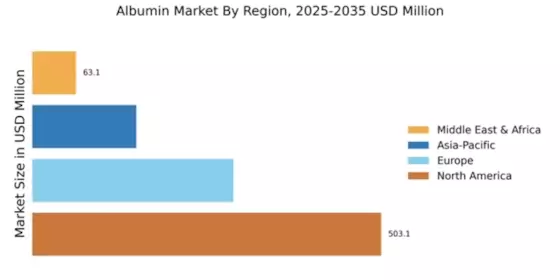
North America continues to lead The Albumin, holding a significant share of 503.12M in 2025. The growth is driven by increasing demand for therapeutic applications, particularly in treating liver diseases and burns. Regulatory support from agencies like the FDA has also catalyzed market expansion, ensuring safety and efficacy in Albumin products. The region's advanced healthcare infrastructure and high R&D investments further bolster this growth trajectory. The competitive landscape in North America is robust, featuring key players such as Baxter International and Grifols. These companies are at the forefront of innovation, focusing on product development and strategic partnerships. The U.S. remains the largest market, with Canada and Mexico also contributing to regional growth. The presence of established manufacturers and a strong distribution network enhances market accessibility, ensuring a steady supply of Albumin products.

Europe : Emerging Market Dynamics

Europe's Albumin market is projected to reach €290.0M by 2025, driven by rising healthcare expenditures and an aging population. The demand for Albumin in critical care settings and surgical procedures is increasing, supported by favorable regulations from the European Medicines Agency (EMA). The region's focus on improving healthcare quality and patient outcomes is a significant catalyst for market growth, alongside advancements in biopharmaceutical technologies. Leading countries in this region include Germany, France, and the UK, where major players like Octapharma and CSL Behring operate. The competitive landscape is characterized by a mix of established firms and emerging biotech companies, fostering innovation. Collaborations and partnerships are common, enhancing product offerings and market reach. The regulatory environment is stringent, ensuring high standards for Albumin products, which further instills confidence among healthcare providers and patients.

Asia-Pacific : Rapidly Growing Market

The Asia-Pacific Albumin market is anticipated to grow to $150.0M by 2025, fueled by increasing healthcare access and rising incidences of liver diseases. The region's expanding population and economic growth are driving demand for Albumin in therapeutic and diagnostic applications. Regulatory bodies are also enhancing their frameworks to support the safe use of Albumin, which is crucial for market development and consumer trust. Countries like China and India are leading the market, with significant contributions from local manufacturers such as Hualan Biological Engineering. The competitive landscape is evolving, with both multinational corporations and regional players vying for market share. Investments in healthcare infrastructure and rising awareness about the benefits of Albumin are expected to further propel market growth, making Asia-Pacific a key player in the global Albumin landscape.

Middle East and Africa : Emerging Opportunities

The Middle East and Africa (MEA) Albumin market is projected to reach $63.12M by 2025, driven by increasing healthcare investments and a growing patient population. The demand for Albumin in treating various medical conditions is rising, supported by government initiatives to improve healthcare access. Regulatory frameworks are gradually evolving, which is essential for ensuring the quality and safety of Albumin products in the region. Leading countries in this market include South Africa and the UAE, where local and international players are establishing a presence. Companies like Biotest and LFB are expanding their operations to meet the growing demand. The competitive landscape is characterized by a mix of established firms and new entrants, fostering innovation and improving product availability. As healthcare systems develop, the Albumin market in MEA is poised for significant growth.

Key Players and Competitive Insights

The Albumin Market is characterized by a dynamic competitive landscape, driven by increasing demand for therapeutic applications and advancements in production technologies. Key players such as Grifols (ES), Baxter International (US), and Octapharma (CH) are at the forefront, each adopting distinct strategies to enhance their market presence. Grifols (ES) focuses on innovation through research and development, particularly in expanding its product portfolio to include specialized albumin formulations. Baxter International (US) emphasizes operational efficiency and supply chain optimization, ensuring timely delivery of high-quality products. Meanwhile, Octapharma (CH) is actively pursuing strategic partnerships to bolster its global reach, indicating a trend towards collaborative growth in the sector.

The business tactics employed by these companies reflect a moderately fragmented market structure, where localized manufacturing and supply chain optimization play crucial roles. The collective influence of these key players shapes competitive dynamics, as they strive to meet the growing demand for albumin in various therapeutic areas. This competitive environment is further intensified by the need for regulatory compliance and the pursuit of cost-effective production methods, which are essential for maintaining market share.

In November 2025, Grifols (ES) announced a significant investment in a new production facility aimed at increasing its albumin output by 30%. This strategic move is expected to enhance its capacity to meet rising global demand, particularly in emerging markets. The investment underscores Grifols' commitment to innovation and operational excellence, positioning the company favorably against its competitors.

In October 2025, Baxter International (US) launched a new digital platform designed to streamline its supply chain processes. This initiative is anticipated to improve efficiency and reduce lead times, thereby enhancing customer satisfaction. By leveraging technology, Baxter aims to differentiate itself in a competitive market, aligning with current trends towards digital transformation.

In September 2025, Octapharma (CH) entered into a strategic alliance with a biotechnology firm to co-develop a novel albumin-based therapy. This collaboration is indicative of a broader trend towards innovation through partnerships, allowing Octapharma to expand its research capabilities and accelerate the development of new treatments. Such strategic alliances are becoming increasingly vital in a market where innovation is key to maintaining a competitive edge.

As of December 2025, the Albumin Market is witnessing trends that emphasize digitalization, sustainability, and the integration of AI technologies. These trends are reshaping the competitive landscape, as companies seek to enhance operational efficiencies and reduce environmental impact. Strategic alliances are playing a pivotal role in this evolution, fostering innovation and enabling companies to adapt to changing market demands. Looking ahead, competitive differentiation is likely to shift from price-based strategies to a focus on innovation, technology integration, and supply chain reliability, reflecting the industry's response to contemporary challenges.

Key Companies in the Albumin Market market include

Industry Developments

Recent news developments in the Albumin Market (as Excipient) Market indicate significant growth and strategic movements among key players. Companies such as Grifols and CSL Behring have reported an increase in market valuation, driven by rising demand for albumin in therapeutic applications over the past few years, particularly through 2022 and 2023. Notably, in March 2023, Hualan Biological Engineering announced its collaboration with Asian Biologics to enhance production capabilities in Asia, focusing on increasing the availability of high-quality albumin products.

In terms of mergers and acquisitions, Baxter completed its acquisition of a minority stake in Ventria Bioscience in April 2023, signaling a strategic partnership to leverage innovative technologies in biologics.

The market has also witnessed an expansion of product lines, with Bio Products Laboratory launching a new albumin formulation in November 2022 to cater to a broader range of therapeutic uses. Overall growth in this segment reflects an increasing focus on Research and Development and regulatory support for biopharmaceuticals, fostering advancements in formulation and application of albumin as an excipient across global markets.

Future Outlook

Albumin Market Future Outlook

The Albumin Market is projected to grow at a 5.92% CAGR from 2024 to 2035, driven by increasing demand in therapeutics, diagnostics, and nutritional applications.

New opportunities lie in:

  • Expansion of albumin-based therapeutics for rare diseases.
  • Development of innovative albumin formulations for enhanced stability.
  • Strategic partnerships with biopharmaceutical companies for co-development initiatives.

By 2035, the Albumin Market is expected to achieve robust growth, solidifying its position in the global healthcare landscape.

Market Segmentation

Albumin Market Source Outlook

  • Human Plasma
  • Recombinant
  • Animal Plasma
  • Synthetic
  • Plant-Based

Albumin Market End Use Outlook

  • Pharmaceuticals
  • Biotechnology
  • Healthcare
  • Food and Beverage
  • Cosmetics

Albumin Market Application Outlook

  • Therapeutic
  • Diagnostic
  • Research
  • Nutritional
  • Industrial

Albumin Market Formulation Outlook

  • Liquid
  • Lyophilized
  • Powder
  • Concentrated
  • Diluted

Albumin Market Purity Level Outlook

  • Low Purity
  • Medium Purity
  • High Purity
  • Ultra High Purity

Report Scope

MARKET SIZE 20241006.24(USD Million)
MARKET SIZE 20251065.81(USD Million)
MARKET SIZE 20351894.4(USD Million)
COMPOUND ANNUAL GROWTH RATE (CAGR)5.92% (2024 - 2035)
REPORT COVERAGERevenue Forecast, Competitive Landscape, Growth Factors, and Trends
BASE YEAR2024
Market Forecast Period2025 - 2035
Historical Data2019 - 2024
Market Forecast UnitsUSD Million
Key Companies ProfiledGrifols (ES), Baxter International (US), Octapharma (CH), CSL Behring (AU), Shire (IE), Kedrion (IT), LFB (FR), Biotest (DE), Hualan Biological Engineering (CN)
Segments CoveredApplication, End Use, Source, Formulation, Purity Level
Key Market OpportunitiesAdvancements in biopharmaceuticals drive demand for high-purity Albumin in therapeutic applications.
Key Market DynamicsRising demand for therapeutic applications drives innovation and competition in the Albumin Market.
Countries CoveredNorth America, Europe, APAC, South America, MEA

Market Highlights

Author
Rahul Gotadki
Assistant Manager

He holds an experience of about 7+ years in Market Research and Business Consulting, working under the spectrum of Life Sciences and Healthcare domains. Rahul conceptualizes and implements a scalable business strategy and provides strategic leadership to the clients. His expertise lies in market estimation, competitive intelligence, pipeline analysis, customer assessment, etc. In addition to the above, his other responsibility includes strategic tracking of high growth markets & advising clients on the potential areas of focus they could direct their business initiatives

Leave a Comment

FAQs

What is the projected growth of the Albumin market?

The Albumin market is the expected increase in total market value of 1.89 USD billion over a defined forecast period 2025–2035. It is driven by factors such as demand trends, technological advances, regulatory changes, and geographic expansion.

What is the size of the Albumin market?

Albumin market size was valued at approximately 1.01 billion USD in 2024. This figure will reach 1.89 billion USD covering all regions (America, Europe, Asia, MEA and ROW), focusing its segments / services / distribution channels till 2035.

What is the CAGR of the Albumin market?

Albumin market is expected to grow at a CAGR of 5.92% between 2025 and 2035.

How much will the Albumin market be worth by 2035?

Albumin market is expected to be worth of 1.89 billion USD, reflecting growth driven by usage, technology and global demands by the end of 2035.

How will the Albumin market perform over the next 10 years?

Over the next 10 years the Albumin market is expected to shift from usd billion 1.01 to 1.89 billion USD, led by adoption of advanced tech, demographic trends, regulatory approvals, with potential headwinds from 2025 to 2035.

Which region holds the largest market share in the Albumin (as Excipient) Market in 2024?

North America holds the largest market share, valued at 0.36 billion USD in 2024.

What is the projected market value of the Asia Pacific region by 2035?

The Asia Pacific region is expected to be valued at 0.38 billion USD by 2035.

What are the projected values of the Pharmaceuticals segment in 2024 and 2035?

The Pharmaceuticals segment is valued at 0.45 billion USD in 2024 and is expected to reach 0.83 billion USD by 2035.

Who are the key players in the Albumin (as Excipient) Market?

Key players include LFB, Proliant Biologicals, Octapharma, Grifols, and Baxter.

What is the expected market value for the Diagnostics segment in 2035?

The Diagnostics segment is projected to reach 0.28 billion USD by 2035.

Download Free Sample

Kindly complete the form below to receive a free sample of this Report

Compare Licence

×
Features License Type
Single User Multiuser License Enterprise User
Price $4,950 $5,950 $7,250
Maximum User Access Limit 1 User Upto 10 Users Unrestricted Access Throughout the Organization
Free Customization
Direct Access to Analyst
Deliverable Format
Platform Access
Discount on Next Purchase 10% 15% 15%
Printable Versions