×
Hero Background
English
Chinese
French
Japanese
Korean
German
Spanish

Aldehyde Market Trends

ID: MRFR/CnM/1739-HCR
111 Pages
Chitranshi Jaiswal
October 2025

Aldehyde Market Research Report Information by Product Type (Formaldehyde, Acetaldehyde, Benzaldehyde, Butyraldehyde, Propionaldehyde, Cinnamic Aldehyde and others), End-Use Industry (Chemicals, Healthcare, Petrochemical, Polymer, Paints & Coatings, Adhesives & Sealants and others) and Region (North America, Latin America, Europe, Asia-Pacific and Middle East & Africa) - Forecast till 2035

Share:
Download PDF ×

We do not share your information with anyone. However, we may send you emails based on your report interest from time to time. You may contact us at any time to opt-out.

Aldehyde Market Infographic
Purchase Options

Market Trends

Key Emerging Trends in the Aldehyde Market

The Aldehyde Market is undergoing dynamic trends influenced by a combination of factors, including industrial applications, regulatory changes, and shifts in consumer preferences. Here's a comprehensive overview of the market trends presented in a paragraph with a pointer format:

Growing Demand in Fragrance and Flavor Industry: One of the significant trends in the Aldehyde Market is the increasing demand from the fragrance and flavor industry. Aldehydes, with their characteristic scents, are crucial components in the formulation of perfumes, cosmetics, and food flavorings. The growing consumer preference for unique and authentic fragrances is driving the demand for aldehydes with distinctive aromatic profiles, contributing to the expansion of the fragrance and flavor industry.

Rising Popularity of Formaldehyde-Free Alternatives: With heightened awareness of environmental and health concerns, there is a rising popularity of formaldehyde-free alternatives in the Aldehyde Market. Formaldehyde, a common aldehyde, has faced scrutiny due to its potential health risks. As a result, industries such as textiles, adhesives, and coatings are seeking formaldehyde-free aldehydes to meet regulatory requirements and address consumer preferences for safer and more sustainable products.

Expanding Applications in Pharmaceuticals: Aldehydes play a crucial role in the pharmaceutical industry, serving as key intermediates in the synthesis of various drugs and active pharmaceutical ingredients (APIs). The demand for pharmaceuticals is on the rise globally, driving the need for specific aldehydes in the production of medicines. The expanding healthcare sector is contributing to the growth of the Aldehyde Market, particularly in the context of drug development and manufacturing.

Focus on Biodegradable Aldehydes: Sustainability is influencing market trends, leading to a focus on the development of biodegradable aldehydes. Manufacturers are investing in research and innovation to create aldehydes derived from renewable sources, aligning with the industry's commitment to eco-friendly practices. Biodegradable aldehydes find applications in various sectors, including packaging and agricultural products, contributing to the broader goal of reducing environmental impact.

Challenges in Formaldehyde Regulation: The Aldehyde Market faces challenges related to formaldehyde regulation, with stricter controls being imposed due to health and environmental concerns. Compliance with evolving regulations is a key consideration for manufacturers, and the market is witnessing efforts to develop and adopt alternative aldehydes that meet regulatory requirements while maintaining performance characteristics in various applications.

Increasing Use in Resin and Polymer Production: Aldehydes are essential in the production of resins and polymers, contributing to the adhesion and structural properties of these materials. The construction, automotive, and packaging industries are driving the demand for aldehydes in resin formulations, where they serve as cross-linking agents and enhance the overall performance of composite materials. This application trend is fostering growth in the Aldehyde Market.

Shift Towards Natural Aldehydes in Food and Beverages: In the food and beverage industry, there is a noticeable shift towards the use of natural aldehydes as flavoring agents. Consumer preferences for natural and clean-label products are influencing food formulations. Natural aldehydes extracted from sources such as fruits and plants are gaining popularity as alternatives to synthetic counterparts, meeting the demand for natural flavors in the food and beverage sector.

Globalization and Market Expansion Strategies: The Aldehyde Market is witnessing globalization as key players expand their market presence through strategic initiatives. Companies are engaging in mergers, acquisitions, and partnerships to strengthen their positions in different regions and enhance their product portfolios. This globalization trend is driven by the need to tap into diverse markets, address regional variations in demand, and capitalize on emerging opportunities.

Research and Development for Specialty Aldehydes: Ongoing research and development efforts are focused on creating specialty aldehydes with unique properties and applications. Specialty aldehydes find use in niche markets such as electronics, fine chemicals, and high-performance materials. Manufacturers are exploring innovative formulations and applications for specialty aldehydes to meet specific industry requirements and cater to evolving technological advancements.

Challenges in Raw Material Availability and Pricing: The Aldehyde Market faces challenges related to the availability and pricing of raw materials, including precursor chemicals such as alcohols and acids. Fluctuations in raw material prices and supply chain disruptions can impact the overall cost of aldehyde production. Manufacturers are actively managing these challenges by exploring alternative sources and implementing efficient supply chain strategies.
Author
Chitranshi Jaiswal
Research Analyst Level I

In her 3 years of experience in the market research field, she has handled critical cross-domain projects. She has an in-depth knowledge of market estimation & analysis, problem-solving, primary as well as secondary research, and team management.She holds an engineering degree and is an MBA professional from a well-known university, capable of evaluating the market and competitive conditions. An exceptional strategist with excellent communication skills and a passion for delivering cutting-edge & practical insights for the market. Proficient in multi-tasking, and can successfully deal with competing demands, while maintaining complete confidentiality. Generated business through active client and project development, networking, and high-quality responses. Her knowledge and skills have helped in making solid business decisions, securing funding from investors, and avoiding business failures.

Leave a Comment

FAQs

At what CAGR the aldehyde market is projected to grow during the forecast period?

The aldehyde market is projected to grow at a 3.80% CAGR between 2025-2035.

What will be the value of the aldehyde market during the forecast period?

The aldehyde market is predicted to touch USD 6.0 billion by 2035.

Which region is expected to have a major share in aldehyde market?

The APAC region is expected to have a major share in the aldehyde market.

What are the different end use industries for aldehyde?

Different end use industries for aldehyde include adhesives and sealants, paints and coatings, polymer, and others.

What are the key factors driving the aldehyde market growth?

Increasing use in chemicals, healthcare, and food & beverage industry is boosting market growth.

How is the Aldehyde Market segmented?

The Aldehyde Market is segmented by end-user and product type.

Market Summary

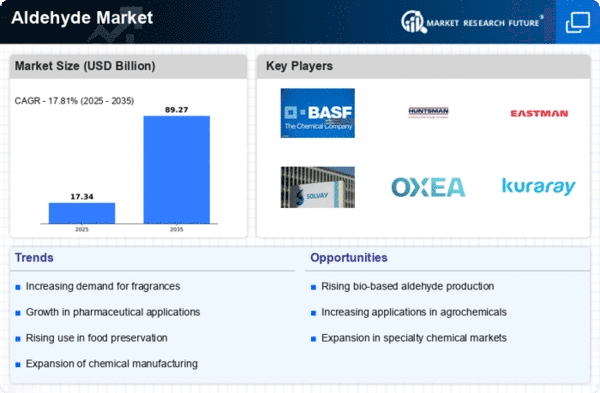
As per MRFR analysis, the Aldehyde Market Size was estimated at 14.72 USD Billion in 2024. The Aldehyde industry is projected to grow from 17.34 USD Billion in 2025 to 89.27 USD Billion by 2035, exhibiting a compound annual growth rate (CAGR) of 17.81 during the forecast period 2025 - 2035.

Key Market Trends & Highlights

The Aldehyde Market is poised for growth driven by sustainability and technological advancements.

  • North America remains the largest market for aldehydes, driven by robust demand in various industries.
  • Asia-Pacific is the fastest-growing region, reflecting increasing investments in chemical synthesis and pharmaceuticals.
  • The chemical synthesis segment dominates the market, while the healthcare segment is experiencing rapid growth.
  • Rising demand in the fragrance industry and growth in pharmaceutical applications are key drivers of market expansion.

Market Size & Forecast

2024 Market Size 14.72 (USD Billion)
2035 Market Size 89.27 (USD Billion)
CAGR (2025 - 2035) 17.81%
Largest Regional Market Share in 2024 North America

Major Players

<p>BASF SE (DE), Huntsman Corporation (US), Eastman Chemical Company (US), Solvay SA (BE), Oxea GmbH (DE), Kuraray Co., Ltd. (JP), Mitsubishi Gas Chemical Company, Inc. (JP), Chemanol (SA)</p>

Market Trends

The Aldehyde Market is currently experiencing a dynamic phase characterized by evolving consumer preferences and regulatory frameworks. The demand for aldehydes is driven by their diverse applications across various industries, including pharmaceuticals, cosmetics, and food preservation. As sustainability becomes increasingly paramount, manufacturers are exploring eco-friendly production methods, which may reshape the market landscape. Furthermore, the rise of innovative technologies in chemical synthesis could enhance the efficiency and reduce the environmental impact of aldehyde production. In addition, the Aldehyde Market appears to be influenced by shifting global trade patterns and economic conditions. Emerging economies are likely to play a pivotal role in shaping demand, as industrialization and urbanization continue to expand. The interplay between supply chain dynamics and consumer behavior suggests that stakeholders must remain agile to adapt to these changes. Overall, the Aldehyde Market is poised for growth, albeit with challenges that require strategic navigation.

Sustainability Initiatives

The Aldehyde Market is witnessing a notable shift towards sustainability, as companies increasingly prioritize eco-friendly practices. This trend encompasses the adoption of greener production methods and the sourcing of raw materials from renewable resources. Stakeholders are likely to invest in research and development to create sustainable alternatives, which may enhance their competitive edge.

Technological Advancements

Innovations in chemical synthesis are emerging as a significant driver within the Aldehyde Market. Advanced technologies, such as catalysis and bioprocessing, could improve production efficiency and reduce waste. These advancements may not only lower costs but also align with environmental regulations, thereby attracting a broader customer base.

Regulatory Compliance

The regulatory landscape surrounding the Aldehyde Market is evolving, with stricter guidelines being implemented globally. Companies are increasingly required to comply with safety and environmental standards, which may influence production processes and product formulations. Adapting to these regulations could present both challenges and opportunities for market participants.

Aldehyde Market Market Drivers

Increased Use in Agriculture

The Global Aldehyde Market Industry is experiencing increased utilization of aldehydes in agricultural applications, particularly as pesticides and herbicides. Aldehydes such as formaldehyde are recognized for their efficacy in pest control and soil treatment, contributing to enhanced crop yields. The growing global population and the corresponding demand for food production are driving this trend. As agricultural practices evolve, the reliance on chemical solutions, including aldehydes, is likely to expand. This shift may further solidify the market's position, as stakeholders seek effective solutions to meet agricultural challenges.

Growth in Personal Care Products

The Global Aldehyde Market Industry is witnessing a robust growth trajectory due to the rising incorporation of aldehydes in personal care products. Aldehydes are utilized for their fragrance properties and as preservatives in cosmetics and skincare formulations. With the global personal care market projected to reach unprecedented levels, the demand for aldehydes is expected to rise correspondingly. This sector's expansion is anticipated to play a crucial role in driving the market, potentially leading to a valuation of 6.71 USD Billion by 2035. The increasing consumer preference for high-quality personal care items further supports this trend.

Rising Demand in Pharmaceuticals

The Global Aldehyde Market Industry experiences a notable surge in demand from the pharmaceutical sector, driven by the increasing use of aldehydes in drug formulation and synthesis. Aldehydes such as formaldehyde and acetaldehyde serve as key intermediates in the production of various medications, including analgesics and antibiotics. This trend is expected to contribute significantly to the market's growth, with projections indicating a market value of 3 USD Billion in 2024. As the pharmaceutical industry continues to expand globally, the reliance on aldehydes for innovative drug development is likely to enhance their market presence.

Emerging Markets and Economic Growth

The Global Aldehyde Market Industry is poised for expansion in emerging markets, where economic growth is fostering increased industrial activity. Countries in Asia-Pacific and Latin America are witnessing a rise in manufacturing sectors, which in turn drives the demand for aldehydes in various applications, including textiles and plastics. As these economies develop, the consumption of aldehydes is expected to rise, contributing to the overall market growth. This trend indicates a potential for significant market opportunities in regions that are currently underrepresented in the global aldehyde landscape.

Advancements in Chemical Manufacturing

The Global Aldehyde Market Industry benefits from advancements in chemical manufacturing processes that enhance the efficiency and yield of aldehyde production. Innovations such as catalytic processes and green chemistry techniques are being adopted to reduce waste and improve sustainability. These advancements not only lower production costs but also align with global environmental regulations, making aldehydes more appealing to manufacturers. As a result, the market is poised for growth, with a projected compound annual growth rate of 7.59% from 2025 to 2035. This trend indicates a shift towards more sustainable practices in the chemical industry.

Market Segment Insights

By Application: Chemical Synthesis (Largest) vs. Pharmaceuticals (Fastest-Growing)

<p>In the Aldehyde Market, the application segments showcase a diverse distribution of market share. The largest segment, Chemical Synthesis, plays a pivotal role in the production of various chemicals and intermediates, commanding a significant portion of the market. Following closely behind, the Pharmaceuticals segment is rapidly gaining traction and is anticipated to grow at an accelerated pace, driven by increasing demand for pharmaceutical products globally. As industries evolve, the growth trends highlight a strong inclination towards the Pharmaceuticals segment, primarily fueled by advancements in healthcare and a rising emphasis on drug development. Meanwhile, the Chemical Synthesis segment remains robust, as it is fundamental for the manufacture of essential compounds across multiple sectors, indicating a competitive yet thriving market landscape.</p>

<p>Chemical Synthesis (Dominant) vs. Food Preservation (Emerging)</p>

<p>Chemical Synthesis stands out as the dominant player in the Aldehyde Market due to its essential role in producing various chemical compounds and formulations critical for industrial applications. This segment benefits from a well-established infrastructure and consistent demand from various sectors, providing stability and resilience against market fluctuations. In contrast, Food Preservation is emerging as a significant segment, driven by growing consumer awareness regarding food safety and shelf-life extension. This segment leverages aldehydes' potent preservation properties to enhance the quality and longevity of food products. As food safety regulations tighten and consumer preferences shift towards natural preservation methods, the Food Preservation segment is poised for notable growth, presenting opportunities for innovation and market expansion.</p>

By End Use: Industrial (Largest) vs. Healthcare (Fastest-Growing)

<p>The Aldehyde Market exhibits diverse end-use applications, with the Industrial segment holding the largest share. Industries utilize aldehydes for various purposes, including manufacturing and chemical processes, which contributes substantially to market dynamics. Alongside, the Healthcare sector is rapidly growing due to the increasing demand for disinfectants and antiseptics driven by health awareness and hygiene practices. The engagement across different segments emphasizes the widespread relevance of aldehydes in modern industries and markets.</p>

<p>Industrial: Dominant vs. Healthcare: Emerging</p>

<p>The Industrial segment of the Aldehyde Market is characterized by its extensive application in the production of plastics, resins, and solvents, making it a critical component for various manufacturing processes. This dominance is supported by the ongoing industrialization and technological advancements that demand higher efficiency. In contrast, the Healthcare segment, although emerging, is witnessing significant growth driven by heightened awareness surrounding hygiene and health safety measures. Here, aldehydes play a pivotal role in creating essential medical products and sterilization applications, thus establishing themselves as key players in the evolving healthcare landscape.</p>

By Type: Formaldehyde (Largest) vs. Acetaldehyde (Fastest-Growing)

<p>In the Aldehyde Market, Formaldehyde takes the lead as the largest segment, commanding a significant share due to its extensive applications in construction, textiles, and adhesives. Acetaldehyde, while smaller in market share, is rapidly gaining traction among manufacturers as a key component in the production of acetic acid and various chemicals, reflecting a growing demand in the industrial sector. Other aldehydes such as Benzaldehyde, Propionaldehyde, and Butyraldehyde occupy niche positions, contributing to the overall diversity of the market.</p>

<p>Formaldehyde (Dominant) vs. Benzaldehyde (Emerging)</p>

<p>Formaldehyde remains the dominant force in the Aldehyde Market, driven by its versatility and widespread usage in different industries, particularly in building materials and automotive sectors. Its ability to serve as a building block for numerous chemical products further solidifies its position. On the other hand, Benzaldehyde is emerging as a rising contender, primarily appealing to the fragrance and flavoring industries. Its unique aromatic profile allows it to serve as a critical ingredient in perfumes, food flavoring, and pharmaceuticals, marking its growing importance as consumer trends shift towards more specialized applications.</p>

By Production Method: Oxidation of Alcohols (Largest) vs. Hydroformylation (Fastest-Growing)

<p>In the Aldehyde Market, the production methods exhibit a diverse landscape characterized by varying shares. Oxidation of Alcohols stands out as the largest production method, holding a significant portion of the market share due to its wide application in various industries, including plastics and pharmaceuticals. Meanwhile, Hydroformylation has emerged rapidly, driven by increasing demand for higher-value chemical intermediates, capturing the attention of manufacturers looking to innovate in their production processes.</p>

<p>Production Method: Oxidation of Alcohols (Dominant) vs. Hydroformylation (Emerging)</p>

<p>Oxidation of Alcohols remains the dominant production method within the Aldehyde Market, well-regarded for its efficiency and versatility. Utilized extensively in the manufacture of a variety of aldehydes, this method benefits from established technology and strong industrial infrastructure. On the other hand, Hydroformylation is gaining traction as an emerging production approach, primarily due to its ability to produce larger aldehyde compounds with high selectivity. The growth of Hydroformylation aligns with industry trends toward sustainable production and the need for specific chemical properties in end-use applications. As demand shifts, both production methods are pivotal to the evolving landscape of the Aldehyde Market.</p>

By Purity Level: High Purity (Largest) vs. Food Grade (Fastest-Growing)

<p>In the Aldehyde Market, the purity level segment is characterized by a variety of classifications that cater to different industrial needs. Currently, High Purity stands out as the largest segment, commanding a significant share of the market, while Food Grade is rapidly gaining traction due to the rising demand in the food and beverage industry. Technical Grade, Reagent Grade, and Industrial Grade also play crucial roles, each serving distinct markets and applications, but they occupy smaller shares comparatively. The growth trends in the purity level segment are being driven by the expanding applications of aldehydes across various industries, particularly in pharmaceuticals and cosmetics for High Purity grades. Meanwhile, the Food Grade category is experiencing the fastest growth. This surge is largely due to increased food safety regulations and a growing consumer preference for high-quality ingredients, pushing manufacturers to seek compliant and trustworthy sources of aldehydes in food products.</p>

<p>High Purity: Dominant vs. Industrial Grade: Emerging</p>

<p>High Purity aldehydes are essential for applications requiring exceptional quality and reliability, such as in pharmaceuticals and laboratory settings. Their stringent production standards ensure minimal impurities, making them a trusted choice for critical applications. The segment benefits from technological advancements in purification processes, allowing for consistent delivery of high-quality products. In contrast, Industrial Grade aldehydes are emerging as vital components in large-scale manufacturing processes where purity is important but not as critical as in High Purity applications. They are cost-effective and suitable for various industrial applications, including solvents and resins, creating a significant demand. As industries continue to expand and evolve, the needs for both High Purity and Industrial Grade aldehydes are expected to remain strong.</p>

Get more detailed insights about Aldehyde Market Research Report - Global Forecast Till 2035

Regional Insights

North America : Market Leader in Aldehyde

North America is poised to maintain its leadership in the aldehyde market, holding a significant market share of 5.86 in 2024. The region's growth is driven by robust demand from industries such as automotive, pharmaceuticals, and personal care. Regulatory support for sustainable chemical production further enhances market dynamics, encouraging innovation and investment in eco-friendly alternatives. The United States stands as the primary contributor, with key players like BASF SE, Huntsman Corporation, and Eastman Chemical Company leading the charge. The competitive landscape is characterized by strategic partnerships and technological advancements, ensuring a steady supply of high-quality aldehydes to meet diverse industrial needs.

Europe : Innovation and Sustainability Focus

Europe's aldehyde market, valued at 4.42, is experiencing growth driven by increasing demand for sustainable and eco-friendly chemical solutions. Regulatory frameworks, such as REACH, are pushing manufacturers to adopt greener practices, thereby catalyzing innovation in aldehyde production. The region's commitment to sustainability is a key driver of market expansion, aligning with global environmental goals. Germany and France are leading countries in this market, with major players like Solvay SA and Oxea GmbH actively investing in research and development. The competitive landscape is marked by a focus on product differentiation and compliance with stringent regulations, ensuring that European manufacturers remain at the forefront of The Aldehyde.

Asia-Pacific : Emerging Market Potential

The Asia-Pacific region, with a market size of 3.84, is witnessing rapid growth in aldehyde consumption, driven by expanding industrial sectors such as textiles, automotive, and construction. The increasing urbanization and rising disposable incomes in countries like China and India are significant demand drivers. Additionally, favorable government policies aimed at boosting the chemical industry are further propelling market growth. China is the dominant player in this region, with companies like Kuraray Co., Ltd. and Mitsubishi Gas Chemical Company, Inc. leading the market. The competitive landscape is evolving, with local manufacturers increasingly focusing on quality and sustainability to capture a larger market share, making the region a hotspot for investment in aldehyde production.

Middle East and Africa : Untapped Market Opportunities

The Middle East and Africa region, with a market size of 0.6, presents untapped opportunities in the aldehyde market. The growth is primarily driven by increasing industrialization and the rising demand for chemicals in various sectors, including agriculture and construction. Government initiatives aimed at diversifying economies are also contributing to market expansion, creating a favorable environment for investment. Countries like South Africa and Saudi Arabia are emerging as key players in this market. The presence of local manufacturers, such as Chemanol, is enhancing competition, while international players are exploring partnerships to leverage regional growth. The competitive landscape is characterized by a mix of established companies and new entrants, aiming to capitalize on the region's growth potential.

Key Players and Competitive Insights

The Aldehyde Market is currently characterized by a competitive landscape that is both dynamic and multifaceted. Key growth drivers include the increasing demand for aldehydes in various applications such as pharmaceuticals, agrochemicals, and plastics. Major players like BASF SE (DE), Huntsman Corporation (US), and Eastman Chemical Company (US) are strategically positioned to leverage innovation and regional expansion. BASF SE (DE) focuses on sustainable production methods, while Huntsman Corporation (US) emphasizes product diversification and technological advancements. Eastman Chemical Company (US) is actively pursuing partnerships to enhance its market reach, collectively shaping a competitive environment that is increasingly reliant on innovation and sustainability.

In terms of business tactics, companies are localizing manufacturing to reduce costs and optimize supply chains. The market structure appears moderately fragmented, with several key players exerting influence over pricing and product availability. This fragmentation allows for niche players to thrive, while larger companies consolidate their market positions through strategic acquisitions and partnerships.

In November 2025, BASF SE (DE) announced a significant investment in a new production facility aimed at increasing its capacity for specialty aldehydes. This move is strategically important as it aligns with the growing demand for high-performance chemicals in the automotive and electronics sectors. By enhancing production capabilities, BASF SE (DE) is likely to strengthen its competitive edge and respond more effectively to market demands.

In October 2025, Huntsman Corporation (US) launched a new line of eco-friendly aldehyde derivatives designed for use in personal care products. This initiative reflects a broader trend towards sustainability in the chemical industry. By introducing environmentally friendly alternatives, Huntsman Corporation (US) not only meets regulatory pressures but also appeals to a growing consumer base that prioritizes sustainable products.

In September 2025, Eastman Chemical Company (US) entered into a strategic partnership with a leading biotechnology firm to develop bio-based aldehydes. This collaboration is indicative of a shift towards renewable resources in chemical production. By investing in bio-based technologies, Eastman Chemical Company (US) positions itself at the forefront of innovation, potentially capturing a larger market share as sustainability becomes a key purchasing criterion.

As of December 2025, current competitive trends in the Aldehyde Market are heavily influenced by digitalization, sustainability, and the integration of AI technologies. Strategic alliances are increasingly shaping the landscape, allowing companies to pool resources and expertise. The competitive differentiation is likely to evolve from traditional price-based competition to a focus on innovation, technology, and supply chain reliability. This shift suggests that companies that prioritize sustainable practices and technological advancements will be better positioned to thrive in the future.

Key Companies in the Aldehyde Market market include

Industry Developments

Future Outlook

Aldehyde Market Future Outlook

<p>The Aldehyde Market is projected to grow at a 17.81% CAGR from 2024 to 2035, driven by increasing demand in pharmaceuticals, agriculture, and specialty chemicals.</p>

New opportunities lie in:

  • <p>Development of bio-based aldehydes for sustainable applications.</p>
  • <p>Expansion into emerging markets with tailored product offerings.</p>
  • <p>Investment in advanced manufacturing technologies to enhance production efficiency.</p>

<p>By 2035, the Aldehyde Market is expected to achieve substantial growth, solidifying its global presence.</p>

Market Segmentation

Aldehyde Market Type Outlook

  • Formaldehyde
  • Acetaldehyde
  • Benzaldehyde
  • Propionaldehyde
  • Butyraldehyde

Aldehyde Market End Use Outlook

  • Industrial
  • Laboratory
  • Household
  • Healthcare
  • Food Industry

Aldehyde Market Application Outlook

  • Chemical Synthesis
  • Pharmaceuticals
  • Agriculture
  • Cosmetics
  • Food Preservation

Aldehyde Market Purity Level Outlook

  • High Purity
  • Technical Grade
  • Reagent Grade
  • Industrial Grade
  • Food Grade

Aldehyde Market Production Method Outlook

  • Oxidation of Alcohols
  • Hydroformylation
  • Dehydrogenation of Alcohols
  • Oxidative Dehydrogenation
  • Thermal Decomposition

Report Scope

MARKET SIZE 202414.72(USD Billion)
MARKET SIZE 202517.34(USD Billion)
MARKET SIZE 203589.27(USD Billion)
COMPOUND ANNUAL GROWTH RATE (CAGR)17.81% (2024 - 2035)
REPORT COVERAGERevenue Forecast, Competitive Landscape, Growth Factors, and Trends
BASE YEAR2024
Market Forecast Period2025 - 2035
Historical Data2019 - 2024
Market Forecast UnitsUSD Billion
Key Companies ProfiledBASF SE (DE), Huntsman Corporation (US), Eastman Chemical Company (US), Solvay SA (BE), Oxea GmbH (DE), Kuraray Co., Ltd. (JP), Mitsubishi Gas Chemical Company, Inc. (JP), Chemanol (SA)
Segments CoveredApplication, End Use, Type, Production Method, Purity Level
Key Market OpportunitiesGrowing demand for bio-based aldehydes driven by sustainability and regulatory shifts in the Aldehyde Market.
Key Market DynamicsRising demand for sustainable chemicals drives innovation and competition in the aldehyde market.
Countries CoveredNorth America, Europe, APAC, South America, MEA

FAQs

At what CAGR the aldehyde market is projected to grow during the forecast period?

The aldehyde market is projected to grow at a 3.80% CAGR between 2025-2035.

What will be the value of the aldehyde market during the forecast period?

The aldehyde market is predicted to touch USD 6.0 billion by 2035.

Which region is expected to have a major share in aldehyde market?

The APAC region is expected to have a major share in the aldehyde market.

What are the different end use industries for aldehyde?

Different end use industries for aldehyde include adhesives and sealants, paints and coatings, polymer, and others.

What are the key factors driving the aldehyde market growth?

Increasing use in chemicals, healthcare, and food &amp; beverage industry is boosting market growth.

How is the Aldehyde Market segmented?

The Aldehyde Market is segmented by end-user and product type.

  1. Executive Summary
  2. Market Introduction
    1. Market Definition
    2. Scope of the
    3. Study
    4. List
    5. of Assumptions
    6. Markets Structure
  3. Market Research Methodology
    1. Research Process
    2. Primary Research
    3. Secondary Research
    4. Market Size Estimation
    5. Forecast
    6. Model
  4. Market Dynamics
    1. of the Global Aldehyde Market
    2. Introduction
    3. Drivers
    4. Restraints
    5. Opportunities
    6. Challenges
    7. Trends/Technology
  5. Market Factor Analysis of the Global Aldehyde Market
    1. Supply Chain Analysis
      1. Manufacturers/Producers
      2. Distributors/Retailers/Wholesalers/E-Commerce
      3. End User
      4. Bargaining
      5. Bargaining Power
      6. Threat of Substitutes
      7. Intensity of Competitive Rivalry
    2. Raw Material Suppliers
    3. Porter’s Five Forces Analysis
    4. Threat of New Entrants
    5. Power of Buyers
    6. of Suppliers
    7. Pricing Analysis
  6. Global Aldehyde Market, by Type
    1. Introduction
    2. Formaldehyde
      1. Market Estimates
      2. Market Estimates &
    3. & Forecast, 2020–2027
    4. Forecast, by Region, 2020–2027
    5. Acetaldehyde
      1. Market Estimates
      2. Market Estimates &
    6. & Forecast, 2020–2027
    7. Forecast, by Region, 2020–2027
    8. Benzaldehyde
      1. Market Estimates
      2. Market Estimates &
    9. & Forecast, 2020–2027
    10. Forecast, by Region, 2020–2027
    11. Butyraldehyde
      1. Market Estimates
      2. Market Estimates &
    12. & Forecast, 2020–2027
    13. Forecast, by Region, 2020–2027
    14. Propionaldehyde
      1. Market Estimates
      2. Market Estimates &
    15. & Forecast, 2020–2027
    16. Forecast, by Region, 2020–2027
    17. Cinnamic Aldehyde
      1. Market Estimates
      2. Market Estimates &
    18. & Forecast, 2020–2027
    19. Forecast, by Region, 2020–2027
    20. Others
      1. Market Estimates &
      2. Market Estimates & Forecast,
    21. Forecast, 2020–2027
    22. by Region, 2020–2027
  7. Global Aldehyde Market, by
    1. End-Use Industry
    2. Introduction
    3. Chemicals
      1. Market Estimates & Forecast, 2020–2027
  8. Market Estimates & Forecast, by Region, 2020–2027
    1. Healthcare
    2. Petrochemical
    3. Polymer
    4. Paints & Coatings
    5. Adhesives & Sealants
  9. Market Estimates & Forecast, 2020–2027
  10. Market Estimates & Forecast, by Region, 2020–2027
  11. Market Estimates & Forecast, 2020–2027
  12. Market Estimates & Forecast, by Region, 2020–2027
  13. Market Estimates & Forecast, 2020–2027
  14. Market Estimates & Forecast, by Region, 2020–2027
  15. Market Estimates & Forecast, 2020–2027
  16. Market Estimates & Forecast, by Region, 2020–2027
  17. Market Estimates & Forecast,
  18. Market Estimates & Forecast, by Region, 2020–2027
    1. Others
      1. Market Estimates & Forecast,
      2. Market Estimates & Forecast, by Region, 2020–2027
  19. Global Aldehyde Market, by Region
    1. Introduction
    2. North America
      1. Market Estimates &
      2. Market Estimates & Forecast,
      3. Market Estimates & Forecast,
      4. US
    3. Forecast, 2020–2027
    4. by Type, 2020–2027
    5. by End-Use Industry, 2020–2027
  20. Market Estimates & Forecast, by Type, 2020–2027
    1. Industry, 2020–2027
  21. Market Estimates & Forecast, by End-Use
  22. Canada
  23. Market Estimates & Forecast,
  24. Market Estimates & Forecast, by Type, 2020–2027
    1. Industry, 2020–2027
    2. Market Estimates & Forecast, 2020–2027
  25. Market Estimates & Forecast, by End-Use
    1. Europe
  26. Market Estimates & Forecast, by Type, 2020–2027
  27. Market Estimates & Forecast, by End-Use Industry, 2020–2027
    1. Germany
    2. Market Estimates & Forecast, 2020–2027
  28. Market Estimates & Forecast, by Type,
  29. Market Estimates & Forecast, by End-Use Industry, 2020–2027
    1. France
    2. Market Estimates & Forecast, 2020–2027
  30. Market Estimates & Forecast, by Type,
  31. Market Estimates & Forecast, by End-Use Industry, 2020–2027
    1. Italy
    2. Market Estimates & Forecast, 2020–2027
  32. Market Estimates & Forecast, by Type,
  33. Market Estimates & Forecast, by End-Use Industry, 2020–2027
    1. Spain
    2. Market Estimates & Forecast, 2020–2027
    3. & Forecast, by End-Use Industry, 2020–2027
    4. UK
    5. & Forecast, 2020–2027
    6. Forecast, by End-Use Industry, 2020–2027
    7. Russia
    8. Estimates & Forecast, 2020–2027
    9. & Forecast, by End-Use Industry, 2020–2027
    10. & Forecast, 2020–2027
    11. Forecast, by End-Use Industry, 2020–2027
    12. of Europe
    13. Market Estimates & Forecast, 2020–2027
  34. Market Estimates & Forecast, by Type,2020–2027
  35. Market Estimates
  36. Market Estimates
  37. Market Estimates & Forecast, by Type,2020–2027
  38. Market Estimates &
  39. Market
  40. Market Estimates & Forecast, by Type,2020–2027
  41. Market Estimates
  42. Poland
  43. Market Estimates
  44. Market Estimates & Forecast, by Type, 2020–2027
  45. Market Estimates &
  46. Rest
  47. Market Estimates & Forecast, by Type,
  48. Market Estimates & Forecast, by End-Use Industry, 2020–2027
    1. Asia-Pacific
      1. Market Estimates &
      2. Market Estimates & Forecast,
      3. Market Estimates & Forecast,
      4. China
    2. Forecast, 2020–2027
    3. by Type, 2020–2027
    4. by End-Use Industry, 2020–2027
    5. & Forecast, 2020–2027
    6. & Forecast, by End-Use Industry, 2020–2027
    7. India
    8. Market Estimates & Forecast, 2020–2027
    9. by Type, 2020–2027
  49. Market Estimates & Forecast, by End-Use Industry, 2020–2027
    1. & Forecast, by Type, 2020–2027
    2. & Forecast, 2020–2027
    3. & Forecast, by End-Use Industry, 2020–2027
    4. Rest of Asia-Pacific
    5. Market Estimates & Forecast, 2020–2027
    6. by Type, 2020–2027
  50. Japan
  51. Market Estimates & Forecast, 2020–2027
  52. Market Estimates
  53. Market Estimates & Forecast, by End-Use Industry,
  54. Australia & New Zealand
  55. Market Estimates
  56. Market Estimates & Forecast, by Type, 2020–2027
  57. Market Estimates
  58. Market Estimates & Forecast,
  59. Market Estimates & Forecast, by End-Use Industry, 2020–2027
    1. Middle East
      1. Market Estimates & Forecast,
      2. Market Estimates & Forecast, by Type,
      3. Market Estimates & Forecast, by End-Use
      4. GCC
      5. Israel
      6. North Africa
    2. & Africa
    3. Industry, 2020–2027
    4. & Forecast, by Type, 2020–2027
    5. & Forecast, by Type, 2020–2027
  60. Market Estimates & Forecast, by Type, 2020–2027
    1. Industry, 2020–2027
    2. Forecast, 2020–2027
    3. Forecast, by End-Use Industry, 2020–2027
    4. of Middle East & Africa
    5. Forecast, by Type, 2020–2027
    6. Forecast, 2020–2027
    7. by Type, 2020–2027
    8. by End-Use Industry, 2020–2027
    9. & Forecast, 2020–2027
    10. Forecast, by End-Use Industry, 2020–2027
    11. Argentina
    12. Market Estimates & Forecast, 2020–2027
    13. & Forecast, by End-Use Industry, 2020–2027
    14. Mexico
    15. Market Estimates & Forecast, 2020–2027
    16. & Forecast, by End-Use Industry, 2020–2027
    17. Rest of Latin America
    18. by Type, 2020–2027
  61. Market Estimates & Forecast, by End-Use
  62. Turkey
  63. Market Estimates &
  64. Market Estimates & Forecast, by Type, 2020–2027
  65. Market Estimates &
  66. Rest
  67. Market Estimates & Forecast, 2020–2027
  68. Market Estimates &
  69. Market Estimates & Forecast, by End-Use Industry, 2020–2027
    1. Latin America
      1. Market Estimates &
      2. Market Estimates & Forecast,
      3. Market Estimates & Forecast,
      4. Brazil
  70. Market Estimates & Forecast, by End-Use Industry, 2020–2027
  71. Company Landscape
    1. Introduction
    2. Market Strategy
    3. Key Development Analysis (Expansion/Merger & Acquisitions/Joint
    4. Venture/New Product Development/Agreement/Investment)
    5. Company Profiles
    6. BASF SE
      1. Financial Updates
      2. Product/Business Segment Overview
      3. Strategy
      4. SWOT Analysis
      5. Company Overview
      6. Financial Updates
      7. Key Developments
      8. SWOT Analysis
    7. Company Overview
    8. Key Developments
    9. AkzoNobel NV
    10. Product/Business Segment Overview
    11. Strategy
    12. DowDuPont,
      1. Financial Updates
      2. Product/Business Segment Overview
      3. Strategy
      4. SWOT Analysis
      5. Financial Updates
      6. Product/Business Segment Overview
      7. Strategy
      8. SWOT Analysis
      9. Financial Updates
      10. Product/Business Segment Overview
      11. Strategy
      12. SWOT Analysis
      13. Company Overview
      14. Financial Updates
      15. Key Developments
      16. SWOT Analysis
    13. Inc.
    14. Company Overview
    15. Key Developments
    16. Lenntech BV
    17. Company Overview
    18. Key Developments
    19. Thermax
    20. Company Overview
    21. Key Developments
    22. Accepta Water Treatment
    23. Product/Business Segment Overview
    24. Strategy
    25. Aries
      1. Company Overview
      2. Strategy
      3. Key Developments
    26. Chemical, Inc.
    27. Financial Updates
    28. Product/Business Segment Overview
    29. SWOT Analysis
    30. Chembond Chemicals Limited
      1. Company Overview
      2. Product/Business
      3. Strategy
      4. SWOT Analysis
    31. Financial Updates
    32. Segment Overview
    33. Key Developments
    34. Wilh. Wilhelmsen Holding ASA
      1. Financial Updates
      2. Product/Business Segment Overview
      3. Strategy
      4. SWOT Analysis
      5. Company Overview
      6. Strategy
      7. Key Developments
      8. Company
      9. Financial Updates
      10. Product/Business Segment Overview
      11. Key Developments
    35. Company Overview
    36. Key Developments
    37. Chemtex Speciality Limited
    38. Financial Updates
    39. Product/Business Segment Overview
    40. SWOT Analysis
    41. ChemTreat Inc.
    42. Overview
    43. Strategy
    44. SWOT Analysis
    45. Culligan
      1. Company Overview
      2. Financial Updates
      3. Key Developments
      4. SWOT Analysis
    46. Product/Business Segment Overview
    47. Strategy
    48. Bionics
      1. Company Overview
      2. Strategy
      3. Key Developments
    49. Advanced Filtration Systems (P) Ltd
    50. Financial Updates
    51. Product/Business Segment Overview
    52. SWOT Analysis
    53. INDOCHEM
      1. Company Overview
      2. Financial Updates
      3. Key Developments
      4. SWOT Analysis
    54. Product/Business Segment Overview
    55. Strategy
    56. Aquaquest
      1. Company Overview
      2. Strategy
      3. Key Developments
    57. Aldehyde
    58. Financial Updates
    59. Product/Business Segment Overview
    60. SWOT Analysis
  72. Conclusion
    1. LIST
  73. OF TABLES
  74. Global Aldehyde
    1. Market: by Region, 2020–2027
  75. North America:
  76. Aldehyde Market, by Country, 2020–2027
  77. Europe:
  78. Aldehyde Market, by Country, 2020–2027
  79. Asia-Pacific:
    1. Aldehyde Market. by Country, 2020–2027
  80. Middle
  81. East & Africa: Aldehyde Market, by Country, 2020–2027
    1. Table 6
  82. Latin America: Aldehyde Market, by Country, 2020–2027
    1. Table 7
  83. Global Aldehyde Type Market, by Regions, 2020–2027
    1. Table 8
  84. North America: Aldehyde Type Market, by Country, 2020–2027
    1. Table
  85. Europe: Aldehyde Type Market, by Country, 2020–2027
  86. Table10 Asia-Pacific: Aldehyde Type Market, by Country, 2020–2027
  87. Table11 Middle East & Africa: Aldehyde Type Market, by Country,
    1. Table12 Latin America: Aldehyde Type Market,
    2. by Country, 2020–2027
  88. Global Aldehyde End-Use
  89. Industry Market, by Regions, 2020–2027
    1. Table14 North
  90. America: Aldehyde End-Use Industry Market, by Country, 2020–2027
    1. Table15
  91. Europe: Aldehyde End-Use Industry Market, by Country, 2020–2027
    1. Table16
  92. Asia-Pacific: Aldehyde End-Use Industry Market, by Country, 2020–2027
    1. Table17 Middle East & Africa: Aldehyde End-Use Industry
  93. Market, by Country, 2020–2027
    1. Table18 Latin America:
  94. Aldehyde by End-Use Industry Market, by Country, 2020-2023
    1. Table19
  95. Global Type Market, by Region, 2020–2027
    1. Table20 Global
  96. End-Use Industry Market, by Region, 2020–2027
    1. Table21 North
  97. America: Aldehyde Market, by Country, 2020–2027
    1. Table22
  98. North America: Aldehyde Market, by Type, 2020–2027
    1. Table23
  99. North America: Aldehyde Market, by End-Use Industry, 2020–2027
  100. Table24 Europe: Aldehyde Market, by Country, 2020–2027
  101. Table25 Europe: Aldehyde Market, by Type, 2020–2027
  102. Table26 Europe: Aldehyde Market, by End-Use Industry, 2020–2027
  103. Table27 Asia-Pacific: Aldehyde Market, by Country,
    1. Table28 Asia-Pacific: Aldehyde Market,
    2. by Type, 2020–2027
    3. Table29 Asia-Pacific: Aldehyde Market,
    4. by End-Use Industry, 2020–2027
    5. Table30 Middle
  104. East & Africa: Aldehyde Market, by Country, 2020–2027
    1. Table31
  105. Middle East & Africa: Aldehyde Market, by Type, 2020–2027
  106. Table32 Middle East & Africa: Aldehyde Market, by End-Use
    1. Industry, 2020–2027
    2. Table33 Latin America: Aldehyde
  107. Market, by Country, 2020–2027
    1. Table34 Latin
  108. America: Aldehyde Market, by Type, 2020–2027
    1. Table35 Latin
  109. America: Aldehyde Market, by End-Use Industry, 2020–2027
    1. LIST
  110. OF FIGURES
  111. Global Aldehyde Market Segmentation
  112. Forecast Research Methodology
    1. FIGURE 3
    2. Five Forces Analysis of Global Aldehyde Market
  113. Value
    1. Chain of Global Aldehyde Market
  114. Share of Global Aldehyde
  115. Market in 2020, by Country
  116. Global Aldehyde Market,
  117. Global Aldehyde Market Size, by Type,
  118. Share of Global Aldehyde Market, by Type, 2020–2027
  119. Global Aldehyde Market Size, by End-Use Industry, 2020
  120. FIGURE10 Share of Global Aldehyde Market, by End-Use Industry, 2020–2027

Aldehyde Market Segmentation

Market Segmentation Overview

  • Detailed segmentation data will be available in the full report
  • Comprehensive analysis by multiple parameters
  • Regional and country-level breakdowns
  • Market size forecasts by segment
Infographic

Free Sample Request

Kindly complete the form below to receive a free sample of this Report

Get Free Sample

Customer Strories

Compare Licence

×
Features License Type
Single User Multiuser License Enterprise User
Price $4,950 $5,950 $7,250
Maximum User Access Limit 1 User Upto 10 Users Unrestricted Access Throughout the Organization
Free Customization
Direct Access to Analyst
Deliverable Format
Platform Access
Discount on Next Purchase 10% 15% 15%
Printable Versions