Alkaline Battery Market Summary
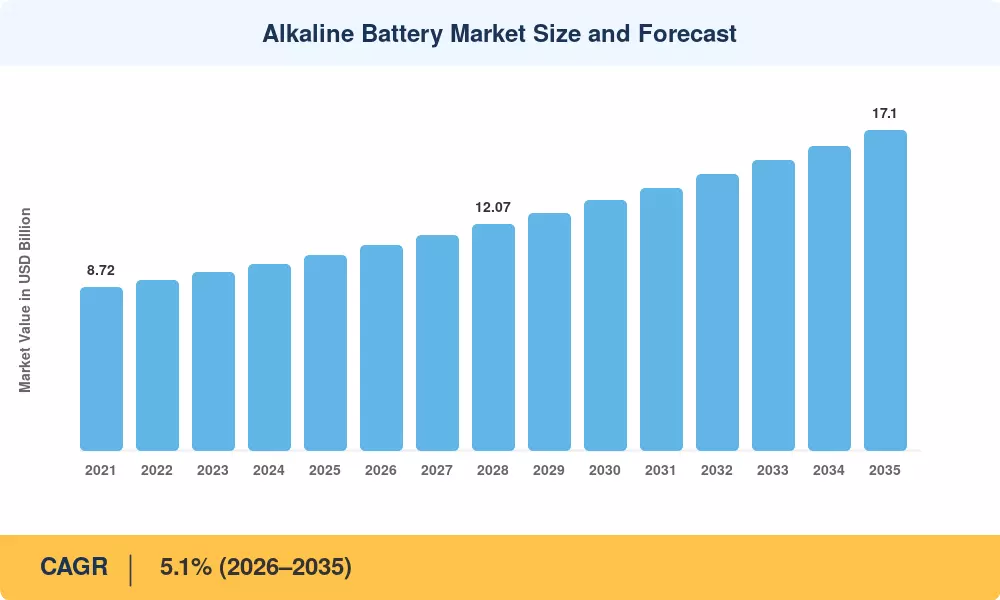
The alkaline battery market was valued at USD 10.40 billion in 2025, with the forecast period opening at USD 10.93 billion in 2026 and climbing to USD 17.10 billion by 2035 at a compound annual growth rate of 5.1%. Two structural forces underpin this trajectory: the global proliferation of low-drain IoT sensors that rely on stable, long-shelf-life power sources, and the rapid expansion of organized retail channels across South and Southeast Asia that are placing alkaline cells within arm's reach of hundreds of millions of new consumers [1]. Governments in over forty countries now mandate emergency-preparedness kits for households in disaster-prone zones, and alkaline cells remain the default chemistry specified in those kits [2].
Technology evolution in this space is less about replacement and more about refinement. Manufacturers are investing in leak-proof seal architectures, higher energy-density cathode formulations, and thinner steel casings that shave weight without sacrificing runtime. Panasonic Energy disclosed a USD 120 million cathode-improvement program in 2024, targeting a 15% energy-density uplift for its consumer AA line by 2027 [3]. The EU Battery Regulation (2023/1542), which imposes minimum recycled-content thresholds starting 2031, is also reshaping production planning across the continent [4].
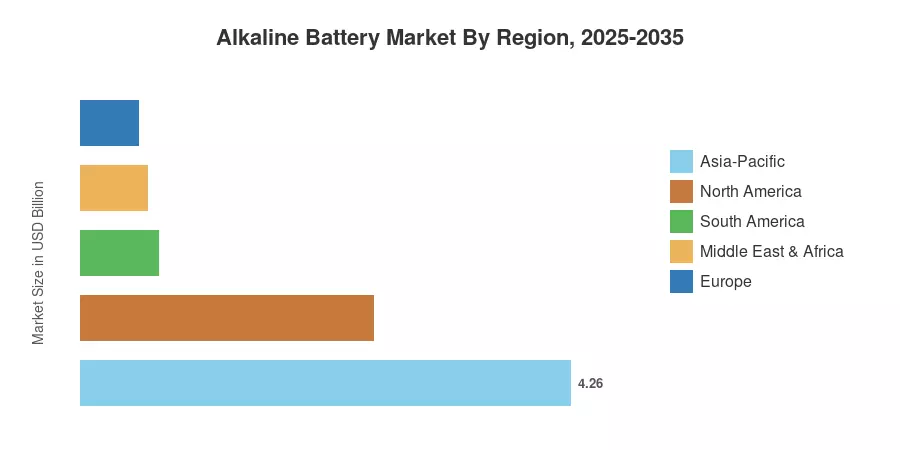
Asia-Pacific commands an estimated 41.0% share of the alkaline battery market, anchored by manufacturing scale in China and surging household consumption in India. North America follows as the second-largest region, contributing roughly USD 2.55 billion in 2025 revenue, while Europe is projected to grow at 4.8% CAGR through 2035 as sustainability-compliant product lines gain shelf space. The decade ahead will reward manufacturers that balance cost discipline with environmental compliance.
Key Report Takeaways
• By Battery Type
- Primary (non-rechargeable) cells controlled approximately 79% of the alkaline battery market in 2025, reflecting their dominance across consumer remote controls, flashlights, and wall clocks.
- Secondary (rechargeable) alkaline formats are projected to expand at a 9.6% CAGR through 2035, driven by cost-conscious buyers seeking reusable alternatives in mid-drain devices.
• By Size
- AA-size cells accounted for roughly 41% of the alkaline battery market share in 2025, underscoring their ubiquity in household electronics.
- 9-volt configurations are expected to post an 8.5% CAGR through 2035, propelled by smoke-detector replacement cycles and portable test-equipment demand.
• By Application
- Consumer electronics generated close to 48.5% of alkaline battery market revenue in 2025.
- Medical devices represent the fastest-growing application, forecast to register a 10.2% CAGR through 2035 as affordable point-of-care diagnostics penetrate rural healthcare systems.
• By Region
- Asia-Pacific captured 41.0% of the alkaline battery market in 2025 and is poised to grow at 6.9% annually through 2035.
- South America is emerging as a high-potential corridor, with Brazil's organized retail expansion unlocking new distribution pathways.
Alkaline Battery Market Size and Forecast (2021–2035)
Market Research Future derives historical estimates from customs-trade databases, corporate filings, and distributor sell-through panels, then calibrates forecast trajectories using bottom-up demand modeling across 28 end-use device categories. All values are expressed in USD Billion at constant 2025 exchange rates.





















.webp?v=1787579707)
