×
Request Free Sample ×

Kindly complete the form below to receive a free sample of this Report

* Please use a valid business email

Leading companies partner with us for data-driven Insights

clients tt-cursor
Hero Background

Alkyl Acetate Market

ID: MRFR/CnM/7909-HCR
111 Pages
Chitranshi Jaiswal
October 2025

Alkyl Acetate Market Research Report By Application (Solvent, Fragrance, Coatings, Adhesives, Personal Care), By Type (Ethyl Acetate, Butyl Acetate, Propyl Acetate, Isobutyl Acetate), By End Use Industry (Automotive, Construction, Food Beverage, Electronics), By Distribution Channel (Direct Sales, Wholesale, Online Retail) and By Regional (North America, Europe, South America, Asia Pacific, Middle East and Africa) - Forecast to 2035

Share:
Download PDF ×

We do not share your information with anyone. However, we may send you emails based on your report interest from time to time. You may contact us at any time to opt-out.

Alkyl Acetate Market Infographic
Purchase Options

Alkyl Acetate Market Summary

As per MRFR analysis, the Alkyl Acetate Market Size was estimated at 6.68 USD Billion in 2024. The Alkyl Acetate industry is projected to grow from 6.9 in 2025 to 9.56 by 2035, exhibiting a compound annual growth rate (CAGR) of 3.31 during the forecast period 2025 - 2035.

Key Market Trends & Highlights

The Alkyl Acetate Market is poised for growth driven by sustainability and diverse applications.

  • The market is witnessing a pronounced shift towards sustainability, influencing production and consumption patterns.
  • North America remains the largest market, while Asia-Pacific is emerging as the fastest-growing region for alkyl acetates.
  • In the solvents segment, alkyl acetates are the most widely used, whereas the fragrance segment is experiencing rapid growth.
  • Rising demand in personal care products and increasing awareness of eco-friendly products are key drivers propelling market expansion.

Market Size & Forecast

2024 Market Size 6.68 (USD Billion)
2035 Market Size 9.56 (USD Billion)
CAGR (2025 - 2035) 3.31%

Major Players

BASF SE (DE), Eastman Chemical Company (US), Celanese Corporation (US), SABIC (SA), Solvay S.A. (BE), Oxea GmbH (DE), Huntsman Corporation (US), Mitsubishi Chemical Corporation (JP), LyondellBasell Industries N.V. (NL)

Alkyl Acetate Market Trends

The Alkyl Acetate Market is currently experiencing a dynamic phase characterized by evolving consumer preferences and increasing applications across various industries. This market encompasses a range of esters derived from alcohol and acetic acid, which are utilized in sectors such as paints, coatings, and personal care products. The growing demand for eco-friendly solvents and the shift towards sustainable practices appear to be driving innovation within this sector. Furthermore, the versatility of alkyl acetates in formulations suggests a potential for expansion in emerging markets, where industrial growth is anticipated. In addition, the Alkyl Acetate Market is influenced by regulatory frameworks that promote the use of low-VOC (volatile organic compounds) products. This regulatory environment encourages manufacturers to adapt their offerings to meet stringent environmental standards. As a result, companies are likely to invest in research and development to create more efficient and sustainable alkyl acetate solutions. Overall, the market seems poised for growth, with opportunities arising from both technological advancements and changing consumer expectations.

Sustainability Focus

The Alkyl Acetate Market is increasingly aligning with sustainability trends, as consumers and industries prioritize eco-friendly products. This shift is prompting manufacturers to develop greener alternatives that minimize environmental impact, thereby enhancing their market appeal.

Diverse Applications

Alkyl acetates are finding new applications across various sectors, including food and beverage, cosmetics, and pharmaceuticals. This diversification indicates a growing recognition of their functional benefits, which may lead to increased demand in non-traditional markets.

Regulatory Compliance

The evolving regulatory landscape is shaping the Alkyl Acetate Market, as stricter guidelines on VOC emissions drive innovation. Companies are compelled to reformulate products to comply with these regulations, potentially leading to the development of safer and more efficient alternatives.

Alkyl Acetate Market Drivers

Market Growth Projections

The Global Alkyl Acetate Market Industry is projected to experience steady growth, with a compound annual growth rate of 3.32% anticipated from 2025 to 2035. This growth trajectory is indicative of the increasing applications of alkyl acetates across various sectors, including solvents, personal care, and food and beverages. The market size is expected to reach 6.68 USD Billion in 2024, with further expansion to 9.57 USD Billion by 2035. These projections highlight the sustained interest and investment in alkyl acetate products, suggesting a robust future for the industry.

Rising Use in Personal Care Products

The Global Alkyl Acetate Market Industry is significantly influenced by the rising incorporation of alkyl acetates in personal care products. These compounds serve as effective solvents and fragrance ingredients, enhancing product performance and consumer experience. With an increasing focus on personal grooming and hygiene, the demand for cosmetics and personal care items is on the rise. This trend indicates a potential growth trajectory for the market, as manufacturers seek to formulate innovative products. The anticipated growth in this sector may further bolster the market, aligning with the overall expansion of the Global Alkyl Acetate Market.

Growing Demand in Solvent Applications

The Global Alkyl Acetate Market Industry experiences a notable increase in demand driven by its extensive use as a solvent in various applications. Industries such as paints, coatings, and adhesives utilize alkyl acetates for their excellent solvency properties. For instance, the paint industry is projected to grow, leading to an increased requirement for high-quality solvents. This trend is expected to contribute to the market's growth, with the market size anticipated to reach 6.68 USD Billion in 2024. The versatility of alkyl acetates in formulations enhances their appeal, suggesting a sustained demand in solvent applications.

Technological Advancements in Production

The Global Alkyl Acetate Market Industry is poised for growth due to technological advancements in production processes. Innovations in manufacturing techniques enhance efficiency and reduce production costs, making alkyl acetates more accessible to various industries. These advancements may lead to improved product quality and consistency, which are critical factors for manufacturers. As production becomes more streamlined, the market could witness an increase in supply, potentially meeting the rising demand across sectors. This dynamic suggests a favorable outlook for the Global Alkyl Acetate Market, particularly as industries seek reliable and cost-effective solutions.

Expansion in the Food and Beverage Sector

The Global Alkyl Acetate Market Industry benefits from the expansion of the food and beverage sector, where alkyl acetates are utilized as flavoring agents and food additives. The increasing consumer preference for natural and synthetic flavors drives the demand for these compounds. As the food industry evolves, manufacturers are likely to seek high-quality flavoring solutions, which could lead to a rise in alkyl acetate consumption. This trend aligns with the projected market growth, with expectations of reaching 9.57 USD Billion by 2035, reflecting the potential of alkyl acetates in enhancing food products.

Regulatory Support for Sustainable Practices

The Global Alkyl Acetate Market Industry is likely to benefit from regulatory support promoting sustainable practices. Governments worldwide are increasingly advocating for environmentally friendly solvents and additives, which aligns with the properties of alkyl acetates. These compounds are often derived from renewable resources, making them attractive alternatives to traditional solvents. As regulations evolve to favor sustainable options, the demand for alkyl acetates may rise, reflecting a shift towards greener formulations. This trend could significantly influence the market landscape, fostering growth opportunities in the Global Alkyl Acetate Market.
Market Segment Insights

By Application: Solvents (Largest) vs. Fragrance (Fastest-Growing)

The Alkyl Acetate Market showcases a diverse application landscape, with solvents leading the way in terms of market share. This segment is essential for various industrial and consumer applications, ranging from paints and coatings to cleaning products. Fragrance applications showcase a growing trend as they increasingly penetrate personal care and household products, reflecting a shift towards more natural and sustainable options in formulations. The demand for suitable solvents continues to drive stability in this segment, while fragrances are thriving due to evolving consumer preferences and an increasing focus on aromatherapy attributes. Growth trends in the Alkyl Acetate Market highlight the solvent segment's resilience, supported by robust demand in the automotive and construction industries. On the other hand, fragrances are experiencing rapid growth driven by the increasing use of aromatics in cosmetics and perfumes. The rise of eco-friendly products is notorious for influencing the shift toward Alkyl Acetates in developing formulations, providing a dual transformation pathway for both solvents and fragrances, ensuring innovation remains at the forefront of these segments.

Solvents (Dominant) vs. Fragrance (Emerging)

In the Alkyl Acetate Market, solvents are positioned as the dominant force, characterized by their versatility and extensive use in various industries such as automotive, coatings, and cleaning products. They serve as critical components, ensuring optimal performance in applications that require effective solvation. Conversely, the fragrance segment is emerging with notable momentum, fueled by consumer shifts toward natural and sustainable products. This segment signifies potential growth with increasing use in personal care items and household products. While solvents stand firm as the backbone of industrial applications, fragrances are reshaping market dynamics to cater to evolving consumer preferences. This juxtaposition presents a simultaneous evolution within the Alkyl Acetate spectrum.

By End Use: Cosmetics (Largest) vs. Pharmaceuticals (Fastest-Growing)

In the Alkyl Acetate Market, the end-use segmentation reveals Cosmetics as the largest application, driven by the rising demand in personal care products. It holds a significant share in the market, leveraging its properties as a solvent and fragrance component. In contrast, the Pharmaceuticals segment is also notable, but it is emerging rapidly, fueled by the increasing use of alkyl acetates in medicinal formulations, thereby capturing a growing share of the market.

Cosmetics: Dominant vs. Pharmaceuticals: Emerging

Cosmetics has emerged as a dominant force in the Alkyl Acetate Market due to its versatile applications in various personal care products, including perfumes, skincare, and hair care items. The properties of alkyl acetates, such as volatility and scent enhancement, make them indispensable in this sector. Conversely, the Pharmaceuticals segment is characterized by its rapid growth as industries increasingly incorporate alkyl acetates in drug formulations, enhancing solubility and absorption. This emerging trend signifies a shift towards more innovative uses of alkyl acetates in healthcare, pointing to a broader acceptance and application in the pharmaceutical field.

By Chemical Structure: Ethyl Acetate (Largest) vs. Butyl Acetate (Fastest-Growing)

The Alkyl Acetate Market demonstrates a diverse landscape characterized by various chemical structures, each contributing uniquely to the overall market dynamics. Ethyl Acetate leads this segment, capturing the highest market share due to its widespread usage in solvents, coatings, and adhesives. Following closely is Butyl Acetate, which is gaining traction across sectors, particularly in paint and lacquer applications, driven by its favorable evaporation rates and solvent properties. Other structures, Propyl Acetate and Methyl Acetate, while significant, account for smaller portions of the market, primarily serving niche segments. Growth prospects for the Alkyl Acetate segment reveal intriguing trends influenced by evolving consumer preferences and regulatory frameworks. The industrial demand for eco-friendly and low-VOC (Volatile Organic Compounds) solvents is propelling Butyl Acetate to the forefront, marking it as the fastest-growing structure in this market. Additionally, the increasing penetration of Ethyl Acetate in emerging economies, coupled with its established role in conventional applications, ensures sustained growth. These trends highlight a shift towards sustainable solutions while adapting to market needs, driving innovation and expansion within the Alkyl Acetate sector.

Ethyl Acetate (Dominant) vs. Butyl Acetate (Emerging)

Ethyl Acetate stands as the dominant player within the Alkyl Acetate Market, recognized for its versatility as a solvent across various industries, including paints, coatings, and adhesives. Its excellent solubility properties and low toxicity make it a preferred choice, particularly in environments seeking to minimize harmful emissions. In contrast, Butyl Acetate is emerging rapidly as a strong contender due to its quick evaporation rates and efficient performance in paint and lacquer production. As industries continue to seek cleaner alternatives, Butyl Acetate's profile is rising, appealing to sectors looking for high-performance yet eco-friendly solutions. This dynamic interaction between Ethyl and Butyl Acetate highlights the evolving landscape of the market, where both segments are poised to play critical roles in the future.

By Purity Level: Industrial Grade (Largest) vs. Food Grade (Fastest-Growing)

In the Alkyl Acetate Market, the distribution of market shares among the purity levels is notably diverse. Industrial Grade alkyl acetates dominate the segment due to their extensive application in various industries, particularly in solvents and coatings. Following this, Laboratory Grade alkyl acetates are significant for research and development applications, while Food Grade alkyl acetates, although a smaller segment, are gaining traction due to increased demand in the food and beverage industry. The growth trends in the purity level segment are shaped by several dynamic factors. The Industrial Grade category continues to leverage its established market presence and robust application range. Meanwhile, the Food Grade segment is emerging rapidly, driven by rising consumer awareness regarding food safety and quality, along with regulatory support promoting the use of safe additives in food processing. This trend is expected to foster a shift towards higher demand for Food Grade alkyl acetates in the coming years.

Industrial Grade (Dominant) vs. Laboratory Grade (Emerging)

The Industrial Grade segment of alkyl acetates remains the dominant player in the market, characterized by its widespread use and versatility across numerous industrial applications such as paints, coatings, and adhesives. This segment is highly favored for its cost-effectiveness and efficiency in large-scale manufacturing processes. In contrast, the Laboratory Grade segment, although smaller, is emerging due to its critical role in research and quality testing. It is increasingly utilized in academic and industrial laboratories for various synthesis procedures and formulations. This segment’s growth is bolstered by advancements in analytical chemistry and a rising focus on research and development across multiple sectors, creating opportunities for innovation and expanded applications.

By Distribution Channel: Direct Sales (Largest) vs. Online Sales (Fastest-Growing)

In the Alkyl Acetate Market, the distribution of sales channels reveals a competitive landscape, with Direct Sales holding the largest share, benefiting from established relationships with manufacturers and consumers. This traditional method remains preferred for bulk purchases and contracts, ensuring a steady flow of demand. In contrast, Online Sales is rapidly gaining traction as consumers increasingly seek convenience and efficiency in their purchasing processes, leading to a dynamic shift in sales strategies especially among younger demographics.

Sales Channel: Direct Sales (Dominant) vs. Online Sales (Emerging)

Direct Sales remains the dominant force in the Alkyl Acetate Market, characterized by personal interactions and direct agreements between buyers and sellers. This traditional method offers stability and predictability, essential for long-term contracts. Conversely, Online Sales is emerging as a significant player, driven by technological advancements and changing consumer habits. It offers flexibility and a broader reach, allowing manufacturers to connect with a global audience. With increased internet penetration and e-commerce growth, Online Sales is expected to expand its market presence, appealing to a younger, tech-savvy consumer base.

Get more detailed insights about Alkyl Acetate Market

Regional Insights

North America : Established Market with Growth Potential

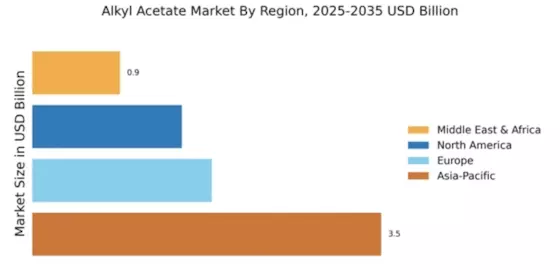
The North American alkyl acetate market is poised for steady growth, driven by increasing demand in the automotive and consumer goods sectors. With a market size of $1.5 billion, the region is focusing on sustainable production methods and regulatory compliance to enhance market appeal. The push for eco-friendly solvents is a significant catalyst, aligning with environmental regulations that promote lower VOC emissions. Leading countries like the US and Canada are home to major players such as Eastman Chemical Company and Celanese Corporation. The competitive landscape is characterized by innovation and strategic partnerships aimed at expanding product offerings. As companies invest in R&D, the market is expected to witness advancements in alkyl acetate applications, further solidifying its position in the region.

Europe : Innovation and Sustainability Focus

Europe's alkyl acetate market, valued at $1.8 billion, is driven by stringent environmental regulations and a strong emphasis on sustainability. The region is witnessing a shift towards bio-based solvents, which are gaining traction due to their lower environmental impact. Regulatory frameworks, such as REACH, are catalyzing innovation and pushing manufacturers to adopt greener practices, thereby enhancing market growth. Germany, France, and the UK are leading countries in this market, hosting key players like BASF SE and Solvay S.A. The competitive landscape is marked by a focus on R&D and strategic collaborations to develop advanced alkyl acetate products. As the demand for eco-friendly solutions rises, European companies are well-positioned to leverage their technological expertise to meet market needs.

Asia-Pacific : Emerging Powerhouse in Market Growth

Asia-Pacific is the largest market for alkyl acetate, with a size of $3.5 billion, driven by rapid industrialization and urbanization. The region's growth is fueled by increasing demand from the paints, coatings, and adhesives industries. Regulatory support for chemical manufacturing and favorable government policies are further enhancing market dynamics, making it a key player in the global landscape. Countries like China, Japan, and India are at the forefront, with major companies such as Mitsubishi Chemical Corporation and Oxea GmbH leading the charge. The competitive environment is characterized by a mix of local and international players, all vying for market share. As the region continues to expand its manufacturing capabilities, the demand for alkyl acetate is expected to rise significantly, solidifying its market leadership.

Middle East and Africa : Emerging Market with Growth Opportunities

The Middle East and Africa (MEA) region, with a market size of $0.88 billion, is gradually emerging as a significant player in the alkyl acetate market. The growth is driven by increasing industrial activities and a rising demand for solvents in various applications, including coatings and personal care products. Regulatory frameworks are evolving, promoting safer chemical practices and enhancing market potential. Countries like South Africa and Saudi Arabia are leading the charge, with a growing presence of international players. The competitive landscape is still developing, with opportunities for local manufacturers to innovate and capture market share. As the region invests in infrastructure and industrial capabilities, the demand for alkyl acetate is expected to grow, presenting new avenues for business expansion.

Key Players and Competitive Insights

The Alkyl Acetate Market is currently characterized by a dynamic competitive landscape, driven by increasing demand across various end-use industries such as paints, coatings, and personal care products. Key players are actively engaging in strategies that emphasize innovation, sustainability, and regional expansion. For instance, BASF SE (Germany) has been focusing on enhancing its product portfolio through sustainable practices, while Eastman Chemical Company (US) is leveraging digital transformation to optimize its operations. These strategies collectively contribute to a competitive environment that is increasingly shaped by the need for environmentally friendly solutions and technological advancements.

In terms of business tactics, companies are localizing manufacturing to reduce lead times and enhance supply chain efficiency. The market structure appears moderately fragmented, with several key players exerting influence over their respective segments. This fragmentation allows for a diverse range of products and innovations, although it also intensifies competition among established and emerging players alike.

In November 2025, Celanese Corporation (US) announced a strategic partnership with a leading technology firm to develop advanced manufacturing processes for alkyl acetates. This collaboration is expected to enhance production efficiency and reduce environmental impact, aligning with the growing trend towards sustainability in chemical manufacturing. Such initiatives not only bolster Celanese's market position but also reflect a broader industry shift towards eco-friendly practices.

In October 2025, SABIC (Saudi Arabia) unveiled a new line of bio-based alkyl acetates, which are derived from renewable resources. This launch is significant as it positions SABIC as a frontrunner in the sustainable chemicals space, catering to the increasing consumer demand for greener alternatives. The introduction of bio-based products may potentially reshape market dynamics, encouraging competitors to innovate in similar directions.

In September 2025, Huntsman Corporation (US) expanded its production capacity for alkyl acetates in response to rising global demand. This expansion is indicative of Huntsman's commitment to meeting market needs while enhancing its competitive edge. By increasing capacity, the company aims to solidify its market share and respond more effectively to customer requirements, which is crucial in a rapidly evolving market.

As of December 2025, the Alkyl Acetate Market is witnessing trends that emphasize digitalization, sustainability, and the integration of AI technologies. Strategic alliances are becoming increasingly prevalent, as companies recognize the value of collaboration in driving innovation and efficiency. The competitive landscape is likely to evolve, with a shift from price-based competition towards differentiation through technology, innovation, and reliable supply chains. This transition suggests that companies that prioritize these aspects will be better positioned to thrive in the future.

Key Companies in the Alkyl Acetate Market market include

Industry Developments

Recent developments in the Alkyl Acetate Market highlight a dynamic landscape driven by various factors, including increasing demand for solvents in paints and coatings, as well as growth in the pharmaceuticals and cosmetics sectors. Companies like BASF and Celanese Corporation are actively innovating their product lines to meet rising consumer needs and sustainability targets. Meanwhile, Huntsman Corporation and Eastman Chemical Company are exploring bio-based alternatives to conventional alkyl acetates, reinforcing their commitment to eco-friendly practices. Noteworthy acquisition activities include Doshi Group's strategic expansion plans, aiming to enhance its market position.

Reports indicate that Oxea and Solvay are also evaluating collaborative ventures to broaden their operational capabilities in high-growth regions. The market valuation of these companies is on an upward trajectory, influenced by both organic growth and strategic partnerships. Increased investments by major players such as SABIC and Lord Corporation in RD are expected to further propel advancements in product offerings and market presence. The Alkyl Acetate Market is thus witnessing a convergence of innovation, strategic acquisition, and keen competition among leading companies, which significantly impacts growth prospects and overall market dynamics.

Future Outlook

Alkyl Acetate Market Future Outlook

The Alkyl Acetate Market is projected to grow at a 3.31% CAGR from 2024 to 2035, driven by increasing demand in the automotive and personal care sectors.

New opportunities lie in:

  • Expansion into bio-based alkyl acetate production
  • Development of customized fragrance formulations for niche markets
  • Investment in advanced distribution logistics for efficiency

By 2035, the Alkyl Acetate Market is expected to achieve robust growth and diversification.

Market Segmentation

Alkyl Acetate Market End Use Outlook

  • Automotive
  • Cosmetics
  • Food and Beverage
  • Pharmaceuticals
  • Textiles

Alkyl Acetate Market Application Outlook

  • Solvents
  • Fragrance
  • Coatings
  • Adhesives
  • Plasticizers

Alkyl Acetate Market Purity Level Outlook

  • Industrial Grade
  • Laboratory Grade
  • Food Grade

Alkyl Acetate Market Chemical Structure Outlook

  • Ethyl Acetate
  • Butyl Acetate
  • Propyl Acetate
  • Methyl Acetate

Alkyl Acetate Market Distribution Channel Outlook

  • Direct Sales
  • Online Sales
  • Retail Sales

Report Scope

MARKET SIZE 20246.68(USD Billion)
MARKET SIZE 20256.9(USD Billion)
MARKET SIZE 20359.56(USD Billion)
COMPOUND ANNUAL GROWTH RATE (CAGR)3.31% (2024 - 2035)
REPORT COVERAGERevenue Forecast, Competitive Landscape, Growth Factors, and Trends
BASE YEAR2024
Market Forecast Period2025 - 2035
Historical Data2019 - 2024
Market Forecast UnitsUSD Billion
Key Companies ProfiledBASF SE (DE), Eastman Chemical Company (US), Celanese Corporation (US), SABIC (SA), Solvay S.A. (BE), Oxea GmbH (DE), Huntsman Corporation (US), Mitsubishi Chemical Corporation (JP), LyondellBasell Industries N.V. (NL)
Segments CoveredApplication, End Use, Chemical Structure, Purity Level, Distribution Channel
Key Market OpportunitiesGrowing demand for eco-friendly solvents in the Alkyl Acetate Market presents significant opportunities.
Key Market DynamicsRising demand for eco-friendly solvents drives innovation and competition in the Alkyl Acetate Market.

Countries CoveredNorth America, Europe, APAC, South America, MEA

Leave a Comment

FAQs

What is the compound annual growth rate (CAGR) of the Alkyl Acetate Market from 2025 to 2034?

Alkyl Acetate Market is projected to register a CAGR of 3.31% from 2025-2035

Which application segment dominated the Alkyl Acetate Market in 2024?

In 2024, the Solvent application segment dominated the market, valued at 6.68 USD Billion.

What will be the market value of the Personal Care application segment by 2035?

The Personal Care application segment is projected to reach a value of 0.63 USD Billion by 2035.

Which region had the highest market share for the Alkyl Acetate Market in 2024?

Alkyl Acetate Market was valued at USD 6.68 Billion in 2024

What is the projected market value for the APAC region by 2035?

The APAC region is projected to reach a market value of 2.85 USD Billion by 2035.

Who are the major players in the Alkyl Acetate Market?

Major players include Doshi Group, BASF, and Celanese Corporation, among others.

What is the anticipated market size for the Coatings application segment by 2035?

The Coatings application segment is expected to be valued at 1.7 USD Billion by 2035.

How large is the Adhesives application segment projected to be by 2035?

The Adhesives application segment is projected to have a value of 1.2 USD Billion by 2035.

What are the projected market growth rates for the MEA region from 2024 to 2035?

The MEA region is expected to grow to a market value of 1.1 USD Billion by 2035.

Download Free Sample

Kindly complete the form below to receive a free sample of this Report

Compare Licence

×
Features License Type
Single User Multiuser License Enterprise User
Price $4,950 $ $7,250
Maximum User Access Limit 1 User Upto 10 Users Unrestricted Access Throughout the Organization
Free Customization
Direct Access to Analyst
Deliverable Format
Platform Access
Discount on Next Purchase 10% 15% 15%
Printable Versions