Aluminum Pigments Market Summary
As per MRFR analysis, the Aluminum Pigments Market Size was estimated at 6.79 USD Million in 2024. The Aluminum Pigments industry is projected to grow from 7.93 USD Million in 2025 to 37.79 USD Million by 2035, exhibiting a compound annual growth rate (CAGR) of 16.89% during the forecast period 2025 - 2035.
Key Market Trends & Highlights
The Aluminum Pigments Market is poised for growth driven by sustainability and technological advancements.
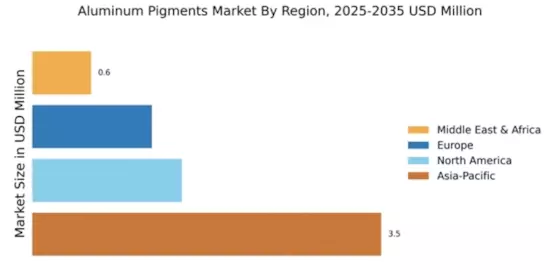
- North America remains the largest market for aluminum pigments, driven by robust demand in the automotive sector.
- Asia-Pacific is the fastest-growing region, reflecting increasing industrial activities and consumer preferences for aesthetics.
- The coatings segment continues to dominate the market, while the plastics segment is experiencing rapid growth due to innovative applications.
- Key market drivers include sustainability initiatives and the expansion of construction activities, which are fueling demand across various sectors.
Market Size & Forecast
| 2024 Market Size | 6.79 (USD Million) |
| 2035 Market Size | 37.79 (USD Million) |
| CAGR (2025 - 2035) | 16.89% |
Major Players
Altana AG (DE), Carl Schlenk AG (DE), Kremer Pigments GmbH & Co. KG (DE), Huntsman Corporation (US), Toyal America Inc. (US), Metaflake Ltd. (GB), Eckart GmbH (DE), Sun Chemical Corporation (US), BASF SE (DE)