Analog Integrated Circuit Market (2026 - 2035)

Analog Integrated Circuit Market Size, Share and Research Report By Technology (CMOS Analog ICs, Bipolar Analog ICs, RF Analog ICs, Power Analog ICs, Mixed-Signal Analog ICs), By Application (Consumer Electronics, Industrial Electronics, Automotive Electronics, Medical Electronics, Telecommunication Electronics), By End User (Original Equipment Manufacturers (OEMs), Contract Manufacturers (CMs), Electronic Manufacturing Services (EMS) Providers, System Integrators, End Consumers), By Distribution Channel (Direct Sales, Indirect Sales, Online Sales, Retail Sales, Distribution Sales), By Packaging (Through-Hole Technology (THT), Surface-Mount Technology (SMT), Ball Grid Array (BGA), Quad Flat No-Leads (QFN), Land Grid Array (LGA)) and By Regional (North America, Europe, South America, Asia-Pacific, Middle East and Africa) - Industry Forecast Till 2035

Forecast Period
2026-2035
CAGR
3.0%
2025 Market Size
USD 89.50 Billion (2025)
2035 Market Size
USD 120.17 Billion (2035)
Semiconductor & Electronics ● Updated August 24, 2026 Report ID: MRFR/SEM/28415-HCR | Pages: 200 | Author: Aarti Dhapte, Aarti Dhapte

Analog Integrated Circuit Market Summary

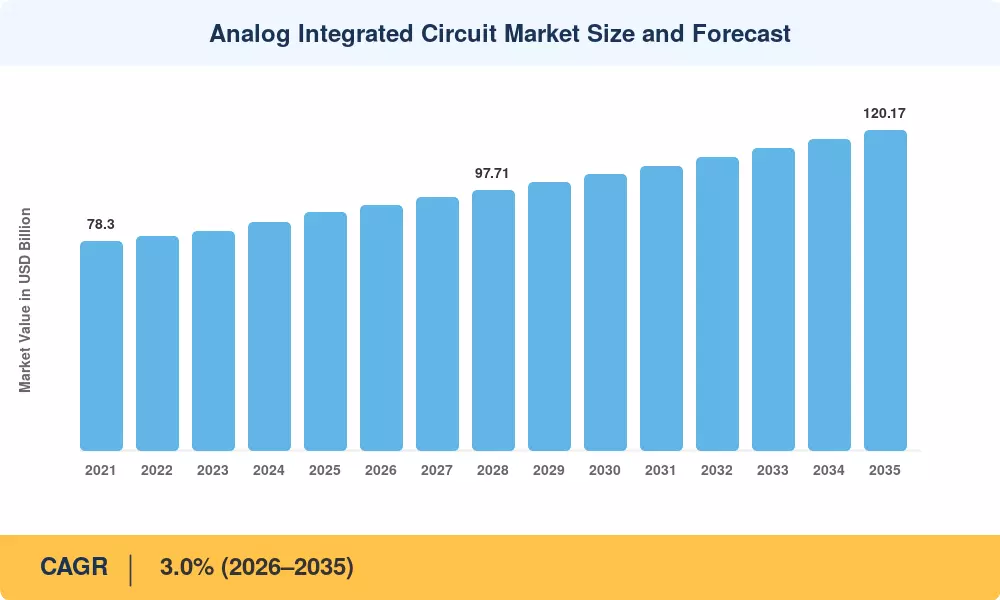
The analog integrated circuit market reached a valuation of USD 89.50 Billion in 2025 and is projected to grow from USD 92.10 Billion in 2026 to USD 120.17 Billion by 2035, advancing at a 3.0% CAGR during 2026–2035. Two structural catalysts anchor this trajectory: the USD 52.7 billion U.S. CHIPS and Science Act [1] and the EUR 43 billion European Chips Act [2], both channeling unprecedented public capital toward domestic analog semiconductor capacity. Vehicle electrification mandates across the EU, China, and California have simultaneously expanded the per-vehicle analog content to over USD 600, nearly double the figure from a decade ago [3].

A technology pivot is underway across the analog integrated circuit market as vertically integrated manufacturers convert aging 200 mm fabrication lines to 300 mm wafer processing, unlocking roughly 40% lower die cost per unit area [4]. Legacy catalog power-management and audio ICs are yielding ground to application-specific devices that integrate multiple analog functions — amplifiers, data converters, voltage references — on a single die, cutting system bill-of-material costs and locking design wins for seven-to-ten-year product cycles [5].

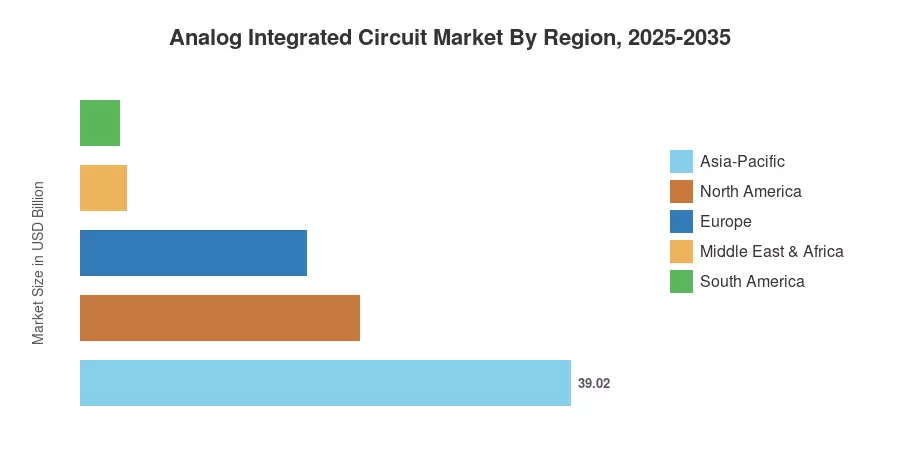
Asia-Pacific commanded a 43.6% share of the analog integrated circuit market in 2025, led by China's fab expansion and Japan's automotive semiconductor cluster. The Middle East & Africa region is the fastest-growing geography at a projected 4.09% CAGR through 2035, driven by smart-city infrastructure in the Gulf states. North America held the second-largest position at USD 22.20 Billion, supported by defense and aerospace demand. As edge-AI inference migrates closer to sensors and actuators, analog front-end silicon will remain indispensable across every end-use vertical through 2035.


Key Report Takeaways

• By Type

  • Application-Specific ICs captured 66.3% of analog integrated circuit market revenue in 2025, reflecting the industry's shift from catalog to custom solutions.
  • General-Purpose ICs are projected to expand at a 2.65% CAGR through 2035 as commodity demand stabilizes in consumer electronics.

• By Technology Node


  • Above-65 nm processes accounted for 46.2% of production output in 2025, anchored by automotive-grade reliability requirements.

• By Wafer Size

  • 300 mm wafer output is forecast to grow at a 3.11% CAGR, as fabs pursue die-cost advantages.

• By End-Use Application

  • Automotive represented 26.3% of the analog integrated circuit market in 2025, the largest end-use vertical.
  • Healthcare applications are on track to register a 3.95% CAGR through 2035.

• By Region

  • Asia-Pacific dominated the analog integrated circuit market with 43.6% of 2025 demand.
  • The Middle East & Africa region is expected to post the fastest CAGR of 4.09% through 2035.


Analog Integrated Circuit Market Size and Forecast (2021–2035)

Market Research Future's sizing methodology combines bottom-up revenue estimation from semiconductor company filings, wafer-start data from SEMI [4], and top-down cross-validation against end-market equipment shipments. Historical figures reflect actual reported revenues; forecast values apply the calibrated 3.0% CAGR with adjustments for known capacity-addition timelines and regulatory spending programs.
Analog Integrated Circuit Market Size and Forecast
Our Impact
Enabled $4.3B Revenue Impact for Fortune 500 and Leading Multinationals
Partnering with 2000+ Global Organizations Each Year
30K+ Citations by Top-Tier Firms in the Industry

Driver Impact Analysis

Driver ~% Impact on CAGR Geographic Relevance Impact Timeline
Vehicle electrification and ADAS proliferation +0.65 Global Long-term (≥4 yr)
5G/6G infrastructure densification +0.45 Asia-Pacific, North America Medium-term (2–4 yr)
CHIPS Act and European Chips Act capex +0.40 North America, Europe Short-term (≤2 yr)
Edge-AI and TinyML sensor fusion +0.35 Global Medium-term (2–4 yr)
Industrial automation (Industry 4.0) +0.30 Europe, Asia-Pacific Long-term (≥4 yr)
Renewable energy and grid modernization +0.25 Global Long-term (≥4 yr)
Medical device digitization +0.20 North America, Europe Medium-term (2–4 yr)


Vehicle Electrification and ADAS Proliferation

Analog semiconductor content for battery-electric vehicles is from USD 550 to USD 650 per car, which is approximately 2.5 times the content of a traditional internal combustion vehicle. This content includes gate drivers, battery-management front-ends, and LiDAR signal-conditioning circuits [3]. Global EV sales are predicted by BloombergNEF to exceed 30 million units per year by 2030 [16], which will result in a persistent demand for high-voltage analog ICs. Through 2030, Tier-1 automotive suppliers have pledged more than USD 18 billion in collective purchase agreements with analog chipmakers, establishing a clear floor for demand in the analog integrated circuit market.


5G and 6G Infrastructure Densification

Analog RF and power-management content costs about USD 300 per 5G macro base station, and small-cell deployments increase demand per node [9]. The cumulative silicon requirement is a key growth vector for the analog integrated circuit market in Asia-Pacific and North America, as 5G Americas reports that over 4.5 million small-cell deployments are anticipated globally by 2028.


Government Semiconductor Investment Programs

The U.S. CHIPS Act has allocated USD 39 billion in direct manufacturing incentives, with several analog-focused fabs — including Texas Instruments' USD 11 billion Richardson, Texas expansion — already breaking ground [1]. Europe's parallel program earmarks EUR 43 billion for domestic semiconductor sovereignty, targeting analog and power-device capacity specifically [2]. These public commitments de-risk private capital and compress the timeline for new 300 mm analog capacity coming online.

Edge-AI and Sensor Fusion

Estimates that edge-AI chipset shipments will exceed 2.5 billion units by 2028 [10]. Every edge-AI node requires analog front-end conditioning — filtering, amplification, and conversion — before digital processing begins. This architectural reality ensures that growth in edge inference translates directly into demand across the analog integrated circuit market.


Restraints Impact Analysis

The restraint percentages below are directional estimates of headwinds moderating the analog integrated circuit market growth rate. These values are not directly subtracted from the CAGR and serve as qualitative guidance.

Restraint ~% Impact on CAGR Geographic Relevance Impact Timeline
Chinese mixed-signal foundry price compression –0.30 Global Short-term (≤2 yr)
Legacy consumer electronics volume plateau –0.25 Asia-Pacific Medium-term (2–4 yr)
Skilled analog design talent shortage –0.20 North America, Europe Long-term (≥4 yr)
Geopolitical export controls on advanced nodes –0.15 Asia-Pacific Medium-term (2–4 yr)
Lengthy automotive qualification cycles –0.10 Global Long-term (≥4 yr)


Chinese Foundry Price Compression

Between 2022 and 2024, average selling prices for commodity low-voltage regulators and audio amplifiers fell by 12–18% due to the strong expansion of 200 mm capacity by domestic Chinese mixed-signal foundries. In the analog integrated circuit business, this price erosion reduces margins for established manufacturers and compels capital reallocation to higher-value automotive and healthcare sectors.


Legacy Consumer Electronics Volume Plateau

Since 2021, the number of smartphones shipped worldwide has been close to 1.2 billion per year, while tablet sales have remained unchanged [6]. This plateau restricts top-line volume growth and puts pressure on utilization rates at older 150 mm fabrication facilities because consumer electronics used to consume about 19% of analog IC output.


Analog Design Talent Shortage

Analog circuit design remains one of the most specialized engineering disciplines, requiring 8–10 years of experience for senior proficiency [17]. The U.S. Bureau of Labor Statistics projects a 15% shortfall in experienced analog engineers through 2030, constraining R&D throughput across the analog integrated circuit market and extending time-to-market for new products.


Analog Integrated Circuit Market Opportunities

Wide-Bandgap Power Semiconductor Integration

Industrial motor drives and EV traction inverters are starting to use silicon-carbide and gallium-nitride technologies. Yole Group projects that the SiC power industry alone will reach USD 11 billion by 2030 [12]. Analog gate-driver and sensor integrated circuits (ICs) co-designed for wide-bandgap switches constitute a high-margin development pocket.


Healthcare Wearable and Implantable Devices

By 2029, more than 500 million connected medical devices will be installed worldwide, according to predictions [11]. Every wearable biosensor, including ECG patches, continuous glucose monitors, and pulse oximeters, depends on ultra-low-power analog signal-conditioning integrated circuits. One of the quickest growth vectors in the analog integrated circuit industry is provided by this segment's 3.95% CAGR.


Smart-City and Industrial IoT in Emerging Markets

Gulf Cooperation Council nations have committed over USD 25 billion to smart-city programs through 2030 [19], and India's production-linked incentive scheme targets domestic semiconductor assembly capacity. Both initiatives create greenfield demand for industrial-grade analog ICs in metering, surveillance, and building automation across the Middle East & Africa and South America.

Data Monetization Through Predictive-Maintenance Platforms

Analog IC suppliers are embedding on-chip diagnostics that stream real-time health data to cloud platforms. Texas Instruments and Analog Devices both offer condition-monitoring reference designs that enable equipment OEMs to sell software-as-a-service maintenance contracts — converting a one-time component sale into a recurring data-driven revenue stream [5].

Satellite and Low-Earth-Orbit Communication

SpaceX, Amazon Kuiper, and OneWeb plan to deploy over 50,000 LEO satellites by 2032, each requiring radiation-tolerant analog front-end and power-conversion ICs [20]. This emerging application extends the analog integrated circuit market into space-grade sockets that command premium pricing.


Analog Integrated Circuit Market Future Outlook

Autonomous Driving and the Analog Content Multiplier

Level 3 and Level 4 autonomous platforms require 30–50 analog ICs per sensor module — spanning radar, LiDAR, and camera interfaces — compared to fewer than 10 in current ADAS systems [3]. As automakers commit to L3+ production vehicles by 2028–2030, the per-vehicle analog bill-of-materials will climb past USD 800, adding structural tailwinds to the analog integrated circuit market through the mid-2030s.

Platform Economics and Chiplet Integration

Analog chiplets that slot into heterogeneous packages alongside digital compute die represent the next architectural frontier. UCIe (Universal Chiplet Interconnect Express) standards, ratified in 2023, enable analog IP blocks — data converters, PLLs, power regulators — to be reused across multiple system-in-package designs [5]. This modular approach could lower analog NRE costs by up to 35%, broadening the accessible market for mid-tier players.

Electrification Supercycle and Grid-Edge Silicon

IEA projections indicate global installed renewable capacity will triple by 2030, with solar PV alone adding 820 GW of annual capacity [15]. Every inverter, battery-management system, and grid-tie relay requires analog sensing and power-conversion ICs. The analog integrated circuit market stands to capture incremental revenue as energy infrastructure electrifies worldwide.

ESG Reporting and Supply-Chain Transparency

Scope 3 emissions disclosure requirements — including the EU's Corporate Sustainability Reporting Directive — are compelling semiconductor buyers to audit fab energy intensity and material sourcing [2]. Analog IC suppliers with audited carbon footprints and conflict-mineral certifications will gain preferred-vendor status among Tier-1 OEMs, creating a differentiation lever in the analog integrated circuit market.


Analog Integrated Circuit Market Segmentation

By Type

Segment Key Metric Primary Demand Driver
General-Purpose IC 2.65% CAGR (2026–2035) Broad industrial and consumer base
Application-Specific IC 66.3% share (2025) Automotive, telecom, and healthcare custom designs


Application-Specific ICs dominate the analog integrated circuit market because OEMs increasingly demand monolithic solutions that combine amplifiers, data converters, and voltage regulators on a single die — reducing board space and qualification complexity. General-Purpose ICs retain relevance in prototyping and low-volume industrial applications, but their share is gradually compressing as custom integration deepens.

By Technology Node

Segment Key Metric Primary Demand Driver
Above 65 nm 46.2% share (2025) Automotive-grade reliability, high-voltage tolerance
40–65 nm USD 22.65 Billion (2025) Mixed-signal integration for telecom
28–40 nm 3.05% CAGR Data-converter performance scaling
Below 28 nm 3.81% CAGR High-speed SerDes and RF transceivers


Above-65 nm nodes continue to anchor the analog integrated circuit market because high-voltage power-management and automotive-grade ICs require thick-oxide transistors incompatible with aggressive scaling. Below-28 nm is the fastest-growing node, driven by 5G mmWave transceivers and high-speed data converters where transistor speed directly translates into system performance.

By Wafer Size

Segment Key Metric Primary Demand Driver
150 mm USD 12.80 Billion (2025) Legacy specialty and discrete analog
200 mm 51.2% share (2025) Established automotive and industrial lines
300 mm 3.11% CAGR Die-cost reduction for high-volume products


The 200 mm wafer base remains the workhorse of the analog integrated circuit market, but the economic case for 300 mm conversion is accelerating. SEMI data indicates that over 30 new 300 mm analog-capable fab projects are scheduled to ramp between 2025 and 2030 [4], driven by a 40% per-die cost advantage at scale.

By End-Use Application

Segment Key Metric Primary Demand Driver
Automotive 26.3% share (2025) EV powertrain and ADAS sensor integration
Industrial 3.15% CAGR Factory automation and predictive maintenance
Consumer Electronics USD 16.73 Billion (2025) Smartphones, wearables, IoT devices
Telecommunications 3.25% CAGR 5G base-station and small-cell rollout
Healthcare 3.95% CAGR Wearable biosensors and diagnostic equipment
Aerospace & Defense USD 6.71 Billion (2025) Radar, EW, and satellite subsystems


Automotive leads the analog integrated circuit market by share, and EV adoption ensures this position will strengthen as analog content per vehicle rises. Healthcare is the fastest-growing end-use application; analog-to-digital converter ADC chipsets embedded in continuous monitoring devices are enabling remote patient diagnostics at scale [11].


Regional Market Share Analysis

Region Key Metric (2025) Primary Investment Themes
Asia-Pacific 43.6% share Fab expansion, EV supply chain, 5G rollout
North America USD 22.20 Billion CHIPS Act fabs, defense, automotive
Europe 20.1% share European Chips Act, automotive electrification
South America 3.45% CAGR Industrial automation, grid modernization
Middle East & Africa 4.09% CAGR Smart cities, energy diversification
Total USD 89.50 Billion

The analog integrated circuit market exhibits a geographically concentrated demand structure, with three regions — Asia-Pacific, North America, and Europe — collectively representing over 88% of 2025 revenue. Emerging regions are gaining share as infrastructure investment accelerates.


North America

Country Key Metric Key Driver
United States 78.4% of regional share CHIPS Act fab investment, defense contracts
Canada USD 1.98 Billion Automotive sensor and clean-energy demand
Mexico 3.25% CAGR Nearshoring of electronics manufacturing


The United States anchors the North American analog integrated circuit market through combined defense procurement, data-center expansion, and the CHIPS Act's direct incentive pipeline. Texas Instruments' USD 11 billion fab complex in Sherman, Texas, and GlobalFoundries' USD 1 billion expansion in Malta, New York, illustrate how federal subsidies are reshaping domestic analog capacity [1].

Europe

Country Key Metric Key Driver
Germany 28.5% of regional share Automotive OEM analog content growth
United Kingdom USD 2.78 Billion Aerospace and industrial automation
France 3.10% CAGR Defense electronics modernization
Italy USD 1.65 Billion Industrial motor-drive applications
Spain 2.85% CAGR Renewable-energy inverter demand
Nordic Countries USD 1.42 Billion Telecom infrastructure
Russia 2.5% of regional share Import-substitution drives
Rest of Europe 3.0% CAGR Diversified industrial


Germany's dominant position reflects its automotive sector, where Infineon and STMicroelectronics supply power-management and sensor-interface ICs to BMW, Volkswagen, and Mercedes-Benz EV platforms. The European Chips Act's allocation for analog and power semiconductors is expected to add over 20,000 wafer starts per month by 2030 [2].

Asia-Pacific

Country Key Metric Key Driver
China 38.2% of regional share Domestic fab capacity and EV market scale
India 4.15% CAGR PLI scheme and electronics manufacturing
Japan USD 6.85 Billion Automotive and industrial sensors
South Korea 3.20% CAGR Memory-adjacent analog integration
ASEAN USD 3.10 Billion Contract manufacturing and assembly
Rest of Asia-Pacific 2.95% CAGR Emerging telecom demand


China's share of the Asia-Pacific analog integrated circuit market reflects both the world's largest EV fleet and government-backed fab construction. India is the region's fastest-growing country-level market, bolstered by a USD 10 billion semiconductor production-linked incentive scheme targeting assembly, testing, and packaging capacity [18].

South America

Country Key Metric Key Driver
Brazil 62.3% of regional share Industrial and energy-sector demand
Argentina USD 0.55 Billion Agricultural automation
Rest of South America 3.55% CAGR Mining and infrastructure


Brazil commands the largest position in South America's analog integrated circuit market, supported by its automotive-assembly base and expanding renewable-energy installations. The region remains nascent for semiconductor manufacturing but benefits from growing electronics assembly driven by Mercosur trade incentives [19].

Middle East & Africa

Country Key Metric Key Driver
Saudi Arabia 31.7% of regional share NEOM and Vision 2030 infrastructure
UAE USD 0.98 Billion Smart-city and telecom buildout
South Africa 3.70% CAGR Industrial and mining automation
Egypt USD 0.42 Billion Infrastructure modernization
Rest of MEA 4.20% CAGR Energy diversification


Saudi Arabia's Vision 2030 and the USD 500 billion NEOM project are generating outsized demand for industrial-grade analog ICs used in building automation, surveillance, and smart-grid metering. The Middle East & Africa region's 4.09% CAGR makes it the fastest-growing geography in the analog integrated circuit market through 2035 [19].


Analog Integrated Circuit Market By Region, 2025-2035

Competitive Benchmarking

The analog integrated circuit market exhibits medium concentration, with an estimated HHI of approximately 1,100 and the top five suppliers controlling roughly 48–52% of global revenue. Texas Instruments and Analog Devices together hold an estimated 28–33% combined share, creating a two-tier structure where scale advantages in fab ownership and catalog breadth define competitive positioning [5][8].

Company Est. Revenue Share Range Key Offerings Strategic Positioning
Texas Instruments ~14–17% Power management, signal chain, embedded processing Vertically integrated 300 mm leader
Analog Devices ~12–15% Precision converters, RF, signal conditioning High-performance mixed-signal specialist
Infineon Technologies ~7–9% Automotive power, sensors, security ICs European automotive analog leader
STMicroelectronics ~6–8% Power discrete, MEMS, automotive analog Broad automotive and industrial portfolio
NXP Semiconductors ~5–7% Automotive networking, RF, secure connectivity Automotive connectivity and processing focus
Renesas Electronics ~4–6% Automotive MCU + analog, power management Integrated MCU–analog platform strategy
Microchip Technology ~3–5% Mixed-signal MCUs, analog peripherals, timing Mid-market catalog breadth
onsemi ~3–5% Image sensors, power modules, SiC Power and sensing pivot to EV
Skyworks Solutions ~2–4% RF front-end, filters, amplifiers Mobile and IoT RF specialization
Rohm Semiconductor ~2–3% SiC power, automotive analog, LEDs Wide-bandgap early mover


Recent News & Developments

  • Texas Instruments (March 2025): Commenced volume production at its new 300 mm RFAB2 facility in Richardson, Texas, adding an estimated 100,000 wafer starts per month for power management ICs for portable devices and automotive analog products [1].
  • Analog Devices (January 2025): Completed its USD 2.1 billion acquisition of a European mixed-signal design house, expanding its precision sensor-interface portfolio for industrial and healthcare markets [8].
  • Infineon Technologies (November 2024): Announced a EUR 5 billion investment in a new SiC wafer fab in Kulim, Malaysia, targeting 2027 volume production for EV traction inverters [12].
  • STMicroelectronics (September 2024): Signed a 10-year supply agreement with a major European automaker for next-generation ADAS analog front-end ICs, valued at over EUR 3 billion [3].
  • U.S. Department of Commerce (August 2024): Finalized a USD 1.6 billion CHIPS Act award to GlobalFoundries for 200 mm and 300 mm analog and mixed-signal capacity expansion in Malta, New York [1].
  • NXP Semiconductors (June 2024): Launched its S32Z and S32E real-time processor platform integrating analog sensing for next-generation vehicle zone controllers [8].
  • Renesas Electronics (February 2024): Opened an analog design center in Bangalore, India, targeting precision amplifier and data-converter IP development for the domestic market [18].
  • onsemi (December 2023): Completed qualification of its EliteSiC 200 mm production line in Hudson, New Hampshire, ramping gate-driver and current-sense analog companion ICs alongside SiC MOSFETs [12].


Analog Integrated Circuit Market Report Scope

Parameter Detail
Market Scope Global analog integrated circuit market, including General-Purpose and Application-Specific ICs
Study Period 2021–2035
CAGR (Forecast) 3.0% (2026–2035)
Base Year Market Size USD 89.50 Billion (2025)
Forecast Endpoint USD 120.17 Billion (2035)
Fastest Growing Segment Healthcare end-use (3.95% CAGR); Below 28 nm node (3.81% CAGR)
Companies Profiled 10 (Texas Instruments, Analog Devices, Infineon, STMicroelectronics, NXP, Renesas, Microchip, onsemi, Skyworks, Rohm)
Valuation Currency USD Billion

FAQs

How does analog IC qualification differ between automotive and industrial grades?
Automotive-grade ICs require AEC-Q100 qualification with junction-temperature testing to 150 °C, while industrial parts follow less stringent JEDEC standards. This gap adds 12–18 months to automotive product development timelines [17].
What pricing premium do application-specific analog ICs command over catalog alternatives?
Custom analog devices typically carry a 30–50% ASP premium versus catalog equivalents, offset by lower system-level costs from reduced external component count [5].
Which wide-bandgap substrate poses the greatest disruption risk to silicon analog ICs?
Gallium nitride threatens silicon in sub-100 V power conversion due to superior switching speed, though silicon retains dominance above 200 V where SiC competes instead [12].
How are analog IC vendors addressing cybersecurity in automotive applications?
Vendors are integrating hardware security modules and encrypted communication interfaces directly into analog sensor-interface ICs, aligning with ISO/SAE 21434 requirements [3].
What role do analog ICs play in quantum computing readiness?
Cryogenic analog control and readout ICs operating below 4 K are essential for qubit management, representing a nascent but high-value design socket [10].
How does the analog integrated circuit market respond to tariff-driven supply-chain reshoring?
Reshoring accelerates regional fab investment but raises near-term capex, compressing margins for two to three years before scale benefits materialize [1].
What sustainability certifications are analog IC buyers beginning to require?
Major OEMs increasingly mandate ISO 14001 and Responsible Minerals Initiative compliance, and some require Scope 3 carbon disclosures from all semiconductor suppliers [2].    
Author
Author
Author Profile
Aarti Dhapte LinkedIn
AVP - Research
A consulting professional focused on helping businesses navigate complex markets through structured research and strategic insights. I partner with clients to solve high-impact business problems across market entry strategy, competitive intelligence, and opportunity assessment. Over the course of my experience, I have led and contributed to 100+ market research and consulting engagements, delivering insights across multiple industries and geographies, and supporting strategic decisions linked to $500M+ market opportunities. My core expertise lies in building robust market sizing, forecasting, and commercial models (top-down and bottom-up), alongside deep-dive competitive and industry analysis. I have played a key role in shaping go-to-market strategies, investment cases, and growth roadmaps, enabling clients to make confident, data-backed decisions in dynamic markets.
Co-Author
Co-Author Profile
Aarti Dhapte LinkedIn
AVP - Research
A consulting professional focused on helping businesses navigate complex markets through structured research and strategic insights. I partner with clients to solve high-impact business problems across market entry strategy, competitive intelligence, and opportunity assessment. Over the course of my experience, I have led and contributed to 100+ market research and consulting engagements, delivering insights across multiple industries and geographies, and supporting strategic decisions linked to $500M+ market opportunities. My core expertise lies in building robust market sizing, forecasting, and commercial models (top-down and bottom-up), alongside deep-dive competitive and industry analysis. I have played a key role in shaping go-to-market strategies, investment cases, and growth roadmaps, enabling clients to make confident, data-backed decisions in dynamic markets.
Share::
Request Free Sample

Research Approach


Secondary Research

The secondary research process involved comprehensive analysis of industry databases, technical publications, semiconductor trade journals, and authoritative technology organizations. Key sources included the Semiconductor Industry Association (SIA), Institute of Electrical and Electronics Engineers (IEEE), International Technology Roadmap for Semiconductors (ITRS), U.S. Department of Commerce Bureau of Industry and Security, European Semiconductor Industry Association (ESIA), Japan Electronics and Information Technology Industries Association (JEITA), China Semiconductor Industry Association (CSIA), World Semiconductor Trade Statistics (WSTS), International Data Corporation (IDC), Gartner Semiconductor Research, IC Insights, TrendForce, Omdia, Yole Développement, TechSearch International, and national statistical agencies including U.S. Census Bureau Electronics Division, Eurostat Industrial Production Statistics, and Ministry of Economy, Trade and Industry (METI) Japan. These sources were used to collect wafer production statistics, foundry capacity data, technology node migration trends, patent filings, trade flow analysis, and competitive landscape intelligence for CMOS analog ICs, bipolar analog ICs, RF analog ICs, power analog ICs, and mixed-signal analog ICs.

Additional authoritative sources included the U.S. Securities and Exchange Commission (SEC) 10-K and 10-Q filings for publicly traded semiconductor companies, Taiwan Stock Exchange filings for TSMC and UMC, Korea Exchange filings for Samsung Electronics and SK Hynix, and industry-specific repositories such as the SEMI Global Semiconductor Equipment Market Statistics, IPC Electronics Industry Reports, and ESD Alliance Market Statistics. Regulatory databases from the U.S. International Trade Commission (USITC), World Trade Organization (WTO) Trade Statistics, and UN Comtrade Database provided import/export analytics for analog semiconductor components across key technology categories and geographic markets.


Primary Research

Qualitative and quantitative insights were obtained by interviewing supply-side and demand-side stakeholders during the primary research process. From integrated device manufacturers (IDMs), fabless analog semiconductor companies, and pure-play analog foundries, supply-side sources included CEOs, CTOs, VPs of Analog/Mixed-Signal Engineering, foundry operations leaders, and strategic sourcing directors. Chief procurement officers from automotive OEMs, director-level hardware engineers from consumer electronics manufacturers, VP of Operations from industrial automation companies, and supply chain managers from telecommunications equipment providers constituted demand-side sources. Technology node adoption timelines were validated, capacity expansion plans were confirmed, and insights on design-win patterns, pricing volatility, and supply chain resilience strategies were gathered through primary research.

Primary Respondent Breakdown:

Table

Copy

Category Segmentation Percentage

By Company Tier Tier 1 (>USD 50B revenue) 38%

Tier 2 (USD 5B-50B revenue) 31%

By Designation C-level Executives 28%

VP/Director Level 33%

Senior Managers/Others 39%

By Region North America 32%

Asia-Pacific 36%

Europe 24%

Rest of World 8%

By Value Chain Position IDMs/Fabless Companies 42%

Foundries/OSATs 23%

OEMs/End Users 28%

Distributors/EMS 7%


Market Size Estimation

Global market valuation was derived through revenue mapping and wafer shipment analysis. The methodology included:

Identification of 60+ key manufacturers across North America, Europe, Asia-Pacific, and emerging markets

Product mapping across CMOS analog ICs, bipolar analog ICs, RF analog ICs, power analog ICs, and mixed-signal analog ICs

Technology node analysis covering 180nm, 130nm, 90nm, 65nm, 40nm, 28nm, and advanced BCD (Bipolar-CMOS-DMOS) processes

Analysis of reported and modeled quarterly revenues specific to analog semiconductor portfolios from SEC filings, investor presentations, and earnings call transcripts

Coverage of manufacturers representing 75-80% of global market share in 2024

Extrapolation using bottom-up (wafer volume × die yield × ASP by technology node and application) and top-down (manufacturer revenue validation and foundry capacity allocation) approaches to derive segment-specific valuations

Cross-validation against WSTS quarterly billing statistics and SIA global sales data

Data Triangulation & Validation

Market estimates were validated through:

Supply-side validation: Quarterly revenue reports from Texas Instruments, Analog Devices, NXP Semiconductors, STMicroelectronics, Infineon Technologies, Maxim Integrated, ON Semiconductor, Microchip Technology, and Renesas Electronics

Demand-side validation: Procurement data from automotive Tier 1 suppliers (Bosch, Continental, Denso) and consumer electronics manufacturers (Apple, Samsung, Sony)

Foundry validation: Capacity utilization rates from TSMC, GlobalFoundries, UMC, and Tower Semiconductor analog/mixed-signal dedicated capacity

Trade data validation: HS Code 8542 (Electronic Integrated Circuits) import/export statistics from customs databases

Technology roadmap alignment: Foundry capacity expansion timelines and process technology transitions (BCD to 12-inch, GaN/SiC integration)

Macroeconomic sensitivity analysis: Semiconductor cycle indicators, GDP-electronics elasticity coefficients, and regional manufacturing incentive programs (CHIPS Act, EU Chips Act, China IC Fund)

Share::
Request Free Sample
Download Free Sample

Kindly complete the form below to receive a free sample of this Report

* Please use a valid business email

Share::
Request Free Sample
Download PDF ×

We do not share your information with anyone. However, we may send you emails based on your report interest from time to time. You may contact us at any time to opt-out.