×
Request Free Sample ×

Kindly complete the form below to receive a free sample of this Report

* Please use a valid business email

Leading companies partner with us for data-driven Insights

clients tt-cursor
Hero Background

Anti Counterfeit Packaging For Food Beverage Market

ID: MRFR/PCM/33130-HCR
111 Pages
Snehal Singh
October 2025

Anti-Counterfeit Packaging for Food and Beverage Market Research Report: By Technology (Holography, RFID, QR Codes, Digital Watermarking, Serialization), By Packaging Type (Labels, Wraps, Tamper-Evident Packaging, Shrink Sleeves, Bottles), By End Use (Food, Beverages, Dairy Products, Alcoholic Drinks, Non-Alcoholic Drinks), By Material (Plastic, Glass, Metal, Paper, Composites) and By Regional (North America, Europe, South America, Asia Pacific, Middle East and Africa) - Forecast to 2035.

Share:
Download PDF ×

We do not share your information with anyone. However, we may send you emails based on your report interest from time to time. You may contact us at any time to opt-out.

Anti Counterfeit Packaging For Food Beverage Market
 Infographic
Purchase Options

Anti Counterfeit Packaging For Food Beverage Market Summary

As per MRFR analysis, the Anti-Counterfeit Packaging for Food and Beverage Market was estimated at 4.472 USD Billion in 2024. The Anti-Counterfeit Packaging industry is projected to grow from 4.717 USD Billion in 2025 to 8.043 USD Billion by 2035, exhibiting a compound annual growth rate (CAGR) of 5.48 during the forecast period 2025 - 2035.

Key Market Trends & Highlights

The Anti-Counterfeit Packaging for Food and Beverage Market is experiencing robust growth driven by technological advancements and consumer demand for authenticity.

  • Technological advancements in packaging are reshaping the landscape of anti-counterfeit solutions, particularly in North America.
  • Consumer demand for transparency is propelling the adoption of innovative packaging technologies across the Asia-Pacific region.
  • Holography remains the largest segment, while RFID is emerging as the fastest-growing technology in anti-counterfeit packaging.
  • The increasing incidence of counterfeit products and regulatory pressures are significant drivers fueling market expansion.

Market Size & Forecast

2024 Market Size 4.472 (USD Billion)
2035 Market Size 8.043 (USD Billion)
CAGR (2025 - 2035) 5.48%

Major Players

SICPA (CH), Zebra Technologies (US), Avery Dennison (US), Authentix (US), Holostik (IN), SATO (JP), Tesa SE (DE), Mettler-Toledo (CH), Krones AG (DE)

Anti Counterfeit Packaging For Food Beverage Market Trends

The Anti-Counterfeit Packaging for Food and Beverage Market is currently experiencing a notable evolution, driven by increasing consumer awareness and regulatory pressures. As counterfeit products pose significant risks to health and safety, stakeholders are prioritizing the implementation of advanced packaging solutions. These innovations not only enhance product integrity but also foster consumer trust. The market landscape is characterized by a diverse array of technologies, including holograms, QR codes, and RFID tags, which serve to authenticate products and deter fraudulent activities. Furthermore, the integration of digital technologies into packaging is becoming more prevalent, allowing for real-time tracking and verification of product authenticity. In addition to technological advancements, the Anti-Counterfeit Packaging for Food and Beverage Market is influenced by shifting consumer preferences towards transparency and sustainability. As consumers increasingly demand information about product origins and safety, brands are compelled to adopt packaging solutions that communicate authenticity effectively. This trend is likely to shape the future of packaging design, as companies seek to balance aesthetic appeal with functional security features. Overall, the market appears poised for growth, with ongoing innovations and heightened awareness driving the adoption of anti-counterfeit measures across the food and beverage sector.

Technological Advancements in Packaging

The Anti-Counterfeit Packaging for Food and Beverage Market is witnessing a surge in technological innovations. Solutions such as holograms, QR codes, and RFID tags are becoming commonplace, enabling brands to enhance product security. These technologies not only help in verifying authenticity but also provide consumers with a means to access detailed product information.

Consumer Demand for Transparency

There is a growing trend among consumers for transparency regarding product origins and safety. This demand is prompting brands to adopt packaging solutions that effectively communicate authenticity. As consumers become more discerning, companies are likely to prioritize clear labeling and informative packaging to build trust.

Sustainability in Anti-Counterfeit Solutions

Sustainability is emerging as a crucial factor in the Anti-Counterfeit Packaging for Food and Beverage Market. Brands are increasingly seeking eco-friendly materials and processes in their packaging solutions. This shift not only addresses environmental concerns but also aligns with consumer preferences for sustainable practices.

Anti Counterfeit Packaging For Food Beverage Market Drivers

Regulatory Pressures and Compliance

Regulatory pressures are increasingly shaping the landscape of the Anti-Counterfeit Packaging for Food and Beverage Market. Governments worldwide are implementing stringent regulations to combat counterfeit goods, particularly in the food and beverage sector. Compliance with these regulations is becoming essential for manufacturers, as non-compliance can result in hefty fines and reputational damage. For instance, the Food and Drug Administration has introduced guidelines that mandate specific labeling and packaging requirements to ensure product authenticity. This regulatory environment is driving investments in anti-counterfeit technologies, as companies seek to align with compliance standards and protect their market share.

Increasing Incidence of Counterfeit Products

The rising incidence of counterfeit products in the food and beverage sector is a critical driver for the Anti-Counterfeit Packaging for Food and Beverage Market. Reports indicate that counterfeit food products can lead to severe health risks, prompting regulatory bodies to enforce stricter packaging standards. The World Health Organization has highlighted that counterfeit food and beverages can account for up to 10% of the global market. This alarming statistic underscores the urgent need for effective anti-counterfeit packaging solutions, as companies strive to safeguard their reputations and maintain consumer trust.

Sustainability Trends in Packaging Solutions

Sustainability trends are influencing the Anti-Counterfeit Packaging for Food and Beverage Market, as consumers and businesses alike prioritize eco-friendly practices. The integration of sustainable materials in anti-counterfeit packaging not only addresses environmental concerns but also enhances brand image. Research suggests that the market for sustainable packaging is expected to reach USD 500 billion by 2027, indicating a robust growth trajectory. Companies are increasingly investing in sustainable anti-counterfeit solutions, recognizing that environmentally responsible practices can serve as a competitive advantage while simultaneously combating counterfeiting.

Consumer Awareness and Demand for Authenticity

Consumer awareness regarding the risks associated with counterfeit food and beverages is a significant driver for the Anti-Counterfeit Packaging for Food and Beverage Market. As consumers become more informed about the potential dangers of counterfeit products, their demand for transparency and authenticity in packaging is increasing. Surveys indicate that over 70% of consumers are willing to pay a premium for products that guarantee authenticity. This shift in consumer behavior is compelling manufacturers to adopt advanced anti-counterfeit packaging solutions, as they aim to meet the growing expectations for product integrity and safety.

Technological Innovations in Anti-Counterfeit Packaging

The Anti-Counterfeit Packaging for Food and Beverage Market is experiencing a surge in technological innovations. Advanced technologies such as RFID, QR codes, and holograms are being integrated into packaging solutions to enhance product authentication. These innovations not only deter counterfeiters but also provide consumers with a means to verify product authenticity. According to recent data, the adoption of RFID technology in packaging is projected to grow at a compound annual growth rate of 20% over the next five years. This trend indicates a strong market demand for sophisticated anti-counterfeit solutions, as manufacturers seek to protect their brands and ensure consumer safety.
Market Segment Insights

By Technology: Holography (Largest) vs. RFID (Fastest-Growing)

In the Anti-Counterfeit Packaging for Food and Beverage Market, holography represents the largest share among the various technologies utilized for product authentication. Its unique visual effects not only deter counterfeiters but also appeal to consumers looking for assurance in product authenticity. Meanwhile, RFID technology is emerging as the fastest-growing segment, gaining traction due to its ability to provide real-time tracking and monitoring, enhancing supply chain transparency and efficiency. As the market evolves, the growth of RFID systems can be attributed to increased demand for automation as well as advancements in IoT and Industry 4.0. These technologies allow for streamlined operations and better inventory management, making RFID a preferred choice for many food and beverage companies looking to ensure product integrity and traceability throughout the supply chain.

Technology: Holography (Dominant) vs. Digital Watermarking (Emerging)

Holography remains a dominant force in anti-counterfeit packaging within the food and beverage sector, primarily due to its visually captivating nature and inherent security features. It plays a crucial role in deterring counterfeiting by offering visual indicators that are nearly impossible to replicate. In contrast, digital watermarking serves as an emerging technology, which is gaining momentum for its ability to embed information directly into packaging without altering the visual appearance. This technology facilitates authentication via digital means and can be integrated with mobile devices, allowing consumers to access product information easily. As companies begin to explore innovative solutions to combat counterfeiting, both holography and digital watermarking are playing indispensable roles in enhancing product integrity.

By Packaging Type: Labels (Largest) vs. Tamper-Evident Packaging (Fastest-Growing)

In the Anti-Counterfeit Packaging for Food and Beverage Market, the packaging type segment demonstrates a diverse distribution. Labels emerge as the largest segment, recognized for their versatility and effectiveness in providing essential product information while deterring counterfeiting. Following closely, tamper-evident packaging is witnessing rapid adoption, driven by rising safety concerns amongst consumers and stringent regulations. Each packaging type offers unique advantages in combating counterfeiting, highlighting the importance of tailored solutions in this market. Recent trends suggest a significant shift towards more advanced solutions within the packaging type segment. As the food and beverage sectors evolve, there is increasing emphasis on integrating technology with conventional packaging methods. Factors such as consumer awareness regarding product authenticity and safety are propelling the demand for innovative packaging solutions like tamper-evident types, thus accelerating their growth in the market.

Labels (Dominant) vs. Tamper-Evident Packaging (Emerging)

Labels have long been the dominant force within the Anti-Counterfeit Packaging for Food and Beverage Market. They serve as a crucial point of interaction between consumers and products, providing not only branding and instructions but also critical anti-counterfeiting features through advanced printing technologies. Their adaptability allows for customization and integration with various anti-counterfeit solutions, making them suitable across multiple food and beverage categories. On the other hand, tamper-evident packaging represents an emerging trend, gaining traction due to its ability to visibly indicate whether a product has been tampered with. This feature builds consumer trust and safety, essential elements in the food and beverage industry. As regulations tighten and consumer preferences shift toward safety-conscious products, tamper-evident packaging is expected to witness accelerated growth, positioning itself as a vital component in the effort to combat counterfeiting.

By End Use: Food (Largest) vs. Beverages (Fastest-Growing)

In the Anti-Counterfeit Packaging for Food and Beverage Market, the segment values exhibit a diverse distribution of market shares. The Food sector holds the largest portion, driven by high consumer demand for safety and authenticity in food products. This segment includes a wide array of products that necessitate robust anti-counterfeit measures, ensuring that consumers receive genuine items. Conversely, the Beverages segment is gaining momentum, reflecting growing concerns over beverage authenticity and safety in a highly competitive market.

Food (Dominant) vs. Beverages (Emerging)

The Food segment in the Anti-Counterfeit Packaging market is characterized by its dominant position, frequently appealing to manufacturers and retailers aiming to protect their brand integrity. This segment is diverse, encompassing a range of food products from packaged goods to fresh items. It is primarily driven by stringent regulatory requirements and consumer awareness regarding food safety. On the other hand, the Beverages segment is emerging rapidly, showcasing innovative packaging solutions that catch the consumers' eyes while providing anti-counterfeit protection. With rising incidences of beverage tampering and counterfeiting, companies are increasingly adopting advanced technologies to ensure the authenticity of their products, making this segment the fastest-growing area in anti-counterfeit packaging.

By Material: Plastic (Largest) vs. Glass (Fastest-Growing)

The Anti-Counterfeit Packaging for Food and Beverage Market features a diverse material segment with Plastic being the largest contributor. The prevalence of plastic due to its versatility, durability, and cost-effectiveness has led to its widespread use in packaging solutions. Following Plastic, Glass stands out as an emerging contender with a rapidly increasing footprint, driven by consumer demand for sustainable and premium packaging options, reflecting a shift towards eco-friendly materials in the food and beverage sector.

Plastic (Dominant) vs. Glass (Emerging)

Plastic remains the dominant material in anti-counterfeit packaging due to its lightweight properties, design flexibility, and ability to incorporate advanced security features. It allows for a variety of printing techniques and is often used in combination with QR codes and holograms to ensure product authenticity. On the other hand, Glass, characterized by its premium feel and recyclability, is gaining traction as consumers prefer transparent packaging that showcases the product while offering security against tampering. This shift is fueled by a rising awareness of sustainability and a desire for higher-end packaging solutions that can convey quality and safety.

Get more detailed insights about Anti Counterfeit Packaging For Food Beverage Market

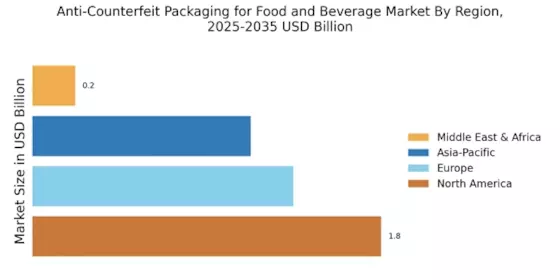
Regional Insights

North America : Innovation and Regulation Hub

North America is the largest market for anti-counterfeit packaging in the food and beverage sector, holding approximately 40% of the global market share. The region's growth is driven by stringent regulations and increasing consumer awareness regarding food safety. The demand for advanced packaging solutions is further fueled by the rise in counterfeit products, prompting companies to invest in innovative technologies. The United States and Canada are the leading countries in this market, with major players like Zebra Technologies and Avery Dennison establishing a strong presence. The competitive landscape is characterized by continuous innovation and partnerships among key players, enhancing the overall market dynamics. The focus on sustainability and compliance with regulations also plays a crucial role in shaping the market strategies of these companies.

Europe : Regulatory Compliance and Innovation

Europe is the second-largest market for anti-counterfeit packaging, accounting for approximately 30% of the global share. The region's growth is significantly influenced by stringent regulations aimed at ensuring product authenticity and consumer safety. The European Union's initiatives to combat counterfeiting have catalyzed demand for advanced packaging solutions, driving innovation in the sector. Leading countries such as Germany, France, and the UK are at the forefront of this market, with key players like Tesa SE and Krones AG actively contributing to the landscape. The competitive environment is marked by a focus on technological advancements and collaborations among industry stakeholders. The presence of robust regulatory frameworks further enhances the market's growth potential, ensuring compliance and fostering consumer trust.

Asia-Pacific : Emerging Market with High Potential

Asia-Pacific is witnessing rapid growth in the anti-counterfeit packaging market, holding approximately 25% of the global share. The region's expansion is driven by increasing urbanization, rising disposable incomes, and a growing awareness of food safety among consumers. Additionally, government initiatives aimed at combating counterfeiting are propelling demand for innovative packaging solutions in the food and beverage sector. Countries like China, India, and Japan are leading the charge, with significant investments from key players such as SATO and Holostik. The competitive landscape is evolving, with a mix of local and international companies striving to capture market share. The focus on technological advancements and sustainable practices is shaping the strategies of these players, enhancing their market presence and consumer appeal.

Middle East and Africa : Resource-Rich with Growing Demand

The Middle East and Africa region is emerging as a significant player in the anti-counterfeit packaging market, accounting for approximately 5% of the global share. The growth is driven by increasing investments in food safety and regulatory measures aimed at combating counterfeiting. The rising demand for packaged food products is also contributing to the market's expansion, as consumers become more aware of the risks associated with counterfeit goods. Countries like South Africa and the UAE are leading the market, with local and international players striving to establish a foothold. The competitive landscape is characterized by a mix of traditional and innovative packaging solutions, with companies focusing on enhancing product authenticity. The region's unique challenges and opportunities present a dynamic environment for growth in the anti-counterfeit packaging sector.

Anti Counterfeit Packaging For Food Beverage Market
 Regional Image

Key Players and Competitive Insights

The Anti-Counterfeit Packaging for Food and Beverage Market is currently characterized by a dynamic competitive landscape, driven by increasing consumer awareness regarding product authenticity and safety. Key players such as SICPA (CH), Zebra Technologies (US), and Avery Dennison (US) are at the forefront, each adopting distinct strategies to enhance their market positioning. SICPA (CH) focuses on innovation through advanced security inks and digital solutions, while Zebra Technologies (US) emphasizes the integration of IoT technologies to provide real-time tracking and authentication. Avery Dennison (US) is leveraging its extensive materials science expertise to develop smart labels that not only prevent counterfeiting but also enhance consumer engagement. Collectively, these strategies contribute to a competitive environment that is increasingly reliant on technological advancements and consumer-centric solutions.

In terms of business tactics, companies are increasingly localizing manufacturing to reduce lead times and enhance supply chain resilience. This approach appears to be particularly effective in a moderately fragmented market, where the collective influence of key players is significant. The competitive structure is evolving, with companies optimizing their supply chains and investing in regional expansions to better serve local markets. This trend indicates a shift towards more agile and responsive operational frameworks, which are essential in addressing the complexities of global supply chains.

In August 2025, Zebra Technologies (US) announced a strategic partnership with a leading beverage manufacturer to implement a comprehensive anti-counterfeit solution that integrates their IoT-enabled tracking systems. This collaboration is poised to enhance product traceability and consumer trust, reflecting a growing trend towards transparency in the food and beverage sector. The strategic importance of this partnership lies in its potential to set a new standard for product authentication, thereby reinforcing Zebra's position as a leader in the anti-counterfeit packaging domain.

In September 2025, Avery Dennison (US) launched a new line of smart labels that utilize NFC technology, allowing consumers to verify product authenticity through their smartphones. This innovation not only addresses counterfeiting but also enhances consumer engagement by providing additional product information. The introduction of these smart labels signifies a critical step towards integrating digital solutions into packaging, which may redefine consumer interactions with brands and products.

In July 2025, SICPA (CH) expanded its operations in Asia by establishing a new manufacturing facility aimed at producing advanced security inks tailored for the food and beverage industry. This move is indicative of SICPA's commitment to meeting the growing demand for anti-counterfeit solutions in emerging markets. The strategic establishment of local production capabilities is likely to enhance responsiveness to regional needs and strengthen SICPA's competitive edge in the global market.

As of October 2025, the competitive trends in the Anti-Counterfeit Packaging for Food and Beverage Market are increasingly shaped by digitalization, sustainability, and the integration of artificial intelligence. Strategic alliances among key players are fostering innovation and enhancing the overall value proposition of anti-counterfeit solutions. Looking ahead, it appears that competitive differentiation will increasingly pivot from price-based strategies to a focus on innovation, technological advancements, and supply chain reliability, as companies strive to meet the evolving demands of consumers and regulatory frameworks.

Key Companies in the Anti Counterfeit Packaging For Food Beverage Market market include

Industry Developments

  • Q2 2024: Avery Dennison launches new RFID-enabled anti-counterfeit packaging solution for food industry Avery Dennison announced the launch of a new RFID-enabled packaging solution designed to combat counterfeiting in the food sector, offering enhanced traceability and authentication features for manufacturers and retailers.
  • Q2 2024: SICPA partners with Nestlé to deploy digital anti-counterfeit packaging for bottled beverages SICPA entered a partnership with Nestlé to implement digital authentication technology on Nestlé’s bottled beverage packaging, aiming to reduce counterfeiting and improve supply chain transparency.
  • Q3 2024: Authentix acquires UK-based security packaging firm SecurityPrint Ltd. Authentix completed the acquisition of SecurityPrint Ltd., expanding its portfolio of anti-counterfeit packaging solutions for the food and beverage market and strengthening its presence in Europe.
  • Q1 2024: VeriPac secures $15M Series B funding to scale anti-counterfeit packaging for food brands VeriPac raised $15 million in Series B funding to accelerate the development and deployment of its anti-counterfeit packaging technologies for global food brands.
  • Q2 2025: Tetra Pak unveils blockchain-based traceability platform for beverage packaging Tetra Pak launched a blockchain-powered traceability platform for its beverage packaging, enabling real-time authentication and anti-counterfeit protection for consumers and supply chain partners.
  • Q1 2025: Amcor opens new anti-counterfeit packaging R&D center in Singapore Amcor inaugurated a research and development center in Singapore focused on advancing anti-counterfeit packaging technologies for the food and beverage industry.
  • Q2 2024: SIG Combibloc signs contract to supply tamper-evident beverage cartons to leading Asian dairy producer SIG Combibloc secured a contract to provide tamper-evident beverage cartons to a major Asian dairy company, enhancing product safety and anti-counterfeit measures.
  • Q3 2024: Systech and Danone announce partnership for digital anti-counterfeit packaging in infant formula Systech and Danone formed a partnership to deploy digital anti-counterfeit packaging solutions for Danone’s infant formula products, aiming to protect consumers and ensure product authenticity.
  • Q1 2025: Sealed Air launches new tamper-evident packaging line for ready-to-eat foods Sealed Air introduced a tamper-evident packaging line specifically designed for ready-to-eat food products, featuring advanced anti-counterfeit security elements.
  • Q2 2025: DuPont receives regulatory approval for new anti-counterfeit food packaging material in EU DuPont obtained regulatory approval from the European Union for its newly developed anti-counterfeit packaging material, enabling food manufacturers to enhance product security.
  • Q3 2024: TruTag Technologies wins contract to supply edible anti-counterfeit tags for beverage company TruTag Technologies was awarded a contract to supply edible anti-counterfeit tags for a global beverage company, providing a novel solution for product authentication.
  • Q1 2024: AIPIA appoints new CEO to lead anti-counterfeit packaging innovation initiatives AIPIA announced the appointment of a new CEO to drive innovation and strategic growth in anti-counterfeit packaging solutions for the food and beverage sector.

Future Outlook

Anti Counterfeit Packaging For Food Beverage Market Future Outlook

The Anti-Counterfeit Packaging for Food and Beverage Market is projected to grow at a 5.48% CAGR from 2024 to 2035, driven by technological advancements and increasing consumer awareness.

New opportunities lie in:

  • Integration of blockchain technology for enhanced traceability
  • Development of smart packaging solutions with IoT capabilities
  • Expansion of anti-counterfeit labeling in emerging markets

By 2035, the market is expected to be robust, driven by innovation and heightened regulatory demands.

Market Segmentation

Anti Counterfeit Packaging For Food Beverage Market End Use Outlook

  • Food
  • Beverages
  • Dairy Products
  • Alcoholic Drinks
  • Non-Alcoholic Drinks

Anti Counterfeit Packaging For Food Beverage Market Material Outlook

  • Plastic
  • Glass
  • Metal
  • Paper
  • Composites

Anti Counterfeit Packaging For Food Beverage Market Technology Outlook

  • Holography
  • RFID
  • QR Codes
  • Digital Watermarking
  • Serialization

Anti Counterfeit Packaging For Food Beverage Market Packaging Type Outlook

  • Labels
  • Wraps
  • Tamper-Evident Packaging
  • Shrink Sleeves
  • Bottles

Report Scope

MARKET SIZE 20244.472(USD Billion)
MARKET SIZE 20254.717(USD Billion)
MARKET SIZE 20358.043(USD Billion)
COMPOUND ANNUAL GROWTH RATE (CAGR)5.48% (2024 - 2035)
REPORT COVERAGERevenue Forecast, Competitive Landscape, Growth Factors, and Trends
BASE YEAR2024
Market Forecast Period2025 - 2035
Historical Data2019 - 2024
Market Forecast UnitsUSD Billion
Key Companies ProfiledMarket analysis in progress
Segments CoveredMarket segmentation analysis in progress
Key Market OpportunitiesIntegration of advanced digital technologies enhances traceability in the Anti-Counterfeit Packaging for Food and Beverage Market.
Key Market DynamicsRising consumer awareness drives demand for advanced anti-counterfeit packaging solutions in the food and beverage sector.
Countries CoveredNorth America, Europe, APAC, South America, MEA

Leave a Comment

FAQs

What is the projected market valuation for the Anti-Counterfeit Packaging for Food and Beverage Market in 2035?

The projected market valuation for 2035 is 8.043 USD Billion.

What was the market valuation for this sector in 2024?

The overall market valuation was 4.472 USD Billion in 2024.

What is the expected CAGR for the Anti-Counterfeit Packaging market from 2025 to 2035?

The expected CAGR during the forecast period 2025 - 2035 is 5.48%.

Which technology segment is anticipated to grow the most by 2035?

The Serialization technology segment is projected to grow from 1.472 USD Billion in 2024 to 2.543 USD Billion by 2035.

How do the key players influence the Anti-Counterfeit Packaging market?

Key players like SICPA, Zebra Technologies, and Avery Dennison are likely to drive innovation and market growth.

What is the expected growth for the Tamper-Evident Packaging segment by 2035?

The Tamper-Evident Packaging segment is expected to increase from 1.2 USD Billion in 2024 to 2.2 USD Billion by 2035.

Which end-use segment shows the highest valuation in 2024?

In 2024, the Food end-use segment had the highest valuation at 1.5 USD Billion.

What is the projected growth for the Plastic material segment by 2035?

The Plastic material segment is projected to grow from 1.5 USD Billion in 2024 to 2.7 USD Billion by 2035.

How does the market for QR Codes in anti-counterfeit packaging evolve by 2035?

The market for QR Codes is expected to grow from 0.6 USD Billion in 2024 to 1.0 USD Billion by 2035.

What are the anticipated trends in the Anti-Counterfeit Packaging market for beverages?

The Beverages segment is projected to grow from 1.2 USD Billion in 2024 to 2.1 USD Billion by 2035.

Download Free Sample

Kindly complete the form below to receive a free sample of this Report

Compare Licence

×
Features License Type
Single User Multiuser License Enterprise User
Price $4,950 $ $7,250
Maximum User Access Limit 1 User Upto 10 Users Unrestricted Access Throughout the Organization
Free Customization
Direct Access to Analyst
Deliverable Format
Platform Access
Discount on Next Purchase 10% 15% 15%
Printable Versions