Download Free Sample
Kindly complete the form below to receive a free sample of this Report
Anti-Jamming GPS Market Size, Share and Research Report By Technology (Military-Grade GPS, Software-Based Anti-Jamming, Phased Array Antennas, Adaptive Filter Technology), By Application (Military and Defense, Civilian and Commercial, Law Enforcement and Public Safety, Critical Infrastructure Protection), By End-User (Government Agencies, Private Security Companies, Military Forces, Commercial Enterprises), By Application Scenario (Anti-Spoofing, Anti-Tracking, Multipath Mitigation, Signal Restoration), By Platform (Ground-Based, Airborne, Naval, Space-Based) and By Regional (North America, Europe, South America, Asia Pacific, Middle East and Africa) - Industry Forecast Till 2035
As per Market Research Future analysis, the Anti-Jamming GPS Market Size was estimated at 4.0 USD Billion in 2024. The Anti-Jamming GPS industry is projected to grow from 4.209 USD Billion in 2025 to 7.001 USD Billion by 2035, exhibiting a compound annual growth rate (CAGR) of 5.22% during the forecast period 2025 - 2035
The Anti-Jamming GPS Market is poised for substantial growth driven by technological advancements and increasing security demands.
| 2024 Market Size | 4.0 (USD Billion) |
| 2035 Market Size | 7.001 (USD Billion) |
| CAGR (2025 - 2035) | 5.22% |
The Anti-Jamming GPS Market is currently experiencing a notable evolution, driven by the increasing reliance on GPS technology across various sectors. As global navigation satellite systems become integral to operations in industries such as transportation, defense, and agriculture, the demand for anti-jamming solutions appears to be on the rise. This trend is likely influenced by the growing awareness of vulnerabilities associated with GPS signals, which can be disrupted by intentional jamming or unintentional interference. Consequently, stakeholders are investing in advanced technologies to enhance the resilience of GPS systems against such threats. Moreover, the landscape of the Anti-Jamming GPS Market is characterized by rapid technological advancements. Innovations in signal processing and the integration of artificial intelligence are emerging as pivotal factors that could redefine the capabilities of anti-jamming solutions. As organizations seek to safeguard their navigation systems, the development of more sophisticated anti-jamming techniques may become a focal point. This shift not only reflects the evolving nature of threats but also indicates a broader trend towards enhancing the security and reliability of GPS-dependent applications. Overall, the Anti-Jamming GPS Market is poised for growth, driven by both technological progress and an increasing emphasis on security in navigation systems.
The Anti-Jamming GPS Market is witnessing a surge in demand for security solutions as organizations recognize the vulnerabilities associated with GPS technology. This heightened awareness is prompting investments in anti-jamming technologies to protect critical operations from potential disruptions.
Innovations in signal processing are playing a crucial role in shaping the Anti-Jamming GPS Market. The integration of advanced algorithms and artificial intelligence is enhancing the effectiveness of anti-jamming solutions, allowing for improved resilience against interference.
The Anti-Jamming GPS Market is expanding across various industries, including defense, transportation, and agriculture. This diversification indicates a growing recognition of the importance of reliable GPS systems, leading to increased adoption of anti-jamming technologies.
The rise of autonomous vehicles is significantly influencing the Anti-Jamming GPS Market. As self-driving technology advances, the reliance on precise GPS signals becomes increasingly critical. Autonomous vehicles require uninterrupted navigation capabilities to ensure safety and efficiency. Consequently, manufacturers are integrating anti-jamming solutions to mitigate risks associated with signal interference. Market data suggests that the autonomous vehicle sector is expected to grow exponentially, with a substantial portion of this growth attributed to the demand for robust GPS systems. This trend indicates a promising future for the Anti-Jamming GPS Market, as it aligns with the broader shift towards automation in transportation.
The Anti-Jamming GPS Market is experiencing a notable surge in demand due to the increasing applications within military operations. As nations prioritize national security, the need for reliable navigation systems that can withstand jamming attempts becomes paramount. Military forces are investing heavily in advanced anti-jamming technologies to ensure operational effectiveness in hostile environments. Reports indicate that military expenditures on GPS technologies are projected to rise, with anti-jamming systems being a critical component. This trend is likely to drive innovation and development within the Anti-Jamming GPS Market, as defense contractors seek to provide cutting-edge solutions that enhance situational awareness and mission success.
The Anti-Jamming GPS Market is witnessing growth driven by the agricultural sector's increasing reliance on precision farming techniques. Farmers are adopting GPS-guided equipment to enhance productivity and efficiency. However, the vulnerability of GPS signals to jamming poses a significant challenge. As a result, there is a growing demand for anti-jamming solutions to ensure uninterrupted service. The agricultural technology market is projected to expand, with anti-jamming GPS systems playing a crucial role in safeguarding operations. This trend highlights the potential for innovation within the Anti-Jamming GPS Market, as stakeholders seek to develop solutions tailored to the unique needs of modern agriculture.
The Anti-Jamming GPS Market is also influenced by the growing demand for consumer electronics that incorporate GPS functionalities. As smartphones, wearables, and other devices increasingly rely on GPS for navigation and location-based services, the need for robust anti-jamming solutions becomes evident. Consumers expect reliable performance, and any disruption in GPS signals can lead to dissatisfaction. Market analysis indicates that the consumer electronics sector is expanding, with GPS-enabled devices becoming ubiquitous. This trend is likely to drive the adoption of anti-jamming technologies within the Anti-Jamming GPS Market, as manufacturers strive to meet consumer expectations for reliability and accuracy.
The Anti-Jamming GPS Market is benefiting from increasing regulatory support aimed at enhancing navigation technologies. Governments are recognizing the importance of reliable GPS systems for various applications, including transportation, logistics, and emergency services. Regulatory bodies are implementing standards that promote the adoption of anti-jamming technologies to ensure the integrity of navigation systems. This supportive environment is likely to stimulate investment in the Anti-Jamming GPS Market, as companies seek to comply with emerging regulations. The alignment of regulatory frameworks with technological advancements suggests a favorable landscape for growth and innovation in the sector.
The Anti-Jamming GPS Market boasts a diverse array of technologies, with Military-Grade GPS holding the largest share due to its critical applications in defense operations. This segment remains essential for ensuring reliable navigation and communication in contested environments, providing resilience against jamming threats. In contrast, Software-Based Anti-Jamming solutions are emerging rapidly, driven by advancements in digital signal processing and increased demand across civilian applications. This technology is becoming increasingly vital in commercial sectors, such as transportation and telecommunications, where uninterrupted GPS signals are crucial.
Technology: Military-Grade GPS (Dominant) vs. Software-Based Anti-Jamming (Emerging)
Military-Grade GPS technologies are characterized by their robustness and precision, making them indispensable in military operations and strategic applications. These systems are designed to operate reliably even in the presence of sophisticated jamming tactics. On the other hand, Software-Based Anti-Jamming is an emerging solution gaining traction by leveraging algorithms to enhance signal integrity. The flexibility and adaptability of software solutions allow for rapid deployment and updates, catering to a broader range of civilian uses. As the need for secure and reliable navigation grows, the competition between these two technologies will likely intensify.
The Anti-Jamming GPS Market exhibits a diverse application range, with the Military and Defense sector holding the largest market share. This segment benefits from significant investments in advanced technologies to enhance navigation reliability and security, driven by heightened defense strategies. In contrast, the Civilian and Commercial application segment is rapidly expanding, fueled by increasing reliance on GPS for navigation in consumer electronics, logistics, and transportation, making it the fastest-growing area in the market.
Military and Defense: Dominant vs. Civilian and Commercial: Emerging
The Military and Defense application stands out as the dominant segment within the Anti-Jamming GPS Market, characterized by its robust demand for reliable navigation systems in various defense operations. This segment emphasizes high-level encryption and anti-jamming features to ensure mission success. On the other hand, the Civilian and Commercial sector is emerging, driven by expanding use cases in automotive navigation, personal devices, and commercial logistics. This growth is supported by technological advancements, such as multi-constellation systems and improved signal integrity, catering to a broader audience and enhancing positioning accuracy.
In the Anti-Jamming GPS Market, the distribution of market share among end-user segments reveals that Government Agencies hold the largest share, driven by the increasing need for reliable navigation systems in public safety and transportation sectors. Military Forces, on the other hand, are witnessing significant growth due to modernization efforts and evolving battlefield requirements, highlighting their strategic importance in adopting anti-jamming technologies.
Government Agencies: Dominant vs. Military Forces: Emerging
Government Agencies represent a dominant force in the Anti-Jamming GPS Market, relying on advanced positioning solutions to enhance operational efficiency and security. Their investments in anti-jamming technology stem from increasing demands for precise navigation in emergency services and defense initiatives. Conversely, Military Forces are emerging as a fast-growing segment, propelled by the need for robust and resilient navigation tools in combat and reconnaissance settings. The rapid advancements in military technology and a shift towards greater reliance on GPS for tactical operations are fueling this growth, indicating a dynamic landscape where both segments play crucial roles in enhancing the effectiveness of GPS systems.
The Anti-Jamming GPS Market exhibits a notable distribution among its application scenarios. Anti-Spoofing leads the segment, commanding the largest share due to its critical role in maintaining the integrity of GPS signals against malicious falsification. Following closely is Anti-Tracking, which significantly contributes to securing user privacy in sensitive positioning applications. Meanwhile, Multipath Mitigation enhances the reliability of GPS signals in challenging environments, addressing multipath effects that degrade accuracy. Lastly, Signal Restoration is emerging rapidly as a vital solution, catering to the increasing demand for reliability in GPS-dependent technologies. Recent trends indicate robust growth within the Anti-Jamming GPS Market segment, primarily driven by advancements in technology and the escalating threat of GPS signal spoofing and jamming. Increased adoption of GPS technologies across sectors such as military, aviation, and automotive fuels demand for Anti-Spoofing techniques. The rise of advanced algorithms and the integration of machine learning also propels growth, especially for Signal Restoration, positioning it as a key growth segment for the future. As challenges evolve in modern navigation, companies are prioritizing investment in these applications to enhance positioning accuracy and security.
Anti-Spoofing (Dominant) vs. Anti-Tracking (Emerging)
Anti-Spoofing technology maintains its dominant position in the Anti-Jamming GPS Market as it provides invaluable defenses against unauthorized signal manipulation. This segment's solutions are critical for sectors that require high-security standards, such as the military and aviation industries. Anti-Tracking, while an emerging player, offers considerable potential by safeguarding user privacy. Its market presence is bolstered by growing public awareness and legislation supporting privacy rights. Both segments focus on technological advancements, with Anti-Spoofing consistently innovating to counteract evolving threats, while Anti-Tracking leverages emerging blockchain and encryption technologies. As demand for secure and reliable GPS capabilities rises, these segments represent vital components of the broader market landscape.
In the Anti-Jamming GPS Market, the platform segmentation reveals that Ground-Based systems currently hold the largest market share, thanks to their widespread applications across various sectors including urban navigation and government defense operations. This platform benefits from established technology and extensive integration, making it a preferred choice among users in both civilian and military sectors. Conversely, the Airborne segment is emerging as the fastest-growing area, fueled by advancements in aviation technology and increasing demand for anti-jamming capabilities in unmanned aerial vehicles and commercial aircraft.
Ground-Based (Dominant) vs. Airborne (Emerging)
Ground-Based Anti-Jamming GPS Market systems represent the dominant force in the market, characterized by their reliability and cost-effectiveness for applications such as military operations and civil infrastructure. These systems utilize established technologies that ensure robust signal integrity, making them essential for accurate positioning in GPS-dependent environments. In contrast, Airborne Anti-Jamming systems are on the rise, primarily due to their integration into advanced aviation platforms. They are engineered to operate at high altitudes and speeds, providing essential navigation support in complex environments where jamming is prevalent. This segment is poised for growth driven by increasing investments in aerospace technologies and the proliferation of drone operations.
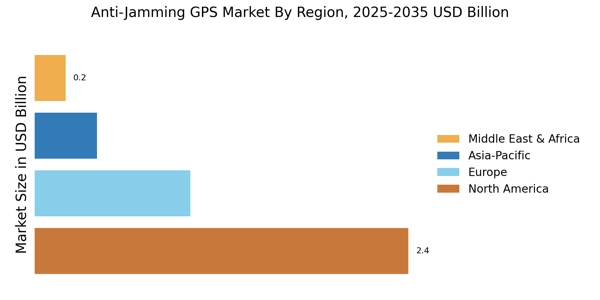
North America is the largest market for anti-jamming GPS technology, driven by significant investments in defense and aerospace sectors. The U.S. government’s focus on enhancing military capabilities and securing GPS systems against jamming threats has led to a robust demand for advanced anti-jamming solutions. This region holds approximately 60% of the global market share, with a strong regulatory framework supporting innovation and development in this field. The competitive landscape in North America is characterized by the presence of major players such as Northrop Grumman, Raytheon Technologies, and Lockheed Martin. These companies are at the forefront of technological advancements, collaborating with government agencies to develop cutting-edge anti-jamming systems. The U.S. military's increasing reliance on GPS technology further fuels market growth, ensuring a continuous demand for reliable and secure navigation solutions.
Europe is witnessing a growing demand for anti-jamming GPS technology, driven by increasing concerns over security and the need for reliable navigation systems. The region is characterized by a strong regulatory framework that encourages the development of advanced technologies. Countries like France and Germany are leading the market, collectively holding around 25% of the global share. The European Union's initiatives to enhance defense capabilities further catalyze market growth, promoting innovation in anti-jamming solutions. Key players in Europe include Thales Group and other defense contractors that are actively involved in developing anti-jamming technologies. The competitive landscape is evolving, with collaborations between private companies and government entities to address security challenges. The emphasis on enhancing military and civilian GPS systems is expected to drive further advancements in this sector, ensuring a robust market presence in the coming years.
Asia-Pacific is rapidly emerging as a significant market for anti-jamming GPS technology, driven by increasing military expenditures and the need for secure navigation systems. Countries like China and India are investing heavily in defense capabilities, contributing to a market share of approximately 10%. The region's growth is further supported by government initiatives aimed at enhancing technological advancements and addressing security concerns related to GPS systems. The competitive landscape in Asia-Pacific is characterized by a mix of local and international players, with companies like Elbit Systems gaining traction. The demand for anti-jamming solutions is expected to rise as nations prioritize the development of secure navigation systems for both military and civilian applications. This trend is likely to foster innovation and collaboration among key stakeholders in the region, ensuring a dynamic market environment.
The Middle East and Africa region is increasingly recognizing the importance of anti-jamming GPS technology, driven by strategic defense investments and the need for reliable navigation systems. Countries in this region are focusing on enhancing their military capabilities, with a market share of around 5%. The growing threat of jamming and interference in GPS signals has prompted governments to prioritize the development of secure navigation solutions, supported by international collaborations and partnerships. Key players in this region are beginning to emerge, with a focus on localizing technology and enhancing defense capabilities. The competitive landscape is evolving, with increased interest from both regional and global companies looking to tap into the growing demand for anti-jamming solutions. As military and civilian applications expand, the market is expected to witness significant growth in the coming years, driven by strategic investments and technological advancements.
Major players in Anti-Jamming GPS Market industry are constantly striving to develop and launch innovative products to gain a competitive edge. Leading Anti-Jamming GPS Market players are investing heavily in research and development to enhance the capabilities of their products and cater to the evolving needs of customers. The Anti-Jamming GPS Market industry is characterized by intense competition, with key players vying for market share through strategic partnerships, acquisitions, and aggressive marketing campaigns. Continuous technological advancements and the growing adoption of Anti-Jamming GPS Market solutions across various sectors are driving the Anti-Jamming GPS Market development, creating opportunities for market growth.
Among the leading players in the Anti-Jamming GPS Market, Rockwell Collins is a prominent provider of advanced navigation and communication systems for aerospace and defense applications. The company's extensive product portfolio includes anti-jamming GPS solutions tailored to meet the specific requirements of military and government customers. Rockwell Collins leverages its expertise in signal processing and antenna design to deliver reliable and secure navigation solutions that enhance situational awareness and mission effectiveness. Through strategic partnerships and ongoing investments in innovation, Rockwell Collins aims to maintain its position as a leading player in the Anti-Jamming GPS Market.
In addition to Rockwell Collins, another key competitor in the Anti-Jamming GPS Market is Leonardo DRS, a global defense and security company specializing in advanced electronic systems and technologies. Leonardo DRS offers a comprehensive suite of anti-jamming GPS solutions for military and commercial applications. The company's products are designed to provide robust and resilient navigation capabilities in challenging environments where GPS signals may be compromised. Leonardo DRS focuses on developing innovative technologies, such as adaptive beamforming and frequency hopping, to enhance the performance and reliability of its anti-jamming GPS solutions.
The company's commitment to research and development, coupled with its strong customer relationships, positions Leonardo DRS as a formidable competitor in the Anti-Jamming GPS Market.
The Anti-Jamming GPS Market is anticipated to reach USD 7.5 billion by 2032, growing at a 9.89% CAGR from 2024 to 2032. The market growth is attributed to the increasing demand for anti-jamming GPS devices in military and defense applications. The rising geopolitical tensions and the growing threat of signal jamming have led to a surge in demand for anti-jamming GPS devices. Moreover, the advancements in technology, such as the development of software-defined radios and the integration of artificial intelligence, are expected to further drive market growth. Key market players include Lockheed Martin, Northrop Grumman, and BAE Systems.
Recent developments in the market include the introduction of new products, such as the AN/PSN-14 Precision Navigation and Timing Receiver by Lockheed Martin, and the development of new technologies, such as the GPS Anti-Jamming System by BAE Systems.
The Anti-Jamming GPS Market is projected to grow at a 5.22% CAGR from 2025 to 2035, driven by increasing demand for secure navigation and advancements in technology.
New opportunities lie in:
By 2035, the Anti-Jamming GPS Market is expected to be robust, driven by technological advancements and strategic partnerships.
| MARKET SIZE 2024 | 4.0(USD Billion) |
| MARKET SIZE 2025 | 4.209(USD Billion) |
| MARKET SIZE 2035 | 7.001(USD Billion) |
| COMPOUND ANNUAL GROWTH RATE (CAGR) | 5.22% (2025 - 2035) |
| REPORT COVERAGE | Revenue Forecast, Competitive Landscape, Growth Factors, and Trends |
| BASE YEAR | 2024 |
| Market Forecast Period | 2025 - 2035 |
| Historical Data | 2019 - 2024 |
| Market Forecast Units | USD Billion |
| Key Companies Profiled | Northrop Grumman (US), Raytheon Technologies (US), Lockheed Martin (US), Thales Group (FR), Rockwell Collins (US), Boeing (US), L3Harris Technologies (US), General Dynamics (US), Elbit Systems (IL) |
| Segments Covered | Technology, Application, End-User, Application Scenario, Platform, Regional |
| Key Market Opportunities | Integration of advanced anti-jamming technologies in autonomous vehicles enhances navigation reliability and safety. |
| Key Market Dynamics | Rising demand for secure navigation solutions drives innovation in anti-jamming GPS technologies and competitive market dynamics. |
| Countries Covered | North America, Europe, APAC, South America, MEA |
The projected market valuation of the Anti-Jamming GPS Market is expected to reach 7.001 USD Billion by 2035.
The overall market valuation of the Anti-Jamming GPS Market was 4.0 USD Billion in 2024.
The expected CAGR for the Anti-Jamming GPS Market during the forecast period 2025 - 2035 is 5.22%.
Key players in the Anti-Jamming GPS Market include Northrop Grumman, Raytheon Technologies, Lockheed Martin, and Thales Group.
The main technology segments include Military-Grade GPS, Software-Based Anti-Jamming, Phased Array Antennas, and Adaptive Filter Technology.
The Military and Defense application segment is projected to grow from 1.5 USD Billion to 2.5 USD Billion by 2035.
The Anti-Spoofing application scenario is expected to range from 1.2 USD Billion to 2.1 USD Billion by 2035.
The Space-Based platform segment is anticipated to grow from 1.0 USD Billion to 2.3 USD Billion by 2035.
The Military Forces end-user segment is expected to have the highest valuation, growing from 1.5 USD Billion to 2.5 USD Billion by 2035.
The Civilian and Commercial application segment is projected to grow from 1.0 USD Billion to 1.5 USD Billion by 2035.





Kindly complete the form below to receive a free sample of this Report

“This is really good guys. Excellent work on a tight deadline. I will continue to use you going forward and recommend you to others. Nice job”


“Thanks. It’s been a pleasure working with you, please use me as reference with any other Intel employees.”


“Thanks for sending the report it gives us a good global view of the Betaïne market.”


“Thank you, this will be very helpful for OQS.”


“We found the report very insightful! we found your research firm very helpful. I'm sending this email to secure our future business.”


“I am very pleased with how market segments have been defined in a relevant way for my purposes (such as "Portable Freezers & refrigerators" and "last-mile"). In general the report is well structured. Thanks very much for your efforts.”


“I have been reading the first document or the study, ,the Global HVAC and FP market report 2021 till 2026. Must say, good info! I have not gone in depth at all parts, but got a good indication of the data inside!”


“We got the report in time, we really thank you for your support in this process. I also thank to all of your team as they did a great job.”


“The Automotive 48V ECU Components Procurement Intelligence Study” was a complex project, but the Market Research Future (MRFR) team handled it with quality, agility, and customer-centricity. They delivered all requested data on time and within the agreed scope. The team, including Shubhendra Anand and Rahul Gotadki, was always readily available to clarify questions and swiftly implement necessary adjustments, driving the project to a successful conclusion within a very demanding timeframe.
I would also like to specifically commend Akshay Agarwal for his responsiveness and support at every stage—from our initial inquiry on May 6th through to final delivery on June 18th. His dedication made the entire process seamless.”



