×
Request Free Sample ×

Kindly complete the form below to receive a free sample of this Report

Leading companies partner with us for data-driven Insights

clients tt-cursor
Hero Background

Anti Riot Equipment Market

ID: MRFR/Equip/33505-HCR
111 Pages
Snehal Singh
October 2025

Anti-Riot Equipment Market Research Report By Equipment Type (Protective Gear, Crowd Control Equipment, Non-Lethal Weapons, Surveillance Equipment), By Application (Law Enforcement, Military, Private Security, Public Events), By Material (Polymer, Metal, Composite, Fabric, Rubber), By Distribution Channel (Online, Retail, Distributors, Direct Sales) and By Regional (North America, Europe, South America, Asia Pacific, Middle East and Africa) - Forecast to 2035

Share:
Download PDF ×

We do not share your information with anyone. However, we may send you emails based on your report interest from time to time. You may contact us at any time to opt-out.

Anti Riot Equipment Market
 Infographic
Purchase Options

Anti Riot Equipment Market Summary

As per MRFR analysis, the Anti Riot Equipment Market Size was estimated at 6.145 USD Billion in 2024. The Anti Riot Equipment industry is projected to grow from 6.404 USD Billion in 2025 to 9.675 USD Billion by 2035, exhibiting a compound annual growth rate (CAGR) of 4.21 during the forecast period 2025 - 2035.

Key Market Trends & Highlights

The Anti Riot Equipment Market is experiencing a dynamic shift towards advanced, non-lethal solutions driven by rising civil unrest and public safety concerns.

  • Technological advancements are reshaping the Anti Riot Equipment Market, enhancing the effectiveness and safety of riot control measures.
  • The demand for non-lethal options is increasing, particularly in North America, where public sentiment favors less aggressive policing methods.
  • Protective gear remains the largest segment, while crowd control equipment is emerging as the fastest-growing category in response to evolving urban challenges.
  • Rising civil unrest and government initiatives focused on public safety are key drivers propelling market growth in both North America and Asia-Pacific.

Market Size & Forecast

2024 Market Size 6.145 (USD Billion)
2035 Market Size 9.675 (USD Billion)
CAGR (2025 - 2035) 4.21%

Major Players

Safariland (US), Harris (US), 3M (US), Condor Outdoor Products (US), Armored Republic (US), Tactical Defense Systems (US), Bolle Safety (FR), Mace Security International (US), Nonlethal Technologies (US)

Anti Riot Equipment Market Trends

The Anti Riot Equipment Market is currently experiencing a notable evolution, driven by various factors including increasing civil unrest and the growing need for public safety measures. Governments and law enforcement agencies are increasingly investing in advanced technologies and equipment to manage crowd control effectively. This shift appears to be influenced by a heightened awareness of the importance of maintaining order during protests and demonstrations. As a result, manufacturers are innovating their product lines to include non-lethal options that prioritize the safety of both law enforcement personnel and civilians. Moreover, the market seems to be expanding due to the rising demand for personal protective gear among security forces. This trend indicates a broader recognition of the necessity for adequate protection in volatile situations. Additionally, the integration of smart technologies into anti-riot equipment is likely to enhance operational efficiency and effectiveness. As the landscape of public safety continues to evolve, the Anti Riot Equipment Market is poised for further growth, reflecting the ongoing commitment to ensuring safety and security in society.

Technological Advancements

The Anti Riot Equipment Market is witnessing a surge in technological innovations, with manufacturers focusing on integrating smart features into their products. This trend suggests a shift towards more effective crowd management solutions, enhancing the capabilities of law enforcement agencies.

Increased Demand for Non-Lethal Options

There is a growing preference for non-lethal anti-riot equipment among law enforcement agencies. This trend indicates a societal shift towards prioritizing safety and minimizing harm during crowd control operations, reflecting a more humane approach to managing civil unrest.

Focus on Personal Protective Gear

The emphasis on personal protective equipment for security personnel is becoming more pronounced. This trend highlights the recognition of the need for adequate protection in potentially dangerous situations, ensuring the safety of those tasked with maintaining order.

Anti Riot Equipment Market Drivers

Rising Civil Unrest

The Anti Riot Equipment Market appears to be significantly influenced by the increasing frequency of civil unrest across various regions. Factors such as political instability, social inequality, and economic challenges contribute to heightened tensions, leading to protests and riots. As a result, law enforcement agencies and private security firms are compelled to invest in anti-riot equipment to maintain order and ensure public safety. Recent data indicates that the demand for such equipment has surged, with a notable increase in procurement budgets allocated for riot control gear. This trend suggests that the Anti Riot Equipment Market is likely to experience sustained growth as authorities seek to effectively manage civil disturbances.

Technological Innovations

Technological innovations play a crucial role in shaping the Anti Riot Equipment Market. The development of advanced materials and smart technologies has led to the creation of more effective and efficient riot control equipment. Innovations such as non-lethal weapons, advanced surveillance systems, and crowd monitoring technologies are becoming increasingly prevalent. These advancements not only enhance the effectiveness of riot control measures but also improve the safety of both law enforcement personnel and civilians. Market data suggests that the integration of technology in anti-riot gear is expected to drive substantial growth in the industry, as stakeholders seek to leverage these innovations for better crowd management solutions.

Increased Focus on Public Safety

The growing emphasis on public safety is a significant driver of the Anti Riot Equipment Market. As urban populations expand and social tensions rise, the need for effective crowd control measures becomes more pronounced. Law enforcement agencies are increasingly prioritizing the acquisition of anti-riot equipment to ensure the safety of citizens during public gatherings. This focus on safety is reflected in the rising budgets allocated for riot control gear, as authorities recognize the importance of being prepared for potential unrest. Consequently, the Anti Riot Equipment Market is likely to witness continued growth as public safety remains a top priority for governments and security organizations.

Government Initiatives and Regulations

Government initiatives aimed at enhancing public safety and security are pivotal drivers of the Anti Riot Equipment Market. Many governments are implementing stricter regulations regarding crowd control and the use of force, which necessitates the adoption of advanced anti-riot technologies. For instance, legislation mandating the use of non-lethal options in crowd management has led to increased investments in protective gear and equipment. Furthermore, funding programs for law enforcement agencies to acquire modern riot control tools have been established, thereby stimulating market growth. The Anti Riot Equipment Market is thus positioned to benefit from these regulatory frameworks that prioritize safety and effective crowd management.

Global Sporting Events and Large Gatherings

The occurrence of The Anti Riot Equipment Industry. Such events often attract large crowds, which can lead to heightened security concerns and the potential for unrest. As a result, event organizers and local authorities are increasingly investing in anti-riot equipment to ensure the safety of attendees and maintain order. The demand for crowd control solutions during these events has led to a notable increase in the procurement of anti-riot gear. This trend indicates that the Anti Riot Equipment Market is poised for growth, driven by the necessity of effective crowd management strategies during high-profile gatherings.
Market Segment Insights

By Type: Protective Gear (Largest) vs. Crowd Control Equipment (Fastest-Growing)

The Anti Riot Equipment Market is primarily divided into four crucial segment values: Protective Gear, Crowd Control Equipment, Non-Lethal Weapons, and Surveillance Equipment. Protective Gear holds the largest market share, as it forms the backbone of safety protocols in riot situations. This segment includes helmets, body armor, and shields that are essential for law enforcement and security personnel. Meanwhile, Crowd Control Equipment is booming rapidly, gaining traction among law enforcement agencies due to increasing demand for efficient management of large gatherings.

Crowd Control Equipment: Tactical Gear (Dominant) vs. Non-Lethal Weapons (Emerging)

Tactical Gear, falling under Crowd Control Equipment, is critical in maintaining order during riots and protests. This equipment includes barricades, riot shields, and mobile sound systems that offer enhanced deployment options. With increasing instances of political unrest and mass gatherings, the market for Tactical Gear is positioned as dominant due to its widespread use among police forces globally. On the other hand, Non-Lethal Weapons are emerging as innovative solutions to address crowd management without lethal force, encompassing technologies such as tasers and gas. Their increasing acceptance marks them as a vital part of the modern approach to riot control.

By Application: Law Enforcement (Largest) vs. Military (Fastest-Growing)

The Anti Riot Equipment Market is heavily influenced by the application across various sectors, with law enforcement taking the largest share. Law enforcement agencies require a variety of anti-riot gear to maintain public order and manage civil unrest effectively. This segment benefits from recurring government budgets and increasing incidents of civil disturbances, leading to enhanced procurement in riot control equipment. In contrast, the military segment is witnessing rapid growth, driven by rising defense budgets and a heightened focus on domestic stability amidst global conflicts. As military organizations seek advanced protective gear, this sector is evolving to incorporate more sophisticated technologies in anti-riot equipment.

Law Enforcement: Dominant vs. Military: Emerging

The law enforcement sector remains dominant in the Anti Riot Equipment Market due to its consistent demand for gear such as shields, helmets, and non-lethal weaponry to control crowds. With increasing protests and civil disturbances worldwide, law enforcement agencies are prioritizing the enhancement of their riot control capabilities, making it a stable market segment. On the other hand, the military sector is emerging rapidly as defense forces around the globe adapt to urban warfare and civil unrest scenarios. This sector is witnessing innovative product developments, including advanced body armor and non-lethal options designed for operational flexibility. The blend of traditional riot response strategies with the incorporation of modern technology marks a significant shift in the military's approach to riot control.

By Material: Polymer (Largest) vs. Metal (Fastest-Growing)

In the Anti Riot Equipment Market, the material segment is dominated by polymers, which have carved a significant share due to their lightweight, durable, and versatile characteristics. Other materials, such as metal, composite, fabric, and rubber, collectively contribute to the diverse offerings in this sector. While polymers hold their ground, the metal segment is on an upward trajectory, increasingly being preferred for its strength and reliability in various riot-control applications.

Material: Polymer (Dominant) vs. Metal (Emerging)

Polymer materials are recognized for their critical role in modern anti-riot equipment, providing an ideal balance between weight and robustness. This has made them the dominant choice among law enforcement and military personnel. Furthermore, the strength and durability of metal make it an emerging choice, particularly in heavy-duty applications where high resilience is needed. As the market evolves, the demand for metal equipment is spurred by advancements in metal fabrication technologies and the growing need for reliable riot control solutions, positioning it as a key player in the future.

By Distribution Channel: Online (Largest) vs. Retail (Fastest-Growing)

The distribution of anti riot equipment across various channels reveals a significant dominance of the online segment, which has impacted purchasing behaviors significantly. Retail outlets continue to hold their position but have experienced a marked shift as consumers increasingly prefer the convenience and accessibility of online shopping. As a result, the online segment's share of sales is substantially larger than retail, which is adapting to this change by enhancing its online presence and customer engagement strategies. A pivotal growth trend in the Anti Riot Equipment Market is the rapid expansion of the online distribution channel. This shift is fueled by several factors, including the proliferation of e-commerce platforms, increasing internet penetration, and consumer preference for direct purchasing experiences. Additionally, the COVID-19 pandemic has accelerated this trend, leading to a lasting transformation in how anti riot equipment is sourced and sold, especially as end-users prioritize efficiency and availability in their procurement processes.

Online (Dominant) vs. Retail (Emerging)

The online distribution channel stands out as the dominant force in the Anti Riot Equipment Market, characterized by growing digital engagement and a diverse range of product offerings. Consumers appreciate the ease of research and ability to compare various options while enjoying the convenience of home delivery. This channel is continuously evolving, with sellers leveraging advanced marketing techniques like targeted ads and influencer partnerships to capture attention. In contrast, retail, while still an essential component of distribution, is emerging as a complementary channel by enhancing in-store experiences and integrating technology to engage customers. Retailers are increasingly focusing on creating a robust online presence and omnichannel strategies to maintain competitiveness in this fast-evolving market.

Get more detailed insights about Anti Riot Equipment Market

Regional Insights

North America : Market Leader in Equipment

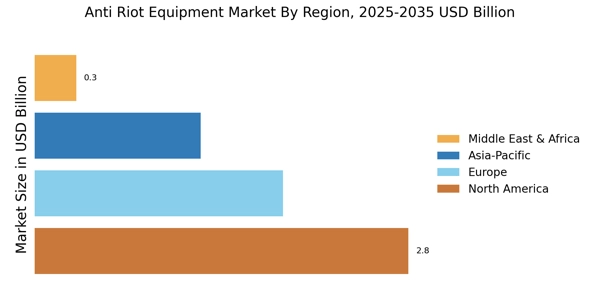
North America is the largest market for anti-riot equipment, holding approximately 45% of the global market share. The region's growth is driven by increasing civil unrest, heightened security concerns, and government regulations mandating the use of non-lethal crowd control measures. The U.S. leads this market, followed closely by Canada, which contributes around 15% to the overall share. Regulatory frameworks are evolving to support the use of advanced riot control technologies. The competitive landscape in North America is robust, featuring key players such as Safariland, Harris, and 3M. These companies are at the forefront of innovation, developing advanced non-lethal solutions tailored for law enforcement and security agencies. The presence of established manufacturers and a strong distribution network further enhance market dynamics, ensuring a steady supply of anti-riot equipment across various sectors.

Europe : Regulatory Frameworks Evolving

Europe is witnessing a significant rise in demand for anti-riot equipment, accounting for approximately 30% of the global market share. The growth is fueled by increasing public protests and the need for law enforcement agencies to manage civil disturbances effectively. Countries like France and Germany are at the forefront, with stringent regulations promoting the use of non-lethal equipment to ensure public safety while maintaining order. The European Union is actively working on policies to standardize equipment used in crowd control. Leading countries in this region include France, Germany, and the UK, where the presence of key players like Bolle Safety and Mace Security International is notable. The competitive landscape is characterized by a mix of established firms and emerging startups focusing on innovative solutions. The emphasis on safety and compliance with regulatory standards is driving companies to invest in research and development, enhancing the overall market landscape.

Asia-Pacific : Emerging Market Potential

Asia-Pacific is rapidly emerging as a significant market for anti-riot equipment, holding about 20% of the global market share. The region's growth is driven by increasing urbanization, rising civil unrest, and government initiatives to enhance public safety. Countries like India and China are leading this trend, with a growing focus on non-lethal crowd control solutions to manage protests and civil disturbances effectively. Regulatory support is gradually increasing, promoting the adoption of advanced technologies in law enforcement. The competitive landscape in Asia-Pacific is diverse, with both local and international players vying for market share. Key companies include Tactical Defense Systems and Nonlethal Technologies, which are expanding their presence through strategic partnerships and collaborations. The region's unique challenges and demands are prompting innovation in product offerings, making it a dynamic market for anti-riot equipment.

Middle East and Africa : Security Challenges Intensifying

The Middle East and Africa region is experiencing a growing demand for anti-riot equipment, accounting for approximately 5% of the global market share. The rise in civil unrest and political instability in several countries is driving the need for effective crowd control solutions. Nations like South Africa and Egypt are increasingly investing in non-lethal technologies to manage protests while ensuring public safety. Regulatory frameworks are evolving to support the use of such equipment in law enforcement operations. In this region, the competitive landscape is characterized by a mix of local manufacturers and international suppliers. Companies are focusing on developing tailored solutions that address the unique security challenges faced by various countries. The presence of key players is gradually increasing, with a focus on enhancing product offerings to meet the growing demand for effective anti-riot equipment.

Anti Riot Equipment Market
 Regional Image

Key Players and Competitive Insights

The Anti Riot Equipment Market is currently characterized by a dynamic competitive landscape, driven by increasing civil unrest and the need for effective crowd control solutions. Key players such as Safariland (US), 3M (US), and Mace Security International (US) are strategically positioned to leverage innovation and technological advancements. Safariland (US) focuses on enhancing its product offerings through continuous research and development, while 3M (US) emphasizes partnerships with law enforcement agencies to tailor solutions that meet specific operational needs. Mace Security International (US) has adopted a strategy of diversifying its product range to include non-lethal options, thereby appealing to a broader customer base. Collectively, these strategies contribute to a competitive environment that is increasingly focused on innovation and customer-centric solutions.

In terms of business tactics, companies are localizing manufacturing to reduce lead times and optimize supply chains, which is particularly crucial in the context of rising global tensions. The market structure appears moderately fragmented, with several players vying for market share, yet the influence of major companies remains substantial. This fragmentation allows for niche players to emerge, but the collective strength of established firms like Harris (US) and Tactical Defense Systems (US) shapes the overall market dynamics.

In August 2025, Safariland (US) announced a partnership with a leading technology firm to develop advanced body armor integrated with smart technology. This strategic move is likely to enhance the company's competitive edge by offering innovative solutions that address the evolving needs of law enforcement and security personnel. The integration of smart technology into traditional equipment could redefine operational effectiveness in riot control scenarios.

In September 2025, 3M (US) launched a new line of non-lethal crowd control products designed to minimize injury while maintaining order during protests. This initiative reflects a growing trend towards more humane approaches in riot management, aligning with public sentiment and regulatory pressures. By prioritizing safety and effectiveness, 3M (US) positions itself as a leader in responsible riot control solutions.

In July 2025, Mace Security International (US) expanded its distribution network in Europe, aiming to tap into the growing demand for non-lethal self-defense products. This expansion not only broadens Mace's market reach but also indicates a strategic focus on international growth, which is essential for sustaining competitive advantage in a globalized market. The move may also enhance brand visibility and customer engagement in regions experiencing heightened civil unrest.

As of October 2025, the Anti Riot Equipment Market is witnessing trends such as digitalization and sustainability, which are reshaping competitive strategies. Companies are increasingly forming strategic alliances to enhance their technological capabilities and market reach. The shift from price-based competition to a focus on innovation, technology integration, and supply chain reliability is evident. Moving forward, competitive differentiation will likely hinge on the ability to innovate and adapt to changing market demands, ensuring that companies remain relevant in an evolving landscape.

Key Companies in the Anti Riot Equipment Market market include

Industry Developments

Recent developments in the Anti-Riot Equipment Market have showcased a significant increase in demand due to ongoing civil unrest and heightened security concerns worldwide. Companies such as Dae Sung and Clyde Armory are expanding their product lines to include advanced non-lethal weaponry, catering to law enforcement agencies looking for safer crowd control solutions. 

Tactical Defense Systems and Safariland have reported growth in their market valuation, driven by increased government spending on public safety measures. Mergers and acquisitions have also been notable, with Combined Tactical Systems reportedly acquiring specific assets from Riot Control Technologies to enhance their portfolio in non-lethal ammunition, while Honeywell's strategic partnership with Nonlethal Technologies aims to innovate crowd management systems.

 The push for sustainable and effective anti-riot solutions has led Armor Holdings and Security Equipment Corporation to collaborate on new technology to improve their equipment's effectiveness. Additionally, the participation of Elections Canada in procuring anti-riot gear has raised the visibility of market needs tied to public safety during political events, reflecting broader trends in the sector. Overall, these developments are shaping a more responsive and dynamic landscape in the Anti-Riot Equipment Market.

Future Outlook

Anti Riot Equipment Market Future Outlook

The Anti Riot Equipment Market is projected to grow at a 4.21% CAGR from 2024 to 2035, driven by increasing civil unrest and government spending on public safety.

New opportunities lie in:

  • Development of advanced non-lethal weaponry for crowd control
  • Integration of smart technology in riot gear
  • Expansion into emerging markets with tailored solutions

By 2035, the market is expected to be robust, reflecting increased investment in public safety and advanced technologies.

Market Segmentation

Anti Riot Equipment Market Type Outlook

  • Protective Gear
  • Crowd Control Equipment
  • Non-Lethal Weapons
  • Surveillance Equipment

Anti Riot Equipment Market Material Outlook

  • Polymer
  • Metal
  • Composite
  • Fabric
  • Rubber

Anti Riot Equipment Market Application Outlook

  • Law Enforcement
  • Military
  • Private Security
  • Public Events

Anti Riot Equipment Market Distribution Channel Outlook

  • Online
  • Retail
  • Distributors
  • Direct Sales

Report Scope

MARKET SIZE 2024 6.145(USD Billion)
MARKET SIZE 2025 6.404(USD Billion)
MARKET SIZE 2035 9.675(USD Billion)
COMPOUND ANNUAL GROWTH RATE (CAGR) 4.21% (2025 - 2035)
REPORT COVERAGE Revenue Forecast, Competitive Landscape, Growth Factors, and Trends
BASE YEAR 2024
Market Forecast Period 2025 - 2035
Historical Data 2019 - 2024
Market Forecast Units USD Billion
Key Companies Profiled Market analysis in progress
Segments Covered Market segmentation analysis in progress
Key Market Opportunities Integration of advanced technologies enhances effectiveness and safety in the Anti Riot Equipment Market.
Key Market Dynamics Rising demand for advanced crowd control solutions drives innovation and competition in the Anti Riot Equipment Market.
Countries Covered North America, Europe, APAC, South America, MEA

Leave a Comment

FAQs

What is the projected market valuation of the Anti Riot Equipment Market by 2035?

The Anti Riot Equipment Market is projected to reach a valuation of 9.675 USD Billion by 2035.

What was the market valuation of the Anti Riot Equipment Market in 2024?

In 2024, the market valuation of the Anti Riot Equipment Market was 6.145 USD Billion.

What is the expected CAGR for the Anti Riot Equipment Market during the forecast period 2025 - 2035?

The expected CAGR for the Anti Riot Equipment Market during the forecast period 2025 - 2035 is 4.21%.

Which segment of the Anti Riot Equipment Market had the highest valuation in 2024?

In 2024, the Crowd Control Equipment segment had the highest valuation at 2.045 USD Billion.

What are the key players in the Anti Riot Equipment Market?

Key players in the Anti Riot Equipment Market include Safariland, Harris, 3M, and Mace Security International.

How does the Protective Gear segment perform in terms of valuation?

The Protective Gear segment was valued at 1.845 USD Billion in 2024 and is expected to grow to 2.845 USD Billion by 2035.

What is the projected valuation for the Military application segment by 2035?

The Military application segment is projected to reach a valuation of 2.675 USD Billion by 2035.

Which distribution channel is expected to show significant growth in the Anti Riot Equipment Market?

The Retail distribution channel is expected to grow from 2.0 USD Billion in 2024 to 3.0 USD Billion by 2035.

What materials are primarily used in the Anti Riot Equipment Market?

The primary materials used in the Anti Riot Equipment Market include Polymer, Metal, and Fabric, with Polymer valued at 1.5 USD Billion in 2024.

What is the expected growth trend for Non-Lethal Weapons in the Anti Riot Equipment Market?

The Non-Lethal Weapons segment is expected to grow from 1.155 USD Billion in 2024 to 1.755 USD Billion by 2035.

Download Free Sample

Kindly complete the form below to receive a free sample of this Report

Compare Licence

×
Features License Type
Single User Multiuser License Enterprise User
Price $4,950 $ $7,250
Maximum User Access Limit 1 User Upto 10 Users Unrestricted Access Throughout the Organization
Free Customization
Direct Access to Analyst
Deliverable Format
Platform Access
Discount on Next Purchase 10% 15% 15%
Printable Versions