×
Request Free Sample ×

Kindly complete the form below to receive a free sample of this Report

* Please use a valid business email

Leading companies partner with us for data-driven Insights

clients tt-cursor
Hero Background

Anti Tank Missile Market

ID: MRFR/AD/2281-CR
134 Pages
Swapnil Palwe
August 2019

Anti-Tank Missile Market Research Report Information By Type (Man-Portable, Vehicle-Mounted), By Platform (Airborne, Ground-Based), By End User (Military, Commercial), And By Region (North America, Europe, Asia-Pacific, And Rest Of The World) –Market Forecast Till 2035

Share:
Download PDF ×

We do not share your information with anyone. However, we may send you emails based on your report interest from time to time. You may contact us at any time to opt-out.

Anti Tank Missile Market Infographic
Purchase Options

Anti Tank Missile Market Summary

As per MRFR analysis, the Anti Tank Missile Market Size was estimated at 14.62 USD Million in 2024. The Anti Tank Missile industry is projected to grow from 15.17 USD Million in 2025 to 21.84 USD Million by 2035, exhibiting a compound annual growth rate (CAGR) of 3.71 during the forecast period 2025 - 2035.

Key Market Trends & Highlights

The Anti Tank Missile Market is poised for substantial growth driven by technological advancements and evolving military strategies.

  • North America remains the largest market for anti-tank missiles, reflecting robust defense spending and military modernization efforts.
  • The Asia-Pacific region is emerging as the fastest-growing market, fueled by increasing geopolitical tensions and defense collaborations.
  • Anti-armor operations continue to dominate the market, while vehicle-mounted launchers are witnessing the fastest growth due to their versatility in modern warfare.
  • Rising defense budgets and evolving warfare tactics are key drivers propelling the demand for advanced anti-tank missile systems.

Market Size & Forecast

2024 Market Size 14.62 (USD Million)
2035 Market Size 21.84 (USD Million)
CAGR (2025 - 2035) 3.71%

Major Players

Lockheed Martin (US), Raytheon Technologies (US), MBDA (GB), Rafael Advanced Defense Systems (IL), Kongsberg Gruppen (NO), Saab AB (SE), Thales Group (FR), Northrop Grumman (US), Boeing (US)

Anti Tank Missile Market Trends

The Anti Tank Missile Market is currently experiencing a dynamic evolution, driven by advancements in technology and increasing defense budgets across various nations. The demand for effective anti-tank solutions is rising, particularly in regions with ongoing conflicts and heightened military tensions. This market appears to be influenced by the need for enhanced mobility, precision, and lethality in modern warfare. As military forces seek to counter evolving threats, the integration of advanced guidance systems and improved warhead designs is becoming increasingly prevalent. Furthermore, the shift towards unmanned systems and drone technology is likely to reshape the landscape of anti-tank capabilities, suggesting a future where these missiles are deployed in more versatile and innovative ways. In addition to technological advancements, geopolitical factors play a crucial role in shaping the Anti Tank Missile Market. Nations are investing in indigenous defense production to reduce reliance on foreign suppliers, which may lead to the emergence of new players in the market. Collaborations between governments and defense contractors are also on the rise, fostering innovation and enhancing the development of next-generation systems. As the global security environment continues to evolve, the Anti Tank Missile Market is poised for significant transformation, with potential implications for military strategies and defense policies worldwide.

Technological Advancements

The Anti Tank Missile Market is witnessing rapid technological advancements, particularly in guidance systems and warhead designs. Innovations such as laser guidance and advanced targeting algorithms are enhancing missile accuracy and effectiveness. This trend indicates a shift towards more sophisticated systems that can adapt to various combat scenarios.

Geopolitical Influences

Geopolitical factors are significantly impacting the Anti Tank Missile Market, as nations prioritize defense spending in response to regional conflicts. Countries are increasingly focusing on developing indigenous capabilities, which may lead to a more competitive landscape with new entrants and collaborations between governments and defense firms.

Integration with Unmanned Systems

The integration of anti-tank missiles with unmanned systems is emerging as a notable trend. This development suggests a future where missiles are deployed from drones or robotic platforms, enhancing operational flexibility and reducing risks to personnel. Such innovations could redefine traditional combat strategies.

Anti Tank Missile Market Drivers

Geopolitical Tensions

Geopolitical tensions and regional conflicts are significant drivers of the Global Anti-Tank Missile Industry. Ongoing disputes and military confrontations in regions such as Eastern Europe and the Middle East have heightened the need for effective anti-tank capabilities. Nations are investing in advanced missile systems to deter potential aggressors and ensure national security. For example, the conflict dynamics in Ukraine have prompted increased procurement of anti-tank missiles by various countries. This trend suggests that the Global Anti-Tank Missile Industry will continue to expand as nations respond to evolving security challenges.

Technological Advancements

Technological innovations play a pivotal role in shaping the Global Anti-Tank Missile Industry. The development of advanced missile systems featuring improved guidance, precision targeting, and enhanced lethality is attracting attention from military forces worldwide. Innovations such as fire-and-forget technology and top-attack capabilities are becoming increasingly prevalent. These advancements not only improve operational effectiveness but also align with the strategic objectives of various nations. As a result, the Global Anti-Tank Missile Industry is likely to witness a surge in demand, particularly as countries seek to integrate these sophisticated systems into their defense strategies.

Market Trends and Projections

The Global Anti-Tank Missile Industry is projected to experience notable growth, with estimates indicating a market value of 0.02 USD Billion by 2035. This growth trajectory reflects the increasing importance of anti-tank capabilities in modern warfare. The anticipated CAGR of 4.1% from 2025 to 2035 underscores the sustained demand for advanced missile systems. Factors such as technological advancements, geopolitical tensions, and military modernization efforts are expected to contribute to this upward trend. As nations continue to invest in their defense sectors, the Global Anti-Tank Missile Industry is poised for expansion.

Increasing Military Expenditure

The Global Anti-Tank Missile Industry is experiencing growth due to rising military expenditures across various nations. Countries are prioritizing defense budgets to enhance their military capabilities, particularly in response to evolving threats. For instance, nations like the United States and India have significantly increased their defense spending, which is projected to reach 0.01 USD Billion in 2024. This trend indicates a commitment to modernizing military arsenals, including anti-tank missile systems, thereby driving demand in the Global Anti-Tank Missile Industry.

Increased Focus on Asymmetric Warfare

The Global Anti-Tank Missile Industry is influenced by the growing emphasis on asymmetric warfare strategies. As military conflicts evolve, conventional forces are increasingly facing non-state actors and guerrilla tactics. Anti-tank missiles provide a critical advantage in such scenarios, allowing smaller forces to effectively counter larger armored units. This shift in warfare dynamics is prompting military planners to prioritize the acquisition of advanced anti-tank systems. Consequently, the Global Anti-Tank Missile Industry is likely to benefit from this strategic focus, as nations adapt their military doctrines to address contemporary threats.

Growing Demand from Emerging Economies

Emerging economies are increasingly recognizing the importance of robust defense capabilities, contributing to the growth of the Global Anti-Tank Missile Industry. Countries in Asia and Africa are investing in military modernization programs, which include the acquisition of anti-tank missile systems. The projected compound annual growth rate (CAGR) of 4.1% from 2025 to 2035 indicates a sustained interest in enhancing military capabilities. As these nations seek to bolster their defense infrastructure, the demand for advanced anti-tank missiles is expected to rise, further propelling the Global Anti-Tank Missile Industry.

Market Segment Insights

By Application: Anti-Armor Operations (Largest) vs. Offensive Operations (Fastest-Growing)

In the Anti Tank Missile Market, the application segment showcases a diverse distribution among anti-armor operations, urban warfare, counter-insurgency, defensive operations, and offensive operations. Notably, anti-armor operations dominate the market due to the ongoing need for robust solutions against armored threats, while offensive operations exhibit the highest growth potential, driven by evolving warfare tactics and emerging geopolitical challenges. As military strategies evolve, the demand for various applications of anti-tank missiles has increased. Anti-armor operations maintain superiority, primarily owing to the modern battlefield's persistent reliance on engaging armored vehicles. Conversely, the growth of offensive operations results from advancements in missile technology and increased investments in enhancing offensive capabilities, reflecting a shift towards proactive engagement in combat scenarios.

Anti-Armor Operations (Dominant) vs. Offensive Operations (Emerging)

Anti-armor operations represent the dominant application in the Anti Tank Missile Market, as military forces prioritize neutralizing armored vehicles on the battlefield. This segment benefits from advancements in missile technology, enabling precision engagements and minimizing collateral damage. The widespread integration of anti-tank missiles in conventional military inventories underscores their critical role in modern warfare. In contrast, offensive operations emerge as a rapidly growing segment, fueled by the necessity for agile and versatile military strategies. As conflicts continue to evolve in complexity, offensive operations demand increased adaptability and effectiveness in anti-tank missile systems. The emphasis on offensive capabilities highlights the changing dynamics of warfare, stressing the importance of proactive engagement and tactical superiority, thus driving innovative developments within this segment.

By Launch Platform: Ground-Based Launchers (Largest) vs. Vehicle-Mounted Launchers (Fastest-Growing)

The anti-tank missile market showcases a diverse range of launch platforms, with Ground-Based Launchers leading the market share due to their established usage in military operations and proven effectiveness on the battlefield. Vehicle-Mounted Launchers are witnessing a notable rise in popularity as they provide enhanced mobility and the capability to launch missiles from various terrains, thus expanding operational flexibility.

Ground-Based Launchers (Dominant) vs. Vehicle-Mounted Launchers (Emerging)

Ground-Based Launchers have established themselves as the dominant platform in the anti-tank missile segment due to their high accuracy and reliability in fixed positions. They are designed for stationary deployment, making them ideal for defense systems and strategic assets. In contrast, Vehicle-Mounted Launchers are emerging rapidly as they incorporate advanced technology and mobility, allowing them to adapt to dynamic battlefield conditions. These launchers are becoming increasingly important in modern warfare, emphasizing rapid deployment and tactical versatility.

By Guidance System: Laser Guidance (Largest) vs. Active Radar Guidance (Fastest-Growing)

In the Anti Tank Missile Market, Laser Guidance holds the largest market share, owing to its precision and effectiveness in targeting stationary and moving targets. This guidance system is widely adopted due to its reliability in varied combat scenarios, making it a preferred choice among military forces worldwide. On the other hand, Active Radar Guidance is emerging rapidly, appealing to manufacturers and defense agencies looking for advanced tracking capabilities that can engage multiple targets simultaneously, enhancing operational efficiency.

Laser Guidance (Dominant) vs. Active Radar Guidance (Emerging)

Laser Guidance systems are currently the dominant force in the Anti Tank Missile Market, characterized by their high accuracy and low susceptibility to countermeasures. They utilize laser beams to guide missiles to their targets, making them effective in both urban combat and open terrain. Meanwhile, Active Radar Guidance systems are emerging as the fastest-growing segment, leveraging advanced radar technology to improve target acquisition and engagement. These systems allow for tactical flexibility and adaptability, particularly in complex environments, thus gaining traction among modern militaries aiming to enhance their anti-tank capabilities.

By Range: Short Range (Largest) vs. Very Long Range (Fastest-Growing)

The Anti Tank Missile Market showcases a diverse distribution among the range segments, with the Short Range segment holding the largest market share due to its prolonged usage in various combat scenarios. Following closely, the Medium Range segment also commands significant attention from military forces worldwide. On the contrary, segments like Extended Range and Very Long Range are gaining traction, primarily due to advancements in technology that enhance their capabilities and effectiveness in modern warfare.

Short Range (Dominant) vs. Very Long Range (Emerging)

The Short Range segment is well-established in the Anti Tank Missile Market, characterized by its agility and effectiveness in close-combat situations. This segment caters to versatile tactical requirements, often preferred by ground forces for urban warfare and confined spaces. Meanwhile, the Very Long Range segment is emerging rapidly, driven by innovations in missile technology that extend their reach and precision. Military forces are increasingly prioritizing these missiles for their strategic advantages, leading to a growing demand. As threats evolve, the competition between these two segments shapes the industry's future, emphasizing the need for constant innovation and adaptation.

By Warhead Type: High-Explosive Anti-Tank (Largest) vs. Kinetic Energy Penetrator (Fastest-Growing)

In the Anti Tank Missile Market, the segment of High-Explosive Anti-Tank warheads holds a substantial share, reflecting their widespread adoption by military forces across various regions. This warhead type excels in effectiveness against armored targets, contributing significantly to its popularity among defense organizations. Meanwhile, Kinetic Energy Penetrator warheads are rapidly gaining traction due to their unique capabilities, which allow them to penetrate heavily armored vehicles with high precision, leading to an increasing share in the market as demand for advanced technology grows. The growth trends in this segment are driven by various factors, including the rising geopolitical tensions and the need for modernizing military arsenals. High-Explosive Anti-Tank warheads remain dominant, as they address the immediate requirements of military operations. Conversely, Kinetic Energy Penetrator warheads are emerging as a preferred option for future developments, as advancements in materials and designs are set to deliver enhanced performance against evolving threats, making them a focal point for innovation and defense procurement strategies.

High-Explosive Anti-Tank (Dominant) vs. Fragmentation (Emerging)

High-Explosive Anti-Tank warheads are recognized as the dominant force in the Anti Tank Missile Market due to their ability to deliver significant explosive power to destroy armored targets effectively. Their extensive use in military operations highlights their reliability and effectiveness. In contrast, Fragmentation warheads, although less commonly employed for direct engagement with tanks, are emerging as a viable option for anti-armor operations due to their ability to incapacitate personnel and disable equipment in the vicinity of armored vehicles. With advancements in their design, fragmentation warheads are being recognized for their potential to disrupt enemy operations from a safe distance. As military strategies evolve, both warhead types are expected to play crucial roles in modern anti-tank warfare.

Get more detailed insights about Anti Tank Missile Market

Regional Insights

North America : Defense Innovation Leader

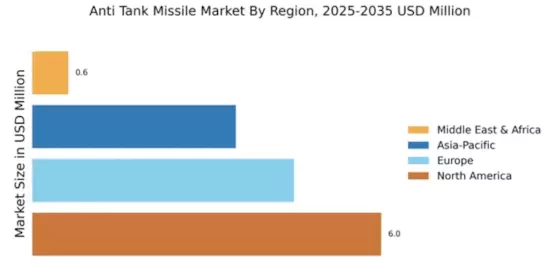
North America is poised to maintain its leadership in the Anti Tank Missile market, holding a significant market share of 6.0 in 2024. The region's growth is driven by increasing defense budgets, technological advancements, and a focus on modernizing military capabilities. Regulatory support from government initiatives further catalyzes demand, ensuring that North America remains at the forefront of defense innovation. The competitive landscape is characterized by major players such as Lockheed Martin, Raytheon Technologies, and Northrop Grumman, which are investing heavily in R&D. The U.S. military's emphasis on advanced weaponry and partnerships with allied nations enhances market dynamics. As a result, North America is expected to continue leading The Anti Tank Missile well into 2025.

Europe : Strategic Defense Collaborations

Europe's Anti Tank Missile market is projected to reach a size of 4.5 by 2025, driven by increasing geopolitical tensions and a focus on enhancing defense capabilities. The region benefits from collaborative defense initiatives among NATO members, which promote joint development and procurement of advanced missile systems. Regulatory frameworks are evolving to support these initiatives, ensuring compliance with international standards and enhancing market growth. Leading countries such as the UK, France, and Germany are at the forefront of this market, with key players like MBDA and Thales Group actively participating in defense contracts. The competitive landscape is marked by innovation and strategic partnerships, enabling European nations to bolster their military readiness. As defense budgets rise, Europe is set to strengthen its position in The Anti Tank Missile.

Asia-Pacific : Emerging Defense Market

The Asia-Pacific region is witnessing a burgeoning Anti Tank Missile market, projected to reach 3.5 by 2025. This growth is fueled by increasing military expenditures, particularly in countries like India, China, and Japan, as they seek to modernize their armed forces. The region's strategic focus on enhancing defense capabilities is supported by government initiatives aimed at boosting domestic production and reducing reliance on imports. Countries such as India and Australia are investing significantly in indigenous missile development programs, fostering a competitive landscape that includes both local and international players. Key companies like Kongsberg Gruppen and Saab AB are expanding their presence in the region, contributing to technological advancements. As military tensions rise, the demand for advanced Anti Tank Missiles is expected to escalate, positioning Asia-Pacific as a critical player in the global market.

Middle East and Africa : Defense Modernization Efforts

The Middle East and Africa region is gradually emerging in the Anti Tank Missile market, with a projected size of 0.62 by 2025. This growth is primarily driven by ongoing conflicts and the need for enhanced military capabilities among nations in the region. Governments are increasingly prioritizing defense spending to address security challenges, leading to a rise in demand for advanced weaponry, including anti-tank systems. Countries like Saudi Arabia and the UAE are investing heavily in modernizing their military arsenals, often collaborating with international defense firms. The competitive landscape is characterized by partnerships with key players such as Rafael Advanced Defense Systems and Thales Group, which are providing advanced solutions tailored to regional needs. As defense priorities shift, the Middle East and Africa are expected to play a more significant role in The Anti Tank Missile.

Key Players and Competitive Insights

The Anti Tank Missile Market is characterized by a dynamic competitive landscape, driven by technological advancements and increasing defense budgets across various nations. Key players such as Lockheed Martin (US), Raytheon Technologies (US), and MBDA (GB) are at the forefront, focusing on innovation and strategic partnerships to enhance their market positions. Lockheed Martin (US) emphasizes the development of next-generation missile systems, while Raytheon Technologies (US) is leveraging its expertise in sensor technology to improve missile accuracy. MBDA (GB) is actively pursuing collaborations with European defense agencies to expand its operational footprint, thereby shaping a competitive environment that prioritizes technological superiority and strategic alliances.

In terms of business tactics, companies are increasingly localizing manufacturing to reduce costs and enhance supply chain resilience. The market appears moderately fragmented, with several players vying for dominance. This fragmentation allows for a diverse range of products and innovations, yet the collective influence of major players like Northrop Grumman (US) and Rafael Advanced Defense Systems (IL) is significant, as they continue to push the boundaries of missile technology and operational capabilities.

In November 2025, Raytheon Technologies (US) announced a partnership with a leading European defense contractor to co-develop a new anti-tank missile system. This collaboration is strategically important as it not only enhances Raytheon's technological capabilities but also allows for shared resources and expertise, potentially leading to a more competitive product offering in the European market. Such partnerships are indicative of a broader trend towards collaborative innovation in the defense sector.

In October 2025, Rafael Advanced Defense Systems (IL) unveiled its latest anti-tank missile, which incorporates advanced AI algorithms for target recognition. This development is crucial as it positions Rafael at the cutting edge of missile technology, appealing to defense forces seeking enhanced operational effectiveness. The integration of AI is likely to become a defining feature in future missile systems, reflecting a shift towards smarter, more autonomous weaponry.

In December 2025, Lockheed Martin (US) completed the acquisition of a small tech firm specializing in drone technology, which is expected to complement its existing missile systems. This acquisition underscores Lockheed's commitment to integrating unmanned systems with traditional missile platforms, potentially revolutionizing battlefield tactics and enhancing the effectiveness of anti-tank operations. Such strategic moves highlight the importance of technological convergence in maintaining competitive advantage.

As of December 2025, the Anti Tank Missile Market is witnessing trends such as digitalization and AI integration, which are reshaping competitive dynamics. Strategic alliances are becoming increasingly vital, as companies recognize the need for collaboration to drive innovation. The competitive differentiation is likely to evolve from traditional price-based competition towards a focus on technological advancements, reliability, and supply chain efficiency. This shift suggests that companies that prioritize innovation and strategic partnerships will be better positioned to thrive in the evolving landscape.

Key Companies in the Anti Tank Missile Market market include

Industry Developments

October 2022:

Bharat Dynamics Limited unveiled three new defense products during the DefExpo event held in Gujarat. These innovative products aim to reduce India's reliance on foreign nations for defense equipment. Among the products introduced are an anti-tank guided missile (ATGM) designed specifically for MBT ARJUN, as well as a lightweight anti-tank guided weapon system that can be mounted on vehicles.

September 2022:

the Slovenian Ministry of Defense announced that they had awarded a contract to EuroSpike worth USD 6.6 million to supply the country with 50 Spike LR2 Long-range Anti-tank Guided Missiles (ATGMs). In addition, the systems will be mounted on Oshkosh's Joint Light Tactical Vehicles (JLTV).

Future Outlook

Anti Tank Missile Market Future Outlook

The Anti Tank Missile Market is projected to grow at a 3.71% CAGR from 2024 to 2035, driven by technological advancements, increasing defense budgets, and geopolitical tensions.

New opportunities lie in:

  • Development of advanced guided missile systems for enhanced precision targeting.
  • Integration of AI for real-time battlefield analytics and decision-making.
  • Expansion into emerging markets with tailored missile solutions for local defense needs.

By 2035, the Anti Tank Missile Market is expected to be robust, reflecting sustained growth and innovation.

Market Segmentation

Anti Tank Missile Market Range Outlook

  • Short Range
  • Medium Range
  • Long Range
  • Extended Range
  • Very Long Range

Anti Tank Missile Market Application Outlook

  • Anti-Armor Operations
  • Urban Warfare
  • Counter-Insurgency
  • Defensive Operations
  • Offensive Operations

Anti Tank Missile Market Warhead Type Outlook

  • High-Explosive Anti-Tank
  • Thermobaric
  • Fragmentation
  • Kinetic Energy Penetrator
  • Multi-Purpose

Anti Tank Missile Market Guidance System Outlook

  • Laser Guidance
  • Infrared Guidance
  • GPS Guidance
  • Semi-Active Guidance
  • Active Radar Guidance

Anti Tank Missile Market Launch Platform Outlook

  • Ground-Based Launchers
  • Vehicle-Mounted Launchers
  • Helicopter Launchers
  • Ship-Based Launchers
  • Man-Portable Launchers

Report Scope

MARKET SIZE 202414.62(USD Million)
MARKET SIZE 202515.17(USD Million)
MARKET SIZE 203521.84(USD Million)
COMPOUND ANNUAL GROWTH RATE (CAGR)3.71% (2024 - 2035)
REPORT COVERAGERevenue Forecast, Competitive Landscape, Growth Factors, and Trends
BASE YEAR2024
Market Forecast Period2025 - 2035
Historical Data2019 - 2024
Market Forecast UnitsUSD Million
Key Companies ProfiledLockheed Martin (US), Raytheon Technologies (US), MBDA (GB), Rafael Advanced Defense Systems (IL), Kongsberg Gruppen (NO), Saab AB (SE), Thales Group (FR), Northrop Grumman (US), Boeing (US)
Segments CoveredApplication, Launch Platform, Guidance System, Range, Warhead Type
Key Market OpportunitiesAdvancements in guided missile technology enhance precision and effectiveness in the Anti Tank Missile Market.
Key Market DynamicsTechnological advancements and regulatory shifts drive competition and innovation in the Anti Tank Missile Market.
Countries CoveredNorth America, Europe, APAC, South America, MEA

Market Highlights

Author
Swapnil Palwe
Team Lead - Research

With a technical background as Bachelor's in Mechanical Engineering, with MBA in Operations Management , Swapnil has 6+ years of experience in market research, consulting and analytics with the tasks of data mining, analysis, and project execution. He is the POC for our clients, for their consulting projects running under the Automotive/A&D domain. Swapnil has worked on major projects in verticals such as Aerospace & Defense, Automotive and many other domain projects. He has worked on projects for fortune 500 companies' syndicate and consulting projects along with several government projects.

Leave a Comment

FAQs

How much is the Anti-Tank Missile market?

The Anti-Tank Missile market size to reach at USD 0.02 Billion by 2035

What is the growth rate of the Anti-Tank Missile market?

The Anti-Tank Missile market is witnessed to grow at a CAGR of 3.71% during the forecast period, 2025-2035.

Which Region witnessed the largest market share in the Anti-Tank Missile market?

North America had the largest share of the market

Who are the key players in the Anti-Tank Missile market?

The key players in the market areRafael Advanced Defense Systems (Israel), MBDA (France), Raytheon Company (U.S.), KBP Instrument Design Bureau (Russia), Saab AB (Sweden), Elbit Systems Ltd. (Israel), Denel Dynamics (South Africa), General Dynamics Corporation (U.S.), Lockheed Martin Corporation (U.S.), and ROKETSAN A.S. (Turkey).

Which type led the Anti-Tank Missile market?

The Man-Portable Anti-Tank Missile category dominated the market in 2022.

Which Platform had the largest market share in the Anti-Tank Missile market?

The Ground-Based had the largest share in the market.

Download Free Sample

Kindly complete the form below to receive a free sample of this Report

Compare Licence

×
Features License Type
Single User Multiuser License Enterprise User
Price $4,950 $5,950 $7,250
Maximum User Access Limit 1 User Upto 10 Users Unrestricted Access Throughout the Organization
Free Customization
Direct Access to Analyst
Deliverable Format
Platform Access
Discount on Next Purchase 10% 15% 15%
Printable Versions