Research Methodology on Antifreeze Coolant Market
Market Research Future (MRFR)'s global Antifreeze Coolant Market study considers a wide scope of market dynamics that govern the market and its performance. The research report includes a qualitative and quantitative assessment of the prevailing and upcoming trends, market segments, shares, and drivers. The current industry landscape and historical records had been taken into consideration when compiling the report.
The research report further than this, comprises inputs from industry veterans. Such inputs are useful in gaining insights into the market's present and future scenarios. The research report's authors collected primary information from numerous industry stakeholders such as leading manufacturers, traders, end-users, research & development centres, and distributors.
Market Segmentation
MRFR's market research report on the Antifreeze Coolant Market has been segmented into different categories based on product type, end-user industry, and region. Each segment is further analyzed for top-notch growth prospects and market penetrations.
The product type category of the global Antifreeze Coolant Market report has been divided into Organic Acid Technology (OAT), Hybrid Organic Acid Technology (HOAT) and IAT (Inorganic Additive Technology).
The end-user industry category of the global Antifreeze Coolant Market report is divided based on automotive, marine, aerospace, power generation, and others.
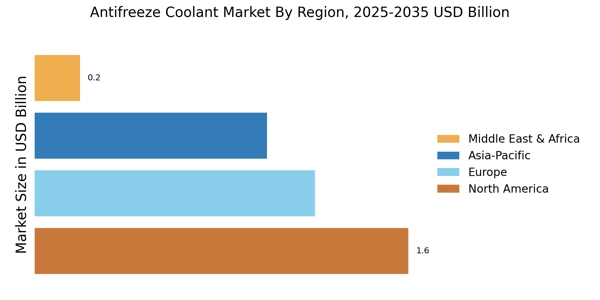
The regional analysis of the global Antifreeze Coolant Market report is divided into the Americas, Europe, Asia-Pacific, and the Middle East & Africa.
Primary and Secondary Research
MRFR's research methodology involves both primary and secondary research aspects. They instructed the market front-runners to gain reliable pieces of information. This information was obtained from sources such as authentic press releases, databases, and in-person surveys/interviews (for primary research). Further, the secondary research process was conducted through various reliable sources such as magazines, company websites, journals, and websites.
The market boundaries within the region are divided by the primary product, demographics, and economic state.
Data Triangulation
The collected information was put through the data triangulation process. It involved an analysis of the same data through various parameters. This data is then used to discover the right statistical research and techniques.
Market Estimation
The market estimation and forecasting process includes bottom-up and top-down approaches. This helps to assess the market size and value with great accuracy.
Data Validation
The data collected from various sources were validated by experts in the industry. This process allowed for analyzing the collected data accurately and prevented the inclusion of any kind of false information.
Competitive Analysis
The report included the competitive landscape of the Antifreeze Coolant Market. It included market share analysis, Porter's five-force model, and value chain analysis. This allowed research on the current and upcoming players' strategic developments in the market, such as joint ventures, mergers, acquisitions, product launches, and technology advancements.
Conclusion
MRFR's research report gives the readers an all-inclusive understanding of the Antifreeze Coolant Market. It also offers reliable growth prospects for the forecast period 2023 to 2030. The report includes a crucial assessment of the leading companies, market segments, business environment, growth opportunities, market share, market size, and other associated elements.