Download Free Sample
Kindly complete the form below to receive a free sample of this Report
Antiperspirants and Deodorants Market Size, Share, Industry Trend & Analysis Research Report Information by Form (Spray, Roll-On, Sticks and others), Distribution Channel (Store-Based [Supermarkets and Hypermarkets, Convenience Stores and others] and Non-Store-Based) and Region (North America, Europe, Asia-Pacific and the Rest of the World) - Forecast till 2035
As per MRFR analysis, the Antiperspirants and Deodorants Market Size was estimated at 22830.0 USD Million in 2024. The Antiperspirants and Deodorants industry is projected to grow from 24006.0 in 2025 to 40120.0 by 2035, exhibiting a compound annual growth rate (CAGR) of 5.2% during the forecast period 2025 - 2035.
The Antiperspirants and Deodorants Market is experiencing a dynamic shift towards natural formulations and innovative delivery systems.
| 2024 Market Size | 22830.0 (USD Million) |
| 2035 Market Size | 40120.0 (USD Million) |
| CAGR (2025 - 2035) | 5.2% |
Procter & Gamble (US), Unilever (GB), Henkel (DE), Colgate-Palmolive (US), Reckitt Benckiser (GB), Estée Lauder (US), Coty (US), Beiersdorf (DE), Shiseido (JP)
Our Impact
Enabled $4.3B Revenue Impact for Fortune 500 and Leading Multinationals
Partnering with 2000+ Global Organizations Each Year
30K+ Citations by Top-Tier Firms in the Industry
The Antiperspirants and Deodorants Market is currently experiencing a dynamic evolution, driven by shifting consumer preferences and heightened awareness regarding personal hygiene. As individuals increasingly prioritize health and wellness, there is a noticeable trend towards products that offer natural ingredients and sustainable packaging. This shift reflects a broader societal movement towards eco-consciousness, where consumers are more discerning about the products they choose to apply to their bodies. Furthermore, the rise of e-commerce platforms has transformed the way consumers access these products, allowing for greater convenience and a wider selection.
In addition to these trends, the market is witnessing innovations in formulation and technology. Brands are investing in research to develop long-lasting and effective solutions that cater to diverse skin types and sensitivities. This focus on inclusivity and personalization is likely to resonate with a broader audience, enhancing brand loyalty and consumer satisfaction. Overall, the Antiperspirants and Deodorants Market appears poised for continued growth, as it adapts to the evolving landscape of consumer demands and preferences.
There is a growing inclination among consumers towards antiperspirants and deodorants that feature natural and organic ingredients. This trend is indicative of a broader movement towards health-conscious choices, as individuals seek products that are perceived as safer and more environmentally friendly.
Sustainability is becoming a focal point in the Antiperspirants and Deodorants Market, with brands increasingly adopting eco-friendly packaging. This shift not only appeals to environmentally aware consumers but also aligns with global efforts to reduce plastic waste and promote responsible consumption.
Innovations in formulation technology are reshaping the market landscape. Brands are exploring advanced techniques to enhance product efficacy, ensuring longer-lasting protection while addressing various skin sensitivities. This focus on performance and personalization is likely to attract a diverse consumer base.
The rise of e-commerce platforms has transformed the purchasing landscape in the Global antiperspirants and deodorants Market Industry. Consumers increasingly prefer the convenience of online shopping, which offers a wider selection of products and the ability to compare prices easily. This trend has been accelerated by advancements in technology and logistics, making it easier for brands to reach consumers directly. As a result, online sales channels are expected to capture a larger share of the market, contributing to the projected CAGR of 3.58% from 2025 to 2035. The ability to access consumer reviews and product information online further enhances purchasing decisions, driving overall market growth.
The Global Antiperspirants and Deodorants Market Industry is poised for substantial growth, with projections indicating a market value of 63.5 USD Billion in 2024 and an anticipated increase to 93.4 USD Billion by 2035. This growth trajectory reflects a compound annual growth rate (CAGR) of 3.58% from 2025 to 2035. Factors contributing to this expansion include rising consumer awareness, innovative product development, and the increasing demand for natural products. As the market evolves, it is expected that brands will continue to innovate and adapt to consumer preferences, ensuring sustained growth in this competitive landscape.
In the Global Antiperspirants and Deodorants Market Industry, increasing consumer awareness regarding personal hygiene and body odor management plays a pivotal role. As individuals become more informed about the importance of maintaining freshness throughout the day, the demand for effective antiperspirants and deodorants rises. This trend is particularly evident in urban areas, where lifestyles are fast-paced, and the need for reliable products is paramount. The market is projected to reach 63.5 USD Billion in 2024, indicating a robust growth trajectory fueled by this heightened awareness. Brands are responding by innovating formulations that cater to diverse consumer preferences, further driving market expansion.
Shifts in lifestyle patterns, particularly among urban populations, are influencing the Global Antiperspirants and Deodorants Market Industry. As more individuals engage in active lifestyles, including fitness and outdoor activities, the demand for effective antiperspirants and deodorants that can withstand physical exertion is increasing. This trend is particularly relevant in regions with warm climates, where perspiration management is crucial. Brands are responding by developing products that cater to these needs, such as sport-specific formulations. This adaptation to changing consumer behaviors is likely to support market growth, as the industry aligns its offerings with the evolving demands of health-conscious consumers.
Innovation in product formulations and packaging is a key driver in the Global Antiperspirants and Deodorants Market Industry. Companies are increasingly investing in research and development to create products that not only provide long-lasting protection but also incorporate natural ingredients and sustainable packaging. For instance, the introduction of aluminum-free deodorants has gained traction among health-conscious consumers. This shift towards innovation is expected to contribute to the market's growth, with projections indicating a rise to 93.4 USD Billion by 2035. As brands strive to differentiate themselves through unique offerings, the competitive landscape becomes more dynamic, attracting a broader consumer base.
The Global Antiperspirants and Deodorants Market Industry is witnessing a significant shift towards natural and organic products. Consumers are increasingly concerned about the ingredients in their personal care items, leading to a surge in demand for products that are free from synthetic chemicals. This trend is particularly pronounced among younger demographics who prioritize health and environmental sustainability. As a result, brands are reformulating their products to include plant-based ingredients and eco-friendly packaging. This movement is likely to bolster market growth, as consumers are willing to pay a premium for products that align with their values, thereby enhancing brand loyalty and market share.
The Antiperspirants and Deodorants Market exhibits a diverse distribution across various application segments. Personal Care remains the largest segment, driven by increasing consumer focus on personal grooming and hygiene. In contrast, the Sports segment is emerging swiftly as consumers become more health-conscious and seek effective products for active lifestyles. This segmentation reflects diverse consumer preferences and usage patterns in maintaining freshness and odor control. As lifestyle changes and heightened awareness of hygiene continue to dominate, the Sports application segment is witnessing a significant upsurge. Factors such as rising participation in sports and fitness activities, coupled with a growing emphasis on performance-enhancing products, are propelling the demand for innovative deodorants tailored for athletes. The evolving market landscape indicates a dynamic shift towards specialized, function-oriented products that cater to diverse consumer needs.
Personal Care (Dominant) vs. Sports (Emerging)
The Personal Care segment in the Antiperspirants and Deodorants Market is characterized by a wide range of products designed to meet the everyday needs of consumers. This dominance is attributed to the constant innovation and variety that cater to different skin types, scents, and preferences, ensuring a loyal customer base. Major brands invest significantly in marketing and developing new formulations to enhance efficacy and appeal. On the other hand, the Sports segment is emerging as a critical player, focusing on delivering high-performance products that address specific needs during physical activities. These formulations often feature advanced sweat and odor control technologies, making them appealing to fitness enthusiasts in a rapidly growing market. This segment's rise highlights a shift towards products that enhance athletic performance while prioritizing personal care.
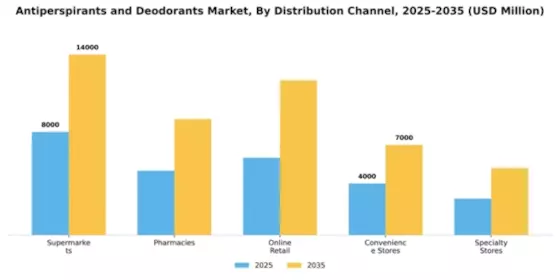
The antiperspirants and deodorants market is segmented into four primary types: Roll-On, Spray, Stick, and Gel. Currently, Roll-On products hold the largest market share due to their easy application and perceived long-lasting effectiveness. In contrast, Spray antiperspirants are rapidly gaining traction, particularly among younger consumers who prefer convenience and quick application, contributing to their status as the fastest-growing segment in this market. The Stick and Gel products continue to maintain significant, though smaller, shares, appealing to niche consumer preferences.
Roll-On (Dominant) vs. Spray (Emerging)
Roll-On antiperspirants are recognized for their reliable performance, providing users with a strong sense of protection against sweat and odor. They are favored for their ease of use and controlled application, which minimizes product wastage. Meanwhile, Spray antiperspirants cater to a different segment of the market, offering a refreshing application method that is particularly appealing to on-the-go consumers. Sprays are known for their quick-drying formulation, which appeals to active individuals seeking an immediate solution. While Roll-Ons dominate in traditional markets, Sprays are emerging rapidly, particularly in urban areas, where lifestyle changes have influenced consumer preferences.
In the Antiperspirants and Deodorants Market, the formulation segment is characterized by significant diversity, with Natural formulations leading in market share. This burgeoning category appeals to health-conscious consumers seeking safer and environmentally friendly alternatives. In contrast, Organic formulations have emerged rapidly, attracting attention for their eco-friendly credentials and fewer synthetic components, reflecting a shift towards cleaner beauty products. The demand for synthetic products, while still considerable, has stabilized as consumers grow increasingly aware of ingredients and their long-term effects on health and the environment.
Natural (Dominant) vs. Antibacterial (Emerging)
Natural formulations are the dominant choice in the Antiperspirants and Deodorants Market, renowned for their gentle ingredients and sustainable sourcing. This segment appeals to consumers who prioritize natural over synthetic and is often associated with skin-friendly properties. On the other hand, Antibacterial formulations are an emerging segment within this market, designed to combat odor-causing bacteria and enhance freshness. While currently smaller in share, their appeal lies in functional benefits and effective odor control, making them popular among active individuals and those seeking reliable performance. As health concerns rise, both segments exhibit strong growth potential, with their unique advantages catering to varying consumer preferences.
The antiperspirants and deodorants market displays a diversified user base among different segments, with women being the largest end-user group. This segment significantly influences product development and marketing strategies, driven by a growing emphasis on personal care and grooming. Men also represent a substantial portion of the market, with increasing acceptance of grooming products, while unisex offerings are gaining traction as consumers seek more flexible options. In recent years, the teenagers segment has emerged as the fastest-growing demographic within the antiperspirants and deodorants market. This trend is largely due to heightened awareness of personal hygiene and the rising prevalence of tailored products that cater to younger consumers’ preferences. Moreover, the promotion of these products through social media and influencers has created an enhanced appeal for this demographic, driving growth and innovation in the sector.
Women (Dominant) vs. Teenagers (Emerging)
Women continue to dominate the antiperspirants and deodorants market, characterized by their higher consumption and greater brand loyalty. This segment often drives trends, with a preference for diverse formulations that cater to varying skin types and fragrance choices. The market for women's products is characterized by a wider range of marketing strategies that emphasize effectiveness, natural ingredients, and luxury branding. In contrast, the teenagers segment is increasingly recognized as an emerging player. This demographic is influenced by social trends and brand image, favoring products that offer unique scents and modern packaging. Teenagers are drawn to trendy and lightweight formulations, including roll-ons and sprays, which reflect their dynamic lifestyle. As brands tailor their offerings to this younger audience, the segment shows significant potential for future growth.
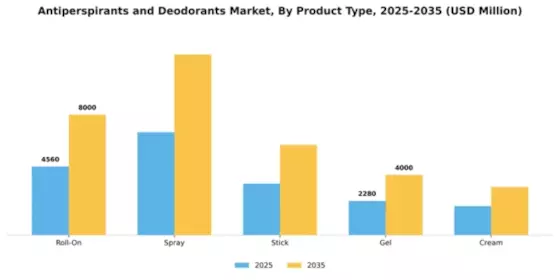
In the Antiperspirants and Deodorants Market, the distribution of sales among channels reveals noteworthy insights. Supermarkets hold the largest share, attributed to their extensive reach and the convenience they offer to consumers. Pharmacies and convenience stores also contribute to the overall market but to a lesser extent. Online retail, however, is gaining traction rapidly, reflecting a shift in consumer purchasing behavior towards e-commerce platforms.
Supermarkets (Dominant) vs. Online Retail (Emerging)
Supermarkets are the dominant distribution channel for antiperspirants and deodorants, providing a wide selection of brands and product types that cater to various consumer preferences. Their physical presence allows for direct customer engagement and promotions, significantly influencing purchase decisions. In contrast, online retail is emerging as a powerful channel, driven by the increasing penetration of smartphones and internet access. Consumers appreciate the convenience and variety offered online, as well as the ease of comparing products. The growth in this segment is fueled by evolving shopping habits, including subscription services and targeted online marketing strategies.
Get more detailed insights about Antiperspirants and Deodorants Market Request Free Sample
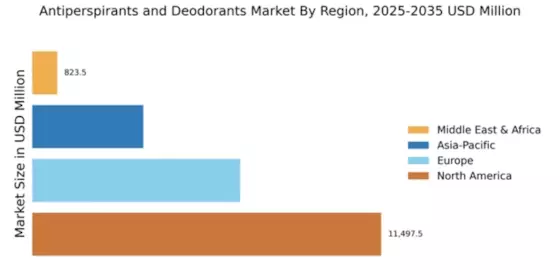
North America continues to lead the antiperspirants and deodorants market, holding a significant share of 11497.5 million in 2024. The growth is driven by increasing consumer awareness regarding personal hygiene and the rising demand for innovative products. Regulatory support for safe and effective formulations further fuels market expansion, with a focus on sustainability and natural ingredients. The competitive landscape is characterized by major players such as Procter & Gamble, Unilever, and Colgate-Palmolive, who dominate the market with their extensive product lines. The U.S. remains the largest market, while Canada and Mexico also contribute significantly. The presence of established brands and continuous product innovation ensures a robust market environment.
Europe's antiperspirants and deodorants market is valued at 6849.0 million, reflecting a growing trend towards sustainability and eco-friendly products. Regulatory frameworks in the EU promote the use of natural ingredients and limit harmful chemicals, which is driving consumer preference for safer options. The market is also influenced by rising health consciousness among consumers, leading to increased demand for organic and hypoallergenic products. Leading countries in this region include Germany, France, and the UK, where brands like Henkel and Unilever are prominent. The competitive landscape is evolving, with new entrants focusing on niche markets. The emphasis on sustainability and ethical sourcing is reshaping product offerings, making the European market a dynamic space for innovation.
The Asia-Pacific region, with a market size of 3660.0 million, is witnessing rapid growth in the antiperspirants and deodorants sector. Factors such as urbanization, increasing disposable incomes, and changing lifestyles are driving demand. Additionally, the influence of Western beauty standards and rising awareness of personal grooming are significant catalysts for market expansion in countries like China and India. Key players such as Shiseido and Unilever are actively investing in this region to capture the growing consumer base. The competitive landscape is marked by a mix of local and international brands, with a focus on affordability and accessibility. As the market matures, innovation in product formulations and packaging will be crucial for sustaining growth.
The Middle East and Africa region, valued at 823.5 million, presents untapped potential in the antiperspirants and deodorants market. The growth is driven by increasing urbanization, a young population, and rising disposable incomes. Additionally, cultural shifts towards personal grooming and hygiene are contributing to the demand for these products. Regulatory frameworks are gradually evolving to support market growth, focusing on safety and efficacy. Leading countries in this region include South Africa and the UAE, where international brands are gaining traction. The competitive landscape is characterized by a mix of established players and local brands, with a focus on affordability and product accessibility. As consumer preferences shift, there is a growing opportunity for innovation and premium product offerings.
The Antiperspirants and Deodorants Market is characterized by a dynamic competitive landscape, driven by innovation, sustainability, and consumer preferences for natural ingredients. Major players such as Procter & Gamble (US), Unilever (GB), and Reckitt Benckiser (GB) are at the forefront, each employing distinct strategies to enhance their market positioning. Procter & Gamble (US) focuses on product innovation, particularly in developing eco-friendly formulations, while Unilever (GB) emphasizes sustainability through its commitment to reducing plastic waste. Reckitt Benckiser (GB) is increasingly investing in digital transformation to enhance consumer engagement and streamline operations, indicating a collective shift towards more responsible and consumer-centric practices.The market structure appears moderately fragmented, with a mix of established brands and emerging players. Key tactics such as localizing manufacturing and optimizing supply chains are prevalent among leading companies, allowing them to respond swiftly to regional demands and preferences. This competitive structure fosters a diverse range of offerings, catering to various consumer segments and preferences, thereby enhancing overall market resilience.In November Unilever (GB) announced a partnership with a leading biotechnology firm to develop a new line of biodegradable deodorants. This strategic move underscores Unilever's commitment to sustainability and innovation, potentially positioning the company as a leader in eco-friendly personal care products. The collaboration is expected to leverage advanced biotechnological processes, which may significantly reduce environmental impact while appealing to environmentally conscious consumers.In October Procter & Gamble (US) launched a new marketing campaign aimed at promoting its latest line of aluminum-free antiperspirants. This initiative not only highlights the company's focus on health-conscious consumers but also reflects a broader industry trend towards natural and organic products. The campaign is likely to enhance brand loyalty and attract a demographic increasingly concerned with ingredient transparency and safety.In September Reckitt Benckiser (GB) expanded its product portfolio by acquiring a niche brand specializing in natural deodorants. This acquisition is indicative of Reckitt's strategy to diversify its offerings and tap into the growing demand for natural personal care products. By integrating this brand into its existing portfolio, Reckitt may enhance its competitive edge and appeal to a broader consumer base seeking healthier alternatives.As of December the competitive trends in the Antiperspirants and Deodorants Market are increasingly defined by digitalization, sustainability, and the integration of artificial intelligence in product development and marketing strategies. Strategic alliances are becoming more prevalent, enabling companies to pool resources and expertise to innovate more effectively. The shift from price-based competition to a focus on innovation, technology, and supply chain reliability is evident, suggesting that future competitive differentiation will hinge on the ability to adapt to evolving consumer preferences and environmental considerations.

The Antiperspirants and Deodorants Market is projected to grow at a 5.2% CAGR from 2025 to 2035, driven by increasing consumer awareness and demand for innovative products.
New opportunities lie in:
By 2035, the market is expected to achieve robust growth, reflecting evolving consumer preferences and innovative product offerings.
| MARKET SIZE 2024 | 22830.0(USD Million) |
| MARKET SIZE 2025 | 24006.0(USD Million) |
| MARKET SIZE 2035 | 40120.0(USD Million) |
| COMPOUND ANNUAL GROWTH RATE (CAGR) | 5.2% (2025 - 2035) |
| REPORT COVERAGE | Revenue Forecast, Competitive Landscape, Growth Factors, and Trends |
| BASE YEAR | 2024 |
| Market Forecast Period | 2025 - 2035 |
| Historical Data | 2019 - 2024 |
| Market Forecast Units | USD Million |
| Key Companies Profiled | Procter & Gamble (US), Unilever (GB), Henkel (DE), Colgate-Palmolive (US), Reckitt Benckiser (GB), Estée Lauder (US), Coty (US), Beiersdorf (DE), Shiseido (JP) |
| Segments Covered | Application, Product Type, End Use, Formulation, Distribution Channel |
| Key Market Opportunities | Growing demand for natural and organic formulations in the Antiperspirants and Deodorants Market presents significant opportunities. |
| Key Market Dynamics | Rising consumer preference for natural ingredients drives innovation and competition in the antiperspirants and deodorants market. |
| Countries Covered | North America, Europe, APAC, South America, MEA |
The market valuation reached 22830.0 USD Million in 2024.
The market is expected to grow to 40120.0 USD Million by 2035.
The market is anticipated to experience a CAGR of 5.2% from 2025 to 2035.
The main segments include Personal Care, Household, Industrial, Medical, and Sports.



Kindly complete the form below to receive a free sample of this Report

“This is really good guys. Excellent work on a tight deadline. I will continue to use you going forward and recommend you to others. Nice job”


“Thanks. It’s been a pleasure working with you, please use me as reference with any other Intel employees.”


“Thanks for sending the report it gives us a good global view of the Betaïne market.”


“Thank you, this will be very helpful for OQS.”


“We found the report very insightful! we found your research firm very helpful. I'm sending this email to secure our future business.”


“I am very pleased with how market segments have been defined in a relevant way for my purposes (such as "Portable Freezers & refrigerators" and "last-mile"). In general the report is well structured. Thanks very much for your efforts.”


“I have been reading the first document or the study, ,the Global HVAC and FP market report 2021 till 2026. Must say, good info! I have not gone in depth at all parts, but got a good indication of the data inside!”


“We got the report in time, we really thank you for your support in this process. I also thank to all of your team as they did a great job.”


“The Automotive 48V ECU Components Procurement Intelligence Study” was a complex project, but the Market Research Future (MRFR) team handled it with quality, agility, and customer-centricity. They delivered all requested data on time and within the agreed scope. The team, including Shubhendra Anand and Rahul Gotadki, was always readily available to clarify questions and swiftly implement necessary adjustments, driving the project to a successful conclusion within a very demanding timeframe.
I would also like to specifically commend Akshay Agarwal for his responsiveness and support at every stage—from our initial inquiry on May 6th through to final delivery on June 18th. His dedication made the entire process seamless.”



