APAC Air Handling Units Market
APAC Air Handling Units Market Summary
As per Market Research Future analysis, the APAC air handling-units market Size was estimated at 5.11 USD Billion in 2024. The APAC air handling-units market is projected to grow from 5.44 USD Billion in 2025 to 10.15 USD Billion by 2035, exhibiting a compound annual growth rate (CAGR) of 6.4% during the forecast period 2025 - 2035
Key Market Trends & Highlights
The APAC air handling-units market is experiencing a transformative shift towards sustainability and smart technology integration.
- The market is increasingly prioritizing sustainability, reflecting a broader global trend towards eco-friendly solutions.
- Smart technology integration is becoming prevalent, enhancing operational efficiency and user experience in air handling units.
- Modular design trends are gaining traction, allowing for flexible and scalable solutions tailored to diverse building needs.
- Rising urbanization and increased awareness of indoor air quality are driving market growth, particularly in China and India.
Market Size & Forecast
| 2024 Market Size | 5.11 (USD Billion) |
| 2035 Market Size | 10.15 (USD Billion) |
| CAGR (2025 - 2035) | 6.44% |
Major Players
Trane Technologies (IE), Carrier Global Corporation (US), Daikin Industries Ltd (JP), Johnson Controls International plc (IE), Mitsubishi Electric Corporation (JP), LG Electronics Inc (KR), Gree Electric Appliances Inc (CN), Rheem Manufacturing Company (US), York International Corporation (US)
APAC Air Handling Units Market Trends
The air handling-units market is currently experiencing notable growth, driven by increasing urbanization and the rising demand for energy-efficient solutions. In the Asia-Pacific region, rapid industrialization and infrastructural development are contributing to the heightened need for advanced air handling systems. These units play a crucial role in maintaining indoor air quality and ensuring optimal climate control in various settings, including commercial, residential, and industrial spaces. As environmental regulations become more stringent, manufacturers are focusing on innovation and sustainability, leading to the introduction of smart technologies and eco-friendly materials in air handling units. This shift not only enhances performance but also aligns with the growing consumer preference for sustainable products. Moreover, the market is witnessing a trend towards modular and customizable solutions, allowing for greater flexibility in design and installation. This adaptability is particularly appealing to businesses looking to optimize their energy consumption and reduce operational costs. The integration of IoT and automation technologies is also reshaping the landscape, enabling real-time monitoring and management of air handling systems. As the air handling-units market continues to evolve, stakeholders must remain vigilant to emerging trends and consumer demands, ensuring that they are well-positioned to capitalize on future opportunities.
Sustainability Focus
There is a growing emphasis on sustainability within the air handling-units market, as manufacturers increasingly adopt eco-friendly materials and energy-efficient technologies. This trend aligns with global efforts to reduce carbon footprints and comply with environmental regulations, particularly in urban areas.
Smart Technology Integration
The integration of smart technologies is transforming the air handling-units market. Features such as IoT connectivity and automation allow for enhanced monitoring and control, improving energy efficiency and user experience. This trend is particularly relevant in commercial applications where operational efficiency is paramount.
Modular Design Trends
Modular design is gaining traction in the air handling-units market, offering flexibility and customization for various applications. This approach allows for easier installation and scalability, catering to the diverse needs of different sectors, including residential and industrial.
APAC Air Handling Units Market Drivers
Rising Urbanization
The rapid urbanization in APAC is a crucial driver for the air handling-units market. As cities expand, the demand for efficient air handling systems increases to ensure adequate ventilation and air quality in densely populated areas. Urban centers are witnessing a surge in construction activities, with an estimated growth rate of 8% in the building sector. This growth necessitates advanced air handling solutions to meet regulatory standards and enhance indoor air quality. Furthermore, the increasing number of commercial and residential buildings in urban areas is likely to propel the demand for air handling-units, as these systems are essential for maintaining comfortable living and working environments. The air handling-units market is thus positioned to benefit significantly from this trend, as urban planners and developers prioritize sustainable and efficient HVAC solutions.
Government Regulations
Stringent government regulations regarding indoor air quality and energy efficiency are driving the air handling-units market in APAC. Regulatory bodies are increasingly mandating the use of energy-efficient systems to reduce carbon footprints and improve public health. For instance, initiatives aimed at reducing energy consumption by 20% in commercial buildings by 2030 are influencing the adoption of advanced air handling technologies. Compliance with these regulations often requires the installation of modern air handling-units that utilize innovative technologies to optimize performance. The air handling-units market is thus experiencing a shift towards products that not only meet regulatory standards but also offer enhanced energy efficiency. This regulatory landscape is expected to continue shaping market dynamics, as manufacturers innovate to align with evolving standards.
Technological Advancements
Technological advancements in the air handling-units market are significantly influencing the industry landscape in APAC. Innovations such as IoT integration and smart sensors are enhancing the functionality and efficiency of air handling systems. These technologies allow for real-time monitoring and control, leading to improved energy management and reduced operational costs. The market is projected to grow at a CAGR of 7% over the next five years, driven by the increasing adoption of smart technologies in HVAC systems. As consumers and businesses seek more efficient solutions, the air handling-units market is likely to see a surge in demand for technologically advanced products that offer better performance and sustainability.
Sustainable Building Practices
The shift towards sustainable building practices is a pivotal driver for the air handling-units market in APAC. As construction companies and architects increasingly prioritize eco-friendly designs, the demand for energy-efficient air handling systems is on the rise. The market is witnessing a trend where buildings are designed to minimize energy consumption, with air handling-units playing a crucial role in achieving these goals. Reports suggest that buildings equipped with energy-efficient HVAC systems can reduce energy costs by up to 30%. This focus on sustainability is likely to propel the air handling-units market forward, as stakeholders seek solutions that align with green building certifications and environmental standards.
Increased Awareness of Indoor Air Quality
The growing awareness of indoor air quality (IAQ) among consumers and businesses is a significant driver for the air handling-units market in APAC. With rising concerns about health issues related to poor air quality, there is a heightened demand for systems that can effectively filter and circulate air. Studies indicate that poor IAQ can lead to a 10% decrease in productivity, prompting organizations to invest in better air handling solutions. This trend is particularly evident in sectors such as healthcare and education, where maintaining optimal air quality is critical. The air handling-units market is thus responding to this demand by offering advanced filtration and ventilation solutions that cater to the needs of various sectors, ensuring healthier indoor environments.
Market Segment Insights
By Type: Packaged Rooftop (Largest) vs. Modular (Fastest-Growing)
In the APAC air handling-units market, the segment distribution shows that Packaged Rooftop units lead with a significant share, largely due to their versatility and ease of installation. Modular units are also emerging strongly among consumers, catering to the demand for customized solutions in various commercial sectors. Custom air handling units, while valuable, currently occupy a smaller share as they are typically tailored for specific projects, thus limiting their overall market presence. Growth trends in this segment indicate a robust future for Modular units, driven by an increase in sustainable building practices and energy-efficient solutions. Advances in technology are enabling quicker deployment and greater flexibility, making Modular units highly appealing for modern constructions. Conversely, Packaged Rooftop units continue to benefit from established usage in large-scale applications, balancing rapid growth in Modular solutions with their own dominance.
Packaged Rooftop (Dominant) vs. Modular (Emerging)
Packaged Rooftop units are characterized by their all-in-one design, providing efficient air handling and temperature regulation, making them a preferred choice for developers and facility managers. These units are particularly advantageous for their quick installation and maintenance, offering significant operational efficiency. On the other hand, Modular units represent a rapidly growing segment, appealing to end-users looking for adaptable systems that can be easily expanded or modified. This flexibility caters to the ongoing trend of customized HVAC solutions, ensuring that Modular units are positioned as a future-oriented alternative to traditional air handling systems, thus creating a dynamic market landscape.
By Effect: Single Effect (Largest) vs. Double Effect (Fastest-Growing)
In the APAC air handling-units market, Single Effect units hold a significant portion of the market share due to their widespread usage in various commercial applications. Their efficiency and cost-effectiveness make them a preferred choice, leading to an established dominance over the segment. On the other hand, Double Effect units are gaining traction, notably in energy-sensitive environments where higher efficiency is crucial. This emerging trend reflects a shift in consumer preference towards systems that offer enhanced performance and sustainability. The growth trends for these units are driven by the increasing demand for energy-efficient solutions across industries. With stringent regulations on energy consumption and rising awareness about environmental impact, the market for Double Effect units is expanding rapidly. Factors such as technological advancements and the need for improved indoor air quality are also boosting the adoption of these units as businesses look for solutions that align with both efficiency and sustainability goals.
Single Effect (Dominant) vs. Double Effect (Emerging)
Single Effect air handling units are characterized by their simplicity and reliability, often chosen for standard applications where cost and efficiency are key considerations. They are well-suited for a variety of settings, from commercial buildings to industrial facilities, making them the backbone of the market. Conversely, Double Effect units are designed for high-demand environments, offering superior energy efficiency and performance. These units operate with two cooling effects, making them ideal for settings that require stringent temperature control. As energy costs rise and sustainability becomes a priority, Double Effect units are positioning themselves as a strong alternative, appealing to environmentally conscious consumers seeking advanced technology in their air handling solutions.
By Capacity: Upto 5000 m3/hr (Largest) vs. Above 15000 m3/hr (Fastest-Growing)
In the APAC air handling-units market, the segment distribution showcases a significant portion of the market captured by units offering upto 5000 m3/hr, making it the largest segment. This capacity is favored for its versatility in small to medium-scale applications, catering to a variety of industries, including commercial and residential sectors. Conversely, the segment above 15000 m3/hr is recognized as the fastest-growing, driven by increased urbanization and the rising demand for efficient air handling solutions in larger facilities, such as manufacturing plants and data centers. The shift towards energy-efficient systems is bolstering this segment's growth, highlighting a trend towards sustainability in industrial sectors.
Upto 5000 m3/hr (Dominant) vs. Above 15000 m3/hr (Emerging)
The upto 5000 m3/hr segment is dominant in the market due to its wide applicability across various sectors, including HVAC systems in smaller buildings and residential complexes. This segment is characterized by its compact design, energy efficiency, and affordability, making it a preferred choice for many users. In contrast, the above 15000 m3/hr segment, while emerging, is experiencing rapid growth fueled by the demand for advanced HVAC solutions in large facilities. This segment typically features high-capacity units designed for industrial applications, equipped with robust technology that ensures optimal air quality and energy utilization.
By Application: Commercial (Largest) vs. Residential (Fastest-Growing)
In the APAC air handling-units market, the application segment is primarily dominated by the commercial sector, which holds the largest share of the market distribution. This sector is characterized by heightened demand due to increased construction activities and a surge in the establishment of office spaces and commercial complexes. In contrast, the residential segment also presents significant market presence with a growing interest in energy-efficient and smart indoor air quality solutions, capturing an essential portion of market share. The growth trends in the application segment indicate a robust increase in the residential sector, which is recognized as the fastest-growing area. This growth is attributed to the rising awareness among consumers about indoor air quality and energy savings. Additionally, government initiatives promoting energy-efficient technologies in residential buildings are further bolstering this segment. The commercial application, while dominant, is also experiencing steady growth driven by heightened regulatory standards and the necessity of maintaining optimal air quality in public spaces.
Commercial: Dominant vs. Residential: Emerging
The commercial segment of the APAC air handling-units market is marked by a focus on advanced air handling technologies designed to meet the needs of larger facilities. These units often feature sophisticated filtration systems and controls that cater to diverse commercial environments, ensuring compliance with health regulations and enhancing occupant comfort. The demand for these units is propelled by rapid urbanization and commercial development, positioning it as a robust pillar of market activity. Conversely, the residential segment is emerging strongly due to changing consumer preferences, with homeowners increasingly seeking environmentally friendly and energy-efficient solutions. The popularity of smart home technologies has further driven innovation in this segment, creating demand for units that offer improved airflow and energy management efficiency.
Regional Insights
China : Unmatched Growth and Demand Trends
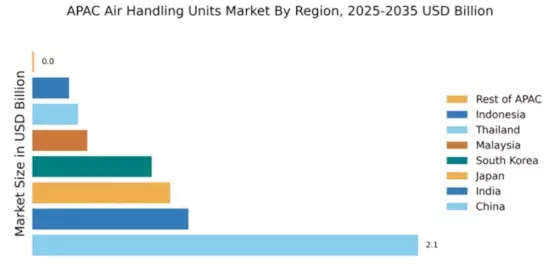
China holds a commanding market share of 2.1 in the APAC air handling units sector, driven by rapid urbanization and industrialization. The demand for energy-efficient systems is surging, supported by government initiatives promoting green technologies. Regulatory policies favoring sustainable practices are also enhancing market growth, while significant investments in infrastructure development bolster the sector's expansion.
India : Rapid Urbanization Fuels Demand
India's air handling units market is valued at 0.85, reflecting a robust growth trajectory. Key drivers include increasing urbanization, rising disposable incomes, and a growing focus on indoor air quality. Government initiatives like the Smart Cities Mission are enhancing infrastructure, while regulatory frameworks are evolving to support energy-efficient solutions, driving consumption patterns.
Japan : Focus on Innovation and Quality
Japan's market share stands at 0.75, characterized by a strong emphasis on technology and quality. The demand for advanced air handling units is driven by stringent environmental regulations and a growing awareness of health and safety standards. The government is promoting energy-efficient technologies, which is further propelling market growth in urban areas.
South Korea : Sustainability Drives Market Growth
With a market share of 0.65, South Korea is witnessing a surge in demand for air handling units, primarily due to government policies aimed at reducing carbon emissions. The focus on smart buildings and energy efficiency is reshaping consumption patterns. Major cities like Seoul and Busan are key markets, supported by robust infrastructure development.
Malaysia : Infrastructure Development Boosts Demand
Malaysia's air handling units market is valued at 0.3, driven by ongoing infrastructure projects and urban development. The demand is influenced by the construction of commercial and residential buildings, alongside government initiatives promoting energy efficiency. Regulatory policies are evolving to support sustainable practices, enhancing market dynamics.
Thailand : Tourism and Industry Drive Growth
Thailand's market share is 0.25, with growth fueled by the tourism sector and industrial expansion. The demand for air handling units is increasing in hospitality and manufacturing industries, supported by government initiatives to enhance energy efficiency. Key cities like Bangkok are pivotal in driving market dynamics and consumption patterns.
Indonesia : Infrastructure Needs Drive Demand
Indonesia's air handling units market is valued at 0.2, with growth driven by urbanization and infrastructure development. The government is investing in energy-efficient technologies, although challenges remain in regulatory frameworks. Key markets include Jakarta and Surabaya, where industrial growth is fostering demand for advanced air handling solutions.
Rest of APAC : Diverse Applications Across Regions
The Rest of APAC holds a minimal market share of 0.01, yet presents niche opportunities. Demand is driven by specific local needs and applications, influenced by varying regulatory environments. Countries in this category are exploring energy-efficient solutions, albeit at a slower pace compared to major markets. The competitive landscape is fragmented, with local players gaining traction.
Key Players and Competitive Insights
Key Companies in the APAC Air Handling Units Market include
Industry Developments
In recent developments within the APAC Air Handling Units Market, several key players have made significant movements. Emerson Electric has been focusing on enhancing energy efficiency in its products, aligning with stricter environmental regulations across various APAC countries. Toshiba Corporation and Mitsubishi Electric are also advancing their technology in air handling solutions to meet the growing demand for smarter building management systems.
In May 2023, Carrier Global announced a partnership with local firms to expand its reach in the Southeast Asian market, reflecting the trend towards localized manufacturing and distribution. Furthermore, GREE Electric Appliances has reported a considerable increase in sales due to rising urbanization and construction activities in the region. The APAC market has seen a surge in demand, with a reported market valuation growth of approximately 10% annually over the last two years, primarily driven by the increased focus on air quality and efficient HVAC systems.
Significant previous actions include Daikin Industries' acquisition of a local manufacturer in January 2022 to strengthen its presence in the market. The competitive landscape continues to evolve as companies like LG Electronics and Panasonic Corporation introduce innovative products to capitalize on the region's growth potential.
Future Outlook
APAC Air Handling Units Market Future Outlook
The Air Handling Units Market is projected to grow at a 6.44% CAGR from 2025 to 2035, driven by urbanization, energy efficiency demands, and technological advancements.
New opportunities lie in:
- Integration of IoT for predictive maintenance solutions.
- Development of energy-efficient units to meet regulatory standards.
- Expansion into emerging markets with tailored product offerings.
By 2035, the air handling-units market is expected to achieve robust growth and innovation.
Market Segmentation
APAC Air Handling Units Market Type Outlook
- Packaged Rooftop
- Modular
- Custom
APAC Air Handling Units Market Effect Outlook
- Single Effect
- Double Effect
APAC Air Handling Units Market Capacity Outlook
- Upto 5000 m3/hr
- 5000 m3/hr – 15000 m3/hr
- Above 15000 m3/hr
APAC Air Handling Units Market Application Outlook
- Industrial
- Residential
- Commercial
Report Scope
| MARKET SIZE 2024 | 5.11(USD Billion) |
| MARKET SIZE 2025 | 5.44(USD Billion) |
| MARKET SIZE 2035 | 10.15(USD Billion) |
| COMPOUND ANNUAL GROWTH RATE (CAGR) | 6.44% (2025 - 2035) |
| REPORT COVERAGE | Revenue Forecast, Competitive Landscape, Growth Factors, and Trends |
| BASE YEAR | 2024 |
| Market Forecast Period | 2025 - 2035 |
| Historical Data | 2019 - 2024 |
| Market Forecast Units | USD Billion |
| Key Companies Profiled | Trane Technologies (IE), Carrier Global Corporation (US), Daikin Industries Ltd (JP), Johnson Controls International plc (IE), Mitsubishi Electric Corporation (JP), LG Electronics Inc (KR), Gree Electric Appliances Inc (CN), Rheem Manufacturing Company (US), York International Corporation (US) |
| Segments Covered | Type, Effect, Capacity, Application |
| Key Market Opportunities | Integration of smart technologies in air handling-units enhances energy efficiency and meets evolving regulatory standards. |
| Key Market Dynamics | Rising demand for energy-efficient air handling units driven by stringent environmental regulations in the APAC region. |
| Countries Covered | China, India, Japan, South Korea, Malaysia, Thailand, Indonesia, Rest of APAC |
FAQs
What was the overall market valuation of the APAC air handling-units market in 2024?
The overall market valuation was 5.11 USD Billion in 2024.
What is the projected market valuation for the APAC air handling-units market by 2035?
The projected valuation for 2035 is 10.15 USD Billion.
What is the expected CAGR for the APAC air handling-units market during the forecast period 2025 - 2035?
The expected CAGR during the forecast period 2025 - 2035 is 6.44%.
Which companies are considered key players in the APAC air handling-units market?
Key players include Trane Technologies, Carrier Global Corporation, Daikin Industries, and others.
What are the main segments of the APAC air handling-units market?
The main segments include Type, Effect, Capacity, and Application.
How did the packaged rooftop segment perform in 2024?
The packaged rooftop segment was valued at 1.53 USD Billion in 2024.
What is the projected value of the custom segment by 2035?
The custom segment is projected to reach 5.05 USD Billion by 2035.
What was the valuation of the industrial application segment in 2024?
The industrial application segment was valued at 1.53 USD Billion in 2024.
How is the capacity segment expected to grow by 2035?
The capacity segment is expected to grow, reaching 3.15 USD Billion for above 15000 m3/hr by 2035.
What was the valuation of the residential application segment in 2024?
The residential application segment was valued at 1.02 USD Billion in 2024.
Kindly complete the form below to receive a free sample of this Report
Customer Stories
“This is really good guys. Excellent work on a tight deadline. I will continue to use you going forward and recommend you to others. Nice job”
“Thanks. It’s been a pleasure working with you, please use me as reference with any other Intel employees.”
“Thanks for sending the report it gives us a good global view of the Betaïne market.”
“Thank you, this will be very helpful for OQS.”
“We found the report very insightful! we found your research firm very helpful. I'm sending this email to secure our future business.”
“I am very pleased with how market segments have been defined in a relevant way for my purposes (such as "Portable Freezers & refrigerators" and "last-mile"). In general the report is well structured. Thanks very much for your efforts.”
“I have been reading the first document or the study, ,the Global HVAC and FP market report 2021 till 2026. Must say, good info! I have not gone in depth at all parts, but got a good indication of the data inside!”
“We got the report in time, we really thank you for your support in this process. I also thank to all of your team as they did a great job.”