×
Request Free Sample ×

Kindly complete the form below to receive a free sample of this Report

Leading companies partner with us for data-driven Insights

clients tt-cursor
Hero Background

APAC Brain Computer Interface Market

ID: MRFR/ICT/56813-HCR
200 Pages
Aarti Dhapte
October 2025

APAC Brain-Computer Interface Market Research Report By Application (Medical, Gaming, Communication, Military, Research), By Technology (Non-Invasive, Invasive, Semi-Invasive), By End-use (Healthcare, Entertainment, Education, Defense, Research Institutions), and By Regional (China, India, Japan, South Korea, Malaysia, Thailand, Indonesia, Rest of APAC)- Forecast to 2035

Share:
Download PDF ×

We do not share your information with anyone. However, we may send you emails based on your report interest from time to time. You may contact us at any time to opt-out.

APAC Brain Computer Interface Market Infographic
Purchase Options

APAC Brain Computer Interface Market Summary

As per MRFR analysis, the APAC brain computer-interface market size was estimated at 623.0 USD Million in 2024. The APAC brain computer-interface market is projected to grow from 654.52 USD Million in 2025 to 1072.57 USD Million by 2035, exhibiting a compound annual growth rate (CAGR) of 5.06% during the forecast period 2025 - 2035.

Key Market Trends & Highlights

The APAC brain computer-interface market is poised for substantial growth driven by technological advancements and increasing consumer adoption.

  • China remains the largest market for brain computer-interfaces, showcasing significant technological advancements.
  • India is emerging as the fastest-growing region, reflecting a surge in consumer adoption of neurotechnology solutions.
  • Regulatory support is enhancing the market landscape, facilitating the integration of brain computer-interfaces into healthcare systems.
  • Rising investment in neurotechnology and the increasing prevalence of neurological disorders are key drivers propelling market expansion.

Market Size & Forecast

2024 Market Size 623.0 (USD Million)
2035 Market Size 1072.57 (USD Million)

Major Players

Neuralink (US), Synchron (US), Kernel (US), Emotiv (US), OpenBCI (US), Blackrock Neurotech (US), Ceregate (DE), Neurable (US), BrainCo (US)

APAC Brain Computer Interface Market Trends

The brain computer-interface market is experiencing notable growth in the Asia-Pacific region, driven by advancements in technology and increasing applications across various sectors. The integration of artificial intelligence and machine learning into brain-computer interfaces is enhancing their functionality, making them more appealing for both medical and non-medical uses. This trend is particularly evident in healthcare, where brain-computer interfaces are being utilized for rehabilitation and assistive technologies, allowing individuals with disabilities to regain control over their environment. Furthermore, the rising demand for innovative solutions in gaming and entertainment is propelling the development of consumer-oriented brain-computer interfaces, which are becoming more accessible to the general public. In addition to technological advancements, the regulatory landscape in the Asia-Pacific region is evolving to accommodate the unique challenges posed by brain-computer interfaces. Governments are increasingly recognizing the potential benefits of these technologies, leading to supportive policies and funding initiatives aimed at fostering research and development. This supportive environment is likely to encourage collaboration between academic institutions, private companies, and healthcare providers, further driving innovation in the brain computer-interface market. As the market continues to mature, it appears poised for significant expansion, with a focus on ethical considerations and user safety becoming paramount in the development of new products and applications.

Technological Advancements

The brain computer-interface market is witnessing rapid technological advancements, particularly in the fields of artificial intelligence and machine learning. These innovations are enhancing the capabilities of brain-computer interfaces, making them more effective for various applications, including healthcare and entertainment.

Regulatory Support

Regulatory frameworks in the Asia-Pacific region are adapting to the unique challenges of brain-computer interfaces. Governments are increasingly implementing supportive policies and funding initiatives, which may foster collaboration among stakeholders and promote research and development.

Consumer Adoption

There is a growing trend towards consumer adoption of brain-computer interfaces, particularly in gaming and entertainment. As these technologies become more accessible, they are likely to attract a broader audience, driving further innovation and market growth.

APAC Brain Computer Interface Market Drivers

Rising Investment in Neurotechnology

The brain computer-interface market is experiencing a surge in investment, driven by both public and private sectors. Governments are increasingly recognizing the potential of neurotechnology to enhance healthcare and education. For instance, funding for research and development in brain-computer interfaces has seen a notable increase, with estimates suggesting that investments could reach $1 billion by 2026. This influx of capital is likely to accelerate innovation and commercialization of brain-computer interfaces, thereby expanding their applications across various sectors. The growing interest from venture capitalists and tech companies further indicates a robust market trajectory. As a result, the brain computer-interface market in APAC is poised for significant growth, potentially transforming how individuals interact with technology and each other.

Advancements in Artificial Intelligence

The integration of artificial intelligence (AI) into the brain computer-interface market is a pivotal driver of growth. AI technologies enhance the functionality and efficiency of brain-computer interfaces, enabling more accurate interpretation of neural signals. This synergy is likely to lead to the development of more sophisticated applications, such as real-time brain activity monitoring and adaptive learning systems. Market analysts suggest that the AI segment within the brain computer-interface market could grow at a CAGR of over 20% in the coming years. As AI continues to evolve, its applications in neurotechnology are expected to expand, potentially revolutionizing user experiences and outcomes in various fields, including gaming, healthcare, and education.

Growing Demand for Assistive Technologies

The brain computer-interface market is witnessing a growing demand for assistive technologies, particularly among individuals with disabilities. As awareness of the capabilities of brain-computer interfaces increases, more consumers are seeking solutions that enhance mobility and communication. This trend is supported by a societal shift towards inclusivity and accessibility, with governments and organizations advocating for the rights of disabled individuals. Market data indicates that the assistive technology segment is expected to grow by approximately 25% by 2027. This demand is likely to drive innovation in the brain computer-interface market, leading to the development of user-friendly devices that cater to diverse needs and preferences.

Increasing Prevalence of Neurological Disorders

The brain computer-interface market is significantly influenced by the rising prevalence of neurological disorders. Conditions such as Parkinson's disease, epilepsy, and stroke are becoming more common, necessitating innovative treatment solutions. According to recent health statistics, the incidence of neurological disorders in the region is projected to increase by approximately 15% over the next decade. This growing patient population is driving demand for advanced therapeutic options, including brain-computer interfaces that can assist in rehabilitation and improve quality of life. The healthcare sector's focus on personalized medicine and technology-driven solutions further supports the expansion of the brain computer-interface market in APAC, as stakeholders seek effective interventions for these challenging conditions.

Collaborations Between Tech Companies and Research Institutions

The brain computer-interface market is benefiting from strategic collaborations between technology companies and research institutions. These partnerships are fostering innovation and accelerating the development of new products and solutions. By combining expertise in neuroscience, engineering, and software development, stakeholders are creating advanced brain-computer interfaces that are more effective and user-friendly. Recent collaborations have resulted in breakthroughs in signal processing and interface design, which are crucial for enhancing user experience. The trend of collaboration is expected to continue, with projections indicating that joint ventures could account for a significant share of the market by 2028. This collaborative approach is likely to drive the brain computer-interface market forward, facilitating the introduction of cutting-edge technologies.

Market Segment Insights

By Application: Medical (Largest) vs. Gaming (Fastest-Growing)

In the APAC brain computer-interface market, the application segment is witnessing a dynamic distribution of market share. The largest share is accounted for by the Medical applications, which leverage BCI technologies for rehabilitation, neurofeedback, and assistive technologies. Following closely, Gaming has emerged as a significant contender, particularly appealing to younger demographics and tech-savvy consumers. Other segments, such as Communication and Military, hold niche positions that contribute to the overall market dynamics, emphasizing the diverse range of applications for BCI. As the sector evolves, several growth trends are influencing these segments. The Medical field shows steady growth driven by increased healthcare investments and technological advancements that enhance patient outcomes. Gaming, on the other hand, is buoyed by growing interest in immersive experiences and competitive e-sports, attracting more investment and innovation. Meanwhile, Communication and Research applications continue to expand, fueled by the need for improved human-computer interfaces in both personal and professional realms.

Medical (Dominant) vs. Gaming (Emerging)

The Medical segment stands out as the dominant application in the APAC brain computer-interface market, driven by strong demand for assistive devices and therapies for neurological conditions. This sector is characterized by rigorous regulatory frameworks and extensive research backing its applications, making it a trusted option for patients and healthcare providers. In contrast, the Gaming segment is emerging rapidly, appealing to a market that seeks novel gaming experiences and high-engagement platforms. This segment is marked by its innovative use of BCI technology to enhance gameplay and user interaction, thus attracting investments and fostering a new wave of game development focused on user-centered technology.

By Technology: Non-Invasive (Largest) vs. Invasive (Fastest-Growing)

The distribution of market share in the APAC brain computer-interface market shows that non-invasive technology maintains a significant lead, accounting for a substantial portion of the total segment. This dominance is attributed to its user-friendly nature and growing applications across various sectors. In contrast, the invasive segment, though smaller, is rapidly gaining traction as advancements in surgical techniques and neuroprosthetic development enhance its viability and attractiveness to medical and defense applications. The growth trends in this segment indicate a strong driver towards innovative developments. Non-invasive devices are becoming integral in rehabilitation and assistive technologies, appealing to a wide audience. Conversely, the invasive segment is projected to flourish as it offers improved performance and precision in applications such as brain mapping and neurodiagnostics, indicating potential for significant market expansion in the coming years.

Technology: Non-Invasive (Dominant) vs. Invasive (Emerging)

Non-invasive brain computer interfaces (BCIs) are dominant due to their ease of use, safety, and non-requirement for surgical intervention. They leverage technologies such as EEG and fNIRS, making them suitable for various applications, including gaming, rehabilitation, and communication aids. This segment's growth is powered by technological advancements and increasing adoption in consumer markets. Conversely, invasive BCIs, while currently considered emerging, are gaining interest for their potential in medical applications like treatment for neurological disorders and brain-computer interaction enhancements. Their ability to provide high-resolution signals presents a unique opportunity for applications requiring precision, thus positioning this segment for substantial future growth as the technology matures.

By End Use: Healthcare (Largest) vs. Entertainment (Fastest-Growing)

The market share distribution for the End Use segment of the brain computer-interface technology illustrates distinct hierarchies among the different applications. Healthcare constitutes the largest share, driven by the increasing use of BCI for neurorehabilitation and mental health treatments. Meanwhile, Entertainment holds significant potential with its growing adoption in gaming and virtual reality, enhancing user interactions and experiences. Growth trends in the BCI for this segment are largely influenced by technological advancements and rising investments in research and development. The increasing awareness of mental health and cognitive enhancement drives demand in healthcare, while entertainment is being propelled by innovations in gaming technology and immersive experiences. The heightened interest among consumers in both sectors affirms the momentum of the APAC brain computer-interface market.

Healthcare: Traditional (Dominant) vs. Entertainment: Gaming (Emerging)

In the End Use segment of the brain computer-interface market, Healthcare is recognized as the dominant force due to its foundational role in medical applications, particularly in neurorehabilitation and assistive technologies. This sector benefits from extensive research and a growing recognition of mental health's importance, securing its position as a primary focus for BCI developments. On the other hand, the Entertainment sector, especially in gaming, is emerging rapidly, characterized by innovative uses of BCI technology to create engaging and interactive experiences. As gaming companies venture into integrating BCI, this segment is expected to attract substantial investment and consumer interest, positioning itself as a vital area for future growth and exploration.

Get more detailed insights about APAC Brain Computer Interface Market

Regional Insights

China : Innovative Technologies Drive Growth

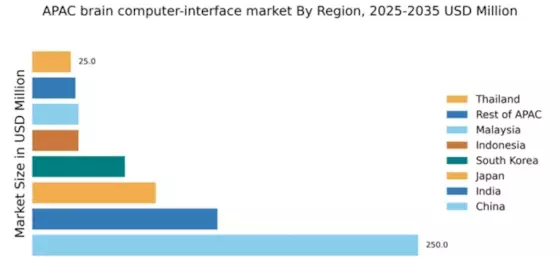
China holds a dominant position in the APAC brain-computer interface (BCI) market, with a market value of $250.0 million, accounting for approximately 40% of the region's total share. Key growth drivers include rapid advancements in AI and machine learning, alongside increasing investments in healthcare technology. Government initiatives, such as the Made in China 2025 plan, support BCI development, while robust infrastructure fosters industrial growth and innovation.

India : Healthcare Innovations Fuel Demand

India's BCI market is valued at $120.0 million, representing about 19% of the APAC market. The growth is driven by increasing healthcare investments and a rising demand for assistive technologies. The government has launched initiatives like Digital India, promoting tech adoption in healthcare. Additionally, urbanization and a growing tech-savvy population are enhancing consumption patterns in this sector.

Japan : Strong R&D and Innovation Focus

Japan's BCI market is valued at $80.0 million, capturing around 13% of the APAC market. The country benefits from a strong emphasis on research and development, particularly in robotics and healthcare. Government policies encourage innovation, while a well-established tech infrastructure supports BCI applications. The aging population also drives demand for assistive technologies, creating a favorable market environment.

South Korea : Government Support and Innovation

South Korea's BCI market is valued at $60.0 million, accounting for about 10% of the APAC market. The growth is fueled by government support for technology startups and a strong focus on AI integration in healthcare. Cities like Seoul and Busan are key markets, with a competitive landscape featuring local players and international firms. The emphasis on smart healthcare solutions enhances the demand for BCI technologies.

Malaysia : Healthcare Sector Transformation

Malaysia's BCI market is valued at $30.0 million, representing about 5% of the APAC market. The growth is driven by increasing healthcare investments and a focus on digital health solutions. Government initiatives, such as the National Health Policy, promote technology adoption in healthcare. The urban centers of Kuala Lumpur and Penang are emerging as key markets for BCI applications.

Thailand : Healthcare Innovations and Investments

Thailand's BCI market is valued at $25.0 million, making up approximately 4% of the APAC market. The growth is supported by rising healthcare expenditures and government initiatives aimed at enhancing healthcare technology. Key cities like Bangkok are pivotal markets, with a competitive landscape featuring both local and international players. The focus on mental health and rehabilitation drives demand for BCI solutions.

Indonesia : Emerging Market with Growth Potential

Indonesia's BCI market is valued at $30.0 million, representing about 5% of the APAC market. The growth is driven by increasing healthcare investments and a rising demand for innovative medical technologies. Government initiatives to improve healthcare access and technology adoption are pivotal. Key cities like Jakarta and Surabaya are central to market dynamics, with a growing interest in BCI applications across various sectors.

Rest of APAC : Varied Applications and Growth Drivers

The Rest of APAC BCI market is valued at $28.0 million, accounting for about 4% of the total market. This sub-region includes diverse markets with unique demands and applications for BCI technologies. Growth is driven by increasing healthcare investments and a focus on mental health solutions. Local dynamics vary significantly, with different regulatory environments and market conditions influencing BCI adoption.

APAC Brain Computer Interface Market Regional Image

Key Players and Competitive Insights

The brain computer-interface market is currently characterized by a dynamic competitive landscape, driven by rapid technological advancements and increasing demand for innovative solutions in healthcare and consumer applications. Key players such as Neuralink (US), Synchron (US), and Kernel (US) are at the forefront, each adopting distinct strategies to enhance their market positioning. Neuralink (US) focuses on pioneering neurotechnology for medical applications, particularly in treating neurological disorders, while Synchron (US) emphasizes minimally invasive techniques for brain-computer interfacing. Kernel (US), on the other hand, is dedicated to developing advanced cognitive enhancement technologies, indicating a diverse operational focus among these companies that collectively shapes a competitive environment marked by innovation and specialization.

In terms of business tactics, companies are increasingly localizing manufacturing and optimizing supply chains to enhance operational efficiency. The market structure appears moderately fragmented, with several players vying for market share, yet the influence of major companies remains substantial. This competitive structure fosters an environment where innovation is paramount, as companies strive to differentiate themselves through unique offerings and technological advancements.

In October 2025, Neuralink (US) announced a groundbreaking partnership with a leading healthcare provider to initiate clinical trials for its brain implant technology aimed at treating severe depression. This strategic move not only underscores Neuralink's commitment to addressing mental health issues but also positions the company to leverage its technology in a rapidly growing segment of the healthcare market. The collaboration is likely to enhance Neuralink's credibility and expand its reach within the medical community.

In September 2025, Synchron (US) secured a significant investment from a venture capital firm, aimed at accelerating the development of its Stentrode device, which enables direct communication between the brain and external devices. This funding is expected to bolster Synchron's research capabilities and expedite the commercialization of its technology, potentially leading to a competitive edge in the brain-computer interface sector. The investment reflects growing confidence in Synchron's innovative approach and its potential to revolutionize patient care.

In August 2025, Kernel (US) launched a new cognitive enhancement product that utilizes its proprietary neuroimaging technology. This product aims to improve mental performance and is targeted at both consumers and professionals. The launch signifies Kernel's strategic intent to diversify its product offerings and tap into the burgeoning market for cognitive enhancement solutions. By positioning itself at the intersection of neuroscience and consumer technology, Kernel is likely to attract a wide range of customers seeking to enhance their cognitive abilities.

As of November 2025, the competitive trends in the brain computer-interface market are increasingly defined by digitalization, sustainability, and the integration of artificial intelligence. Strategic alliances among companies are shaping the landscape, fostering collaboration that enhances innovation and accelerates product development. Looking ahead, competitive differentiation is expected to evolve, with a shift from price-based competition to a focus on technological innovation, reliability in supply chains, and the ability to deliver unique, high-quality solutions. This transition may redefine the competitive dynamics, emphasizing the importance of adaptability and forward-thinking strategies in a rapidly changing market.

Key Companies in the APAC Brain Computer Interface Market market include

Industry Developments

Researchers from Tsinghua University and Bible Capital Xuanwu Hospital in China successfully implanted a wireless brain-computer interface (BCI) processor in a paraplegic patient in early January 2024, allowing for over 90% accurate control of robotic aid. This significant medical achievement highlights China's quick development of semi-invasive BCI technology.

Research and development (R&D) advancements in South Korea and India were bolstering neurorehabilitation and augmentative technologies, while researchers in China (e.g., Tianjin University) were creating second-generation low-power chips by November 2023.

According to Grand View Research's market forecasts, the APAC BCI market is expected to develop at the quickest rate in the world, reaching USD 495.8 million in 2024 with a projected 18.9% compound annual growth rate (CAGR) from 2025 to 2030. Current revenue sources are dominated by non-invasive devices, but invasive and semi-invasive applications are predicted to grow quickly.

The sector is expanding thanks to government backing, expanding healthcare investments, advantageous industrial infrastructure, and growing consumer demand for wellness. Overall, APAC is well-positioned to lead the world in BCI innovation thanks to developments in clinical applications, chipset development, and advantageous market conditions.

Future Outlook

APAC Brain Computer Interface Market Future Outlook

The brain computer-interface market is projected to grow at a 5.06% CAGR from 2024 to 2035, driven by technological advancements, increasing demand for assistive devices, and expanding applications in healthcare.

New opportunities lie in:

  • Development of AI-integrated BCI systems for enhanced user experience.
  • Expansion into telemedicine solutions leveraging BCI technology.
  • Partnerships with educational institutions for BCI research and development.

By 2035, the market is expected to achieve substantial growth, driven by innovation and strategic partnerships.

Market Segmentation

APAC Brain Computer Interface Market End Use Outlook

  • Healthcare
  • Entertainment
  • Education
  • Defense
  • Research Institutions

APAC Brain Computer Interface Market Technology Outlook

  • Non-Invasive
  • Invasive
  • Semi-Invasive

APAC Brain Computer Interface Market Application Outlook

  • Medical
  • Gaming
  • Communication
  • Military
  • Research

Report Scope

MARKET SIZE 2024623.0(USD Million)
MARKET SIZE 2025654.52(USD Million)
MARKET SIZE 20351072.57(USD Million)
COMPOUND ANNUAL GROWTH RATE (CAGR)5.06% (2024 - 2035)
REPORT COVERAGERevenue Forecast, Competitive Landscape, Growth Factors, and Trends
BASE YEAR2024
Market Forecast Period2025 - 2035
Historical Data2019 - 2024
Market Forecast UnitsUSD Million
Key Companies Profiled["Neuralink (US)", "Synchron (US)", "Kernel (US)", "Emotiv (US)", "OpenBCI (US)", "Blackrock Neurotech (US)", "Ceregate (DE)", "Neurable (US)", "BrainCo (US)"]
Segments CoveredApplication, Technology, End Use
Key Market OpportunitiesAdvancements in neurotechnology drive demand for innovative applications in the brain computer-interface market.
Key Market DynamicsRapid technological advancements drive innovation and competition in the brain computer-interface market across APAC.
Countries CoveredChina, India, Japan, South Korea, Malaysia, Thailand, Indonesia, Rest of APAC

Leave a Comment

FAQs

What is the expected market size of the APAC Brain-Computer Interface Market by the year 2024?

The APAC Brain-Computer Interface Market is expected to be valued at 836.5 USD Million in 2024.

What will be the projected market size of the APAC Brain-Computer Interface Market by 2035?

By 2035, the APAC Brain-Computer Interface Market is projected to reach 7175.0 USD Million.

What is the expected compound annual growth rate (CAGR) of the APAC Brain-Computer Interface Market from 2025 to 2035?

The expected CAGR for the APAC Brain-Computer Interface Market from 2025 to 2035 is 21.577%.

Which country is expected to hold the largest market share for the APAC Brain-Computer Interface Market in 2024?

China is expected to dominate the market with a value of 321.5 USD Million in 2024.

What is the projected market size for the Medical application segment of the APAC Brain-Computer Interface Market by 2035?

The Medical application segment is projected to reach 2100.0 USD Million by 2035.

Who are the major players navigating the APAC Brain-Computer Interface Market?

Key players in the market include Guger Technologies, Blackrock Neurotech, Medtronic, and Neuralink, among others.

What is the anticipated market value for the Gaming application segment in the APAC Brain-Computer Interface Market by the year 2024?

The Gaming application segment is expected to be valued at 150.0 USD Million in 2024.

Which region is expected to see significant growth in the APAC Brain-Computer Interface Market, especially by 2035?

India is expected to see significant growth, with an estimated market value of 1850.0 USD Million by 2035.

How much is the Communication application segment projected to be worth in 2035?

The Communication application segment is projected to reach 1800.0 USD Million by 2035.

What is the total market value expected for the Research application segment in 2024?

The Research application segment is expected to hold a market value of 236.5 USD Million in 2024.

Download Free Sample

Kindly complete the form below to receive a free sample of this Report

Compare Licence

×
Features License Type
Single User Multiuser License Enterprise User
Price $4,950 $5,950 $7,250
Maximum User Access Limit 1 User Upto 10 Users Unrestricted Access Throughout the Organization
Free Customization
Direct Access to Analyst
Deliverable Format
Platform Access
Discount on Next Purchase 10% 15% 15%
Printable Versions