×
Request Free Sample ×

Kindly complete the form below to receive a free sample of this Report

* Please use a valid business email

Leading companies partner with us for data-driven Insights

clients tt-cursor
Hero Background

APAC Intelligent Network Market

ID: MRFR/ICT/58945-HCR
200 Pages
Aarti Dhapte
October 2025

APAC Intelligent Network Market Research Report By Application (Information Cognition, Traffic Prediction & Classification, Resource Management & Network Adoption, Performance Prediction & Configuration Extrapolation), By Enterprise Size (Small & Medium Sized Enterprises, Large Enterprises), By End-User (Telecom Service Providers, Cloud Service Providers, Managed Network Service Providers, Others) and By Regional (China, India, Japan, South Korea, Malaysia, Thailand, Indonesia, Rest of APAC) - Forecast to 2035

Share:
Download PDF ×

We do not share your information with anyone. However, we may send you emails based on your report interest from time to time. You may contact us at any time to opt-out.

APAC Intelligent Network Market Infographic
Purchase Options

APAC Intelligent Network Market Summary

As per MRFR analysis, the APAC intelligent network market Size was estimated at 1656.0 USD Million in 2024. The APAC intelligent network market is projected to grow from 1890.32 USD Million in 2025 to 7100.0 USD Million by 2035, exhibiting a compound annual growth rate (CAGR) of 14.15% during the forecast period 2025 - 2035.

Key Market Trends & Highlights

The APAC intelligent network market is experiencing robust growth driven by technological advancements and increasing demand for connectivity.

  • The market is witnessing an increased adoption of AI and automation, particularly in China, which is the largest market.
  • India, recognized as the fastest-growing region, shows a strong focus on cybersecurity enhancements within intelligent network solutions.
  • Integration of IoT in network solutions is becoming a prevalent trend across the APAC region, enhancing operational efficiency.
  • Rising demand for enhanced connectivity and government initiatives are key drivers propelling the market forward.

Market Size & Forecast

2024 Market Size 1656.0 (USD Million)
2035 Market Size 7100.0 (USD Million)
CAGR (2025 - 2035) 14.15%

Major Players

Cisco Systems (US), Huawei Technologies (CN), Nokia (FI), Ericsson (SE), Juniper Networks (US), Arista Networks (US), ZTE Corporation (CN), Ciena Corporation (US), Mavenir (US)

APAC Intelligent Network Market Trends

The intelligent network market is currently experiencing a transformative phase, driven by advancements in technology and increasing demand for efficient network solutions. In the APAC region, the integration of artificial intelligence and machine learning into network management is becoming more prevalent. This shift not only enhances operational efficiency but also improves the overall user experience. As organizations seek to optimize their network performance, the adoption of intelligent network solutions is likely to accelerate, reflecting a broader trend towards automation and data-driven decision-making. Moreover, the growing emphasis on cybersecurity within the intelligent network market cannot be overlooked. With the rise in cyber threats, businesses are prioritizing secure network infrastructures. This focus on security is prompting investments in advanced technologies that can proactively identify and mitigate risks. As a result, the intelligent network market is evolving to incorporate robust security measures, ensuring that organizations can operate safely in an increasingly digital landscape. The interplay between efficiency, security, and technological innovation is shaping the future of this market in the APAC region, indicating a promising trajectory for stakeholders involved in this sector.

Increased Adoption of AI and Automation

The intelligent network market is witnessing a surge in the adoption of artificial intelligence and automation technologies. Organizations are increasingly leveraging these tools to enhance network management, streamline operations, and improve service delivery. This trend suggests a shift towards more intelligent systems that can adapt to changing demands and optimize performance.

Focus on Cybersecurity Enhancements

As cyber threats continue to evolve, the intelligent network market is placing a heightened emphasis on cybersecurity. Businesses are investing in advanced security solutions to protect their networks from potential breaches. This focus on security indicates a growing recognition of the importance of safeguarding sensitive data and maintaining operational integrity.

Integration of IoT in Network Solutions

The integration of Internet of Things (IoT) devices into network solutions is becoming increasingly prevalent. This trend reflects the need for networks that can support a vast array of connected devices. The intelligent network market is adapting to accommodate this influx, suggesting a future where seamless connectivity and data exchange are paramount.

APAC Intelligent Network Market Drivers

Emergence of Edge Computing

The emergence of edge computing is significantly influencing the intelligent network market in APAC. As the demand for real-time data processing increases, businesses are shifting towards decentralized computing models that bring data processing closer to the source. This shift is particularly relevant for industries such as manufacturing and healthcare, where latency can impact operational efficiency. The edge computing market in APAC is expected to grow at a CAGR of 25% over the next five years, indicating a strong trend towards intelligent networking solutions that can support edge architectures. Consequently, service providers are adapting their offerings to incorporate edge capabilities, thereby enhancing the overall value proposition of the intelligent network market.

Growing Cybersecurity Concerns

Growing cybersecurity concerns are driving the intelligent network market in APAC as organizations prioritize the protection of their digital assets. With the increasing frequency of cyber threats, businesses are compelled to adopt advanced security measures within their network infrastructures. This trend is evident in sectors such as finance and healthcare, where data breaches can have severe consequences. The cybersecurity market in APAC is projected to reach $40 billion by 2026, reflecting the urgency for enhanced security solutions. As organizations invest in intelligent networking technologies that incorporate robust security features, the demand for such solutions is likely to escalate, thereby propelling the growth of the intelligent network market.

Increased Focus on Data Analytics

The intelligent network market in APAC is witnessing an increased focus on data analytics as organizations seek to leverage insights for better decision-making. The integration of advanced analytics tools into network management systems allows businesses to optimize performance and enhance operational efficiency. This trend is particularly relevant in sectors such as telecommunications and finance, where data-driven strategies are becoming essential. Reports suggest that the adoption of analytics in network solutions could lead to a 20% reduction in operational costs for companies in the region. As organizations recognize the value of data analytics, investments in intelligent networking solutions are likely to rise, further driving the growth of the intelligent network market.

Government Initiatives and Support

Government initiatives in APAC are playing a crucial role in shaping the intelligent network market. Various countries are implementing policies aimed at enhancing digital infrastructure and promoting smart city initiatives. For instance, investments in 5G technology are being prioritized, with governments allocating substantial budgets to facilitate its rollout. This is expected to create a favorable environment for the intelligent network market, as 5G networks are inherently designed to support advanced networking solutions. Furthermore, public-private partnerships are emerging, fostering innovation and collaboration in the sector. The anticipated growth in government spending on digital infrastructure is projected to reach $200 billion by 2027, indicating a robust commitment to advancing the intelligent network market in the region.

Rising Demand for Enhanced Connectivity

The intelligent network market in APAC is experiencing a surge in demand for enhanced connectivity solutions. As businesses increasingly rely on digital platforms, the need for robust and reliable network infrastructure becomes paramount. This demand is driven by the rapid growth of cloud computing and data-intensive applications, which require seamless connectivity. According to recent data, the APAC region is projected to witness a compound annual growth rate (CAGR) of approximately 15% in network services by 2026. This growth indicates a strong inclination towards intelligent networking solutions that can support high-speed data transfer and low latency. Consequently, service providers are investing heavily in upgrading their infrastructure to meet these evolving demands, thereby propelling the intelligent network market forward.

Market Segment Insights

By Application: Information Cognition (Largest) vs. Traffic Prediction & Classification (Fastest-Growing)

In the intelligent network market, Information Cognition holds the largest share among the application segments, suggesting a strong preference for systems that enhance decision-making through effective information processing. This segment benefits from advancements in artificial intelligence and machine learning, which improve the accuracy and efficiency of data interpretation. Conversely, Traffic Prediction & Classification is identified as the fastest-growing segment, driven by the increasing demand for smarter network management solutions that can adeptly handle the growing volume of data traffic. The growth trends in these segments are influenced by the rapid digital transformation occurring across various industries in the APAC region. Organizations are recognizing the necessity to leverage their network data effectively, propelling the development of traffic prediction capabilities to optimize network performance. Furthermore, the shift towards more automated and intelligent systems is contributing to the rising significance of Information Cognition, making it a focal point for future investments and innovations in intelligent networking technology.

Information Cognition: Dominant vs. Traffic Prediction & Classification: Emerging

Information Cognition serves as the dominant application segment in the intelligent network landscape, characterized by its ability to harness data for strategic insights, supporting decision-making processes in organizations. This segment focuses on technologies that analyze vast data streams, enhancing operational efficiency and facilitating real-time responses to network demands. In contrast, Traffic Prediction & Classification represents an emerging area, driven by the necessity to manage and predict data flows accurately as network complexities grow. By utilizing advanced algorithms, this segment enables proactive network adjustments, making it vital for organizations aiming to elevate their infrastructural capabilities amidst increasing traffic demands.

By Enterprise Size: Small & Medium-Sized Enterprises (Largest) vs. Large Enterprises (Fastest-Growing)

The market distribution within the enterprise size segment shows that Small & Medium-Sized Enterprises (SMEs) hold the largest share, mainly due to their rapid digital transformation and adoption of intelligent networks. SMEs are increasingly leveraging these technologies to enhance operational efficiency and improve customer experiences, making them a focal point in the market landscape. On the other hand, Large Enterprises are identified as the fastest-growing segment, driven by their significant investment in advanced network solutions. This growth can be attributed to the need for scalability, enhanced security, and improved data management capabilities. As these enterprises seek to innovate and stay competitive, their demand for sophisticated intelligent network solutions continues to rise.

Small & Medium-Sized Enterprises: Dominant vs. Large Enterprises: Emerging

Small & Medium-Sized Enterprises (SMEs) are characterized by their agility and adaptability, which allows them to implement intelligent network solutions more swiftly than their larger counterparts. This segment is primarily focused on cost-effective solutions that drive efficiency and enhance user experiences. In contrast, Large Enterprises, while emerging rapidly, prioritize robust infrastructure and extensive data handling capabilities, reflecting a different set of operational needs. They are investing heavily in intelligent networks to support large-scale operations and complex corporate environments. The interaction between these two segments showcases a dynamic market, where SMEs set the pace for innovation while Large Enterprises leverage established frameworks for growth.

By End-User: Telecom Service Providers (Largest) vs. Cloud Service Providers (Fastest-Growing)

The distribution of market share among the end-user segment is diverse, with telecom service providers occupying the largest share due to their significant investments in upgrading network infrastructures to support intelligent network capabilities. Meanwhile, cloud service providers are rapidly gaining traction as businesses increasingly migrate to cloud-based solutions that require sophisticated networking technology to ensure reliability and performance. This shift is reshaping the competitive landscape as these two segments vie for dominance in the APAC region. Growth trends within this segment indicate a robust acceleration, particularly for cloud service providers who are emerging as the fastest-growing segment. This growth is driven by the rising demand for cloud services, the need for enhanced data management capabilities, and the increasing emphasis on digital transformation across industries. As telecom service providers continue to innovate, they must also adapt to the changing dynamics brought forth by the agile nature of cloud solutions, leading to a more competitive environment in the market.

Telecom Service Providers (Dominant) vs. Managed Network Service Providers (Emerging)

Telecom service providers are positioned as the dominant force within this end-user segment, leveraging existing infrastructure and customer bases to develop and deploy intelligent network solutions that enhance operational efficiencies. Their comprehensive service offerings include a variety of communication and connectivity services, which cater to both individual and enterprise customers. On the other hand, managed network service providers represent the emerging segment, providing specialized services that focus on the management and optimization of networks, often appealing to businesses that prefer outsourcing their network needs. While telecom service providers focus on broad market penetration, managed network service providers are carving out a niche that emphasizes customizable and responsive network management services, indicating the evolving nature of end-user requirements in the intelligent network landscape.

Get more detailed insights about APAC Intelligent Network Market

Regional Insights

China : Unmatched Growth and Innovation

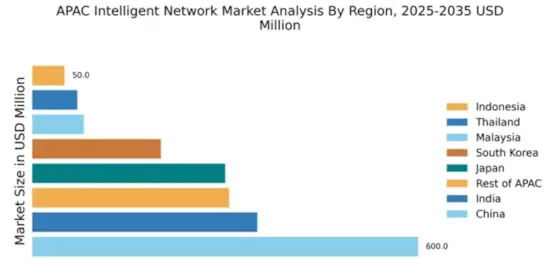
China holds a commanding market share of 40% in the APAC intelligent network market, valued at $600.0 million. Key growth drivers include rapid urbanization, increased internet penetration, and government initiatives like the "Made in China 2025" plan, which emphasizes advanced technologies. Demand trends show a shift towards AI-driven solutions and 5G infrastructure, supported by significant investments in telecommunications and smart city projects.

India : Emerging Market with High Demand

India accounts for 23% of the APAC market, valued at $350.0 million. The growth is driven by increasing mobile data consumption, government initiatives like Digital India, and a burgeoning startup ecosystem. Demand for intelligent networks is rising, particularly in urban areas, as businesses seek to enhance connectivity and efficiency. Regulatory support is evident through policies promoting digital infrastructure development.

Japan : Innovation Meets Tradition

Japan holds a 20% market share in the APAC intelligent network sector, valued at $300.0 million. The growth is fueled by advancements in IoT and 5G technology, alongside a strong focus on R&D. Demand trends indicate a preference for high-quality, reliable network solutions, driven by both consumer and enterprise needs. Government policies support innovation through funding and collaboration with tech firms.

South Korea : Smart Solutions for a Digital Era

South Korea represents 13% of the APAC market, valued at $200.0 million. The country is a leader in 5G deployment and smart city initiatives, driving demand for intelligent networks. Key growth drivers include high smartphone penetration and a tech-savvy population. The competitive landscape features major players like Samsung and LG, with a focus on enhancing connectivity and user experience.

Malaysia : Strategic Location and Development

Malaysia captures 5% of the APAC market, valued at $80.0 million. The growth is supported by government initiatives like the Malaysia Digital Economy Blueprint, which aims to enhance digital infrastructure. Demand is rising in urban centers like Kuala Lumpur, where businesses are increasingly adopting intelligent network solutions. The competitive landscape includes local and international players, focusing on telecommunications and IT services.

Thailand : Digital Transformation in Progress

Thailand holds a 4% market share in the APAC intelligent network market, valued at $70.0 million. The growth is driven by government initiatives promoting digital economy and smart city projects. Demand trends show increasing adoption of cloud services and IoT applications. Key cities like Bangkok are central to this growth, with a competitive landscape featuring both local and international firms.

Indonesia : Expanding Digital Infrastructure

Indonesia accounts for 3% of the APAC market, valued at $50.0 million. The growth is driven by rising internet penetration and government initiatives aimed at enhancing digital infrastructure. Demand is particularly strong in urban areas like Jakarta, where businesses are seeking to improve connectivity. The competitive landscape includes both local players and international firms, focusing on telecommunications and digital services.

Rest of APAC : Varied Markets with Unique Needs

The Rest of APAC holds a 20% market share, valued at $306.0 million. This diverse region includes emerging markets with unique demands for intelligent networks. Growth drivers vary by country, influenced by local regulations and infrastructure development. Key players include both regional and global firms, addressing sector-specific applications in telecommunications, healthcare, and finance.

APAC Intelligent Network Market Regional Image

Key Players and Competitive Insights

The intelligent network market is currently characterized by a dynamic competitive landscape, driven by rapid technological advancements and increasing demand for efficient network solutions. Key players such as Cisco Systems (US), Huawei Technologies (CN), and Nokia (FI) are at the forefront, each adopting distinct strategies to enhance their market positioning. Cisco Systems (US) emphasizes innovation through its robust portfolio of software-defined networking (SDN) solutions, while Huawei Technologies (CN) focuses on regional expansion, particularly in emerging markets across Asia. Nokia (FI) is leveraging partnerships to enhance its 5G capabilities, indicating a collective shift towards integrated solutions that cater to diverse customer needs.

The market structure appears moderately fragmented, with a mix of established players and emerging companies vying for market share. Key business tactics include localizing manufacturing to reduce costs and optimize supply chains, which is becoming increasingly vital in a competitive environment. The influence of major players is significant, as their strategic decisions often set the tone for market trends and customer expectations.

In October 2025, Cisco Systems (US) announced a strategic partnership with a leading telecommunications provider in Southeast Asia to enhance its cloud-based networking solutions. This move is likely to bolster Cisco's presence in the region, allowing it to tap into the growing demand for scalable and flexible network infrastructures. The partnership underscores Cisco's commitment to innovation and its focus on delivering tailored solutions that meet local market requirements.

In September 2025, Huawei Technologies (CN) launched a new AI-driven network management platform aimed at optimizing operational efficiency for enterprises. This initiative reflects Huawei's ongoing investment in artificial intelligence and its potential to transform network management processes. By integrating AI capabilities, Huawei positions itself as a leader in providing intelligent solutions that enhance network performance and reliability.

In August 2025, Nokia (FI) secured a multi-year contract with a major telecommunications operator in Japan to deploy its latest 5G technology. This contract not only reinforces Nokia's foothold in the Asia-Pacific region but also highlights the increasing demand for advanced network solutions. The deployment of 5G technology is expected to drive significant growth in data traffic, further solidifying Nokia's strategic importance in the market.

As of November 2025, current trends in the intelligent network market are heavily influenced by digitalization, sustainability, and the integration of AI technologies. Strategic alliances are becoming more prevalent, as companies recognize the need for collaborative approaches to address complex challenges. Looking ahead, competitive differentiation is likely to evolve, with a shift from price-based competition towards innovation, technological advancements, and supply chain reliability. This transition suggests that companies that prioritize these aspects will be better positioned to thrive in an increasingly competitive landscape.

Key Companies in the APAC Intelligent Network Market market include

Industry Developments

In recent months, the APAC Intelligent Network Market has witnessed significant developments, notably with companies like NTT Communications, M1 Limited, Alibaba Group, and Cisco Systems expanding their offerings in response to increased demand for smart network solutions. In October 2023, Tata Communications announced the enhancement of its network capabilities to support a growing digital ecosystem in Asia, reflecting the market’s evolution towards advanced connectivity. Furthermore, in September 2023, Microsoft Corporation revealed strategic collaborations with regional telecom operators to enhance cloud services, highlighting a growing trend of partnerships aimed at improving network intelligence and efficiencies.

Recent mergers and acquisitions include ZTE Corporation's acquisition of a smaller communications provider in August 2023 to bolster its service portfolio. Another significant move involved Ericsson acquiring a stake in a leading APAC internet service provider in July 2023, focusing on IoT and network management technologies. The market valuation is increasing as demand for digital transformation intensifies, driving companies such as Juniper Networks, Huawei Technologies, and Nokia Corporation to innovate and strengthen their market positions as they capitalize on emerging technologies like AI and machine learning in network management.

Future Outlook

APAC Intelligent Network Market Future Outlook

The intelligent network market is projected to grow at a 14.15% CAGR from 2024 to 2035, driven by advancements in AI, IoT integration, and demand for enhanced connectivity.

New opportunities lie in:

  • Development of AI-driven network optimization tools for real-time performance enhancement.
  • Expansion of IoT-enabled smart grid solutions to improve energy efficiency.
  • Implementation of advanced cybersecurity frameworks to protect intelligent networks from emerging threats.

By 2035, the intelligent network market is expected to achieve substantial growth, driven by innovation and strategic investments.

Market Segmentation

APAC Intelligent Network Market End-User Outlook

  • Telecom Service Providers
  • Cloud Service Providers
  • Managed Network Service Providers
  • Others

APAC Intelligent Network Market Application Outlook

  • Information Cognition
  • Traffic Prediction & Classification
  • Resource Management & Network Adoption
  • Performance Prediction & Configuration Extrapolation

APAC Intelligent Network Market Enterprise Size Outlook

  • Small & Medium-Sized Enterprises
  • Large Enterprises

Report Scope

MARKET SIZE 2024 1656.0(USD Million)
MARKET SIZE 2025 1890.32(USD Million)
MARKET SIZE 2035 7100.0(USD Million)
COMPOUND ANNUAL GROWTH RATE (CAGR) 14.15% (2024 - 2035)
REPORT COVERAGE Revenue Forecast, Competitive Landscape, Growth Factors, and Trends
BASE YEAR 2024
Market Forecast Period 2025 - 2035
Historical Data 2019 - 2024
Market Forecast Units USD Million
Key Companies Profiled ["Cisco Systems (US)", "Huawei Technologies (CN)", "Nokia (FI)", "Ericsson (SE)", "Juniper Networks (US)", "Arista Networks (US)", "ZTE Corporation (CN)", "Ciena Corporation (US)", "Mavenir (US)"]
Segments Covered Application, Enterprise Size, End-User
Key Market Opportunities Integration of artificial intelligence in network management enhances operational efficiency and customer experience.
Key Market Dynamics Rapid technological advancements drive competitive forces in the intelligent network market across the APAC region.
Countries Covered China, India, Japan, South Korea, Malaysia, Thailand, Indonesia, Rest of APAC

Leave a Comment

FAQs

What is the expected market size of the APAC Intelligent Network Market in 2024?

The APAC Intelligent Network Market is expected to be valued at 1.66 billion USD in 2024.

What is the projected market size for the APAC Intelligent Network Market by 2035?

By 2035, the APAC Intelligent Network Market is projected to reach a value of 16.38 billion USD.

What is the expected CAGR for the APAC Intelligent Network Market from 2025 to 2035?

The expected CAGR for the APAC Intelligent Network Market from 2025 to 2035 is 23.16%.

Which country is expected to hold the largest market share in the APAC Intelligent Network Market in 2035?

China is expected to hold the largest market share, reaching approximately 4.901 billion USD in 2035.

How is the market size for India projected to grow by 2035?

The market size for India is projected to grow to about 3.676 billion USD by 2035.

What is the anticipated market value for Traffic Prediction & Classification by 2035?

The market value for Traffic Prediction & Classification is expected to be around 4.0 billion USD by 2035.

Who are the key players dominating the APAC Intelligent Network Market?

Key players in the APAC Intelligent Network Market include NTT Communications, Alibaba Group, and Cisco Systems.

What will be the market size for Performance Prediction & Configuration Extrapolation in 2035?

The market size for Performance Prediction & Configuration Extrapolation is expected to reach 4.38 billion USD by 2035.

What is the projected growth rate of the South Korean segment of the APAC Intelligent Network Market?

The South Korean segment is expected to grow to approximately 3.063 billion USD by 2035.

What factors are driving the growth of the APAC Intelligent Network Market?

The growth of the APAC Intelligent Network Market is driven by advancements in network technologies and increasing demand for intelligent applications.

Download Free Sample

Kindly complete the form below to receive a free sample of this Report

Compare Licence

×
Features License Type
Single User Multiuser License Enterprise User
Price $4,950 $5,950 $7,250
Maximum User Access Limit 1 User Upto 10 Users Unrestricted Access Throughout the Organization
Free Customization
Direct Access to Analyst
Deliverable Format
Platform Access
Discount on Next Purchase 10% 15% 15%
Printable Versions