×
Request Free Sample ×

Kindly complete the form below to receive a free sample of this Report

* Please use a valid business email

Leading companies partner with us for data-driven Insights

clients tt-cursor
Hero Background

APAC Multifactor Authentication Market

ID: MRFR/ICT/62186-HCR
200 Pages
Aarti Dhapte
October 2025

APAC Multifactor Authentication Market Research Report By Model (Two-Factor, Multifactor with Three-Factor Authentication, Multifactor with Four-Factor, Multifactor with Five-Factor Authentication), By Deployment Type (On-Premise, On-Cloud) and By Regional (China, India, Japan, South Korea, Malaysia, Thailand, Indonesia, Rest of APAC)- Forecast to 2035

Share:
Download PDF ×

We do not share your information with anyone. However, we may send you emails based on your report interest from time to time. You may contact us at any time to opt-out.

APAC Multifactor Authentication Market Infographic
Purchase Options

APAC Multifactor Authentication Market Summary

As per MRFR analysis, the APAC multifactor authentication market Size was estimated at 2750.0 USD Million in 2024. The APAC multifactor authentication market is projected to grow from 3047.28 USD Million in 2025 to 8503.5 USD Million by 2035, exhibiting a compound annual growth rate (CAGR) of 10.81% during the forecast period 2025 - 2035.

Key Market Trends & Highlights

The APAC multifactor authentication market is experiencing robust growth driven by increasing cybersecurity awareness and regulatory compliance.

  • China remains the largest market for multifactor authentication solutions, reflecting a strong emphasis on cybersecurity measures.
  • India is emerging as the fastest-growing region, propelled by rapid digital transformation initiatives and rising mobile device usage.
  • Technological advancements in authentication methods are enhancing user experience and security across various sectors.
  • The market is primarily driven by increasing cyber threats and a growing awareness of data privacy, necessitating stronger authentication protocols.

Market Size & Forecast

2024 Market Size 2750.0 (USD Million)
2035 Market Size 8503.5 (USD Million)
CAGR (2025 - 2035) 10.81%

Major Players

Microsoft (US), Google (US), IBM (US), Duo Security (US), Okta (US), RSA Security (US), Auth0 (US), Ping Identity (US)

APAC Multifactor Authentication Market Trends

The multifactor authentication market is experiencing notable growth in the Asia-Pacific region, driven by increasing concerns over cybersecurity threats and the need for enhanced security measures. Organizations across various sectors are adopting multifactor authentication solutions to protect sensitive data and ensure secure access to systems. This trend is particularly evident in industries such as finance, healthcare, and government, where data breaches can have severe consequences. As digital transformation accelerates, the demand for robust authentication methods is likely to rise, prompting businesses to invest in advanced technologies that offer greater security and user convenience. Moreover, the regulatory landscape in the Asia-Pacific region is evolving, with governments implementing stricter compliance requirements related to data protection and privacy. This regulatory push is encouraging organizations to adopt multifactor authentication as a standard security practice. Additionally, the growing awareness of identity theft and fraud is prompting consumers to seek more secure online experiences. As a result, the multifactor authentication market is poised for continued expansion, with innovations in biometric authentication and mobile-based solutions likely to shape its future.

Rising Cybersecurity Awareness

There is a growing recognition among businesses and consumers regarding the importance of cybersecurity. This heightened awareness is driving the adoption of multifactor authentication solutions, as organizations seek to mitigate risks associated with data breaches and unauthorized access.

Regulatory Compliance

Governments in the Asia-Pacific region are increasingly enforcing regulations that mandate stronger security measures for data protection. This regulatory environment is compelling organizations to implement multifactor authentication as a means to comply with legal requirements and safeguard sensitive information.

Technological Advancements

Innovations in technology, particularly in biometric authentication and mobile security, are transforming the multifactor authentication market. These advancements are enhancing user experience and making it easier for organizations to implement secure authentication methods.

APAC Multifactor Authentication Market Drivers

Increasing Cyber Threats

The multifactor authentication market in APAC is experiencing growth due to the rising incidence of cyber threats. Organizations are increasingly targeted by sophisticated cyber attacks, which has heightened the need for robust security measures. In 2025, it is estimated that cybercrime could cost businesses globally over $10 trillion annually, prompting companies in APAC to adopt multifactor authentication solutions. This trend is particularly evident in sectors such as finance and healthcare, where sensitive data is at risk. As a result, the multifactor authentication market is likely to see a surge in demand as businesses seek to protect their assets and maintain customer trust.

Rising Mobile Device Usage

The multifactor authentication market in APAC is witnessing growth due to the rising usage of mobile devices. With an increasing number of consumers accessing services through smartphones and tablets, the demand for secure authentication methods has surged. In 2025, it is estimated that mobile internet users in APAC will surpass 2 billion, highlighting the need for effective security solutions. Multifactor authentication provides an additional layer of security that is particularly appealing to organizations looking to protect user data. This trend suggests that the multifactor authentication market will continue to expand as businesses adapt to the mobile-centric landscape.

Evolving Regulatory Landscape

The multifactor authentication market in APAC is significantly influenced by the evolving regulatory landscape. Governments are implementing stricter regulations to enhance data protection and privacy, compelling organizations to adopt multifactor authentication solutions. For instance, the Personal Data Protection Act in various APAC countries mandates the use of advanced security measures to safeguard personal information. This regulatory push is expected to drive the multifactor authentication market, as compliance becomes a critical factor for businesses. By 2025, it is projected that compliance-related investments in cybersecurity could reach $200 billion in the region, further bolstering the demand for multifactor authentication.

Growing Awareness of Data Privacy

The multifactor authentication market in APAC is benefiting from the growing awareness of data privacy among consumers and businesses alike. As individuals become more conscious of their personal information and its security, organizations are compelled to implement stronger authentication measures. Surveys indicate that over 70% of consumers in APAC are concerned about data breaches, prompting companies to adopt multifactor authentication solutions to enhance their security posture. This heightened awareness is likely to drive the multifactor authentication market, as businesses strive to meet consumer expectations and regulatory requirements, ensuring the protection of sensitive information.

Digital Transformation Initiatives

The multifactor authentication market in APAC is being propelled by ongoing digital transformation initiatives across various industries. As organizations increasingly migrate to cloud-based services and digital platforms, the need for enhanced security measures becomes paramount. In 2025, it is anticipated that the cloud services market in APAC will exceed $100 billion, creating a fertile ground for multifactor authentication solutions. Companies are recognizing that traditional security measures are insufficient in the face of evolving threats, leading to a greater emphasis on multifactor authentication. This trend indicates a robust growth trajectory for the multifactor authentication market as businesses prioritize securing their digital assets.

Market Segment Insights

By Authentication Method: Biometrics (Largest) vs. Token-Based (Fastest-Growing)

In the APAC multifactor authentication market, Biometrics holds the largest market share, driven by the increasing demand for secure and user-friendly authentication solutions. One-Time Passwords continue to have a significant presence, but their growth is being outpaced by emerging technologies like Smart Cards and Token-Based authentication, which are gaining traction for their enhanced security features. As security threats evolve, the growth of the Token-Based segment can be attributed to heightened awareness of cybersecurity risks and the need for more robust authentication methods. The market is witnessing rapid adoption of Biometrics, notably in mobile devices and secure entry systems, while Token-Based authentication is experiencing a surge due to its ease of integration and effectiveness in preventing unauthorized access.

Biometrics: Dominant vs. Token-Based: Emerging

Biometrics is recognized as the dominant force in the authentication methods segment, offering unique features such as fingerprint and facial recognition that enhance user convenience and security. This method is particularly effective in sectors requiring rigorous authentication standards, such as finance and healthcare, where data sensitivity is paramount. On the other hand, Token-Based authentication is emerging as a vital player, offering tangible benefits like portability and an additional layer of security. It is gaining popularity in organizations seeking to implement multi-layered defense mechanisms against cyber threats. Both segments are critical in shaping the future landscape of secure authentication in the region, responding to evolving user expectations and regulatory standards.

By Deployment Type: Cloud-Based (Largest) vs. Hybrid (Fastest-Growing)

The APAC multifactor authentication market shows a noteworthy distribution in the deployment type segment, with Cloud-Based solutions holding the largest market share. This dominance can be attributed to the increasing preference for remote access and secure online transactions among businesses and consumers alike. On-Premises solutions, while still relevant for certain sectors, are gradually losing traction in comparison to the flexibility offered by cloud-based services. The growth trends in this segment reveal that Hybrid deployments are becoming the fastest-growing category. The rise in hybrid solutions is driven by organizations seeking to balance security with scalability and flexibility. This trend is expected to continue as businesses adopt more hybrid approaches to accommodate their varying security needs while leveraging the benefits of both Cloud-Based and On-Premises solutions.

Cloud-Based (Dominant) vs. Hybrid (Emerging)

Cloud-Based multifactor authentication solutions stand out as the dominant deployment type in the market, providing robust security features that cater to the growing digital requirements of businesses. Their scalability, ease of access, and reduced maintenance costs make them highly attractive for organizations aiming to enhance their security frameworks. On the other hand, Hybrid solutions are emerging as a popular option as they allow businesses to utilize existing on-premises infrastructure while integrating cloud capabilities. This combination helps organizations achieve enhanced security and compliance, making Hybrid deployments appealing to companies that prioritize flexibility and control. As organizations increasingly recognize the need for a tailored approach, Hybrid solutions are gaining momentum in the APAC multifactor authentication market.

By End-user: Banking and Financial Services (Largest) vs. IT and Telecom (Fastest-Growing)

The market for multifactor authentication among end-users in the APAC region is predominantly led by the Banking and Financial Services sector, which holds a significant share due to strong regulatory requirements and growing demand for secure transactions. Following closely are the Government and Healthcare sectors, which also leverage multifactor authentication for securing sensitive data and ensuring compliance with various regulations. Retail is rapidly gaining momentum as well, driven by the increasing need for secure payment solutions. On the growth front, the IT and Telecom sector emerges as the fastest-growing segment, fueled by the escalation of cyber threats and a heightened awareness of data security. The prevalence of digital services across all sectors, coupled with a surge in remote working trends, is propelling the demand for robust authentication methods. Furthermore, technological advancements and increasing adoption of cloud-based services are also significant growth drivers for multifactor authentication solutions.

Banking and Financial Services: Dominant vs. IT and Telecom: Emerging

The Banking and Financial Services sector remains the dominant player in multifactor authentication, characterized by its heavy investment in security measures to protect financial transactions and sensitive customer information. Regulatory frameworks mandating strong authentication processes further solidify its position. On the other hand, the IT and Telecom sector is emerging rapidly, driven by the increasing frequency of cyber attacks and the necessity for secure access to networks. Companies in this segment are adopting multifactor authentication solutions not just for regulatory compliance, but also to enhance user trust and safeguard their digital environments against potential breaches. This increase in awareness and investment in security measures is setting a strong foundation for future growth in this segment.

By Component: Hardware (Largest) vs. Software (Fastest-Growing)

In the segment of multifactor authentication, the distribution of market share shows that hardware remains the largest contributor, reflecting a steadfast market preference for physical security devices. This stronghold is supplemented by the software aspect, which reveals promising growth trajectories as digital solutions gain traction within enterprises across the region. The growth trends for this segment are driven by the increasing demand for robust security measures that hardware offers, combined with rapid advancements in software capabilities. The push towards digital transformation across various industries has further elevated the importance of software solutions, making them the fastest-growing component. As organizations prioritize comprehensive security protocols, the integration of both hardware and software becomes essential, enhancing user experiences and security effectiveness.

Hardware (Dominant) vs. Software (Emerging)

Hardware has established itself as the dominant element in the multifactor authentication market, providing reliable physical devices that enhance security protocols. Its market position is strengthened by the growing recognition of the necessity for tangible security measures within various sectors. Meanwhile, software emerges as a crucial trendsetter, fostering innovative solutions that complement hardware systems. The rising adoption of cloud services and mobile applications significantly contributes to its rapid growth. As enterprises increasingly lean on digital environments, software scalability and flexibility stand out as critical attributes, positioning it as an essential component in the evolving landscape of security solutions.

Get more detailed insights about APAC Multifactor Authentication Market

Regional Insights

China : Robust Growth Driven by Demand

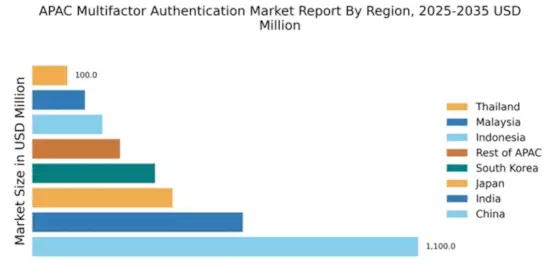
China holds a commanding market share of 44% in the APAC multifactor authentication sector, valued at $1,100.0 million. Key growth drivers include the rapid digital transformation across industries, increasing cyber threats, and government initiatives promoting cybersecurity. The Chinese government has implemented stringent regulations to enhance data protection, fostering a favorable environment for multifactor authentication solutions. Infrastructure development, particularly in technology hubs like Beijing and Shenzhen, further supports market expansion.

India : Emerging Market with High Demand

India's multifactor authentication market is valued at $600.0 million, accounting for 24% of the APAC market. The surge in demand is driven by the increasing adoption of digital services, especially in fintech and e-commerce sectors. Government initiatives like Digital India aim to bolster cybersecurity, while regulatory frameworks are evolving to address data privacy concerns. The growing IT infrastructure in cities like Bangalore and Hyderabad is also a significant factor in market growth.

Japan : Innovation and Security Integration

Japan's multifactor authentication market is valued at $400.0 million, representing 16% of the APAC market. The growth is fueled by the country's advanced technological landscape and a strong focus on cybersecurity. Regulatory policies, including the Act on the Protection of Personal Information, encourage the adoption of multifactor authentication. The demand is particularly high in sectors like finance and healthcare, where data security is paramount, supported by robust infrastructure in cities like Tokyo and Osaka.

South Korea : Cybersecurity Focus in Business

South Korea's multifactor authentication market is valued at $350.0 million, making up 14% of the APAC market. The growth is driven by increasing cyber threats and a proactive approach to cybersecurity from both government and private sectors. Initiatives like the Cybersecurity Strategy 2020 aim to enhance security measures. Key markets include Seoul and Busan, where major players like Samsung and LG are investing in secure solutions, creating a competitive landscape.

Malaysia : Emerging Market with Potential

Malaysia's multifactor authentication market is valued at $150.0 million, representing 6% of the APAC market. The growth is driven by rising awareness of cybersecurity threats and government initiatives to promote digital security. The National Cyber Security Policy encourages the adoption of multifactor authentication across sectors. Key markets include Kuala Lumpur and Penang, where local players are emerging alongside global giants like Microsoft and Google, enhancing competition.

Thailand : Focus on Digital Transformation

Thailand's multifactor authentication market is valued at $100.0 million, accounting for 4% of the APAC market. The growth is supported by the government's push for digital transformation and new regulations aimed at enhancing cybersecurity. The Electronic Transactions Act promotes secure online transactions, driving demand for multifactor authentication. Key markets include Bangkok and Chiang Mai, where local businesses are increasingly adopting these solutions to protect customer data.

Indonesia : Growing Demand for Security Solutions

Indonesia's multifactor authentication market is valued at $200.0 million, representing 8% of the APAC market. The growth is driven by the rapid digitalization of services and increasing cyber threats. Government initiatives like the National Cybersecurity Strategy aim to enhance security measures across sectors. Key markets include Jakarta and Surabaya, where local startups are emerging alongside established players like IBM and Google, creating a dynamic competitive landscape.

Rest of APAC : Varied Growth Across Sub-regions

The Rest of APAC multifactor authentication market is valued at $250.0 million, accounting for 10% of the overall market. Growth is driven by varying levels of digital adoption and regulatory environments across countries. Government initiatives in countries like Vietnam and the Philippines are promoting cybersecurity awareness. The competitive landscape includes both local and international players, with a focus on sector-specific applications in finance, healthcare, and e-commerce.
APAC Multifactor Authentication Market Regional Image

Key Players and Competitive Insights

The multifactor authentication market is currently characterized by a dynamic competitive landscape, driven by increasing cybersecurity threats and the growing demand for secure access solutions across various sectors. Major players such as Microsoft (US), Google (US), and IBM (US) are strategically positioned to leverage their technological prowess and extensive resources. Microsoft (US) focuses on integrating multifactor authentication into its cloud services, enhancing user experience while ensuring robust security. Google (US) emphasizes innovation through its advanced security keys and biometric solutions, aiming to simplify user authentication processes. IBM (US) adopts a comprehensive approach, combining AI-driven analytics with multifactor authentication to provide tailored security solutions, thereby shaping a competitive environment that prioritizes innovation and user-centric strategies.

Key business tactics within this market include localizing services and optimizing supply chains to enhance responsiveness to regional demands. The competitive structure appears moderately fragmented, with numerous players vying for market share. However, the collective influence of key players like Microsoft (US) and Google (US) suggests a trend towards consolidation, as these companies seek to expand their market presence through strategic partnerships and acquisitions.

In October 2025, Microsoft (US) announced the launch of its new Azure Active Directory feature, which integrates advanced multifactor authentication capabilities with AI-driven risk assessment tools. This strategic move is likely to enhance security for enterprise clients, allowing for more adaptive and context-aware authentication processes. By leveraging AI, Microsoft (US) positions itself as a leader in providing not only security but also a seamless user experience, which is crucial in retaining and attracting customers in a competitive market.

In September 2025, Google (US) unveiled its latest security key, designed to support a wider range of devices and platforms. This initiative reflects Google's commitment to enhancing user accessibility while maintaining high security standards. The introduction of this versatile security key may significantly influence user adoption rates, as it simplifies the authentication process across various environments, thereby reinforcing Google's competitive edge in the market.

In August 2025, IBM (US) expanded its partnership with a leading telecommunications provider to integrate multifactor authentication solutions into their network services. This collaboration is indicative of IBM's strategy to penetrate new markets and enhance service offerings through strategic alliances. By embedding its security solutions within telecommunications infrastructure, IBM (US) not only broadens its customer base but also strengthens its position as a comprehensive security provider.

As of November 2025, current trends in the multifactor authentication market are heavily influenced by digitalization, AI integration, and a growing emphasis on sustainability. Strategic alliances are increasingly shaping the competitive landscape, as companies recognize the value of collaboration in enhancing their technological capabilities. Looking ahead, competitive differentiation is expected to evolve, shifting from traditional price-based competition to a focus on innovation, technology integration, and supply chain reliability. This transition underscores the necessity for companies to adapt and innovate continuously to maintain their competitive advantage in an ever-evolving market.

Key Companies in the APAC Multifactor Authentication Market market include

Industry Developments

The APAC Multifactor Authentication Market has been witnessing significant developments recently, marked by increased investments and innovations by leading companies such as Microsoft, IBM, and Okta. In recent months, companies have been enhancing their MFA solutions to address the growing cybersecurity risks in the region, particularly in sectors like finance and healthcare. 

For instance, CyberArk has rolled out new features that strengthen identity protection for cloud environments in September 2023. In terms of mergers and acquisitions, RSA Security announced its acquisition by Symphony Technology Group in August 2023, a move aimed at expanding its security offerings across the APAC market. Growth in the market is also evident, with multifactor authentication solutions projected to reach a valuation of USD 1.8 billion by 2025, driven by demands for enhanced security protocols amid rising cyber threats. 

Furthermore, companies like Duo Security and Thales are focusing on building partnerships within the region to tap into the surging demand for secure authentication mechanisms. Over the past two years, increased regulatory scrutiny and government initiatives in cybersecurity have further catalyzed advancements in this segment across APAC nations.

Future Outlook

APAC Multifactor Authentication Market Future Outlook

The Multifactor Authentication Market is projected to grow at a 10.81% CAGR from 2024 to 2035, driven by increasing cybersecurity threats and regulatory compliance demands.

New opportunities lie in:

  • Integration of biometric authentication in mobile applications
  • Development of AI-driven fraud detection systems
  • Expansion of cloud-based multifactor authentication solutions

By 2035, the multifactor authentication market is expected to achieve substantial growth and innovation.

Market Segmentation

APAC Multifactor Authentication Market End-user Outlook

  • Banking and Financial Services
  • Government
  • Healthcare
  • Retail
  • IT and Telecom

APAC Multifactor Authentication Market Component Outlook

  • Hardware
  • Software
  • Services

APAC Multifactor Authentication Market Deployment Type Outlook

  • On-Premises
  • Cloud-Based
  • Hybrid

APAC Multifactor Authentication Market Authentication Method Outlook

  • One-Time Passwords
  • Biometrics
  • Smart Cards
  • Token-Based

Report Scope

MARKET SIZE 20242750.0(USD Million)
MARKET SIZE 20253047.28(USD Million)
MARKET SIZE 20358503.5(USD Million)
COMPOUND ANNUAL GROWTH RATE (CAGR)10.81% (2024 - 2035)
REPORT COVERAGERevenue Forecast, Competitive Landscape, Growth Factors, and Trends
BASE YEAR2024
Market Forecast Period2025 - 2035
Historical Data2019 - 2024
Market Forecast UnitsUSD Million
Key Companies Profiled["Microsoft (US)", "Google (US)", "IBM (US)", "Duo Security (US)", "Okta (US)", "RSA Security (US)", "Auth0 (US)", "Ping Identity (US)"]
Segments CoveredAuthentication Method, Deployment Type, End-user, Component
Key Market OpportunitiesGrowing demand for enhanced security solutions drives innovation in the multifactor authentication market.
Key Market DynamicsRising regulatory requirements drive demand for multifactor authentication solutions across various sectors in APAC.
Countries CoveredChina, India, Japan, South Korea, Malaysia, Thailand, Indonesia, Rest of APAC

Leave a Comment

FAQs

What is the projected market size of the APAC Multifactor Authentication Market in 2024?

The APAC Multifactor Authentication Market is projected to be valued at 4.47 billion USD in 2024.

What is the expected market value of the APAC Multifactor Authentication Market in 2035?

In 2035, the APAC Multifactor Authentication Market is expected to reach a value of 19.39 billion USD.

What is the compound annual growth rate (CAGR) of the APAC Multifactor Authentication Market from 2025 to 2035?

The APAC Multifactor Authentication Market is anticipated to have a CAGR of 14.256% during the forecast period from 2025 to 2035.

Which region is projected to dominate the APAC Multifactor Authentication Market in 2024?

In 2024, China is projected to dominate the APAC Multifactor Authentication Market, valued at 1.6 billion USD.

What will be the market value of India in the APAC Multifactor Authentication Market by 2035?

By 2035, the market value of India in the APAC Multifactor Authentication Market is expected to reach 5.22 billion USD.

What is the expected valuation of the Two-Factor Authentication model in 2035?

The Two-Factor Authentication model is expected to be valued at 6.45 billion USD in 2035.

Who are the key players in the APAC Multifactor Authentication Market?

Some key players in the APAC Multifactor Authentication Market include Microsoft, RSA Security, CyberArk, and Google.

How much is the Multifactor with Three-Factor Authentication model expected to be worth in 2024?

The Multifactor with Three-Factor Authentication model is expected to be worth 1.2 billion USD in 2024.

What is the projected market value for the Multifactor with Four-Factor model in 2035?

The projected market value for the Multifactor with Four-Factor model is expected to be 4.28 billion USD in 2035.

What are the anticipated growth drivers for the APAC Multifactor Authentication Market?

The anticipated growth drivers for the APAC Multifactor Authentication Market include increasing cybersecurity concerns and regulatory demands.

Download Free Sample

Kindly complete the form below to receive a free sample of this Report

Compare Licence

×
Features License Type
Single User Multiuser License Enterprise User
Price $4,950 $5,950 $7,250
Maximum User Access Limit 1 User Upto 10 Users Unrestricted Access Throughout the Organization
Free Customization
Direct Access to Analyst
Deliverable Format
Platform Access
Discount on Next Purchase 10% 15% 15%
Printable Versions