×
Request Free Sample ×

Kindly complete the form below to receive a free sample of this Report

* Please use a valid business email

Leading companies partner with us for data-driven Insights

clients tt-cursor
Hero Background

APAC Natural Language Processing Market

ID: MRFR/ICT/56026-HCR
200 Pages
Aarti Dhapte
October 2025

APAC Natural Language Processing Market Research Report By Technology (Auto-coding, Text analytics, Pattern & Image recognition, Speech analytics), By Type (Rule-based, Statistical, Hybrid), By Deployment (On-Cloud, On-Premise), By Service (Integration, Consulting & maintenance), By Vertical (Healthcare, Retail Sector, Media & Entertainment) and By Regional (China, India, Japan, South Korea, Malaysia, Thailand, Indonesia, Rest of APAC)- Forecast to 2035

Share:
Download PDF ×

We do not share your information with anyone. However, we may send you emails based on your report interest from time to time. You may contact us at any time to opt-out.

APAC Natural Language Processing Market Infographic
Purchase Options

APAC Natural Language Processing Market Summary

As per MRFR analysis, the APAC natural language processing market size was estimated at 26.43 USD Billion in 2024. The APAC natural language processing market is projected to grow from 34.26 USD Billion in 2025 to 458.67 USD Billion by 2035, exhibiting a compound annual growth rate (CAGR) of 29.62% during the forecast period 2025 - 2035.

Key Market Trends & Highlights

The APAC natural language-processing market is experiencing robust growth driven by technological advancements and regional dynamics.

  • The APAC natural language processing market is witnessing increased adoption of AI-driven solutions, particularly in China and India.
  • There is a notable focus on multilingual capabilities to cater to diverse linguistic needs across the region.
  • Collaboration between tech firms and local businesses is becoming a prevalent strategy to enhance service offerings and market reach.
  • Key market drivers include the rising demand for automation in enterprises and government initiatives supporting AI development.

Market Size & Forecast

2024 Market Size 26.43 (USD Billion)
2035 Market Size 458.67 (USD Billion)
CAGR (2025 - 2035) 29.62%

Major Players

Google (US), Microsoft (US), IBM (US), Amazon (US), Facebook (US), Baidu (CN), Salesforce (US), SAP (DE), NVIDIA (US)

APAC Natural Language Processing Market Trends

The natural language processing market is experiencing notable growth, driven by advancements in artificial intelligence and machine learning technologies. In the APAC region, businesses are increasingly adopting these technologies to enhance customer interactions and streamline operations. This trend is evident across various sectors, including finance, healthcare, and retail, where organizations leverage natural language processing to analyze customer feedback, automate responses, and improve decision-making processes. The integration of natural language processing into existing systems appears to be a strategic move for many companies aiming to remain competitive in a rapidly evolving digital landscape. Moreover, the demand for multilingual support is rising, as businesses in the APAC region seek to cater to diverse populations. This has led to an increased focus on developing language models that can understand and generate text in multiple languages. As a result, investments in research and development are likely to intensify, fostering innovation within the natural language-processing market. The collaboration between technology providers and local enterprises may further enhance the capabilities of natural language processing solutions, ensuring they meet the unique needs of the region's consumers. Overall, the natural language processing market is poised for continued expansion, driven by technological advancements and a growing emphasis on customer-centric approaches.

Increased Adoption of AI-driven Solutions

Organizations are increasingly integrating AI-driven solutions into their operations, enhancing efficiency and customer engagement. This trend is particularly evident in sectors such as finance and healthcare, where natural language processing tools are utilized to analyze vast amounts of data and improve service delivery.

Focus on Multilingual Capabilities

As the APAC region is home to a multitude of languages, there is a growing emphasis on developing natural language processing systems that can effectively handle multilingual inputs. This focus aims to improve user experience and accessibility for diverse populations.

Collaboration Between Tech Firms and Local Businesses

Partnerships between technology providers and local enterprises are becoming more common, fostering innovation in the natural language-processing market. These collaborations aim to tailor solutions to meet specific regional needs, enhancing the effectiveness of natural language processing applications.

APAC Natural Language Processing Market Drivers

Rising Demand for Automation in Enterprises

The natural language-processing market in APAC is experiencing a notable surge in demand for automation solutions across various industries. Enterprises are increasingly recognizing the potential of NLP technologies to streamline operations, enhance customer interactions, and improve decision-making processes. According to recent data, the automation market in APAC is projected to grow at a CAGR of approximately 25% over the next five years. This growth is likely to drive investments in NLP applications, as businesses seek to leverage AI-driven tools for tasks such as sentiment analysis, chatbots, and automated content generation. The integration of NLP into enterprise systems appears to be a strategic move to enhance efficiency and reduce operational costs, thereby propelling the natural language-processing market forward.

Emergence of Advanced Analytics and Insights

The natural language-processing market in APAC is witnessing a significant shift towards advanced analytics and insights. Organizations are increasingly leveraging NLP technologies to extract valuable information from unstructured data sources, such as social media, customer feedback, and Market Research Future. This trend is driven by the need for data-driven decision-making, as businesses aim to gain a competitive edge. Recent analyses suggest that the market for advanced analytics in APAC is expected to grow by over 30% in the coming years. As companies recognize the potential of NLP in transforming raw data into actionable insights, the natural language-processing market is likely to expand, offering innovative solutions that cater to the evolving needs of businesses.

Expansion of E-commerce and Digital Services

The rapid expansion of e-commerce and digital services in APAC is significantly influencing the natural language-processing market. As online shopping continues to gain traction, businesses are increasingly adopting NLP technologies to enhance customer experiences through personalized recommendations and efficient customer support. Recent statistics indicate that the e-commerce sector in APAC is expected to reach a valuation of over $4 trillion by 2025. This growth presents a substantial opportunity for NLP solutions, particularly in areas such as product search optimization and automated customer service. The natural language processing market is likely to benefit from this trend, as companies strive to meet the evolving demands of tech-savvy consumers.

Increasing Focus on Data Privacy and Security

As the natural language-processing market in APAC continues to evolve, there is a growing emphasis on data privacy and security. With the rise of AI-driven solutions, concerns regarding data protection have become paramount. Organizations are now prioritizing the implementation of robust security measures to safeguard sensitive information processed by NLP systems. Recent surveys indicate that approximately 70% of businesses in the region are investing in enhanced data security protocols. This focus on privacy is likely to shape the development of NLP technologies, as companies seek to ensure compliance with regulations while maintaining user trust. Consequently, the natural language-processing market may witness innovations aimed at balancing functionality with stringent security requirements.

Government Initiatives Supporting AI Development

Government initiatives across APAC are playing a crucial role in fostering the growth of the natural language-processing market. Various countries are implementing policies and funding programs aimed at promoting AI research and development. For instance, initiatives in nations like China and India are focused on enhancing AI capabilities, which includes advancements in NLP technologies. The investment in AI is projected to exceed $100 billion in the region by 2025, indicating a strong commitment to developing cutting-edge solutions. These government-backed efforts are likely to create a conducive environment for innovation, thereby accelerating the adoption of NLP applications in various sectors, including healthcare, finance, and education.

Market Segment Insights

By Technology: Text analytics (Largest) vs. Speech analytics (Fastest-Growing)

In the APAC natural language-processing market, the technology segment showcases diverse capabilities. Text analytics holds the largest share, leveraging extensive datasets to glean insights from unstructured content, significantly influencing customer engagement strategies across verticals. In contrast, speech analytics has emerged rapidly, utilizing voice data analytics to enhance customer interactions and operational efficiency, gliding towards becoming a significant player in the market. Based on recent trends, the demand for automated solutions and AI-driven tools is propelling the growth of the technology segment. Organizations are increasingly recognizing the value of text and speech analytics in streamlining operations and enhancing the customer experience. Moreover, advancements in machine learning and artificial intelligence are driving innovation, with companies investing heavily in these areas to stay competitive in the dynamic landscape of natural language-processing solutions.

Technology: Text analytics (Dominant) vs. Speech analytics (Emerging)

Text analytics stands strong as the dominant technology in the APAC natural language-processing market due to its ability to convert vast amounts of text data into actionable insights. This capability enables businesses in a variety of sectors to enhance decision-making processes and improve customer interactions. On the other hand, speech analytics is emerging as a crucial technology, driven by the increasing integration of voice-enabled applications in customer service and support. Its real-time processing capabilities allow organizations to analyze customer conversations, uncover patterns, and identify trends. These two technologies are pivotal, with text analytics facilitating deeper analytics on written content and speech analytics revolutionizing how businesses interpret spoken dialogue.

By Type: Rule-based (Largest) vs. Hybrid (Fastest-Growing)

The market share distribution within the APAC natural language-processing market showcases Rule-based systems as the largest segment, commanding a significant portion due to their extensive application in sectors requiring structured language processing. In contrast, Hybrid systems are gaining traction and show promising growth, appealing to organizations looking for a balanced approach that combines the strengths of both rule-based and statistical methodologies. This shift highlights a diversification in market preferences, as businesses increasingly adopt flexible solutions. Growth in the Type segment is driven by the increasing demand for advanced language understanding capabilities across various industries, from customer service to content generation. The rapid evolution of AI technologies fuels interest in Hybrid systems, which blend traditional rule-based techniques with modern statistical models to improve performance. Moreover, the rising adoption of machine learning is prompting companies to explore more adaptable and robust NLP frameworks that can cater to complex language scenarios effectively.

Rule-based (Dominant) vs. Statistical (Emerging)

Rule-based natural language processing systems are the dominant force in the market, recognized for their reliability and effectiveness in environments where precise language parsing is crucial. Their ability to implement fixed rules allows organizations to achieve high accuracy in structured tasks. Conversely, Statistical systems are emerging as valuable alternatives, relying on data-driven approaches to generate insights from vast datasets. This segment is appealing to companies seeking the agility afforded by machine learning techniques, making them suitable for tasks involving ambiguous language. The interplay between these two approaches highlights a dynamic market landscape, where businesses must weigh the benefits of stability against the flexibility and innovation of statistical solutions.

By Service: Integration (Largest) vs. Consulting & Maintenance (Fastest-Growing)

In the Service segment of the natural language-processing market, Integration holds a substantial market share due to its critical role in ensuring that NLP systems effectively communicate with existing technology infrastructures. This segment's dominance arises from the increasing need for organizations to seamlessly integrate AI-driven language solutions with their operations, enhancing productivity and efficiency. On the other hand, the Consulting & Maintenance segment is rapidly gaining ground as businesses recognize the importance of expert guidance and ongoing support for NLP system implementations. As companies seek to optimize their NLP capabilities, the demand for consulting and maintenance services is being propelled upward. The growth trends in the Service segment are largely driven by advancements in AI technologies and the growing integration of NLP solutions across various industries. Companies are increasingly investing in consulting and maintenance to ensure they leverage the full potential of their NLP systems, fostering innovation and enhanced user experiences. As organizations realize that having the right infrastructure is paramount for success, the demand for integration services will likely remain robust, while consulting and maintenance will emerge as key enablers for sustainable growth in NLP applications.

Integration (Dominant) vs. Consulting & Maintenance (Emerging)

Integration services are characterized by their essential role in embedding natural language-processing solutions into the current IT frameworks of organizations. This segment is particularly dominant as it addresses the critical challenges of interoperability and system compatibility, ensuring that NLP tools function effectively within diverse technological landscapes. On the other hand, Consulting and Maintenance services are emerging as vital components for companies looking to maximize their investment in NLP technologies. These services provide the necessary expertise and continuous support that organizations need to adapt to evolving technologies and user requirements. As market competition intensifies, both Integration and Consulting & Maintenance will play pivotal roles in shaping the future of natural language processing, facilitating smoother transitions and improving the overall effectiveness of language solutions.

By Deployment: On-Premise (Largest) vs. On-Demand (Fastest-Growing)

In the deployment segment of the natural language-processing market, On-Premise solutions hold a significant market share, driven by organizations seeking enhanced control and security over their data assets. This model appeals to industries that prioritize compliance and data sovereignty, enabling them to manage sensitive information while leveraging advanced NLP technologies. Conversely, On-Demand solutions, which are often cloud-based, are capturing an increasing portion of the market due to their scalability and cost-effectiveness, appealing to businesses aiming for rapid deployment and minimal upfront investment. The growth trends in this segment reveal a shift towards flexibility and accessibility, with On-Demand deployment emerging as the fastest-growing option in the region. This surge is primarily fueled by the growing adoption of cloud technologies and the increasing demand for rapid NLP deployment without the burden of significant infrastructure investment. Businesses are favoring On-Demand solutions to leverage AI capabilities quickly and efficiently, thus driving the market forward.

Deployment Type: On-Premise (Dominant) vs. On-Demand (Emerging)

On-Premise deployment in the natural language-processing market is characterized by its robust performance and reliability, offering organizations greater control over their NLP applications and data management processes. This approach is favored by large enterprises with established IT infrastructures, allowing for tailored solutions and long-term data integrity. In contrast, On-Demand deployment is emerging rapidly as a preferred choice for small to medium-sized enterprises, providing them with an agile and flexible model that aligns with their budget constraints and operational needs. As businesses increasingly prioritize innovation and speed, On-Demand solutions are expected to gain momentum, supported by the expansion of cloud services and advancements in technology.

By Vertical: Healthcare (Largest) vs. Retail Sector (Fastest-Growing)

In the APAC natural language-processing market, the distribution of market share reveals that the healthcare segment is currently the largest, driven by a surge in demand for innovative solutions that aid in patient care and data management. The retail sector, while smaller, is experiencing rapid growth as businesses increasingly adopt NLP technologies to enhance customer experiences and streamline operations. Growth trends indicate that the healthcare segment will continue to thrive as telemedicine and digital health solutions become more prevalent. Conversely, the retail sector is emerging as a dynamic force, propelled by the need for personalized shopping experiences and efficient supply chain management. As businesses invest in AI-driven technologies, the expansion of NLP applications in this sector is expected to accelerate substantially.

Healthcare: Dominant vs. Retail Sector: Emerging

The healthcare segment exemplifies dominance in the APAC natural language-processing market due to its critical role in improving patient interactions, enhancing diagnostic capabilities, and enabling real-time data processing for medical professionals. Innovations in AI-driven chatbots and virtual assistants are revolutionizing patient care and engagement. On the other hand, the retail sector is marked as an emerging player that leverages NLP to create tailored shopping experiences, optimize inventory management, and analyze consumer sentiment. Companies are increasingly integrating chatbots for customer service and utilizing analytics to refine marketing strategies, thus positioning the retail sector for accelerated growth in the coming years.

Get more detailed insights about APAC Natural Language Processing Market

Regional Insights

China : Unmatched Growth and Innovation

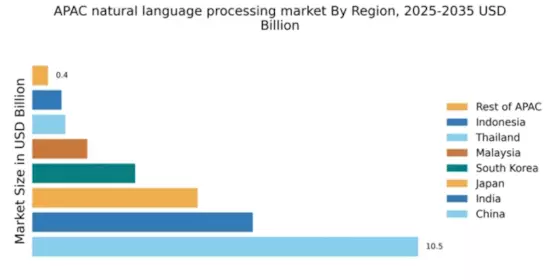
China holds a commanding 10.5% market share in the APAC NLP sector, valued at approximately $3.5 billion. Key growth drivers include rapid advancements in AI technology, increasing demand for automated customer service solutions, and government support for tech innovation. The Chinese government has implemented favorable policies to boost AI research and development, while significant investments in infrastructure enhance the industrial landscape, fostering a conducive environment for NLP applications.

India : Innovation and Start-up Surge

India's NLP market is projected to reach a 6.0% share, valued at around $2 billion. The growth is fueled by a burgeoning start-up ecosystem, increasing internet penetration, and a young, tech-savvy population. Government initiatives like Digital India promote the adoption of AI technologies, while investments in IT infrastructure support the demand for NLP solutions across various sectors, including healthcare and finance.

Japan : Integration with Traditional Industries

Japan's NLP market accounts for 4.5%, valued at approximately $1.5 billion. The country is witnessing growth driven by the integration of NLP in traditional industries such as manufacturing and retail. The Japanese government supports AI initiatives through funding and regulatory frameworks, encouraging innovation. Demand for multilingual NLP solutions is rising, reflecting Japan's diverse consumer base and global business interactions.

South Korea : Focus on Urban Development

South Korea holds a 2.8% market share in NLP, valued at about $900 million. The growth is propelled by smart city initiatives and the government's commitment to AI technology. Key demand trends include the use of NLP in public services and customer engagement. Major cities like Seoul and Busan are at the forefront of adopting NLP solutions, supported by a competitive landscape featuring local and international players.

Malaysia : Government Support and Investment

Malaysia's NLP market is valued at 1.5%, approximately $500 million. The growth is driven by government initiatives promoting digital transformation and investments in AI research. Demand for NLP solutions is increasing in sectors like e-commerce and education. The Malaysian government has launched programs to enhance digital skills, creating a favorable environment for NLP adoption and innovation.

Thailand : Focus on Tourism and Retail

Thailand's NLP market represents 0.9%, valued at around $300 million. The growth is supported by the tourism and retail sectors, where NLP applications enhance customer experiences. Government initiatives aim to boost digital economy strategies, fostering an environment conducive to NLP development. Key cities like Bangkok are central to the competitive landscape, with both local and international players vying for market share.

Indonesia : Rising Demand and Infrastructure Needs

Indonesia's NLP market is at 0.8%, valued at approximately $250 million. The growth is driven by increasing internet usage and a young population eager for digital solutions. However, challenges remain in infrastructure and regulatory frameworks. Major cities like Jakarta are key markets, with local start-ups and international players competing. The government is working on policies to enhance digital literacy and support AI initiatives.

Rest of APAC : Varied Market Dynamics and Growth

The Rest of APAC holds a 0.43% market share in NLP, valued at around $150 million. This sub-region showcases diverse market dynamics, with varying levels of technology adoption and regulatory environments. Growth is driven by localized demand for NLP solutions in sectors like education and healthcare. Countries like Vietnam and the Philippines are emerging markets, with increasing investments in digital infrastructure and AI technologies.

APAC Natural Language Processing Market Regional Image

Key Players and Competitive Insights

The natural language-processing market is currently characterized by intense competition and rapid innovation, driven by the increasing demand for AI-driven solutions across various sectors. Major players such as Google (US), Microsoft (US), and Baidu (CN) are at the forefront, leveraging their technological prowess to enhance their offerings. Google (US) focuses on integrating NLP capabilities into its cloud services, while Microsoft (US) emphasizes partnerships with enterprises to facilitate digital transformation. Baidu (CN), on the other hand, is strategically positioning itself within the Chinese market, capitalizing on its extensive data resources to refine its NLP algorithms. Collectively, these strategies contribute to a dynamic competitive environment, where innovation and regional adaptation are paramount.

Key business tactics within the market include localized development and supply chain optimization, which are essential for meeting diverse consumer needs. The competitive structure appears moderately fragmented, with a mix of established giants and emerging startups. This fragmentation allows for a variety of approaches to NLP solutions, fostering a landscape where innovation can thrive. The influence of key players is substantial, as they set benchmarks for technology and service delivery, thereby shaping market expectations.

In October 2025, Google (US) announced the launch of its latest NLP model, which reportedly enhances contextual understanding and user interaction. This development is significant as it not only strengthens Google's position in the cloud services sector but also reflects its commitment to advancing AI capabilities. The model's ability to process and analyze language nuances could potentially redefine user experiences across various applications, from customer service to content creation.

In September 2025, Microsoft (US) expanded its partnership with a leading telecommunications provider to integrate NLP solutions into customer support systems. This strategic move underscores Microsoft's focus on enhancing user engagement through AI-driven tools. By embedding NLP into customer service frameworks, Microsoft aims to streamline operations and improve customer satisfaction, which is increasingly vital in a competitive landscape.

In August 2025, Baidu (CN) unveiled a new suite of NLP tools tailored for the education sector, aiming to facilitate personalized learning experiences. This initiative highlights Baidu's strategy to penetrate niche markets and leverage its technological advancements to address specific industry needs. By focusing on education, Baidu not only diversifies its portfolio but also positions itself as a leader in applying NLP in innovative ways.

As of November 2025, the competitive trends within the market are increasingly defined by digitalization, sustainability, and the integration of AI technologies. Strategic alliances are becoming more prevalent, as companies recognize the value of collaboration in enhancing their technological capabilities. Looking ahead, it is likely that competitive differentiation will evolve, shifting from traditional price-based competition to a focus on innovation, technological advancement, and supply chain reliability. This transition suggests that companies will need to invest in R&D and strategic partnerships to maintain their competitive edge.

Key Companies in the APAC Natural Language Processing Market market include

Industry Developments

Recent developments in the APAC Natural Language Processing Market have shown significant growth, particularly with key players like Salesforce, Appen, Alibaba Group, SAP, Google, Microsoft, and Tencent investing in advanced technologies. For instance, SAP announced enhancements to its AI capabilities in August 2023, focusing on research initiatives aimed at integrating machine learning into various applications. Meanwhile, iFLYTEK launched new language processing tools in September 2023 to enhance user interaction in Chinese dialects.

Notably, mergers and acquisitions have played a pivotal role in market consolidation, with Microsoft acquiring a minority stake in a major AI startup in July 2023, fostering innovation in language processing capabilities. 

Tencent also strengthened its position by acquiring a local AI company in June 2023, enhancing its natural language understanding technologies for diverse applications.The market valuation of companies in the APAC region continues to rise, driven by increasing demand for NLP applications in sectors such as customer service and healthcare. Over the past two years, advancements in AI and machine learning have prompted significant investments, particularly in India and China, reshaping the technological landscape and expanding opportunities for stakeholders in Natural Language Processing.


Future Outlook

APAC Natural Language Processing Market Future Outlook

The natural language-processing market is projected to grow at a 29.62% CAGR from 2024 to 2035, driven by advancements in AI, increased data generation, and demand for automation.

New opportunities lie in:

  • Development of AI-driven customer support chatbots for e-commerce platforms.
  • Integration of NLP in healthcare for patient data analysis and management.
  • Creation of multilingual content generation tools for global marketing strategies.

By 2035, the market is expected to be robust, driven by innovative applications and widespread adoption.

Market Segmentation

APAC Natural Language Processing Market Type Outlook

  • Rule-based
  • Statistical
  • Hybrid

APAC Natural Language Processing Market Service Outlook

  • Integration
  • Consulting & maintenance

APAC Natural Language Processing Market Vertical Outlook

  • Healthcare
  • Retail Sector
  • Media & Entertainment

APAC Natural Language Processing Market Deployment Outlook

  • On-Premise
  • On-Demand

APAC Natural Language Processing Market Technology Outlook

  • Auto-coding
  • Text analytics
  • Pattern & Image recognition
  • Speech analytics

Report Scope

MARKET SIZE 202426.43(USD Billion)
MARKET SIZE 202534.26(USD Billion)
MARKET SIZE 2035458.67(USD Billion)
COMPOUND ANNUAL GROWTH RATE (CAGR)29.62% (2024 - 2035)
REPORT COVERAGERevenue Forecast, Competitive Landscape, Growth Factors, and Trends
BASE YEAR2024
Market Forecast Period2025 - 2035
Historical Data2019 - 2024
Market Forecast UnitsUSD Billion
Key Companies Profiled["Google (US)", "Microsoft (US)", "IBM (US)", "Amazon (US)", "Facebook (US)", "Baidu (CN)", "Salesforce (US)", "SAP (DE)", "NVIDIA (US)"]
Segments CoveredTechnology, Type, Service, Deployment, Vertical
Key Market OpportunitiesIntegration of advanced AI-driven solutions in customer service enhances efficiency in the natural language-processing market.
Key Market DynamicsRapid advancements in artificial intelligence drive innovation in the natural language-processing market across the APAC region.
Countries CoveredChina, India, Japan, South Korea, Malaysia, Thailand, Indonesia, Rest of APAC

Leave a Comment

FAQs

What is the expected market size of the APAC Natural Language Processing Market in 2024?

The APAC Natural Language Processing Market is expected to be valued at 40.88 USD Billion in 2024.

What is the projected market value of the APAC Natural Language Processing Market by 2035?

By 2035, the APAC Natural Language Processing Market is projected to reach a value of 483.99 USD Billion.

What is the expected CAGR for the APAC Natural Language Processing Market from 2025 to 2035?

The market is expected to grow at a CAGR of 25.192% from 2025 to 2035.

Which region holds the largest market share in the APAC Natural Language Processing Market in 2024?

In 2024, China holds the largest market share valued at 16.0 USD Billion.

How much is the Indian market for Natural Language Processing expected to grow by 2035?

The Indian market for Natural Language Processing is expected to grow to 120.0 USD Billion by 2035.

What are the projected market sizes for Text Analytics by 2035?

Text Analytics is projected to reach a market size of 145.0 USD Billion by 2035.

Who are the key players in the APAC Natural Language Processing Market?

Major players in the market include Salesforce, Google, Microsoft, Alibaba Group, and IBM.

What is the expected market size for Speech Analytics in 2024?

Speech Analytics is expected to be valued at 10.88 USD Billion in 2024.

How much will the Pattern & Image Recognition market segment be valued by 2035?

The Pattern & Image Recognition segment is anticipated to be valued at 95.0 USD Billion by 2035.

What are the growth opportunities within the APAC Natural Language Processing Market?

Emerging trends in AI-driven applications and increased demand for automation present significant growth opportunities in the market.

Download Free Sample

Kindly complete the form below to receive a free sample of this Report

Compare Licence

×
Features License Type
Single User Multiuser License Enterprise User
Price $4,950 $5,950 $7,250
Maximum User Access Limit 1 User Upto 10 Users Unrestricted Access Throughout the Organization
Free Customization
Direct Access to Analyst
Deliverable Format
Platform Access
Discount on Next Purchase 10% 15% 15%
Printable Versions