APAC Pipe Laying Vessel Market
APAC Pipe Laying Vessel Market Summary
As per Market Research Future analysis, the APAC pipe laying-vessel market size was estimated at 600.0 USD Million in 2024.. The APAC pipe laying-vessel market is projected to grow from 664.68 USD Million in 2025 to 1850.0 USD Million by 2035, exhibiting a compound annual growth rate (CAGR) of 10.7% during the forecast period 2025 - 2035
Key Market Trends & Highlights
The APAC pipe laying-vessel market is poised for substantial growth driven by technological advancements and increasing infrastructure investments.
- China remains the largest market for pipe laying-vessels, reflecting its extensive offshore energy projects.
- India is emerging as the fastest-growing region, fueled by rapid infrastructure development and energy demands.
- Technological innovations in vessel design are enhancing operational efficiency and sustainability in the market.
- Rising energy demand and increased offshore exploration activities are key drivers propelling market expansion.
Market Size & Forecast
| 2024 Market Size | 600.0 (USD Million) |
| 2035 Market Size | 1850.0 (USD Million) |
| CAGR (2025 - 2035) | 10.78% |
Major Players
Saipem (IT), Subsea 7 (GB), TechnipFMC (GB), Van Oord (NL), McDermott International (US), Boskalis Westminster (NL), Prysmian Group (IT), Nexans (FR)
APAC Pipe Laying Vessel Market Trends
The pipe laying-vessel market is currently experiencing notable developments, particularly within the Asia-Pacific region. This market is characterized by a growing demand for advanced vessels capable of efficiently laying pipelines for various applications, including oil and gas, telecommunications, and water supply. The increasing investments in infrastructure projects across several APAC countries are likely to drive the need for specialized vessels. Furthermore, the shift towards sustainable energy sources may influence the design and functionality of these vessels, as operators seek to minimize environmental impact while maximizing operational efficiency. In November 2025, the competitive landscape of the pipe laying-vessel market appears to be evolving. Companies are focusing on technological advancements, such as automation and enhanced safety features, to meet the rising expectations of clients. Additionally, partnerships and collaborations among industry players may emerge as a strategy to leverage resources and expertise. The regulatory environment is also expected to play a crucial role, as governments implement stricter guidelines to ensure safety and environmental compliance. Overall, the future of the pipe laying-vessel market in the APAC region seems promising, with various factors contributing to its growth and transformation.
Technological Advancements
The pipe laying-vessel market is witnessing a surge in technological innovations. Companies are increasingly investing in automation and advanced navigation systems to enhance operational efficiency. These advancements not only improve the speed of pipeline installation but also ensure higher safety standards during operations.
Sustainability Initiatives
There is a growing emphasis on sustainability within the pipe laying-vessel market. Operators are exploring eco-friendly designs and alternative energy sources to reduce carbon footprints. This trend aligns with global efforts to promote environmental responsibility and may influence vessel design and operational practices.
Infrastructure Investments
Significant investments in infrastructure development across the APAC region are driving demand for pipe laying vessels. Governments and private entities are prioritizing projects that require extensive pipeline networks, thereby creating opportunities for vessel manufacturers and operators to expand their services.
APAC Pipe Laying Vessel Market Drivers
Rising Energy Demand
The increasing energy demand in APAC is a crucial driver for the pipe laying-vessel market. As countries in the region strive to meet their energy needs, there is a notable shift towards offshore oil and gas exploration. This trend is particularly evident in nations like India and China, where energy consumption is projected to grow by approximately 4.5% annually. Consequently, the need for advanced pipe laying vessels to facilitate the installation of subsea pipelines becomes paramount. The investments in offshore projects are expected to reach $200 billion by 2027, further propelling the demand for specialized vessels. This scenario indicates that the pipe laying-vessel market is likely to experience substantial growth as energy companies seek to enhance their operational capabilities in response to rising energy requirements.
Government Regulations and Policies
Government regulations and policies play a significant role in shaping the pipe laying-vessel market in APAC. Many countries are implementing stricter environmental regulations aimed at reducing carbon emissions and promoting sustainable practices. For instance, Japan has introduced policies that encourage the use of eco-friendly technologies in marine operations. These regulations often necessitate the adoption of advanced pipe laying vessels equipped with innovative technologies that minimize environmental impact. As a result, companies are increasingly investing in modern vessels that comply with these regulations, which could lead to a market growth of around 15% over the next five years. This regulatory landscape suggests that the pipe laying-vessel market must adapt to evolving standards to remain competitive.
Growing Subsea Infrastructure Development
The growing subsea infrastructure development in APAC is a vital driver for the pipe laying-vessel market. As nations invest in expanding their subsea networks, the demand for efficient and reliable pipe laying vessels is increasing. Countries like Indonesia and Malaysia are focusing on enhancing their underwater infrastructure to support energy distribution and telecommunications. The market for subsea infrastructure is projected to grow at a CAGR of 12% over the next five years, indicating a robust demand for specialized vessels. This trend suggests that the pipe laying-vessel market must align its offerings with the evolving needs of subsea projects to capture emerging opportunities.
Increased Offshore Exploration Activities
Increased offshore exploration activities are a pivotal driver for the pipe laying-vessel market in APAC. As countries seek to tap into untapped oil and gas reserves, there is a surge in offshore drilling projects. For instance, the South China Sea and the Bay of Bengal are becoming focal points for exploration, with investments expected to exceed $150 billion in the next decade. This escalation in exploration activities necessitates the deployment of specialized pipe laying vessels capable of handling complex installations in challenging environments. The growing interest in offshore resources suggests that the pipe laying-vessel market is poised for significant expansion as companies seek to capitalize on these opportunities.
Technological Innovations in Vessel Design
Technological innovations in vessel design are transforming the pipe laying-vessel market in APAC. The introduction of automation and advanced materials is enhancing the efficiency and safety of operations. For example, the use of dynamic positioning systems allows vessels to maintain precise locations during installation, reducing the risk of accidents. Furthermore, the integration of digital technologies, such as real-time monitoring systems, is improving operational efficiency. The market for these advanced vessels is projected to grow by 20% by 2026, driven by the demand for enhanced performance and reduced operational costs. This trend indicates that companies in the pipe laying-vessel market must invest in research and development to stay ahead of technological advancements.
Market Segment Insights
By Installation: S-lay Barges (Largest) vs. J-lay Barges (Fastest-Growing)
In the market for installation methods, S-lay barges hold the largest share due to their versatility and efficiency in laying pipes under various sea conditions. J-lay barges, while smaller in market share, are gaining traction due to increasing offshore projects that require deep-water installations. Reel barges are specialized but occupy a niche segment of the market. Growth trends indicate a strong demand for J-lay barges driven by investment in offshore oil and gas explorations, alongside advancements in technology that enhance operational efficiency. Increasing offshore renewable energy projects are also contributing to the rise in S-lay and J-lay barge usage, positioning them favorably in the competitive landscape.
S-lay Barges (Dominant) vs. J-lay Barges (Emerging)
S-lay barges are known for their ability to lay pipes on the seabed with relative ease, making them a preferred choice for many projects in various water depths. Their design accommodates significant payloads, enhancing operational efficiency in pipe installation. On the other hand, J-lay barges are becoming increasingly popular in deep-water scenarios due to their capability to handle heavier, larger-diameter pipes. As environmental regulations tighten and project demands evolve, J-lay barges are emerging as a critical asset for companies aiming for sustainability and efficiency in challenging installations.
By Positioning System: Dynamic Positioning System (Largest) vs. Anchor System (Fastest-Growing)
In the positioning system segment, the Dynamic Positioning System holds a considerable share, reflecting its established role in enhancing operational efficiency. The Anchor System, while currently smaller in terms of market share, is emerging as a competitive alternative, often preferred in specific applications due to its reliability and simplicity. The dynamic positioning technology continues to lead, driven by the increasing demand for precision in offshore operations. Growth trends indicate that the Anchor System is gaining traction, particularly among new entrants in the market seeking cost-effective solutions. The trends are influenced by advancements in technology, coupled with the rising need for versatile equipment in challenging maritime environments. As vessel operators prioritize efficiency, the Anchor System is projected to expand its market presence, positioning it as a key player in the evolving landscape of positioning systems.
Positioning Systems: Dynamic Positioning System (Dominant) vs. Anchor System (Emerging)
The Dynamic Positioning System is recognized as the dominant technology within the positioning systems segment, offering unmatched precision and the ability to maintain vessel position autonomously. This system integrates advanced sensors and control systems, enhancing operational safety and efficiency. On the other hand, the Anchor System is positioned as an emerging alternative that caters to specific user needs, particularly in scenarios where cost and simplicity are prioritized. The Anchor System is gaining popularity due to its robustness and lower operational costs, making it attractive for various projects, especially in regions with less demanding marine conditions.
By Depth: Shallow Water (Largest) vs. Deep Water (Fastest-Growing)
In the APAC pipe laying-vessel market, the Shallow Water segment currently dominates the landscape, holding a significant share of the overall market, reflecting the region's geographical features and operational preferences. This segment benefits from the increasing demand for infrastructure development and offshore activities in relatively shallow regions, allowing for cost-effective operations and quicker project turnaround times. Conversely, the Deep Water segment is experiencing rapid growth driven by advancements in technology and the rising exploration of untapped resources. As companies invest more in sophisticated equipment and techniques to operate in challenging environments, Deep Water is anticipated to emerge as a crucial segment in upcoming years, addressing high-value projects that seek new energy sources and infrastructure solutions.
Shallow Water (Dominant) vs. Deep Water (Emerging)
The Shallow Water segment is characterized by its established operation frameworks, where lower costs and efficient project implementations make it the preferred choice for many contractors. This segment is vital for projects such as pipeline installations in coastal areas, leveraging accessible resources and simplified logistics. On the other hand, the Deep Water segment, while emerging, poses unique challenges, including harsher environmental conditions and technological demands. However, its appeal lies in the potential for high-return projects, making it a focus area for innovation and investment as companies look to explore deeper reserves of oil and gas, aiming to meet future energy demands.
Regional Insights
China : Robust Growth and Infrastructure Development
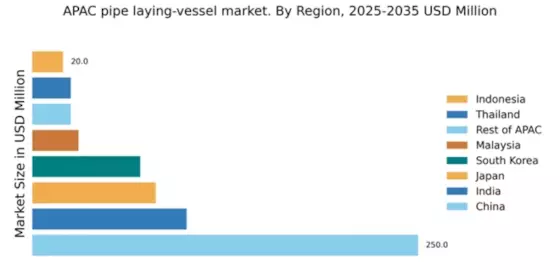
China holds a commanding market share of 250.0, representing a significant portion of the APAC pipe laying-vessel market. Key growth drivers include massive investments in infrastructure, particularly in energy and telecommunications sectors. The government's commitment to renewable energy projects and the Belt and Road Initiative are pivotal in shaping demand trends. Regulatory policies favoring foreign investments and local manufacturing further enhance market dynamics, while urbanization continues to drive consumption patterns.
India : Infrastructure Push Fuels Demand
India's market value stands at 100.0, reflecting a growing demand for pipe laying vessels driven by infrastructure projects and urban development. The government's initiatives, such as the National Infrastructure Pipeline, aim to boost investment in transportation and energy sectors. This regulatory support is crucial for attracting foreign players and enhancing local capabilities. Demand is particularly strong in urban areas, where industrial growth is accelerating consumption patterns.
Japan : Innovation Drives Competitive Advantage
Japan's market value is 80.0, characterized by a stable demand for advanced pipe laying technologies. The country's focus on innovation and sustainability in energy projects, particularly offshore wind farms, is a key growth driver. Regulatory frameworks support environmental standards, promoting the adoption of cutting-edge technologies. The aging infrastructure also necessitates upgrades, further fueling demand for specialized vessels.
South Korea : Strong Industrial Base and Expertise
South Korea's market value is 70.0, supported by a robust marine engineering sector. The government's focus on expanding offshore energy projects, including oil and gas exploration, drives demand for pipe laying vessels. Regulatory policies encourage technological advancements and partnerships with global players. Key cities like Busan and Ulsan are central to this market, fostering a competitive landscape with major players like Samsung Heavy Industries and Daewoo Shipbuilding.
Malaysia : Investment in Energy Sector Expansion
Malaysia's market value is 30.0, with growth driven by investments in oil and gas infrastructure. The government's initiatives to enhance energy security and promote renewable energy projects are pivotal. Regulatory frameworks support foreign investments, creating a conducive environment for market players. Demand is concentrated in states like Sarawak and Sabah, where offshore projects are prevalent, attracting major players like Sapura Energy.
Thailand : Government Initiatives Boost Demand
Thailand's market value is 25.0, reflecting a developing landscape for pipe laying vessels. The government's focus on infrastructure development, particularly in transportation and energy, is a key growth driver. Regulatory policies support public-private partnerships, enhancing investment opportunities. Key markets include Bangkok and Rayong, where industrial activities are concentrated, attracting both local and international players.
Indonesia : Natural Resources Drive Demand Growth
Indonesia's market value is 20.0, driven by its rich natural resources and growing energy sector. The government's focus on infrastructure development and energy security is crucial for market expansion. Regulatory frameworks are evolving to attract foreign investments, particularly in offshore projects. Key regions include Sumatra and Java, where demand for pipe laying vessels is increasing due to ongoing oil and gas exploration activities.
Rest of APAC : Regional Growth Across Multiple Sectors
The Rest of APAC market value is 25.0, encompassing diverse countries with varying demand for pipe laying vessels. Growth is driven by regional infrastructure projects and energy sector developments. Regulatory policies differ significantly, impacting market dynamics. Countries like Vietnam and the Philippines are emerging markets, attracting investments in energy and telecommunications, creating opportunities for major players in the sector.
Key Players and Competitive Insights
Key Companies in the APAC Pipe Laying Vessel Market include
Industry Developments
Recent developments in the APAC Pipe Laying Vessel Market include a notable increase in investment, driven by rising demands for subsea infrastructure due to expanding oil and gas exploration activities. TNO C Marine and Royal IHC are actively focusing on innovative vessel technologies, enhancing capabilities for deep-water operations. Additionally, Saipem and McDermott International are making significant strides in collaboration, seeking to optimize project delivery times and reduce costs. Current affairs also highlight the growing trend of mergers and acquisitions, with significant activities noted.
Recently in June 2023, Subsea 7 acquired a majority stake in a regional player, further consolidating its market position.
In the previous year, in October 2022, Kris Energy announced a strategic partnership with Fugro to enhance its marine surveys, improving operational efficiency. The market valuation growth for companies like Boskalis and DeepOcean indicates a positive trajectory, attributed to increased government investments in renewable energy initiatives in the region. Over the past 2-3 years, APAC has witnessed enhanced regulatory support, promoting efficient environmental practices and sustainability in pipe laying activities, thereby influencing market dynamics and investments significantly.
Future Outlook
APAC Pipe Laying Vessel Market Future Outlook
The Pipe Laying Vessel Market is projected to grow at a 10.78% CAGR from 2025 to 2035, driven by increasing offshore energy projects and technological advancements.
New opportunities lie in:
- Development of advanced automated pipe laying technologies
- Expansion into emerging markets with untapped offshore resources
- Partnerships for sustainable vessel designs and eco-friendly operations
By 2035, the market is expected to achieve robust growth, driven by innovation and strategic partnerships.
Market Segmentation
APAC Pipe Laying Vessel Market Depth Outlook
- Shallow Water
- Deep Water
APAC Pipe Laying Vessel Market Installation Outlook
- J-lay Barges
- S-lay Barges
- Reel Barges
APAC Pipe Laying Vessel Market Positioning System Outlook
- Anchor System
- Dynamic Positioning System
Report Scope
| MARKET SIZE 2024 | 600.0(USD Million) |
| MARKET SIZE 2025 | 664.68(USD Million) |
| MARKET SIZE 2035 | 1850.0(USD Million) |
| COMPOUND ANNUAL GROWTH RATE (CAGR) | 10.78% (2025 - 2035) |
| REPORT COVERAGE | Revenue Forecast, Competitive Landscape, Growth Factors, and Trends |
| BASE YEAR | 2024 |
| Market Forecast Period | 2025 - 2035 |
| Historical Data | 2019 - 2024 |
| Market Forecast Units | USD Million |
| Key Companies Profiled | Saipem (IT), Subsea 7 (GB), TechnipFMC (GB), Van Oord (NL), McDermott International (US), Boskalis Westminster (NL), Prysmian Group (IT), Nexans (FR) |
| Segments Covered | Installation, Positioning System, Depth |
| Key Market Opportunities | Adoption of advanced automation technologies enhances efficiency in the pipe laying-vessel market. |
| Key Market Dynamics | Technological advancements drive efficiency in the pipe laying-vessel market, enhancing competitiveness and operational capabilities. |
| Countries Covered | China, India, Japan, South Korea, Malaysia, Thailand, Indonesia, Rest of APAC |
FAQs
What is the current valuation of the APAC pipe laying-vessel market as of 2024?
The overall market valuation was $600.0 Million in 2024.
What is the projected market valuation for the APAC pipe laying-vessel market in 2035?
The projected valuation for 2035 is $1850.0 Million.
What is the expected CAGR for the APAC pipe laying-vessel market during the forecast period 2025 - 2035?
The expected CAGR during the forecast period 2025 - 2035 is 10.78%.
Which companies are considered key players in the APAC pipe laying-vessel market?
Key players include Saipem (IT), Subsea 7 (GB), TechnipFMC (GB), Van Oord (NL), McDermott International (US), Boskalis Westminster (NL), Prysmian Group (IT), and Nexans (FR).
What are the main segments of the APAC pipe laying-vessel market?
The main segments include Installation, Positioning System, and Depth.
What was the valuation of J-lay Barges in the Installation segment?
The valuation of J-lay Barges in the Installation segment ranged from $120.0 Million to $380.0 Million.
How does the valuation of S-lay Barges compare to that of Reel Barges in the Installation segment?
S-lay Barges had a valuation range of $240.0 Million to $740.0 Million, while Reel Barges ranged from $240.0 Million to $730.0 Million.
What is the valuation range for the Dynamic Positioning System in the Positioning System segment?
The valuation range for the Dynamic Positioning System is from $360.0 Million to $1110.0 Million.
What are the valuation ranges for shallow and deep water in the Depth segment?
Shallow Water is valued between $240.0 Million and $740.0 Million, whereas Deep Water ranges from $360.0 Million to $1110.0 Million.
How might the growth of the APAC pipe laying-vessel market impact its key players?
The growth of the market could provide opportunities for key players like TechnipFMC and McDermott International to expand their operations and increase market share.
Kindly complete the form below to receive a free sample of this Report
Customer Stories
“This is really good guys. Excellent work on a tight deadline. I will continue to use you going forward and recommend you to others. Nice job”
“Thanks. It’s been a pleasure working with you, please use me as reference with any other Intel employees.”
“Thanks for sending the report it gives us a good global view of the Betaïne market.”
“Thank you, this will be very helpful for OQS.”
“We found the report very insightful! we found your research firm very helpful. I'm sending this email to secure our future business.”
“I am very pleased with how market segments have been defined in a relevant way for my purposes (such as "Portable Freezers & refrigerators" and "last-mile"). In general the report is well structured. Thanks very much for your efforts.”
“I have been reading the first document or the study, ,the Global HVAC and FP market report 2021 till 2026. Must say, good info! I have not gone in depth at all parts, but got a good indication of the data inside!”
“We got the report in time, we really thank you for your support in this process. I also thank to all of your team as they did a great job.”