APAC Threat Intelligence Market
APAC Threat Intelligence Market Summary
As per Market Research Future analysis, the APAC threat intelligence market size was estimated at 3920.0 USD Million in 2024. The APAC threat intelligence market is projected to grow from 4248.5 USD Million in 2025 to 9500.0 USD Million by 2035, exhibiting a compound annual growth rate (CAGR) of 8.3% during the forecast period 2025 - 2035
Key Market Trends & Highlights
The APAC threat intelligence market is experiencing robust growth driven by technological advancements and increasing cybersecurity concerns.
- The integration of AI and Machine Learning is transforming threat detection and response capabilities across the region.
- Real-time threat intelligence is becoming a critical focus for organizations in China and India to enhance their cybersecurity posture.
- Collaboration and information sharing among businesses are fostering a more resilient cybersecurity ecosystem in the APAC region.
- Rising cybersecurity threats and increased investment in cybersecurity infrastructure are key drivers propelling market growth in both China and India.
Market Size & Forecast
| 2024 Market Size | 3920.0 (USD Million) |
| 2035 Market Size | 9500.0 (USD Million) |
| CAGR (2025 - 2035) | 8.38% |
Major Players
FireEye (US), CrowdStrike (US), Palo Alto Networks (US), IBM (US), McAfee (US), Cisco (US), Check Point Software (IL), ThreatConnect (US), Recorded Future (US)
APAC Threat Intelligence Market Trends
The threat intelligence market is currently experiencing notable growth, driven by the increasing frequency and sophistication of cyber threats across various sectors. Organizations are recognizing the necessity of proactive measures to safeguard their digital assets, leading to heightened investments in threat intelligence solutions. This market is characterized by a diverse range of offerings, including threat detection, incident response, and risk assessment services. As businesses in the region strive to enhance their cybersecurity posture, the demand for tailored threat intelligence solutions is likely to rise, reflecting the unique challenges faced by different industries. Moreover, the regulatory landscape in the region is evolving, with governments emphasizing the importance of cybersecurity frameworks. This shift is prompting organizations to adopt comprehensive threat intelligence strategies that align with compliance requirements. The collaboration between public and private sectors is also becoming increasingly vital, as information sharing can significantly enhance the effectiveness of threat intelligence initiatives. As the threat landscape continues to evolve, the market is expected to adapt, fostering innovation and the development of advanced technologies to counter emerging threats.
Integration of AI and Machine Learning
The incorporation of artificial intelligence and machine learning technologies into the threat intelligence market is becoming more prevalent. These technologies enhance the ability to analyze vast amounts of data, enabling organizations to identify patterns and anomalies that may indicate potential threats. This trend suggests a shift towards more automated and efficient threat detection processes, allowing for quicker responses to incidents.
Focus on Real-time Threat Intelligence
There is a growing emphasis on real-time threat intelligence solutions within the market. Organizations are increasingly seeking tools that provide immediate insights into emerging threats, allowing for timely decision-making and incident response. This trend indicates a shift from traditional, periodic threat assessments to continuous monitoring and analysis.
Collaboration and Information Sharing
The threat intelligence market is witnessing a rise in collaboration among organizations, particularly in sharing threat data and intelligence. This trend highlights the importance of collective defense strategies, where entities work together to enhance their understanding of threats. Such collaboration can lead to improved threat detection and response capabilities across sectors.
APAC Threat Intelligence Market Drivers
Rising Cybersecurity Threats
The increasing frequency and sophistication of cyberattacks in APAC is a primary driver for the threat intelligence market. Organizations are facing a surge in ransomware, phishing, and advanced persistent threats (APTs), prompting a heightened demand for robust threat intelligence solutions. According to recent data, the cybersecurity market in APAC is projected to reach $40 billion by 2026, with threat intelligence playing a crucial role in this growth. Companies are investing in threat intelligence to proactively identify vulnerabilities and mitigate risks, thereby enhancing their overall security posture. This trend indicates that as cyber threats evolve, the need for comprehensive threat intelligence solutions will likely continue to expand, making it a vital component of the cybersecurity strategy for businesses across the region.
Emergence of Advanced Threats
The emergence of advanced threats, including state-sponsored attacks and sophisticated cybercriminal activities, is a significant driver for the threat intelligence market in APAC. These threats often employ complex tactics that require organizations to adopt advanced threat intelligence solutions to effectively counteract them. The increasing sophistication of cyber adversaries necessitates a proactive approach to threat detection and response, which is driving investments in threat intelligence capabilities. As organizations strive to protect their assets from these advanced threats, the demand for comprehensive threat intelligence solutions is expected to grow. This trend highlights the importance of staying informed about the evolving threat landscape and adapting security strategies accordingly, thereby reinforcing the critical role of threat intelligence in safeguarding organizations across the region.
Regulatory Compliance Requirements
In APAC, stringent regulatory frameworks are emerging, compelling organizations to adopt threat intelligence solutions to ensure compliance. Regulations such as the Personal Data Protection Act (PDPA) in Singapore and the General Data Protection Regulation (GDPR) in the EU have influenced local laws, necessitating robust data protection measures. Companies are increasingly required to demonstrate their ability to detect and respond to threats effectively, which has led to a growing investment in threat intelligence capabilities. The threat intelligence market is expected to benefit from this trend, as organizations seek to align their security practices with regulatory requirements. This compliance-driven approach not only enhances security but also fosters trust among customers and stakeholders, further driving the demand for threat intelligence solutions in the region.
Growing Awareness of Cybersecurity Risks
There is a notable increase in awareness regarding cybersecurity risks among organizations in APAC, which is significantly influencing the threat intelligence market. As businesses become more cognizant of the potential impacts of cyber threats, they are prioritizing investments in threat intelligence solutions. This heightened awareness is driven by high-profile data breaches and cyber incidents that have underscored the vulnerabilities present in various sectors. Consequently, organizations are seeking to enhance their threat detection and response capabilities, leading to a surge in demand for threat intelligence services. The market is likely to continue expanding as companies recognize the necessity of staying ahead of evolving threats and ensuring the security of their operations and customer data.
Increased Investment in Cybersecurity Infrastructure
The threat intelligence market in APAC is experiencing growth due to increased investments in cybersecurity infrastructure. Organizations are recognizing the importance of integrating advanced technologies to protect their digital assets. A report indicates that spending on cybersecurity in APAC is expected to grow at a CAGR of 12% from 2023 to 2028, with threat intelligence solutions being a key focus area. This investment trend reflects a broader understanding of the need for proactive threat detection and response capabilities. As businesses expand their digital footprints, the demand for sophisticated threat intelligence tools that can provide actionable insights is likely to rise, thereby propelling the market forward. This shift towards enhanced cybersecurity infrastructure is essential for safeguarding sensitive information and maintaining operational continuity.
Market Segment Insights
By Deployment Model: Cloud-Based (Largest) vs. On-Premises (Fastest-Growing)
In the deployment model segment, Cloud-Based solutions are leading the market, primarily due to their scalability and flexibility, making them the preferred choice for many organizations. On-Premises solutions follow closely, valued for their control and security features. Hybrid models are also gaining traction as businesses seek to combine the benefits of both cloud and on-premises services, reflecting a diverse market demand. Growth trends indicate a dynamic shift with On-Premises solutions rapidly gaining market interest, primarily driven by increasing concerns over data security and regulatory compliance. Meanwhile, Cloud-Based solutions continue to thrive as companies embrace digital transformation, facilitating agile and streamlined operations. The Hybrid model's growth is fueled by organizations wanting to customize their deployment to suit specific operational needs, further adding to the segment's vibrancy.
Cloud-Based (Dominant) vs. On-Premises (Emerging)
Cloud-Based deployment models are characterized by their ability to support a wide range of applications and services, offering scalability and cost-effectiveness that resonate with both SME and large enterprises. These models allow companies to avoid significant upfront investments in IT infrastructure, making them attractive in a rapidly evolving IT landscape. On the other hand, On-Premises solutions are emerging at a faster rate, appealing to organizations that prioritize security and have strict compliance requirements. They provide greater control over data and infrastructure, which is crucial in ensuring sensitive data is adequately protected. The balance between these models is shifting, with businesses increasingly adopting Hybrid solutions to tailor their approach to data management and security.
By Component: Services (Largest) vs. Solutions (Fastest-Growing)
In the APAC threat intelligence market, the 'Services' segment holds the largest share, driven by the increasing demand for managed security services and incident response capabilities. Organizations prioritize outsourcing threat management to specialized service providers, leading to a robust growth trajectory for service-based solutions. Conversely, 'Solutions' are rapidly gaining traction, reflecting the evolving needs for advanced automated technologies that can detect and mitigate threats in real time. The growth of the 'Services' segment is supported by rising cybersecurity concerns and regulatory compliance requirements across various industries. As cyber threats become more sophisticated, companies are investing heavily in expert services to navigate complex security landscapes. Meanwhile, 'Solutions' are positioned as the fastest-growing segment, bolstered by technological innovations and growing awareness of proactive threat intelligence tools aimed at enhancing organizational resilience against cyber threats.
Services (Dominant) vs. Solutions (Emerging)
The 'Services' segment in the APAC threat intelligence market is characterized by its comprehensive approach, offering tailored security solutions that include consulting, threat analysis, and incident management. Service providers ensure organizations can efficiently respond to and recover from cyber incidents while maintaining compliance with industry standards. On the other hand, 'Solutions' represent an emerging opportunity within this space, focusing on advanced technological frameworks such as AI-driven analytics and automation. This segment is gaining momentum as businesses seek integrated systems that enhance their cybersecurity posture, enabling faster detection and response to potential threats.
By Application: Network Security (Largest) vs. Cloud Security (Fastest-Growing)
In the Application segment of the threat intelligence market, Network Security holds the largest share, reflecting a robust demand for safeguarding network infrastructures against various cyber threats. Following closely, Endpoint Security, Application Security, and Cloud Security play crucial roles as organizations prioritize comprehensive defense strategies. This market distribution illustrates a clear recognition among enterprises of the diverse areas needing protection to combat ever-evolving threats. Cloud Security is emerging as the fastest-growing segment, driven by the accelerated adoption of cloud services and digital transformation initiatives across businesses in the region. Factors such as increased remote work and the rise in sophisticated cyberattacks are propelling investments in Cloud and Endpoint Security solutions. Organizations are increasingly looking to integrate advanced analytics and machine learning to enhance their security postures, thereby boosting growth in this vital segment.
Network Security: Dominant vs. Cloud Security: Emerging
Network Security is characterized by its comprehensive approach to protecting internal networks and data flows, serving as the backbone of IT security strategies in many organizations. With an increasing number of cyber threats targeting network vulnerabilities, Network Security solutions have become essential. In contrast, Cloud Security is emerging rapidly as more enterprises shift workloads to the cloud, necessitating new strategies for protecting sensitive data stored off-premises. While Network Security remains dominant, Cloud Security's growth is bolstered by innovations that address specific challenges associated with cloud environments. Companies are increasingly recognizing the importance of a multi-layered approach that encompasses both network and cloud security measures to mitigate risks effectively.
By End Use: BFSI (Largest) vs. IT and Telecom (Fastest-Growing)
In the threat intelligence market, the distribution of market share among end-use segments reveals substantial variations. The BFSI sector holds the largest share, driven by the increasing need for secure transactions and protection against fraud. Government, Healthcare, IT and Telecom, and Retail follow closely, with unique requirements necessitating robust threat intelligence solutions that cater to their specific challenges. Growth trends indicate that while BFSI remains dominant, the IT and Telecom sector is recognized as the fastest-growing segment. The rise in cyber threats and incidents within these industries encourages investment in advanced threat detection and response capabilities. Factors such as regulatory compliance and the need for enhanced security measures are propelling market growth, making IT and Telecom a critical focus area for innovation and development.
BFSI: Dominant vs. IT and Telecom: Emerging
The BFSI segment is characterized by its extensive reliance on threat intelligence solutions to safeguard sensitive financial information and maintain trust among customers. This sector's dominant position in the market is attributed to ongoing cybersecurity challenges, such as the rise in online fraud and data breaches. Conversely, the IT and Telecom sector is emerging rapidly due to increased digital transformation and the expansion of cloud services. This segment emphasizes the necessity for real-time threat detection and proactive defenses as organizations face sophisticated cyber attacks. Both segments require tailored threat intelligence solutions to address their specific vulnerabilities, with BFSI focusing on compliance and security processes, while IT and Telecom emphasizes innovation and resilience against new threats.
Regional Insights
China : Robust Growth Driven by Innovation
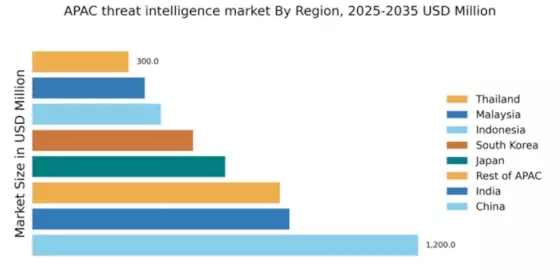
China holds a commanding market share of 30% in the APAC threat intelligence sector, valued at $1200.0 million. Key growth drivers include rapid digital transformation, increasing cyber threats, and government initiatives promoting cybersecurity. The demand for advanced threat detection solutions is rising, supported by regulatory policies like the Cybersecurity Law, which mandates stringent data protection measures. Infrastructure development, particularly in tech hubs like Beijing and Shenzhen, further fuels market expansion.
India : Rapid Growth in Cybersecurity Needs
India's threat intelligence market is valued at $800.0 million, accounting for 20% of the APAC share. The surge in cyberattacks and the push for digitalization across sectors are key growth drivers. Government initiatives like the National Cyber Security Policy aim to bolster cybersecurity frameworks. The increasing adoption of cloud services and IoT devices is also driving demand for threat intelligence solutions.
Japan : Strong Focus on Innovation and Security
Japan's market for threat intelligence stands at $600.0 million, representing 15% of the APAC market. The country's emphasis on technological innovation and stringent cybersecurity regulations are significant growth factors. The government has implemented policies to enhance national security, including the Cybersecurity Strategy. Demand is particularly high in sectors like finance and manufacturing, where data protection is critical.
South Korea : Government Support and Industry Growth
South Korea's threat intelligence market is valued at $500.0 million, capturing 12.5% of the APAC share. The government's proactive stance on cybersecurity, including the Cybersecurity Act, drives market growth. The increasing sophistication of cyber threats has led to heightened demand for advanced threat intelligence solutions. Key cities like Seoul are central to this market, hosting major players and tech startups.
Malaysia : Investment in Digital Infrastructure
Malaysia's threat intelligence market is valued at $350.0 million, accounting for 8.75% of the APAC market. The government's Digital Economy Blueprint aims to enhance cybersecurity capabilities, driving demand for threat intelligence solutions. The rise of e-commerce and digital banking is also contributing to market growth. Key cities like Kuala Lumpur are emerging as cybersecurity hubs, attracting investments from major players.
Thailand : Focus on Regulatory Compliance
Thailand's threat intelligence market is valued at $300.0 million, representing 7.5% of the APAC share. The increasing frequency of cyber incidents has prompted businesses to invest in cybersecurity solutions. Government initiatives, such as the Cybersecurity Act, are fostering a more secure digital environment. Bangkok is a key market, with local firms collaborating with international players to enhance their cybersecurity posture.
Indonesia : Rising Threats and Solutions Demand
Indonesia's threat intelligence market is valued at $400.0 million, making up 10% of the APAC market. The rapid digitalization of businesses and increasing cyber threats are driving demand for threat intelligence solutions. Government policies aimed at improving cybersecurity infrastructure are also contributing to market growth. Jakarta is a focal point for cybersecurity investments, with both local and international firms establishing a presence.
Rest of APAC : Varied Growth Across Sub-regions
The Rest of APAC market for threat intelligence is valued at $770.0 million, accounting for 19.25% of the overall APAC share. This diverse region experiences varied growth driven by local regulations and market needs. Countries like Vietnam and the Philippines are increasingly focusing on cybersecurity, supported by government initiatives. The competitive landscape includes both local startups and established international players, catering to sector-specific needs.
Key Players and Competitive Insights
Key Companies in the APAC Threat Intelligence Market include
Industry Developments
The APAC Threat Intelligence Market has seen significant developments recently, with various companies innovating and expanding their capabilities. Cisco has enhanced its security offerings, ensuring organizations are better prepared against rising cyber threats. ThreatConnect is making strides in integrating threat intelligence with security operations, focusing on improving the user interface and experience for better analysis and response.
Logicalis was the first partner in the Asia-Pacific region to introduce Cisco's Extended Detection and Response as a managed service (MXDR) on April 22, 2025. This service is delivered through the regional Security Operations Center network, which enables Cisco to detect threats. On October 16, 2024, Recorded Future and the Cyber Security Agency of Singapore executed a memorandum of collaboration to enhance the analytical and technical threat intelligence capabilities of Singapore and the broader ASEAN region together. On an unspecified date, ThreatConnect expanded its presence in Australia, Singapore, and Hong Kong through an exclusive partnership with emt Distribution.
This partnership enabled broader channel support for its threat intelligence and orchestration platform in the region.
Future Outlook
APAC Threat Intelligence Market Future Outlook
The threat intelligence market is projected to grow at 8.38% CAGR from 2025 to 2035, driven by increasing cyber threats, regulatory compliance, and demand for advanced analytics.
New opportunities lie in:
- Development of AI-driven threat detection platforms
- Expansion of managed threat intelligence services
- Integration of threat intelligence with IoT security solutions
By 2035, the market is expected to be robust, driven by innovation and strategic partnerships.
Market Segmentation
APAC Threat Intelligence Market End Use Outlook
- BFSI
- Government
- Healthcare
- IT and Telecom
- Retail
APAC Threat Intelligence Market Component Outlook
- Solutions
- Services
- Platform
APAC Threat Intelligence Market Application Outlook
- Network Security
- Endpoint Security
- Cloud Security
- Application Security
APAC Threat Intelligence Market Deployment Model Outlook
- Cloud-Based
- On-Premises
- Hybrid
Report Scope
| MARKET SIZE 2024 | 3920.0(USD Million) |
| MARKET SIZE 2025 | 4248.5(USD Million) |
| MARKET SIZE 2035 | 9500.0(USD Million) |
| COMPOUND ANNUAL GROWTH RATE (CAGR) | 8.38% (2025 - 2035) |
| REPORT COVERAGE | Revenue Forecast, Competitive Landscape, Growth Factors, and Trends |
| BASE YEAR | 2024 |
| Market Forecast Period | 2025 - 2035 |
| Historical Data | 2019 - 2024 |
| Market Forecast Units | USD Million |
| Key Companies Profiled | FireEye (US), CrowdStrike (US), Palo Alto Networks (US), IBM (US), McAfee (US), Cisco (US), Check Point Software (IL), ThreatConnect (US), Recorded Future (US) |
| Segments Covered | Deployment Model, Component, Application, End Use |
| Key Market Opportunities | Integration of artificial intelligence enhances predictive capabilities in the threat intelligence market. |
| Key Market Dynamics | Rising demand for proactive cybersecurity measures drives innovation in threat intelligence solutions across the APAC region. |
| Countries Covered | China, India, Japan, South Korea, Malaysia, Thailand, Indonesia, Rest of APAC |
FAQs
What is the projected market valuation of the APAC threat intelligence market by 2035?
The projected market valuation is $9500.0 Million by 2035.
What was the overall market valuation of the APAC threat intelligence market in 2024?
The overall market valuation was $3920.0 Million in 2024.
What is the expected CAGR for the APAC threat intelligence market during the forecast period 2025 - 2035?
The expected CAGR is 8.38% during the forecast period 2025 - 2035.
Which deployment model segment is projected to grow the most in the APAC threat intelligence market?
The Hybrid deployment model segment is projected to grow from $1568.0 Million to $3900.0 Million.
What are the key components of the APAC threat intelligence market?
The key components include Solutions, Services, and Platform, with Solutions projected to grow from $1960.0 Million to $4500.0 Million.
How does the endpoint security application segment perform in the APAC threat intelligence market?
The endpoint security application segment is expected to grow from $900.0 Million to $2200.0 Million.
Which end-use sector is anticipated to have the highest growth in the APAC threat intelligence market?
The IT and Telecom sector is anticipated to grow from $1200.0 Million to $3000.0 Million.
Who are the leading players in the APAC threat intelligence market?
Key players include FireEye, CrowdStrike, Palo Alto Networks, IBM, and McAfee.
What is the projected growth for the cloud security application segment in the APAC threat intelligence market?
The cloud security application segment is projected to grow from $1000.0 Million to $2500.0 Million.
What is the expected performance of the services component in the APAC threat intelligence market?
The services component is expected to grow from $1176.0 Million to $2700.0 Million.
Kindly complete the form below to receive a free sample of this Report
Customer Stories
“This is really good guys. Excellent work on a tight deadline. I will continue to use you going forward and recommend you to others. Nice job”
“Thanks. It’s been a pleasure working with you, please use me as reference with any other Intel employees.”
“Thanks for sending the report it gives us a good global view of the Betaïne market.”
“Thank you, this will be very helpful for OQS.”
“We found the report very insightful! we found your research firm very helpful. I'm sending this email to secure our future business.”
“I am very pleased with how market segments have been defined in a relevant way for my purposes (such as "Portable Freezers & refrigerators" and "last-mile"). In general the report is well structured. Thanks very much for your efforts.”
“I have been reading the first document or the study, ,the Global HVAC and FP market report 2021 till 2026. Must say, good info! I have not gone in depth at all parts, but got a good indication of the data inside!”
“We got the report in time, we really thank you for your support in this process. I also thank to all of your team as they did a great job.”