×
Request Free Sample ×

Kindly complete the form below to receive a free sample of this Report

* Please use a valid business email

Leading companies partner with us for data-driven Insights

clients tt-cursor
Hero Background

APAC Transportation Predictive Analytics Market

ID: MRFR/ICT/62217-HCR
200 Pages
Aarti Dhapte
October 2025

APAC Transportation Predictive Analytics Market Research Report By Component (Hardware, Software), By Transport Type (Roadway, Railway, Aviation, Maritime), By End-User (Public Enterprises, Private Enterprises) and By Regional (China, India, Japan, South Korea, Malaysia, Thailand, Indonesia, Rest of APAC)-Forecast to 2035

Share:
Download PDF ×

We do not share your information with anyone. However, we may send you emails based on your report interest from time to time. You may contact us at any time to opt-out.

APAC Transportation Predictive Analytics Market Infographic
Purchase Options

APAC Transportation Predictive Analytics Market Summary

As per MRFR analysis, the transportation predictive analytics market size was estimated at 2800.0 USD Million in 2024. The APAC transportation predictive-analytics market is projected to grow from 3119.76 USD Million in 2025 to 9200.0 USD Million by 2035, exhibiting a compound annual growth rate (CAGR) of 11.42% during the forecast period 2025 - 2035.

Key Market Trends & Highlights

The APAC transportation predictive-analytics market is poised for substantial growth driven by technological advancements and urbanization.

  • The integration of AI and Machine Learning is transforming predictive analytics capabilities across the region.
  • China remains the largest market, while India is emerging as the fastest-growing region in transportation predictive analytics.
  • The rise of smart cities is fostering innovative solutions that enhance urban mobility and efficiency.
  • Key market drivers include the growing demand for real-time data analytics and government initiatives supporting infrastructure development.

Market Size & Forecast

2024 Market Size 2800.0 (USD Million)
2035 Market Size 9200.0 (USD Million)
CAGR (2025 - 2035) 11.42%

Major Players

IBM (US), SAP (DE), Oracle (US), Microsoft (US), Siemens (DE), TIBCO Software (US), SAS Institute (US), Alteryx (US), C3.ai (US)

APAC Transportation Predictive Analytics Market Trends

The transportation predictive-analytics market is currently experiencing notable growth, driven by the increasing demand for data-driven decision-making in the transportation sector. As organizations seek to optimize operations, enhance efficiency, and improve customer experiences, predictive analytics tools are becoming essential. The integration of advanced technologies, such as artificial intelligence and machine learning, is facilitating the development of sophisticated models that can forecast traffic patterns, predict maintenance needs, and analyze consumer behavior. This trend is particularly evident in urban areas, where congestion and logistical challenges necessitate innovative solutions. Furthermore, the rise of smart cities in the region is likely to propel the adoption of predictive analytics, as municipalities aim to leverage data for better infrastructure planning and resource allocation. In addition, the transportation predictive-analytics market is influenced by regulatory frameworks and government initiatives aimed at promoting sustainable practices. Policymakers are increasingly recognizing the importance of data analytics in achieving environmental goals, such as reducing emissions and improving public transport efficiency. As a result, investments in transportation infrastructure and technology are expected to increase, further driving the demand for predictive analytics solutions. The collaboration between public and private sectors is also anticipated to enhance the development of analytics tools tailored to specific regional needs, thereby fostering innovation and growth in the market.

Integration of AI and Machine Learning

The transportation predictive-analytics market is witnessing a significant shift towards the incorporation of artificial intelligence and machine learning technologies. These advancements enable organizations to analyze vast amounts of data more effectively, leading to improved forecasting accuracy and operational efficiency. As companies increasingly adopt these technologies, they are likely to enhance their ability to predict traffic patterns and optimize routes.

Focus on Sustainability

Sustainability is becoming a central theme within the transportation predictive-analytics market. Governments and organizations are prioritizing eco-friendly practices, which drives the demand for analytics solutions that can help reduce emissions and improve resource management. This trend suggests a growing alignment between environmental goals and data-driven decision-making.

Rise of Smart Cities

The emergence of smart cities is significantly impacting the transportation predictive-analytics market. Urban areas are increasingly leveraging data analytics to address challenges such as congestion and public transport inefficiencies. This trend indicates a shift towards more integrated and responsive transportation systems, where predictive analytics plays a crucial role in enhancing urban mobility.

APAC Transportation Predictive Analytics Market Drivers

Rising Adoption of IoT Technologies

The proliferation of Internet of Things (IoT) devices in APAC is a key driver for the transportation predictive-analytics market. With the increasing deployment of connected vehicles and smart infrastructure, vast amounts of data are generated, which can be harnessed for predictive analytics. It is estimated that the number of connected devices in the region will reach 50 billion by 2030, creating a rich data ecosystem. This data can be analyzed to predict traffic patterns, optimize routes, and enhance overall transportation efficiency. As organizations recognize the potential of IoT in transforming transportation systems, the demand for predictive analytics solutions is expected to rise, thereby driving market growth.

Focus on Enhancing Safety and Security

The emphasis on safety and security in transportation systems is becoming increasingly pronounced in APAC, thereby impacting the transportation predictive-analytics market. Stakeholders are leveraging predictive analytics to identify potential risks and enhance safety measures. For example, predictive models can analyze historical accident data to forecast high-risk areas and times, allowing for proactive measures to be implemented. This focus on safety is reflected in the growing investments in analytics solutions, with the market projected to grow by 12% annually over the next five years. As safety becomes a priority for both public and private sectors, the demand for predictive analytics tools that can enhance security measures is likely to increase.

Government Initiatives and Investments

Government initiatives aimed at enhancing transportation infrastructure in APAC are significantly influencing the transportation predictive-analytics market. Various governments are investing heavily in smart transportation systems, which integrate predictive analytics to improve safety and efficiency. For instance, the Indian government has allocated over $10 billion for smart city projects that include advanced traffic management systems. Such investments are likely to foster the adoption of predictive analytics tools, as they enable better resource allocation and traffic management. Furthermore, these initiatives often come with regulatory support, encouraging private sector participation in developing innovative solutions, thus propelling the growth of the transportation predictive-analytics market.

Growing Demand for Real-Time Data Analytics

The increasing need for real-time data analytics in the transportation predictive-analytics market is driven by the rapid urbanization in APAC. As cities expand, the volume of transportation data generated rises significantly, necessitating advanced analytics to optimize traffic flow and reduce congestion. According to recent estimates, the APAC region is expected to witness a growth rate of approximately 15% in data generation by 2026. This surge in data creates opportunities for predictive analytics solutions that can process and analyze vast amounts of information swiftly. Consequently, stakeholders in the transportation predictive-analytics market are focusing on developing tools that can provide actionable insights in real-time, thereby enhancing operational efficiency and improving decision-making processes.

Integration of Multimodal Transportation Systems

The integration of multimodal transportation systems in APAC is driving the need for advanced predictive analytics solutions. As cities adopt various modes of transport, including buses, trains, and ride-sharing services, the complexity of managing these systems increases. Predictive analytics can facilitate seamless integration by providing insights into passenger flow and optimizing connections between different transport modes. This trend is underscored by the fact that multimodal transport systems can reduce travel times by up to 20%, making them more attractive to users. Consequently, the transportation predictive-analytics market is likely to see heightened demand for solutions that can effectively manage and analyze data across multiple transportation modes.

Market Segment Insights

By Component: Software (Largest) vs. Hardware (Fastest-Growing)

In the transportation predictive-analytics segment, software holds a significant market share, driven by organizations prioritizing data analysis tools to enhance operational efficiency. The reliance on software solutions enables businesses to harness real-time insights, improving decision-making processes and operational transparency. Hardware, on the other hand, is gaining traction, albeit at a smaller share, as companies increasingly invest in related physical devices to support their digital infrastructures. The growth trajectory for these components is largely influenced by trends such as increased automation and the ongoing digital transformation in the transportation sector. Software development is evolving rapidly, with advanced analytics and machine learning capabilities becoming essential tools for businesses. In contrast, hardware is experiencing rapid growth due to the need for robust devices capable of supporting advanced analytical software, signifying a shift towards integrated solutions that combine both elements effectively.

Software (Dominant) vs. Hardware (Emerging)

Software has established itself as the dominant component in the transportation predictive-analytics market, characterized by its ability to deliver sophisticated analytical solutions that cater to industry needs. This segment benefits from continuous innovation in algorithms and data processing capabilities, allowing users to generate actionable insights from vast amounts of transportation data. Conversely, hardware is positioned as an emerging component, witnessing a surge in demand due to the increasing need for reliable and high-performance devices that can support software applications. The convergence of software and hardware highlights a trend towards integrated systems, where robust hardware is essential for running complex predictive models, thereby enhancing overall system efficiency and effectiveness.

By Transport Type: Roadway (Largest) vs. Railway (Fastest-Growing)

The transport type segment is marked by significant variability in market share distribution. Roadway transport holds the largest share, driven by its extensive infrastructure and adaptability to varying cargo needs. It encompasses a wide range of logistics operations across urban and rural settings, reinforcing its position as a staple of transportation analytics. In contrast, railway transport, while smaller in overall share, is showing promising growth due to recent investments in infrastructure and a renewed focus on sustainability in freight transport. Growth trends in the transport type segment are influenced by technological advancements and environmental concerns. The increasing demand for data-driven analytics is enhancing operational efficiency across all transport types, particularly in railway systems. The integration of IoT and AI is enabling predictive maintenance and better route optimization, contributing to higher efficiency. Furthermore, government initiatives aimed at improving connectivity and reducing carbon footprints are propelling the railway sector as the fastest-growing segment.

Roadway (Dominant) vs. Railway (Emerging)

Roadway transport, characterized by its flexibility and broad application, remains the dominant force in transportation predictive analytics. It serves as the backbone for delivery systems, catering to various cargo types across diverse routes. The established nature of roadway infrastructure allows for rapid data collection and analysis, providing rich insights into traffic patterns and logistics efficiency. Conversely, railway transport is emerging as a significant player, benefiting from technological upgrades and sustainability initiatives. Enhanced data analytics capabilities in railway systems enable improved tracking and route planning, gradually shifting market dynamics. As such, while roadway maintains a steadfast lead, the growth of railway analytics illustrates the evolving landscape of the transport types in the industry.

By Transport End User: Public Enterprises (Largest) vs. Private Enterprises (Fastest-Growing)

The transport end user segment is characterized by a distinct distribution of market share between public and private enterprises. Public enterprises dominate the landscape, benefiting from consistent funding and established infrastructure, which allows them to leverage predictive analytics effectively. In contrast, private enterprises are gaining traction, closing the gap as they adopt innovative technologies and responsive solutions tailored to market demands. Growth trends reveal a compelling shift within this segment, with private enterprises emerging as the fastest-growing component. This surge is driven by increasing investments in technology and a growing appetite for data-driven decision-making. As private enterprises recognize the benefits of predictive analytics, they are rapidly adapting and expanding their capabilities, thus reshaping the competitive landscape in the transport sector.

Public Enterprises (Dominant) vs. Private Enterprises (Emerging)

Public enterprises in the transport end user segment are marked by their extensive reach and stable market presence. These organizations often manage vital public transportation systems and are equipped with robust datasets that aid in precise analytics. They enjoy significant government backing and can apply predictive analytics to enhance service delivery and operational efficiency. Conversely, private enterprises are experiencing accelerated growth, characterized by their agility and innovative approaches to analytics. With the rise of smart technologies and a focus on customer satisfaction, these enterprises are evolving rapidly, leading to disruptive changes in service provision and operational strategies.

Get more detailed insights about APAC Transportation Predictive Analytics Market

Regional Insights

China : Unmatched Growth and Innovation

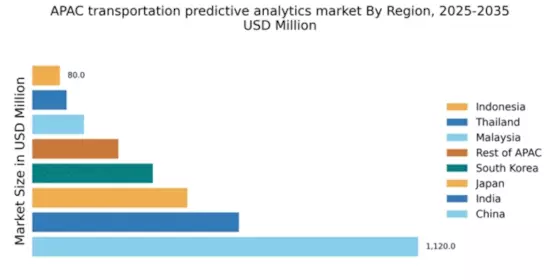
China holds a commanding market share of 44% in the transportation predictive-analytics sector, valued at $1,120.0 million. Key growth drivers include rapid urbanization, government investments in smart transportation, and increasing demand for data-driven decision-making. Regulatory policies favoring technological advancements and infrastructure development, such as the Belt and Road Initiative, further bolster market growth. The rise in e-commerce and logistics demands also fuels consumption patterns, pushing for enhanced predictive analytics solutions.

India : Transforming Transportation with Data

India's market share stands at 24% with a value of $600.0 million, driven by a burgeoning digital economy and government initiatives like the National Logistics Policy. The demand for predictive analytics is surging, particularly in urban areas, as cities like Bengaluru and Mumbai invest in smart infrastructure. The competitive landscape features major players like IBM and SAP, who are adapting their solutions to local needs, enhancing the business environment for analytics applications in transportation and logistics.

Japan : Innovative Solutions for Efficiency

Japan's transportation predictive-analytics market is valued at $450.0 million, accounting for 18% of the APAC share. The country benefits from advanced technology adoption and a strong focus on automation in logistics. Government initiatives promoting smart city projects and sustainable transport solutions are key growth drivers. The demand for real-time data analytics is increasing, particularly in urban centers like Tokyo and Osaka, where traffic congestion is a major concern.

South Korea : Leading in Data-Driven Solutions

South Korea's market is valued at $350.0 million, representing 14% of the APAC market. The country is witnessing a surge in demand for predictive analytics, driven by government policies supporting smart transportation and urban mobility. Cities like Seoul are investing heavily in data infrastructure to enhance public transport efficiency. Major players like Microsoft and TIBCO Software are actively participating in this market, providing tailored solutions for local needs.

Malaysia : Growth in Smart Infrastructure

Malaysia's transportation predictive-analytics market is valued at $150.0 million, capturing 6% of the APAC share. The growth is fueled by government initiatives aimed at enhancing public transport systems and urban planning. Demand for predictive analytics is rising, particularly in Kuala Lumpur, where smart city projects are underway. The competitive landscape includes local firms and international players like Oracle, who are adapting their offerings to meet local market dynamics.

Thailand : Focus on Urban Mobility Solutions

Thailand's market is valued at $100.0 million, accounting for 4% of the APAC market. The growth is driven by increasing urbanization and government support for smart transport initiatives. Cities like Bangkok are focusing on improving traffic management through predictive analytics. The competitive landscape features both local startups and established players like SAS Institute, who are providing innovative solutions tailored to the Thai market.

Indonesia : Transforming Transportation Sector

Indonesia's market is valued at $80.0 million, representing 3% of the APAC share. The growth is driven by rapid urbanization and increasing investments in transportation infrastructure. Jakarta is a key market, where the government is implementing smart city initiatives. The competitive landscape includes both local and international players, with a focus on enhancing logistics and public transport efficiency through predictive analytics solutions.

Rest of APAC : Varied Market Dynamics Across Regions

The Rest of APAC market is valued at $250.0 million, capturing 10% of the overall market. This segment includes a mix of developed and developing economies, each with unique growth drivers. Demand for predictive analytics is rising across various sectors, including logistics and public transport. The competitive landscape is diverse, featuring both local and international players adapting to regional needs and regulatory environments.
APAC Transportation Predictive Analytics Market Regional Image

Key Players and Competitive Insights

The transportation predictive-analytics market is currently characterized by a dynamic competitive landscape, driven by the increasing demand for data-driven decision-making and operational efficiency. Key players such as IBM (US), SAP (DE), and Microsoft (US) are strategically positioned to leverage their technological prowess and extensive resources. IBM (US) focuses on innovation through its Watson AI platform, enhancing predictive capabilities in transportation logistics. Meanwhile, SAP (DE) emphasizes regional expansion, particularly in Asia, to capture emerging market opportunities. Microsoft (US) is heavily investing in partnerships with local firms to enhance its cloud-based analytics solutions, thereby strengthening its market presence. Collectively, these strategies contribute to a competitive environment that is increasingly reliant on advanced analytics and integrated solutions.

In terms of business tactics, companies are localizing their operations to better serve regional markets, optimizing supply chains to enhance efficiency, and investing in digital transformation initiatives. The market structure appears moderately fragmented, with several key players holding substantial market shares while numerous smaller firms also contribute to the competitive dynamics. This fragmentation allows for diverse offerings and innovation, although the influence of major players remains significant in shaping market trends and customer expectations.

In October 2025, IBM (US) announced a strategic partnership with a leading logistics provider to enhance its predictive analytics capabilities. This collaboration aims to integrate AI-driven insights into supply chain management, potentially improving delivery times and reducing operational costs. The strategic importance of this partnership lies in its ability to leverage IBM's advanced analytics tools, thereby providing clients with actionable insights that can lead to more efficient transportation operations.

In September 2025, SAP (DE) launched a new suite of predictive analytics tools tailored for the transportation sector, focusing on sustainability and efficiency. This initiative is particularly relevant as companies increasingly prioritize eco-friendly practices. By offering solutions that help clients reduce their carbon footprint, SAP positions itself as a leader in sustainable transportation analytics, which may enhance its competitive edge in a market that is progressively leaning towards environmental responsibility.

In August 2025, Microsoft (US) expanded its Azure cloud services to include enhanced predictive analytics features specifically for transportation companies. This move is indicative of the growing trend towards cloud-based solutions, which allow for greater scalability and flexibility. By integrating advanced analytics into its cloud offerings, Microsoft not only strengthens its product portfolio but also addresses the increasing demand for real-time data processing in transportation logistics.

As of November 2025, current competitive trends are heavily influenced by digitalization, sustainability, and the integration of AI technologies. Strategic alliances are becoming increasingly vital, as they enable companies to pool resources and expertise to innovate more effectively. The competitive landscape is shifting from traditional price-based competition to a focus on technological advancement, innovation, and supply chain reliability. This evolution suggests that companies that prioritize these aspects will likely emerge as leaders in the transportation predictive-analytics market.

Key Companies in the APAC Transportation Predictive Analytics Market market include

Industry Developments

In recent months, the APAC Transportation Predictive Analytics Market has witnessed significant developments, marked by technological advancements and growing investments. Companies like Microsoft, SAP, and IBM are increasingly leveraging artificial intelligence to enhance predictive capabilities and optimize transportation operations. In June 2023, HPE announced a partnership with a regional logistics provider to integrate predictive analytics into supply chain processes.

Furthermore, in July 2023, Accenture acquired a data analytics firm specializing in transportation solutions, thereby enhancing its offerings in the APAC region. The market has experienced a surge in growth, with a valuation increase driven by the need for efficiency and cost reduction in logistics and transportation sectors. Government initiatives in countries such as Singapore and Japan are fostering innovation, focusing on smart transportation systems and sustainability through digital transformation.

Future Outlook

APAC Transportation Predictive Analytics Market Future Outlook

The transportation predictive-analytics market is projected to grow at 11.42% CAGR from 2024 to 2035, driven by technological advancements and increasing demand for efficiency.

New opportunities lie in:

  • Development of AI-driven route optimization software for logistics companies.
  • Integration of predictive maintenance solutions in fleet management systems.
  • Expansion of real-time traffic analytics platforms for urban planning.

By 2035, the market is expected to be robust, driven by innovation and strategic investments.

Market Segmentation

APAC Transportation Predictive Analytics Market Component Outlook

  • Hardware
  • Software

APAC Transportation Predictive Analytics Market Transport Type Outlook

  • Roadway
  • Railway
  • Aviation
  • Maritime

APAC Transportation Predictive Analytics Market Transport End User Outlook

  • Public Enterprises
  • Private Enterprises

Report Scope

MARKET SIZE 2024 2800.0(USD Million)
MARKET SIZE 2025 3119.76(USD Million)
MARKET SIZE 2035 9200.0(USD Million)
COMPOUND ANNUAL GROWTH RATE (CAGR) 11.42% (2024 - 2035)
REPORT COVERAGE Revenue Forecast, Competitive Landscape, Growth Factors, and Trends
BASE YEAR 2024
Market Forecast Period 2025 - 2035
Historical Data 2019 - 2024
Market Forecast Units USD Million
Key Companies Profiled ["IBM (US)", "SAP (DE)", "Oracle (US)", "Microsoft (US)", "Siemens (DE)", "TIBCO Software (US)", "SAS Institute (US)", "Alteryx (US)", "C3.ai (US)"]
Segments Covered Component, Transport Type, Transport End User
Key Market Opportunities Integration of artificial intelligence enhances predictive capabilities in the transportation predictive-analytics market.
Key Market Dynamics Rising demand for data-driven insights enhances competitive strategies in the transportation predictive-analytics market.
Countries Covered China, India, Japan, South Korea, Malaysia, Thailand, Indonesia, Rest of APAC

Leave a Comment

FAQs

What is the expected market size of the APAC Transportation Predictive Analytics Market in 2024?

The APAC Transportation Predictive Analytics Market is expected to be valued at 2.44 billion USD in 2024.

What is the projected market growth rate for the APAC Transportation Predictive Analytics Market from 2025 to 2035?

The market is expected to grow at a CAGR of 18.796% from 2025 to 2035.

How much will the market be valued at by 2035?

By 2035, the APAC Transportation Predictive Analytics Market is projected to reach a value of 16.2 billion USD.

Which region is expected to have the largest market share in 2024?

China is expected to hold the largest market share, valued at 0.92 billion USD in 2024.

What is the market size for India in 2024?

The market size for India is anticipated to be 0.74 billion USD in 2024.

Who are the key players in the APAC Transportation Predictive Analytics Market?

Major players include Microsoft, SAP, IBM, Accenture, and Deloitte among others.

What is the market size for hardware in the APAC Transportation Predictive Analytics Market in 2024?

The market size for hardware is expected to be 0.98 billion USD in 2024.

How much is the software segment projected to be worth in 2035?

The software segment is projected to reach a value of 9.64 billion USD by 2035.

What will the market size for Japan be in 2035?

Japan's market size is expected to be valued at 3.2 billion USD in 2035.

What challenges are anticipated for the APAC Transportation Predictive Analytics Market?

Challenges include data privacy concerns and the need for advanced technological integration.

Download Free Sample

Kindly complete the form below to receive a free sample of this Report

Compare Licence

×
Features License Type
Single User Multiuser License Enterprise User
Price $4,950 $5,950 $7,250
Maximum User Access Limit 1 User Upto 10 Users Unrestricted Access Throughout the Organization
Free Customization
Direct Access to Analyst
Deliverable Format
Platform Access
Discount on Next Purchase 10% 15% 15%
Printable Versions