×
Request Free Sample ×

Kindly complete the form below to receive a free sample of this Report

* Please use a valid business email

Leading companies partner with us for data-driven Insights

clients tt-cursor
Hero Background

Arduino Compatible Market

ID: MRFR/ICT/33216-HCR
100 Pages
Aarti Dhapte
October 2025

Arduino Compatible Market Research Report: By Application (Education, Prototyping, Home Automation, Robotics, Internet of Things), By End Use (Hobbyists, Professionals, Educational Institutions, Research and Development), By Product Type (Microcontrollers, Development Boards, Sensors, Shields, Modules), By Distribution Channel (Online Retail, Physical Retail, Direct Sales) and By Regional (North America, Europe, South America, Asia Pacific, Middle East and Africa) - Forecast to 2035.

Share:
Download PDF ×

We do not share your information with anyone. However, we may send you emails based on your report interest from time to time. You may contact us at any time to opt-out.

Arduino Compatible Market Infographic
Purchase Options

Arduino Compatible Market Summary

As per MRFR analysis, the Arduino Compatible Market Size was estimated at 2.887 USD Billion in 2024. The Arduino Compatible industry is projected to grow from 3.123 USD Billion in 2025 to 6.857 USD Billion by 2035, exhibiting a compound annual growth rate (CAGR) of 8.18 during the forecast period 2025 - 2035.

Key Market Trends & Highlights

The Arduino Compatible Market is experiencing robust growth driven by educational adoption and technological advancements.

  • The North American region remains the largest market for Arduino-compatible products, reflecting a strong demand in educational settings.
  • Asia-Pacific is emerging as the fastest-growing region, fueled by increasing interest in IoT applications and smart technologies.
  • The education segment dominates the market, while the prototyping segment is witnessing rapid growth due to rising demand for innovative solutions.
  • Technological advancements and the growing maker movement are key drivers propelling the expansion of Arduino-compatible products in both educational institutions and hobbyist communities.

Market Size & Forecast

2024 Market Size 2.887 (USD Billion)
2035 Market Size 6.857 (USD Billion)
CAGR (2025 - 2035) 8.18%

Major Players

Arduino (IT), Adafruit Industries (US), SparkFun Electronics (US), Seeed Studio (CN), DFRobot (CN), Mouser Electronics (US), Element14 (GB), Tindie (US), RobotShop (CA)

Arduino Compatible Market Trends

The Arduino Compatible Market is currently experiencing a dynamic evolution, driven by the increasing demand for accessible and versatile prototyping solutions. This market encompasses a wide range of products, including microcontrollers, sensors, and various accessories that facilitate the development of innovative projects across multiple sectors. As technology continues to advance, the integration of Arduino-compatible devices into educational curricula and hobbyist projects appears to be gaining momentum. This trend suggests a growing recognition of the importance of hands-on learning and experimentation in fostering creativity and technical skills among individuals of all ages. Moreover, the Arduino Compatible Market is likely to benefit from the rising interest in the Internet of Things (IoT) and smart home applications. As consumers seek to enhance their living environments with connected devices, the versatility of Arduino-compatible solutions positions them as attractive options for both developers and end-users. The potential for customization and scalability in projects further enhances their appeal, indicating that the market may continue to expand as more individuals and businesses explore the possibilities offered by these technologies.

Increased Educational Adoption

The integration of Arduino-compatible products into educational settings is becoming more prevalent. Schools and universities are increasingly incorporating these tools into their curricula, promoting hands-on learning and fostering innovation among students. This trend highlights the growing recognition of the value of practical experience in developing technical skills.

Expansion in IoT Applications

The Arduino Compatible Market is witnessing a notable shift towards applications in the Internet of Things. As more consumers and businesses seek to implement smart technologies, the adaptability of Arduino-compatible devices makes them ideal for creating interconnected systems. This trend suggests a promising future for the market as it aligns with the increasing demand for automation and connectivity.

Rising Community Engagement

The community surrounding Arduino-compatible products is expanding, with more enthusiasts and developers sharing projects and resources online. This collaborative environment fosters innovation and encourages newcomers to explore the technology. The growth of online forums and maker spaces indicates a vibrant ecosystem that supports the ongoing development of the Arduino Compatible Market.

Arduino Compatible Market Drivers

Growing Maker Movement

The rise of the maker movement has significantly impacted the Arduino Compatible Market, fostering a culture of DIY electronics and innovation. This movement encourages individuals to create, modify, and share their projects, leading to a vibrant community of makers and hobbyists. As more people engage in hands-on learning and experimentation, the demand for Arduino-compatible components and kits has escalated. Market data suggests that the number of maker spaces and workshops has increased by over 30% in recent years, providing essential resources and support for aspiring creators. This trend not only boosts sales in the Arduino-compatible sector but also cultivates a new generation of engineers and designers who are likely to influence future technological advancements.

Technological Advancements

The Arduino Compatible Market is experiencing a surge in technological advancements, which is driving innovation and product development. The integration of advanced sensors, microcontrollers, and connectivity options enhances the capabilities of Arduino-compatible devices. As a result, developers are able to create more sophisticated applications across various sectors, including robotics, automation, and smart home technologies. The market is projected to grow at a compound annual growth rate of approximately 10% over the next five years, indicating a robust demand for these technologies. This growth is likely fueled by the increasing need for efficient and cost-effective solutions in both consumer and industrial applications, thereby solidifying the position of Arduino-compatible products in the market.

Expansion of Educational Programs

The Arduino Compatible Market is benefiting from the expansion of educational programs that incorporate hands-on learning with electronics and programming. Schools and universities are increasingly adopting Arduino-compatible platforms as teaching tools, enabling students to engage in practical projects that enhance their understanding of STEM concepts. This educational trend is supported by various government initiatives aimed at promoting technology education. Data indicates that institutions utilizing Arduino-compatible kits have reported improved student engagement and performance in technical subjects. As educational institutions continue to integrate these tools into their curricula, the demand for Arduino-compatible products is expected to rise, further solidifying their role in the educational landscape.

Increased Demand for Prototyping Solutions

The Arduino Compatible Market is witnessing an increased demand for rapid prototyping solutions, particularly among startups and small businesses. Entrepreneurs are leveraging Arduino-compatible platforms to develop and test their ideas quickly and cost-effectively. This trend is indicative of a broader shift towards agile development methodologies, where speed and flexibility are paramount. Market analysis reveals that the prototyping segment is expected to account for a significant portion of the overall market share, driven by the need for iterative design processes in product development. As more companies recognize the value of Arduino-compatible solutions for prototyping, the industry is likely to see sustained growth and diversification of applications.

Rising Interest in Smart Home Technologies

The Arduino Compatible Market is experiencing a notable increase in interest surrounding smart home technologies. Consumers are increasingly seeking customizable and affordable solutions for home automation, which Arduino-compatible devices can provide. This trend is reflected in the growing number of smart home products that utilize Arduino platforms for enhanced functionality and user control. Market Research Future indicates that the smart home segment is projected to grow significantly, with a substantial portion of this growth attributed to DIY enthusiasts who prefer Arduino-compatible solutions for their flexibility and ease of use. As the demand for smart home technologies continues to rise, the Arduino-compatible market is likely to expand, catering to a diverse range of consumer needs.
Market Segment Insights

By Application: Education (Largest) vs. Prototyping (Fastest-Growing)

In the Arduino Compatible Market, the application segment shows a diverse distribution among its core values. Education holds the largest market share, driven primarily by the growing demand for STEM education tools that enhance learning through practical engagement. Prototyping follows closely, becoming increasingly vital as industries utilize Arduino technology for rapid product development and innovation in various sectors.

Education: (Dominant) vs. Prototyping (Emerging)

The Education segment remains dominant within the Arduino Compatible Market, serving as a cornerstone for enhancing technological literacy among students and hobbyists. With a strong focus on hands-on learning, this segment drives the adoption of Arduino platforms in schools and universities, integrating coding and electronics into curricula. Conversely, the Prototyping segment represents an emerging force, with startups and established companies leveraging Arduino for quick iterations and testing of ideas. This adaptability positions it for rapid growth, fostering innovation across multiple industries, including electronics, automotive, and consumer products.

By End Use: Hobbyists (Largest) vs. Educational Institutions (Fastest-Growing)

In the Arduino Compatible Market, the end use segments exhibit distinct share distributions. The Hobbyists segment leads the way, capturing the largest portion of the market, driven by the growing community of DIY electronics enthusiasts. Following closely, professionals utilize Arduino-compatible boards for various applications, while educational institutions and research and development entities represent the emerging forces fueling market dynamics. As technology evolves, institutions are increasingly integrating Arduino into curricula to teach programming and robotics.

Hobbyists (Dominant) vs. Educational Institutions (Emerging)

The Hobbyists segment remains dominant in the Arduino Compatible Market, characterized by a vibrant community passionate about experimenting with electronics and programming. These users are often motivated by personal projects, DIY innovations, and the desire to learn through hands-on experience. In contrast, the Educational Institutions segment is rapidly emerging, as schools and universities adopt Arduino technologies to facilitate interactive learning. This shift is propelled by the need for practical STEM education. Both segments contribute significantly to market growth, with Hobbyists driving creativity and Educational Institutions fostering a new generation of tech-savvy individuals.

By Product Type: Microcontrollers (Largest) vs. Development Boards (Fastest-Growing)

In the Arduino Compatible Market, microcontrollers hold the largest share among all product types, serving as the core of many electronic projects. Their versatility and widespread adoption in both professional and hobbyist applications contribute significantly to their dominant position. Following closely are development boards, which have emerged as the fastest-growing segment due to increasing demand for prototyping and rapid development processes in the tech ecosystem. Sensors, shields, and modules also carry considerable market interest, although they play more specialized roles.

Development Boards (Dominant) vs. Modules (Emerging)

Development boards are characterized by their user-friendly designs and extensive compatibility with various sensors and modules, making them essential for both beginners and advanced developers. Their dominance in the Arduino Compatible Market stems from their ability to simplify the development process and accelerate innovation. In contrast, modules are gaining traction as emerging components that offer specialized functionalities, such as wireless communication and advanced sensing capabilities. While still a niche segment, their adoption is expanding alongside the growing interest in IoT applications, where quick and reliable integration is essential. As the market evolves, the interdependence of development boards and modules is expected to create new opportunities for innovation.

By Distribution Channel: Online Retail (Largest) vs. Physical Retail (Fastest-Growing)

In the Arduino Compatible Market, the online retail segment commands the largest share, seamlessly integrating e-commerce platforms with diverse product offerings. This segment has rapidly expanded its dominance, capitalizing on consumer trends towards convenience and digital shopping. In contrast, the physical retail segment is witnessing the fastest growth, appealing to customers who seek hands-on experience and immediate product availability, thereby enhancing their market penetration. The growth trend observed in this segment is driven by changing consumer preferences and advancements in technology. Online retail continues to gain traction, supported by improved logistics and a global move towards digital transactions. Meanwhile, physical retail is revitalizing its strategies to cater to a tech-savvy audience seeking tangible interaction with Arduino products, fostering community engagement through workshops and events, further propelling its growth.

Online Retail (Dominant) vs. Direct Sales (Emerging)

Online retail stands out as the dominant force in the Arduino Compatible Market, leveraging the vast reach of e-commerce to cater to a diverse customer base. Its extensive product variety and the ease of online transactions make it the preferred choice for many consumers. In contrast, direct sales, although still emerging, are gaining traction with consumers seeking personalized service and direct engagement with knowledgeable sales representatives. This approach allows for tailored solutions and builds trust among customers. The shift towards direct sales is often accompanied by a focus on regional markets and niche segments, reflecting a growing trend of consumers valuing relationship-driven interactions alongside traditional purchasing methods.

Get more detailed insights about Arduino Compatible Market

Regional Insights

North America : Innovation and Growth Hub

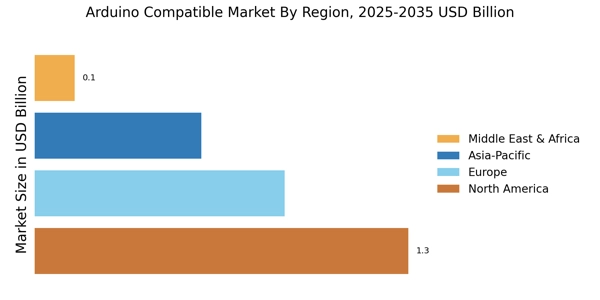
North America is the largest market for Arduino-compatible products, holding approximately 45% of the global market share. The region benefits from a robust tech ecosystem, high demand for educational tools, and a strong emphasis on innovation. Regulatory support for STEM education and maker culture further drives growth, with initiatives promoting technology in schools and communities. The United States is the primary market player, followed by Canada, with key companies like Arduino, Adafruit Industries, and SparkFun Electronics leading the charge. The competitive landscape is characterized by a mix of established firms and startups, fostering a vibrant community of developers and hobbyists. The presence of major distributors like Mouser Electronics and Element14 enhances accessibility and market penetration.

Europe : Emerging Market with Potential

Europe is witnessing significant growth in the Arduino-compatible market, accounting for about 30% of the global share. The region's demand is driven by increasing interest in DIY electronics, educational programs, and government initiatives promoting innovation and technology. Countries like Germany and the UK are at the forefront, supported by favorable regulations that encourage tech development and entrepreneurship. Germany leads the market, followed closely by the UK and France, with a competitive landscape featuring both local and international players. Companies like Seeed Studio and DFRobot are making strides in the European market, while local distributors enhance product availability. The region's focus on sustainability and green technology also influences product development and consumer preferences.

Asia-Pacific : Rapidly Expanding Market

Asia-Pacific is rapidly emerging as a significant player in the Arduino-compatible market, holding around 20% of the global share. The region's growth is fueled by increasing technological adoption, a burgeoning maker culture, and government initiatives aimed at enhancing digital literacy. Countries like China and India are leading this growth, with a strong focus on education and innovation in technology. China is the largest market, driven by local manufacturers like Seeed Studio and DFRobot, while India is witnessing a rise in startups and educational institutions adopting Arduino solutions. The competitive landscape is diverse, with a mix of established companies and new entrants, fostering innovation and collaboration in the tech ecosystem. The region's emphasis on affordable technology solutions further supports market expansion.

Middle East and Africa : Emerging Tech Landscape

The Middle East and Africa region is gradually emerging in the Arduino-compatible market, currently holding about 5% of the global share. The growth is driven by increasing interest in technology and innovation, particularly in educational sectors and among hobbyists. Countries like South Africa and the UAE are leading the way, with initiatives aimed at promoting STEM education and technology adoption. South Africa is the largest market in the region, with a growing community of makers and tech enthusiasts. The competitive landscape is still developing, with local distributors and international players like RobotShop beginning to establish a presence. The region's potential for growth is significant, as more individuals and institutions recognize the value of Arduino-compatible products in fostering creativity and technical skills.

Arduino Compatible Market Regional Image

Key Players and Competitive Insights

The Arduino Compatible Market has seen notable growth and diversification in recent years, spurred by the increasing popularity of electronic prototyping and the rise of the maker movement. Competition in this market is characterized by a mix of established players and emerging innovators, all vying to capture a share of a rapidly expanding consumer base that values creativity, accessibility, and affordability in technology. Key market drivers include advancements in technology, the proliferation of educational programs, and a wide variety of applications across sectors such as robotics, IoT, and DIY electronics. 

The accessibility of open-source hardware and software has further spurred this growth, allowing more individuals and small businesses to participate in the market. Digikey holds a strong position within the Arduino Compatible Market, largely due to its extensive distribution network and an impressive variety of products that cater to both hobbyists and professionals alike. With a comprehensive selection and a user-friendly website, Digikey allows users to easily navigate through different Arduino-compatible offerings, making it simple for customers to find exactly what they need.

The company’s strengths lie not only in its vast catalog of components but also in its robust logistics and customer support, which facilitate timely delivery and reliable service.

This positions Digikey as a go-to resource for anyone looking to source Arduino-compatible products, fostering a loyal customer base through consistently high service quality and product availability.RobotShop is another key player in the Arduino Compatible Market, focusing on providing a variety of robotics and automation solutions that incorporate Arduino technology. Their unique blend of products, which includes a wide range of robotic kits and components, appeals to both educational institutions and hobbyists looking to prototype or create complex automated systems. 

RobotShop’s strengths include a solid reputation for quality and innovation, along with a knowledgeable customer support team that assists users in selecting the best products for their projects. Additionally, the company regularly hosts community engagement initiatives, such as forums and educational content, promoting an interactive platform where users can share ideas and collaborate. Overall, RobotShop’s commitment to the robotics community and its focus on Arduino-compatible solutions significantly enhance its competitive positioning within the market.

Key Companies in the Arduino Compatible Market market include

Industry Developments

The Arduino Compatible Market has recently seen a surge in interest due to advancements in IoT and automation technologies. Companies like Arduino and Raspberry Pi Foundation continue to innovate, introducing new microcontroller boards that cater to various developers’ needs. RobotShop has also expanded its product offerings, enhancing accessibility for hobbyists and professionals. Moreover, STMicroelectronics and Texas Instruments are significantly investing in research and development to enhance their existing product ranges, which has contributed to an upswing in their market valuation.

In terms of mergers and acquisitions, there hasn’t been any reported activity involving major players like Digikey, SparkFun Electronics, or Mouser Electronics in recent months. This stability indicates a focus on organic growth rather than consolidation. Companies like Adafruit and DFRobot are also experiencing growth, owing to increased demand for educational kits and DIY projects, which have become quite popular. The market is expected to continue evolving with a broader acceptance of Arduino-compatible solutions across different sectors, further driving growth and innovation in the industry.

As a result, the market valuation for these companies has seen steady improvement, reflecting the robust demand for affordable and versatile hardware solutions.

Future Outlook

Arduino Compatible Market Future Outlook

The Arduino Compatible Market is projected to grow at an 8.18% CAGR from 2024 to 2035, driven by increasing IoT applications, educational initiatives, and demand for prototyping tools.

New opportunities lie in:

  • Development of specialized IoT sensor kits for smart agriculture.
  • Expansion into educational institutions with tailored Arduino curriculum packages.
  • Creation of subscription-based services for ongoing software and hardware updates.

By 2035, the Arduino Compatible Market is expected to be robust, driven by innovation and diverse applications.

Market Segmentation

Arduino Compatible Market End Use Outlook

  • Hobbyists
  • Professionals
  • Educational Institutions
  • Research and Development

Arduino Compatible Market Application Outlook

  • Education
  • Prototyping
  • Home Automation
  • Robotics
  • Internet of Things

Arduino Compatible Market Product Type Outlook

  • Microcontrollers
  • Development Boards
  • Sensors
  • Shields
  • Modules

Arduino Compatible Market Distribution Channel Outlook

  • Online Retail
  • Physical Retail
  • Direct Sales

Report Scope

MARKET SIZE 20242.887(USD Billion)
MARKET SIZE 20253.123(USD Billion)
MARKET SIZE 20356.857(USD Billion)
COMPOUND ANNUAL GROWTH RATE (CAGR)8.18% (2024 - 2035)
REPORT COVERAGERevenue Forecast, Competitive Landscape, Growth Factors, and Trends
BASE YEAR2024
Market Forecast Period2025 - 2035
Historical Data2019 - 2024
Market Forecast UnitsUSD Billion
Key Companies ProfiledMarket analysis in progress
Segments CoveredMarket segmentation analysis in progress
Key Market OpportunitiesIntegration of Internet of Things (IoT) solutions in the Arduino Compatible Market enhances automation and connectivity.
Key Market DynamicsRising demand for open-source hardware fosters innovation and competition in the Arduino compatible market.
Countries CoveredNorth America, Europe, APAC, South America, MEA

Leave a Comment

FAQs

What is the current valuation of the Arduino Compatible Market?

The Arduino Compatible Market was valued at 2.887 USD Billion in 2024.

What is the projected market size for the Arduino Compatible Market by 2035?

The market is projected to reach 6.857 USD Billion by 2035.

What is the expected CAGR for the Arduino Compatible Market during the forecast period?

The expected CAGR for the Arduino Compatible Market from 2025 to 2035 is 8.18%.

Which segments are expected to show significant growth in the Arduino Compatible Market?

Segments such as Prototyping and Home Automation are anticipated to grow from 0.867 to 2.067 USD Billion and 0.578 to 1.367 USD Billion, respectively.

Who are the key players in the Arduino Compatible Market?

Key players include Arduino (IT), Adafruit Industries (US), and SparkFun Electronics (US), among others.

What are the primary distribution channels for Arduino compatible products?

The primary distribution channels include Online Retail, Physical Retail, and Direct Sales, with Online Retail projected to grow from 1.5 to 3.5 USD Billion.

How do the end-use segments of the market compare in terms of valuation?

Hobbyists and Professionals are expected to grow from 0.866 to 1.999 USD Billion each, indicating robust demand.

What product types are driving growth in the Arduino Compatible Market?

Microcontrollers and Development Boards are leading product types, both projected to grow from 0.866 to 1.999 USD Billion.

What role do educational institutions play in the Arduino Compatible Market?

Educational Institutions are projected to grow from 0.578 to 1.333 USD Billion, highlighting their importance in market expansion.

How does the market's growth potential compare across different applications?

Applications like Robotics and Internet of Things are expected to grow from 0.578 to 1.367 USD Billion and 0.286 to 0.786 USD Billion, respectively.

Download Free Sample

Kindly complete the form below to receive a free sample of this Report

Compare Licence

×
Features License Type
Single User Multiuser License Enterprise User
Price $4,950 $5,950 $7,250
Maximum User Access Limit 1 User Upto 10 Users Unrestricted Access Throughout the Organization
Free Customization
Direct Access to Analyst
Deliverable Format
Platform Access
Discount on Next Purchase 10% 15% 15%
Printable Versions