Download Free Sample
Kindly complete the form below to receive a free sample of this Report
Argentina Agricultural Fumigants Market Size, Share, Industry Trend & Analysis Research Report By Type (phosphine, methyl bromide, chloropicrin, metam sodium, 1,3 dichloropropene, others), By Form (solid, liquid, gas) and By Application (soil, warehouse) - Forecast to 2035
As per Market Research Future analysis, the Argentina Agricultural Fumigants Market size was estimated at 78.3 $ Million in 2024. The Agricultural Fumigants market is projected to grow from 81.2 $ Million in 2025 to 116.95 $ Million by 2035, exhibiting a compound annual growth rate (CAGR) of 3.7% during the forecast period 2025 - 2035
The Argentina agricultural fumigants market is experiencing a transformative shift towards sustainability and innovation.
| 2024 Market Size | 78.3 (USD Million) |
| 2035 Market Size | 116.95 (USD Million) |
| CAGR (2025 - 2035) | 3.71% |
BASF SE (DE), FMC Corporation (US), Syngenta AG (CH), Corteva Agriscience (US), Nufarm Limited (AU), ADAMA Agricultural Solutions Ltd. (IL), UPL Limited (IN), Nutrien Ltd. (CA)
Our Impact
Enabled $4.3B Revenue Impact for Fortune 500 and Leading Multinationals
Partnering with 2000+ Global Organizations Each Year
30K+ Citations by Top-Tier Firms in the Industry
The Argentina Agricultural Fumigants Market in Argentina is experiencing notable developments., driven by the increasing demand for effective pest control solutions in the agricultural sector. The country's diverse agricultural landscape, which includes crops such as soybeans, corn, and wheat, necessitates the use of various fumigants to protect yields from pests and diseases. Furthermore, the regulatory environment is evolving, with authorities emphasizing the need for sustainable practices. This shift may lead to the adoption of more environmentally friendly fumigants, aligning with global trends towards sustainability. In addition, the agricultural fumigants market is influenced by technological advancements in application methods and product formulations. Innovations such as precision agriculture and integrated pest management are gaining traction, allowing for more efficient use of fumigants. This not only enhances crop protection but also minimizes potential environmental impacts. As farmers seek to optimize their operations, the demand for advanced fumigation solutions is likely to grow, indicating a dynamic future for the market. Overall, The agricultural fumigants market in Argentina appears poised for growth. This growth is driven by regulatory changes and technological innovations that cater to the evolving needs of the agricultural sector.
There is a noticeable trend towards the adoption of sustainable practices within the agricultural fumigants market. Regulatory bodies are increasingly promoting environmentally friendly alternatives, which may lead to a gradual phase-out of certain harmful chemicals. This shift reflects a broader commitment to sustainable agriculture, aligning with global environmental goals.
Technological innovations are transforming the application methods of agricultural fumigants. Precision agriculture techniques are being integrated, allowing for targeted application that enhances efficacy while reducing waste. This trend suggests a move towards more efficient and responsible use of fumigants in the field.
The agricultural sector is witnessing a rising demand for effective crop protection solutions, driven by the need to safeguard yields against pests and diseases. This trend indicates a robust market for agricultural fumigants, as farmers seek reliable products to ensure the health and productivity of their crops.
The agricultural fumigants market in Argentina is experiencing growth due to the rising incidence of pest resistance. As pests evolve and develop resistance to conventional pesticides, farmers are increasingly turning to fumigants as an effective solution. This shift is particularly evident in key crops such as soybeans and corn, which are staples in Argentina's agricultural sector. The market for agricultural fumigants is projected to expand as these products offer targeted action against resistant pest populations. In 2025, the market is expected to reach approximately $150 million, driven by the need for effective pest management strategies. The increasing awareness among farmers regarding the efficacy of fumigants in controlling resistant pests is likely to further bolster market growth.
Regulatory frameworks in Argentina are evolving to support the use of agricultural fumigants, which is positively impacting the market. The government has recognized the importance of these products in ensuring food security and enhancing agricultural productivity. Recent policies have streamlined the approval process for new fumigant formulations, making them more accessible to farmers. This regulatory support is crucial, especially in a country where agriculture plays a vital role in the economy. The agricultural fumigants market is anticipated to benefit from these favorable regulations, with an expected growth rate of around 5% annually. As farmers gain easier access to effective fumigants, the overall market is likely to expand, addressing both pest control and crop yield enhancement.
The effects of climate change are increasingly felt in Argentina's agricultural landscape, influencing the agricultural fumigants market. Changes in temperature and precipitation patterns are leading to shifts in pest populations and the emergence of new pest species. As a result, farmers are compelled to adapt their pest management strategies, often turning to fumigants for effective control. The agricultural fumigants market is expected to see a growth rate of around 5% as farmers respond to these climatic challenges. The need for effective pest management solutions in the face of climate variability is likely to drive the demand for fumigants, ensuring their continued relevance in the agricultural sector.
Technological advancements in fumigation methods are significantly influencing the agricultural fumigants market in Argentina. Innovations such as precision application techniques and improved formulation technologies are enhancing the effectiveness and safety of fumigants. These advancements allow for more targeted applications, reducing the environmental impact while maximizing pest control efficiency. As farmers become more aware of these technologies, the adoption rate of modern fumigants is expected to rise. The market is projected to grow by approximately 4% annually as these innovations become more mainstream. The integration of technology in fumigation practices is likely to reshape the agricultural fumigants market, making it more efficient and sustainable.
Argentina's agricultural sector is heavily reliant on exports, particularly in commodities like soybeans and wheat. The increasing The agricultural fumigants market as farmers seek to maximize yields and ensure quality. To meet international standards, Argentine farmers are adopting advanced fumigation techniques to protect their crops from pests and diseases. This trend is expected to propel the market, with estimates suggesting a growth of 6% in the agricultural fumigants market by 2026. The need to maintain competitive pricing and quality in the export market is likely to encourage the adoption of fumigants, thereby enhancing the overall market landscape.
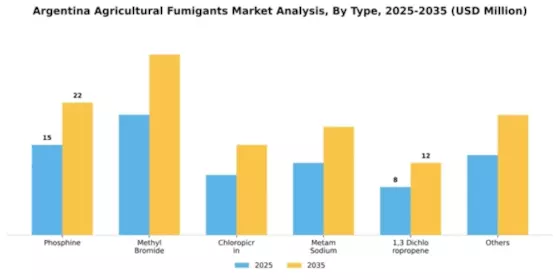
In the Argentina agricultural fumigants market, Phosphine holds the largest market share, benefiting from its effectiveness in a variety of applications, particularly in grain storage. Methyl Bromide, while facing regulatory scrutiny, remains a significant player in the market and is noted for its role in soil fumigation, thus capturing a substantial segment of usage among farmers seeking efficient pest control solutions. The growth trends indicate a shift towards more environmentally-friendly alternatives, which may create opportunities for Methyl Bromide as its application techniques evolve. Additionally, increasing pest resistance has driven demand for products like 1,3 Dichloropropene, while innovations in application methods may enhance Phosphine's utilization in diverse agricultural settings, further stimulating overall market expansion.
Phosphine (Dominant) vs. Methyl Bromide (Emerging)
Phosphine is recognized as the dominant fumigant in the Argentina agricultural fumigants market due to its high efficiency and cost-effectiveness in controlling pests in stored grains and cereals. Its solid market presence is supported by its favorable regulatory status compared to alternatives. Methyl Bromide, however, is emerging as a pivotal solution for soil application and pre-shipment treatment, adapting to stricter environmental regulations through targeted application techniques. As farmers increasingly seek effective ways to address pest pressures, both segments are shaping their strategies to meet evolving market demands, with Phosphine continuing to lead while Methyl Bromide carves out its niche in sustainable pest management.
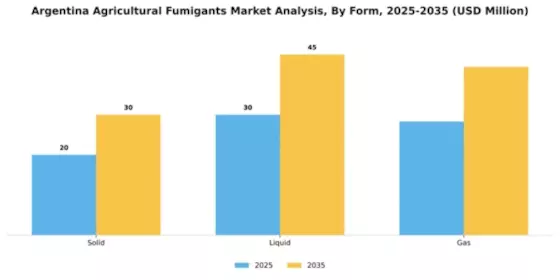
The Argentina agricultural fumigants market has distinct segment values categorized by form, including solid, liquid, and gas. Among these, liquid fumigants command the largest market share, driven by their ease of application and effectiveness in pest control. Meanwhile, the solid form is gaining attention as an innovative and more concentrated alternative, contributing to a shift in market dynamics. Growth trends in this segment reflect an increasing preference for liquid formulations due to their efficiency and favorable environmental profile. Solid fumigants are rapidly emerging as the fastest-growing option, appealing to environmentally conscious farmers seeking sustainable solutions. The shift indicates a transformative phase in the market, where innovation and efficacy drive adoption across various agricultural applications.
Liquid (Dominant) vs. Solid (Emerging)
In the Argentina agricultural fumigants market, liquid fumigants are seen as the dominant form, offering superior flexibility and convenience for users. Their formulation allows for quick application and effective distribution, making them a preferred choice among agricultural professionals. Conversely, solid fumigants represent an emerging trend, noted for their high concentration and reduced volume requirements. This segment is gaining traction as farmers look for effective ways to minimize environmental impact while maximizing pest control efficiency. The contrasting characteristics of these forms highlight a fundamental evolution in market preferences, driven by changing agricultural practices and increasing awareness of sustainability.
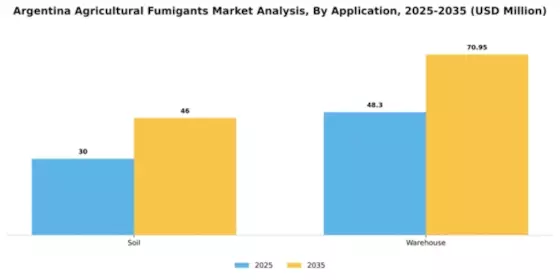
In the Argentina agricultural fumigants market, the application of fumigants in soil is the largest segment, accounting for a significant share of the market. This dominance is driven by the need for effective pest and disease management in crop production, where soil fumigation is essential for maintaining soil health and optimizing yield potential. Conversely, the warehouse segment, although smaller, is gaining traction due to increased investments in storage facilities and the rising importance of preserving stored agricultural products from pests and diseases. The growth trends for the soil application segment continue to be supported by advancements in fumigant technologies, allowing for more effective and environmentally-friendly solutions. In contrast, the warehouse segment is emerging as the fastest-growing segment, driven by the growing awareness of the need for pest control in storage environments, as well as heightened export requirements. This shift underscores the evolving landscape of agricultural practices in Argentina, where efficiency and quality are paramount.
Soil (Dominant) vs. Warehouse (Emerging)
The soil application of fumigants remains the dominant force in the Argentina agricultural fumigants market, as it addresses critical agricultural needs such as soil sterilization and pest control before planting. This method enables farmers to create a conducive environment for crops, which is crucial in a region that heavily relies on agriculture. On the other hand, the warehouse application is emerging, reflecting a growing recognition of the importance of protecting stored grain and produce from pest infestations. This shift is characterized by innovative storage solutions and the adoption of effective fumigation practices that meet stringent quality control standards. The contrast between these segments highlights the diverse strategies being employed by agricultural stakeholders in the region.
Get more detailed insights about Argentina Agricultural Fumigants Market Request Free Sample
The agricultural fumigants market in Argentina is characterized by a competitive landscape that is increasingly shaped by innovation, sustainability, and strategic partnerships. Key players such as BASF SE (DE), FMC Corporation (US), and Corteva Agriscience (US) are actively pursuing strategies that emphasize product development and regional expansion. BASF SE (DE) focuses on enhancing its portfolio through innovative solutions that address pest management challenges, while FMC Corporation (US) is leveraging its expertise in crop protection to strengthen its market position. Corteva Agriscience (US) appears to be concentrating on sustainable practices, aligning its operations with the growing demand for environmentally friendly agricultural solutions. Collectively, these strategies contribute to a dynamic competitive environment where differentiation is increasingly reliant on technological advancements and sustainability initiatives.In terms of business tactics, companies are localizing manufacturing and optimizing supply chains to enhance efficiency and responsiveness to market demands. The market structure is moderately fragmented, with several key players exerting influence over pricing and product availability. This fragmentation allows for a diverse range of products and solutions, catering to the varying needs of Argentine farmers. The collective actions of these companies indicate a trend towards collaboration and innovation, which is likely to reshape the competitive dynamics in the near future.
In October BASF SE (DE) announced the launch of a new line of bio-based fumigants aimed at reducing environmental impact while maintaining efficacy against pests. This strategic move not only aligns with global sustainability trends but also positions BASF as a leader in eco-friendly agricultural solutions. The introduction of these products is expected to enhance the company's market share and appeal to environmentally conscious consumers.
In September Corteva Agriscience (US) entered into a partnership with a local Argentine agricultural cooperative to develop tailored fumigation solutions that address specific regional pest challenges. This collaboration is significant as it allows Corteva to leverage local knowledge and expertise, thereby enhancing its product offerings and strengthening its market presence. Such partnerships are indicative of a broader trend towards localized solutions in the agricultural sector.
In August FMC Corporation (US) expanded its distribution network in Argentina by acquiring a local distributor specializing in agricultural chemicals. This acquisition is likely to enhance FMC's operational capabilities and improve its market penetration. By integrating local distribution channels, FMC can respond more effectively to customer needs and optimize its supply chain, which is crucial in a competitive market.
As of November the agricultural fumigants market is witnessing trends that emphasize digitalization, sustainability, and the integration of artificial intelligence in product development and supply chain management. Strategic alliances are increasingly shaping the competitive landscape, allowing companies to pool resources and expertise. Looking ahead, competitive differentiation is expected to evolve from traditional price-based competition to a focus on innovation, technology, and supply chain reliability. This shift underscores the importance of adapting to changing market dynamics and consumer preferences.

The Argentina Agricultural Fumigants Market has been witnessing significant developments recently. In October 2023, FMC Corporation announced substantial investments in advanced pest management solutions aimed at enhancing crop yield efficiency, reflecting the increasing demand for environmentally sustainable agricultural practices. Meanwhile, BASF and Corteva Agriscience have been jointly working on developing new fumigant formulations to comply with stringent environmental regulations imposed by the Argentine government, indicating a shift towards more sustainable agricultural practices.
Notably, in June 2023, UPL completed the acquisition of a regional competitor, bolstering its market presence in Argentina and enhancing its product portfolio. Furthermore, Bayer and Syngenta have been actively involved in Research and Development collaborations to create innovative solutions as the demand for precision farming techniques rises. Over the last two years, the market has seen a consistent growth trajectory, driven by the increasing adoption of fumigants for pest control and the need to counteract the effects of climate variability on crop production.
The Argentine government continues to support agricultural innovation, leading to increased investments from major players like Nutrien and Adama Agricultural Solutions, further propelling the market forward amidst evolving industry dynamics.
The Agricultural Fumigants Market in Argentina is projected to grow at a 3.71% CAGR from 2025 to 2035, driven by increasing agricultural productivity and pest management needs.
New opportunities lie in:
By 2035, the market is expected to achieve robust growth, reflecting evolving agricultural practices.
| MARKET SIZE 2024 | 78.3(USD Million) |
| MARKET SIZE 2025 | 81.2(USD Million) |
| MARKET SIZE 2035 | 116.95(USD Million) |
| COMPOUND ANNUAL GROWTH RATE (CAGR) | 3.71% (2025 - 2035) |
| REPORT COVERAGE | Revenue Forecast, Competitive Landscape, Growth Factors, and Trends |
| BASE YEAR | 2024 |
| Market Forecast Period | 2025 - 2035 |
| Historical Data | 2019 - 2024 |
| Market Forecast Units | USD Million |
| Key Companies Profiled | BASF SE (DE), FMC Corporation (US), Syngenta AG (CH), Corteva Agriscience (US), Nufarm Limited (AU), ADAMA Agricultural Solutions Ltd. (IL), UPL Limited (IN), Nutrien Ltd. (CA) |
| Segments Covered | Type, Form, Application |
| Key Market Opportunities | Adoption of innovative biopesticides in the agricultural fumigants market enhances sustainability and efficacy. |
| Key Market Dynamics | Regulatory changes and technological advancements drive innovation in the agricultural fumigants market in Argentina. |
| Countries Covered | Argentina |
The market valuation of agricultural fumigants in Argentina was $78.3 Million in 2024.
The projected market valuation for agricultural fumigants in Argentina is $116.95 Million by 2035.
The expected CAGR for the agricultural fumigants market in Argentina during the forecast period 2025 - 2035 is 3.71%.
Key players in the agricultural fumigants market in Argentina include BASF SE, FMC Corporation, Syngenta AG, Corteva Agriscience, Nufarm Limited, ADAMA Agricultural Solutions Ltd., UPL Limited, and Nutrien Ltd.
The main types of agricultural fumigants available in Argentina include Phosphine, Methyl Bromide, Chloropicrin, Metam Sodium, 1,3 Dichloropropene, and others.
The valuation of Phosphine in the agricultural fumigants market in Argentina was between $15.0 Million and $22.0 Million in 2024.
In 2024, the valuation of liquid agricultural fumigants ranged from $30.0 Million to $45.0 Million, which is higher than the solid form at $20.0 Million to $30.0 Million and gas form at $28.3 Million to $41.95 Million.
The dominant applications in the agricultural fumigants market in Argentina are soil and warehouse applications, with valuations of $30.0 Million to $46.0 Million and $48.3 Million to $70.95 Million, respectively.
The agricultural fumigants market in Argentina is expected to grow steadily, with a projected valuation increase to $116.95 Million by 2035.
Factors that might influence the growth of the agricultural fumigants market in Argentina include advancements in agricultural technology, regulatory changes, and shifts in pest management practices.



Kindly complete the form below to receive a free sample of this Report

“This is really good guys. Excellent work on a tight deadline. I will continue to use you going forward and recommend you to others. Nice job”


“Thanks. It’s been a pleasure working with you, please use me as reference with any other Intel employees.”


“Thanks for sending the report it gives us a good global view of the Betaïne market.”


“Thank you, this will be very helpful for OQS.”


“We found the report very insightful! we found your research firm very helpful. I'm sending this email to secure our future business.”


“I am very pleased with how market segments have been defined in a relevant way for my purposes (such as "Portable Freezers & refrigerators" and "last-mile"). In general the report is well structured. Thanks very much for your efforts.”


“I have been reading the first document or the study, ,the Global HVAC and FP market report 2021 till 2026. Must say, good info! I have not gone in depth at all parts, but got a good indication of the data inside!”


“We got the report in time, we really thank you for your support in this process. I also thank to all of your team as they did a great job.”


“The Automotive 48V ECU Components Procurement Intelligence Study” was a complex project, but the Market Research Future (MRFR) team handled it with quality, agility, and customer-centricity. They delivered all requested data on time and within the agreed scope. The team, including Shubhendra Anand and Rahul Gotadki, was always readily available to clarify questions and swiftly implement necessary adjustments, driving the project to a successful conclusion within a very demanding timeframe.
I would also like to specifically commend Akshay Agarwal for his responsiveness and support at every stage—from our initial inquiry on May 6th through to final delivery on June 18th. His dedication made the entire process seamless.”



