×
Request Free Sample ×

Kindly complete the form below to receive a free sample of this Report

* Please use a valid business email

Leading companies partner with us for data-driven Insights

clients tt-cursor
Hero Background

Armored Personnel Carrier Market

ID: MRFR/AD/9197-CR
148 Pages
Sejal Akre
September 2021

Armoured Personnel Carrier Market Research Report By Application (Military Operations, Civilian Protection, Peacekeeping Missions, Counter-Terrorism Operations), By Armour Type (Composite Armour, Steel Armour, Ceramic Armour, Soft Armour), By Vehicle Capacity (2-4 Personnel, 5-10 Personnel, 11-20 Personnel, 21+ Personnel), By End Use (Defense Forces, Law Enforcement Agencies, Private Security) and By Regional (North America, Europe, South America, Asia Pacific, Middle East and Africa) - Forecast to 2032

Share:
Download PDF ×

We do not share your information with anyone. However, we may send you emails based on your report interest from time to time. You may contact us at any time to opt-out.

Armored Personnel Carrier Market Infographic
Purchase Options

Armored Personnel Carrier Market Summary

As per MRFR analysis, the Armored Personnel Carrier Market Size was estimated at 3900.0 USD Million in 2024. The Armored Personnel Carrier industry is projected to grow from 4100.0 in 2025 to 6100.0 by 2035, exhibiting a compound annual growth rate (CAGR) of 4.05 during the forecast period 2025 - 2035.

Key Market Trends & Highlights

The Armored Personnel Carrier Market is poised for growth driven by technological advancements and evolving defense strategies.

  • North America remains the largest market for armored personnel carriers, reflecting substantial military expenditure.
  • The Asia-Pacific region is emerging as the fastest-growing market, driven by increasing geopolitical tensions.
  • Military operations continue to dominate the market, while counter-terrorism operations are witnessing rapid growth.
  • Key market drivers include rising military expenditure and a heightened focus on soldier safety.

Market Size & Forecast

2024 Market Size 3900.0 (USD Million)
2035 Market Size 6100.0 (USD Million)
CAGR (2025 - 2035) 4.05%

Major Players

General Dynamics (US), BAE Systems (GB), Rheinmetall (DE), Oshkosh Defense (US), Thales Group (FR), Navistar Defense (US), Krauss-Maffei Wegmann (DE), L3Harris Technologies (US), Elbit Systems (IL)

Armored Personnel Carrier Market Trends

The Armored Personnel Carrier Market is currently experiencing a notable evolution, driven by various factors including geopolitical tensions and the increasing need for enhanced troop protection. Nations across the globe are investing in advanced military technologies, which has led to a surge in demand for armored vehicles that can withstand diverse combat scenarios. This market appears to be characterized by a shift towards more versatile and adaptable designs, integrating cutting-edge technologies such as improved armor materials and advanced communication systems. Furthermore, the emphasis on mobility and operational efficiency suggests that manufacturers are focusing on creating vehicles that not only provide protection but also enhance the overall effectiveness of military operations. In addition to technological advancements, the Armored Personnel Carrier Market is influenced by changing defense strategies and the evolving nature of warfare. As asymmetric threats become more prevalent, there is a growing recognition of the need for vehicles that can operate in urban environments and provide support in peacekeeping missions. This trend indicates a potential diversification in the types of armored personnel carriers being developed, catering to a broader range of operational requirements. Overall, the market appears poised for continued growth, with manufacturers likely to prioritize innovation and adaptability in their offerings, ensuring that armed forces are equipped to meet contemporary challenges.

Technological Advancements

The Armored Personnel Carrier Market is witnessing a trend towards the integration of advanced technologies. Innovations in armor materials, weapon systems, and communication capabilities are becoming increasingly prevalent. This focus on technology aims to enhance the operational effectiveness and survivability of personnel carriers in various combat scenarios.

Shift in Defense Strategies

There is a noticeable shift in defense strategies among nations, leading to an increased demand for versatile armored personnel carriers. As military operations evolve, the need for vehicles that can adapt to different environments and mission types is becoming more pronounced, particularly in urban warfare and peacekeeping operations.

Sustainability Considerations

Sustainability is emerging as a key consideration in the Armored Personnel Carrier Market. Manufacturers are exploring eco-friendly materials and energy-efficient technologies to reduce the environmental impact of production and operation. This trend reflects a broader commitment to sustainability within the defense sector.

Armored Personnel Carrier Market Drivers

Increasing Defense Budgets

The Global Armored Personnel Carrier Industry is experiencing growth driven by rising defense budgets across various nations. Countries are prioritizing military modernization and enhancing their defense capabilities, leading to increased procurement of armored vehicles. For instance, nations like the United States and India have allocated substantial portions of their budgets to upgrade their military fleets. In 2024, the market is projected to reach 11.6 USD Billion, reflecting the urgency for advanced armored personnel carriers that can withstand modern warfare challenges. This trend indicates a robust demand for innovative designs and technologies in the armored personnel carrier segment.

Market Segment Insights

By Application: Military Operations (Largest) vs. Counter-Terrorism Operations (Fastest-Growing)

The Armored Personnel Carrier (APC) market is primarily driven by military operations, with substantial market share attributed to this segment. Military operations encompass diverse activities requiring fortified vehicle solutions for troop transport and engagement in combat. It has been the cornerstone of APC utilization, reflecting a robust trend towards enhanced tactical capabilities and operational readiness. In contrast, the counter-terrorism operations segment is rapidly gaining traction, accounting for a significant uptick in demand. This growth indicates a strategic shift towards addressing emerging security threats and highlights the evolving nature of warfare.

Military Operations: Dominant vs. Counter-Terrorism Operations: Emerging

Military operations remain the dominant application for armored personnel carriers, characterized by their necessity in conflicts and combat situations. These vehicles are essential for transporting troops in dangerous environments while providing necessary protection and mobility. Counter-terrorism operations represent an emerging segment that has witnessed accelerated adoption of APCs, fueled by increasing global concerns over terrorism and asymmetric warfare. The need for quick response and high-mobility armored solutions has led to innovations in design and technology, aiming to meet the specific requirements of counter-terrorism units. This juxtaposition between a traditional stronghold and an evolving frontier highlights the dynamic landscape of military vehicle applications.

By Vehicle Type: Wheeled Armored Personnel Carriers (Largest) vs. Tracked Armored Personnel Carriers (Fastest-Growing)

In the Armored Personnel Carrier Market, the distribution of market share among vehicle types reveals that Wheeled Armored Personnel Carriers dominate the segment due to their versatility and ease of mobility. These carriers are favored for urban operations and have been widely adopted by military forces around the globe. In contrast, Tracked Armored Personnel Carriers are gaining traction with a notable increase in market share as they are recognized for superior off-road capabilities and enhanced protection in rugged terrains.

Wheeled Armored Personnel Carriers (Dominant) vs. Tracked Armored Personnel Carriers (Emerging)

Wheeled Armored Personnel Carriers are characterized by their high mobility, lower operational costs, and ability to navigate urban environments effectively. Their design typically incorporates advanced technologies for communication and protection, making them essential for various military applications. On the other hand, Tracked Armored Personnel Carriers are emerging as a competitive alternative with their robust build and superior cross-country performance. They excel in challenging terrains and are often preferred for missions requiring heavy armor and firepower. The growing demand for advanced tactical solutions in diverse terrains is driving the adoption of these tracked vehicles.

By Mobility Type: Off-Road Mobility (Largest) vs. Amphibious Mobility (Fastest-Growing)

In the Armored Personnel Carrier (APC) market, mobility type plays a crucial role in defining operational capabilities. Off-Road Mobility currently holds the largest share, favored for its adaptability to diverse terrains, allowing for strategic deployment in various combat environments. On-Road Mobility, while significant, primarily caters to logistic operations and urban conflict scenarios. Amphibious Mobility, though smaller in market share, is gaining attention due to its versatility in riverine and coastal operations, addressing modern warfare's evolving requirements.

Off-Road Mobility (Dominant) vs. Amphibious Mobility (Emerging)

Off-Road Mobility represents the dominant force in the armored personnel carrier segment, characterized by robust designs enabling maneuverability across rugged landscapes. This type is essential for military operations in rural and uneven terrains, providing enhanced tactical advantages during deployments. In contrast, Amphibious Mobility is emerging as a key segment, offering unique capabilities for dual land and water operations. This segment's growing importance is driven by the need for flexible forces capable of rapid deployment in diverse environments, catering to advanced military strategies that emphasize versatility and operational readiness.

By Protection Level: Ballistic Protection (Largest) vs. Mine Protection (Fastest-Growing)

In the Armored Personnel Carrier Market, the protection levels are classified into three major segments: ballistic protection, mine protection, and blast protection. Among these, ballistic protection continues to hold the largest share due to its longstanding significance in military operations. This segment is critical for sustaining soldier safety against direct projectile threats, hence its dominance. On the other hand, mine protection is gaining traction and is recognized as the fastest-growing segment, driven by increasing instances of asymmetric warfare and conflicts where landmines are frequently deployed.

Ballistic Protection (Dominant) vs. Mine Protection (Emerging)

Ballistic protection remains the dominant force within the Armored Personnel Carrier Market, fundamentally designed to safeguard personnel against small arms fire and shrapnel. Its established technologies and materials, such as hardened steel and advanced composites, ensure reliability on the battlefield. Conversely, mine protection is emerging robustly, focusing on mitigating the risks from landmines and IEDs. This segment leverages advanced engineering solutions such as V-shaped hull designs and blast-mitigating materials to enhance survivability. The increasing demand for adaptable armored vehicles equipped with both ballistic and mine protection systems signifies a growing trend towards multipurpose platforms in modern defense strategies.

By Payload Capacity: Medium Weight Armored Personnel Carriers (Largest) vs. Lightweight Armored Personnel Carriers (Fastest-Growing)

In the Armored Personnel Carrier Market, the payload capacity segment is primarily categorized into lightweight, medium weight, and heavyweight armored personnel carriers. Medium weight armored personnel carriers currently dominate the market, holding a significant share due to their balanced capabilities that cater to diverse military operations. On the other hand, lightweight armored personnel carriers are rapidly gaining traction, especially in urban warfare scenarios where maneuverability and speed are critical. The growth trends in this segment are driven by increasing demand for versatile and adaptable military vehicles. Lightweight armored personnel carriers are being embraced for their innovative designs and affordability, making them the preferred choice for many armed forces globally. Additionally, medium weight armored personnel carriers are being upgraded with advanced technological features, enhancing their operational effectiveness and boosting their appeal in the defense sector.

Medium Weight Armored Personnel Carriers (Dominant) vs. Lightweight Armored Personnel Carriers (Emerging)

Medium weight armored personnel carriers represent the core of military vehicle capabilities, balancing protection, payload, and mobility effectively. These carriers are equipped with advanced armor technology, enhancing troop safety while allowing for substantial payload capacity, making them ideal for various combat scenarios. Conversely, lightweight armored personnel carriers are emerging as critical assets on the battlefield, focusing on speed, agility, and cost-effectiveness. Their lightweight design allows for rapid deployment and maneuverability in tight urban environments, catering to modern military strategies where quick response times are essential. Both segment values are expected to play pivotal roles in the evolving landscape of military operations.

Get more detailed insights about Armored Personnel Carrier Market

Regional Insights

North America : Market Leader in Defense Technology

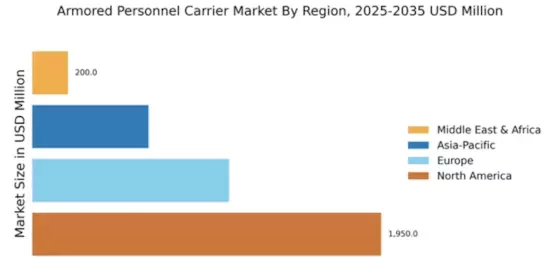
North America is poised to maintain its leadership in the Armored Personnel Carrier (APC) market, holding a significant share of 1950.0 million in 2024. The region's growth is driven by increasing defense budgets, modernization of military fleets, and a focus on advanced technologies. Regulatory support for defense spending and procurement processes further catalyze market expansion, ensuring a robust demand for APCs. The United States stands as the primary contributor, with key players like General Dynamics, Oshkosh Defense, and L3Harris Technologies leading the charge. The competitive landscape is characterized by innovation and strategic partnerships, enhancing the capabilities of APCs. The presence of established defense contractors ensures a steady supply of advanced armored vehicles, catering to both military and humanitarian needs.

Europe : Emerging Market with Strong Demand

Europe's Armored Personnel Carrier market is projected to grow significantly, with a market size of 1100.0 million. The region benefits from increasing geopolitical tensions and a commitment to enhancing defense capabilities. Regulatory frameworks, such as the European Defense Fund, are fostering collaboration among member states, driving demand for modernized APCs that meet evolving security challenges. Leading countries like Germany, France, and the UK are at the forefront, with companies such as Rheinmetall and BAE Systems playing pivotal roles. The competitive landscape is marked by innovation and a focus on interoperability among NATO allies. The presence of established manufacturers ensures a diverse range of APCs, catering to various operational requirements.

Asia-Pacific : Growing Defense Budgets and Needs

The Asia-Pacific region is witnessing a burgeoning demand for Armored Personnel Carriers, with a market size of 650.0 million. This growth is fueled by rising defense budgets, territorial disputes, and the need for enhanced military capabilities. Countries are increasingly investing in modernizing their armed forces, leading to a surge in demand for advanced APCs that can operate in diverse environments. Key players in this region include companies like Elbit Systems and Thales Group, which are focusing on technological advancements and local partnerships. Nations such as India, Japan, and Australia are leading the charge, emphasizing the importance of domestic production and collaboration with international defense firms. The competitive landscape is evolving, with a focus on innovation and adaptability to meet specific regional challenges.

Middle East and Africa : Emerging Market with Unique Challenges

The Middle East and Africa region is gradually emerging in the Armored Personnel Carrier market, with a market size of 200.0 million. The growth is driven by increasing security concerns, regional conflicts, and the need for enhanced military capabilities. Governments are prioritizing defense spending to address these challenges, leading to a rising demand for APCs that can operate in harsh environments. Countries like South Africa and the UAE are at the forefront of this market, with local manufacturers and international players collaborating to meet the demand. The competitive landscape is characterized by a mix of established defense contractors and new entrants, focusing on cost-effective solutions tailored to regional needs. The emphasis on local production is also growing, aiming to enhance self-reliance in defense capabilities.

Key Players and Competitive Insights

The Armored Personnel Carrier Market is characterized by a dynamic competitive landscape, driven by increasing defense budgets and the need for enhanced troop protection. Major players such as General Dynamics (US), BAE Systems (GB), and Rheinmetall (DE) are at the forefront, each adopting distinct strategies to solidify their market positions. General Dynamics (US) emphasizes innovation in vehicle design and technology integration, while BAE Systems (GB) focuses on strategic partnerships to enhance its product offerings. Rheinmetall (DE) appears to be leveraging its expertise in advanced materials and systems integration, which collectively shapes a competitive environment that is increasingly focused on technological advancement and operational efficiency.

Key business tactics within the market include localizing manufacturing and optimizing supply chains to enhance responsiveness to regional demands. The competitive structure is moderately fragmented, with several key players exerting influence over market dynamics. This fragmentation allows for a variety of offerings, catering to diverse customer needs while fostering innovation through competition.

In November 2025, General Dynamics (US) announced a significant partnership with a leading technology firm to develop next-generation armored vehicles equipped with AI-driven systems. This strategic move is likely to enhance their product capabilities, positioning them as a leader in the integration of advanced technologies in armored personnel carriers. The collaboration may also facilitate faster development cycles and improved operational effectiveness in the field.

In October 2025, BAE Systems (GB) unveiled a new manufacturing facility in Eastern Europe aimed at localizing production of armored vehicles. This initiative not only reduces lead times but also aligns with regional defense strategies, potentially increasing their market share in a growing defense sector. The facility is expected to enhance BAE's responsiveness to local demands and strengthen its competitive edge in the region.

In September 2025, Rheinmetall (DE) secured a major contract with a European government for the supply of armored personnel carriers, emphasizing their commitment to sustainability through the use of eco-friendly materials. This contract not only reinforces their market position but also highlights a growing trend towards environmentally conscious manufacturing practices in the defense sector, which could influence future procurement decisions.

As of December 2025, current competitive trends in the Armored Personnel Carrier Market are increasingly defined by digitalization, sustainability, and AI integration. Strategic alliances are becoming pivotal, as companies seek to enhance their technological capabilities and market reach. The competitive differentiation is likely to evolve from traditional price-based competition towards a focus on innovation, technology, and supply chain reliability, indicating a shift in how companies will compete in the future.

Key Companies in the Armored Personnel Carrier Market market include

Industry Developments

An uptick in defense spending globally has catalyzed advancements within the Armoured Personnel Carrier Market, with companies such as BAE Systems, General Dynamics, and Rheinmetall recently unveiling new models featuring enhanced technologies like autonomous systems and improved armor capabilities.

Navistar International and Oshkosh Corporation continue to engage in fruitful partnerships to innovate logistics and sustainment solutions. Notably, FNSS Defense Systems has expanded its footprint in Asia, signing contracts worth millions to supply armored vehicles, which reflects the increasing demand in that region.

Mergers and acquisitions have also shaped the market, with Lockheed Martin eyeing strategic collaborations to bolster its capabilities in armored systems. Elbit Systems has recently merged with a smaller tech firm focused on defense electronics, streamlining its production processes.

On the valuation front, the market has seen significant growth, projected to expand at a noteworthy CAGR over the coming years, bolstered by increasing geopolitical tensions and military modernization initiatives. This growth trajectory is impacting companies like Textron and Hanwha Defense as they position themselves to capitalize on emerging opportunities within diverse international markets.

Future Outlook

Armored Personnel Carrier Market Future Outlook

The Armored Personnel Carrier Market is projected to grow at 4.05% CAGR from 2024 to 2035, driven by increasing defense budgets and modernization initiatives.

New opportunities lie in:

  • Development of hybrid-electric armored vehicles for enhanced fuel efficiency.
  • Integration of advanced surveillance systems for improved situational awareness.
  • Expansion into emerging markets with tailored APC solutions.

By 2035, the market is expected to exhibit robust growth, driven by innovation and strategic investments.

Market Segmentation

Armored Personnel Carrier Market Application Outlook

  • Military Operations
  • Peacekeeping Missions
  • Humanitarian Assistance
  • Counter-Terrorism Operations

Armored Personnel Carrier Market Vehicle Type Outlook

  • Wheeled Armored Personnel Carriers
  • Tracked Armored Personnel Carriers
  • Hybrid Armored Personnel Carriers

Armored Personnel Carrier Market Mobility Type Outlook

  • Off-Road Mobility
  • On-Road Mobility
  • Amphibious Mobility

Armored Personnel Carrier Market Payload Capacity Outlook

  • Lightweight Armored Personnel Carriers
  • Medium Weight Armored Personnel Carriers
  • Heavyweight Armored Personnel Carriers

Armored Personnel Carrier Market Protection Level Outlook

  • Ballistic Protection
  • Mine Protection
  • Blast Protection

Report Scope

MARKET SIZE 20243900.0(USD Million)
MARKET SIZE 20254100.0(USD Million)
MARKET SIZE 20356100.0(USD Million)
COMPOUND ANNUAL GROWTH RATE (CAGR)4.05% (2024 - 2035)
REPORT COVERAGERevenue Forecast, Competitive Landscape, Growth Factors, and Trends
BASE YEAR2024
Market Forecast Period2025 - 2035
Historical Data2019 - 2024
Market Forecast UnitsUSD Million
Key Companies ProfiledGeneral Dynamics (US), BAE Systems (GB), Rheinmetall (DE), Oshkosh Defense (US), Thales Group (FR), Navistar Defense (US), Krauss-Maffei Wegmann (DE), L3Harris Technologies (US), Elbit Systems (IL)
Segments CoveredApplication, Vehicle Type, Mobility Type, Protection Level, Payload Capacity
Key Market OpportunitiesIntegration of advanced technologies enhances operational efficiency in the Armored Personnel Carrier Market.
Key Market DynamicsTechnological advancements and regulatory changes drive innovation and competition in the Armored Personnel Carrier market.
Countries CoveredNorth America, Europe, APAC, South America, MEA

Market Highlights

Author
Sejal Akre
Senior Research Analyst

She has over 5 years of rich experience, in market research and consulting providing valuable market insights to client. Hands on expertise in management consulting, and extensive knowledge in domain including ICT, Automotive & Transportation and Aerospace & Defense. She is skilled in Go-to market strategy, industry analysis, market sizing, in depth company profiling, competitive intelligence & benchmarking and value chain amongst others.

Leave a Comment

FAQs

What is the estimated market size of the Armoured Personnel Carrier Market in 2032?

The Armoured Personnel Carrier Market is expected to reach a valuation of 15.22 USD Billion in 2032.

What is the expected CAGR for the Armoured Personnel Carrier Market from 2024 to 2032?

The market is projected to grow at a CAGR of 3.39% from 2024 to 2032.

Which region is anticipated to hold the largest market share in the Armoured Personnel Carrier Market by 2032?

North America is expected to hold the largest market share, valued at 5.5 USD Billion in 2032.

What applications are driving the Armoured Personnel Carrier Market?

The market is driven by applications in military operations, civilian protection, peacekeeping missions, and counter-terrorism operations.

What is the market size for military operations within the Armoured Personnel Carrier Market in 2032?

The market size for military operations is expected to reach 6.82 USD Billion in 2032.

Who are the key players in the Armoured Personnel Carrier Market?

Key players in the market include Navistar International, General Dynamics, KraussMaffei Wegmann, FNSS Defense Systems, and BAE Systems.

What is the projected market size for Europe in the Armoured Personnel Carrier Market by 2032?

The market size for Europe is projected to be 4.2 USD Billion by 2032.

What is the anticipated growth rate for the APAC region in the Armoured Personnel Carrier Market?

The APAC region is anticipated to grow to 3.2 USD Billion by 2032.

How much is the Counter-Terrorism Operations segment valued in 2032?

The Counter-Terrorism Operations segment is expected to be valued at 2.13 USD Billion in 2032.

What is the expected market size for civilian protection in the Armoured Personnel Carrier Market by 2032?

The market for civilian protection is anticipated to reach 3.42 USD Billion by 2032.

Download Free Sample

Kindly complete the form below to receive a free sample of this Report

Compare Licence

×
Features License Type
Single User Multiuser License Enterprise User
Price $4,950 $5,950 $7,250
Maximum User Access Limit 1 User Upto 10 Users Unrestricted Access Throughout the Organization
Free Customization
Direct Access to Analyst
Deliverable Format
Platform Access
Discount on Next Purchase 10% 15% 15%
Printable Versions