Author

Aromatherapy Market Size, Share, Industry Trend & Analysis Research Report Information By Product (Essential Oil, Carrier Oils And Blended Oils), Equipment (Nebulizer Diffuser, Ultrasonic Diffuser, Heat Diffuser), By Application (Tropical, Inhalation, Aerial Diffusion), Therapeutic Application (Relaxation And Sleep, Pain Management, Skin And Hair Care And Other Remedies), And By Region (North America, Europe, Asia-Pacific, And Rest Of The World) – Forecast Till 2035
As per Market Research Future analysis, the Aromatherapy Market Size was estimated at 6.29 USD Billion in 2024. The Aromatherapy industry is projected to grow from 6.785 USD Billion in 2025 to 14.48 USD Billion by 2035, exhibiting a compound annual growth rate (CAGR) of 7.8% during the forecast period 2025 - 2035. North America holds the largest share of the global Aromatherapy Market at approximately 35%, driven by strong consumer preference for natural health and wellness solutions, growing adoption of essential oils in personal care and home care applications, and a mature spa and wellness industry. The United States is the leading country within North America, capturing approximately 28% of the global Aromatherapy Market share, supported by high consumer spending on holistic wellness products, a large network of wellness centers and spas, and strong brand presence of companies like doTERRA and Young Living. Essential Oils dominate the Aromatherapy Market as the largest product type segment, accounting for approximately 46% of the global market share in 2025, driven by their widespread use in inhalation therapy, topical applications, and diffusers for relaxation, stress relief, and mental wellness purposes.
The Aromatherapy Market is experiencing robust growth driven by a shift towards natural wellness solutions.
| 2024 Market Size | 6.29 (USD Billion) |
| 2035 Market Size | 14.48 (USD Billion) |
| CAGR (2025 - 2035) | 7.87% |
doTERRA (US), Young Living (US), Eden's Garden (US), Plant Therapy (US), Aura Cacia (US), Mountain Rose Herbs (US), Healing Solutions (US), Radha Beauty (US), Florihana (FR), Neal's Yard Remedies (GB)
Our Impact
Enabled $4.3B Revenue Impact for Fortune 500 and Leading Multinationals
Partnering with 2000+ Global Organizations Each Year
30K+ Citations by Top-Tier Firms in the Industry
The Aromatherapy Market is currently experiencing a notable evolution, driven by a growing awareness of holistic health and wellness practices. Consumers increasingly seek natural alternatives to conventional medicine, which has led to a surge in the popularity of essential oils and related products. This shift appears to be influenced by a broader trend towards self-care and mental well-being, as individuals look for ways to alleviate stress and enhance their quality of life. Furthermore, the rise of e-commerce platforms has facilitated access to a diverse range of aromatherapy products, allowing consumers to explore various options from the comfort of their homes. In addition, the Aromatherapy Market seems to be benefiting from the integration of aromatherapy into various sectors, including spas, wellness centers, and even corporate environments. This trend indicates a growing recognition of the therapeutic benefits associated with essential oils, which may enhance relaxation and productivity. As the market continues to expand, it is likely that innovation in product offerings and delivery methods will play a crucial role in shaping consumer preferences and driving future growth.
There is a rising consumer preference for natural and organic products, which is significantly influencing the Aromatherapy Market. This trend reflects a broader societal shift towards sustainability and health consciousness, as individuals become more discerning about the ingredients in their wellness routines.
Aromatherapy is increasingly being incorporated into various wellness practices, such as yoga and meditation. This integration suggests that consumers are seeking holistic approaches to health, where essential oils are used to enhance physical and mental well-being.
The expansion of e-commerce platforms is transforming how consumers access aromatherapy products. This trend indicates a shift towards online shopping, providing consumers with greater convenience and a wider selection of essential oils and related items.
Innovations in product offerings are playing a crucial role in shaping the aromatherapy Market. Manufacturers are continuously developing new and diverse products, such as essential oil blends, diffusers, and personal care items infused with aromatherapy benefits. This trend is supported by market data indicating that the essential oil segment is anticipated to witness significant growth, driven by the introduction of novel formulations and delivery methods. As consumers seek unique and effective ways to experience aromatherapy, the expansion of product lines is likely to attract a broader audience, thereby enhancing the overall appeal of the Aromatherapy Market.
The Aromatherapy Market is experiencing a notable surge in consumer awareness regarding the health benefits associated with essential oils and aromatherapy practices. As individuals increasingly seek natural alternatives to conventional medicine, the demand for aromatherapy products has escalated. Reports indicate that the market is projected to grow at a compound annual growth rate of approximately 8.5% over the next few years. This heightened awareness is driven by a growing body of research that suggests essential oils may alleviate stress, improve sleep quality, and enhance overall well-being. Consequently, consumers are more inclined to incorporate aromatherapy into their daily routines, thereby propelling the growth of the Aromatherapy Market.
The increasing popularity of home fragrance products is significantly impacting the Aromatherapy Market. Consumers are increasingly investing in essential oil diffusers, candles, and other aromatic products to create a soothing atmosphere in their homes. Market data suggests that the home fragrance segment is expected to grow substantially, driven by the desire for enhanced living environments and the therapeutic benefits of aromatherapy. As more individuals recognize the positive effects of scent on mood and ambiance, the demand for home fragrance products infused with essential oils is likely to rise, further propelling the growth of the Aromatherapy Market.
The growing emphasis on mental health and well-being is a pivotal driver for the Aromatherapy Market. As society becomes more aware of the importance of mental health, individuals are turning to aromatherapy as a complementary approach to managing stress, anxiety, and other emotional challenges. Market data indicates that the demand for aromatherapy products designed to promote relaxation and mental clarity is on the rise. This trend is likely to continue as more people seek natural remedies to support their mental health, thereby contributing to the expansion of the Aromatherapy Market.
The integration of aromatherapy into spa and wellness centers is significantly influencing the Aromatherapy Market. These establishments are increasingly adopting aromatherapy as a core component of their services, recognizing its potential to enhance relaxation and therapeutic experiences. The market data suggests that the spa segment is expected to account for a substantial share of the overall aromatherapy market, driven by consumer preferences for holistic wellness solutions. As more wellness centers incorporate aromatherapy into their offerings, the visibility and acceptance of these products are likely to increase, further stimulating growth in the Aromatherapy Market.
The aromatherapy market's product type segment is diverse, with essential oils commanding the largest share due to their widespread usage in treatments, relaxation, and holistic wellness practices. Essential oils, known for their therapeutic benefits, are highly favored by consumers, thereby dominating market presence. On the other hand, carrier oils, which are critical for diluting essential oils for topical application, are witnessing rapid growth as awareness of their benefits rises among consumers. This trend is supported by the increasing popularity of DIY personal care products.

Essential Oils (Dominant) vs. Carrier Oils (Emerging)
Essential oils are the foundational product in aromatherapy, prized for their concentrated natural extracts that provide therapeutic benefits. Dominating the market, they are utilized in various applications from diffusers to topical applications, highlighting their versatility. In contrast, carrier oils serve as diluents that enable safe application of essential oils, making them essential in a growing number of homemade personal care products. With a rise in cosmetic use and a trend towards natural alternatives, carrier oils are becoming increasingly popular, positioning themselves as an emerging product that complements essential oils in the aromatherapy landscape.

The Aromatherapy Market showcases a diverse range of equipment, with the Ultrasonic Diffuser leading the pack in market share, thanks to its efficiency and affordable price point. Contrarily, the Nebulizer Diffuser, while currently smaller in market share, is rapidly gaining traction among consumers seeking more potent and concentrated aroma distributions. As wellness trends continue to favor natural therapeutic options, both equipment types play crucial roles in meeting varying consumer preferences across the board.
Ultrasonic Diffuser (Dominant) vs. Heat Diffuser (Emerging)
The Ultrasonic Diffuser retains its dominance in the aromatherapy equipment market due to its ability to create a fine mist of essential oils while preserving their therapeutic properties. This technology appeals to both novice and experienced users of aromatherapy, as it combines ease of use with effective scent dispersion. Meanwhile, the Heat Diffuser, once a staple, is now considered an emerging option. Its potential for use in more traditional settings offers a nostalgic appeal, yet it is often seen as less effective than the ultrasonic alternative. The market is observing a shift as consumers lean towards technology-driven solutions that offer safety and efficiency.
In the Aromatherapy Market, the application of essential oils reveals an intriguing distribution of market share among key segment values. Inhalation stands as the largest application, significantly preferred by consumers seeking immediate benefits for stress relief and relaxation. On the other hand, Aerial Diffusion has emerged as a prominent choice, capturing a growing consumer base that demands innovative and ambient ways to enjoy aromatherapy within their living spaces. This competition reflects an evolving market adapting to varying consumer preferences and lifestyles. The growth trends in the Aromatherapy Market application segment are strongly influenced by increasing consumer awareness about wellness and holistic health benefits. Aerial Diffusion is set to become the fastest-growing segment as more consumers adopt diffusers that enhance the ambiance of their spaces while promoting tranquility and relaxation. Furthermore, the rise of wellness tourism and spa experiences has driven demand for these applications, pushing brands to innovate and introduce diverse scent experiences for their customers.

Inhalation (Dominant) vs. Aerial Diffusion (Emerging)
Inhalation as an application dominates the Aromatherapy Market, appealing widely to those who seek immediate therapeutic effects. It is predominantly characterized by the direct inhalation of essential oils, often used in personal care products, diffusers, or steam inhalation. The deep-rooted tradition of using inhaled oils for relaxation and stress relief underpins its established market position. On the other hand, Aerial Diffusion represents an emerging trend in aromatherapy applications. It relies on the ambient dispersion of essential oils into the environment, often utilizing technologically advanced diffusers. This method offers a unique way to fragrance spaces, appealing to modern consumers who value both aesthetics and the well-being that aromatherapy offers. The growing interest in creating calming environments in homes and workplaces supports Aerial Diffusion's ascent.

In the Aromatherapy Market, the 'Therapeutic Application' segment is primarily driven by several key areas, namely Relaxation and Sleep, Pain Management, Skin and Hair Care, and Other Remedies. Among these, Relaxation and Sleep holds the largest market share, appealing to a wide consumer base that prioritizes well-being and stress relief. The growing emphasis on mental health and the benefits of essential oils in promoting relaxation contribute significantly to its dominance. Meanwhile, Pain Management is noted as the fastest-growing segment, gaining traction as more individuals turn to natural remedies to alleviate pain and discomfort without adverse side effects.
Relaxation and Sleep (Dominant) vs. Pain Management (Emerging)
Relaxation and Sleep is the dominant therapeutic application in the aromatherapy market, known for its effectiveness in reducing stress and improving sleep quality through essential oils. Products tailored for relaxation often include lavender, chamomile, and ylang-ylang, enhancing their appeal to consumers seeking holistic wellness solutions. Conversely, Pain Management is emerging as a significant segment, characterized by the increasing consumer shift towards natural alternatives for pain relief. This trend is fueled by a growing awareness of the limitations of traditional pain medications. Essential oils like peppermint and eucalyptus are being embraced as effective alternatives, catering to the needs of individuals dealing with chronic pain and discomfort.
Get more detailed insights about Aromatherapy Market Request Free Sample
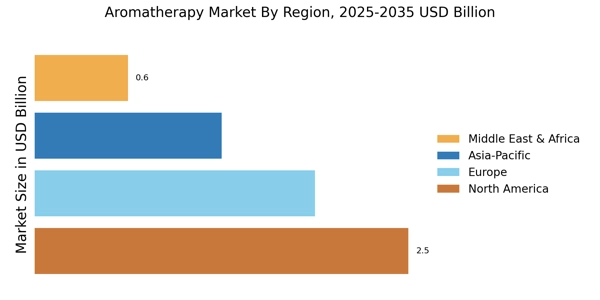
North America is the largest market for aromatherapy, accounting for approximately 40% of the global share. The growth is driven by increasing consumer awareness of the health benefits of essential oils, coupled with a rise in wellness tourism. Regulatory support from agencies like the FDA, which oversees the safety of essential oils, further catalyzes market expansion. The demand for natural and organic products is also on the rise, contributing to market growth. The United States is the leading country in this region, with key players such as doTERRA, Young Living, and Eden's Garden dominating the market. The competitive landscape is characterized by a mix of established brands and emerging companies, all vying for market share. The presence of a robust distribution network, including online platforms, enhances accessibility for consumers, further driving sales in the aromatherapy sector.
Europe is witnessing significant growth in the aromatherapy market, holding approximately 30% of the global share. The increasing trend towards holistic health and wellness, along with a growing preference for natural remedies, are key drivers of this expansion. Regulatory frameworks, such as the EU Cosmetics Regulation, ensure product safety and efficacy, fostering consumer trust and market growth. Countries like Germany and France are leading this trend, contributing significantly to the market size. Germany is the largest market in Europe, followed closely by France and the UK. The competitive landscape features both local and international players, including Florihana and Neal's Yard Remedies. The presence of a well-established retail network, including health stores and online platforms, facilitates consumer access to a wide range of aromatherapy products. This competitive environment encourages innovation and product diversification, further enhancing market growth.
Asia-Pacific is emerging as a significant player in the aromatherapy market, currently holding about 20% of the global share. The region's growth is fueled by rising disposable incomes, increasing awareness of mental health, and a growing trend towards natural and organic products. Countries like China and Japan are leading the market, supported by favorable government policies promoting wellness and alternative therapies. The demand for aromatherapy in spas and wellness centers is also on the rise, contributing to market expansion. China is the largest market in the region, with Japan and Australia following closely. The competitive landscape is characterized by a mix of local and international brands, with key players like Healing Solutions and Radha Beauty making significant inroads. The increasing penetration of e-commerce platforms is enhancing product availability, allowing consumers to access a diverse range of aromatherapy products easily. This dynamic environment is expected to drive further growth in the sector.
The Middle East and Africa region is gradually emerging in the aromatherapy market, currently holding about 10% of the global share. The growth is driven by increasing consumer interest in natural health solutions and the cultural significance of essential oils in traditional practices. However, challenges such as regulatory hurdles and market fragmentation can hinder growth. Countries like South Africa and the UAE are leading the market, supported by a growing wellness tourism sector. South Africa is the largest market in the region, with the UAE following closely. The competitive landscape is diverse, featuring both local artisans and international brands. Key players are beginning to establish a presence, but the market remains fragmented. The increasing availability of aromatherapy products through online channels is expected to enhance consumer access and drive market growth in the coming years.
Major industry players are investing a lot of money in R&D to expand their product offerings, which will spur further growth in the aromatherapy market. With significant market developments like new product releases, contractual agreements, mergers and acquisitions, increased investments, and collaboration with other organizations, market participants are also undertaking a variety of strategic activities to expand their presence. In order to grow and thrive in an atmosphere where competition is fierce and the market is growing, competitors in the aromatherapy industry must provide products that are affordable.Manufacturing locally to cut operational costs is one of the main business tactics used by manufacturers in the aromatherapy industry to benefit customers and increase the market sector. The aromatherapy industry has recently given medicine some of the most important advantages. Major players in the aromatherapy market include Neal's Yard Remedies, International Flavors & Fragrances Inc, Nu Skin, Air Aroma, Muji, dTERRA, NOW Foods, Tree of Life, Young Living, Zija International, and others.An American company called International Tastes & Perfumes manufactures flavors, fragrances, and cosmetic ingredients that are sold throughout the world. Its headquarters are in New York City, and it has production, sales, and creative sites spread over 44 nations. The business is a constituent of the S&P 500 Index. In Octobar 2022 International Flavors & Fragrances Inc. announced the launch of its new Singapore Innovation Center, the newest facility to join the organization’s network of research, creative, and application centers.This facility will bring together the technologies, capacities, and knowledge of all four business divisions: Nourish, Health & Biosciences, Scent, and Pharma Solutions. It is the largest IFF facility in the area, measuring more than 11,000 square meters.Young Living, established in Lehi, Utah, is a multi-level marketing organization. Donald Gary Young founded it in 1993 and distributes essential oils and other related products.In September Young Living, the leader in essential oils and essential oil-infused products, received 17 essential di broduction patents in usefulness and design from the US Patent and Trademark Office, more than any other direct sales firm in the world.


The Aromatherapy Market is projected to grow at a 7.87% CAGR from 2025 to 2035, driven by increasing consumer awareness and demand for natural wellness products.
New opportunities lie in:
By 2035, the Aromatherapy Market is expected to be robust, reflecting substantial growth and innovation.
| MARKET SIZE 2024 | 6.29(USD Billion) |
| MARKET SIZE 2025 | 6.785(USD Billion) |
| MARKET SIZE 2035 | 14.48(USD Billion) |
| COMPOUND ANNUAL GROWTH RATE (CAGR) | 7.87% (2025 - 2035) |
| REPORT COVERAGE | Revenue Forecast, Competitive Landscape, Growth Factors, and Trends |
| BASE YEAR | 2024 |
| Market Forecast Period | 2025 - 2035 |
| Historical Data | 2019 - 2024 |
| Market Forecast Units | USD Billion |
| Key Companies Profiled | doTERRA (US), Young Living (US), Eden's Garden (US), Plant Therapy (US), Aura Cacia (US), Mountain Rose Herbs (US), Healing Solutions (US), Radha Beauty (US), Florihana (FR), Neal's Yard Remedies (GB) |
| Segments Covered | Product, Application, Region |
| Key Market Opportunities | Growing consumer interest in natural wellness products drives innovation in the Aromatherapy Market. |
| Key Market Dynamics | Rising consumer interest in wellness drives demand for essential oils and aromatherapy products across diverse applications. |
| Countries Covered | North America, Europe, APAC, South America, MEA |
As of 2024, the Aromatherapy Market was valued at 6.29 USD Billion.
The Aromatherapy Market is projected to reach 14.48 USD Billion by 2035.
The expected CAGR for the Aromatherapy Market during the forecast period 2025 - 2035 is 7.87%.
The Essential Oils segment, valued at 3.15 USD Billion in 2024, is expected to grow significantly, reaching 7.2 USD Billion by 2035.
Key players in the Aromatherapy Market include doTERRA, Young Living, and Eden's Garden, among others.


The secondary research process involved comprehensive analysis of regulatory databases, peer-reviewed scientific journals, clinical publications, and authoritative health and wellness organizations. Key sources included the US Food & Drug Administration (FDA), European Medicines Agency (EMA), National Institutes of Health (NIH), National Center for Biotechnology Information (NCBI/PubMed), World Health Organization (WHO) Traditional Medicine Strategy, International Organization for Standardization (ISO) Technical Committee 54 (Essential Oils), International Fragrance Association (IFRA), National Association for Holistic Aromatherapy (NAHA), Alliance of International Aromatherapists (AIA), European Federation of Essential Oils (E.F.E.O.), International Federation of Aromatherapists (IFA), US Department of Agriculture (USDA) National Organic Program, European Food Safety Authority (EFSA), National Center for Complementary and Integrative Health (NCCIH), Centers for Disease Control and Prevention (CDC) National Health Statistics Reports, World Trade Organization (WTO) Trade Statistics, and national health ministry reports from key markets. These sources were used to collect regulatory compliance data, essential oil safety profiles, therapeutic application studies, consumer wellness trends, import/export statistics, organic certification standards, and market landscape analysis for essential oils, carrier oils, ultrasonic diffusers, nebulizer diffusers, and therapeutic applications including relaxation, sleep, pain management, and skin/hair care.
To get both qualitative and quantitative insights, supply-side and demand-side stakeholders were interviewed as part of the primary research process. Supply-side sources were CEOs, VPs of Product Development, master distillers, heads of quality assurance, and commercial directors from companies that make essential oils, diffusers, and wellness products. Demand-side sources included certified aromatherapists, spa directors, wellness center managers, naturopathic practitioners, procurement leaders from specialty shops, e-commerce platform category managers, and wellness coordinators in the hospitality industry. Primary research established market segmentation, product pipeline timings, and gathered information on how consumers embrace new products, how prices are set, how distribution channels work, and how organic certification trends are changing.
Primary Respondent Breakdown:
By Designation: C-level Primaries (32%), Director Level (31%), Others (37%)
By Region: North America (32%), Europe (30%), Asia-Pacific (28%), Rest of World (10%)
Global market valuation was derived through revenue mapping and product volume analysis. The methodology included:
Identification of 50+ key manufacturers across North America, Europe, Asia-Pacific, and Latin America
Product mapping across essential oils (lavender, peppermint, eucalyptus, tea tree, citrus), carrier oils (jojoba, coconut, sweet almond), ultrasonic diffusers, nebulizer diffusers, heat diffusers, and therapeutic application categories
Analysis of reported and modeled annual revenues specific to aromatherapy portfolios
Coverage of manufacturers representing 65-70% of global market share in 2024
Extrapolation using bottom-up (product volume × ASP by country/region) and top-down (manufacturer revenue validation) approaches to derive segment-specific valuations for relaxation/sleep, pain management, skin/hair care, and other therapeutic applications
Kindly complete the form below to receive a free sample of this Report

“This is really good guys. Excellent work on a tight deadline. I will continue to use you going forward and recommend you to others. Nice job”


“Thanks. It’s been a pleasure working with you, please use me as reference with any other Intel employees.”


“Thanks for sending the report it gives us a good global view of the Betaïne market.”


“Thank you, this will be very helpful for OQS.”


“We found the report very insightful! we found your research firm very helpful. I'm sending this email to secure our future business.”


“I am very pleased with how market segments have been defined in a relevant way for my purposes (such as "Portable Freezers & refrigerators" and "last-mile"). In general the report is well structured. Thanks very much for your efforts.”


“I have been reading the first document or the study, ,the Global HVAC and FP market report 2021 till 2026. Must say, good info! I have not gone in depth at all parts, but got a good indication of the data inside!”


“We got the report in time, we really thank you for your support in this process. I also thank to all of your team as they did a great job.”


“The Automotive 48V ECU Components Procurement Intelligence Study” was a complex project, but the Market Research Future (MRFR) team handled it with quality, agility, and customer-centricity. They delivered all requested data on time and within the agreed scope. The team, including Shubhendra Anand and Rahul Gotadki, was always readily available to clarify questions and swiftly implement necessary adjustments, driving the project to a successful conclusion within a very demanding timeframe.
I would also like to specifically commend Akshay Agarwal for his responsiveness and support at every stage—from our initial inquiry on May 6th through to final delivery on June 18th. His dedication made the entire process seamless.”



