Download Free Sample
Kindly complete the form below to receive a free sample of this Report
Artificial Cartilage Implant Market Research Report By Material Type (Polyethylene, Hydrogel, Ceramics, Composites), By Application (Knee Replacement, Hip Replacement, Shoulder Reconstruction, Ankle Replacement), By End User (Hospitals, Orthopedic Clinics, Ambulatory Surgical Centers), By Technology (3D Bioprinting, Nanotechnology, Tissue Engineering) and By Regional (North America, Europe, South America, Asia Pacific, Middle East and Africa) - Growth & Industry Forecast 2025 To 2035
As per Market Research Future analysis, the Artificial Cartilage Implant Market Size was estimated at 1.154 USD Billion in 2024. The Artificial Cartilage Implant industry is projected to grow from USD 1.288 Billion in 2025 to USD 3.868 Billion by 2035, exhibiting a compound annual growth rate (CAGR) of 11.62% during the forecast period 2025 - 2035
The Artificial Cartilage Implant Market is poised for substantial growth driven by technological advancements and increasing demand for joint replacement procedures.
| 2024 Market Size | 1.154 (USD Billion) |
| 2035 Market Size | 3.868 (USD Billion) |
| CAGR (2025 - 2035) | 11.62% |
Smith & Nephew (GB), Stryker Corporation (US), Zimmer Biomet (US), Medtronic (IE), DePuy Synthes (US), Aesculap (DE), Exactech (US), Arthrex (US), B. Braun Melsungen AG (DE)
Our Impact
Enabled $4.3B Revenue Impact for Fortune 500 and Leading Multinationals
Partnering with 2000+ Global Organizations Each Year
30K+ Citations by Top-Tier Firms in the Industry
The Artificial Cartilage Implant Market is currently experiencing a notable evolution, driven by advancements in biomaterials and surgical techniques. As the demand for effective solutions to joint disorders increases, the market appears poised for growth. Innovations in implant design and the development of biocompatible materials suggest a shift towards more durable and functional implants. Furthermore, the rising prevalence of osteoarthritis and other degenerative joint diseases indicates a growing need for effective treatment options, which may further stimulate market expansion. In addition, the increasing focus on minimally invasive surgical procedures is likely to enhance the adoption of artificial cartilage implants. Surgeons and patients alike seem to favor techniques that reduce recovery time and minimize complications. This trend, coupled with ongoing research into the long-term efficacy of these implants, suggests a promising future for the Artificial Cartilage Implant Market. As healthcare providers continue to seek innovative solutions, the market may witness a surge in new product offerings and enhanced patient outcomes, ultimately reshaping the landscape of joint treatment.
Recent developments in biomaterials are transforming the Artificial Cartilage Implant Market. Researchers are exploring new substances that mimic natural cartilage properties, potentially leading to improved implant performance and longevity. This trend indicates a shift towards more effective solutions for joint repair.
The growing preference for minimally invasive surgical methods is influencing the Artificial Cartilage Implant Market. These techniques promise reduced recovery times and lower complication rates, making them attractive to both patients and healthcare providers. This trend may drive increased adoption of artificial cartilage implants.
The increasing prevalence of joint disorders, particularly osteoarthritis, is a significant factor in the Artificial Cartilage Implant Market. As more individuals seek effective treatment options, the demand for artificial cartilage implants is likely to rise, prompting further innovation and market growth.
The Artificial Cartilage Implant Market is benefiting from a heightened awareness of regenerative medicine and its potential to restore joint function. Patients and healthcare professionals are increasingly recognizing the advantages of using artificial cartilage implants as a means to repair damaged joints without resorting to more invasive surgical options. This shift in perception is likely to drive market growth, as more individuals seek out these innovative solutions. Additionally, educational campaigns and research initiatives are further promoting the benefits of artificial cartilage, potentially leading to a broader acceptance and utilization of these implants in clinical practice.
The Artificial Cartilage Implant Market is experiencing a surge in technological advancements that enhance the design and functionality of implants. Innovations in 3D printing and computer-aided design are enabling the creation of patient-specific implants that better mimic natural cartilage. This customization is likely to improve patient outcomes and satisfaction. Furthermore, the integration of smart materials that respond to physiological conditions may revolutionize the way implants function, potentially leading to longer-lasting solutions. As a result, the market is projected to grow at a compound annual growth rate of approximately 8% over the next five years, driven by these advancements.
The Artificial Cartilage Implant Market is supported by various government initiatives aimed at advancing research and development in the field of orthopedic implants. Funding for innovative projects and clinical trials is becoming more accessible, encouraging companies to invest in the development of new and improved artificial cartilage solutions. These initiatives not only foster innovation but also aim to improve patient care and outcomes. As governments recognize the economic burden of joint disorders, they are likely to continue supporting research efforts, which could significantly impact the growth trajectory of the artificial cartilage implant market.
The Artificial Cartilage Implant Market is witnessing a notable increase in the demand for joint replacement procedures, particularly among the aging population. As individuals age, the prevalence of osteoarthritis and other degenerative joint diseases rises, necessitating effective treatment options. According to recent data, the number of knee and hip replacement surgeries is expected to reach over 4 million annually by 2026. This growing demand is propelling the market for artificial cartilage implants, as they offer a less invasive alternative to traditional joint replacement methods, thereby appealing to both patients and healthcare providers.
The Artificial Cartilage Implant Market is experiencing a shift towards minimally invasive surgical techniques, which are becoming increasingly preferred by both surgeons and patients. These techniques offer numerous advantages, including reduced recovery times, less postoperative pain, and lower risk of complications. As a result, there is a growing inclination towards artificial cartilage implants that can be inserted using these less invasive methods. This trend is expected to drive market growth, as more healthcare facilities adopt advanced surgical technologies that align with patient preferences for quicker and less traumatic procedures.
The material type segment in the artificial cartilage implant market is characterized by a diverse distribution among its components, namely Polyethylene, Hydrogel, Ceramics, and Composites. Polyethylene holds the largest market share due to its established use in numerous orthopedic procedures, offering high wear resistance and durability. Hydrogel, on the other hand, is gaining traction rapidly, attributed to its biocompatibility and ability to mimic natural cartilage properties, thus attracting attention in recent years. The growth trends in this segment are influenced by advancements in material sciences and the increasing demand for less invasive surgical options. Hydrogel's emergence as the fastest-growing segment showcases the market's shift towards innovative technologies that enhance patient outcomes. Furthermore, the rising global aging population and associated orthopedic ailments are driving investments in research for improved material solutions, leading to a higher adoption rate of Hydrogel implants in clinical practices.
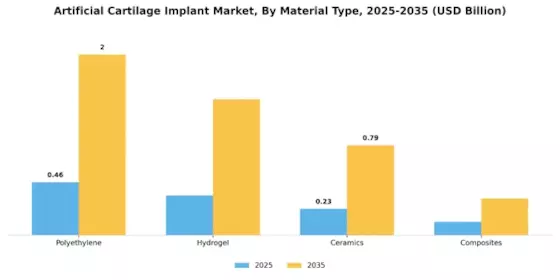
Polyethylene (Dominant) vs. Ceramics (Emerging)
Polyethylene is recognized as the dominant material in the artificial cartilage implant market, primarily due to its long-standing acceptance in joint replacement surgeries and proven performance metrics. Its properties, such as low friction and high wear resistance, make it an ideal choice for enduring joint function. Conversely, Ceramics is emerging as a noteworthy alternative, with significant research and development aimed at enhancing its biocompatibility and mechanical properties. While still in the nascent stages compared to Polyethylene, Ceramics is attracting interest for its potential to reduce wear-related complications and improve longevity in implants. This emerging interest is partly driven by the clinical need for material solutions that can better mimic the natural properties of cartilage, paving the way for an increased market presence in the coming years.
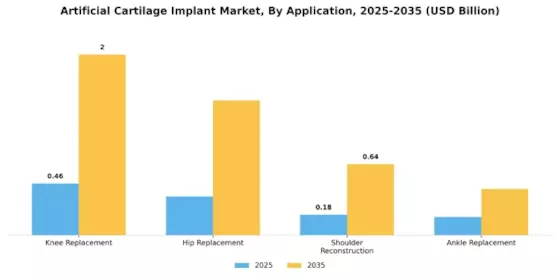
The Artificial Cartilage Implant Market is segmented primarily into Knee Replacement, Hip Replacement, Shoulder Reconstruction, and Ankle Replacement. Among these, Knee Replacement holds the largest market share due to its widespread adoption and established procedures. Following closely, Hip Replacement has a significant share as well, while Ankle Replacement, despite being smaller in comparison, is rapidly gaining attention. Shoulder Reconstruction also maintains a stable portion of the market, but it currently does not match the performance of the aforementioned segments.
Knee Replacement (Dominant) vs. Ankle Replacement (Emerging)
Knee Replacement is the dominant application in the Artificial Cartilage Implant Market, benefiting from advanced technologies and a robust patient demographic seeking relief from arthritis and severe joint pain. Its strong market position is propelled by improving surgical techniques and patient outcomes. In contrast, Ankle Replacement is an emerging segment characterized by innovation and increasing acceptance among orthopedic surgeons. A growing awareness of the benefits of ankle implant surgeries, coupled with advancements in materials enhancing durability and mobility, contributes to its rapid growth. As patient preference shifts towards less invasive options, the Ankle Replacement segment is poised for substantial expansion.
The Artificial Cartilage Implant Market showcases a varied distribution of end users, with hospitals taking the largest share due to their comprehensive infrastructure and established patient bases. Hospitals offer advanced surgical services, making them the primary choice for complex procedures. In contrast, orthopedic clinics have emerged as a significant segment, experiencing rapid growth as they develop specialized services tailored to joint-related issues, attracting a wider range of patients seeking less invasive treatments.
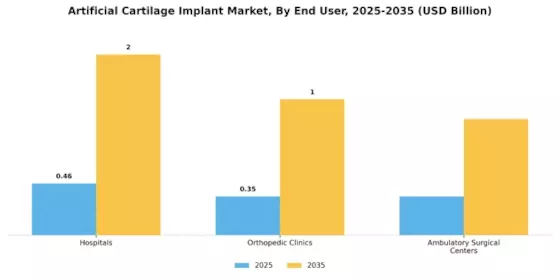
Hospitals (Dominant) vs. Orthopedic Clinics (Emerging)
Hospitals remain the dominant end user in the Artificial Cartilage Implant Market, primarily due to their ability to provide a full spectrum of healthcare services, including pre-operative assessments and post-operative care. Patients often prefer hospitals for the assurance of expertise and advanced technologies. On the other hand, orthopedic clinics are emerging as a notable competitor in the market, leveraging specialized expertise in joint treatments. These clinics typically offer a more personalized approach, lower costs, and shorter wait times, making them attractive to patients looking for quicker alternatives. This growing trend towards outpatient services is expected to bolster the orthopedic clinic segment significantly.
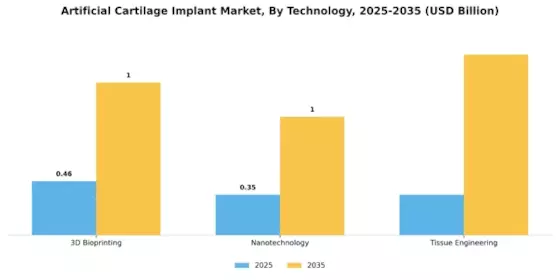
In the Artificial Cartilage Implant Market, 3D Bioprinting holds the largest share among the technology segment values, showcasing its significant impact on the development of custom implants that closely mimic natural cartilage. On the other hand, Nanotechnology is emerging rapidly, capturing attention for its potential in enhancing the properties of cartilage implants through innovative materials and processes. The growth trends indicate a robust demand for advanced alternatives to conventional cartilage repairs, driven by the increasing incidences of osteoarthritis and sports-related injuries. The adoption of 3D Bioprinting technologies opens new avenues for personalization in treatment, while Nanotechnology stands out for its applications in improving implant integration and durability, enhancing overall patient outcomes.
Technology: 3D Bioprinting (Dominant) vs. Nanotechnology (Emerging)
3D Bioprinting technology has established itself as the dominant force in the Artificial Cartilage Implant Market due to its ability to produce complex structures that replicate the biomechanical properties of natural cartilage. This capability allows for the creation of patient-specific implants that improve surgical outcomes and reduce recovery times. Conversely, Nanotechnology represents an emerging segment that is gaining traction for its potential to enhance the performance of traditional implant materials. By manipulating materials at the nano scale, this technology aims to improve the biocompatibility and mechanical strength of implants, making them more effective and longer-lasting for patients suffering from cartilage damage.
Get more detailed insights about Artificial Cartilage Implant Market Request Free Sample
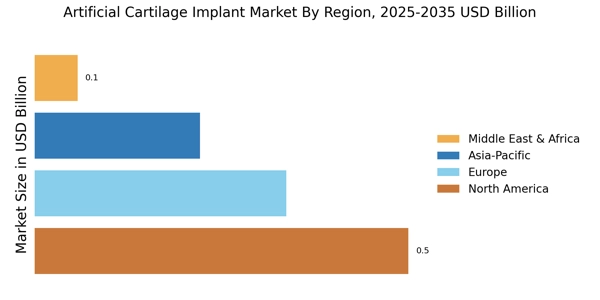
North America is the largest market for artificial cartilage implants, holding approximately 45% of the global market share. The region benefits from advanced healthcare infrastructure, high disposable income, and increasing prevalence of orthopedic disorders. Regulatory support from agencies like the FDA further drives innovation and adoption of new technologies, enhancing market growth. The demand for minimally invasive procedures is also a significant catalyst for market expansion. The United States is the leading country in this region, with major players like Stryker Corporation and Zimmer Biomet dominating the landscape. The competitive environment is characterized by continuous innovation and strategic partnerships among key players. Canada also contributes to the market, albeit at a smaller scale, focusing on improving healthcare access and patient outcomes. The presence of established companies ensures a robust supply chain and distribution network.
Europe is the second-largest market for artificial cartilage implants, accounting for approximately 30% of the global market share. The region is witnessing a surge in demand due to an aging population and increasing awareness of advanced orthopedic solutions. Regulatory frameworks, such as the EU Medical Device Regulation, are facilitating the introduction of innovative products, thereby enhancing market dynamics. Countries like Germany and the UK are at the forefront of this growth, driven by technological advancements and healthcare investments. Germany leads the European market, supported by a strong presence of key players like Aesculap and B. Braun Melsungen AG. The competitive landscape is marked by collaborations between manufacturers and healthcare providers to improve patient outcomes. The UK and France also play significant roles, focusing on research and development to enhance product offerings. The emphasis on quality and safety in medical devices further strengthens the market position of European companies.
Asia-Pacific is an emerging powerhouse in the artificial cartilage implant market, holding about 20% of the global market share. The region is experiencing rapid growth due to increasing healthcare expenditure, rising awareness of advanced medical technologies, and a growing elderly population. Countries like China and India are witnessing significant demand for orthopedic solutions, driven by urbanization and lifestyle changes. Government initiatives to improve healthcare infrastructure are also contributing to market expansion. China is the largest market in the region, with a growing number of local manufacturers entering the space. The competitive landscape is evolving, with both domestic and international players like Medtronic and Exactech expanding their presence. India is also emerging as a key market, focusing on affordable healthcare solutions. The increasing prevalence of joint disorders is further propelling the demand for artificial cartilage implants in this region.
The Middle East and Africa region is gradually emerging in the artificial cartilage implant market, holding approximately 5% of the global market share. The growth is driven by increasing healthcare investments, rising awareness of orthopedic treatments, and a growing population. Countries like South Africa and the UAE are focusing on enhancing healthcare infrastructure, which is expected to boost the adoption of advanced medical technologies, including artificial cartilage implants. South Africa is the leading market in this region, with a growing number of healthcare facilities adopting innovative solutions. The competitive landscape is characterized by a mix of local and international players, with companies like Arthrex and Stryker Corporation making significant inroads. The region's potential is further supported by government initiatives aimed at improving healthcare access and quality, paving the way for future growth in the orthopedic sector.
The Artificial Cartilage Implant Market is characterized by a competitive landscape driven by rapid advancements in orthopedic medicine and an increasing demand for effective treatments for cartilage injuries and degenerative joint diseases. This market is fueled by innovations in biomaterials and the growing preference for minimally invasive surgical procedures. As the population ages and awareness about joint health rises, various companies are vying to enhance their product offerings and strengthen their market presence. Key players are focusing on strategic collaborations, research and development, and geographical expansion to cater to the diverse needs of patients and healthcare professionals. The competitive dynamics of this market reflect ongoing technological enhancements and the pursuit of superior clinical outcomes. Smith and Nephew has established itself as a prominent player in the Artificial Cartilage Implant Market, leveraging its extensive experience in the orthopedic sector. The company has a strong focus on research and development, which has enabled it to innovate and deliver products that meet the evolving demands of healthcare providers. Its robust portfolio of solutions for cartilage reconstruction showcases its commitment to improving surgical outcomes, thereby enhancing its reputation in the market. Smith and Nephew's global reach allows it to tap into various regional markets, making it well-positioned to capitalize on growing opportunities. The company’s strong relationships with healthcare professionals and institutions contribute to its competitive advantage, as it seeks to provide advanced solutions that facilitate patient recovery and improve quality of life. Orthofix plays a significant role in the Artificial Cartilage Implant Market and is recognized for its commitment to providing innovative healthcare solutions. The company focuses on developing cutting-edge technologies that cater to the needs of orthopedic patients, particularly in the arena of cartilage repair and regeneration. Orthofix's expertise in bioengineering principles allows it to offer products that are both effective and efficient. The company emphasizes its dedication to quality, with a strong regulatory framework that ensures compliance and safety across its product lines. Orthofix's approach to customer collaboration and education enhances its market presence, enabling it to forge beneficial partnerships and support initiatives that advance treatment protocols in the field of artificial cartilage implants.



The Artificial Cartilage Implant Market has recently witnessed significant developments, particularly with companies like Smith & Nephew and Stryker enhancing their product offerings through innovative technologies. Medtronic has also made strides in product integration to provide advanced solutions for cartilage regeneration. Orthofix and Conmed continue to expand their reach through strategic partnerships aimed at increasing market penetration. Current trends show a growing emphasis on minimally invasive procedures, with Zimmer Biomet and DePuy Synthes leading the charge in developing user-friendly implant options. In terms of mergers and acquisitions, Medshape has pursued acquisitions to broaden its portfolio, potentially affecting its competitive landscape.
Meanwhile, tissue regenix has bolstered its market position through collaboration efforts with Arthrex. The overall market valuation for these companies is projected to rise, reflecting increased demand driven by aging populations and a rise in orthopedic surgeries. The competition among key players like Corin Group, Aesculap, and Exactech is intensifying, leading to continuous innovation and improvements in product quality and performance, ultimately benefiting patients worldwide. These developments resonate well in a market poised for further growth and technological advancements.
The Artificial Cartilage Implant Market is projected to grow at 11.62% CAGR from 2025 to 2035, driven by technological advancements, increasing prevalence of joint disorders, and rising demand for minimally invasive procedures.
New opportunities lie in:
By 2035, the market is expected to achieve substantial growth, positioning itself as a leader in orthopedic innovations.
| MARKET SIZE 2024 | 1.154(USD Billion) |
| MARKET SIZE 2025 | 1.288(USD Billion) |
| MARKET SIZE 2035 | 3.868(USD Billion) |
| COMPOUND ANNUAL GROWTH RATE (CAGR) | 11.62% (2025 - 2035) |
| REPORT COVERAGE | Revenue Forecast, Competitive Landscape, Growth Factors, and Trends |
| BASE YEAR | 2024 |
| Market Forecast Period | 2025 - 2035 |
| Historical Data | 2019 - 2024 |
| Market Forecast Units | USD Billion |
| Key Companies Profiled | Smith & Nephew (GB), Stryker Corporation (US), Zimmer Biomet (US), Medtronic (IE), DePuy Synthes (US), Aesculap (DE), Exactech (US), Arthrex (US), B. Braun Melsungen AG (DE) |
| Segments Covered | Material Type, Application, End User, Technology, Regional |
| Key Market Opportunities | Advancements in biomaterials enhance performance and longevity in the Artificial Cartilage Implant Market. |
| Key Market Dynamics | Technological advancements and regulatory changes drive innovation and competition in the artificial cartilage implant market. |
| Countries Covered | North America, Europe, APAC, South America, MEA |
The projected market valuation for the Artificial Cartilage Implant Market is expected to reach 3.868 USD Billion by 2035.
The overall market valuation of the Artificial Cartilage Implant Market was 1.154 USD Billion in 2024.
The expected CAGR for the Artificial Cartilage Implant Market during the forecast period 2025 - 2035 is 11.62%.
The Polyethylene segment is projected to have the highest valuation, expected to reach 1.577 USD Billion by 2035.
Key applications include Knee Replacement, projected to reach 1.615 USD Billion, and Hip Replacement, expected to reach 1.205 USD Billion by 2035.
The Hospitals segment is anticipated to dominate the market, with a projected valuation of 1.615 USD Billion by 2035.
Technological advancements in 3D Bioprinting and Tissue Engineering are influencing the market, with projected valuations of 1.307 USD Billion and 1.547 USD Billion, respectively, by 2035.
Key players in the market include Smith & Nephew, Stryker Corporation, and Zimmer Biomet, among others.
The Hydrogel material type is projected to grow to 1.186 USD Billion by 2035, indicating a strong upward trend.


Kindly complete the form below to receive a free sample of this Report

“This is really good guys. Excellent work on a tight deadline. I will continue to use you going forward and recommend you to others. Nice job”


“Thanks. It’s been a pleasure working with you, please use me as reference with any other Intel employees.”


“Thanks for sending the report it gives us a good global view of the Betaïne market.”


“Thank you, this will be very helpful for OQS.”


“We found the report very insightful! we found your research firm very helpful. I'm sending this email to secure our future business.”


“I am very pleased with how market segments have been defined in a relevant way for my purposes (such as "Portable Freezers & refrigerators" and "last-mile"). In general the report is well structured. Thanks very much for your efforts.”


“I have been reading the first document or the study, ,the Global HVAC and FP market report 2021 till 2026. Must say, good info! I have not gone in depth at all parts, but got a good indication of the data inside!”


“We got the report in time, we really thank you for your support in this process. I also thank to all of your team as they did a great job.”


“The Automotive 48V ECU Components Procurement Intelligence Study” was a complex project, but the Market Research Future (MRFR) team handled it with quality, agility, and customer-centricity. They delivered all requested data on time and within the agreed scope. The team, including Shubhendra Anand and Rahul Gotadki, was always readily available to clarify questions and swiftly implement necessary adjustments, driving the project to a successful conclusion within a very demanding timeframe.
I would also like to specifically commend Akshay Agarwal for his responsiveness and support at every stage—from our initial inquiry on May 6th through to final delivery on June 18th. His dedication made the entire process seamless.”



