×
Request Free Sample ×

Kindly complete the form below to receive a free sample of this Report

* Please use a valid business email

Leading companies partner with us for data-driven Insights

clients tt-cursor
Hero Background

Atomic Layer Deposition Market

ID: MRFR/CnM/6579-HCR
140 Pages
Priya Nagrale
February 2026

Atomic Layer Deposition (ALD) Market Size, Share & Industry Analysis Research Report Information by Type (Metal ALD, Aluminum Oxide ALD, Plasma Enhanced ALD, Catalytic ALD and others), Application (Semiconductors, Instrumentation, Solar Devices, Nanotechnology, Electronics, Flexible Devices, Medical Equipment and others) and Region (North America, Europe, Latin America, Asia-Pacific and Middle East & Africa) - Forecast till 2035

Share:
Download PDF ×

We do not share your information with anyone. However, we may send you emails based on your report interest from time to time. You may contact us at any time to opt-out.

Atomic Layer Deposition Market Infographic
Purchase Options

Atomic Layer Deposition Market Summary

As per MRFR analysis, the Atomic Layer Deposition Market Size was estimated at 11.22 USD Million in 2024. The Atomic Layer Deposition industry is projected to grow from 13.21 in 2025 to 67.62 by 2035, exhibiting a compound annual growth rate (CAGR) of 17.74% during the forecast period 2025 - 2035.

Key Market Trends & Highlights

The Atomic Layer Deposition Market is poised for substantial growth driven by technological advancements and a focus on sustainability.

  • North America remains the largest market for atomic layer deposition, driven by its robust semiconductor industry.
  • Asia-Pacific is emerging as the fastest-growing region, fueled by increasing investments in electronics and energy sectors.
  • The semiconductor segment continues to dominate the market, while the solar cells segment is experiencing rapid growth due to rising energy demands.
  • Technological advancements and a sustainability focus in manufacturing processes are key drivers propelling market expansion.

Market Size & Forecast

2024 Market Size 11.22 (USD Million)
2035 Market Size 67.62 (USD Million)
CAGR (2025 - 2035) 17.74%

Major Players

Applied Materials (US), Lam Research (US), Tokyo Electron (JP), ASM International (NL), Veeco Instruments (US), Oxford Instruments (GB), SENTECH Instruments (DE), Picosun (FI)

Our Impact
Enabled $4.3B Revenue Impact for Fortune 500 and Leading Multinationals
Partnering with 2000+ Global Organizations Each Year
30K+ Citations by Top-Tier Firms in the Industry

Atomic Layer Deposition Market Trends

The Atomic Layer Deposition Market is currently experiencing a notable evolution, driven by advancements in technology and increasing demand across various sectors. This market is characterized by its ability to deposit thin films with precision, which is essential for applications in electronics, optics, and energy. As industries seek to enhance product performance and efficiency, the adoption of atomic layer deposition techniques is likely to expand. Furthermore, the growing emphasis on miniaturization in electronic devices appears to be a significant factor propelling market growth. Companies are investing in research and development to innovate and improve deposition processes, which may lead to more efficient and cost-effective solutions. In addition, the Atomic Layer Deposition Market is witnessing a shift towards sustainable practices. Manufacturers are increasingly focusing on environmentally friendly materials and processes, aligning with global sustainability goals. This trend suggests a potential for the market to not only grow but also adapt to changing regulatory landscapes and consumer preferences. As the demand for high-quality coatings and films continues to rise, the market is poised for further expansion, with new applications emerging in sectors such as healthcare and renewable energy. Overall, the future of the Atomic Layer Deposition Market appears promising, with numerous opportunities for growth and innovation.


Technological Advancements


Recent innovations in atomic layer deposition techniques are enhancing the efficiency and precision of film deposition. These advancements are likely to improve the performance of electronic components and other applications, driving further adoption.


Sustainability Focus


There is a growing trend towards environmentally friendly practices within the Atomic Layer Deposition Market. Companies are increasingly prioritizing sustainable materials and processes, which may align with global environmental goals.


Miniaturization Trends


The ongoing trend towards miniaturization in electronics is significantly impacting the Atomic Layer Deposition Market trends. As devices become smaller and more complex, the need for precise thin film deposition techniques is becoming more critical.

Atomic Layer Deposition Market Drivers

Advancements in Nanotechnology

The Global Atomic Layer Deposition Market (ALD) Market Industry is propelled by advancements in nanotechnology, which require precise control over material properties at the atomic level. ALD enables the deposition of ultra-thin films with uniform thickness, essential for applications in nanostructured materials and devices. This technology is increasingly utilized in various sectors, including healthcare, electronics, and materials science. The growing interest in nanotechnology applications suggests a sustained demand for ALD processes, as industries seek to leverage the unique properties of nanoscale materials. The anticipated CAGR of 7.33% from 2025 to 2035 underscores the potential for growth in this sector.

Rising Demand for Advanced Electronics

The Global Atomic Layer Deposition Market (ALD) Market Industry experiences a surge in demand driven by the rapid advancement of electronic devices. As manufacturers strive for miniaturization and enhanced performance, ALD technology provides the precision needed for atomic-scale control in thin film deposition. This is particularly evident in the semiconductor sector, where ALD is utilized for high-k dielectrics and metal gate applications. The market is projected to reach 5.67 USD Billion in 2024, reflecting the increasing reliance on ALD for producing next-generation electronic components. The trend indicates a robust growth trajectory, as the industry adapts to the evolving needs of advanced electronics.

Growth in Renewable Energy Technologies

The Global Atomic Layer Deposition Market (ALD) Market Industry is significantly influenced by the expansion of renewable energy technologies. ALD plays a crucial role in the fabrication of thin-film solar cells and energy storage devices, where precise material properties are essential for efficiency. The increasing global focus on sustainable energy solutions drives investments in ALD processes, enhancing the performance of photovoltaic cells and batteries. As the market evolves, the integration of ALD in these technologies is expected to contribute to a notable increase in market size, potentially reaching 12.34 USD Billion by 2035, highlighting the synergy between ALD and renewable energy advancements.

Regulatory Support for Advanced Manufacturing

The Global Atomic Layer Deposition Market (ALD) Market Industry is positively impacted by regulatory support aimed at promoting advanced manufacturing technologies. Governments worldwide are increasingly recognizing the importance of ALD in enhancing manufacturing capabilities and competitiveness. Initiatives that encourage the adoption of ALD processes in various industries, including electronics and energy, are likely to foster innovation and drive market growth. This regulatory environment creates a favorable landscape for companies to invest in ALD technologies, potentially leading to increased production efficiency and product quality. As a result, the market is expected to thrive in response to supportive policies and funding opportunities.

Increased Investment in Research and Development

The Global Atomic Layer Deposition Market (ALD) Market Industry benefits from heightened investment in research and development across various sectors. As industries recognize the advantages of ALD in producing high-quality thin films, funding for innovative applications and process improvements is on the rise. This trend is particularly evident in the semiconductor and materials science fields, where R&D efforts focus on enhancing deposition techniques and expanding the range of materials that can be processed using ALD. The influx of investment is likely to accelerate technological advancements, further solidifying ALD's position in the market and contributing to its growth trajectory.
Market Segment Insights

By Application: Semiconductor (Largest) vs. Solar Cells (Fastest-Growing)

The Atomic Layer Deposition (ALD) Market displays a diverse application landscape, with semiconductors commanding the largest share. This dominance is chiefly attributable to the unprecedented demand for smaller, more efficient electronic components that are critical for advanced technologies. Other noteworthy segments include solar cells, optoelectronics, nanotechnology, and biomedical applications, each contributing substantially to market dynamics while varying in size and growth rate.

Semiconductors (Dominant) vs. Biomedical (Emerging)

The semiconductor application remains the dominant force within the Atomic Layer Deposition market, characterized by its reliance on precision and control over deposition processes. The need for thinner films and complex geometries in modern electronic devices places ALD as a cornerstone technology in this space. On the other hand, the biomedical application segment, while emerging, showcases significant potential for growth as it seeks to utilize ALD for creating bio-compatible coatings, drug delivery systems, and advanced medical devices. Although currently smaller in market share compared to semiconductors, biomedical applications are rapidly gaining interest owing to innovation in materials science and regulatory advancements. This dynamic evokes a promising evolution in the market, with ALD playing a critical role in both segments.

By End Use: Electronics (Largest) vs. Energy (Fastest-Growing)

The Atomic Layer Deposition (ALD) market showcases a diverse range of end-use applications, with the electronics segment leading in market share. Electronics applications utilize ALD for the deposition of thin films essential in semiconductor manufacturing, memory devices, and display technologies. As the demand for miniaturization and enhanced performance in electronic devices continues to rise, this segment maintains a commanding presence in the market. On the other hand, the energy sector is emerging as the fastest-growing segment, driven by the increasing adoption of renewable energy technologies and demand for energy-efficient systems. ALD is pivotal in the development of advanced materials such as perovskites for solar cells and solid electrolytes for batteries. As sustainability becomes a priority globally, investments in clean energy are expected to accelerate growth in this sector during the forecast period.

Electronics: Dominant vs. Energy: Emerging

The Electronics segment stands out as the dominant force in the Atomic Layer Deposition Market, driven by the demand for high-performance semiconductor devices and advanced display technologies. Major players focus on innovation, using ALD to achieve superior film qualities and conformality, critical for next-generation devices. In contrast, the Energy sector represents an emerging market for ALD, highlighting its increasing importance in enhancing the efficiency of solar panels and energy storage systems. The growing emphasis on renewable energy sources and energy-efficient technologies positions ALD as a key technology in addressing global energy challenges.

By Technology: Chemical Vapor Deposition (Largest) vs. Physical Vapor Deposition (Fastest-Growing)

In the Atomic Layer Deposition Market, Chemical Vapor Deposition (CVD) commands a substantial share due to its extensive application in microelectronics and semiconductor manufacturing. As the largest segment, CVD is favored for its ability to produce high-quality, uniform thin films across various substrates. In contrast, Physical Vapor Deposition (PVD), while smaller in market share, is rapidly gaining traction, especially in coating applications for electronics and optics, showcasing a promising growth trajectory.

Technology: Chemical Vapor Deposition (Dominant) vs. Physical Vapor Deposition (Emerging)

Chemical Vapor Deposition (CVD) remains a dominant player in the Atomic Layer Deposition Market, renowned for its established processes and reliability in producing high-purity films. CVD's versatility allows it to cater to a wide array of industries, including semiconductor, solar, and optics. On the other hand, Physical Vapor Deposition (PVD), which includes techniques like sputtering and evaporation, is emerging as a vital technology. Its capability to deposit thin films with exceptional precision is driving applications in MEMS and advanced optics. Despite being the underdog, PVD's innovations and expanding applications position it well for future competitiveness.

By Material Type: Metal (Largest) vs. Dielectric (Fastest-Growing)

In the Atomic Layer Deposition (ALD) market, the material type segment is characterized by significant diversity, with metals holding the largest share. Traditional metals such as titanium and aluminum are favored for their excellent conductivity and reliability. Dielectric materials, while smaller in market share, are rapidly gaining traction due to their crucial role in advanced microelectronics, notably in memory devices and semiconductor fabrication. The increasing demand for smaller and more efficient electronic components drives the growth of dielectric ALD materials.

Material Types: Metal (Dominant) vs. Dielectric (Emerging)

Metals, particularly titanium and aluminum, dominate the Atomic Layer Deposition market due to their well-established properties that support various industries, including electronics and optics. Their thermal and electrical conductivity make them ideal choices for layer deposition. Conversely, dielectric materials are emerging as a critical component in the market, driven by the acceleration of miniaturization in electronics. These materials, such as hafnium oxide and aluminum oxide, provide excellent insulating properties while enabling better performance in high-k applications, reflecting a shift in focus towards more advanced technology solutions.

By Substrate Type: Silicon (Largest) vs. Glass (Fastest-Growing)

In the Atomic Layer Deposition (ALD) market, Silicon stands out as the largest substrate type, holding a significant share due to its established applications in semiconductor manufacturing and its critical role in advanced microelectronics. Glass, while not the largest, is quickly gaining traction as a substrate material, especially in the projection and display technologies, attracting considerable interest from manufacturers and researchers alike. The market distribution reveals how each substrate's unique properties cater to different technological demands, influencing their uptake in various industries.

Silicon (Dominant) vs. Glass (Emerging)

Silicon remains the dominant substrate type in the Atomic Layer Deposition Market, largely due to its deep-rooted presence in semiconductor manufacturing and the demand for high-performance electronics. It enables precise film deposition essential for electronic components. Meanwhile, Glass is emerging as a significant contender, particularly in advanced applications like OLED displays and photovoltaic cells where lightweight and flexible materials are advantageous. The growing need for innovative technologies that require intricate layering of materials positions Glass as a versatile option, appealing to companies focused on sustainability and efficiency.

Get more detailed insights about Atomic Layer Deposition Market

Regional Insights

North America : Innovation and Market Leadership

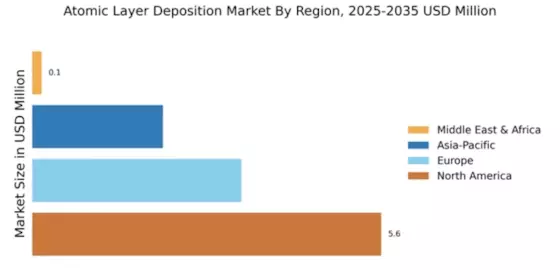
North America continues to lead the Atomic Layer Deposition Market, holding a significant share of 5.0 in 2025. The region's growth is driven by robust demand from the semiconductor and electronics sectors, alongside increasing investments in R&D. Regulatory support for advanced manufacturing technologies further catalyzes market expansion, ensuring compliance with environmental standards and promoting innovation. The competitive landscape is characterized by major players such as Applied Materials, Lam Research, and Veeco Instruments, which are at the forefront of technological advancements. The U.S. remains a key player, leveraging its strong industrial base and skilled workforce. The presence of leading companies fosters a dynamic ecosystem, enhancing collaboration and driving market growth.

Europe : Emerging Technologies and Growth

Europe's Atomic Layer Deposition Market is projected to reach 3.0 by 2025, fueled by increasing demand for advanced materials in industries such as automotive and renewable energy. Regulatory frameworks promoting sustainable manufacturing practices are pivotal in shaping market dynamics, encouraging investments in innovative technologies that comply with stringent environmental standards. Germany and the Netherlands are leading countries in this sector, hosting key players like ASM International and SENTECH Instruments. The competitive landscape is marked by a focus on research and development, with European firms collaborating with academic institutions to drive innovation. This synergy enhances the region's position as a hub for cutting-edge ALD technologies.

Asia-Pacific : Rapid Expansion and Innovation

The Asia-Pacific region is witnessing rapid growth in the Atomic Layer Deposition Market, projected to reach 2.5 by 2025. This growth is primarily driven by the booming semiconductor industry, particularly in countries like Japan and South Korea, where demand for miniaturized electronic components is surging. Government initiatives aimed at boosting technological advancements and manufacturing capabilities are also significant growth catalysts. Japan and South Korea are at the forefront, with companies like Tokyo Electron leading the charge. The competitive landscape is evolving, with increasing investments from both domestic and international players. This influx of capital is fostering innovation and enhancing the region's capabilities in ALD technologies, positioning it as a key player in the global market.

Middle East and Africa : Emerging Market Potential

The Middle East and Africa region, while currently smaller with an Atomic Layer Deposition Market size of 0.72, presents significant growth opportunities in the Atomic Layer Deposition sector. The increasing focus on diversifying economies and investing in advanced manufacturing technologies is driving interest in ALD applications. Governments are recognizing the potential of high-tech industries to boost economic development and create jobs. Countries like South Africa and the UAE are beginning to establish themselves in the ALD landscape, with initiatives aimed at fostering innovation and attracting foreign investment. The competitive environment is still developing, but the presence of emerging players indicates a growing interest in this technology, paving the way for future expansion.

Atomic Layer Deposition Market Regional Image

Key Players and Competitive Insights

The Atomic Layer Deposition Market is characterized by a dynamic competitive landscape, driven by technological advancements and increasing demand for precision in thin film applications. Key players such as Applied Materials (US), Lam Research (US), and ASM International (NL) are at the forefront, each adopting distinct strategies to enhance their market positioning. Applied Materials (US) focuses on innovation through substantial investments in R&D, aiming to develop next-generation deposition technologies. Meanwhile, Lam Research (US) emphasizes strategic partnerships and collaborations to expand its technological capabilities and market reach. ASM International (NL) is actively pursuing regional expansion, particularly in Asia, to capitalize on the growing semiconductor manufacturing sector, thereby shaping a competitive environment that is increasingly interconnected and reliant on technological prowess. In terms of business tactics, companies are localizing manufacturing and optimizing supply chains to enhance operational efficiency and responsiveness to market demands. The market structure appears moderately fragmented, with several key players exerting significant influence. This fragmentation allows for a diverse range of offerings, yet the collective strength of major companies fosters a competitive atmosphere where innovation and technological advancements are paramount. In November 2025, Applied Materials (US) announced a groundbreaking development in atomic layer deposition technology, unveiling a new system designed to improve the efficiency of semiconductor manufacturing processes. This strategic move is likely to reinforce its leadership position in the market, as it addresses the increasing demand for higher performance and lower cost solutions in chip production. The introduction of this technology could potentially set new industry standards, further intensifying competition among peers. In October 2025, Lam Research (US) entered into a strategic partnership with a leading semiconductor manufacturer to co-develop advanced deposition equipment tailored for next-generation devices. This collaboration not only enhances Lam's product offerings but also positions it as a key player in the rapidly evolving semiconductor landscape. The partnership underscores the importance of collaborative innovation in maintaining competitive advantage and responding to the fast-paced technological changes in the industry. In September 2025, ASM International (NL) expanded its operations in Asia by establishing a new manufacturing facility in Taiwan, aimed at supporting the burgeoning semiconductor market in the region. This strategic expansion is indicative of ASM's commitment to meeting local demand and enhancing its supply chain capabilities. By localizing production, ASM is likely to improve its responsiveness to customer needs while also reducing lead times, thereby strengthening its competitive position. As of December 2025, the competitive trends in the Atomic Layer Deposition Market are increasingly defined by digitalization, sustainability, and the integration of AI technologies. Strategic alliances are becoming more prevalent, as companies recognize the need for collaborative approaches to drive innovation and efficiency. Looking ahead, it appears that competitive differentiation will increasingly hinge on technological innovation and supply chain reliability, rather than solely on price. This shift suggests a transformative phase in the market, where companies that prioritize R&D and strategic partnerships are likely to emerge as leaders.

Key Companies in the Atomic Layer Deposition Market include

Industry Developments

June 2023:

A company called Applied Materials announced the launch of its new ALD system, the Centura NXT. The Centura NXT is said to be the most advanced ALD system on the market, and it is designed to meet the growing demand for ALD in the semiconductor and electronics industries.

June 2023:

A team of researchers from the University of Texas at Austin developed a new method for using ALD to deposit graphene. This new method could lead to the development of more efficient and scalable graphene production processes.

May 2023:

A company called CVD Equipment Corporation announced the launch of its new ALD system, the ALD-300. The ALD-300 is a small-scale ALD system that is designed for research and development applications.

Q2 2024: Tokyo Electron Announces New Development Facility at Hosaka Office in Nirasaki City Tokyo Electron Limited announced the opening of a new development facility in Yamanashi Prefecture, Japan, focused on advancing atomic layer deposition (ALD) technology for semiconductor manufacturing and meeting rising industry demand.

Future Outlook

Atomic Layer Deposition Market Future Outlook

The Atomic Layer Deposition Market size is projected to grow at a 17.74% CAGR from 2024 to 2035, driven by advancements in semiconductor manufacturing and increased demand for nanotechnology applications.
The future of Atomic Layer Deposition Market is robust, fueled by sub-3nm semiconductor scaling and 3D NAND architectures. Innovations in spatial ALD and medical encapsulation will enhance throughput and device longevity.

New opportunities lie in:

  • Development of customized ALD systems for niche applications Expansion into emerging markets with tailored solutions Partnerships with research institutions for innovative material development

By 2035, the Atomic Layer Deposition Market  is expected to achieve substantial growth, solidifying its position as a leader in advanced manufacturing technologies.

Market Segmentation

Atomic Layer Deposition Market End Use Outlook

  • Electronics

  • Energy

  • Automotive

  • Aerospace

  • Healthcare

Atomic Layer Deposition Market Technology Outlook

  • Chemical Vapor Deposition

  • Physical Vapor Deposition

  • Molecular Beam Epitaxy

  • Sputtering

  • Atomic Layer Etching

Atomic Layer Deposition Market Application Outlook

  • Semiconductor

  • Solar Cells

  • Optoelectronics

  • Nanotechnology

  • Biomedical

Atomic Layer Deposition Market Material Type Outlook

  • Metal

  • Dielectric

  • Polymer

  • Composite

  • Ceramic

Atomic Layer Deposition Market Substrate Type Outlook

  • Silicon

  • Glass

  • Metal

  • Plastic

  • Ceramic

Report Scope

MARKET SIZE 2024 11.22(USD Million)
MARKET SIZE 2025 13.21(USD Million)
MARKET SIZE 2035 67.62(USD Million)
COMPOUND ANNUAL GROWTH RATE (CAGR) 17.74% (2025 - 2035)
REPORT COVERAGE Revenue Forecast, Competitive Landscape, Growth Factors, and Trends
BASE YEAR 2024
Market Forecast Period 2025 - 2035
Historical Data 2019 - 2024
Market Forecast Units USD Million
Key Companies Profiled Applied Materials (US), Lam Research (US), Tokyo Electron (JP), ASM International (NL), Veeco Instruments (US), Oxford Instruments (GB), SENTECH Instruments (DE), Picosun (FI)
Segments Covered Application, End Use, Technology, Material Type, Substrate Type
Key Market Opportunities Advancements in semiconductor manufacturing drive demand for precision in the Atomic Layer Deposition Market.
Key Market Dynamics Technological advancements in Atomic Layer Deposition drive competitive forces and enhance material performance across various industries.
Countries Covered North America, Europe, APAC, South America, MEA

Market Highlights

Author
Priya Nagrale
Senior Research Analyst

With an experience of over five years in market research industry (Chemicals & Materials domain), I gather and analyze market data from diverse sources to produce results, which are then presented back to a client. Also, provide recommendations based on the findings. As a Senior Research Analyst, I perform quality checks (QC) for market estimations, QC for reports, and handle queries and work extensively on client customizations. Also, handle the responsibilities of client proposals, report planning, report finalization, and execution

Leave a Comment

FAQs

What is the intended audience for the global market during the forecast period?

● Potential Investors and market buyers ● Contract research organizations (CROs) and forms ● Research and development institutions ● Nationalized laboratories ● Government and public sector bodies

What is the predicted CAGR for the market during the forecast period of 2025-2035?

The global market is likely to attain a CAGR of 13.9%.

Which region is likely to dominate the global market operations during the forecast period?

The market is likely to be dominated by the APAC region.

Who are the top players in the global atomic layer deposition (ALD) market?

Applied Materials, Inc. (US), ALD NanoSolutions, Inc. (US), ALD Vacuum Technologies GmbH (Germany), CVD Equipment Corporation (US), ASM International NV (The Netherlands), Tokyo Electron Limited (Japan), Veeco Instruments (US), Jiangsu Leadmicro Guide Nano Equipment Technology Co., Ltd. (China), Kurt J. Lesker Company (UK), and Denton Vacuum (US), are some of the major players operating in the atomic layer deposition (ALD) market.

Research Approach

Secondary Research

The secondary research process involved comprehensive analysis of semiconductor industry databases, peer-reviewed materials science journals, technical publications, and authoritative industry organizations. Key sources included the US Department of Energy (DOE), National Institute of Standards and Technology (NIST), Semiconductor Industry Association (SIA), European Semiconductor Equipment Association (ESEMI), Japan Semiconductor Equipment Association (SEAJ), International Energy Agency (IEA), International Renewable Energy Agency (IRENA), National Science Foundation (NSF), European Commission Horizon Europe Program, US Patent and Trademark Office (USPTO), European Patent Office (EPO), International Electrotechnical Commission (IEC), SEMI Global, Institute of Electrical and Electronics Engineers (IEEE), American Vacuum Society (AVS), Materials Research Society (MRS), and national semiconductor consortia from key markets. These sources were used to collect equipment shipment statistics, technology roadmaps, patent landscapes, wafer fab capacity data, R&D investment trends, and market landscape analysis for metal ALD, aluminum oxide ALD, plasma enhanced ALD, catalytic ALD, and other deposition technologies.

Primary Research

Qualitative and quantitative insights were obtained by interviewing supply-side and demand-side stakeholders during the primary research process. ALD equipment manufacturers, precursor chemical suppliers, and semiconductor OEMs were among the supply-side sources, which included CEOs, VPs of Technology Development, chief technology officers, and product line directors. Process integration engineers, thin film deposition specialists, fab managers, and procurement leads from semiconductor fabs, solar cell manufacturers, display panel producers, research institutes, and advanced packaging facilities constituted demand-side sources. Market segmentation was verified, equipment shipment timelines were verified, and insights regarding technology adoption patterns, pricing strategies, and supply chain dynamics were obtained through primary research.

Primary Respondent Breakdown:

By Designation: C-level Primaries (32%), Director Level (30%), Others (38%)

By Region: North America (32%), Europe (25%), Asia-Pacific (35%), Rest of World (8%)

Market Size Estimation

Global market valuation was derived through equipment revenue mapping and wafer processing capacity analysis. The methodology included:

Identification of 50+ key equipment manufacturers across North America, Europe, Asia-Pacific, and emerging markets

Product mapping across metal ALD, aluminum oxide ALD, plasma enhanced ALD, catalytic ALD, and other technology categories

Analysis of reported and modeled annual revenues specific to ALD equipment portfolios

Coverage of manufacturers representing 75-80% of global market share in 2024

Extrapolation using bottom-up (fab capacity × equipment ASP by region) and top-down (manufacturer revenue validation) approaches to derive segment-specific valuations

Download Free Sample

Kindly complete the form below to receive a free sample of this Report

Compare Licence

×
Features License Type
Single User Multiuser License Enterprise User
Price $4,950 $5,950 $7,250
Maximum User Access Limit 1 User Upto 10 Users Unrestricted Access Throughout the Organization
Free Customization
Direct Access to Analyst
Deliverable Format
Platform Access
Discount on Next Purchase 10% 15% 15%
Printable Versions