×
Request Free Sample ×

Kindly complete the form below to receive a free sample of this Report

* Please use a valid business email

Leading companies partner with us for data-driven Insights

clients tt-cursor
Hero Background

Automatic Identification System Market

ID: MRFR/AD/9086-HCR
174 Pages
Swapnil Palwe
October 2025

Automatic Identification System Market Research Report Automatic Identification System by Class (Class A and Class B), By Platform (Vessel Based and Onshore Based), By Application (Fleet Management, Vessel Tracking, Maritime Security and Others), and By Region (North America, Europe, Asia-Pacific, And Rest Of The World) –Market Forecast Till 2035.

Share:
Download PDF ×

We do not share your information with anyone. However, we may send you emails based on your report interest from time to time. You may contact us at any time to opt-out.

Automatic Identification System Market Infographic
Purchase Options

Automatic Identification System Market Summary

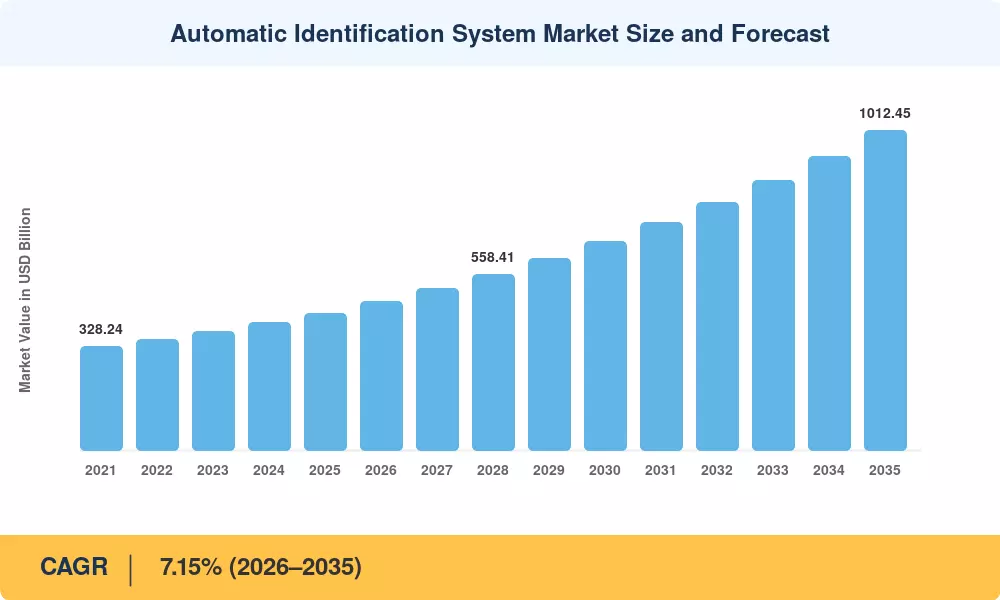
As per MRFR analysis, the Automatic Identification System Market Size was estimated at 471.01 USD Million in 2024. The Automatic Identification System industry is projected to grow from 590.19 in 2025 to 5630.79 by 2035, exhibiting a compound annual growth rate (CAGR) of 25.3 during the forecast period 2025 - 2035.

Key Market Trends & Highlights

The Automatic Identification System Market is experiencing robust growth driven by technological advancements and increasing demand for efficient supply chain management.

  • Technological advancements are enhancing the capabilities of Automatic Identification Systems, particularly in the marine segment, which remains the largest market.
  • The Asia-Pacific region is emerging as the fastest-growing area for Automatic Identification Systems, driven by rapid industrialization and e-commerce growth.
  • Integration with IoT is becoming a critical trend, facilitating real-time data exchange and improving operational efficiency across various sectors.
  • Rising demand for efficient supply chain management and regulatory compliance are key drivers propelling market expansion, especially in the commercial segment.

Market Size & Forecast

2024 Market Size 471.01 (USD Million)
2035 Market Size 5630.79 (USD Million)
CAGR (2025 - 2035) 25.3%

Major Players

Honeywell (US), Zebra Technologies (US), Siemens (DE), Datalogic (IT), Cognex (US), Omron (JP), SATO Holdings (JP), Toshiba (JP), Impinj (US)

Automatic Identification System Market Trends

The Automatic Identification System Market is currently experiencing a transformative phase, driven by advancements in technology and increasing demand for efficient tracking solutions. This market encompasses a variety of technologies, including RFID, barcodes, and biometric systems, which are utilized across diverse sectors such as logistics, healthcare, and retail. The integration of these systems enhances operational efficiency, reduces human error, and improves inventory management. As organizations seek to streamline processes and enhance customer experiences, the adoption of automatic identification technologies is likely to accelerate, fostering innovation and competition among key players. Moreover, the growing emphasis on data security and regulatory compliance is shaping the landscape of the Automatic Identification System Market. Companies are increasingly investing in robust identification solutions that not only facilitate tracking but also ensure the protection of sensitive information. This trend indicates a shift towards more sophisticated systems that incorporate advanced encryption and authentication measures. As the market evolves, it appears poised for substantial growth, with emerging technologies and changing consumer preferences driving further developments in automatic identification solutions.

Technological Advancements

The Automatic Identification System Market is witnessing rapid technological advancements, particularly in the realms of RFID and biometric systems. These innovations are enhancing the accuracy and speed of identification processes, thereby improving overall operational efficiency. As organizations increasingly adopt these technologies, they are likely to experience significant improvements in tracking and inventory management.

Focus on Data Security

There is a growing focus on data security within the Automatic Identification System Market. Organizations are prioritizing the implementation of secure identification solutions that protect sensitive information from unauthorized access. This trend suggests a shift towards systems that incorporate advanced encryption and authentication protocols, ensuring compliance with regulatory standards.

Integration with IoT

The integration of automatic identification technologies with the Internet of Things (IoT) is emerging as a notable trend. This convergence allows for real-time data collection and analysis, enabling organizations to make informed decisions based on accurate information. As IoT continues to expand, its synergy with automatic identification systems is expected to enhance operational capabilities across various industries.

Automatic Identification System Market Drivers

Market Growth Projections

The Global Automatic Identification System Market Industry is projected to experience robust growth over the coming years. With a market valuation of 0.3 USD Billion in 2024, the industry is expected to expand significantly, reaching 2.86 USD Billion by 2035. This growth trajectory indicates a compound annual growth rate of 22.75% from 2025 to 2035, reflecting the increasing adoption of automatic identification technologies across various sectors. The demand for efficient logistics, regulatory compliance, and technological advancements are key factors driving this expansion, positioning the industry for a promising future.

Emerging Markets and Global Expansion

Emerging markets present substantial opportunities for the Global Automatic Identification System Market Industry. As developing economies continue to industrialize, there is a growing demand for efficient identification solutions across various sectors. Countries in Asia-Pacific and Latin America are witnessing rapid growth in logistics and manufacturing, driving the need for automatic identification systems. These regions are increasingly adopting technologies such as RFID and barcode scanning to enhance operational efficiency and accuracy. The expansion into these emerging markets is expected to fuel market growth, as businesses seek to leverage automatic identification systems to improve productivity and competitiveness.

Growth of E-commerce and Retail Sectors

The growth of e-commerce and retail sectors significantly impacts the Global Automatic Identification System Market Industry. With the increasing volume of online transactions and the need for efficient order fulfillment, businesses are turning to automatic identification systems to streamline operations. Technologies such as barcode scanning and RFID enable retailers to manage inventory effectively, reduce shrinkage, and enhance customer experience. The ongoing expansion of e-commerce platforms necessitates robust identification solutions to ensure timely deliveries and accurate order processing. This trend is likely to contribute to the market's expansion, as companies invest in advanced identification technologies to stay competitive.

Increasing Demand for Efficient Logistics

The Global Automatic Identification System Market Industry experiences a surge in demand driven by the need for efficient logistics and supply chain management. As businesses strive to optimize operations, technologies such as RFID and barcode scanning become essential. In 2024, the market is valued at 0.3 USD Billion, reflecting a growing recognition of the importance of real-time tracking and inventory management. Companies are increasingly adopting these systems to enhance operational efficiency, reduce errors, and improve customer satisfaction. This trend is expected to continue, with the market projected to reach 2.86 USD Billion by 2035, indicating a robust growth trajectory.

Regulatory Compliance and Safety Standards

Regulatory compliance and safety standards are pivotal drivers in the Global Automatic Identification System Market Industry. Governments worldwide are implementing stringent regulations to enhance safety and security across various sectors, including transportation, healthcare, and manufacturing. Automatic identification systems play a crucial role in ensuring compliance with these regulations by providing accurate tracking and reporting capabilities. For instance, the adoption of RFID technology in healthcare has improved patient safety and medication management. As organizations strive to meet regulatory requirements, the demand for automatic identification systems is expected to rise, further propelling market growth.

Technological Advancements in Identification Systems

Technological advancements significantly influence the Global Automatic Identification System Market Industry, as innovations in identification technologies enhance performance and reliability. The integration of artificial intelligence and machine learning into automatic identification systems allows for improved data analysis and decision-making processes. These advancements not only streamline operations but also reduce costs associated with manual identification methods. As organizations increasingly adopt these cutting-edge technologies, the market is poised for substantial growth. The anticipated compound annual growth rate of 22.75% from 2025 to 2035 underscores the potential for widespread adoption and integration of advanced identification solutions.

Market Segment Insights

By Application: Marine (Largest) vs. Aviation (Fastest-Growing)

The Automatic Identification System Market is segmented by application into Marine, Aviation, Transportation, Logistics, and Defense, with Marine occupying the largest share. The use of AIS in maritime activities ensures safer navigation and monitoring, which is essential in crowded or hazardous waters. Additionally, the increased government regulations and emphasis on maritime safety have contributed to the sector's comprehensive development and extensive adoption of AIS technologies across various maritime entities. Conversely, the Aviation sector is witnessing rapid growth in the adoption of AIS technologies, primarily driven by the need for enhancing air traffic management systems and improving flight safety. The evolving trends of automation and real-time data analytics are accelerating growth opportunities, enabling more efficient operations within Aviation. Investments in advanced tracking technologies are also propelling growth, making Aviation a dynamic area within the AIS market.

Marine: Dominant vs. Aviation: Emerging

The Marine application segment is the dominant player in the Automatic Identification System Market, characterized by its extensive utilization in vessel tracking and maritime security. The demand for AIS in this sector is largely driven by regulations aimed at improving safety at sea and optimizing maritime traffic. This segment benefits from its established infrastructure and a broad range of applications, including commercial shipping, fishing, and pleasure crafts. In contrast, the Aviation application segment is emerging with substantial growth prospects, fueled by technological advancements in air traffic management. The need for improved safety standards and operational efficiency in aviation creates demand for AIS solutions, marking it as a key area for innovation and market expansion. As both sectors evolve, their interdependencies could emerge, potentially enhancing efficiency and safety in both marine and aerial navigation.

By End Use: Commercial (Largest) vs. Government (Fastest-Growing)

In the Automatic Identification System Market, the commercial segment holds the largest market share, driven by the increasing need for efficient asset management and tracking solutions across various industries. This segment encompasses a wide range of applications including retail, logistics, and transportation, which are rapidly adopting automatic identification technologies for enhanced operational efficiency. The government segment, while smaller in scale, is recognized as the fastest-growing among the end-use categories. Various government initiatives focused on public safety, security, and smart city developments are fueling the demand for advanced identification systems in this area.

Commercial (Dominant) vs. Government (Emerging)

The commercial segment of the Automatic Identification System Market is characterized by its extensive usage across various industries, including retail, logistics, and supply chain management. This segment dominates the market due to the increasing adoption of technologies like RFID and barcode systems, which offer significant improvements in efficiency and accuracy. On the other hand, the government segment, though currently smaller, is emerging rapidly with a focus on public security, identification for transportation, and enhancing the effectiveness of public services. Investments in smart city projects and increased funding for security initiatives are contributing to its growth. The unique requirements of each sector drive distinct technological innovations and adaptations in this market.

By Technology: RFID (Largest) vs. Barcode Scanning (Fastest-Growing)

In the Automatic Identification System Market, the technology segment is primarily dominated by Radio Frequency Identification (RFID), which holds the largest market share among all technologies. Barcode scanning follows closely, demonstrating a significant presence within the sector. Optical Character Recognition (OCR) and Biometric systems, while important, occupy smaller segments with limited market shares when compared to RFID and barcode scanning. Overall, the distribution among these technologies reveals RFID's strong hold, while barcode scanning shows solid traction in adoption rates. Examining growth trends, RFID continues to lead due to its wide applicability across various industries, including retail, logistics, and healthcare. Meanwhile, barcode scanning is currently the fastest-growing segment, largely due to advancements in mobile scanning technology and the increasing prevalence of mobile point-of-sale solutions. The rise in e-commerce and demand for faster checkout processes are contributing significantly to the growth of this segment, alongside operational efficiency improvements that both technologies provide.

RFID (Dominant) vs. Optical Character Recognition (Emerging)

RFID stands as the dominant technology in the Automatic Identification System Market, offering unparalleled benefits such as improved inventory management and supply chain visibility. Its ability to capture data without direct line-of-sight and operate in various environments makes it an essential tool for industries like retail, healthcare, and logistics. In contrast, Optical Character Recognition (OCR) is emerging as a notable alternative, particularly in document management and data entry processes. While OCR is gaining traction, enabling organizations to digitize paper documents efficiently and accurately, it is still developing its market position relative to the well-established RFID technology. OCR's growth is propelled by automation trends and the need for digital transformation, making it a strong competitor in the long run.

By Component: Hardware (Largest) vs. Software (Fastest-Growing)

In the Automatic Identification System Market, the component segment is characterized by three primary values: Hardware, Software, and Services. Among these, Hardware holds the largest share, reflecting its critical role in the overall system's functionality. The adoption of advanced hardware technologies, such as RFID readers and barcode scanners, contributes significantly to the segment's dominance. Software follows as the fastest-growing segment, driven by increasing demands for integrated solutions and enhanced tracking capabilities.

Software (Emerging) vs. Services (Dominant)

The comparison between Software and Services in the Automatic Identification System Market elucidates the dynamic nature of the component segment. Software is emerging rapidly, fueled by innovation in application areas such as inventory management and asset tracking, offering users comprehensive and real-time data analytics. On the other hand, Services, including installation and maintenance, remain dominant due to their necessity for system optimization and user support. This reliance on service provision underlines the importance of integrating software with robust service frameworks to ensure efficiency and customer satisfaction.

Get more detailed insights about Automatic Identification System Market

Regional Insights

North America : Market Leader in Innovation

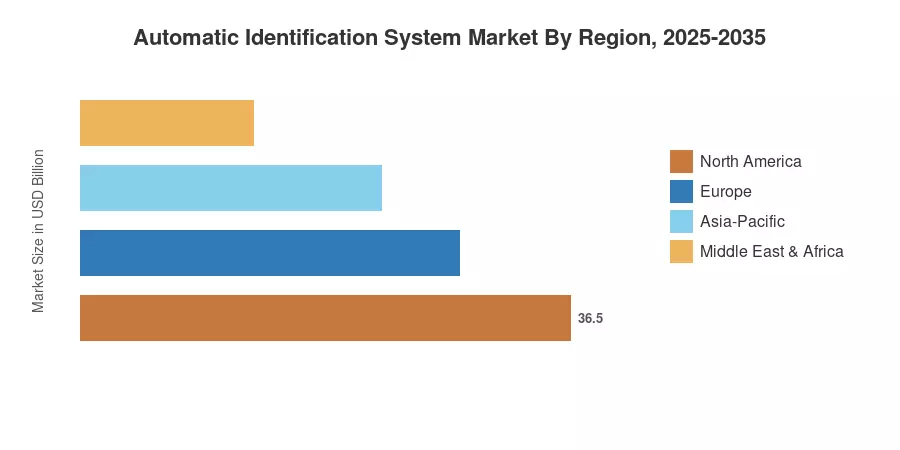
North America is poised to maintain its leadership in the Automatic Identification System market, holding a significant market share of 235.5 million in 2025. The region's growth is driven by rapid technological advancements, increasing demand for automation in various sectors, and supportive regulatory frameworks. The integration of IoT and AI technologies is further propelling market expansion, as businesses seek efficient identification solutions to enhance operational efficiency. The United States stands out as the leading country in this region, with major players like Honeywell, Zebra Technologies, and Cognex driving innovation and competition. The competitive landscape is characterized by a mix of established firms and emerging startups, all striving to capture market share. The presence of advanced manufacturing capabilities and a strong focus on R&D ensures that North America remains at the forefront of the Automatic Identification System market.

Europe : Growing Demand for Automation

Europe is witnessing a robust growth trajectory in the Automatic Identification System market, with a projected market size of 130.0 million by 2025. The demand for automation across various industries, including logistics and retail, is a key driver of this growth. Regulatory initiatives aimed at enhancing operational efficiency and safety standards are also contributing to market expansion. The European market is increasingly adopting advanced technologies to streamline processes and improve accuracy in identification systems. Germany, the UK, and France are leading countries in this region, hosting key players such as Siemens and Datalogic. The competitive landscape is marked by a strong emphasis on innovation and collaboration among industry stakeholders. The presence of established companies alongside startups fosters a dynamic environment, ensuring that Europe remains a significant player in The Automatic Identification System. "The European market is evolving rapidly, driven by technological advancements and regulatory support," European Commission report, European Commission.

Asia-Pacific : Emerging Powerhouse in Technology

Asia-Pacific is emerging as a significant player in the Automatic Identification System market, with a projected market size of 85.0 million by 2025. The region's growth is fueled by increasing industrialization, urbanization, and a rising demand for efficient identification solutions. Governments are implementing policies to promote automation and enhance supply chain efficiency, which is further driving market growth. The adoption of smart technologies is becoming prevalent across various sectors, including manufacturing and retail. Japan and China are the leading countries in this region, with companies like Omron and SATO Holdings making substantial contributions to market development. The competitive landscape is characterized by a mix of local and international players, all vying for market share. The focus on innovation and technology integration is crucial for companies looking to succeed in the rapidly evolving Automatic Identification System market.

Middle East and Africa : Untapped Market Potential

The Middle East and Africa region is gradually emerging in the Automatic Identification System market, with a market size of 20.51 million projected for 2025. The growth is driven by increasing investments in infrastructure and technology, as well as a growing awareness of the benefits of automation in various sectors. Governments are focusing on enhancing operational efficiency and safety, which is creating opportunities for Automatic Identification Systems. The region's diverse economic landscape presents unique challenges and opportunities for market players. Countries like South Africa and the UAE are leading the way in adopting advanced identification technologies. The competitive landscape is still developing, with both local and international companies exploring opportunities. The presence of key players is expected to grow as the market matures, making the Middle East and Africa a region to watch in the Automatic Identification System market.

Key Players and Competitive Insights

The Automatic Identification System Market is currently characterized by a dynamic competitive landscape, driven by technological advancements and increasing demand for efficient tracking and identification solutions across various sectors. Key players such as Honeywell (US), Zebra Technologies (US), and Siemens (DE) are strategically positioned to leverage innovation and partnerships to enhance their market presence. Honeywell (US) focuses on integrating advanced analytics and IoT capabilities into its product offerings, while Zebra Technologies (US) emphasizes the development of mobile computing solutions that enhance operational efficiency. Siemens (DE) is actively pursuing digital transformation initiatives, which include the integration of AI and machine learning into its identification systems, thereby shaping a competitive environment that prioritizes technological sophistication and customer-centric solutions.

In terms of business tactics, companies are increasingly localizing manufacturing and optimizing supply chains to enhance responsiveness to market demands. The market structure appears moderately fragmented, with a mix of established players and emerging companies vying for market share. The collective influence of these key players fosters a competitive atmosphere where innovation and operational efficiency are paramount, allowing them to adapt to evolving customer needs and technological trends.

In November 2025, Honeywell (US) announced the launch of its new AI-driven identification platform, which aims to streamline inventory management processes for retail and logistics sectors. This strategic move is significant as it not only enhances operational efficiency but also positions Honeywell as a leader in the integration of AI technologies within the Automatic Identification System Market. The platform's capabilities are expected to reduce operational costs and improve accuracy in inventory tracking, thereby providing a competitive edge.

In October 2025, Zebra Technologies (US) expanded its partnership with a leading logistics provider to enhance supply chain visibility through advanced tracking solutions. This collaboration is crucial as it underscores Zebra's commitment to delivering innovative solutions that address the complexities of modern supply chains. By leveraging its expertise in mobile computing and data analytics, Zebra is likely to strengthen its market position and drive customer loyalty through enhanced service offerings.

In September 2025, Siemens (DE) unveiled a new suite of identification solutions that incorporate machine learning algorithms to optimize asset tracking in manufacturing environments. This development is indicative of Siemens' strategic focus on digital transformation and its intent to provide cutting-edge solutions that meet the demands of Industry 4.0. The integration of machine learning not only enhances operational efficiency but also positions Siemens as a forward-thinking player in the Automatic Identification System Market.

As of December 2025, current competitive trends are heavily influenced by digitalization, sustainability, and the integration of AI technologies. Strategic alliances among key players are shaping the landscape, fostering innovation and enhancing product offerings. The shift from price-based competition to a focus on technological advancement and supply chain reliability is evident, suggesting that future competitive differentiation will hinge on the ability to innovate and adapt to changing market dynamics.

Key Companies in the Automatic Identification System Market market include

Industry Developments

  • Q2 2024: Saab Receives Order for Advanced Automatic Identification System Market from the Swedish Maritime Administration Saab announced it has secured a contract to deliver its next-generation Automatic Identification System Market (AIS) solutions to the Swedish Maritime Administration, enhancing maritime safety and traffic management along Sweden’s coast.
  • Q2 2024: ORBCOMM Launches New Satellite AIS Data Service for Global Maritime Tracking ORBCOMM introduced a new satellite-based AIS data service, providing enhanced vessel tracking and maritime domain awareness for government and commercial customers worldwide.
  • Q1 2024: Furuno Unveils FA-170 AIS Class A Transponder with Enhanced Cybersecurity Features Furuno launched the FA-170, a new AIS Class A transponder designed to meet updated IMO cybersecurity requirements, targeting commercial shipping fleets.
  • Q2 2024: Spire Global Expands Maritime Data Partnership with Lloyd’s List Intelligence Spire Global announced an expanded partnership with Lloyd’s List Intelligence to deliver real-time AIS data and analytics for global maritime risk and compliance solutions.
  • Q3 2024: Garmin Launches AIS 800 Transceiver for Enhanced Marine Safety Garmin introduced the AIS 800, a new Class B AIS transceiver, offering faster vessel position updates and improved integration with Garmin marine electronics.
  • Q2 2024: ORBCOMM Wins Multi-Year Contract to Provide Satellite AIS Data to European Coast Guard Agency ORBCOMM secured a multi-year contract to supply satellite-based AIS data services to a major European coast guard agency, supporting maritime surveillance and security operations.
  • Q1 2024: Saab Appoints New Head of Maritime Traffic Management Division Saab announced the appointment of a new executive to lead its Maritime Traffic Management division, which oversees the company’s AIS and vessel traffic solutions.
  • Q2 2024: Spire Global Raises $40 Million to Expand Maritime AIS Satellite Constellation Spire Global completed a $40 million funding round to accelerate the deployment of additional satellites for its global AIS data network, aiming to improve vessel tracking coverage.
  • Q1 2024: Furuno Partners with Japan Coast Guard for Nationwide AIS Upgrade Furuno announced a partnership with the Japan Coast Guard to upgrade AIS infrastructure across Japanese waters, enhancing maritime safety and regulatory compliance.
  • Q3 2024: Saab Opens New Maritime Technology Center in Rotterdam Saab inaugurated a new maritime technology center in Rotterdam, focusing on the development and testing of advanced AIS and vessel traffic management systems.

Future Outlook

Automatic Identification System Market Future Outlook

The Automatic Identification System Market is projected to grow at a 25.3% CAGR from 2024 to 2035, driven by technological advancements, regulatory mandates, and increasing demand for efficient tracking solutions.

New opportunities lie in:

  • Integration of AI-driven analytics for real-time decision-making
  • Development of portable identification devices for remote applications
  • Expansion into emerging markets with tailored solutions

By 2035, the market is expected to achieve substantial growth, solidifying its role in global identification systems.

Market Segmentation

Automatic Identification System Market End Use Outlook

  • Commercial
  • Government
  • Industrial
  • Residential

Automatic Identification System Market Component Outlook

  • Hardware
  • Software
  • Services

Automatic Identification System Market Technology Outlook

  • Radio Frequency Identification
  • Barcode Scanning
  • Optical Character Recognition
  • Biometric Systems

Automatic Identification System Market Application Outlook

  • Marine
  • Aviation
  • Transportation
  • Logistics
  • Defense

Report Scope

MARKET SIZE 2024471.01(USD Million)
MARKET SIZE 2025590.19(USD Million)
MARKET SIZE 20355630.79(USD Million)
COMPOUND ANNUAL GROWTH RATE (CAGR)25.3% (2024 - 2035)
REPORT COVERAGERevenue Forecast, Competitive Landscape, Growth Factors, and Trends
BASE YEAR2024
Market Forecast Period2025 - 2035
Historical Data2019 - 2024
Market Forecast UnitsUSD Million
Key Companies ProfiledHoneywell (US), Zebra Technologies (US), Siemens (DE), Datalogic (IT), Cognex (US), Omron (JP), SATO Holdings (JP), Toshiba (JP), Impinj (US)
Segments CoveredApplication, End Use, Technology, Component
Key Market OpportunitiesIntegration of advanced technologies enhances efficiency in the Automatic Identification System Market.
Key Market DynamicsRising demand for enhanced maritime safety drives innovation in Automatic Identification System technology and regulatory compliance.
Countries CoveredNorth America, Europe, APAC, South America, MEA

Market Highlights

Author
Swapnil Palwe
Team Lead - Research

With a technical background as Bachelor's in Mechanical Engineering, with MBA in Operations Management , Swapnil has 6+ years of experience in market research, consulting and analytics with the tasks of data mining, analysis, and project execution. He is the POC for our clients, for their consulting projects running under the Automotive/A&D domain. Swapnil has worked on major projects in verticals such as Aerospace & Defense, Automotive and many other domain projects. He has worked on projects for fortune 500 companies' syndicate and consulting projects along with several government projects.

Leave a Comment

FAQs

How much is the Automatic Identification System Market?

The Automatic Identification System Market size was valued at USD 0.3759 Billion in 2023.

What is the growth rate of the Automatic Identification System Market?

The market is projected to grow at a CAGR of 25.30% during the forecast period, 2025-2034.

Which Region held the largest market share in the Automatic Identification System Market?

North America had the largest share of the market

Who are the key players in the Automatic Identification System Market?

The key players in the market are Exact Earth Ltd, Kongsberg Gruppen, SAAB AB, Furuno Electric Co. Ltd., L-3 communication holdings, Orbcomm Inc, True Heading AB, Gramin International, Japan Radio Ltd.

Which application led the Automatic Identification System Market?

Fleet Management dominated the market in 2023.

Which Class had the largest market share in the Automatic Identification System Market?

Class B had the largest share of the market.

Download Free Sample

Kindly complete the form below to receive a free sample of this Report

Compare Licence

×
Features License Type
Single User Multiuser License Enterprise User
Price $4,950 $5,950 $7,250
Maximum User Access Limit 1 User Upto 10 Users Unrestricted Access Throughout the Organization
Free Customization
Direct Access to Analyst
Deliverable Format
Platform Access
Discount on Next Purchase 10% 15% 15%
Printable Versions