Automotive Active Noise Cancellation (ANC) Systems Market (2026 - 2035)

ID: MRFR/AT/66589-CR
200 Pages
Garvit Vyas
Last Updated: July 13, 2026
Automotive Active Noise Cancellation (ANC) Systems Market
Market Size
Forecast Period2026-2035
CAGR (2026-2035)8.15%
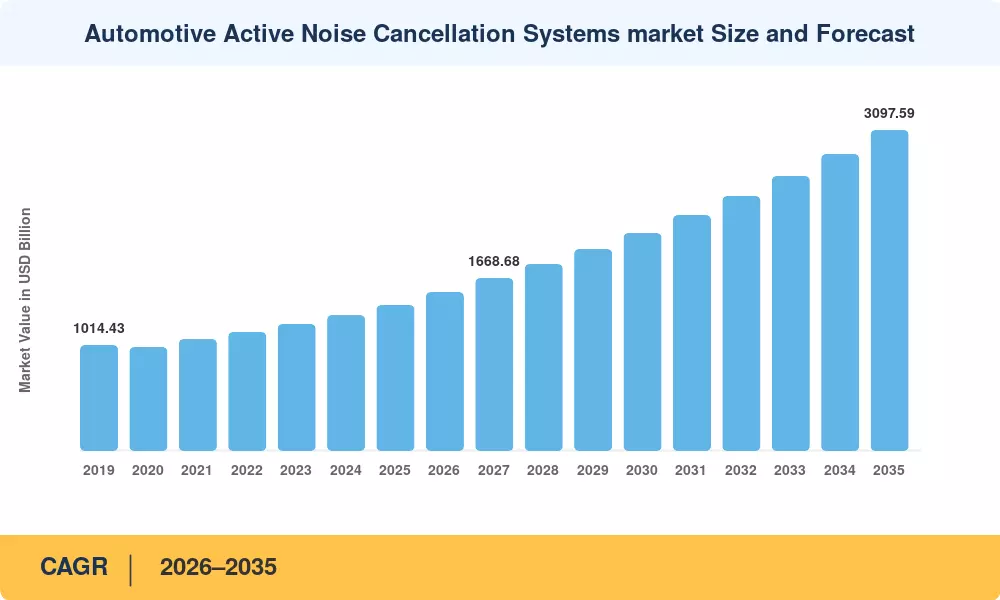
2025 Market SizeUSD 1,403.34 Billion
2035 Market SizeUSD 3,097.59 Billion
Key Players
Harman International
Bose
Continental AG
Hyundai Mobis
Panasonic Automotive Systems
NXP Semiconductors
Opportunities
  • Advancements in Artificial Intelligence and Machine Learning Enhancing Noise Cancellation Capabilities
  • Growing Trend of Connected Vehicles Offering Potential for Innovative Noise Management Solutions
  • Expanding Automotive Aftermarket Creating Demand for Noise Cancellation Retrofitting

Automotive Active Noise Cancellation Systems Market Summary

The global Automotive Active Noise Cancellation (ANC) Systems market was valued at USD 1,403.34 billion in 2025 and is projected to reach USD 3,097.59 billion by 2035, registering a compound annual growth rate (CAGR) of 8.15% during the forecast period 2026–2035. The market crossed the USD 1,529.84 billion threshold in 2026, the first year of the forecast window. Structural growth is underpinned by the accelerating global shift toward electric vehicles (EVs), which inherently lack internal-combustion-engine masking noise and therefore expose occupants to road and wind noise that must be actively managed. Concurrently, original equipment manufacturers (OEMs) pursuing aggressive lightweighting strategies are replacing heavy passive insulation materials—such as dense bitumen pads and mass-loaded vinyl barriers—with electronically driven ANC solutions that deliver superior noise attenuation at a fraction of the weight penalty. Consumer expectations for premium cabin acoustics have risen sharply, reinforced by the proliferation of in-car infotainment systems, voice-activated digital assistants, and hands-free communication features that demand a low-noise acoustic environment to function reliably.

From a technology standpoint, hybrid ANC architectures—combining feedforward and feedback signal paths—have emerged as the dominant technology segment, capturing the largest share of 2025 revenue. Hybrid systems leverage multiple reference microphones placed at the vehicle's exterior surfaces alongside error microphones inside the cabin to generate phase-inverted anti-noise signals in real time, yielding broadband cancellation across engine, road, and wind noise spectra. The fastest-growing technology segment is AI-enhanced adaptive ANC, propelled by recent strategic moves such as Analog Devices' August 2025 acquisition of an automotive AI audio processing startup that strengthens adaptive DSP and intelligent cabin acoustics capabilities, and NXP Semiconductors' June 2025 launch of an upgraded S32 automotive processing platform engineered for high-performance ANC workloads and AI-driven smart cockpit applications. These developments signal a clear trajectory toward software-defined, over-the-air-updatable noise management systems embedded within centralized vehicle compute architectures.

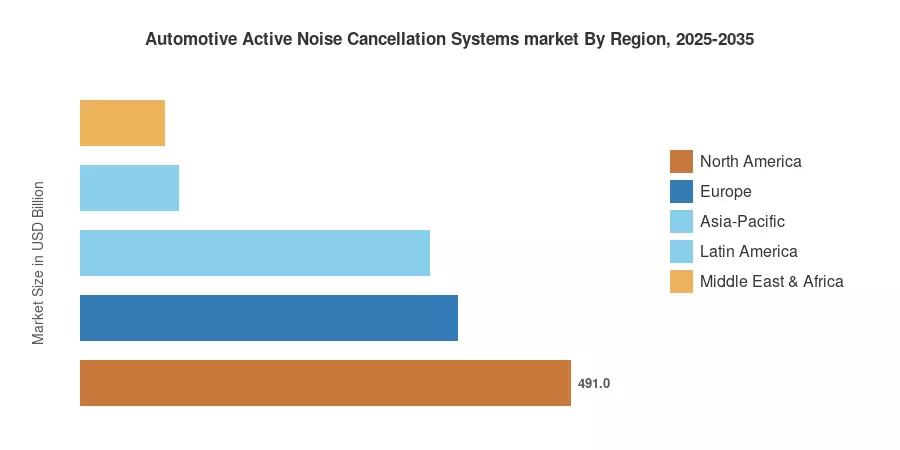
Regionally, North America commands the largest revenue share, driven by high consumer willingness to pay for premium vehicle features, a mature OEM ecosystem, and the rapid expansion of the North American EV market. Asia-Pacific is the fastest-growing region with the highest forecast CAGR, fueled by surging EV production in China, South Korea, and Japan, rising per-capita income supporting premiumization in India and Southeast Asia, and the strategic investments of regional tier-one suppliers such as Hyundai Mobis, which in December 2025 acquired a South Korean EV acoustic engineering firm to bolster its road-noise-reduction and vibration-optimization portfolio. Europe holds the second-largest market position, supported by stringent noise-pollution directives and strong demand for luxury and premium vehicles equipped with advanced cabin technologies. Looking ahead, the convergence of electrification, autonomous driving, and connected-vehicle platforms is expected to sustain double-digit growth pockets within the ANC market well into the next decade.


Key Report Takeaways

Segment Dimension Key Metric Notes
Technology Type — Dominant Hybrid ANC held the largest 2025 revenue share Broadband cancellation across engine, road, and wind noise
Technology Type — Fastest Growing AI-Enhanced Adaptive ANC, highest CAGR 2026–2035 Driven by ADI and NXP platform launches
Vehicle Type — Dominant Passenger Cars, the largest 2025 segment Consumer premiumization and EV sedan proliferation
Vehicle Type — Fastest Growing Heavy Commercial Vehicles, the highest CAGR Regulatory push for driver-cabin comfort in long-haul transport
Propulsion Type — Dominant ICE Vehicles, the largest installed base in 2025 The legacy fleet is still dominant, though its share is declining
Propulsion Type — Fastest Growing Electric Vehicles, the highest CAGR Absence of engine masking noise creates structural demand
Application — Dominant Road Noise Cancellation, largest 2025 share Critical for EVs and lightweight vehicle architectures
Application — Fastest Growing Wind Noise Cancellation, the highest CAGR Growing importance of aerodynamic EV designs
Sales Channel — Dominant OEM (factory-installed), largest 2025 share Deep integration with vehicle ECU and audio systems
Sales Channel — Fastest Growing Aftermarket, the highest CAGR Retrofit kits expanding for mid-cycle and used EV markets
Region — Dominant North America, ~35% of 2025 global revenue Premium vehicle mix and high EV adoption rates
Region — Fastest Growing Asia-Pacific, the highest regional CAGR China/Korea EV production boom and tier-one supplier investment


Market Size and Forecast (2019–2035)

MRFR's market sizing methodology combines a bottom-up revenue model aggregating OEM installation rates, average system selling prices, and aftermarket retrofit volumes across five geographic regions with a top-down cross-validation using supplier revenue disclosures, component shipment data, and patent filings. The base-year (2025) estimate is triangulated against primary interviews with tier-one audio system integrators and secondary sources, including automotive production databases, OEM annual reports, and industry association publications. Forecast-period projections apply segment-specific growth assumptions incorporating EV penetration curves, regulatory timelines, and technology adoption S-curves.
Automotive Active Noise Cancellation Systems market Size and Forecast
Our Impact
Enabled $4.3B Revenue Impact for Fortune 500 and Leading Multinationals
Partnering with 2000+ Global Organizations Each Year
30K+ Citations by Top-Tier Firms in the Industry

Driver Impact Analysis

Driver ~% Impact on CAGR Geographic Relevance Impact Timeline
Rising EV adoption is driving the need for road and wind noise reduction ~45% Global, strongest in APAC and North America Short to Long-term
Increasing consumer demand for enhanced cabin acoustic comfort ~30% Global, strongest in North America and Europe Short to Medium-term
OEM lightweighting strategies replacing heavy passive insulation ~25% Global, strongest in Europe and APAC Medium to Long-term


Rising EV Adoption Driving the Need for Road and Wind Noise Reduction

The acoustic environment in the cabin is significantly changed when internal combustion engine (ICE) vehicles give way to battery electric vehicles (BEVs). Ironically, road-surface tire contact noise and aerodynamic wind noise at cruising speeds are obscured by the wideband mechanical noise produced by ICE powertrains. These previously hidden noise sources become noticeably audible and perceptually obtrusive when the engine is removed, or when plug-in hybrids only run occasionally, which lowers the perceived quality of the ride. Research shows that compared to similar ICE cabins, EV occupants experience road noise as 6–10 dB more noticeable, which creates a structural and ongoing demand driver for active cancellation. The addressable ANC market is expected to grow proportionately as a result of global BEV sales, which exceeded 14 million units in 2024 and are predicted to surpass 30 million units yearly by 2030. APAC is at the forefront of this dynamic; in 2024, China alone produced more than 60% of the world's EVs, while South Korean automakers like Hyundai and Kia have pledged to have all-electric lineups by the early 2030s. The critical importance tier-one suppliers place on EV-specific ANC solutions is demonstrated by Hyundai Mobis' acquisition of a local EV acoustic engineering business in December 2025 [1][2].

The performance difference between passive and active noise suppression in the low-frequency range (20–500 Hz), where wind buffeting and tire-cavity resonance concentrate their energy, increases the influence of this driver. Mass-barrier composites and heavy butyl damping sheets are examples of passive treatments that work at these frequencies. These treatments add 15–30 kg of mass to a vehicle, which directly contradicts the range-maximization requirement in EVs, where every kilogram of extra mass decreases driving range. ANC systems, on the other hand, are not just a comfort feature but also a range-optimization facilitator because they produce equivalent or greater attenuation with minimal mass increase [2].


Increasing Consumer Demand for Enhanced Cabin Acoustic Comfort and Quieter Interiors

Consumer expectations for in-vehicle acoustic environments have shifted dramatically over the past decade. The proliferation of premium audio systems, voice-activated digital assistants, video-conferencing capabilities during commutes, and in-cabin wellness features (ambient soundscapes, white-noise generators) all depend on a low-noise baseline for effective operation. Market surveys consistently indicate that cabin quietness ranks among the top five purchase decision factors for new-vehicle buyers in North America and Europe, and its importance is rising rapidly in the Chinese and Indian markets as per-capita incomes increase. Consumers trade up from economy to mid-tier vehicles. OEMs, including BMW, Mercedes-Benz, Genesis, and Lucid, have positioned advanced ANC as a marquee feature in their flagship models, and competitive pressure is now cascading this technology into mainstream segments. The growing integration of in-car communication (ICC) systems—which use ANC microphone arrays to suppress background noise during phone calls—further reinforces demand, as ANC hardware installed for noise cancellation serves a dual purpose for voice clarity enhancement [3].

OEM Lightweighting Strategies Replacing Heavy Passive Insulation

Regulatory pressure on fleet-average CO₂ emissions and fuel-economy standards—including the EU's 2035 ICE phase-out and the U.S. CAFE targets—has compelled OEMs to pursue aggressive vehicle lightweighting programs. Passive noise insulation materials account for 30–60 kg in a typical mid-size sedan and represent one of the most accessible mass-reduction opportunities. Replacing even half of this passive treatment with active cancellation can save 15–30 kg per vehicle, contributing measurably to emissions and range targets. European OEMs have been at the forefront of this shift, leveraging their engineering heritage in NVH (noise, vibration, and harshness) to develop integrated ANC-plus-reduced-insulation packages that achieve net-neutral or net-positive acoustic outcomes at lower mass. The trend is accelerating in APAC as Chinese OEMs, competing fiercely on range specifications for their EV models, adopt ANC to offset the removal of heavy sound-deadening materials. This driver has a medium-to-long-term impact timeline as lightweighting standards progressively tighten through 2035 and beyond [5][6].


Restraints Impact Analysis

Restraint ~% Drag on CAGR Geographic Relevance Impact Timeline
High integration cost and wiring complexity ~40% Global, strongest in emerging markets Short to Medium-term
Limited integration in budget or entry-level vehicles ~35% APAC (India, SEA), Latin America, MEA Short to Medium-term
Stringent government regulations regarding safety and environmental standards ~25% Europe, North America Medium to Long-term


High Integration Cost and Wiring Complexity

Multiple accelerometers, reference microphones, error microphones, DSP processing units, and amplifier stages coupled with the vehicle's head unit or a specialized ANC electronic control unit are necessary for active noise cancellation systems. Signal cables from wheel-well-mounted accelerometers and exterior-mounted reference microphones are routed to a centralized processor via the wiring harness alone, which significantly increases assembly complexity and bill-of-material costs. An ANC installation for a standard four-door sedan would require eight to sixteen extra sensor channels, each of which needs shielded wiring to avoid electromagnetic interference from EV traction inverters. Depending on the complexity of the architecture, system-level expenses might range from USD 80 to USD 250 per vehicle, which is a significant additional expense for OEMs with narrow margins per unit, especially in the mass-market category [7].


Limited Integration in Budget or Entry-Level Vehicles

ANC penetration is still focused on the mid-tier and luxury car segments despite the structural demand reasons mentioned above. In high-growth markets like India, Southeast Asia, and Latin America, entry-level vehicles account for the majority of sales volume. These vehicles are extremely cost-sensitive, and OEMs struggle to convince budget-conscious consumers of the USD 80–150 incremental cost of even a basic feedforward ANC system. The market's overall addressable base will be constrained by ANC adoption in the sub-USD 20,000 vehicle class until system prices are reduced by semiconductor integration and standardization of software-defined architectures [8].


Stringent Government Regulations Regarding Safety and Environmental Standards

While regulations generally drive demand for quieter, lighter vehicles—which favors ANC—the regulatory landscape also imposes constraints. Minimum exterior noise requirements for EVs (mandated acoustic vehicle alerting systems, or AVAS) introduce complexity in calibrating ANC systems to avoid interfering with legally required external sound emissions. Additionally, electromagnetic compatibility (EMC) standards require extensive validation of ANC sensor and amplifier components, adding certification timelines and costs. Environmental regulations governing the disposal of electronic components (WEEE Directive in Europe, similar frameworks in Asia) add end-of-life compliance costs that can further raise the effective system price [9].


Automotive Active Noise Cancellation Systems market Opportunities

Advancements in Artificial Intelligence and Machine Learning Enhancing Noise Cancellation Capabilities

The integration of AI and machine learning algorithms into ANC controllers represents a transformative opportunity. Traditional ANC systems rely on fixed-filter or slowly adaptive algorithms (e.g., filtered-x LMS) that are optimized for specific noise profiles and lose effectiveness when road conditions, tire types, or vehicle speeds change. AI-driven ANC systems can learn and predict noise patterns in real time, adapting cancellation filters across a broader range of operating conditions with lower latency and higher cancellation depth. Analog Devices' August 2025 acquisition of an AI audio processing startup and NXP's S32 platform launch with AI-driven smart cockpit support (June 2025) signal that the semiconductor supply chain is aligning behind this opportunity. The addressable incremental revenue for AI-enhanced ANC is estimated to constitute 15–20% of the total market by 2030, potentially exceeding USD 350 billion in annual revenue. The timeline to realization is medium-term, with initial OEM deployments in 2026–2027 model years scaling to mass adoption by 2030 [10][11].

Growing Trend of Connected Vehicles Offering Potential for Innovative Noise Management Solutions

A new paradigm in noise management is made possible by connected-vehicle architectures, which include V2X communication, cloud connectivity, and centralized computation platforms. In order to pre-load cancellation filters for upcoming road segments before the vehicle meets the noise, cloud-connected ANC systems can acquire road-surface acoustic profiles from crowdsourced databases. By using this predictive method, the cancellation bandwidth can be expanded to higher frequencies that traditional reactive ANC is unable to successfully handle. Additionally, ANC algorithms can be continuously improved after a sale thanks to over-the-air (OTA) upgrades, giving vendors a recurring software revenue potential. By 2030, the connected-vehicle ecosystem is expected to include more than 500 million vehicles worldwide, providing a sizable installed base for software-defined ANC monetization. OTA-updatable audio and NVH systems are already being implemented by OEMs, including Tesla, BMW, and NIO, setting the commercial standard [12].


Expanding Automotive Aftermarket Creating Demand for Noise Cancellation Retrofitting

The automotive aftermarket presents a significant and largely untapped opportunity for ANC system providers. As the global fleet of EVs and hybrid vehicles grows—expected to exceed 100 million units on the road by 2030—owners of early-generation models that shipped without ANC or with basic ANC systems will seek retrofit solutions to improve cabin comfort. Aftermarket ANC kits, leveraging Bluetooth-connected smartphone processing or dedicated retrofit modules, are beginning to emerge from both established suppliers and startups. The aftermarket channel offers higher per-unit margins than OEM supply and avoids the lengthy OEM qualification cycles, enabling faster revenue capture. MRFR estimates the aftermarket ANC segment could grow at a CAGR exceeding 12% through 2035, outpacing the overall market growth rate.


Automotive Active Noise Cancellation Systems market Future Outlook

Technology and Product Evolution Trajectory

Over the course of the next ten years, software-defined, AI-adaptive noise management technologies will replace hardware-centric ANC architectures. Prior to 2025, first-generation ANC systems used fixed-filter or slowly adaptive algorithms that were frozen during production and refined during vehicle development. Real-time adaptive DSP with wider frequency coverage and multi-zone cancelation is incorporated into second-generation systems (2025–2028). Third-generation systems (2029–2035) will provide customized acoustic environments that dynamically adapt to individual occupant preferences, seating position, window configuration, and road-surface conditions thanks to centralized vehicle compute architectures and neural-network-based noise prediction. This evolution is supported by the semiconductor future, which includes low-latency audio pipelines and processing headroom needed for real-time AI inference at the edge, as demonstrated by NXP's S32 platform.


Competitive Dynamics and Market Structure Evolution

The competitive landscape is expected to consolidate moderately as tier-one suppliers with integrated sensor-processor-software capabilities gain an advantage over component-only specialists. Harman International's 16.4% market share provides a significant scale advantage, but challengers such as Hyundai Mobis (8.9%) are closing the gap through targeted acquisitions and vertical integration within the Hyundai-Kia ecosystem. The entry of semiconductor companies—Analog Devices, NXP—as system-level solution providers (rather than component suppliers) is blurring traditional tier boundaries and may trigger a reshuffling of market share by the early 2030s. Strategic partnerships between audio DSP specialists and autonomous-driving compute platform providers will emerge as a defining competitive dynamic.

Digital, Regulatory, and Sustainability-Driven Shifts

Minimum cabin noise levels will become more and more mandated by regulatory frameworks, especially for shared autonomous vehicles (passenger comfort standards) and commercial vehicles (driver tiredness laws). ANC is anticipated to become a quasi-mandatory feature in some vehicle categories by 2030 as a result of China's GB/T requirements for EV cabin acoustics and the EU's proposed modification of vehicle noise type-approval procedures. The value proposition will be further skewed toward active solutions by sustainability factors, such as lowering material waste from passive insulation and enabling electronic ANC modules that are compatible with the circular economy.


Long-Range Demand Scenario

Under MRFR's base-case scenario, the market reaches USD 3,097.59 billion by 2035 at an 8.15% CAGR. An accelerated-adoption scenario—driven by faster-than-expected EV penetration, earlier-than-forecast AI-ANC cost reduction, and regulatory mandates—could push the market toward USD 3,400–3,600 billion by 2035. A decelerated scenario—reflecting prolonged economic slowdowns, slower EV adoption in emerging markets, or supply-chain disruptions in MEMS sensor production—would yield a market size closer to USD 2,700–2,800 billion. The base case reflects the most probable trajectory given current investment patterns and policy commitments.


Automotive Active Noise Cancellation Systems market Segmentation

Dimension Sub-Segments Dominant Segment (2025) Fastest Growing Segment
Technology Type Feedforward ANC, Feedback ANC, Hybrid ANC Hybrid ANC AI-Enhanced Adaptive ANC
Vehicle Type Passenger Cars, Light Commercial Vehicles, Heavy Commercial Vehicles Passenger Cars Heavy Commercial Vehicles
Propulsion Type ICE Vehicles, Electric Vehicles, Hybrid Vehicles ICE Vehicles Electric Vehicles
Application Engine Noise Cancellation, Road Noise Cancellation, Wind Noise Cancellation Road Noise Cancellation Wind Noise Cancellation
Sales Channel OEM, Aftermarket OEM Aftermarket


By Technology Type

Segment Key Metric Primary Demand Driver
Hybrid ANC Largest 2025 share (~46%) Broadband cancellation; OEM preference for multi-path architectures
Feedforward ANC Second largest (~30%) Cost-effective for single-source noise (engine order cancellation)
Feedback ANC Third (~15%) Simpler installation; aftermarket and retrofit applications
AI-Enhanced Adaptive ANC Emerging (~9%) Highest CAGR: AI-driven personalization and predictive cancellation


Hybrid ANC systems dominate the market owing to their ability to address multiple noise sources simultaneously—combining feedforward paths that reference noise at source (e.g., road-surface vibration via accelerometers) with feedback paths that measure residual noise at the occupant's ear position. This dual architecture delivers 10–15 dB of cancellation across a 20–500 Hz bandwidth, outperforming single-path systems. The AI-enhanced adaptive segment, though nascent, is growing at the fastest rate as semiconductor platforms from NXP and ADI enable real-time neural-network inference for noise prediction and filter optimization.

By Vehicle Type

Segment Key Metric Primary Demand Driver
Passenger Cars Largest 2025 share (~72%) Volume dominance: EV sedan and SUV adoption
Light Commercial Vehicles Second (~18%) Last-mile delivery EV fleets require driver comfort
Heavy Commercial Vehicles Smallest (~10%) but fastest CAGR Driver fatigue regulations; long-haul cab-comfort standards


Passenger cars account for the overwhelming majority of ANC system installations, reflecting the segment's dominance in global vehicle production and the consumer-driven demand for acoustic comfort. However, heavy commercial vehicles represent the fastest-growing segment as occupational health regulations in Europe and North America increasingly mandate cabin-noise limits for long-haul truck drivers, creating a regulatory pull for ANC integration in Class 7–8 vehicles.

By Propulsion Type

Segment Key Metric Primary Demand Driver
ICE Vehicles Largest 2025 installed base (~52%) Legacy fleet; engine-order cancellation remains the primary use case
Electric Vehicles Fastest CAGR (~12.5%) Structural need for road/wind noise cancellation, absent engine masking
Hybrid Vehicles Moderate share (~20%) Dual-mode noise profiles require versatile ANC algorithms


While ICE vehicles still represent the largest installed base for ANC systems in 2025, the electric vehicle segment is growing at approximately 12.5% CAGR—significantly outpacing the overall market—driven by the fundamental acoustic challenge described in Section 4.1. By 2030, EVs are expected to surpass ICE vehicles as the largest propulsion-type segment for new ANC installations.

By Application

Segment Key Metric Primary Demand Driver
Road Noise Cancellation (RNC) Largest 2025 share (~48%) EV-driven demand; tire-cavity resonance suppression
Engine Noise Cancellation (ENC) Second (~32%) Legacy ICE application; declining share as EVs grow
Wind Noise Cancellation (WNC) Fastest CAGR (~10.8%) Aerodynamic noise prominence at highway speeds in EVs


Road noise cancellation has overtaken engine noise cancellation as the dominant application segment, reflecting the shift toward electric propulsion. Wind noise cancellation, though currently the smallest segment, is the fastest growing as improved road-noise suppression makes wind noise the next most prominent source of cabin intrusion, particularly in streamlined EV body designs with flush door handles and sealed panel gaps that alter aeroacoustic flow patterns.

By Sales Channel

Segment Key Metric Primary Demand Driver
OEM Largest 2025 share (~88%) Factory integration with vehicle ECU, sensors, and speaker arrays
Aftermarket Fastest CAGR (~12.2%) Retrofit demand for existing EV and hybrid fleets


The OEM channel dominates because effective ANC requires deep integration with the vehicle's sensor network, audio amplifiers, and electronic architecture. However, the aftermarket segment is growing rapidly as Bluetooth-connected and smartphone-processed ANC solutions lower the barrier to retrofit installation, particularly for first-generation EVs that shipped without active noise management.


Regional Market Share Analysis

Region 2025 Market (USD Mn) CAGR (2026–2035) Primary Investment Themes
North America 491,168.95 7.2% Premium EV cabin integration; voice-assistant acoustic optimization
Europe 378,901.64 7.8% Lightweighting compliance; luxury vehicle ANC standardization
Asia-Pacific 350,833.75 10.5% EV production scaling in China/Korea; tier-one supplier M&A
Latin America 98,233.38 7.0% Mid-tier vehicle premiumization; aftermarket growth
Middle East & Africa 84,200.28 6.5% Luxury imports; infrastructure-driven noise demand
Total 1,403,338.00 8.15%


North America

Country Key Metric Key Driver
United States ~78% of regional revenue (2025) Largest EV market in the region; high premium vehicle share
Canada ~14% of regional revenue Growing EV incentives; cold-climate road-noise demand
Mexico ~8% of regional revenue Expanding automotive manufacturing hub; OEM integration spillover


North America commands the largest share of the global automotive ANC systems market, accounting for approximately 35% of 2025 revenue. The region benefits from a high concentration of premium and luxury vehicle sales, where ANC has achieved near-universal penetration rates. The United States leads regional demand, driven by the rapid expansion of the domestic EV market—supported by Inflation Reduction Act incentives—and the deep integration of ANC into infotainment and voice-assistant ecosystems by OEMs such as General Motors, Ford, and Tesla. Canadian demand is reinforced by extreme winter driving conditions that amplify tire-road noise on studded and snow-covered surfaces, creating a functional rather than purely premium use case for ANC. Mexico's growing role as an automotive manufacturing hub for North American-market vehicles ensures that ANC integration decisions made by Detroit-based OEMs cascade into Mexican assembly plants.

Europe

Country Key Metric Key Driver
Germany ~30% of regional revenue Luxury OEM hub (BMW, Mercedes-Benz, Audi); NVH engineering leadership
United Kingdom ~16% of regional revenue Premium vehicle market; Jaguar Land Rover EV transition
France ~14% of regional revenue Renault/Stellantis EV platforms integrating ANC
Italy ~10% of regional revenue Luxury segment (Ferrari, Maserati); Stellantis integration
Rest of Europe ~30% of regional revenue Nordic EV adoption; Eastern Europe manufacturing expansion


Europe is the second-largest regional market, underpinned by the continent's leadership in luxury automotive engineering and stringent emissions regulations that incentivize lightweighting. The EU's 2035 ICE phase-out mandate is accelerating the electrification timeline for all major European OEMs, creating a structural tailwind for ANC adoption. German automakers in particular have invested heavily in hybrid ANC architectures integrated with premium audio systems (Burmester, Bang & Olufsen, Harman Kardon), establishing technology benchmarks that cascade through the industry. Continental AG, headquartered in Hanover, holds an 11.0% global market share and leverages its proximity to European OEM engineering centers for co-development partnerships.

Asia-Pacific

Country Key Metric Key Driver
China ~48% of regional revenue World's largest EV market; domestic ANC supplier ecosystem
Japan ~20% of regional revenue Advanced NVH heritage (Toyota, Honda); Panasonic ANC systems
South Korea ~16% of regional revenue Hyundai/Kia EV expansion; Hyundai Mobis tier-one leadership
India ~10% of regional revenue Emerging mid-tier vehicle premiumization; cost-sensitive ANC demand
Rest of APAC ~6% of regional revenue Southeast Asia EV adoption; Thailand/Indonesia assembly growth


Asia-Pacific is the fastest-growing region, projected to register a CAGR of 10.5% through 2035. China's dominance of global EV production—exceeding 10 million BEVs annually by 2025—creates an enormous addressable market for ANC systems, and domestic suppliers are rapidly closing the technology gap with Western incumbents. South Korea is a critical innovation hub, anchored by Hyundai Mobis' aggressive investment in EV-focused acoustic solutions, including its December 2025 acquisition of a specialized EV acoustic engineering company. Japan contributes advanced NVH engineering heritage through Panasonic Automotive Systems (7.9% global share) and close integration with Toyota's and Honda's vehicle platforms. India represents a longer-term opportunity as rising incomes support premiumization in the mid-tier segment, though cost sensitivity remains a near-term constraint.

Latin America

Country Key Metric Key Driver
Brazil ~52% of regional revenue Largest automotive market in the region; growing EV policy
Mexico Covered under North America Dual role as manufacturing hub and domestic consumer market
Argentina ~18% of regional revenue Vehicle premiumization trend
Rest of Latin America ~30% of regional revenue Gradual EV introduction; aftermarket demand


Latin America represents a smaller but steadily growing market for ANC systems, driven by the gradual premiumization of the regional vehicle fleet and early-stage EV adoption policies in Brazil and Chile. The aftermarket channel is relatively more important in Latin America than in other regions, as the long average vehicle age creates retrofit opportunities.

Middle East & Africa

Country/Sub-Region Key Metric Key Driver
GCC Countries ~55% of regional revenue Luxury vehicle imports; extreme heat driving conditions
South Africa ~20% of regional revenue Largest automotive manufacturing base in Africa
Rest of MEA ~25% of regional revenue Nascent market; reliance on imported vehicles


The Middle East and Africa region is the smallest market by revenue but benefits from strong demand for luxury and ultra-premium vehicles in the Gulf Cooperation Council (GCC) countries, where ANC is a standard or near-standard feature. South Africa's automotive manufacturing sector provides a potential future localization opportunity for ANC component assembly.


Automotive Active Noise Cancellation Systems market By Region, 2025-2035

Competitive Benchmarking

The global automotive ANC systems market exhibits moderate concentration, with the top five players collectively holding approximately 56.2% of 2025 revenue. Harman International leads with a 16.4% share, leveraging its position as a Samsung subsidiary and its deep integration with multiple global OEM audio platforms. The Herfindahl-Hirschman Index (HHI) for the market is estimated at approximately 750–850, indicating a moderately competitive structure with no single dominant player but meaningful concentration among the top tier.

Company Est. Revenue Share (2025) Key Offerings Strategic Positioning
Harman International 16.4% HALOsonic platform (ENC, RNC, eSSA); JBL and Harman Kardon audio integration Market leader; broadest OEM footprint across luxury and mass-market; Samsung ecosystem synergies
Bose 12.0% Bose QuietComfort road noise control; engine harmonic cancellation Premium audio brand heritage; strong in North American and European luxury segments
Continental AG 11.0% ANC systems integrated with tire/chassis sensors; Ac2ated audio technology Tier-one automotive supplier with vertically integrated sensor capability
Hyundai Mobis 8.9% EV-focused ANC modules; road noise and vibration cancellation Captive Hyundai-Kia supply chain; aggressive M&A in EV acoustics
Panasonic Automotive Systems 7.9% In-vehicle ANC solutions integrated with infotainment platforms Strong Japan and APAC OEM relationships; Panasonic electronics ecosystem
NXP Semiconductors Included in Others S32 automotive processing platform for ANC workloads Semiconductor-level enabler; system-on-chip approach to ANC processing
Analog Devices Included in Others Adaptive DSP solutions; AI-assisted audio processing Signal-processing expertise; growing through AI audio acquisitions
Bosch Included in Others NVH management solutions; integrated vehicle control systems Broad automotive tier-one presence; cross-selling with chassis and powertrain
Other Market Players 43.8% Various niche, regional, and emerging ANC solution providers Fragmented tail of regional suppliers, startups, and aftermarket specialists


Recent News & Developments

BlackBerry QNX (April 2026)

BlackBerry expanded the global rollout of its QNX Sound platform, a software-defined audio and acoustics framework designed for next-generation vehicle architectures. By moving processing away from expensive, standalone hardware DSPs, the platform allows automakers to deploy Active Noise Cancellation (ANC) and Active Sound Design (ASD) as pure software applications running on central cockpit domain controllers. QNX Sound utilizes integrated plug-and-play sensor abstractions to dramatically reduce software latency when neutralizing low-frequency cabin noise. This scalable architectural initiative enables mainstream passenger vehicles to implement premium acoustic management features while drastically decreasing vehicle electronic system costs.


Harman International (January 2025)

Harman International accelerated commercial integration of its Seat Sonic system in partnership with global seating supplier Adient, shifting the deployment of automotive acoustic management directly into passenger seats. This system combines localized, headrest-integrated transducers with Harman’s proprietary active noise control algorithms to cancel intrusive road, tire, and powertrain noise right at the passenger's ears. By managing localized sound fields, the technology minimizes the physical footprint and power requirements of traditional cabin-wide speaker arrays. This collaborative initiative allows automakers to bypass heavy acoustic insulation materials, enhancing energy efficiency and reducing total vehicle weight across emerging electric vehicle platforms.


Bose Corporation (October 2025)

Bose Corporation expanded the integration of its QuietComfort Road Noise Control (RNC) system into several mass-production global vehicles, including the newly unveiled 2026 Nissan Murano. The technology uses strategically placed chassis accelerometers to monitor structural vibrations before they transform into airborne low-frequency cabin drone. The Bose algorithm processes these sensor signals in real-time to emit inverted anti-noise waveforms through the vehicle's standard entertainment speakers. By effectively substituting passive sound-deadening insulation mats with a lightweight electronic alternative, this software-driven solution helps automotive engineers reduce total vehicular mass, thereby improving fuel efficiency and extending overall electric vehicle driving range.


Automotive Active Noise Cancellation Systems market Report Scope

Parameter Detail
Market Scope Global Automotive Active Noise Cancellation (ANC) Systems
Study Period 2019–2035
CAGR Window 2026–2035
Base Year 2025
Market Size (2025) USD 1,403.34 Billion
Market Size (2035) USD 3,097.59 Billion
Fastest Growing Region Asia-Pacific
Dominant Region North America
Fastest Growing Segment — Technology Type AI-Enhanced Adaptive ANC
Fastest Growing Segment — Vehicle Type Heavy Commercial Vehicles
Fastest Growing Segment — Propulsion Type Electric Vehicles
Fastest Growing Segment — Application Wind Noise Cancellation
Fastest Growing Segment — Sales Channel Aftermarket
Companies Profiled Harman International, Bose, Continental AG, NXP Semiconductors, Analog Devices, Hyundai Mobis, Bosch, Panasonic Automotive Systems
Valuation Currency USD (Billion for global headline; Million for segment/regional tables)
Segments Covered Technology Type, Vehicle Type, Propulsion Type, Application, Sales Channel


FAQs

What is the projected size of the global Automotive ANC Systems market by 2035?
The global Automotive Active Noise Cancellation Systems market is projected to reach USD 3,097.59 Billion by 2035, growing from USD 1,403.34 Billion in 2025 at a CAGR of 8.15% during the 2026–2035 forecast period. This growth is primarily driven by rising EV adoption and OEM lightweighting strategies [1][5].
Why is EV adoption the single most important growth driver for the ANC market?
Electric vehicles lack the broadband mechanical noise generated by internal combustion engines, which previously masked road and wind noise. Without this masking effect, road-surface tire interaction and aerodynamic noise become prominently audible, creating a structural and persistent demand for active noise cancellation that passive insulation alone cannot efficiently address. Global BEV sales are forecast to exceed 30 million units annually by 2030, directly expanding the ANC addressable market [1][2].
Which region is expected to grow fastest through 2035?
Asia-Pacific is the fastest-growing region, projected to register a CAGR of approximately 10.5% through 2035. Growth is driven by China's dominance of global EV production, South Korea's tier-one supplier investments (notably Hyundai Mobis' December 2025 acquisition), and rising vehicle premiumization in India and Southeast Asia [14].
How are AI and machine learning reshaping the competitive landscape?
AI-enhanced adaptive ANC represents the fastest-growing technology segment, enabling real-time noise prediction and personalized acoustic environments. The August 2025 acquisition by Analog Devices and NXP's S32 platform launch signals that semiconductor companies are evolving from component suppliers to system-level solution providers, challenging traditional tier-one integrators and potentially reshuffling market share by the early 2030s [10][11].
What role does the aftermarket play in the overall ANC market?
The aftermarket segment is the fastest-growing sales channel, with a projected CAGR exceeding 12%. As the global fleet of first-generation EVs ages, owners seek retrofit ANC solutions to improve cabin comfort. Bluetooth-connected and smartphone-processed ANC kits are lowering the barrier to aftermarket installation, creating a high-margin growth opportunity outside traditional OEM supply chains [13].
Which companies dominate the Automotive ANC Systems market?
Harman International leads with a 16.4% revenue share, followed by Bose (12.0%), Continental AG (11.0%), Hyundai Mobis (8.9%), and Panasonic Automotive Systems (7.9%). The top five players collectively hold approximately 56.2% of the market. The competitive structure is moderately concentrated, with significant activity from semiconductor players (NXP, ADI) moving into system-level solutions [10][11][14].  
Author
Author
Author Profile
Garvit Vyas LinkedIn
Vice President - Operations
Garvit Vyas is a Research Analyst with experience in working across multiple industry domains in the market research sector. Over the past four years, he has been actively involved in analyzing diverse markets, gathering industry insights, and contributing to the development of comprehensive research reports. His work includes studying market trends, evaluating competitive landscapes, and supporting data-driven business insights. In the early phase of his career, Garvit worked on cross-domain research projects, which helped him build a strong foundation in market analysis, data interpretation, and industry intelligence across various sectors. Later, he transitioned into the Quality Control (QC) function, where he focuses on reviewing and refining research reports and marketing collaterals to ensure accuracy, consistency, and high editorial standards. His responsibilities include validating research data, improving report structure, and maintaining the overall quality of published content. Garvit is committed to maintaining strong research integrity and delivering reliable insights that support informed business decision-making.
Download Free Sample

Kindly complete the form below to receive a free sample of this Report

Download PDF ×

We do not share your information with anyone. However, we may send you emails based on your report interest from time to time. You may contact us at any time to opt-out.