Automotive Adhesives Market Summary
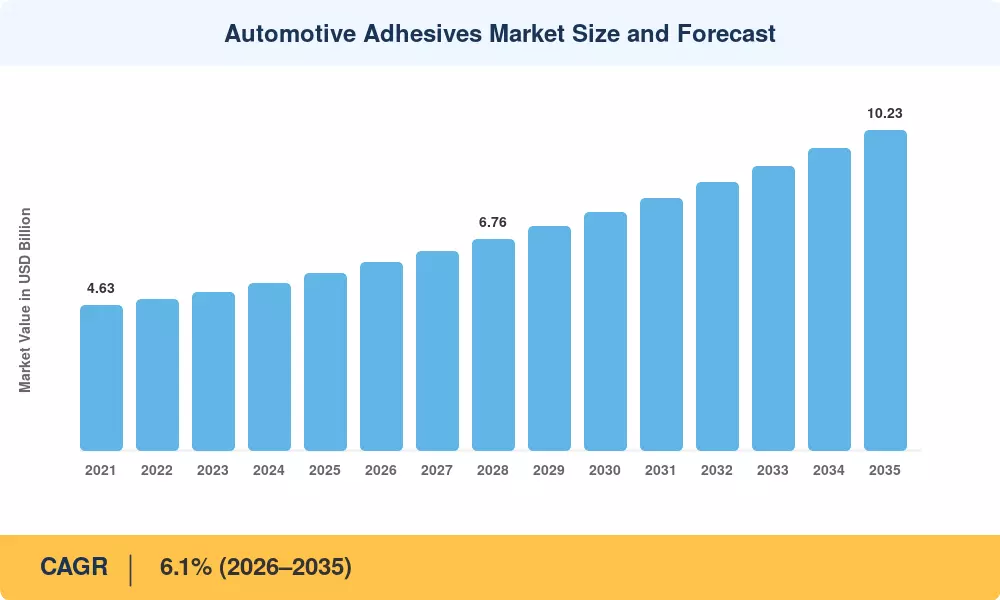
The Automotive Adhesives Market reached an estimated USD 5.66 Billion in 2025 and is projected to grow from USD 6.01 Billion in 2026 to USD 10.23 Billion by 2035, registering a CAGR of 6.1% during the forecast period (2026–2035). Two catalysts anchor this growth trajectory: the global push toward fleet electrification — the International Energy Agency projects over 45 million battery-electric vehicles sold annually by 2030 [1] — and tightening CO₂ emission standards across Europe, China, and North America that compel automakers to reduce vehicle mass by 10–15% over the next decade [2]. Both trends translate directly into higher adhesive intensity per vehicle.
Legacy mechanical fastening — spot welding, bolts, and rivets — is steadily yielding ground to bonding chemistries capable of joining dissimilar substrates such as aluminum-to-carbon-fiber-reinforced-polymer panels. Automakers like BMW, Tesla, and BYD now specify adhesive-bonded body-in-white designs that cut assembly weight while boosting torsional rigidity. The European Commission's Euro 7 proposal and China's Stage 6b emission rules have accelerated investment in mixed-material platforms, and OEM R&D spending on next-generation bonding solutions exceeded USD 1.2 Billion globally in 2024 [3].
Asia-Pacific commands roughly 57% of the Automotive Adhesives Market by volume, driven by China's dominance in cell manufacturing and India's expanding light-vehicle production base. The region also records the fastest CAGR at 6.4%. North America holds the second-largest share at approximately 19.5%, buoyed by the Inflation Reduction Act's domestic-content incentives for EV battery packs. Europe follows closely, concentrating on high-margin specialty grades for premium OEMs. As autonomous-driving sensor modules and solid-state battery architectures introduce new bonding geometries, the Automotive Adhesives Market stands at the front edge of a multi-decade material transition.
Key Report Takeaways
• By Backing Material
- Polyvinyl chloride (PVC) accounted for approximately 36% of 2025 revenue in the Automotive Adhesives Market, reflecting its broad compatibility with exterior trim and underbody protection applications.
- Polypropylene (PP) is forecast to expand at a 6.6% CAGR through 2035, the fastest trajectory among backing materials, propelled by recyclability targets in the EU Packaging & Waste Directive.
• By Adhesive Type
- Acrylic adhesives captured the largest revenue share in 2025 within the Automotive Adhesives Market, supported by UV stability and wide service-temperature performance across steel, aluminum, and composite substrates.
- Epoxy formulations are gaining traction in structural body-in-white joints, with the segment projected to reach USD 1.08 Billion by 2035.
• By Application
- Electronics applications represented the highest growth segment at a 6.7% CAGR, as thermal management, EMI shielding, and wire-harness bonding tasks migrate from mechanical fasteners to specialty tapes.
- Exterior applications held the second-largest value share in 2025, driven by emblem bonding and paint-protection film attachment.
• By Region
- Asia-Pacific commanded a 57% share of the global Automotive Adhesives Market in 2025, underpinned by China and India's combined output exceeding 45 million light vehicles annually.
- North America recorded the second-largest regional share, with domestic EV assembly expansion supporting specialty-grade demand.
Market Size and Forecast (2021–2035)
Market Research Future's proprietary estimation framework combines bottom-up revenue aggregation from over 400 adhesive SKUs with top-down validation against OEM production volume data, customs trade statistics, and publicly reported revenues of profiled companies. Historical figures (2021–2024) draw on verified shipment records; the 2025 base year integrates the latest available data as of Q1 2026. Forecast values (2026–2035) apply a calibrated compound annual growth rate consistent with segment-level demand models.






















.webp?v=1787579604)
