×
Request Free Sample ×

Kindly complete the form below to receive a free sample of this Report

* Please use a valid business email

Leading companies partner with us for data-driven Insights

clients tt-cursor
Hero Background

Automotive Air Flow Meter Market

ID: MRFR/AT/3290-HCR
111 Pages
Swapnil Palwe
October 2025

Automotive Air Flow Meter Market Report by Vehicle Type (Heavy duty vehicle and Light duty vehicle), by Sales Channel (Aftersales market and Original equipment market (OEM)), by Display Type (Analog type and Digital type) and By Region - Global Forecast to 2035

Share:
Download PDF ×

We do not share your information with anyone. However, we may send you emails based on your report interest from time to time. You may contact us at any time to opt-out.

Automotive Air Flow Meter Market Infographic
Purchase Options

Automotive Air Flow Meter Market Summary

As per MRFR analysis, the Automotive Air Flow Meter Market Size was estimated at 1.5 USD Million in 2024. The Automotive Air Flow Meter industry is projected to grow from 1.6 in 2025 to 3.5 by 2035, exhibiting a compound annual growth rate (CAGR) of 8.14 during the forecast period 2025 - 2035.

Key Market Trends & Highlights

The Automotive Air Flow Meter Market is experiencing a dynamic shift driven by technological advancements and increasing environmental awareness.

  • Technological advancements are enhancing the accuracy and efficiency of air flow meters in vehicles.
  • Integration with smart systems is becoming prevalent, allowing for improved vehicle performance and diagnostics.
  • The market is witnessing a shift towards eco-friendly solutions, particularly in the context of rising environmental regulations.
  • Rising demand for fuel efficiency and regulatory pressure for emission reductions are key drivers propelling market growth, especially in North America and the Asia-Pacific region.

Market Size & Forecast

2024 Market Size 1.5 (USD Million)
2035 Market Size 3.5 (USD Million)
CAGR (2025 - 2035) 8.14%

Major Players

Continental AG (DE), Denso Corporation (JP), Bosch (DE), Honeywell International Inc. (US), Aisin Seiki Co., Ltd. (JP), Delphi Technologies (GB), Hitachi Automotive Systems, Ltd. (JP), Marelli Holdings Co., Ltd. (JP), Sensata Technologies, Inc. (US)

Automotive Air Flow Meter Market Trends

The Automotive Air Flow Meter Market is currently experiencing a notable transformation driven by advancements in technology and increasing environmental regulations. As vehicles become more sophisticated, the demand for precise air flow measurement has surged. This trend is largely influenced by the need for improved fuel efficiency and reduced emissions, prompting manufacturers to innovate and enhance their products. Furthermore, the growing popularity of electric and hybrid vehicles is reshaping the market landscape, as these vehicles require specialized air flow management systems to optimize performance. In addition to technological advancements, the Automotive Air Flow Meter Market is also witnessing a shift towards integration with smart vehicle systems. The rise of connected cars has led to an increased focus on data analytics and real-time monitoring, which could potentially enhance vehicle performance and safety. As consumers become more environmentally conscious, the demand for efficient air flow meters that contribute to lower emissions is likely to grow. Overall, the Automotive Air Flow Meter Market appears poised for significant evolution, driven by innovation, regulatory pressures, and changing consumer preferences.

Technological Advancements

The Automotive Air Flow Meter Market is witnessing rapid technological advancements, particularly in sensor technology and data analytics. These innovations enable more accurate measurements and improved vehicle performance, aligning with the industry's push for efficiency.

Integration with Smart Systems

There is a growing trend towards the integration of air flow meters with smart vehicle systems. This integration facilitates real-time data monitoring and analytics, enhancing overall vehicle performance and safety.

Shift Towards Eco-Friendly Solutions

The market is increasingly leaning towards eco-friendly solutions, driven by stringent environmental regulations. Manufacturers are focusing on developing air flow meters that contribute to reduced emissions and improved fuel efficiency.

Automotive Air Flow Meter Market Drivers

Market Growth Projections

The Global Automotive Air Flow Meter Market Industry is poised for substantial growth, with projections indicating a market size of 12.2 USD Billion by 2035. This growth is underpinned by various factors, including increasing demand for fuel-efficient vehicles, stringent emission regulations, and advancements in automotive technologies. The anticipated CAGR of 8.23% from 2025 to 2035 reflects a robust market environment, driven by continuous innovation and evolving consumer preferences. As the automotive industry adapts to these changes, the Global Automotive Air Flow Meter Market Industry is likely to witness significant transformations, positioning itself as a critical component in the future of automotive engineering.

Stringent Emission Regulations

The Global Automotive Air Flow Meter Market Industry is significantly influenced by stringent emission regulations imposed by governments worldwide. These regulations aim to reduce harmful emissions from vehicles, thereby promoting cleaner air quality. As a result, automotive manufacturers are increasingly adopting advanced air flow meters to ensure compliance with these regulations. The market is projected to grow at a CAGR of 8.23% from 2025 to 2035, indicating a robust response to regulatory pressures. By utilizing precise air flow measurement technologies, manufacturers can optimize combustion processes, leading to reduced emissions and improved fuel economy. This regulatory landscape is a key driver for the Global Automotive Air Flow Meter Market Industry.

Increasing Demand for Fuel Efficiency

The Global Automotive Air Flow Meter Market Industry is experiencing a surge in demand driven by the increasing focus on fuel efficiency. As consumers become more environmentally conscious, automakers are compelled to enhance vehicle performance while reducing emissions. This trend is reflected in the projected market size, which is expected to reach 5.1 USD Billion in 2024. The integration of advanced air flow meters plays a crucial role in optimizing engine performance, thereby contributing to lower fuel consumption. Consequently, manufacturers are investing in innovative technologies to meet these evolving consumer preferences, which further propels the growth of the Global Automotive Air Flow Meter Market Industry.

Growth of Electric and Hybrid Vehicles

The rise of electric and hybrid vehicles is a pivotal factor influencing the Global Automotive Air Flow Meter Market Industry. As these vehicles become more prevalent, the demand for advanced air flow measurement technologies is expected to increase. Although electric vehicles primarily rely on electric propulsion, hybrid systems still require efficient air flow management to optimize performance and emissions. The market's growth trajectory, with a projected CAGR of 8.23% from 2025 to 2035, reflects the automotive industry's shift towards sustainable solutions. This transition not only enhances the performance of hybrid vehicles but also aligns with global efforts to reduce carbon footprints, thereby driving the Global Automotive Air Flow Meter Market Industry.

Rising Consumer Awareness and Preferences

Rising consumer awareness regarding vehicle performance and environmental impact is significantly shaping the Global Automotive Air Flow Meter Market Industry. Consumers are increasingly seeking vehicles that offer better fuel efficiency and lower emissions, prompting manufacturers to invest in advanced air flow meter technologies. This shift in consumer preferences is leading to a more competitive market landscape, where companies are compelled to innovate and enhance their product offerings. As the market evolves, the anticipated growth to 5.1 USD Billion in 2024 highlights the importance of aligning product development with consumer expectations. This trend underscores the critical role of consumer awareness in driving the Global Automotive Air Flow Meter Market Industry.

Technological Advancements in Automotive Sensors

Technological advancements in automotive sensors are reshaping the Global Automotive Air Flow Meter Market Industry. Innovations such as digital air flow meters and enhanced sensor technologies are enabling more accurate measurements and improved vehicle performance. These advancements not only enhance the efficiency of internal combustion engines but also support the transition towards electric and hybrid vehicles. As the market evolves, the integration of smart technologies is expected to drive further growth. The anticipated market expansion to 12.2 USD Billion by 2035 underscores the importance of these technological developments in meeting consumer demands and regulatory requirements within the Global Automotive Air Flow Meter Market Industry.

Market Segment Insights

By Application: Passenger Vehicle (Largest) vs. Heavy-Duty Vehicle (Fastest-Growing)

The automotive air flow meter market is prominently shaped by its application segments, with passenger vehicles holding the largest share. This segment dominates the market due to the high demand for fuel-efficient and innovative technologies in personal transportation. Commercial vehicles, including trucks and buses, follow closely; however, they play a crucial role given the rising focus on emissions reduction. Motorcycles and heavy-duty vehicles contribute to the market but represent smaller portions overall. In recent years, the heavy-duty vehicle segment has emerged as the fastest-growing application in the automotive air flow meter market. Factors such as increasing regulations on emissions and fuel efficiency have propelled this growth, prompting manufacturers to innovate in air flow meter technologies. Additionally, the surge in logistics and freight transportation underscores the need for advanced air flow management solutions to enhance performance and meet stringent regulatory standards.

Passenger Vehicle (Dominant) vs. Motorcycle (Emerging)

In the automotive air flow meter market, the passenger vehicle segment stands as the dominant application due to its extensive production and consumer demand for enhanced vehicle performance. Passenger vehicles typically incorporate sophisticated air flow meters to optimize engine performance, promote fuel efficiency, and reduce emissions. Meanwhile, the motorcycle segment is emerging as a noteworthy player due to increasing popularity and demand for more efficient and powerful two-wheelers. Motorcycles are being designed with advanced technologies that necessitate precise air flow measurements, thus creating a growing market for air flow meters tailored to this segment. Innovations in motorcycle design, aimed at improving performance and reducing environmental impact, are essential for this segment's continued growth and relevance in the overall market.

By Type: Mass Air Flow Meter (Largest) vs. Volumetric Air Flow Meter (Fastest-Growing)

The Automotive Air Flow Meter Market exhibits a diverse landscape characterized by several key types of air flow meters. Among these, the Mass Air Flow Meter holds the largest market share due to its widespread application in various automotive vehicles. Its reliable performance in measuring air mass flow has positioned it as a preferred choice among manufacturers. On the other hand, the Volumetric Air Flow Meter is emerging rapidly, gaining traction as automotive industries shift towards more precise fuel management systems, enhancing engine efficiency and emissions control. In terms of growth trends, the Mass Air Flow Meter continues to dominate, driven by increasing demand for fuel-efficient vehicles. Additionally, technological advancements are shaping the market dynamics, with manufacturers continuously innovating to improve accuracy and reliability. Meanwhile, the Volumetric Air Flow Meter is projected to experience the fastest growth, spurred by the rising adoption of electric vehicles and stringent emissions regulations, encouraging shifts towards more sophisticated airflow measurement solutions.

Mass Air Flow Meter (Dominant) vs. Thermal Air Flow Meter (Emerging)

The Mass Air Flow Meter remains the dominant player in the Automotive Air Flow Meter Market, recognized for its robustness and accurate measurement of air mass flow. It is extensively utilized in gasoline and diesel engines, making it an integral component in enhancing fuel efficiency and optimizing engine performance. On the other hand, the Thermal Air Flow Meter, while emerging, is gaining popularity due to its compact size and ability to provide rapid response times. It is particularly suited for specific applications within automotive systems such as intake air management and exhaust gas recirculation. As trends shift towards lightweight and efficient designs, the Thermal Air Flow Meter's capabilities align well with the evolving needs of modern vehicles, positioning it as a promising option in the industry.

By Fuel Type: Gasoline (Largest) vs. Diesel (Fastest-Growing)

The Automotive Air Flow Meter Market shows a substantial split in its fuel type segments, with gasoline dominating the market share. Gasoline air flow meters are preferred for their widespread application in conventional vehicles, thus holding the largest market share. Diesel, on the other hand, is emerging with increased adoption in commercial vehicles, driven by a focus on fuel efficiency and lower emissions, making it a significant contender for market growth. In terms of growth trends, the diesel segment is rapidly gaining traction, especially with rising fuel prices and stringent emission regulations. As consumers and manufacturers pivot towards more efficient and sustainable solutions, alternative fuel and hybrid segments are also picking up pace, albeit at a slower rate compared to diesel. The overall shift towards greener technologies in the automotive sector is set to shape future demand for air flow meters across these segments.

Gasoline (Dominant) vs. Alternative Fuel (Emerging)

Gasoline remains the dominant fuel type in the Automotive Air Flow Meter Market due to its longstanding presence in personal and commercial vehicles. Its system simplicity and compatibility with existing automotive technologies make it continue to lead consumer preference. Conversely, the alternative fuel segment is emerging steadily, driven by the global shift towards sustainable energy solutions. This includes electric vehicles and biofuels, which are becoming increasingly prevalent. Alternative fuels often require specialized air flow meters for optimized performance, indicating a growing market for innovation. As regulations tighten regarding emissions, manufacturers are investing in alternative fuel technologies, positioning themselves to capitalize on a market that is likely to expand significantly in the upcoming years.

By Technology: Digital (Largest) vs. Smart (Fastest-Growing)

In the Automotive Air Flow Meter Market, the technology segment shows a clearly defined landscape with digital technology holding the largest market share. Digital air flow meters are favored for their accuracy, reliability, and advanced features, making them the preferred choice for most automotive applications. Analog technology has steadily declined in popularity due to the increasing preference for more sophisticated digital solutions. Meanwhile, the emerging smart air flow meters, equipped with connectivity and IoT capabilities, are capturing attention and expanding their share in the market.

Technology: Digital (Dominant) vs. Smart (Emerging)

Digital air flow meters dominate the Automotive Air Flow Meter Market due to their precision and integration with modern automotive systems. As vehicles become increasingly reliant on electronic systems for operation, the need for accurate air flow measurement has prompted manufacturers to adopt digital solutions extensively. On the other hand, smart air flow meters are emerging as a transformative force with their ability to connect to networks and provide real-time data analysis. This trend is driven by the automotive industry's shift towards electrification and enhanced vehicle performance, making smart technology a key focus for future innovations.

By End Use: OEM (Largest) vs. Aftermarket (Fastest-Growing)

In the Automotive Air Flow Meter Market, the OEM segment holds the largest share, dominating the market due to its established relationships with automotive manufacturers and the increasing demand for advanced vehicle technologies. This segment benefits from a steady vehicle production rate and the ongoing innovations in fuel efficiency and emissions control, leading to a dominant position. Meanwhile, the Aftermarket segment, although smaller in comparison, is experiencing rapid growth as vehicle owners increasingly seek replacements and upgrades for their air flow meters to enhance performance and fuel economy in older models. This trend has made the aftermarket segment the fastest-growing area within the market.

End Use: OEM (Dominant) vs. Aftermarket (Emerging)

The OEM segment is characterized by long-term contracts with major automotive manufacturers, ensuring a stable demand for air flow meters as part of new vehicle assembly. This segment typically benefits from technological advancements driven by regulatory compliance, making it resilient to market fluctuations. The Aftermarket segment, on the other hand, is marked by a diverse range of products catering to various vehicle models, including aftermarket parts that enhance performance and efficiency. This segment appeals to DIY enthusiasts and fleet operators, showing a vibrant growth trajectory as vehicle owners look to optimize their older vehicles by replacing OEM components with high-performance alternatives. As the aftermarket evolves, it is attracting more players entering the market with innovative solutions.

Get more detailed insights about Automotive Air Flow Meter Market

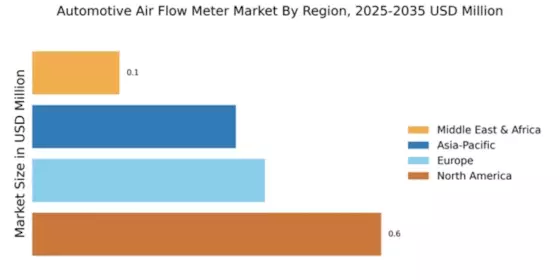
Regional Insights

North America : Market Leader in Innovation

North America is poised to maintain its leadership in the automotive air flow meter market, holding a significant 75% market share as of 2024. The region's growth is driven by increasing vehicle production, stringent emissions regulations, and a shift towards fuel-efficient technologies. The demand for advanced air flow meters is further fueled by the rising adoption of electric vehicles (EVs) and hybrid models, which require precise air management systems to optimize performance and efficiency. The competitive landscape in North America is robust, featuring key players such as Honeywell International Inc., Continental AG, and Sensata Technologies, Inc. These companies are investing heavily in R&D to innovate and enhance product offerings. The presence of established automotive manufacturers in the U.S. and Canada also supports market growth, as they increasingly integrate advanced air flow meters into their vehicles to meet regulatory standards and consumer expectations.

Europe : Emerging Market with Regulations

Europe is emerging as a significant player in the automotive air flow meter market, with a market share of 40% as of 2024. The region's growth is primarily driven by stringent environmental regulations aimed at reducing emissions and enhancing fuel efficiency. The European Union's commitment to sustainability and the transition to electric vehicles are key catalysts for demand, as manufacturers seek to comply with regulations while meeting consumer expectations for greener technologies. Leading countries in this market include Germany, France, and the UK, where major automotive manufacturers are based. Companies like Bosch and Denso Corporation are at the forefront, leveraging advanced technologies to develop innovative air flow meters. The competitive landscape is characterized by collaborations and partnerships among manufacturers to enhance product offerings and meet regulatory requirements. "The automotive industry is undergoing a transformation towards sustainability, and air flow meters play a crucial role in this shift," states a report from the European Commission.

Asia-Pacific : Rapid Growth and Adoption

Asia-Pacific is witnessing rapid growth in the automotive air flow meter market, holding a 25% market share as of 2024. The region's expansion is driven by increasing vehicle production, rising disposable incomes, and a growing middle class. Countries like China and India are leading this growth, with a surge in demand for personal vehicles and a focus on improving fuel efficiency and emissions standards. Government initiatives promoting electric vehicles further bolster market demand for advanced air flow meters. The competitive landscape in Asia-Pacific is dynamic, with key players such as Denso Corporation and Hitachi Automotive Systems leading the charge. These companies are focusing on innovation and technology to enhance product performance. The presence of numerous automotive manufacturers in the region creates a competitive environment, pushing for advancements in air flow meter technology to meet the evolving needs of consumers and regulatory standards.

Middle East and Africa : Niche Market with Potential

The Middle East and Africa represent a niche market in the automotive air flow meter sector, with a market share of only 5% as of 2024. However, the region is gradually emerging as a potential growth area due to increasing vehicle ownership and a focus on improving fuel efficiency. The demand for air flow meters is expected to rise as governments implement stricter emissions regulations and promote sustainable automotive technologies. The growth of the automotive sector in countries like South Africa and the UAE is also contributing to this trend. Despite its smaller market size, the competitive landscape is evolving, with both local and international players looking to capitalize on emerging opportunities. Companies are beginning to invest in R&D to develop products tailored to the unique needs of the region. As the automotive industry in the Middle East and Africa matures, the demand for advanced air flow meters is likely to increase significantly, driven by both regulatory and consumer pressures.

Key Players and Competitive Insights

The Automotive Air Flow Meter Market is currently characterized by a dynamic competitive landscape, driven by technological advancements and increasing demand for fuel-efficient vehicles. Key players such as Continental AG (DE), Denso Corporation (JP), and Bosch (DE) are at the forefront, each adopting distinct strategies to enhance their market positioning. Continental AG (DE) focuses on innovation in sensor technology, aiming to improve the accuracy and efficiency of air flow measurement systems. Meanwhile, Denso Corporation (JP) emphasizes regional expansion, particularly in emerging markets, to capitalize on the growing automotive sector. Bosch (DE) is heavily investing in digital transformation, integrating AI and IoT capabilities into their products, which collectively shapes a competitive environment that is increasingly reliant on technological prowess and adaptability.

In terms of business tactics, companies are localizing manufacturing to reduce costs and optimize supply chains, which is particularly crucial in a moderately fragmented market. The collective influence of these key players fosters a competitive structure where innovation and operational efficiency are paramount. This approach not only enhances product offerings but also ensures responsiveness to market demands, thereby solidifying their positions in the Automotive Air Flow Meter Market.

In November 2025, Denso Corporation (JP) announced a strategic partnership with a leading electric vehicle manufacturer to develop advanced air flow meters tailored for electric powertrains. This collaboration is significant as it aligns with the growing trend towards electrification in the automotive industry, positioning Denso as a key player in the evolving market landscape. The partnership is expected to enhance Denso's product portfolio and strengthen its foothold in the electric vehicle segment.

In October 2025, Bosch (DE) unveiled a new line of air flow meters equipped with AI-driven analytics capabilities. This launch is indicative of Bosch's commitment to integrating cutting-edge technology into its offerings, thereby enhancing the functionality and efficiency of its products. The incorporation of AI not only improves performance but also provides valuable data insights, which could be a game-changer in optimizing vehicle performance and emissions control.

In December 2025, Continental AG (DE) revealed plans to invest €100 million in expanding its manufacturing capabilities in Eastern Europe. This strategic move aims to bolster production capacity and meet the rising demand for air flow meters in the region. By enhancing its manufacturing footprint, Continental is likely to improve supply chain reliability and reduce lead times, which are critical factors in maintaining competitiveness in the market.

As of December 2025, the Automotive Air Flow Meter Market is witnessing trends such as digitalization, sustainability, and AI integration, which are reshaping competitive dynamics. Strategic alliances are becoming increasingly prevalent, allowing companies to leverage complementary strengths and enhance innovation. Looking ahead, competitive differentiation is expected to evolve from traditional price-based competition to a focus on technological innovation, reliability, and sustainable practices. This shift underscores the importance of adapting to market changes and consumer preferences, ensuring that companies remain relevant in a rapidly changing landscape.

Key Companies in the Automotive Air Flow Meter Market market include

Industry Developments

Emerson has announced the release of a new Micro Motion Coriolis flowmeter for high-pressure hydrogen dispensing and chemical injection applications. It can measure gas mass flow with a flow accuracy margin of 0.5 percent and liquid mass flow with a margin of 0.1 percent.

The Sensyflow FMT700-P Compact thermal mass flow meter was introduced by ABB. The P-Compact is used to evaluate the performance of hydrogen fuel cells as well as typical turbochargers and components such as throttle valves, intake fans, and air filters.

Automotive Air Flow Meter Market Report Outlook

The research gives an analytical portrayal of the airflow sensor market, as well as current trends and future projections, to identify potential investment opportunities. The research discusses the market's major drivers, constraints, opportunities, and challenges, as well as the market's key drivers, restraints, and opportunities. To highlight the automotive mass airflow meter market growth scenario, the existing market is statistically examined. 

The study examines the airflow meter market in-depth, focusing on competitive intensity and how the market will evolve in the future years. Flow meters are rapidly being utilized in coal-fired, fuel oil and natural gas, hydroelectric, geothermal, and nuclear power plants due to their numerous advantages.

Future Outlook

Automotive Air Flow Meter Market Future Outlook

The Automotive Air Flow Meter Market is projected to grow at 8.14% CAGR from 2024 to 2035, driven by advancements in automotive technology and increasing fuel efficiency regulations.

New opportunities lie in:

  • Integration of advanced sensor technologies for enhanced accuracy
  • Development of compact air flow meters for electric vehicles
  • Expansion into emerging markets with tailored product offerings

By 2035, the market is expected to achieve robust growth, driven by innovation and strategic expansion.

Market Segmentation

Automotive Air Flow Meter Market Type Outlook

  • Mass Air Flow Meter
  • Volumetric Air Flow Meter
  • Thermal Air Flow Meter
  • Karman Vortex Air Flow Meter

Automotive Air Flow Meter Market End Use Outlook

  • OEM
  • Aftermarket

Automotive Air Flow Meter Market Fuel Type Outlook

  • Gasoline
  • Diesel
  • Alternative Fuel
  • Hybrid

Automotive Air Flow Meter Market Technology Outlook

  • Digital
  • Analog
  • Smart

Automotive Air Flow Meter Market Application Outlook

  • Passenger Vehicle
  • Commercial Vehicle
  • Motorcycle
  • Heavy-Duty Vehicle

Report Scope

MARKET SIZE 20241.5(USD Million)
MARKET SIZE 20251.6(USD Million)
MARKET SIZE 20353.5(USD Million)
COMPOUND ANNUAL GROWTH RATE (CAGR)8.14% (2024 - 2035)
REPORT COVERAGERevenue Forecast, Competitive Landscape, Growth Factors, and Trends
BASE YEAR2024
Market Forecast Period2025 - 2035
Historical Data2019 - 2024
Market Forecast UnitsUSD Million
Key Companies ProfiledContinental AG (DE), Denso Corporation (JP), Bosch (DE), Honeywell International Inc. (US), Aisin Seiki Co., Ltd. (JP), Delphi Technologies (GB), Hitachi Automotive Systems, Ltd. (JP), Marelli Holdings Co., Ltd. (JP), Sensata Technologies, Inc. (US)
Segments CoveredApplication, Type, Fuel Type, Technology, End Use
Key Market OpportunitiesIntegration of advanced sensors for enhanced fuel efficiency and emissions control in the Automotive Air Flow Meter Market.
Key Market DynamicsTechnological advancements in sensor accuracy and efficiency drive competitive dynamics in the Automotive Air Flow Meter Market.
Countries CoveredNorth America, Europe, APAC, South America, MEA

Market Highlights

Author
Swapnil Palwe
Team Lead - Research

With a technical background as Bachelor's in Mechanical Engineering, with MBA in Operations Management , Swapnil has 6+ years of experience in market research, consulting and analytics with the tasks of data mining, analysis, and project execution. He is the POC for our clients, for their consulting projects running under the Automotive/A&D domain. Swapnil has worked on major projects in verticals such as Aerospace & Defense, Automotive and many other domain projects. He has worked on projects for fortune 500 companies' syndicate and consulting projects along with several government projects.

Leave a Comment

FAQs

At what CAGR can the automotive air flow meter market expand?

The automotive air flow meter market can expand at 8% CAGR by 2030.

What is the estimated valuation for the automotive air flow meter market?

MRFR study reveals that the automotive air flow meter market can attain a considerable value of USD 8,290 Million by 2030.

Who are the key players of the automotive air flow meter market?

Mitsubishi Motors Corporation (Japan), Nissan Motor Co., Ltd. (Japan), K&N Engineering, Inc. (U.S), and FLIR Systems (U.S) are some well-established companies in the automotive air flow meter market.

What is the automotive air flow meter market growth driver?

The growing utility of automotive air flow meter in the automobile industry can encourage the market expansion.

What is the regional analysis of the automotive air flow meter market?

In APAC, air pollution is seriously impacting lives of people, which is encouraging the need for automotive air flow meter. Thus, can impel the regional market expansion.

Download Free Sample

Kindly complete the form below to receive a free sample of this Report

Compare Licence

×
Features License Type
Single User Multiuser License Enterprise User
Price $4,950 $5,950 $7,250
Maximum User Access Limit 1 User Upto 10 Users Unrestricted Access Throughout the Organization
Free Customization
Direct Access to Analyst
Deliverable Format
Platform Access
Discount on Next Purchase 10% 15% 15%
Printable Versions