×
Hero Background
English
Chinese
French
Japanese
Korean
German
Spanish

Automotive Evaporative Emission Control System Market Trends

ID: MRFR/AT/8615-HCR
130 Pages
Sejal Akre
October 2025

Automotive Evaporative Emission Control System (EVAP) Market Research Report Information by Part (Fuel Tank, Vent Hoses, Purge Valve/Sensor, EVAP Canister, Fuel Tank Pressure Sensor, Liquid-vapor Separator, Fuel Level Sensor and Gas Cap), by Vehicle Type (Passenger Vehicle, Light Commercial Vehicle, Heavy Commercial Vehicle and Two-wheelers), by Distribution Channel (OEM and Aftermarket) and Region (North America, Europe, Asia-Pacific and Rest of the World) - Forecast till 2035

Share:
Download PDF ×

We do not share your information with anyone. However, we may send you emails based on your report interest from time to time. You may contact us at any time to opt-out.

Automotive Evaporative Emission Control System Market Infographic
Purchase Options

Market Trends

Key Emerging Trends in the Automotive Evaporative Emission Control System Market

The Automotive Evaporative Emission Control System (EVAP) market is a dynamic place where companies employ different approaches for winning a larger share of this highly competitive field. This involves developing unique features or characteristics about their EVAP systems hence differentiating them from those produced by other manufacturers. Companies do this by incorporating cutting-edge technologies such as better leak detection or enhanced fuel vapor recovery which helps them stand out in a highly crowded space. Prominent among these are environment-sensitive consumers who find it easier to be identified with products which are ahead of their time.

Another strategy is cost leadership whereby companies focus on producing EVAP systems at a lower cost without sacrificing quality and this enables them to offer competitive prices in the market thereby attracting more consumers. Companies achieve cost leadership through economies of scale, efficient production processes, and strategic supplier alliances. In addition, the provision of affordable solutions allows businesses to take up larger proportion of the market especially in price sensitive markets.

Furthermore, market segmentation is a common positioning strategy used by companies in the Automotive EVAP industry besides differentiation as aforementioned. Knowledge about various customer segments’ distinct needs enables a company to tailor products according to specific preferences. For example, some customers value fuel efficiency while others are concerned about environmental friendliness. This creates an opportunity for differentiating EVAP systems targeting each niche market that they serve well.

Moreover, geographical expansion is an important strategy for firms seeking to grow their share of the Automotive EVAP market. Demand for emission control systems differs across regions due to variations in regulations, environmental concerns and technological choices. Companies therefore develop their products specifically to meet different regional requirements based on certain reasons. For instance, if one enters into highly demanding regions around the globe with expansions like these companies can grab more global pie.

The automotive industry employs a dynamic approach that entails constant innovative ideas and adjustments in relation to dynamic technologies, which are critical determinants of market share position within the Automotive EVAP Industry. With an increasingly progressive automotive sector, those who keep up with these innovation and laws changes will have an advantage over their competitors since they will be able to satisfy customer needs. This suppleness allows them to exploit emerging prospects, keeping one step ahead of their rivals.


Author
Sejal Akre
Senior Research Analyst

She has over 5 years of rich experience, in market research and consulting providing valuable market insights to client. Hands on expertise in management consulting, and extensive knowledge in domain including ICT, Automotive & Transportation and Aerospace & Defense. She is skilled in Go-to market strategy, industry analysis, market sizing, in depth company profiling, competitive intelligence & benchmarking and value chain amongst others.

Leave a Comment

FAQs

At what CAGR is the global automotive evaporative emission control system (EVAP) market predicted to grow during the forecast period?

The global automotive evaporative emission control system (EVAP) market is predicted to grow at a 4% CAGR between 2023- 2030.

Who are the key contenders profiled in the global automotive evaporative emission control system (EVAP) market?

Key contenders profiled in the global automotive evaporative emission control system (EVAP) market include SenTec Group (Switzerland), The Plastic Omnium Group, Eagle Industry Co., Ltd., Delphi Technologies, TI Automotive, Plastic Fuel Systems, Didac International, Padmini VNA Mechatronics Pvt Ltd , Stant Corporation, Robert Bosch GmbH, Okay Motor Products Hangzhou Inc., and Standard Motor Products Inc..

What are the key factors driving the global automotive evaporative emission control system (EVAP) market?

Demand for eco-friendly cars is driving the global automotive evaporative emission control system (EVAP) market growth.

Which region will lead the global automotive evaporative emission control system (EVAP) market?

Asia Pacific will lead the automotive evaporative emission control system (EVAP) market.

Market Summary

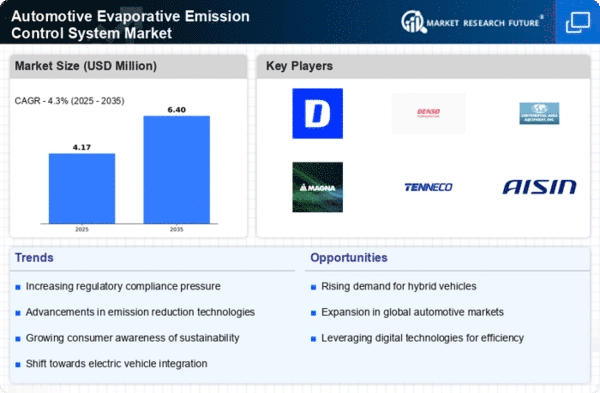
As per MRFR analysis, the Automotive Evaporative Emission Control System Market was estimated at 4.0 USD Million in 2024. The Automotive Evaporative Emission Control System industry is projected to grow from 4.2 in 2025 to 6.4 by 2035, exhibiting a compound annual growth rate (CAGR) of 4.3 during the forecast period 2025 - 2035.

Key Market Trends & Highlights

The Automotive Evaporative Emission Control System Market is poised for growth driven by regulatory compliance and technological advancements.

  • North America remains the largest market for automotive evaporative emission control systems, reflecting robust regulatory frameworks.
  • Asia-Pacific is emerging as the fastest-growing region, driven by increasing vehicle production and environmental awareness.
  • The fuel system segment continues to dominate the market, while the evaporative emission control system segment is experiencing rapid growth.
  • Key market drivers include stringent regulatory compliance and rising consumer demand for sustainability, alongside government incentives.

Market Size & Forecast

2024 Market Size 4.0 (USD Million)
2035 Market Size 6.4 (USD Million)
CAGR (2025 - 2035) 4.3%
Largest Regional Market Share in 2024 North America

Major Players

<p>Delphi Technologies (GB), Denso Corporation (JP), Continental AG (DE), Magna International Inc. (CA), Tenneco Inc. (US), Aisin Seiki Co., Ltd. (JP), Valeo SA (FR), Bosch (DE), Hitachi Automotive Systems (JP)</p>

Market Trends

The Automotive Evaporative Emission Control System Market is currently experiencing a notable transformation driven by increasing environmental regulations and consumer awareness regarding vehicle emissions. As governments worldwide implement stricter standards to mitigate air pollution, manufacturers are compelled to innovate and enhance their emission control technologies. This shift not only aligns with regulatory compliance but also caters to a growing consumer demand for greener vehicles. Consequently, the market is witnessing a surge in research and development activities aimed at improving the efficiency and effectiveness of evaporative emission control systems. Moreover, advancements in technology are playing a pivotal role in shaping the Automotive Evaporative Emission Control System Market. The integration of smart technologies, such as sensors and data analytics, is enabling manufacturers to develop more sophisticated systems that can monitor and manage emissions in real-time. This trend suggests a potential for increased collaboration between automotive manufacturers and technology firms, fostering innovation and enhancing product offerings. As the market evolves, it appears that the focus will remain on sustainability and efficiency, driving further advancements in emission control solutions.

Regulatory Compliance and Innovation

The Automotive Evaporative Emission Control System Market is increasingly influenced by stringent environmental regulations. Manufacturers are innovating to meet these standards, leading to the development of advanced emission control technologies.

Technological Integration

The incorporation of smart technologies, such as sensors and data analytics, is transforming the Automotive Evaporative Emission Control System Market. This trend enhances real-time monitoring and management of emissions, promoting efficiency.

Consumer Demand for Sustainability

There is a growing consumer preference for environmentally friendly vehicles, which is impacting the Automotive Evaporative Emission Control System Market. This shift is prompting manufacturers to prioritize sustainable practices and products.

Automotive Evaporative Emission Control System Market Market Drivers

Rising Fuel Prices

The escalation of fuel prices has a profound impact on the Global Automotive Evaporative Emission Control System Market Industry. As fuel costs rise, consumers are increasingly seeking vehicles that offer better fuel efficiency and lower emissions. This demand drives manufacturers to enhance their evaporative emission control systems, ensuring that vehicles not only comply with regulations but also provide economic benefits to consumers. The market's growth trajectory is likely to be influenced by this trend, as automakers prioritize the development of systems that optimize fuel usage while minimizing environmental impact.

Technological Advancements

Technological innovations play a crucial role in shaping the Global Automotive Evaporative Emission Control System Market Industry. The development of advanced materials and smart technologies enhances the efficiency of evaporative emission control systems. For example, the integration of sensors and electronic controls allows for real-time monitoring and optimization of emissions. These advancements not only improve vehicle performance but also contribute to environmental sustainability. As manufacturers increasingly adopt these technologies, the market is expected to grow at a CAGR of 4.0% from 2025 to 2035, indicating a robust trajectory driven by continuous innovation.

Growing Environmental Awareness

Increasing environmental consciousness among consumers is a significant driver for the Global Automotive Evaporative Emission Control System Market Industry. As awareness of climate change and air pollution rises, consumers are demanding cleaner and more efficient vehicles. This shift in consumer preference encourages automakers to invest in advanced evaporative emission control systems that minimize harmful emissions. Consequently, the market is anticipated to expand, with projections indicating a growth to 134.3 USD Billion by 2035. This trend underscores the importance of aligning product offerings with consumer values and environmental goals.

Regulatory Compliance and Standards

The Global Automotive Evaporative Emission Control System Market Industry is significantly influenced by stringent regulatory frameworks aimed at reducing vehicular emissions. Governments worldwide are implementing regulations that mandate the use of advanced emission control technologies in vehicles. For instance, the European Union's Euro 6 standards and the U.S. EPA regulations require manufacturers to integrate efficient evaporative emission control systems. This regulatory pressure drives innovation and investment in the sector, as companies strive to meet compliance requirements. As a result, the market is projected to reach 87.3 USD Billion in 2024, reflecting the industry's adaptation to these evolving standards.

Expansion of Electric Vehicle Market

The burgeoning electric vehicle (EV) market is reshaping the Global Automotive Evaporative Emission Control System Market Industry. As the automotive landscape transitions towards electrification, the demand for traditional internal combustion engine vehicles is expected to decline. However, the need for effective evaporative emission control systems remains relevant, particularly in hybrid vehicles. This transition presents opportunities for manufacturers to innovate and adapt their technologies to meet the evolving market demands. The industry must navigate this shift while maintaining compliance with emission standards, ensuring that the market continues to thrive in the face of changing consumer preferences.

Market Segment Insights

By Application: Fuel System (Largest) vs. Evaporative Emission Control System (Fastest-Growing)

<p>In the Automotive Evaporative Emission Control System Market, the Fuel System holds the largest market share, driven by its critical role in optimizing fuel efficiency and meeting stringent emission regulations. The segment benefits from technological advancements and a growing emphasis on sustainability, making it a key focus area for manufacturers. Meanwhile, the Evaporative Emission Control System is rapidly gaining traction, benefiting from increasing regulatory pressures and a greater awareness of environmental impacts associated with vehicle emissions.</p>

<p>Fuel System (Dominant) vs. Exhaust System (Emerging)</p>

<p>The Fuel System is a dominant player in the Automotive Evaporative Emission Control System Market due to its essential function in managing the delivery and storage of fuel, thereby ensuring optimal engine performance and compliance with emissions standards. It encompasses components such as fuel injectors and pumps, which are integral to enhancing vehicle efficiency. Conversely, the Exhaust System is emerging as a significant component of the segment, focusing on after-treatment solutions to reduce harmful emissions. Innovations in catalytic converters and particulate filters are vital for its growth, aligning with the global shift toward cleaner automobiles.</p>

By End Use: Passenger Vehicles (Largest) vs. Commercial Vehicles (Fastest-Growing)

<p>The Automotive Evaporative Emission Control System Market showcases a distinct market share distribution among its segments. Passenger vehicles dominate the market significantly, reflecting the high volume of personal transportation globally. In contrast, commercial vehicles, while smaller in share, exhibit a rapidly growing demand driven by the expanding logistics and transportation industry, which seeks to comply with stringent emissions regulations. This distribution underscores the importance of personal and commercial mobility in shaping the market landscape.</p>

<p>Passenger Vehicles (Dominant) vs. Commercial Vehicles (Emerging)</p>

<p>Passenger vehicles occupy a dominant position in the Automotive Evaporative Emission Control System Market due to their sheer numbers and the growing consumer preference for environmentally friendly vehicles. This segment leverages advanced evaporative emission technologies to meet regulatory standards, thereby enhancing vehicle performance and sustainability. On the other hand, commercial vehicles represent an emerging segment driven by regulatory pressures and a shift towards greener fleets. The growth in e-commerce and delivery services has accelerated the adoption of efficient emission control systems within this segment, highlighting the critical role both segments play in the overall market evolution.</p>

By Component Type: Charcoal Canister (Largest) vs. Purge Valve (Fastest-Growing)

<p>The Automotive Evaporative Emission Control System Market is segmented into several key component types, with the charcoal canister taking the lead as the largest segment. This component is essential in capturing fuel vapors and preventing them from escaping into the atmosphere. Following closely are the purge valve and fuel tank pressure sensor, both playing crucial roles in the emission control process. While the charcoal canister dominates in market share, the purge valve is gaining traction due to its rapid adoption in newer vehicle models as emissions regulations become stricter. Growth trends for the component type segment are driven by increasing regulations concerning vehicle emissions and the global push towards sustainability. The charcoal canister is a technological staple, while the purge valve has shown significant potential for growth, especially as electric and hybrid vehicles gain popularity. The demand for technological advancement in emissions control is propelling innovation and market expansion, making it a critical segment of the automotive industry.</p>

<p>Charcoal Canister (Dominant) vs. Vent Valve (Emerging)</p>

<p>The charcoal canister remains the dominant component in the automotive evaporative emission control system due to its essential function in vapor recovery and environmental compliance. It effectively captures and holds fuel vapors over a vehicle's lifespan, contributing significantly to reduced emissions. In contrast, the vent valve is emerging as a critical component, facilitating the release of trapped vapors back into the intake system when needed. This shift towards more integrated systems aligns with the automotive industry’s trends toward efficiency and sustainability, making both components vital. As vehicles evolve towards electrification and stricter emission standards, the importance of these components in achieving compliance and efficiency will only increase, showcasing their distinct but complementary roles in the market.</p>

By Fuel Type: Gasoline (Largest) vs. Alternative Fuels (Fastest-Growing)

<p>The Automotive Evaporative Emission Control System Market exhibits a diverse distribution in fuel type segmentation, prominently featuring gasoline, diesel, and alternative fuels. Gasoline leads the market, leveraging its widespread use in traditional vehicles, while diesel continues to maintain a significant portion due to its efficiency and fuel economy. Meanwhile, alternative fuels are carving out a notable presence, driven by advancements in technology and changing consumer preferences towards greener solutions.</p>

<p>Gasoline (Dominant) vs. Alternative Fuels (Emerging)</p>

<p>Gasoline remains the dominant fuel type in the Automotive Evaporative Emission Control System Market, attributed to its entrenched infrastructure and widespread acceptance among consumers. Vehicles using gasoline typically exhibit familiarity and established performance metrics. Alternatively, alternative fuels are emerging rapidly, becoming an attractive option for environmentally conscious consumers and manufacturers looking to comply with emission regulations. This segment includes biofuels, electricity, and hydrogen options, each supported by growing investments and innovations. Collectively, these alternative solutions are set to redefine market dynamics, driven by government policies favoring cleaner energy sources and technological advancements aimed at improving performance and affordability.</p>

By Vehicle Type: Internal Combustion Engine (Largest) vs. Electric Vehicles (Fastest-Growing)

<p>In the Automotive Evaporative Emission Control System Market, the Internal Combustion Engine (ICE) segment remains the largest, driven by its long-standing dominance in the automotive industry. Despite a gradual shift towards more sustainable solutions, ICE vehicles still comprise a significant portion of sales, supported by established infrastructure and consumer preferences. On the other hand, the Electric Vehicles (EV) segment is rapidly gaining traction, reflecting changing consumer attitudes and increasing environmental regulations that favor low-emission alternatives.</p>

<p>Internal Combustion Engine (Dominant) vs. Electric Vehicles (Emerging)</p>

<p>The Internal Combustion Engine segment continues to assert its dominance due to extensive market familiarity and technological advancements that optimize performance and emissions. However, the Electric Vehicles segment is emerging as a compelling force, propelled by innovations in battery technologies and heightened awareness of climate change impacts. As automakers pivot towards electrification, the demand for efficient evaporative emission control systems in EVs is on the rise, indicating a significant shift in the automotive landscape. This trend highlights the challenges and opportunities for EV manufacturers to incorporate advanced emissions control features, positioning them to meet future regulatory standards and consumer expectations.</p>

Get more detailed insights about Automotive Evaporative Emission Control System (EVAP) Market Research Report - Global Forecast till 2035

Regional Insights

North America : Market Leader in Emission Control

North America is poised to maintain its leadership in the Automotive Evaporative Emission Control System market, holding a significant market share of 2.0 in 2024. The region's growth is driven by stringent environmental regulations and a shift towards electric vehicles, which necessitate advanced emission control technologies. Additionally, increasing consumer awareness regarding air quality and emissions is propelling demand for efficient systems. The competitive landscape in North America is robust, featuring key players such as Delphi Technologies, Denso Corporation, and Tenneco Inc. These companies are investing heavily in R&D to innovate and enhance their product offerings. The presence of major automotive manufacturers further strengthens the market, as they seek to comply with regulatory standards while meeting consumer expectations for sustainability and performance.

Europe : Regulatory-Driven Market Growth

Europe is experiencing significant growth in the Automotive Evaporative Emission Control System market, with a market size of 1.0 in 2024. The region's stringent environmental regulations, such as the Euro 6 standards, are key drivers of demand for advanced emission control technologies. Additionally, the European Union's commitment to reducing greenhouse gas emissions is fostering innovation in this sector, pushing manufacturers to adopt cleaner technologies. Leading countries like Germany, France, and the UK are at the forefront of this market, with major players such as Bosch and Valeo SA actively contributing to advancements in emission control systems. The competitive landscape is characterized by a focus on sustainability, with companies investing in eco-friendly technologies to meet regulatory requirements and consumer expectations for greener vehicles.

Asia-Pacific : Emerging Market Potential

The Asia-Pacific region is witnessing a burgeoning Automotive Evaporative Emission Control System market, with a size of 0.8 in 2024. Rapid urbanization, increasing vehicle ownership, and rising environmental concerns are driving demand for effective emission control solutions. Governments in countries like China and India are implementing stricter emission regulations, which are catalyzing the adoption of advanced technologies in the automotive sector. China stands out as a leading country in this market, with significant contributions from local manufacturers and global players like Denso Corporation and Aisin Seiki Co., Ltd. The competitive landscape is evolving, with companies focusing on innovation and partnerships to enhance their market presence. As the region continues to develop, the demand for efficient emission control systems is expected to grow substantially, aligning with global sustainability goals.

Middle East and Africa : Untapped Market Opportunities

The Middle East and Africa region is in the nascent stages of developing its Automotive Evaporative Emission Control System market, currently valued at 0.2 in 2024. The growth is primarily driven by increasing vehicle sales and a gradual shift towards stricter environmental regulations. Governments are beginning to recognize the importance of emission control in combating air pollution, which is expected to spur market development in the coming years. Countries like South Africa and the UAE are leading the way in adopting emission control technologies, with a growing interest from international players. The competitive landscape is still developing, but there is potential for significant growth as local manufacturers and global companies explore opportunities in this region. As awareness of environmental issues rises, the demand for effective emission control systems is likely to increase.

Key Players and Competitive Insights

The Automotive Evaporative Emission Control System Market is currently characterized by a dynamic competitive landscape, driven by stringent environmental regulations and a growing emphasis on sustainability. Key players such as Delphi Technologies (GB), Denso Corporation (JP), and Bosch (DE) are actively positioning themselves through innovation and strategic partnerships. Delphi Technologies (GB) has focused on enhancing its product offerings by integrating advanced technologies that improve emission control efficiency. Meanwhile, Denso Corporation (JP) emphasizes regional expansion, particularly in Asia, to capitalize on the increasing demand for eco-friendly automotive solutions. Bosch (DE) is leveraging its extensive R&D capabilities to develop next-generation emission control systems, thereby reinforcing its competitive edge in the market.

The market structure appears moderately fragmented, with several players vying for market share. Key business tactics include localizing manufacturing to reduce costs and optimize supply chains. This approach not only enhances operational efficiency but also allows companies to respond swiftly to regional market demands. The collective influence of these major players shapes the competitive environment, fostering a landscape where innovation and operational excellence are paramount.

In November 2025, Denso Corporation (JP) announced a strategic partnership with a leading electric vehicle manufacturer to develop integrated evaporative emission control systems tailored for electric vehicles. This collaboration is significant as it positions Denso at the forefront of the transition towards electrification, potentially expanding its market reach and enhancing its product portfolio in a rapidly evolving sector.

In October 2025, Bosch (DE) unveiled a new line of evaporative emission control systems designed to meet the latest regulatory standards in Europe. This launch underscores Bosch's commitment to sustainability and innovation, as it aims to provide solutions that not only comply with regulations but also enhance vehicle performance. The introduction of these systems is likely to strengthen Bosch's market position and appeal to environmentally conscious consumers.

In September 2025, Tenneco Inc. (US) completed the acquisition of a smaller competitor specializing in advanced emission control technologies. This acquisition is expected to bolster Tenneco's capabilities in developing cutting-edge solutions, thereby enhancing its competitive stance in the market. The integration of new technologies could lead to improved product offerings and increased market share.

As of December 2025, current trends in the Automotive Evaporative Emission Control System Market indicate a strong shift towards digitalization and sustainability. Companies are increasingly focusing on integrating AI and IoT technologies into their systems to enhance efficiency and reduce emissions. Strategic alliances are becoming more prevalent, as firms recognize the need to collaborate to innovate and meet evolving consumer demands. Looking ahead, competitive differentiation is likely to evolve from traditional price-based competition to a focus on technological innovation, reliability in supply chains, and sustainable practices, reflecting the industry's broader shift towards environmental responsibility.

Key Companies in the Automotive Evaporative Emission Control System Market market include

Industry Developments

Bosch has stated that it is working on an efficient drive solution for commercial cars with diesel-fueled internal combustion engines. Engine and air control, fuel delivery, and exhaust gas after-treatment systems are all part of this product line.

Eaton and Tenneco teamed up to create an integrated thermal management system that would help commercial cars fulfill rigorous emission standards. This system directs heat to after-treatment systems, which can help to minimize dangerous exhaust emissions. 

Future Outlook

Automotive Evaporative Emission Control System Market Future Outlook

<p>The Automotive Evaporative Emission Control System Market is projected to grow at a 4.3% CAGR from 2024 to 2035, driven by stringent emission regulations and technological advancements.</p>

New opportunities lie in:

  • <p>Development of advanced materials for lightweight EVAP systems</p>
  • <p>Integration of IoT for real-time monitoring and diagnostics</p>
  • <p>Expansion into emerging markets with tailored solutions</p>

<p>By 2035, the market is expected to achieve robust growth, driven by innovation and regulatory compliance.</p>

Market Segmentation

Automotive Evaporative Emission Control System Market End Use Outlook

  • Passenger Vehicles
  • Commercial Vehicles
  • Two-Wheelers

Automotive Evaporative Emission Control System Market Fuel Type Outlook

  • Gasoline
  • Diesel
  • Alternative Fuels

Automotive Evaporative Emission Control System Market Application Outlook

  • Fuel System
  • Evaporative Emission Control System
  • Exhaust System
  • Engine Management System

Automotive Evaporative Emission Control System Market Vehicle Type Outlook

  • Internal Combustion Engine
  • Hybrid Vehicles
  • Electric Vehicles

Automotive Evaporative Emission Control System Market Component Type Outlook

  • Charcoal Canister
  • Fuel Tank Pressure Sensor
  • Purge Valve
  • Vent Valve

Report Scope

MARKET SIZE 20244.0(USD Million)
MARKET SIZE 20254.2(USD Million)
MARKET SIZE 20356.4(USD Million)
COMPOUND ANNUAL GROWTH RATE (CAGR)4.3% (2024 - 2035)
REPORT COVERAGERevenue Forecast, Competitive Landscape, Growth Factors, and Trends
BASE YEAR2024
Market Forecast Period2025 - 2035
Historical Data2019 - 2024
Market Forecast UnitsUSD Million
Key Companies ProfiledDelphi Technologies (GB), Denso Corporation (JP), Continental AG (DE), Magna International Inc. (CA), Tenneco Inc. (US), Aisin Seiki Co., Ltd. (JP), Valeo SA (FR), Bosch (DE), Hitachi Automotive Systems (JP)
Segments CoveredApplication, End Use, Component Type, Fuel Type, Vehicle Type
Key Market OpportunitiesIntegration of advanced materials for enhanced efficiency in Automotive Evaporative Emission Control System Market.
Key Market DynamicsRising regulatory pressures drive innovation and adoption of advanced evaporative emission control technologies in the automotive sector.
Countries CoveredNorth America, Europe, APAC, South America, MEA

FAQs

At what CAGR is the global automotive evaporative emission control system (EVAP) market predicted to grow during the forecast period?

The global automotive evaporative emission control system (EVAP) market is predicted to grow at a 4% CAGR between 2023- 2030.

Who are the key contenders profiled in the global automotive evaporative emission control system (EVAP) market?

Key contenders profiled in the global automotive evaporative emission control system (EVAP) market include SenTec Group (Switzerland), The Plastic Omnium Group, Eagle Industry Co., Ltd., Delphi Technologies, TI Automotive, Plastic Fuel Systems, Didac International, Padmini VNA Mechatronics Pvt Ltd , Stant Corporation, Robert Bosch GmbH, Okay Motor Products Hangzhou Inc., and Standard Motor Products Inc..

What are the key factors driving the global automotive evaporative emission control system (EVAP) market?

Demand for eco-friendly cars is driving the global automotive evaporative emission control system (EVAP) market growth.

Which region will lead the global automotive evaporative emission control system (EVAP) market?

Asia Pacific will lead the automotive evaporative emission control system (EVAP) market.

  1. Executive Summary
  2. Market Introduction
    1. Market Definition
    2. Scope of the Study
    3. Market Structure
  3. Research Methodology
    1. Primary Research
    2. Secondary Research
    3. Market Capacity Estimation
    4. Forecast Model
    5. List of Assumptions
    6. Limitations of the Study
  4. Market Insights
  5. Market Dynamics
    1. Introduction
    2. Market Drivers
    3. Market Restraints
    4. Market Opportunities
    5. Porter’s Five Forces Analysis
      1. Threat of New Entrants
      2. Bargaining Power of Buyers
      3. Bargaining Power of Suppliers
      4. Threat of Substitutes
      5. Intensity of Rivalry
    6. Value Chain/Supply Chain Analysis
  6. Global Automotive Evaporative Emission Control System (EVAP) Market, by Part
    1. Introduction
    2. Fuel Tank
      1. Market Estimates & Forecast, 2020–2027
      2. Market Estimates & Forecast, by Region, 2020–2027
    3. Vent Hoses
      1. Market Estimates & Forecast, 2020–2027
      2. Market Estimates & Forecast, by Region, 2020–2027
    4. Purge Valve/Sensor
      1. Market Estimates & Forecast, 2020–2027
      2. Market Estimates & Forecast, by Region, 2020–2027
    5. EVAP Canister
      1. Market Estimates & Forecast, 2020–2027
      2. Market Estimates & Forecast, by Region, 2020–2027
    6. Fuel Tank Pressure Sensor
      1. Market Estimates & Forecast, 2020–2027
      2. Market Estimates & Forecast, by Region, 2020–2027
    7. Liquid-vapor Separator
      1. Market Estimates & Forecast, 2020–2027
      2. Market Estimates & Forecast, by Region, 2020–2027
    8. Fuel Level Sensor
      1. Market Estimates & Forecast, 2020–2027
      2. Market Estimates & Forecast, by Region, 2020–2027
    9. Gas Cap
      1. Market Estimates & Forecast, 2020–2027
      2. Market Estimates & Forecast, by Region, 2020–2027
  7. Global Automotive Evaporative Emission Control System (EVAP) Market, by Vehicle Type
    1. Introduction
    2. Passenger Vehicle
      1. Market Estimates & Forecast, 2020–2027
      2. Market Estimates & Forecast, by Region, 2020–2027
    3. Light Commercial Vehicle
      1. Market Estimates & Forecast, 2020–2027
      2. Market Estimates & Forecast, by Region, 2020–2027
    4. Heavy Commercial Vehicle
      1. Market Estimates & Forecast, 2020–2027
      2. Market Estimates & Forecast, by Region, 2020–2027
    5. Two-wheelers
      1. Market Estimates & Forecast, 2020–2027
      2. Market Estimates & Forecast, by Region, 2020–2027
  8. Global Automotive Evaporative Emission Control System (EVAP) Market, by Distribution Channel
    1. Introduction
    2. OEM
      1. Market Estimates & Forecast, 2020–2027
      2. Market Estimates & Forecast, by Region, 2020–2027
    3. Aftermarket
      1. Market Estimates & Forecast, 2020–2027
      2. Market Estimates & Forecast, by Region, 2020–2027
  9. Global Automotive Evaporative Emission Control System (EVAP) Market, by Region
    1. Introduction
    2. North America
      1. Market Estimates & Forecast, by Part, 2020–2027
      2. Market Estimates & Forecast, by Vehicle Type, 2020–2027
      3. Market Estimates & Forecast, by Distribution Channel, 2020–2027
      4. Market Estimates & Forecast, by Country, 2020–2027
      5. US
      6. Canada
      7. Mexico
    3. Europe
      1. Market Estimates & Forecast, by Part, 2020–2027
      2. Market Estimates & Forecast, by Vehicle Type, 2020–2027
      3. Market Estimates & Forecast, by Distribution Channel, 2020–2027
      4. Market Estimates & Forecast, by Country, 2020–2027
      5. Germany
      6. UK
      7. France
      8. Italy
      9. Rest of Europe
    4. Asia-Pacific
      1. Market Estimates & Forecast, by Part, 2020–2027
      2. Market Estimates & Forecast, by Vehicle Type, 2020–2027
      3. Market Estimates & Forecast, by Distribution Channel, 2020–2027
      4. Market Estimates & Forecast, by Country, 2020–2027
      5. China
      6. Japan
      7. India
      8. Rest of Asia-Pacific
    5. Rest of the World
      1. Market Estimates & Forecast, by Part, 2020–2027
      2. Market Estimates & Forecast, by Vehicle Type, 2020–2027
      3. Market Estimates & Forecast, by Distribution Channel, 2020–2027
  10. Competitive Landscape
    1. Competitive Scenario
    2. Competitive Benchmarking of the Global Automotive Evaporative Emission Control System (EVAP) Market
    3. Major Growth Key Strategies in the Global Automotive Evaporative Emission Control System (EVAP) Market
    4. Market Share Analysis: Global Automotive Evaporative Emission Control System (EVAP) Market
    5. Product Development in Global Automotive Evaporative Emission Control System (EVAP) Market
    6. Mergers and Acquisitions in the Global Automotive Evaporative Emission Control System (EVAP) Market
    7. Contracts and Agreements in the Global Automotive Evaporative Emission Control System (EVAP) Market
    8. Expansions and Investments in Global Automotive Evaporative Emission Control System (EVAP) Market
  11. Company Profile
    1. SenTec Group (Switzerland)
      1. Company Overview
      2. Products/Services Offered
      3. Financial Overview
      4. Key Developments
      5. Key Strategies
      6. SWOT Analysis
    2. The Plastic Omnium Group (France)
      1. Company Overview
      2. Products/Services Offered
      3. Financial Overview
      4. Key Developments
      5. Key Strategies
      6. SWOT Analysis
    3. Eagle Industry Co., Ltd. (Japan)
      1. Company Overview
      2. Products/Services Offered
      3. Financial Overview
      4. Key Developments
      5. Key Strategies
      6. SWOT Analysis
    4. Delphi Technologies (UK)
      1. Company Overview
      2. Products/Services Offered
      3. Financial Overview
      4. Key Developments
      5. Key Strategies
      6. SWOT Analysis
    5. TI Automotive (UK)
      1. Company Overview
      2. Products/Services Offered
      3. Financial Overview
      4. Key Developments
      5. Key Strategies
      6. SWOT Analysis
    6. Plastic Fuel Systems (China)
      1. Company Overview
      2. Products/Services Offered
      3. Financial Overview
      4. Key Developments
      5. Key Strategies
      6. SWOT Analysis
    7. Didac International (India)
      1. Company Overview
      2. Products/Services Offered
      3. Financial Overview
      4. Key Developments
      5. Key Strategies
      6. SWOT Analysis
    8. Padmini VNA Mechatronics Pvt Ltd (India)
      1. Company Overview
      2. Products/Services Offered
      3. Financial Overview
      4. Key Developments
      5. Key Strategies
      6. SWOT Analysis
    9. Stant Corporation (Indiana)
      1. Company Overview
      2. Products/Services Offered
      3. Financial Overview
      4. Key Developments
      5. Key Strategies
      6. SWOT Analysis
    10. Robert Bosch GmbH (Germany)
      1. Company Overview
      2. Products/Services Offered
      3. Financial Overview
      4. Key Developments
      5. Key Strategies
      6. SWOT Analysis
    11. Okay Motor Products Hangzhou Inc. (China)
      1. Company Overview
      2. Products/Services Offered
      3. Financial Overview
      4. Key Developments
      5. Key Strategies
      6. SWOT Analysis
    12. Standard Motor Products Inc. (US)
      1. Company Overview
      2. Products/Services Offered
      3. Financial Overview
      4. Key Developments
      5. Key Strategies
      6. SWOT Analysis
    13. List of Tables
  12. Global Automotive Evaporative Emission Control System (EVAP) Market, by Region, 2020–2027 (USD Million)
  13. North America Automotive Evaporative Emission Control System (EVAP) Market, by Country, 2020–2027 (USD Million)
  14. Europe Automotive Evaporative Emission Control System (EVAP) Market, by Country, 2020–2027 (USD Million)
  15. Asia-Pacific Automotive Evaporative Emission Control System (EVAP) Market, by Country, 2020–2027 (USD Million)
  16. Rest of the World Automotive Evaporative Emission Control System (EVAP) Market, by Country, 2020–2027 (USD Million)
  17. Global Automotive Evaporative Emission Control System (EVAP) Market, by Part, 2020–2027 (USD Million)
  18. North America Automotive Evaporative Emission Control System (EVAP) Market, by Part, 2020–2027 (USD Million)
  19. Europe Automotive Evaporative Emission Control System (EVAP) Market, by Part, 2020–2027 (USD Million)
  20. Asia-Pacific Automotive Evaporative Emission Control System (EVAP) Market, by Part, 2020–2027 (USD Million)
  21. Rest of the World Automotive Evaporative Emission Control System (EVAP) Market, by Part, 2020–2027 (USD Million)
  22. Global Automotive Evaporative Emission Control System (EVAP) Market, by Vehicle Type, 2020–2027 (USD Million)
  23. North America Automotive Evaporative Emission Control System (EVAP) Market, by Vehicle Type, 2020–2027 (USD Million)
  24. Europe Automotive Evaporative Emission Control System (EVAP) Market, by Vehicle Type, 2020–2027 (USD Million)
  25. Asia-Pacific Automotive Evaporative Emission Control System (EVAP) Market, by Vehicle Type, 2020–2027 (USD Million)
  26. Rest of the World Automotive Evaporative Emission Control System (EVAP) Market, by Vehicle Type, 2020–2027 (USD Million)
  27. Global Automotive Evaporative Emission Control System (EVAP) Market, by Distribution Channel, 2020–2027 (USD Million)
  28. North America Automotive Evaporative Emission Control System (EVAP) Market, by Distribution Channel, 2020–2027 (USD Million)
  29. Europe Automotive Evaporative Emission Control System (EVAP) Market, by Distribution Channel, 2020–2027 (USD Million)
  30. Asia-Pacific Automotive Evaporative Emission Control System (EVAP) Market, by Distribution Channel, 2020–2027 (USD Million)
  31. Rest of the World Automotive Evaporative Emission Control System (EVAP) Market, by Distribution Channel, 2020–2027 (USD Million)
  32. Global Automotive Evaporative Emission Control System (EVAP) Market: by Region, 2020–2027 (USD Million)
  33. North America Automotive Evaporative Emission Control System (EVAP) Market, by Country, 2020–2027 (USD Million)
  34. North America Automotive Evaporative Emission Control System (EVAP) Market, by Part, 2020–2027 (USD Million)
  35. North America Automotive Evaporative Emission Control System (EVAP) Market, by Vehicle Type, 2020–2027 (USD Million)
  36. North America Automotive Evaporative Emission Control System (EVAP) Market, by Distribution Channel, 2020–2027 (USD Million)
  37. US Automotive Evaporative Emission Control System (EVAP) Market, by Part, 2020–2027 (USD Million)
  38. US Automotive Evaporative Emission Control System (EVAP) Market, by Vehicle Type, 2020–2027 (USD Million)
  39. North America Automotive Evaporative Emission Control System (EVAP) Market, by Distribution Channel, 2020–2027 (USD Million)
  40. Canada Automotive Evaporative Emission Control System (EVAP) Market, by Part, 2020–2027 (USD Million)
  41. Canada Automotive Evaporative Emission Control System (EVAP) Market, by Vehicle Type, 2020–2027 (USD Million)
  42. Canada Automotive Evaporative Emission Control System (EVAP) Market, by Distribution Channel, 2020–2027 (USD Million)
  43. Mexico Automotive Evaporative Emission Control System (EVAP) Market, by Part, 2020–2027 (USD Million)
  44. Mexico Automotive Evaporative Emission Control System (EVAP) Market, by Vehicle Type, 2020–2027 (USD Million)
  45. Mexico Automotive Evaporative Emission Control System (EVAP) Market, by Distribution Channel, 2020–2027 (USD Million)
  46. Europe Automotive Evaporative Emission Control System (EVAP) Market, by Country, 2020–2027 (USD Million)
  47. Europe Automotive Evaporative Emission Control System (EVAP) Market, by Part, 2020–2027 (USD Million)
  48. Europe Automotive Evaporative Emission Control System (EVAP) Market, by Vehicle Type, 2020–2027 (USD Million)
  49. Europe Automotive Evaporative Emission Control System (EVAP) Market, by Distribution Channel, 2020–2027 (USD Million)
  50. Germany Automotive Evaporative Emission Control System (EVAP) Market, by Part, 2020–2027 (USD Million)
  51. Germany Automotive Evaporative Emission Control System (EVAP) Market, by Vehicle Type, 2020–2027 (USD Million)
  52. Germany Automotive Evaporative Emission Control System (EVAP) Market, by Distribution Channel, 2020–2027 (USD Million)
  53. UK Automotive Evaporative Emission Control System (EVAP) Market, by Part, 2020–2027 (USD Million)
  54. UK Automotive Evaporative Emission Control System (EVAP) Market, by Vehicle Type, 2020–2027 (USD Million)
  55. UK Automotive Evaporative Emission Control System (EVAP) Market, by Distribution Channel, 2020–2027 (USD Million)
  56. France Automotive Evaporative Emission Control System (EVAP) Market, by Part, 2020–2027 (USD Million)
  57. France Automotive Evaporative Emission Control System (EVAP) Market, by Vehicle Type, 2020–2027 (USD Million)
  58. France Automotive Evaporative Emission Control System (EVAP) Market, by Distribution Channel, 2020–2027 (USD Million)
  59. Italy Automotive Evaporative Emission Control System (EVAP) Market, by Part, 2020–2027 (USD Million)
  60. Italy Automotive Evaporative Emission Control System (EVAP) Market, by Vehicle Type, 2020–2027 (USD Million)
  61. Italy Automotive Evaporative Emission Control System (EVAP) Market, by Distribution Channel, 2020–2027 (USD Million)
  62. Rest of Europe Automotive Evaporative Emission Control System (EVAP) Market, by Part, 2020–2027 (USD Million)
  63. Rest of Europe Automotive Evaporative Emission Control System (EVAP) Market, by Vehicle Type, 2020–2027 (USD Million)
  64. Rest of Europe Automotive Evaporative Emission Control System (EVAP) Market, by Distribution Channel, 2020–2027 (USD Million)
  65. Asia-Pacific Automotive Evaporative Emission Control System (EVAP) Market, by Country, 2020–2027 (USD Million)
  66. Asia-Pacific Automotive Evaporative Emission Control System (EVAP) Market, by Part, 2020–2027 (USD Million)
  67. Asia-Pacific Automotive Evaporative Emission Control System (EVAP) Market, by Vehicle Type, 2020–2027 (USD Million)
  68. Asia-Pacific Automotive Evaporative Emission Control System (EVAP) Market, by Distribution Channel, 2020–2027 (USD Million)
  69. China Automotive Evaporative Emission Control System (EVAP) Market, by Part, 2020–2027 (USD Million)
  70. China Automotive Evaporative Emission Control System (EVAP) Market, by Vehicle Type, 2020–2027 (USD Million)
  71. China Automotive Evaporative Emission Control System (EVAP) Market, by Distribution Channel, 2020–2027 (USD Million)
  72. Japan Automotive Evaporative Emission Control System (EVAP) Market, by Part, 2020–2027 (USD Million)
  73. Japan Automotive Evaporative Emission Control System (EVAP) Market, by Vehicle Type, 2020–2027 (USD Million)
  74. Japan Automotive Evaporative Emission Control System (EVAP) Market, by Distribution Channel, 2020–2027 (USD Million)
  75. India Automotive Evaporative Emission Control System (EVAP) Market, by Part, 2020–2027 (USD Million)
  76. India Automotive Evaporative Emission Control System (EVAP) Market, by Vehicle Type, 2020–2027 (USD Million)
  77. India Automotive Evaporative Emission Control System (EVAP) Market, by Distribution Channel, 2020–2027 (USD Million)
  78. Rest of Asia-Pacific Automotive Evaporative Emission Control System (EVAP) Market, by Part, 2020–2027 (USD Million)
  79. Rest of Asia-Pacific Automotive Evaporative Emission Control System (EVAP) Market, by Vehicle Type, 2020–2027 (USD Million)
  80. Rest of Asia-Pacific Automotive Evaporative Emission Control System (EVAP) Market, by Distribution Channel, 2020–2027 (USD Million)
  81. Rest of the World Automotive Evaporative Emission Control System (EVAP) Market, by Country, 2020–2027 (USD Million)
  82. Rest of the World Automotive Evaporative Emission Control System (EVAP) Market, by Part, 2020–2027 (USD Million)
  83. Rest of the World Automotive Evaporative Emission Control System (EVAP) Market, by Vehicle Type, 2020–2027 (USD Million)
  84. Rest of the World Automotive Evaporative Emission Control System (EVAP) Market, by Distribution Channel, 2020–2027 (USD Million)
    1. List of Figures
  85. Research Process of MRFR
  86. Top-Down and Bottom-Up Approach
  87. Market Dynamics
  88. Impact Analysis: Market Drivers
  89. Impact Analysis: Market Restraints
  90. Porter’s Five Forces Analysis
  91. Value Chain Analysis
  92. Global Automotive Evaporative Emission Control System (EVAP) Market Share, by Part, 2020 (%)
  93. Global Automotive Evaporative Emission Control System (EVAP) Market, by Part, 2020–2027 (USD Million)
  94. Global Automotive Evaporative Emission Control System (EVAP) Market Share, by Vehicle Type, 2020 (%)
  95. Global Automotive Evaporative Emission Control System (EVAP) Market, by Vehicle Type, 2020–2027 (USD Million)
  96. Global Automotive Evaporative Emission Control System (EVAP) Market Share, by Distribution Channel, 2020 (%)
  97. Global Automotive Evaporative Emission Control System (EVAP) Market, by Distribution Channel, 2020–2027 (USD Million)
  98. North America Automotive Evaporative Emission Control System (EVAP) Market Share (%), 2020
  99. North America Automotive Evaporative Emission Control System (EVAP) Market, by Country, 2020–2027 (USD Million)
  100. Europe Automotive Evaporative Emission Control System (EVAP) Market Share (%), 2020
  101. Europe Automotive Evaporative Emission Control System (EVAP) Market, by Country, 2020–2027 (USD Million)
  102. Asia-Pacific Automotive Evaporative Emission Control System (EVAP) Market Share (%), 2020
  103. Asia-Pacific Automotive Evaporative Emission Control System (EVAP) Market, by Country, 2020–2027 (USD Million)
  104. Rest of the World Automotive Evaporative Emission Control System (EVAP) Market Share (%), 2020
  105. Rest of the World Automotive Evaporative Emission Control System (EVAP) Market, by Country, 2020–2027 (USD Million)

Automotive Evaporative Emission Control System (EVAP) Market Segmentation

Market Segmentation Overview

  • Detailed segmentation data will be available in the full report
  • Comprehensive analysis by multiple parameters
  • Regional and country-level breakdowns
  • Market size forecasts by segment
Infographic

Free Sample Request

Kindly complete the form below to receive a free sample of this Report

Get Free Sample

Customer Strories

Compare Licence

×
Features License Type
Single User Multiuser License Enterprise User
Price $4,950 $5,950 $7,250
Maximum User Access Limit 1 User Upto 10 Users Unrestricted Access Throughout the Organization
Free Customization
Direct Access to Analyst
Deliverable Format
Platform Access
Discount on Next Purchase 10% 15% 15%
Printable Versions