Automotive Fuel Filter Market (2026 - 2035)

Automotive Fuel Filter Market Research Report By Fuel Type (Gasoline, Diesel, Alternative Fuels), By Filter Media (Cellulose, Synthetic (Glass and Polyester), Other Media), By Vehicle Type (Passenger Cars, Light Commercial Vehicles, Medium and Heavy Commercial Vehicles, Other Vehicle Types), By Sales Channel (OEM, Aftermarket) and By Regional (North America, Europe, South America, Asia Pacific, Middle East and Africa) - Forecast to 2035
ID: MRFR/AT/2296-CR
200 Pages
Shubham Munde, Sejal Akre
Last Updated: August 24, 2026
Automotive Fuel Filter Market
Market Size
Forecast Period2026-2035
CAGR (2026-2035)3.74%
2025 Market SizeUSD 6.25 Billion
2035 Market SizeUSD 9.01 Billion
Key Players
MANN+HUMMEL
Robert Bosch
Parker Hannifin
Mahle GmbH
Cummins Filtration
Denso Corporation
Opportunities
  • Advanced Synthetic and Nanofibre Media Premiumisation
  • Alternative-Fuel Filtration Systems
  • Aftermarket Brand Authentication and Digital Traceability

Automotive Fuel Filter Market Summary

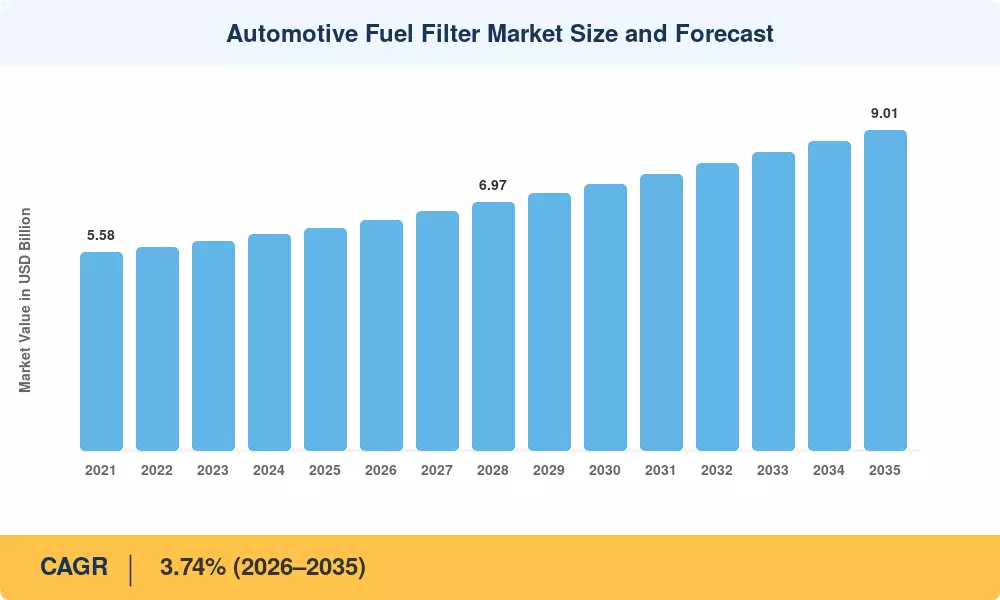
The Automotive Fuel Filter Market was valued at USD 6.25 billion in 2025, with the forecast period beginning at USD 6.48 billion in 2026 and projected to reach USD 9.01 billion by 2035, registering a CAGR of 3.74% during the 2026–2035 window. This trajectory reflects the combined pull of tightening global emission standards — the Euro 7 framework in Europe and Bharat Stage VI norms in India, for example — and sustained internal-combustion-engine (ICE) vehicle production across developing economies where electrification timelines remain long[2]. Replacement demand from an ageing global vehicle fleet exceeding 1.5 billion units continues to anchor aftermarket volumes.

Filtration technology is undergoing a material transformation. Legacy cellulose-based media, long the workhorse of the industry, is being displaced by multi-layer synthetic and nanofibre composites designed to collect more contaminants at lower pressure drops. Manufacturers have committed over USD 450 million collectively since 2023 to retrofit production lines to accommodate advanced media. Ultra-low-sulphur diesel mandates are partially responsible for these commitments, as water-separators must perform beyond the capabilities of cellulose alone [3][4].


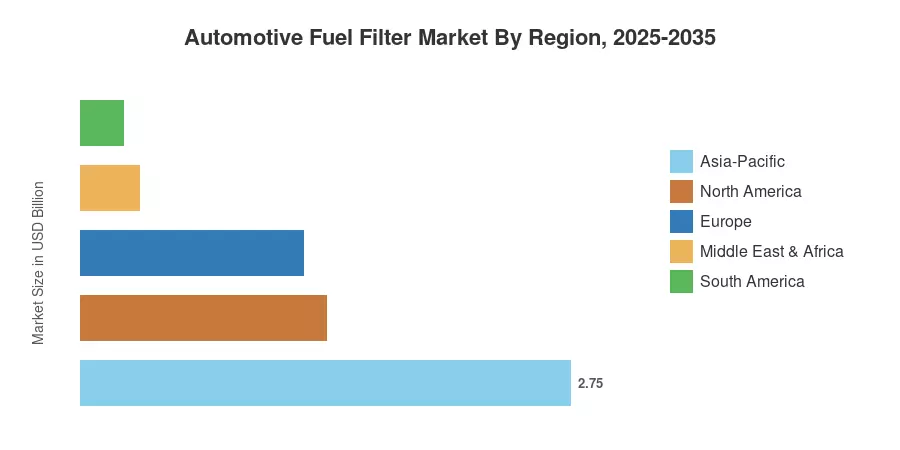
Asia-Pacific region is estimated to dominate the Automotive Fuel Filter Market with a share of 44.0% of the worldwide sales due to the high vehicle production volumes in China and India. The Middle East & Africa is the fastest-growing geography with a CAGR of 5.33% through 2035, as motorisation rates increase and aftermarket infrastructure becomes formalised. Europe is the second-largest region, with a ~ 20% share, propelled by the vast installed diesel fleet and tight regulatory compliance cycles. As powertrains continue to diversify, the Automotive Fuel Filter Market is projected to evolve, not diminish, in the next decade.


Key Report Takeaways

• By Fuel Type

  • Diesel fuel filters held a 44.9% share of the Automotive Fuel Filter Market in 2025, sustained by commercial-vehicle demand and ultra-low-sulphur legislation.
  • Alternative-fuel filters are forecast to expand at a 9.50% CAGR through 2035, reflecting rising CNG and biofuel adoption in fleet applications.

• By Filter Media

  • Cellulose media commanded approximately 40.5% of global revenue in 2025, though its share is gradually yielding to advanced composites.
  • Synthetic-fibre media are projected to grow at a 5.95% CAGR, driven by OEM specifications for higher-efficiency particulate removal.

• By Vehicle Type

  • Passenger cars represented about 50.3% of the Automotive Fuel Filter Market in 2025.
  • Light commercial vehicles are advancing at a 4.58% CAGR through 2035, led by last-mile delivery fleet expansion.

• By Sales Channel

  • The aftermarket channel controlled roughly 65.9% of the Automotive Fuel Filter Market in 2025, buoyed by digital retail penetration.

• By Geography

  • Asia-Pacific accounted for 44.0% of the global Automotive Fuel Filter Market in 2025.
  • The Middle East & Africa region is on track for a 5.33% CAGR to 2035.


Market Size and Forecast (2021–2035)

Market sizing is based on a triangulated technique of top-down industry revenue research, bottom-up component-level demand modelling and cross-checking with OEM production plans released by OICA and national automobile organizations [5]. Historical figures (2021–2024) are sourced from audited corporate filings and customs trade data; projection values (2026–2035) are calculated from the calibrated CAGR of 3.74%.
Automotive Fuel Filter Market Size and Forecast
Our Impact
Enabled $4.3B Revenue Impact for Fortune 500 and Leading Multinationals
Partnering with 2000+ Global Organizations Each Year
30K+ Citations by Top-Tier Firms in the Industry

Driver Impact Analysis

Driver ~% Impact on CAGR Geographic Relevance Impact Timeline
Tightening emission & fuel-quality regulations 22–25% Global Long-term (≥4 yr)
Ageing global vehicle fleet 18–21% North America, Europe Medium-term (2–4 yr)
Rising ICE vehicle production in emerging markets 15–18% Asia-Pacific, MEA Long-term (≥4 yr)
Aftermarket digitalisation & e-commerce growth 12–14% Global Short-term (≤2 yr)
Alternative-fuel fleet expansion (CNG, biofuels) 10–12% South America, India Medium-term (2–4 yr)
OEM shift to higher-efficiency synthetic media 8–10% Europe, North America Medium-term (2–4 yr)
Commercial-vehicle fleet renewal programmes 6–8% China, India Long-term (≥4 yr)


Tightening Emission and Fuel-Quality Regulations

The European Commission's Euro 7 standard, finalised in late 2024, imposes particle-number limits on ICE vehicles that effectively mandate multi-stage fuel filtration for both gasoline direct-injection and diesel powertrains [2]. India's Bharat Stage VI real-driving-emissions update, enforced from April 2023, has already pushed OEMs to specify higher-grade cellulose-synthetic hybrid filter cartridges valued at 15–20% above prior-generation units. These regulatory tailwinds translate directly into average-selling-price uplift across the Automotive Fuel Filter Market, especially in the OEM channel.

Ageing Global Vehicle Fleet

The International Council on Clean Transportation estimates that the average age of light vehicles in the United States reached 12.6 years in 2024, while European averages exceeded 12 years [7]. Older vehicles require more frequent filter replacements — typically every 30,000–50,000 km versus 80,000–100,000 km for newer sealed modules — creating robust recurring demand in the aftermarket segment. This dynamic is a primary pillar of the Automotive Fuel Filter Market in mature economies.

Rising ICE Production in Emerging Markets

OICA data show that combined vehicle production in India, Indonesia, Thailand, and Brazil exceeded 16 million units in 2024, with ICE powertrains representing over 92% of output [5]. Each new ICE vehicle requires at least one OE fuel filter at the point of assembly, and the replacement cycle generates aftermarket revenue for 12–18 years thereafter. This structural volume base underpins long-term demand across the Automotive Fuel Filter Market.

Aftermarket Digitalisation

Online auto-parts platforms such as Amazon Automotive, RockAuto, and regional players like Boodmo (India) now account for an estimated 18% of global aftermarket fuel-filter sales, up from roughly 10% in 2020 [10]. Digital search and price-comparison tools lower buyer friction, compress distribution margins, and expand addressable demand to DIY consumers who previously relied on workshop intermediaries.


Restraints Impact Analysis

Restraint impact percentages are directional estimates of negative pressure on overall market growth. They represent countervailing forces that moderate the CAGR but do not sum to produce an alternative growth figure.

Restraint ~% Negative Impact on CAGR Geographic Relevance Impact Timeline
BEV adoption reducing ICE filter demand –20 to –25% Europe, China Long-term (≥4 yr)
Sealed lifetime filter modules –12 to –15% Global OEM Medium-term (2–4 yr)
Counterfeit and substandard filters –8 to –10% Asia-Pacific, MEA Short-term (≤2 yr)
Raw-material cost volatility (cellulose, synthetics) –6 to –8% Global Medium-term (2–4 yr)
Consolidation pressure on Tier-2 suppliers –4 to –6% Europe, North America Long-term (≥4 yr)


Battery-Electric Vehicle Adoption

BloombergNEF projects that global BEV sales will surpass 20 million units annually by 2027, with BEV penetration reaching roughly 35% in Europe and 45% in China by 2030 [15]. Every BEV sale eliminates one ICE filter set from both the OEM and long-tail aftermarket pipelines. While the Automotive Fuel Filter Market retains a large installed ICE base through 2035, the pace of BEV substitution will temper growth in regions with aggressive electrification mandates.

Sealed Lifetime Filter Modules

Several OEMs — including select Toyota and Hyundai models — have introduced non-serviceable fuel-filter assemblies integrated into the fuel pump module, marketed as "lifetime" components [16]. These designs shift revenue from the high-margin aftermarket into the lower-margin OEM channel and reduce per-vehicle filter replacement frequency, eroding long-run aftermarket volumes in the Automotive Fuel Filter Market.

Counterfeit and Substandard Filters

The Automotive Aftermarket Suppliers Association estimated that counterfeit filters accounted for 8–12% of unit sales across Southeast Asia and parts of Africa in 2024, depressing branded-manufacturer revenue and eroding consumer trust in quality standards [17]. Authentic filter suppliers face both price undercutting and warranty-claim exposure from failures caused by inferior counterfeit products.


Automotive Fuel Filter Market Opportunities

Advanced Synthetic and Nanofibre Media Premiumisation

OEM specifications increasingly call for multi-layer glass-polyester and melt-blown nanofibre media that deliver ≥98.7% contaminant capture efficiency [3]. Manufacturers who invest early in these technologies can command 25–35% price premiums over standard cellulose cartridges, expanding the value pool within the Automotive Fuel Filter Market without requiring unit-volume growth.

Alternative-Fuel Filtration Systems

The global CNG vehicle fleet exceeded 30 million units in 2024, with India and Brazil together accounting for over half [9]. CNG and hydrogen fuel-cell systems demand filters engineered for gaseous-phase particulates and moisture control, opening an adjacent product category for incumbent filter manufacturers.

Aftermarket Brand Authentication and Digital Traceability

QR-coded packaging and blockchain-enabled supply-chain tracking offer Tier-1 filter brands a route to combat counterfeit penetration while capturing consumer data for targeted remarketing [17]. This approach converts a defensive necessity into a customer-engagement asset and strengthens channel loyalty in the Automotive Fuel Filter Market.

Africa and Middle East Aftermarket Formalisation

Sub-Saharan Africa's vehicle parc is projected to reach 75 million units by 2030, yet formalised aftermarket penetration remains below 30% [11]. Establishing branded distribution networks and workshop-training programmes in Nigeria, Kenya, and Ethiopia represents a greenfield growth corridor for established filter suppliers.

Data-Driven Predictive Maintenance Services

Connected-vehicle telematics can monitor fuel-pressure differentials across the filter element in real time, enabling predictive replacement alerts tied to a supplier's e-commerce platform [10]. This "filter-as-a-service" model transforms a commodity transaction into a recurring digital revenue stream and deepens OEM-aftermarket integration.


Automotive Fuel Filter Market Future Outlook

Powertrain Diversification and Filter Complexity

The coexistence of gasoline, diesel, CNG, hydrogen, and hybrid powertrains will expand the breadth of filter specifications required across the Automotive Fuel Filter Market through 2035. IEA projections indicate that ICE and hybrid vehicles will still represent over 60% of the global fleet by 2035, ensuring a durable volume base even as BEV penetration climbs [15].

Smart Filtration and Connected-Vehicle Integration

Embedded sensors capable of measuring differential pressure and contaminant loading in real time are expected to become standard on premium vehicles by 2030. This capability transforms the filter from a passive consumable into a data-generating component, enabling predictive-maintenance alerts and OEM-linked aftermarket replenishment — a shift that will redefine competitive positioning in the Automotive Fuel Filter Market [10].

Sustainability and Circular-Economy Pressures

EU End-of-Life Vehicle (ELV) regulation revisions under discussion target 95% recyclability of vehicle components by weight, pressing filter manufacturers to develop recyclable housings and biodegradable media [20]. Companies that achieve closed-loop material recovery early will secure preferential OEM qualification status in the Automotive Fuel Filter Market.

Consolidation and Platform Standardisation

Tier-1 suppliers are pursuing acquisition-led strategies to broaden geographic aftermarket coverage and cross-sell filtration product families. The top-five players currently hold an estimated 28–32% combined share, leaving substantial room for further consolidation in the fragmented Automotive Fuel Filter Market [19]. Platform standardisation across vehicle architectures will reduce SKU complexity and improve margins for scaled operators.


Automotive Fuel Filter Market Segmentation

By Fuel Type

Segment Key Metric Primary Demand Driver
Gasoline 3.50% CAGR (2026–2035) GDI engine proliferation requiring finer particulate filtration
Diesel 44.9% share (2025) Commercial-vehicle dominance; ULSD compliance
Alternative Fuels 9.50% CAGR (2026–2035) CNG fleet growth in India, Brazil; early hydrogen pilots


Diesel fuel filters represent the largest revenue segment in the Automotive Fuel Filter Market, sustained by global commercial-vehicle demand and increasingly stringent ultra-low-sulphur diesel specifications that mandate water-separator functionality. Heavy-duty trucking fleets in China, the United States, and India account for the bulk of diesel filter consumption, with replacement intervals averaging 40,000–60,000 km depending on fuel quality [2][14].

Alternative-fuel filters are the fastest-growing category within the Automotive Fuel Filter Market. India's CNG vehicle registrations surpassed 4.5 million in 2024, each requiring specialised filters rated for gaseous-phase contaminants and moisture ingress. Hydrogen fuel-cell systems represent a nascent but technically demanding filtration application, with pilot projects in Japan and Germany driving early-stage R&D investment [9].

By Filter Media

Segment Key Metric Primary Demand Driver
Cellulose 40.5% share (2025) Cost-effective; broad aftermarket compatibility
Synthetic (Glass and Polyester) 5.95% CAGR (2026–2035) OEM high-efficiency mandates; pressure-drop optimisation
Other Media USD 0.48 Billion (2025) Niche applications including activated carbon and nanofibre


Cellulose remains the dominant filter medium by revenue share in the Automotive Fuel Filter Market, prized for its low cost and wide aftermarket availability. Synthetic glass-polyester composites are gaining ground rapidly, driven by OEM demands for ≥98% contaminant capture efficiency at reduced pressure differentials. Premium synthetic filters command 25–35% price premiums over cellulose equivalents, expanding the value base despite slower unit growth [3].

By Vehicle Type

Segment Key Metric Primary Demand Driver
Passenger Cars 50.3% share (2025) Largest installed fleet globally
Light Commercial Vehicles 4.58% CAGR (2026–2035) Last-mile delivery and fleet renewal cycles
Medium and Heavy Commercial Vehicles USD 1.42 Billion (2025) Long-haul trucking; high replacement frequency
Other Vehicle Types 3.20% CAGR (2026–2035) Off-highway, agricultural, and marine applications


Passenger cars account for the majority of unit demand in the Automotive Fuel Filter Market. However, medium and heavy commercial vehicles contribute disproportionate revenue per unit due to larger filter assemblies and shorter replacement intervals. The light-commercial-vehicle segment is the fastest-growing category by CAGR, driven by the global expansion of e-commerce logistics fleets [14].

By Sales Channel

Segment Key Metric Primary Demand Driver
OEM 34.1% share (2025) New-vehicle assembly line integration
Aftermarket 65.9% share (2025) Ageing fleet; digital platforms; DIY and workshop demand


The aftermarket dominates the Automotive Fuel Filter Market by a wide margin, reflecting the consumable nature of fuel filters and the large global vehicle parc. Digital retail platforms have lowered barriers for price-conscious consumers and independent workshops alike, enabling branded filter suppliers to reach end-users directly and bypass multi-tier distribution [10].


Regional Market Share Analysis

Region Key Metric Primary Investment Themes
North America 22.0% share (2025) Fleet ageing; digital aftermarket; emissions compliance
Europe 20.0% share (2025) Euro 7 transition; diesel fleet servicing; premiumisation
Asia-Pacific USD 2.75 Billion (2025) OEM volume; India BS-VI replacement cycle; CNG growth
South America 3.80% CAGR (2026–2035) Biofuel mandates; Brazil fleet renewal
Middle East & Africa 5.33% CAGR (2026–2035) Motorisation; aftermarket formalisation; fuel-quality upgrades
Total USD 6.25 Billion (2025)

The Automotive Fuel Filter Market exhibits a distinct regional hierarchy shaped by vehicle-park size, emission-regulation maturity, and aftermarket channel structure. Asia-Pacific leads on volume, while mature markets prioritise value-added replacement products.


North America

Country Key Metric Key Driver
United States 68% of regional share Ageing light-truck fleet; e-commerce parts distribution
Canada 4.12% CAGR Cold-climate diesel demand; federal clean-fuel regulations
Mexico USD 0.17 Billion (2025) Growing domestic assembly; nearshoring supply chains


North America's Automotive Fuel Filter Market is characterised by a mature aftermarket where the average vehicle age exceeds 12 years, ensuring high replacement frequency. The U.S. dominates with roughly 68% of regional revenue, supported by a 290-million-unit registered vehicle fleet and an expanding digital parts ecosystem led by Amazon, AutoZone, and O'Reilly [7][10].

Europe

Country Key Metric Key Driver
Germany 24% of regional share Diesel OEM base; Euro 7 compliance
United Kingdom 3.95% CAGR Post-Brexit independent aftermarket growth
France USD 0.16 Billion (2025) PSA/Stellantis diesel fleet; biofuel blending mandates
Italy 12% of regional share High diesel-car penetration
Spain 3.70% CAGR Commercial-vehicle corridor to North Africa
Nordic Countries USD 0.08 Billion (2025) Cold-climate filtration requirements
Russia 4.10% CAGR Domestic vehicle production rebound
Rest of Europe 14% of regional share Diversified aftermarket demand


Europe's Automotive Fuel Filter Market is being reshaped by the Euro 7 regulatory package, which imposes tighter real-driving-emissions limits effective 2027 for new type approvals. Germany anchors regional revenue through its large diesel OEM production base, while the United Kingdom's independent aftermarket has grown post-Brexit as workshops diversify supply sources [2][8].

Asia-Pacific

Country Key Metric Key Driver
China 36% of regional share World's largest vehicle producer; diesel trucking demand
India 5.10% CAGR BS-VI replacement cycle; CNG three-wheeler fleet
Japan USD 0.28 Billion (2025) High-precision OEM specifications; kei-car segment
South Korea 9% of regional share Hyundai-Kia supply chain; export-oriented production
ASEAN 4.80% CAGR Pickup-truck and motorcycle filter demand
Rest of Asia-Pacific 8% of regional share Emerging vehicle parcs in Bangladesh, Pakistan


Asia-Pacific commands the largest share of the Automotive Fuel Filter Market, driven by China's annual vehicle output exceeding 30 million units and India's rapidly expanding ICE fleet [5]. India's BS-VI norms have catalysed a significant filter-upgrade cycle, with CNG vehicles adding a parallel demand stream for specialised gas-phase filtration.

South America

Country Key Metric Key Driver
Brazil 62% of regional share Flex-fuel vehicle fleet; ethanol-blend filtration needs
Argentina 3.65% CAGR Agricultural diesel fleet; grain-transport corridor
Rest of South America USD 0.06 Billion (2025) Gradually formalising aftermarket channels


Brazil's flex-fuel vehicle fleet — exceeding 40 million units — creates unique filtration challenges as ethanol blends require corrosion-resistant filter media and more frequent replacement intervals. The Automotive Fuel Filter Market in South America benefits from government biofuel mandates that effectively expand the addressable filter specification range [9][12].

Middle East & Africa

Country Key Metric Key Driver
Saudi Arabia 28% of regional share Large vehicle parc; hot-climate fuel volatility
UAE USD 0.05 Billion (2025) Fuel-quality upgrade programmes
South Africa 4.90% CAGR Diesel commercial-vehicle corridor
Egypt 5.20% CAGR Rapidly growing CNG conversion fleet
Rest of MEA 35% of regional share Motorisation and aftermarket formalisation


The Middle East & Africa region is the fastest-growing geography in the Automotive Fuel Filter Market, propelled by rising motorisation rates and the transition from informal to branded aftermarket channels. Egypt's government-backed CNG conversion programme has created measurable demand for gas-phase filtration products [11].


Automotive Fuel Filter Market By Region, 2025-2035

Competitive Benchmarking

The automotive fuel filters market is fairly consolidated, with the top 5 firms accounting for 28-32% of the market. The Herfindahl-Hirschman Index is less than 800, indicating a fragmented competitive environment with regional specialists and aftermarket companies with various Tier-1 filtration groups. Competition is based on filter-media technology, breadth of OEM qualification, brand awareness in the after-market and reach of geographic distribution.

Company Est. Revenue Share Range Key Offerings Strategic Positioning
MANN+HUMMEL ~6–9% Full-range fuel filters for passenger and commercial vehicles Broad OEM relationships; heavy R&D in synthetic media
Robert Bosch ~5–8% Gasoline and diesel inline fuel filters Integrated powertrain supplier; global aftermarket brand
Donaldson Company ~4–7% Heavy-duty diesel filtration; proprietary media technology Commercial-vehicle focus; strong Americas presence
Parker Hannifin (Racor) ~3–6% Water-separator fuel filters; marine and heavy-duty systems Premium niche positioning; industrial crossover
Mahle GmbH ~3–6% OE and aftermarket fuel filters across all vehicle types European OEM anchor; emerging-market expansion
Cummins Filtration (Fleetguard) ~3–5% Diesel fuel-water separator systems; fleet solutions Captive Cummins engine base; heavy-duty leadership
Denso Corporation ~3–5% High-precision fuel filters for Japanese and Korean OEMs Quality-driven; strong Asia-Pacific presence
Sogefi (CIR Group) ~2–4% Aftermarket-focused fuel filter range under Purflux/CoopersFiaam brands European aftermarket depth; cost-competitive positioning
Hengst SE ~2–4% Modular fuel-filter systems; all-plastic housings Sustainability focus; European OEM partnerships
Fram / DRiV (Tenneco) ~2–4% Mass-market aftermarket fuel filters High brand recognition in North America; value segment


Recent News & Developments

  • MANN+HUMMEL (September 2024): Inaugurated a USD 85 million filtration-media manufacturing plant in Pune, India, targeting both OEM supply and aftermarket distribution across South Asia [21].
  • Robert Bosch (June 2024): Launched a next-generation GDI fuel filter designed for direct-injection gasoline engines operating at pressures above 350 bar, addressing particulate reduction ahead of Euro 7 timelines [22].


  • European Commission (November 2024): Published the final Euro 7 implementing regulation, confirming particle-number limits for ICE vehicles from July 2027, directly impacting fuel-filter specifications across the Automotive Fuel Filter Market [2].
  • Cummins Filtration (January 2025): Introduced a connected fuel-filter sensor module for Class 8 trucks, enabling real-time contamination monitoring through the Cummins digital platform [24].
  • Mahle GmbH (August 2023): Signed a multi-year OEM supply agreement with a major Chinese commercial-vehicle manufacturer for cellulose-synthetic hybrid fuel filters [25].
  • Sogefi (May 2024): Expanded its Purflux aftermarket catalogue to include CNG-compatible fuel filters covering over 200 vehicle applications in India and Southeast Asia [9].


Automotive Fuel Filter Market Report Scope

Parameter Detail
Market Scope Global Automotive Fuel Filter Market across all powertrain types and sales channels
Study Period 2021–2035
CAGR (Forecast) 3.74% (2026–2035)
Base-Year Market Size USD 6.25 Billion (2025)
Forecast-Year Market Size USD 9.01 Billion (2035)
Fastest Growing Segment Alternative Fuels (by fuel type); Middle East & Africa (by region)
Companies Profiled MANN+HUMMEL, Robert Bosch, Donaldson, Parker Hannifin, Mahle, Cummins Filtration, Denso, Sogefi, Hengst SE, Fram/DRiV
Valuation Currency USD Billion

FAQs

How do fuel-filter replacement intervals vary between gasoline and diesel vehicles?
Gasoline filters typically last 60,000–100,000 km, while diesel filters require replacement every 30,000–50,000 km due to higher contaminant loads and water-separation demands [7]. Diesel's shorter cycle drives significantly higher per-vehicle aftermarket revenue.
What certification standards should fleet operators verify when sourcing fuel filters?
Filters should meet ISO 19438 for multi-pass efficiency testing and the OEM-specific performance spec for each engine platform [4]. Third-party certifications from bodies like TÜV add an extra quality assurance layer.
How does ethanol-blended fuel affect filter material selection?
Ethanol blends above E20 degrade standard cellulose media faster due to moisture absorption and chemical interaction [12]. Fleet operators in high-ethanol markets should specify synthetic or composite media rated for alcohol-fuel compatibility.
What role does filter housing material play in total cost of ownership?
All-plastic housings reduce weight by 30–40% versus metal and resist corrosion, lowering lifetime replacement costs [3]. They also simplify end-of-life recycling under evolving EU ELV regulations.
How are counterfeit fuel filters identified in the supply chain?
Branded manufacturers increasingly embed QR-coded authentication labels and tamper-evident packaging linked to online verification portals [17]. Distributors should cross-check part-number holograms against manufacturer databases before stocking.
What is the typical lead time for OEM fuel-filter qualification with a new vehicle platform?
OEM qualification cycles range from 18 to 36 months, encompassing durability testing, contamination-capacity validation, and field trials across climate zones [16]. Suppliers invest heavily in pre-development partnerships to shorten this window.
How will hydrogen fuel-cell vehicles influence fuel-filter demand beyond 2030?
Fuel-cell stacks require ultra-high-purity hydrogen filtration at the sub-micron level, creating a premium product tier [15]. Volumes will remain modest through 2035 but represent a strategic R&D priority for leading filter companies.    
Author
Author
Author Profile
Shubham Munde LinkedIn
Team Lead - Research
Shubham brings over 7 years of expertise in Market Intelligence and Strategic Consulting, with a strong focus on the Automotive, Aerospace, and Defense sectors. Backed by a solid foundation in semiconductors, electronics, and software, he has successfully delivered high-impact syndicated and custom research on a global scale. His core strengths include market sizing, forecasting, competitive intelligence, consumer insights, and supply chain mapping. Widely recognized for developing scalable growth strategies, Shubham empowers clients to navigate complex markets and achieve a lasting competitive edge. Trusted by start-ups and Fortune 500 companies alike, he consistently converts challenges into strategic opportunities that drive sustainable growth.
Co-Author
Co-Author Profile
Sejal Akre LinkedIn
Senior Research Analyst
She has over 5 years of rich experience, in market research and consulting providing valuable market insights to client. Hands on expertise in management consulting, and extensive knowledge in domain including ICT, Automotive & Transportation and Aerospace & Defense. She is skilled in Go-to market strategy, industry analysis, market sizing, in depth company profiling, competitive intelligence & benchmarking and value chain amongst others.

Research Approach


Secondary Research

The secondary research process involved comprehensive analysis of regulatory databases, automotive industry publications, technical standards repositories, and authoritative transportation organizations. Key sources included the US Environmental Protection Agency (EPA), National Highway Traffic Safety Administration (NHTSA), European Environment Agency (EEA), European Automobile Manufacturers Association (ACEA), International Organization of Motor Vehicle Manufacturers (OICA), Society of Automotive Engineers (SAE) International, International Agency for Research on Cancer (IARC) - Diesel Emissions working group, US Department of Energy (DOE) Clean Cities Program, California Air Resources Board (CARB), International Council on Clean Transportation (ICCT), US Bureau of Transportation Statistics (BTS), EU Eurostat Transport Database, country-specific automotive ministries (China MIIT, Japan MLIT, India MoRTH), and OEM technical specification databases (Ford Fleet Technical Resources, GM Service Information, VW Technical Bulletins). These sources were utilized to collect vehicle production statistics, emissions regulation compliance data, filtration efficiency standards, recall databases, material safety specifications, and aftermarket sales trends for in-line fuel filters, cartridge filters, mesh filters, and emerging synthetic filtration media across gasoline, diesel, and alternative fuel vehicle platforms.


Primary Research

During the primary research process, both supply-side and demand-side stakeholders were interviewed to gather both qualitative and quantitative data. Tier 1 and tier 2 automotive component manufacturers, filter media producers, and OEM suppliers provided supply-side sources. These included CEOs, VPs of Manufacturing, Chief Technology Officers, and heads of thermal management and filtration divisions. Demand-side sources included procurement directors from major automotive OEMs (passenger car and commercial vehicle divisions), fleet management operators, heavy-duty truck maintenance heads, motorcycle OEM technical directors, aftermarket distributor chain executives, and performance automotive engineers from specialty vehicle manufacturers. Primary research confirmed market segmentation across fuel types (gasoline, diesel, CNG, alternative fuels), confirmed product development pipelines for synthetic and metal filter media, and gathered insights on OEM vs. aftermarket channel dynamics, pricing strategies, inventory management practices, and compliance with evolving emissions standards (Euro 7, EPA Tier 3, China VI).

Primary Respondent Breakdown:

• By Designation: C-level Primaries (28%), Director Level (41%), Others (31%)

• By Region: North America (31%), Europe (32%), Asia-Pacific (24%), Rest of World (13%)


Market Size Estimation

Global market valuation was derived through revenue mapping and production volume analysis. The methodology included:

• Identification of 60+ key manufacturers across North America, Europe, Asia-Pacific, Latin America, and Middle East & Africa

• Product mapping across in-line fuel filters, cartridge filters, mesh filters, and specialty performance filters

• Material-type segmentation analysis covering cellulose paper, synthetic microfiber, and stainless steel mesh configurations

• Sales channel differentiation between OEM fitments (passenger cars, commercial vehicles, heavy-duty trucks) and aftermarket (OES and independent)

• Analysis of reported and modeled annual revenues specific to automotive fuel filter portfolios

• Coverage of manufacturers representing 75-80% of global market share in 2024

• Extrapolation using bottom-up (automotive production volumes × filter content per vehicle × ASP by filter type and region) and top-down (manufacturer revenue validation, tier-1 supplier financial segment reporting) approaches to derive segment-specific valuations by fuel type, application, and material composition

Download Free Sample

Kindly complete the form below to receive a free sample of this Report

* Please use a valid business email

Download PDF ×

We do not share your information with anyone. However, we may send you emails based on your report interest from time to time. You may contact us at any time to opt-out.
















