Automotive Inside Rearview Mirror Market
Automotive Inside Rearview Mirror Market Summary
As per Market Research Future analysis, the Automotive Inside Rearview Mirror Market was estimated at 3.512 USD Billion in 2024. The Automotive Inside Rearview Mirror industry is projected to grow from 3.694 USD Billion in 2025 to 6.11 USD Billion by 2035, exhibiting a compound annual growth rate (CAGR) of 5.16% during the forecast period 2025 - 2035
Key Market Trends & Highlights
The Automotive Inside Rearview Mirror Market is experiencing a transformative shift towards advanced technologies and design aesthetics.
- The integration of smart technologies is reshaping the functionality of automotive inside rearview mirrors, particularly in North America.
- Aesthetic design is becoming increasingly important, as consumers in the Asia-Pacific region seek visually appealing vehicle interiors.
- Standard mirrors remain the largest segment, while smart mirrors are rapidly gaining traction as the fastest-growing category.
- Rising demand for advanced safety features and consumer preference for enhanced connectivity are driving market growth.
Market Size & Forecast
| 2024 Market Size | 3.512 (USD Billion) |
| 2035 Market Size | 6.11 (USD Billion) |
| CAGR (2025 - 2035) | 5.16% |
Major Players
Gentex Corporation (US), Ficosa International (ES), Magna International (CA), Valeo (FR), Murakami Corporation (JP), Samvardhana Motherson Group (IN), Denso Corporation (JP), Bosch (DE), Continental AG (DE)
Automotive Inside Rearview Mirror Market Trends
The Automotive Inside Rearview Mirror Market is currently experiencing a transformative phase, driven by advancements in technology and evolving consumer preferences. The integration of smart features, such as digital displays and connectivity options, appears to be reshaping the landscape of rearview mirrors. This shift not only enhances driver safety but also contributes to a more connected driving experience. Furthermore, the growing emphasis on vehicle aesthetics and interior design is influencing the development of more stylish and functional mirror designs, which may appeal to a broader range of consumers. In addition to technological innovations, sustainability trends are gaining traction within the Automotive Inside Rearview Mirror Market. Manufacturers are increasingly focusing on eco-friendly materials and production processes, reflecting a broader commitment to environmental responsibility. This trend suggests that the market is not only adapting to consumer demands for advanced features but also aligning with global sustainability goals. As the industry continues to evolve, it is likely that the Automotive Inside Rearview Mirror Market will witness further innovations and shifts in consumer expectations, ultimately shaping the future of automotive design and functionality.
Integration of Smart Technologies
The incorporation of smart technologies into automotive inside rearview mirrors is becoming increasingly prevalent. Features such as integrated displays, navigation systems, and connectivity with smartphones are enhancing the functionality of these mirrors. This trend indicates a shift towards a more interactive driving experience, where mirrors serve not only as reflective surfaces but also as multifunctional devices that improve safety and convenience.
Focus on Aesthetic Design
There is a noticeable trend towards the development of aesthetically pleasing automotive inside rearview mirrors. Manufacturers are prioritizing sleek designs that complement modern vehicle interiors. This emphasis on style suggests that consumers are seeking products that not only perform well but also enhance the overall look of their vehicles, indicating a shift in consumer priorities.
Sustainability Initiatives
Sustainability is becoming a key consideration in the Automotive Inside Rearview Mirror Market. Companies are increasingly adopting eco-friendly materials and sustainable manufacturing practices. This trend reflects a growing awareness of environmental issues among consumers and suggests that manufacturers are responding to these concerns by prioritizing sustainability in their product offerings.
Automotive Inside Rearview Mirror Market Drivers
Increasing Focus on Vehicle Aesthetics
The Automotive Inside Rearview Mirror Market is also influenced by an increasing focus on vehicle aesthetics. As consumers become more discerning about the design and appearance of their vehicles, manufacturers are responding by creating rearview mirrors that not only serve functional purposes but also enhance the overall look of the car interior. This trend is reflected in market data showing that aesthetically pleasing designs can significantly influence purchasing decisions. Consequently, manufacturers are investing in innovative designs and materials to meet consumer expectations, thereby driving growth in the automotive inside rearview mirror market.
Growth of Electric and Autonomous Vehicles
The Automotive Inside Rearview Mirror Market is poised for growth due to the rising prevalence of electric and autonomous vehicles. As these vehicles become more mainstream, the demand for innovative rearview mirror solutions that integrate with advanced driver-assistance systems is increasing. For instance, mirrors that provide real-time data on vehicle surroundings are becoming essential in autonomous driving scenarios. Market data suggests that the electric vehicle segment is expected to grow at a compound annual growth rate of over 20% in the coming years, further driving the need for sophisticated rearview mirror technologies that enhance the driving experience.
Regulatory Compliance and Safety Standards
The Automotive Inside Rearview Mirror Market is significantly impacted by regulatory compliance and safety standards. Governments worldwide are implementing stricter regulations regarding vehicle safety, which necessitates the incorporation of advanced features in automotive mirrors. For instance, regulations mandating the inclusion of features like auto-dimming and glare reduction are becoming more prevalent. This regulatory landscape is compelling manufacturers to innovate and enhance their product offerings to meet these standards. Market data indicates that compliance with safety regulations not only boosts consumer confidence but also opens up new opportunities for growth within the automotive inside rearview mirror market.
Rising Demand for Advanced Safety Features
The Automotive Inside Rearview Mirror Market is experiencing a notable surge in demand for advanced safety features. As consumers increasingly prioritize safety, manufacturers are integrating technologies such as blind-spot detection and lane departure warnings into rearview mirrors. This trend is supported by data indicating that vehicles equipped with such features can reduce accident rates significantly. The incorporation of these technologies not only enhances driver awareness but also aligns with regulatory standards aimed at improving road safety. Consequently, the market for automotive inside rearview mirrors is likely to expand as automakers seek to meet consumer expectations and comply with safety regulations.
Consumer Preference for Enhanced Connectivity
In the Automotive Inside Rearview Mirror Market, there is a growing consumer preference for enhanced connectivity features. Modern drivers are increasingly seeking mirrors that can connect to smartphones and other devices, allowing for seamless access to navigation, music, and communication. This trend is indicative of a broader shift towards smart vehicle technologies, where integration and connectivity play crucial roles. Market analysis reveals that the demand for connected car technologies is projected to grow significantly, with a substantial portion of consumers expressing interest in features that enhance their driving experience. This shift is likely to propel the development of multifunctional rearview mirrors.
Market Segment Insights
By Type: Standard Mirrors (Largest) vs. Smart Mirrors (Fastest-Growing)
In the Automotive Inside Rearview Mirror Market, the segment distribution showcases Standard Mirrors as the leading type, holding a significant share due to their cost-effectiveness and traditional preference among vehicle manufacturers. Electrochromatic Mirrors follow, attracting users seeking enhanced safety features by mitigating glare. Conversely, Smart Mirrors and Digital Mirrors are gaining traction, appealing to the tech-savvy demographic looking for improved functionality and connectivity.
Smart Mirrors (Dominant) vs. Digital Mirrors (Emerging)
Smart Mirrors are swiftly establishing themselves as a dominant force in the market, incorporating various technologies to provide advanced functionalities such as GPS navigation, connectivity, and integrated cameras for enhanced safety. Their ability to offer real-time information makes them particularly attractive to modern consumers. On the other hand, Digital Mirrors represent an emerging trend, characterized by high-resolution displays and advanced features aimed at improving visibility and driving experience. While they currently hold a smaller market share, their innovative approach and integration of modern technology signify a growing presence, potentially reshaping consumer preferences in the near future.
By Functionality: Automatic Adjustment (Largest) vs. Mirror with Display (Fastest-Growing)
The Automotive Inside Rearview Mirror Market shows a varied distribution among its functionality segments. Manual Adjustment mirrors hold a significant portion of the market, widely appreciated for their simplicity and reliability. However, Automatic Adjustment mirrors dominate the segment due to their convenience and advanced technology integration, enhancing driver safety and comfort. Mirrors with Displays are gaining traction as they offer additional functionalities like navigation and vehicle diagnostics, contributing to their growing share in the market. Growth trends in the functionality segment reveal a shift towards higher demand for Automatic Adjustment and Camera Integrated mirrors. With advancements in technology, consumers are increasingly seeking features that enhance their driving experience. Safety regulations are also driving the integration of cameras, and features in rearview mirrors, presenting opportunities for manufacturers to innovate and capture emerging markets. The trend towards customization and smart features in automobiles further supports the expansion of displays in these mirrors, indicating a technological transformation in the industry.
Automatic Adjustment (Dominant) vs. Camera Integrated (Emerging)
Automatic Adjustment mirrors stand out as the dominant segment within the Automotive Inside Rearview Mirror Market due to their ease of use and integration with advanced vehicle systems. They offer adjustable angles without manual input, ensuring an optimal view regardless of changes in passenger load. Their growing popularity ties closely to the increasing demand for smart car features, aligning with modern drivers' expectations for convenience and safety. On the other hand, Camera Integrated mirrors are emerging as a significant segment, leveraging advanced technology to directly enhance vehicle safety and driver awareness. By integrating cameras into the mirror unit, these systems provide expanded visibility, helping to minimize blind spots. As manufacturers commit to improving vehicle safety standards, the market position of Camera Integrated mirrors is expected to strengthen, emphasizing their role in the future of automotive design and functionality.
By Vehicle Type: Passenger Cars (Largest) vs. Luxury Vehicles (Fastest-Growing)
The Automotive Inside Rearview Mirror Market is predominantly driven by passenger cars, which hold the largest market share due to their extensive production and consumer demand. This segment benefits from the increasing focus on safety and driver assistance technologies, making them a must-have component in modern vehicles. In contrast, luxury vehicles, while smaller in share, are rapidly gaining traction as manufacturers enhance their offerings with advanced mirror technologies for better functionality and aesthetics.
Passenger Cars: Dominant vs. Luxury Vehicles: Emerging
Passenger cars represent the dominant segment in the Automotive Inside Rearview Mirror Market, providing a variety of features such as automatic dimming, integrated cameras, and connectivity options. This segment benefits from continual innovations aimed at improving safety and convenience. On the other hand, luxury vehicles are identified as an emerging segment, characterized by high-end features such as enhanced display technologies, sophisticated design, and smart systems integration. As consumer preferences shift towards premium experiences, this segment is likely to experience substantial growth, attracting investments in advanced mirror technologies and unique functionalities.
By Material: Plastic (Largest) vs. Glass (Fastest-Growing)
In the Automotive Inside Rearview Mirror Market, the material segment showcases a diverse distribution of market share among four primary constituents: Plastic, Glass, Composite Materials, and Metal. Plastic reigns as the largest segment due to its lightweight nature and cost-effectiveness, making it the go-to choice for many manufacturers. Meanwhile, Glass has emerged as the fastest-growing segment, capturing the attention of consumers looking for premium aesthetics and better visibility. The Composite Materials and Metal segments hold smaller shares but are crucial for specific high-end automotive applications.
Material: Plastic (Dominant) vs. Glass (Emerging)
Plastic, as the dominant material in the Automotive Inside Rearview Mirror Market, is renowned for its affordability and versatility, which facilitates mass production and ease of design. On the other hand, Glass is rapidly becoming an emerging player, appealing to a segment of consumers desiring enhanced clarity and a luxury feel in their vehicles. While Plastic mirrors dominate mass-market vehicles, Glass mirrors are increasingly favored in premium models due to their higher quality and performance attributes. Composite Materials and Metal are also important but cater to niche markets with specific performance requirements, such as durability and stylistic preferences.
Regional Insights
North America : Automotive Innovation Leader
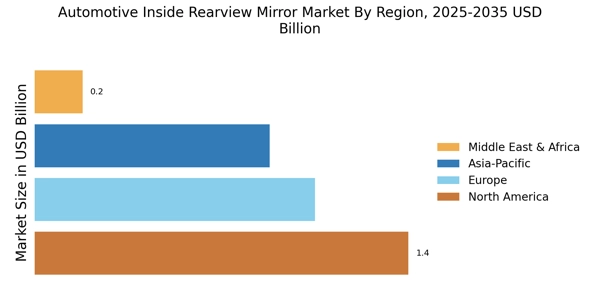
North America is the largest market for automotive inside rearview mirrors, holding approximately 40% of the global market share. The region's growth is driven by increasing vehicle production, technological advancements, and stringent safety regulations. The demand for smart mirrors with integrated features like navigation and connectivity is also on the rise, further propelling market growth. The United States and Canada are the leading countries in this market, with major automotive manufacturers and suppliers based in these regions. Key players such as Gentex Corporation and Magna International are at the forefront, driving innovation and competition. The presence of advanced manufacturing facilities and a strong supply chain network enhances the competitive landscape, making North America a pivotal region for automotive mirror technologies.
Europe : Regulatory-Driven Market
Europe is the second-largest market for automotive inside rearview mirrors, accounting for approximately 30% of the global market share. The region's growth is fueled by stringent EU regulations on vehicle safety and emissions, which encourage the adoption of advanced mirror technologies. Additionally, the increasing demand for electric vehicles (EVs) is driving innovation in mirror design and functionality. Leading countries in this market include Germany, France, and the UK, where major automotive manufacturers are investing in R&D for smart mirror solutions. Companies like Valeo and Bosch are key players, focusing on integrating advanced features such as camera systems and connectivity. The competitive landscape is characterized by collaborations and partnerships aimed at enhancing product offerings and meeting regulatory standards.
Asia-Pacific : Emerging Market Potential
Asia-Pacific is witnessing rapid growth in the automotive inside rearview mirror market, holding approximately 25% of the global market share. The region's expansion is driven by increasing vehicle production, rising disposable incomes, and a growing middle class. Additionally, government initiatives to promote electric vehicles and smart technologies are further boosting demand for advanced mirror systems. China, Japan, and India are the leading countries in this market, with significant investments in automotive manufacturing and technology. Key players such as Denso Corporation and Murakami Corporation are actively involved in developing innovative mirror solutions. The competitive landscape is marked by a focus on cost-effective production and technological advancements, positioning Asia-Pacific as a vital region for future growth in the automotive sector.
Middle East and Africa : Untapped Market Opportunities
The Middle East and Africa (MEA) region is emerging as a potential market for automotive inside rearview mirrors, currently holding about 5% of the global market share. The growth in this region is driven by increasing vehicle ownership, urbanization, and investments in infrastructure. Additionally, the rising demand for luxury vehicles is expected to boost the adoption of advanced mirror technologies. Countries like South Africa and the UAE are leading the market, with a growing automotive industry and increasing foreign investments. The presence of key players such as Samvardhana Motherson Group is enhancing the competitive landscape. However, challenges such as economic fluctuations and regulatory hurdles remain, which could impact market growth in the region.
Key Players and Competitive Insights
Key Companies in the Automotive Inside Rearview Mirror Market include
Industry Developments
Recent developments in the Automotive Inside Rearview Mirror Market have seen a growing emphasis on advanced technology integration, particularly in smart mirrors equipped with features like navigation, camera displays, and connectivity options. Companies such as Gentex and Aisin Seiki are spearheading innovations that enhance driver safety and convenience.
Current market trends indicate a notable increase in demand for high-quality mirrors that incorporate sensor technology and infotainment systems, reflecting the automotive industry's shift towards advanced driver assistance systems (ADAS).
Moreover, the acquisition landscape is witnessing strategic alignments, with notable mergers being announced among key players such as Magna International and Ficosa International. These movements aim to bolster technological capabilities and expand product offerings in the competitive marketplace.
Companies are also observing growth in market valuations due to the rising emphasis on electric vehicles (EVs) and passenger safety, leading to increased investments in research and development. As automakers adapt to rapidly evolving consumer demands, the automotive inside rearview mirror market is poised for significant transformations, emphasizing innovation and enhanced user experience.
Future Outlook
Automotive Inside Rearview Mirror Market Future Outlook
The Automotive Inside Rearview Mirror Market is projected to grow at a 5.16% CAGR from 2025 to 2035, driven by technological advancements and increasing safety regulations.
New opportunities lie in:
- Integration of advanced driver-assistance systems (ADAS) into rearview mirrors.

- Development of smart mirrors with augmented reality features.
- Expansion into electric vehicle markets with specialized mirror solutions.
By 2035, the market is expected to be robust, reflecting significant advancements and increased adoption.
Market Segmentation
Automotive Inside Rearview Mirror Market Type Outlook
- Standard Mirrors
- Electrochromatic Mirrors
- Smart Mirrors
- Digital Mirrors
Automotive Inside Rearview Mirror Market Material Outlook
- Plastic
- Glass
- Composite Materials
- Metal
Automotive Inside Rearview Mirror Market Vehicle Type Outlook
- Passenger Cars
- Commercial Vehicles
- Two Wheelers
- Luxury Vehicles
Automotive Inside Rearview Mirror Market Functionality Outlook
- Manual Adjustment
- Automatic Adjustment
- Mirror with Display
- Camera Integrated
Report Scope
| MARKET SIZE 2024 | 3.512(USD Billion) |
| MARKET SIZE 2025 | 3.694(USD Billion) |
| MARKET SIZE 2035 | 6.11(USD Billion) |
| COMPOUND ANNUAL GROWTH RATE (CAGR) | 5.16% (2025 - 2035) |
| REPORT COVERAGE | Revenue Forecast, Competitive Landscape, Growth Factors, and Trends |
| BASE YEAR | 2024 |
| Market Forecast Period | 2025 - 2035 |
| Historical Data | 2019 - 2024 |
| Market Forecast Units | USD Billion |
| Key Companies Profiled | Gentex Corporation (US), Ficosa International (ES), Magna International (CA), Valeo (FR), Murakami Corporation (JP), Samvardhana Motherson Group (IN), Denso Corporation (JP), Bosch (DE), Continental AG (DE) |
| Segments Covered | Type, Functionality, Vehicle Type, Material, Regional |
| Key Market Opportunities | Integration of advanced driver assistance systems in the Automotive Inside Rearview Mirror Market presents substantial growth potential. |
| Key Market Dynamics | Technological advancements in safety features drive innovation in the Automotive Inside Rearview Mirror Market. |
| Countries Covered | North America, Europe, APAC, South America, MEA |
FAQs
What is the projected market valuation for the Automotive Inside Rearview Mirror Market in 2035?
The projected market valuation for the Automotive Inside Rearview Mirror Market in 2035 is expected to reach 6.11 USD Billion.
What was the market valuation for the Automotive Inside Rearview Mirror Market in 2024?
The market valuation for the Automotive Inside Rearview Mirror Market in 2024 was 3.512 USD Billion.
What is the expected CAGR for the Automotive Inside Rearview Mirror Market during the forecast period 2025 - 2035?
The expected CAGR for the Automotive Inside Rearview Mirror Market during the forecast period 2025 - 2035 is 5.16%.
Which companies are considered key players in the Automotive Inside Rearview Mirror Market?
Key players in the Automotive Inside Rearview Mirror Market include Gentex Corporation, Ficosa International, Magna International, and Valeo, among others.
What are the projected values for Standard Mirrors in the Automotive Inside Rearview Mirror Market?
The projected values for Standard Mirrors in the Automotive Inside Rearview Mirror Market are expected to range from 2.1 USD Billion in 2025.
How do Electrochromatic Mirrors perform in terms of market valuation?
Electrochromatic Mirrors are projected to reach a market valuation of 1.5 USD Billion by 2035.
What is the expected market size for Automatic Adjustment mirrors by 2035?
The expected market size for Automatic Adjustment mirrors is projected to be 1.9 USD Billion by 2035.
What segment shows the highest projected growth in the Automotive Inside Rearview Mirror Market?
Passenger Cars show the highest projected growth, with values expected to reach 3.12 USD Billion by 2035.
What materials are primarily used in the production of Automotive Inside Rearview Mirrors?
The primary materials used in the production of Automotive Inside Rearview Mirrors include Plastic, Glass, and Composite Materials.
What is the projected market value for Camera Integrated mirrors by 2035?
The projected market value for Camera Integrated mirrors is expected to reach 0.6 USD Billion by 2035.
Kindly complete the form below to receive a free sample of this Report
Customer Stories
“This is really good guys. Excellent work on a tight deadline. I will continue to use you going forward and recommend you to others. Nice job”
“Thanks. It’s been a pleasure working with you, please use me as reference with any other Intel employees.”
“Thanks for sending the report it gives us a good global view of the Betaïne market.”
“Thank you, this will be very helpful for OQS.”
“We found the report very insightful! we found your research firm very helpful. I'm sending this email to secure our future business.”
“I am very pleased with how market segments have been defined in a relevant way for my purposes (such as "Portable Freezers & refrigerators" and "last-mile"). In general the report is well structured. Thanks very much for your efforts.”
“I have been reading the first document or the study, ,the Global HVAC and FP market report 2021 till 2026. Must say, good info! I have not gone in depth at all parts, but got a good indication of the data inside!”
“We got the report in time, we really thank you for your support in this process. I also thank to all of your team as they did a great job.”