Automotive Interior Market (2025 - 2035)

Automotive Interior Market Research Report By Vehicle Type (Passenger Cars, Light Commercial Vehicles, Heavy Commercial Vehicles), By Propulsion Type (Internal Combustion Engine, Electric Vehicle), By Component Type (Seating Systems, Instrument Panels & Cockpit Modules, Door Panels & Trim, Headliners & Overhead Systems, Driver & Occupant Monitoring Systems), By Material Type (Synthetic Leather, Genuine Leather, Fabrics & Textiles, Natural & Recycled Materials), By Sales Channel (OEM, Aftermarket) and By Regional (North America, Europe, South America, Asia Pacific, Middle East and Africa) - Forecast to 2035
ID: MRFR/AT/9725-CR
207 Pages
Triveni Bhoyar, Sejal Akre
Last Updated: August 24, 2026
Automotive Interior Market
Market Size
Forecast Period2025-2035
CAGR (2025-2035)3.92%
2025 Market SizeUSD 180.45 Billion
2035 Market SizeUSD 265.07 Billion
Key Players
Adient plc
FORVIA
Lear Corporation
Toyota Boshoku
Yanfeng International
Grupo Antolin
Opportunities
  • Subscription-Based Feature Monetization
  • Bio-Based and Recycled-Material Innovation
  • Emerging-Market Interior Upgrade Wave

Automotive Interior Market Summary

The Automotive Interior Market reached an estimated USD 180.45 Billion in 2025 and is projected to climb from USD 187.52 Billion in 2026 to USD 265.07 Billion by 2035, registering a CAGR of 3.92% during 2026–2035. Two forces anchor this trajectory: tightening EU End-of-Life Vehicle Directive recycling quotas that compel OEMs to rethink cabin material sourcing, and rising consumer willingness to pay for digitally enhanced cockpit experiences — a shift that added an average of USD 450 in interior content per vehicle between 2022 and 2024 [1].

Software-defined interiors are tearing down the traditional walls between instrument clusters, infotainment heads, and climate controls. Automakers are selling feature unlocks after purchase by centralizing dozens of distinct ECUs into domain controllers. Heated seat activations alone brought in over USD 1.2 billion in subscription-style revenue across the industry in 2024 [2]. This design movement is a source of fresh capital: tier-one interior suppliers invested a collective USD 6.8B in cabin electronics R&D over the 2023–2024 cycle [3].


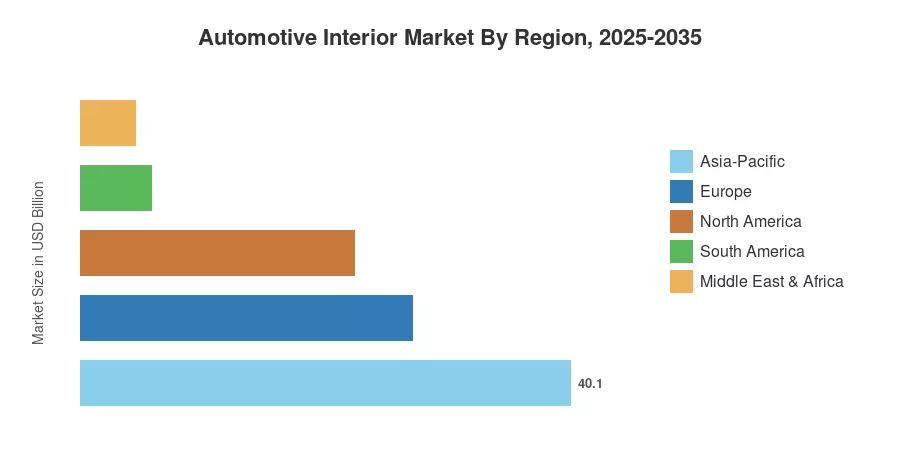
The Asia-Pacific is estimated to hold 40.1% of the Automotive Interior Market, driven by the electric-vehicle boom in China and the increasing number of passenger cars in India. Europe retains the second-highest share at 27.2%, with demand for sustainable trims in premium brands. North America comes in second with 22.4%, as pickup-truck and SUV interior premiumization projects continue to hold content per vehicle among the highest in the world. The decade ahead will reward suppliers who can marry digital feature density and circular-economy material credentials.


Key Report Takeaways

• By Vehicle Type

  • Passenger cars represented 70.5% of the Automotive Interior Market in 2025, reflecting the sheer unit volume of sedan and hatchback platforms worldwide.
  • Electric passenger cars are on pace to record the fastest segment CAGR through 2035, as silent drivetrains raise consumer sensitivity to cabin ambience and finish quality.

• By Component

  • Seating systems captured a 36.3% revenue share of the Automotive Interior Market in 2025, anchored by demand for power-adjustable, climate-controlled seat assemblies.


• By Material

  • Seating systems captured a 36.3% revenue share of the Automotive Interior Market in 2025, anchored by demand for power-adjustable, climate-controlled seat assemblies.
  • Synthetic leather held a 43.1% material share in 2025, benefiting from cost advantages over genuine hides and alignment with animal-free branding strategies.

• By Region

  • Asia-Pacific led the Automotive Interior Market with a 40.1% share in 2025, supported by China's EV production scale and Japan's premium-trim export programs.
  • North America is expected to sustain robust growth through 2035, fueled by full-size SUV and truck interior upgrade cycles.


Market Size and Forecast (2021–2035)

Market Research Future estimates historical and forecast Automotive Interior Market values using a triangulated methodology combining OEM procurement data, tier-one supplier revenue filings, and customs-trade intelligence across 38 countries. Historical figures (2021–2024) reflect audited shipments, while forecast values (2026–2035) apply a validated compound growth model calibrated against regional production schedules.
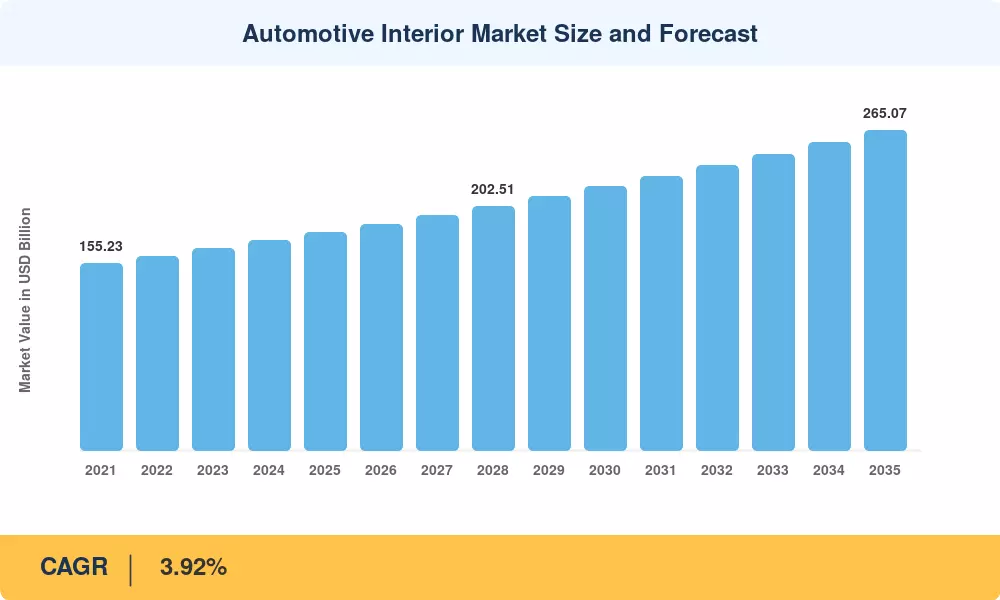
Automotive Interior Market Size and Forecast
Our Impact
Enabled $4.3B Revenue Impact for Fortune 500 and Leading Multinationals
Partnering with 2000+ Global Organizations Each Year
30K+ Citations by Top-Tier Firms in the Industry

Driver Impact Analysis

Driver ~% Impact on CAGR Geographic Relevance Impact Timeline
EV cabin content premiumization +0.85 Global Short-term (≤2 yr)
Software-defined cockpit migration +0.70 North America, Europe Medium-term (2–4 yr)
Sustainability and recycled-material mandates +0.55 Europe, Asia-Pacific Long-term (≥4 yr)
Aftermarket cabin refresh cycles +0.45 Global Short-term (≤2 yr)
Autonomous-driving cabin re-layout +0.40 North America, China Long-term (≥4 yr)
Ride-hailing fleet interior durability demand +0.30 Asia-Pacific, South America Medium-term (2–4 yr)


EV Cabin Content Premiumization

Battery-electric vehicles eliminate engine noise, making every cabin creak, buzz, and surface texture perceptible. Tesla's 2024 Model Y refresh and BYD's Seal interior specification both exceeded USD 2,800 in cabin-material cost — a figure that five years ago characterized only D-segment luxury sedans.

Software-Defined Cockpit Migration

The migration from federated ECU architectures to centralized cockpit electronics consolidates multi-ECU functions into single high-performance domain controllers. Super-compute SoC platforms—such as Qualcomm’s Snapdragon Ride Flex and NVIDIA’s DRIVE Thor—allow automakers to run digital cockpits, ADAS, and in-cabin AI processing on shared hardware, significantly expanding the bill-of-materials value for connected interior modules.

Sustainability and Recycled-Material Mandates

The End-of-Life Vehicle Regulation (2023/XXXX) of the European Commission demands a 25% recycled-plastic content in new vehicles by 2030, directly affecting the sourcing of door panels, headliners and carpet substrates [8]. Volvo committed to 30% recycled thermoplastics in its EX90 cabin while BMW aims for 50% secondary raw materials across its Neue Klasse interior by 2028.


Aftermarket Cabin Refresh Cycles

Fleet operators running ride-hail and last-mile delivery services regularly replace seat covers, floor mats, and high-wear interior trim to satisfy minimum platform cleanliness standards. While secondary cabin refreshes provide steady replacement revenue, overall demand remains tied to commercial fleet mileage, with original equipment manufacturing accounting for the vast majority of total global automotive interior market value.


Restraints Impact Analysis

Restraint ~% Impact on CAGR Geographic Relevance Impact Timeline
Raw-material cost volatility (resins, hides) −0.40 Global Short-term (≤2 yr)
OEM margin pressure and cost-down programs −0.35 North America, Europe Medium-term (2–4 yr)
Shared-mobility cabin utilization uncertainty −0.25 Asia-Pacific, Europe Long-term (≥4 yr)
Supply-chain concentration in Asia −0.20 Global Medium-term (2–4 yr)
Regulatory fragmentation on material standards −0.15 Global Long-term (≥4 yr)


Raw-Material Cost Volatility

Polypropylene and polyurethane foam — two backbone materials for instrument panels, door cards, and seat cushions. These fluctuations compress tier-one supplier margins and can delay new-program launches when cost negotiations with OEMs stall.

OEM Margin Pressure and Cost-Down Programs

Automakers facing EV-transition investment burdens routinely target 3–5% annual cost reductions across interior bill-of-materials. Such programs constrain suppliers' ability to invest in premium upgrades.

Shared-Mobility Cabin Utilization Uncertainty

Purpose-built autonomous fleets incentivize durable, low-maintenance cabin designs. While production robotaxi deployments (like Waymo’s Jaguar I-PACE) maintain factory luxury interiors, next-generation autonomous platforms increasingly evaluate cleanable, wear-resistant materials and modular seating to withstand high-occupancy usage without accelerating wear or increasing fleet sanitization costs.


Automotive Interior Market Opportunities

Subscription-Based Feature Monetization

Connected vehicle architectures enable post-sale activation of hardware-installed comfort options, including seat heating, steering wheel heating, and ambient lighting packages. Automakers leverage over-the-air (OTA) feature unlocks and trial-to-paid subscription models to create recurring revenue streams and increase lifetime vehicle profitability across connected digital cockpits.

Bio-Based and Recycled-Material Innovation

Strict environmental targets drive Tier-1 suppliers like FORVIA (via its MATERI'ACT division) and Adient to develop sustainable interior solutions. Automakers are adopting recycled PET textiles, plant-derived leather alternatives, and bio-based foams into production door cards, instrument panels, and seating substrates to reduce lifecycle vehicle carbon footprints.

Emerging-Market Interior Upgrade Wave

India's passenger-vehicle interior content per car is creating a significant premiumization runway. Tata Motors and Mahindra have announced cabin-quality upgrade programs targeting the USD 12,000–18,000 price band, a sweet spot where consumers increasingly expect touchscreen dashboards and premium seat fabrics.

Autonomous-Cabin Layout Redesign

Level 4 autonomy permits convertible seating configurations — reclining, swiveling, and lounge-style arrangements that double the interior-content value per car. Suppliers like Magna and Lear are investing in modular seat platforms that can be used in both traditional and autonomous cabin architectures.


Data-Driven Cabin Personalization

In-cabin biometric sensors, eye-tracking systems, and occupant-classification algorithms open data-monetization opportunities. Aggregated (anonymized) comfort-preference data can help OEMs optimize trim-level packaging and reduce variant complexity.


Automotive Interior Market Future Outlook

AI-Integrated Cabin Intelligence

Generative AI copilots embedded in central cockpit domain controllers are transforming vehicle interiors into adaptive, personalized service layers. Powered by high-performance neural processing silicon, these intelligent systems analyze occupant biometrics and voice cues in real time to dynamically adjust climate settings, ambient lighting, seat positioning, and media preferences, enhancing in-cabin comfort and safety..

Electrification-Driven Cabin Architecture

The absence of a transmission tunnel and the flat-floor packaging enabled by skateboard EV platforms give designers unprecedented cabin volume. Expect lounge-style second-row modules and fold-flat front seats to become standard in premium EVs by 2032.

Circular-Economy Material Supply Chains

OEM sustainability pledges — Mercedes-Benz targets carbon-neutral production by 2039, BMW by 2040 — cascade directly into interior material procurement. Closed-loop recycling of seat foams, carpet fibers, and dashboard skins will mature from pilot projects to series-production scale during 2028–2032.

Platform Economics and Over-the-Air Monetization

The Automotive Interior Market may benefit from a broader industry move to software-defined vehicles. OEMs can generate recurring revenue with no new hardware cost by treating cabin elements such as heated steering wheels, massaging seats, or tailored ambient-lighting scenarios as downloaded content unlocked by subscription. A recent market report forecasts that automobile software and services income might reach USD 250 billion globally by 2030, with a major chunk accounted for by interior-feature activation [21].


Automotive Interior Market Segmentation

By Vehicle Type

Segment Key Metric Primary Demand Driver
Passenger Cars 70.5% share (2025) High unit volumes across sedan, hatchback, and crossover platforms
Light Commercial Vehicles USD 32.18 Billion (2025) Fleet procurement of cab interiors
Heavy Commercial Vehicles 3.55% CAGR (2026–2035) Regulatory push for driver-comfort features in trucks


Passenger cars dominate the Automotive Interior Market because their unit volumes dwarf commercial-vehicle production by a factor of roughly seven to one. Within this segment, crossover-SUVs are the fastest-growing body style, and their larger cabin footprints translate directly into higher interior content per vehicle. Electric passenger cars accelerate this trend — a battery-electric crossover typically carries USD 300–500 more interior content than its ICE counterpart due to NVH (noise, vibration, harshness) treatments and premium surface finishes demanded by early-adopter buyers.

By Propulsion Type

Segment Key Metric Primary Demand Driver
Internal Combustion Engine 77.3% share (2025) Installed base dominance
Electric Vehicle 4.55% CAGR (2026–2035) Higher per-unit cabin content and premiumization


ICE vehicles still account for the bulk of the Automotive Interior Market by installed production volume, but their share is contracting steadily as EV adoption climbs. The EV segment's faster CAGR reflects not only rising unit sales but also the premium interior specifications that EV buyers expect — larger display surfaces, quieter cabins requiring superior acoustic materials, and wellness-oriented features such as air purification and ionization.

By Component Type

Segment Key Metric Primary Demand Driver
Seating Systems 36.3% share (2025) Power-adjustable and climate-controlled seats
Instrument Panels & Cockpit Modules USD 35.47 Billion (2025) Digital-display integration
Door Panels & Trim 3.88% CAGR (2026–2035) Ambient-lighting and speaker integration
Headliners & Overhead Systems USD 12.64 Billion (2025) Panoramic-roof and sunroof framing demand
Driver & Occupant Monitoring Systems 4.51% CAGR (2026–2035) Euro NCAP and NHTSA distraction-monitoring mandates


Seating systems remain the largest component category in the Automotive Interior Market, reflecting both the physical size and the feature complexity of modern automotive seats. Power lumbar, ventilation, and massage functions have migrated from luxury to mid-tier vehicles, widening the addressable market. Driver and occupant monitoring systems post the highest projected CAGR, propelled by Euro NCAP's 2026 requirement for driver-drowsiness and attention-warning systems in all new vehicles sold in Europe [22].

By Material Type

Segment Key Metric Primary Demand Driver
Synthetic Leather 43.1% share (2025) Cost-effective, animal-free positioning
Genuine Leather USD 28.94 Billion (2025) Luxury-brand heritage preference
Fabrics & Textiles 3.80% CAGR (2026–2035) Recycled-polyester and knit innovations
Natural & Recycled Materials 4.52% CAGR (2026–2035) Regulatory mandates, ESG commitments


Synthetic leather's commanding share of the Automotive Interior Market stems from its ability to replicate genuine-leather aesthetics at 40–60% lower cost while satisfying consumers who prefer cruelty-free products. Natural and recycled materials are growing fastest, propelled by EU circular-economy regulations and OEM pledges to raise recycled content to 25–30% by 2030.

By Sales Channel

Segment Key Metric Primary Demand Driver
Aftermarket 77.5% share (2025) Fleet refresh, consumer customization, replacement cycles
OEM 4.08% CAGR (2026–2035) New-vehicle production ramp and content upgrades


The aftermarket channel dominates the Automotive Interior Market because the global vehicle parc — estimated at 1.47 billion units — generates continuous replacement demand for seat covers, floor mats, steering-wheel wraps, and dashboard components. OEM-channel growth, while lower in share, accelerates as automakers introduce higher-content interior packages tied to electrification and premiumization strategies.


Regional Market Share Analysis

Region Share of Automotive Interior Market (2025) Primary Investment Themes
Asia-Pacific 40.1% EV production scale, localized supplier parks
Europe 27.2% Sustainability mandates, premium-brand content
North America 22.4% Truck/SUV premiumization, USMCA sourcing
South America 5.8% Volume-segment growth, aftermarket refresh
Middle East & Africa 4.5% Fleet procurement, luxury import demand
Total 100.0%

The Automotive Interior Market spans five macro-regions, each shaped by distinct regulatory frameworks, vehicle-mix profiles, and consumer preferences.


North America

Country Key Metric Key Driver
US 74.8% of regional share Full-size truck and SUV interior programs
Canada 13.6% of regional share Cross-border OEM supply integration
Mexico 11.6% of regional share Low-cost trim manufacturing hubs


The US Automotive Interior Market benefits from the highest per-vehicle interior content globally, driven by pickup-truck and large-SUV platforms from GM, Ford, and Stellantis. The Inflation Reduction Act's domestic-content incentives indirectly favor locally sourced cabin components. Canada's Ontario corridor supplies seats and instrument panels to Detroit-area assembly plants, while Mexico's Puebla and Saltillo clusters handle labor-intensive trim assembly [17].

Europe

Country Key Metric Key Driver
Germany 4.58% CAGR (2026–2035) Premium OEM headquarters (BMW, Mercedes, VW)
UK USD 8.12 Billion (2025) Luxury-brand cabin craftsmanship
France 3.74% CAGR (2026–2035) Stellantis interior consolidation
Italy USD 5.41 Billion (2025) Leather-goods heritage, sports-car trims
Spain 3.68% CAGR (2026–2035) SEAT/Cupra EV cabin launches
Nordic Countries USD 3.20 Billion (2025) Volvo sustainability-led interiors
Russia 3.15% CAGR (2026–2035) Import-substitution programs
Rest of Europe USD 6.85 Billion (2025) Eastern European assembly expansion


Europe's Automotive Interior Market is shaped by the EU's Green Deal material regulations and by the premium-brand concentration in Germany. The European Commission's proposed Ecodesign for Sustainable Products Regulation will require digital product passports for cabin components by 2028, adding traceability costs but also opening differentiation opportunities for compliant suppliers [8].

Asia-Pacific

Country Key Metric Key Driver
China 46.2% of regional share BEV interior content leadership
India 4.62% CAGR (2026–2035) Premiumization of mass-market cabins
Japan USD 11.84 Billion (2025) Export-grade premium trims
South Korea 4.38% CAGR (2026–2035) Hyundai–Kia global platform rollouts
ASEAN USD 7.15 Billion (2025) Assembly-hub expansion (Thailand, Indonesia)
Rest of Asia-Pacific 3.95% CAGR (2026–2035) Emerging OEM partnerships


Asia-Pacific's dominance in the Automotive Interior Market reflects China's position as the world's largest vehicle producer and the fastest-adopting EV market. BYD, NIO, and Li Auto have raised cabin specifications to compete with European luxury brands, while Japanese tier-ones such as Toyota Boshoku supply high-precision trims globally. India's Automotive Interior Market is the fastest-growing country segment, lifted by Tata and Mahindra interior upgrades targeting first-time car buyers [18].

South America

Country Key Metric Key Driver
Brazil 62.4% of regional share Largest regional vehicle market
Argentina 3.48% CAGR (2026–2035) Pickup-focused interior demand
Rest of South America USD 2.45 Billion (2025) Aftermarket and refurbishment activity


Brazil's Automotive Interior Market is underpinned by Fiat, VW, and GM assembly plants in São Paulo and Minas Gerais that absorb domestically produced seat assemblies and dashboard modules. Government incentives under the Rota 2030 program encourage local content, pushing tier-one suppliers to establish foam and textile operations in-country [19].

Middle East & Africa

Country Key Metric Key Driver
Saudi Arabia 28.5% of regional share Vision 2030 automotive localization
UAE 3.82% CAGR (2026–2035) Luxury-vehicle import hub
South Africa USD 1.62 Billion (2025) Regional assembly and export base
Egypt 3.45% CAGR (2026–2035) CKD assembly expansion
Rest of MEA USD 1.95 Billion (2025) Fleet procurement cycles


Saudi Arabia's push to localize automotive manufacturing under Vision 2030 creates greenfield demand for interior component plants. Lucid Motors' Jeddah facility, operational since late 2023, sources seat assemblies and trim from newly established Saudi suppliers, setting a template for future OEM entrants in the region [20].


Automotive Interior Market By Region, 2025-2035

Competitive Benchmarking

The Automotive Interior Market exhibits medium concentration, with the top five players commanding an estimated 32–38% combined revenue share. The Herfindahl–Hirschman Index sits in the 600–900 range, indicating a moderately fragmented landscape where regional specialists coexist with global tier-one conglomerates. Competition intensifies around software-integration capabilities and sustainable-material sourcing, as OEMs consolidate their supplier base toward partners that can deliver complete cockpit modules rather than discrete components.

Company Est. Revenue Share Range Key Offerings for Automotive Interior Market Strategic Positioning
Adient plc ~7–10% Complete seating systems, seat structures, mechanisms Global seating leader with JIT manufacturing network
FORVIA (Faurecia) ~6–9% Cockpit modules, seating, clean-mobility interiors Sustainability-forward, Maison FORVIA integration
Lear Corporation ~6–8% Seating, e-systems, thermal-comfort modules E-systems cross-sell into connected cabins
Toyota Boshoku ~5–7% Seat systems, door trims, headliners, filters Toyota-ecosystem anchor, Asia-Pacific footprint
Yanfeng International ~5–7% Cockpit electronics, instrument panels, door trims China-centric scale, JV with ADAC Automotive
Grupo Antolin ~4–6% Headliners, overhead systems, door panels, lighting Overhead-systems specialist, European heritage
Continental AG ~3–5% Surface materials, instrument clusters, display solutions Electronics-to-interiors convergence play
Magna International ~3–5% Complete vehicle interiors, seating, mirrors Full-vehicle assembly capability differentiator
Marelli Holdings ~2–4% Cockpit electronics, lighting systems, cabin modules Calsonic Kansei + Magneti Marelli merger synergies
Toyoda Gosei ~2–4% Steering wheels, airbag modules, weatherstrips, interior trims Safety-interior integration, Toyota supply chain


Recent News & Developments

  • FORVIA (November 2022): FORVIA launched MATERI'ACT, a dedicated subsidiary developing sustainable materials including recycled polypropylene compounds, bio-sourced hemp door panels, and recycled PET textiles to supply European automotive OEMs with low-carbon interior solutions.


  • Lear Corporation (November 2024): Launched ConfigurE+, a modular seat architecture enabling 80% part commonality across sedan, SUV, and EV body styles, reducing OEM tooling investment by up to 30% [24].


  • Yanfeng International (June 2024): Expanded its Shanghai smart-cabin demo center, showcasing biometric-adaptive interiors with real-time health monitoring and personalized climate zoning [10].
  • Euro NCAP (April 2024): Confirmed that driver-monitoring system performance will become a mandatory scoring element for five-star safety ratings from January 2026, accelerating OEM procurement of cabin-monitoring hardware [22].


Automotive Interior Market Report Scope

Parameter Detail
Market Scope Global Automotive Interior Market — components, materials, and systems installed in passenger and commercial vehicle cabins
Study Period 2021–2035
CAGR (2026–2035) 3.92%
Market Size (2025) USD 180.45 Billion
Market Size (2035) USD 265.07 Billion
Fastest Growing Segment Driver & Occupant Monitoring Systems (by component); Natural & Recycled Materials (by material)
Companies Profiled Adient, FORVIA, Lear, Toyota Boshoku, Yanfeng, Grupo Antolin, Continental, Magna, Marelli, Toyoda Gosei
Valuation Currency USD Billion

FAQs

How do centralized cockpit domain controllers affect tier-one interior suppliers' business models?
They shift value from discrete hardware modules toward integrated software-hardware platforms. Suppliers that cannot offer embedded software competencies risk margin compression as OEMs consolidate cockpit-module awards to fewer partners.
What role does NVH engineering play in EV interior differentiation?
EV powertrains remove engine acoustic masking, making road and wind noise more noticeable. Automakers integrate specialized acoustic dampening foams, sound-absorbing carpet substrates, and laminated glass to elevate cabin quietness.
How are recycled-content mandates changing supplier qualification processes?
OEMs require certified chain-of-custody documentation for recycled polymers and textiles. Suppliers must invest in traceability systems and third-party audits, raising compliance costs but creating barriers that protect qualified incumbents.
What pricing pressure do Chinese EV brands exert on global interior suppliers?
Intense domestic competition among Chinese OEMs places continuous cost-down pressure on interior suppliers, driving Tier-1 integrators to leverage localized supply chains and production scale to preserve profit margins.
How will Level 4 autonomy reshape cabin seating layouts?
Swivel and recline-flat seats become viable when drivers no longer face forward permanently. Modular seat rails enabling lounge configurations could double seating-system revenue per vehicle in autonomous-ready platforms.
What cybersecurity risks arise from connected cabin electronics?
Over-the-air feature activation creates attack surfaces for seat, HVAC, and display control systems. OEMs increasingly require ISO/SAE 21434-compliant cybersecurity management from interior electronics suppliers before awarding contracts.
How does the Automotive Interior Market outlook differ for luxury versus mass-market segments?
Luxury interiors grow through feature richness — massage seats, configurable ambient lighting, and premium hides. Mass-market growth stems from content migration, where features once exclusive to luxury trickle down within five-to-seven-year cycles.    
Author
Author
Author Profile
Triveni Bhoyar LinkedIn
Senior Research Analyst
Triveni Bhoyar has over 5 years of experience in the market research industry, specializing in the Automotive and Aerospace & Defense sectors. She has contributed to 200+ reports, including numerous custom projects for leading global companies, delivering solutions to complex business challenges. Renowned for her ability to generate valuable insights, Triveni excels in addressing unique market dynamics with precision and depth. Her expertise spans market sizing, competitive intelligence, and trend analysis, enabling clients to craft data-driven growth strategies. With strong analytical rigor and a client-centric approach, she plays a pivotal role in driving impactful, strategic decision-making.
Co-Author
Co-Author Profile
Sejal Akre LinkedIn
Senior Research Analyst
She has over 5 years of rich experience, in market research and consulting providing valuable market insights to client. Hands on expertise in management consulting, and extensive knowledge in domain including ICT, Automotive & Transportation and Aerospace & Defense. She is skilled in Go-to market strategy, industry analysis, market sizing, in depth company profiling, competitive intelligence & benchmarking and value chain amongst others.

Research Approach


Secondary Research

The secondary research process involved comprehensive analysis of regulatory databases, automotive industry publications, technical standards documentation, and authoritative transportation organizations. Key sources included the US Department of Transportation (DOT), National Highway Traffic Safety Administration (NHTSA), Environmental Protection Agency (EPA), European Automobile Manufacturers Association (ACEA), Japan Automobile Manufacturers Association (JAMA), International Organization of Motor Vehicle Manufacturers (OICA), Society of Automotive Engineers (SAE International), International Energy Agency (IEA) Global EV Outlook, US Bureau of Transportation Statistics, EU Eurostat Transport Database, China Association of Automobile Manufacturers (CAAM), and national automotive ministry reports from key production markets. These sources were used to collect vehicle production statistics, safety regulation compliance data, material innovation studies, electric vehicle adoption trends, and market landscape analysis for center console systems, head-up displays, instrument clusters, seats & upholstery, dashboard components, and advanced interior technologies across passenger cars, heavy-duty trucks, and electric vehicle segments.


Primary Research

In order to gather both qualitative and quantitative insights, supply-side and demand-side stakeholders were interviewed during the primary research process. CEOs, VPs of Manufacturing, heads of Interior Design & Engineering, and commercial directors from Tier 1 and Tier 2 automotive interior suppliers and OEMs were examples of supply-side sources. Design directors from luxury automobile companies, fleet managers from commercial vehicle operators, procurement chiefs from large automakers, and aftersales directors from dealership networks were examples of demand-side sources. In addition to confirming product development timelines and gathering information on smart technology integration, sustainable material adoption, pricing dynamics, and supply chain strategies, primary research validated market segmentation across component types (center console, HUD, instrument cluster, seats, upholstery), vehicle propulsion categories (ICE, BEV, PHEV, HEV, FCEV), and sales channels (OEM vs. Aftermarket).

Primary Respondent Breakdown:

By Designation: C-level Primaries (28%), Director Level (35%), Others (37%)

By Region: North America (32%), Europe (30%), Asia-Pacific (34%), Rest of World (4%)


Market Size Estimation

Global market valuation was derived through revenue mapping and vehicle production volume analysis. The methodology included:

Identification of 60+ key manufacturers and suppliers across North America, Europe, Asia-Pacific, and Latin America

Component mapping across center console/center stack, head-up display, instrument cluster, rear seat entertainment, dashboard, arm rest, seats & storage, upholstery, and other interior systems

Analysis of reported and modeled annual revenues specific to automotive interior portfolios

Coverage of manufacturers representing 75-80% of global market share in 2024

Extrapolation using bottom-up (vehicle production volume × interior content value by vehicle class) and top-down (manufacturer revenue validation) approaches to derive segment-specific valuations across passenger cars (economic, mid-segment, luxury) and heavy-duty trucks (Class 8, Class 9)

Download Free Sample

Kindly complete the form below to receive a free sample of this Report

* Please use a valid business email

Download PDF ×

We do not share your information with anyone. However, we may send you emails based on your report interest from time to time. You may contact us at any time to opt-out.
















