×
Request Free Sample ×

Kindly complete the form below to receive a free sample of this Report

* Please use a valid business email

Leading companies partner with us for data-driven Insights

clients tt-cursor
Hero Background

Automotive Lane Warning System Market

ID: MRFR/AT/3246-HCR
100 Pages
Sejal Akre
October 2025

Automotive Lane Warning System Market Research Report Information, By Functioning (Lane departure warning, Lane keeping system), By Sensor Type (Video sensors, Laser sensors and Infrared sensors), by Vehicle Type (Passenger Vehicles and Commercial Vehicles), by End Market (OEMs and Aftermarket) and By Region - Forecast To 2035

Share:
Download PDF ×

We do not share your information with anyone. However, we may send you emails based on your report interest from time to time. You may contact us at any time to opt-out.

Automotive Lane Warning System Market Infographic
Purchase Options

Automotive Lane Warning System Market Summary

As per MRFR analysis, the Automotive Lane Warning System Market was estimated at 8.0 USD Million in 2024. The Automotive Lane Warning System industry is projected to grow from 8.4 in 2025 to 15.0 by 2035, exhibiting a compound annual growth rate (CAGR) of 5.97 during the forecast period 2025 - 2035.

Key Market Trends & Highlights

The Automotive Lane Warning System Market is poised for substantial growth driven by technological advancements and increasing consumer awareness.

  • North America remains the largest market for automotive lane warning systems, driven by stringent safety regulations and consumer demand.
  • The Asia-Pacific region is emerging as the fastest-growing market, fueled by rapid urbanization and increasing vehicle production.
  • Lane Departure Warning systems dominate the market, while Lane Keeping Assist is witnessing the fastest growth due to advancements in automation.
  • Key market drivers include technological advancements and rising incidence of road accidents, which are propelling the adoption of these safety systems.

Market Size & Forecast

2024 Market Size 8.0 (USD Million)
2035 Market Size 15.0 (USD Million)
CAGR (2025 - 2035) 5.97%

Major Players

Bosch (DE), Continental (DE), Denso (JP), Delphi Technologies (GB), Mobileye (IL), Nissan (JP), Ford (US), Toyota (JP), General Motors (US)

Automotive Lane Warning System Market Trends

The Automotive Lane Warning System Market is currently experiencing a notable evolution, driven by advancements in technology and increasing consumer awareness regarding road safety. As vehicles become more sophisticated, the integration of lane warning systems has emerged as a critical component in enhancing driver assistance features. These systems utilize sensors and cameras to monitor lane positioning, alerting drivers when they unintentionally drift from their designated lanes. This proactive approach to safety not only aims to reduce accidents but also fosters a greater sense of security among drivers. Furthermore, the growing emphasis on autonomous driving technologies is likely to propel the demand for lane warning systems, as they serve as foundational elements in the development of fully automated vehicles. In addition to technological advancements, regulatory frameworks are evolving to support the implementation of lane warning systems in new vehicles. Governments worldwide are increasingly mandating safety features, which may lead to a surge in adoption rates. The Automotive Lane Warning System Market appears poised for growth, as manufacturers strive to meet these regulatory requirements while also catering to consumer preferences for enhanced safety features. As the market continues to mature, collaboration between automotive manufacturers and technology providers is expected to intensify, potentially resulting in innovative solutions that further enhance the effectiveness of lane warning systems. Overall, the future landscape of the Automotive Lane Warning System Market seems promising, with numerous opportunities for development and expansion.

Technological Advancements

The Automotive Lane Warning System Market is witnessing rapid technological advancements, particularly in sensor and camera technologies. These innovations enhance the accuracy and reliability of lane detection, allowing for more effective driver alerts. As systems become more sophisticated, they are likely to integrate with other vehicle safety features, creating a comprehensive safety ecosystem.

Regulatory Support

Regulatory bodies are increasingly recognizing the importance of lane warning systems in promoting road safety. New regulations may mandate the inclusion of these systems in vehicles, driving manufacturers to adopt such technologies. This regulatory support is expected to significantly boost the Automotive Lane Warning System Market.

Consumer Awareness

There is a growing awareness among consumers regarding the benefits of lane warning systems. As safety becomes a priority for many drivers, the demand for vehicles equipped with these systems is likely to increase. This trend suggests that manufacturers will need to focus on marketing the safety advantages of lane warning technologies.

Automotive Lane Warning System Market Drivers

Market Growth Projections

The Global Automotive Lane Warning System Market Industry is poised for substantial growth, with projections indicating a market size of 5.94 USD Billion in 2024 and a remarkable increase to 25.8 USD Billion by 2035. This growth trajectory suggests a robust compound annual growth rate (CAGR) of 14.3% from 2025 to 2035. Such projections reflect the increasing integration of lane warning systems in vehicles as manufacturers respond to consumer demand for enhanced safety features. The market's expansion is likely to be driven by technological advancements, regulatory support, and evolving consumer preferences, positioning lane warning systems as a critical component of modern automotive safety.

Consumer Awareness and Preferences

Consumer awareness and preferences are shaping the Global Automotive Lane Warning System Market Industry as individuals increasingly seek vehicles equipped with advanced safety technologies. The growing recognition of the benefits of lane warning systems, such as accident prevention and enhanced driving comfort, is influencing purchasing decisions. As consumers prioritize safety features, manufacturers are responding by integrating these systems into their offerings. This shift in consumer behavior is expected to sustain market growth, with projections indicating a significant increase in demand for lane warning systems in the coming years, aligning with the overall trend towards safer and more technologically advanced vehicles.

Government Regulations and Initiatives

Government regulations and initiatives are crucial drivers of the Global Automotive Lane Warning System Market Industry. Many countries are enacting stringent safety regulations that mandate the inclusion of advanced driver assistance systems in new vehicles. These regulations aim to enhance road safety and reduce traffic fatalities. For instance, several regions are pushing for the adoption of lane departure warning systems as part of their road safety strategies. This regulatory push not only fosters innovation among manufacturers but also ensures that lane warning systems become a standard feature in vehicles, thereby contributing to the overall growth of the market.

Increasing Vehicle Production and Sales

The Global Automotive Lane Warning System Market Industry is significantly influenced by the increasing production and sales of vehicles worldwide. As global vehicle sales continue to rise, manufacturers are compelled to incorporate advanced safety features, including lane warning systems, to remain competitive. The growing automotive sector, particularly in emerging markets, is expected to drive demand for these systems. With the market projected to expand to 25.8 USD Billion by 2035, the integration of lane warning systems is becoming a standard feature in new vehicles, reflecting a shift towards safer driving practices and enhanced consumer expectations.

Growing Demand for Advanced Safety Features

The Global Automotive Lane Warning System Market Industry experiences heightened demand for advanced safety features as consumers increasingly prioritize vehicle safety. This trend is driven by rising awareness of road safety and the need to reduce accidents. In 2024, the market is projected to reach 5.94 USD Billion, reflecting a significant investment in technologies that enhance driver awareness and prevent lane departure. Governments worldwide are also implementing stricter regulations regarding vehicle safety, further propelling the adoption of lane warning systems. As a result, manufacturers are integrating these systems into new vehicle models to meet consumer expectations and regulatory requirements.

Technological Advancements in Automotive Systems

Technological advancements play a pivotal role in shaping the Global Automotive Lane Warning System Market Industry. Innovations in sensor technology, artificial intelligence, and machine learning are enhancing the capabilities of lane warning systems. These advancements enable more accurate detection of lane markings and improved responsiveness to driver behavior. As vehicles become increasingly connected, the integration of lane warning systems with other safety features is becoming more seamless. This synergy not only enhances the overall driving experience but also contributes to the projected market growth, with an anticipated CAGR of 14.3% from 2025 to 2035, indicating a robust future for these technologies.
Market Segment Insights

By Application: Lane Departure Warning (Largest) vs. Lane Keeping Assist (Fastest-Growing)

The Automotive Lane Warning System Market is characterized by distinct applications, with Lane Departure Warning holding the largest market share among them. This segment's technology is widely adopted due to its proven capability to enhance driving safety by alerting drivers when they unintentionally drift out of their lanes. Meanwhile, Lane Keeping Assist is emerging as the fastest-growing application, driven by advancements in automated driving technologies and increasing consumer demand for smart safety features. The growth trajectory of the Lane Keeping Assist segment reflects a broader trend toward enhanced driver assistance systems. Factors fueling this expansion include stricter safety regulations, rising awareness of road safety, and continuous innovation from automotive manufacturers, leading to the development of sophisticated lane-keeping technologies that enhance user experience and safety effectiveness.

Lane Departure Warning (Dominant) vs. Traffic Jam Assist (Emerging)

Lane Departure Warning stands out as the dominant application in the automotive lane warning system landscape, primarily due to its widespread integration into various vehicle models. It functions by utilizing cameras and sensors to detect lane markings and provide auditory or visual warnings to the driver. In contrast, Traffic Jam Assist is an emerging segment that capitalizes on the growing trend of urbanization and congested road conditions. This feature automates driving during traffic jams, significantly reducing driver stress and increasing comfort. While Lane Departure Warning remains essential for overall road safety, the evolving nature of Traffic Jam Assist represents a shift towards greater automation and convenience in daily commuting.

By Vehicle Type: Passenger Car (Largest) vs. Electric Vehicle (Fastest-Growing)

The Automotive Lane Warning System Market displays a significant distribution among different vehicle types, with Passenger Cars holding the largest market share. This segment benefits from a vast consumer base and widespread adoption of lane warning systems, driven by increasing safety regulations and consumer awareness. Meanwhile, Electric Vehicles are carving out their place in this market, gaining traction due to the rising popularity of green technologies and the need for advanced safety features that integrate seamlessly with driving assist systems.

Passenger Car (Dominant) vs. Electric Vehicle (Emerging)

Passenger Cars have established themselves as the dominant segment within the Automotive Lane Warning System Market, primarily fueled by consumer demand for safety and comfort features. This segment incorporates sophisticated lane departure warning systems and collision avoidances that enhance overall driving safety. In contrast, Electric Vehicles represent an emerging segment, rapidly growing due to increasing government incentives and technological advancements. These vehicles not only focus on energy efficiency but also emphasize enhanced safety features, therefore capturing the interest of tech-savvy consumers who prioritize innovation in their driving experience.

By Technology: Camera-Based System (Largest) vs. Radar-Based System (Fastest-Growing)

In the Automotive Lane Warning System Market, the market share distribution among various technologies showcases the dominance of Camera-Based Systems, which are extensively utilized for their high-resolution imaging capabilities. This segment is followed by Radar-Based Systems, Lidar-Based Systems, and Ultrasonic Sensor Systems, each contributing uniquely to the overall functionality of lane warning systems. Camera-Based Systems offer enhanced vision capabilities that are crucial for accurate lane detection, while Radar-Based Systems are gaining traction due to their ability to operate effectively in adverse weather conditions. Growth trends in this segment highlight a significant shift towards the adoption of Radar-Based Systems, which are currently the fastest-growing technology due to increasing demand for safety features in vehicles. Advances in sensor technologies and decreased costs are encouraging automakers to integrate these systems extensively. In addition, regulatory pressures and consumer awareness of safety are driving the need for reliable lane warning solutions, resulting in rapid advancements across all technologies within this segment.

Technology: Camera-Based System (Dominant) vs. Radar-Based System (Emerging)

The Camera-Based System segment is currently the dominant player in the Automotive Lane Warning System Market, recognized for its capability to provide accurate visual data for lane detection. Its integration in modern vehicles allows for advanced features such as high-definition image capture and enhanced algorithmic processing for real-time lane recognition. In contrast, the Radar-Based System is the emerging technology, characterized by its ability to operate under various environmental conditions and providing reliable lane tracking even in poor visibility. The increasing focus on vehicle safety is propelling Radar-Based Systems into the spotlight, as manufacturers increasingly incorporate this technology to meet consumer demands and regulatory requirements for enhanced safety features. As these systems continue to evolve, we can expect a more competitive landscape shaped by innovation and technological advancements.

By End User: Automotive Manufacturers (Largest) vs. Fleet Operators (Fastest-Growing)

In the Automotive Lane Warning System Market, automotive manufacturers hold the largest share among the end user segment. These manufacturers are leveraging lane warning systems to enhance vehicle safety features, catering to consumer demand for advanced driver-assistance systems (ADAS). Their substantial investment in innovative technologies establishes their dominance in the market, allowing them to capture a significant portion of the overall demand for lane warning systems. Meanwhile, fleet operators are emerging as a vital player in this market. With the increasing focus on safety and efficiency in fleet logistics, they are increasingly adopting lane warning systems to prevent accidents and enhance operational effectiveness.

Automotive Manufacturers (Dominant) vs. Fleet Operators (Emerging)

Automotive manufacturers, as the dominant end users of lane warning systems, prioritize integration of advanced safety features in their vehicles, responding to both regulatory requirements and consumer expectations for enhanced safety. These manufacturers often include lane warning systems as part of larger ADAS packages, driving their competitive advantage in the automotive market. On the other hand, fleet operators, being an emerging segment, recognize the value of lane warning systems for reducing accidents, improving driver safety, and ultimately lowering insurance costs. With the rising adoption of smart technology in commercial fleets, fleet operators are expected to invest more in these systems, pushing for a safer and more efficient driving experience.

Get more detailed insights about Automotive Lane Warning System Market

Regional Insights

North America : Market Leader in Innovation

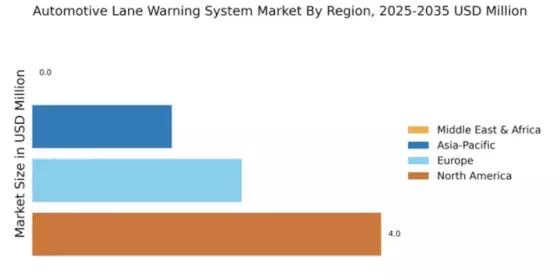
North America is poised to maintain its leadership in the Automotive Lane Warning System market, holding a significant market share of 4.0 in 2024. The region's growth is driven by increasing consumer demand for advanced safety features and stringent regulatory requirements aimed at reducing road accidents. The push for autonomous driving technologies further fuels this demand, as manufacturers seek to integrate lane-keeping assistance systems into their vehicles. The competitive landscape in North America is robust, with key players such as Ford, General Motors, and Bosch leading the charge. The presence of established automotive giants and innovative tech companies fosters a dynamic environment for growth. Additionally, government initiatives promoting vehicle safety and environmental sustainability are expected to enhance market opportunities, ensuring that North America remains at the forefront of automotive technology.

Europe : Regulatory-Driven Market Growth

Europe's Automotive Lane Warning System market is characterized by a strong regulatory framework that promotes vehicle safety, contributing to a market size of 2.4. The European Union's stringent safety regulations and initiatives aimed at reducing traffic fatalities are key drivers of market growth. As consumers become more aware of safety features, the demand for lane warning systems is expected to rise, supported by government incentives for manufacturers to adopt advanced technologies. Leading countries in this region include Germany, France, and the UK, where major automotive manufacturers like Continental and Denso are based. The competitive landscape is marked by innovation and collaboration among industry players, with a focus on integrating lane-keeping technologies into new vehicle models. The presence of a well-established automotive supply chain further enhances the region's market potential.

Asia-Pacific : Emerging Market Potential

The Asia-Pacific region, with a market size of 1.6, is rapidly emerging as a significant player in the Automotive Lane Warning System market. The growth is driven by increasing vehicle production, rising disposable incomes, and a growing awareness of road safety among consumers. Countries like Japan and China are at the forefront, with government initiatives promoting the adoption of advanced safety technologies in vehicles, thereby enhancing market demand. Key players in this region include Denso and Nissan, who are investing heavily in research and development to innovate lane warning systems. The competitive landscape is evolving, with both established manufacturers and new entrants vying for market share. As the region continues to urbanize and vehicle ownership increases, the demand for lane warning systems is expected to grow significantly, making Asia-Pacific a vital market for future investments.

Middle East and Africa : Untapped Market Opportunities

The Middle East and Africa region currently shows a market size of 0.0 for Automotive Lane Warning Systems, indicating significant untapped potential. The growth in this region is expected to be driven by increasing vehicle sales and a rising focus on road safety. Governments are beginning to recognize the importance of advanced safety features, which could lead to regulatory changes that promote the adoption of lane warning systems in the coming years. Countries like South Africa and the UAE are likely to lead the charge in adopting these technologies, as urbanization and infrastructure development continue. The competitive landscape is still developing, with opportunities for both local and international players to enter the market. As awareness of vehicle safety grows, the demand for lane warning systems is anticipated to rise, presenting a promising outlook for the region.

Key Players and Competitive Insights

The Automotive Lane Warning System Market is currently characterized by a dynamic competitive landscape, driven by technological advancements and increasing consumer demand for safety features in vehicles. Key players such as Bosch (DE), Continental (DE), and Mobileye (IL) are at the forefront, focusing on innovation and strategic partnerships to enhance their market positions. Bosch (DE) emphasizes its commitment to developing advanced driver-assistance systems (ADAS), while Continental (DE) is actively pursuing collaborations with automotive manufacturers to integrate lane warning technologies into new vehicle models. Mobileye (IL), known for its cutting-edge computer vision technology, is leveraging its expertise to expand its product offerings, thereby shaping the competitive environment through a focus on technological superiority and strategic alliances.

In terms of business tactics, companies are increasingly localizing manufacturing and optimizing supply chains to enhance efficiency and reduce costs. The market structure appears moderately fragmented, with several key players exerting significant influence. This fragmentation allows for a variety of competitive strategies, as companies seek to differentiate themselves through innovation and customer-centric solutions.

In November 2025, Bosch (DE) announced the launch of its latest lane-keeping assistance system, which utilizes artificial intelligence to improve accuracy and responsiveness. This strategic move is likely to bolster Bosch's competitive edge by enhancing the safety features of its products, thereby appealing to both manufacturers and consumers who prioritize advanced safety technologies.

In October 2025, Continental (DE) entered into a partnership with a leading automotive manufacturer to co-develop next-generation lane warning systems. This collaboration is significant as it not only expands Continental's market reach but also allows for the integration of cutting-edge technologies into mass-produced vehicles, potentially setting new industry standards for safety and reliability.

In September 2025, Mobileye (IL) secured a major contract with a global automaker to supply its lane departure warning systems for a new line of electric vehicles. This contract underscores Mobileye's strategic focus on electric mobility and positions the company favorably within the growing market for sustainable transportation solutions, which is increasingly important to consumers and regulators alike.

As of December 2025, current trends in the Automotive Lane Warning System Market are heavily influenced by digitalization, sustainability, and the integration of artificial intelligence. Strategic alliances are becoming more prevalent, as companies recognize the need to collaborate in order to innovate and meet evolving consumer expectations. Looking ahead, competitive differentiation is likely to shift from price-based competition to a focus on technological innovation and supply chain reliability, as companies strive to deliver superior products that enhance safety and driving experience.

Key Companies in the Automotive Lane Warning System Market market include

Industry Developments

  • Q2 2024: Toyota to Use Invisible AI’s Computer Vision Tech in North American Assembly Plants Toyota announced it will deploy computer-based vision technology from Austin-based startup Invisible AI in its North American assembly plants to enhance quality, safety, and efficiency, including applications in driver assistance and lane warning systems.
  • Q2 2024: GM Partners with INRIX to Provide Safety Solutions Data to US Department of Transportation GM announced a partnership with INRIX to deliver analytics-assisted, cloud-based safety data to the US Department of Transportation, supporting the development and deployment of advanced driver assistance features such as lane warning systems.

Future Outlook

Automotive Lane Warning System Market Future Outlook

The Automotive Lane Warning System Market is projected to grow at a 5.97% CAGR from 2024 to 2035, driven by advancements in safety regulations, technological innovations, and increasing consumer demand for enhanced vehicle safety features.

New opportunities lie in:

  • Integration of AI-driven predictive analytics for lane departure alerts.
  • Development of customizable lane warning systems for fleet management.
  • Partnerships with automotive manufacturers for embedded lane warning technologies.

By 2035, the market is expected to be robust, reflecting substantial advancements and widespread adoption.

Market Segmentation

Automotive Lane Warning System Market End User Outlook

  • Automotive Manufacturers
  • Fleet Operators
  • Individual Consumers

Automotive Lane Warning System Market Technology Outlook

  • Camera-Based System
  • Radar-Based System
  • Lidar-Based System
  • Ultrasonic Sensor System

Automotive Lane Warning System Market Application Outlook

  • Lane Departure Warning
  • Lane Keeping Assist
  • Lane Change Assist
  • Traffic Jam Assist

Automotive Lane Warning System Market Vehicle Type Outlook

  • Passenger Car
  • Commercial Vehicle
  • Electric Vehicle
  • Luxury Vehicle

Report Scope

MARKET SIZE 20248.0(USD Million)
MARKET SIZE 20258.4(USD Million)
MARKET SIZE 203515.0(USD Million)
COMPOUND ANNUAL GROWTH RATE (CAGR)5.97% (2024 - 2035)
REPORT COVERAGERevenue Forecast, Competitive Landscape, Growth Factors, and Trends
BASE YEAR2024
Market Forecast Period2025 - 2035
Historical Data2019 - 2024
Market Forecast UnitsUSD Million
Key Companies ProfiledBosch (DE), Continental (DE), Denso (JP), Delphi Technologies (GB), Mobileye (IL), Nissan (JP), Ford (US), Toyota (JP), General Motors (US)
Segments CoveredApplication, Vehicle Type, Technology, End User
Key Market OpportunitiesIntegration of advanced sensors and artificial intelligence enhances safety in the Automotive Lane Warning System Market.
Key Market DynamicsRising demand for advanced safety features drives innovation in Automotive Lane Warning Systems and regulatory compliance.
Countries CoveredNorth America, Europe, APAC, South America, MEA

Market Highlights

Author
Sejal Akre
Senior Research Analyst

She has over 5 years of rich experience, in market research and consulting providing valuable market insights to client. Hands on expertise in management consulting, and extensive knowledge in domain including ICT, Automotive & Transportation and Aerospace & Defense. She is skilled in Go-to market strategy, industry analysis, market sizing, in depth company profiling, competitive intelligence & benchmarking and value chain amongst others.

Leave a Comment

FAQs

What is the CAGR anticipated to be identified in the lane warning system market?

A 14.3% CAGR is expected to spur the global market in the coming years.

Who are the contenders in the lane warning system market?

Nissan (Japan), Delphi (UK), Magna International (Canada), Autoliv Inc (Sweden), and ZF TRW (US) are the contenders in the market.

What revenues are foreseen to be ascertained in the global lane warning system market?

The revenue level of the market is expected to develop USD 5,940 Million in the forecast period.

What are the elements contributing to the momentum of the lane warning system market?

The rising awareness of car safety standards is estimated to offer an advantage to the market’s development in the forecast period.

Which regions are expected to procure eminence in the global lane warning system market?

The European region is estimated to acquire prominence in the market during the forecast period.

Download Free Sample

Kindly complete the form below to receive a free sample of this Report

Compare Licence

×
Features License Type
Single User Multiuser License Enterprise User
Price $4,950 $5,950 $7,250
Maximum User Access Limit 1 User Upto 10 Users Unrestricted Access Throughout the Organization
Free Customization
Direct Access to Analyst
Deliverable Format
Platform Access
Discount on Next Purchase 10% 15% 15%
Printable Versions