×
Request Free Sample ×

Kindly complete the form below to receive a free sample of this Report

Leading companies partner with us for data-driven Insights

clients tt-cursor
Hero Background

Automotive Mini Led Market

ID: MRFR/SEM/33868-HCR
100 Pages
Aarti Dhapte
October 2025

Automotive Mini LED Market Research Report: By Application (Front Lighting, Rear Lighting, Interior Lighting, Signaling, Daytime Running Lights), By Vehicle Type (Passenger Cars, Light Commercial Vehicles, Heavy Commercial Vehicles, Electric Vehicles, Luxury Vehicles), By Form Factor (Surface Mounted Device, Chip on Board, Integrated Module, Flexible LED, Panel LED), By End Use (OEM, Aftermarket) and By Regional (North America, Europe, South America, Asia Pacific, Middle East and Africa) - Forecast to 2035

Share:
Download PDF ×

We do not share your information with anyone. However, we may send you emails based on your report interest from time to time. You may contact us at any time to opt-out.

Automotive Mini Led Market Infographic
Purchase Options

Automotive Mini Led Market Summary

As per MRFR analysis, the Automotive Mini LED Market Size was estimated at 1.64 USD Billion in 2024. The Automotive Mini LED industry is projected to grow from 2.076 USD Billion in 2025 to 21.81 USD Billion by 2035, exhibiting a compound annual growth rate (CAGR) of 26.52 during the forecast period 2025 - 2035.

Key Market Trends & Highlights

The Automotive Mini LED Market is poised for substantial growth driven by technological advancements and evolving consumer preferences.

  • North America remains the largest market for Automotive Mini LEDs, driven by increasing safety regulations and consumer demand.
  • The Asia-Pacific region is emerging as the fastest-growing market, fueled by rapid urbanization and a shift towards electric mobility.
  • Front lighting continues to dominate the market, while interior lighting is experiencing the fastest growth due to rising consumer interest in vehicle aesthetics.
  • Technological advancements in lighting and the rising demand for electric vehicles are key drivers propelling market expansion.

Market Size & Forecast

2024 Market Size 1.64 (USD Billion)
2035 Market Size 21.81 (USD Billion)
CAGR (2025 - 2035) 26.52%

Major Players

Samsung Electronics (KR), Osram Licht AG (DE), Nichia Corporation (JP), Cree, Inc. (US), LG Innotek (KR), Seoul Semiconductor (KR), Epistar Corporation (TW), Broadcom Inc. (US), Aptiv PLC (IE)

Automotive Mini Led Market Trends

The Automotive Mini LED Market is currently experiencing a transformative phase, characterized by rapid advancements in lighting technology and increasing consumer demand for enhanced vehicle aesthetics and functionality. Mini LED technology, known for its superior brightness and energy efficiency, is becoming a preferred choice among automotive manufacturers. This shift is largely driven by the growing emphasis on safety features, as well as the integration of smart technologies in vehicles. As automakers strive to differentiate their offerings, the incorporation of Mini LED lighting solutions is likely to play a pivotal role in enhancing the overall driving experience. Moreover, the Automotive Mini LED Market appears to be influenced by evolving regulatory standards aimed at improving vehicle visibility and reducing energy consumption. Manufacturers are increasingly investing in research and development to innovate and refine Mini LED applications, which may lead to more sophisticated lighting systems. The trend towards electrification in the automotive sector further supports the adoption of energy-efficient lighting solutions. As the market continues to evolve, it seems poised for substantial growth, driven by technological advancements and changing consumer preferences.

Enhanced Safety Features

The Automotive Mini LED Market is witnessing a trend towards the integration of advanced safety features. Mini LED lighting systems provide improved visibility, which is crucial for nighttime driving and adverse weather conditions. This enhancement not only aids in accident prevention but also aligns with regulatory requirements aimed at increasing road safety.

Aesthetic Customization

Another notable trend in the Automotive Mini LED Market is the focus on aesthetic customization. Automakers are increasingly utilizing Mini LED technology to create unique lighting designs that enhance the visual appeal of vehicles. This trend caters to consumer preferences for personalized and distinctive automotive designs.

Sustainability and Energy Efficiency

The push for sustainability is significantly shaping the Automotive Mini LED Market. Mini LED technology is recognized for its energy efficiency, which aligns with the automotive industry's broader goals of reducing carbon footprints. As consumers become more environmentally conscious, the demand for energy-efficient lighting solutions is likely to rise.

Automotive Mini Led Market Drivers

Rising Demand for Electric Vehicles

The Automotive Mini LED Market is closely linked to the rising demand for electric vehicles (EVs). As consumers become more environmentally conscious, the shift towards EVs is accelerating. Mini LEDs are particularly suited for EVs due to their low power consumption and high efficiency, which aligns with the sustainability goals of electric vehicle manufacturers. Reports indicate that the EV market is anticipated to grow at a rate of approximately 25% annually, creating a substantial opportunity for Mini LED technology to be integrated into these vehicles. This trend is likely to drive the demand for advanced lighting solutions, further propelling the Automotive Mini LED Market.

Technological Advancements in Lighting

The Automotive Mini LED Market is experiencing a surge in technological advancements that enhance vehicle lighting systems. Innovations in Mini LED technology allow for improved brightness, color accuracy, and energy efficiency. As manufacturers increasingly adopt these technologies, the market is projected to grow significantly. For instance, the integration of adaptive lighting systems, which adjust based on driving conditions, is becoming more prevalent. This trend not only improves visibility but also enhances safety, making vehicles more appealing to consumers. The market is expected to witness a compound annual growth rate of over 20% in the coming years, driven by these advancements.

Consumer Preference for Enhanced Aesthetics

In the Automotive Mini LED Market, consumer preferences are shifting towards vehicles that offer enhanced aesthetics and personalization options. Mini LEDs provide manufacturers with the ability to create unique lighting designs that appeal to modern consumers. The ability to customize lighting features, such as ambient lighting and dynamic turn signals, is becoming a key selling point for new vehicles. Market analysis suggests that aesthetic customization is a significant factor influencing purchasing decisions, with nearly 60% of consumers indicating a preference for vehicles with advanced lighting features. This trend is likely to stimulate growth in the Automotive Mini LED Market as manufacturers seek to meet these evolving consumer demands.

Integration of Smart Technologies in Vehicles

The Automotive Mini LED Market is witnessing a trend towards the integration of smart technologies in vehicles. As vehicles become more connected, the demand for advanced lighting systems that can interact with other smart features is increasing. Mini LEDs can be integrated with smart systems to provide functionalities such as automatic brightness adjustment and communication with other vehicles. This integration enhances the overall driving experience and safety. Market forecasts indicate that the smart vehicle segment is expected to grow at a rate of 30% annually, which will likely drive the demand for Mini LED lighting solutions, further expanding the Automotive Mini LED Market.

Regulatory Support for Advanced Lighting Technologies

The Automotive Mini LED Market is benefiting from increasing regulatory support for advanced lighting technologies. Governments are implementing stricter safety regulations that encourage the adoption of innovative lighting solutions. Mini LEDs, with their superior performance and energy efficiency, are well-positioned to meet these regulatory requirements. For example, regulations aimed at reducing energy consumption in vehicles are likely to favor the use of Mini LEDs over traditional lighting technologies. This regulatory environment is expected to drive investment in Mini LED technology, fostering growth in the Automotive Mini LED Market as manufacturers adapt to comply with new standards.

Market Segment Insights

By Application: Front Lighting (Largest) vs. Interior Lighting (Fastest-Growing)

The Automotive Mini LED Market is segmented into various application categories, including Front Lighting, Rear Lighting, Interior Lighting, Signaling, and Daytime Running Lights. Among these, Front Lighting holds the largest market share, primarily due to its essential role in vehicle safety and visibility. Meanwhile, Interior Lighting is showing rapid growth, driven by advancements in automotive design and consumer preference for enhanced cabin aesthetics and customizable lighting options. The market dynamics are influenced by ongoing trends in vehicle electrification and increasing consumer demand for smart and connected vehicles, which bolster the need for functional yet stylish lighting solutions. As automotive manufacturers compete to innovate, Interior Lighting is gaining traction with consumers who prioritize comfort and modern amenities, further accelerating its growth in the market.

Lighting: Front Lighting (Dominant) vs. Daytime Running Lights (Emerging)

In the Automotive Mini LED Market, Front Lighting is a dominant application, vital for ensuring safety and compliance with regulations regarding visibility. This segment includes headlights and high-intensity beams that are increasingly being integrated with advanced technologies like adaptive lighting systems, offering improved illumination performance. On the other hand, Daytime Running Lights (DRLs) are classified as an emerging segment, gaining attention for their role in visibility during the daytime and enhancing vehicle aesthetics. DRLs are becoming a standard feature in various vehicle models due to regulatory requirements and are appealing to manufacturers aiming to boost brand image through modern designs. Both segments represent pivotal aspects of automotive lighting, reflecting the balance between safety, regulations, and consumer preferences.

By Vehicle Type: Passenger Cars (Largest) vs. Electric Vehicles (Fastest-Growing)

The Automotive Mini LED Market exhibits a diverse distribution of market share across various vehicle types. Among these segments, Passenger Cars dominate the market due to their widespread usage and increasing incorporation of advanced lighting technologies such as Mini LEDs. Following closely are Light Commercial Vehicles and Heavy Commercial Vehicles, which are significant contributors but lag behind in comparison to the extensive penetration of Mini LEDs in Passenger Cars. Electric Vehicles are emerging as a crucial segment, propelled by the global shift towards electrification and sustainability.

Passenger Cars (Dominant) vs. Electric Vehicles (Emerging)

Passenger Cars represent the most dominant segment within the Automotive Mini LED Market, characterized by a high adoption rate and the integration of innovative lighting features for aesthetics and safety. Their widespread use in urban transportation and family-oriented functions bolsters their market position. In contrast, Electric Vehicles are emerging as a pivotal segment, driven by environmental regulations and consumer preference for sustainable options. The rapid technological advancements in EV design and functionality are making them a hotbed for Mini LED integration, signaling a shift in market dynamics.

By Form Factor: Surface Mounted Device (Largest) vs. Chip on Board (Fastest-Growing)

The Automotive Mini LED Market exhibits a diversified segment structure in the 'Form Factor' category, where Surface Mounted Device (SMD) holds the largest market share due to its widespread adoption in modern vehicle lighting and display applications. Meanwhile, Chip on Board (COB) technology is garnering attention as an innovative alternative, capturing an increasing portion of the market owing to its compact design and superior light output. Emerging forms like Integrated Modules and Flexible LEDs are also witnessing substantial interest, as manufacturers seek versatile lighting solutions to enhance vehicle aesthetics and functionality. Growth trends within the Automotive Mini LED 'Form Factor' segment are characterized by technological advancements and evolving consumer preferences. The shift towards electric vehicles and automated driving systems is driving demand for high-performance lighting solutions, leading to a surging interest in emerging technologies like Chip on Board. Additionally, the integration of smart functionalities within Mini LEDs, along with growing collaborations among automotive suppliers, is expected to foster rapid growth across several segment values, particularly with Integrated Modules and Flexible LEDs capturing interest due to their adaptability in design and application.

Technology: Surface Mounted Device (Dominant) vs. Flexible LED (Emerging)

Surface Mounted Device (SMD) technology remains the dominant force in the Automotive Mini LED Market due to its efficiency, reliability, and ease of integration into various automotive applications such as dashboard displays and exterior lighting. SMD units are favored for their stability and consistent performance, making them a go-to choice for automobile manufacturers. In contrast, Flexible LEDs represent an emerging segment that appeals to innovators who prioritize versatility in design. Their unique ability to conform to complex shapes allows for creative applications in ambient lighting and intricate vehicle designs, attracting niche automotive producers and enhancing user engagement. As both segments evolve, their synergy could redefine future automotive lighting solutions.

By End Use: OEM (Largest) vs. Aftermarket (Fastest-Growing)

In the Automotive Mini LED Market, the OEM segment dominates the landscape, contributing significantly to the market share due to the increasing adoption of Mini LED technology by original equipment manufacturers. This trend is fueled by the demand for higher quality lighting solutions in vehicles, enhanced aesthetic designs, and improved energy efficiency. OEMs are steadily incorporating advanced lighting technologies, with Mini LEDs being favored for their excellent performance and durability, solidifying their position in the market. Conversely, the aftermarket segment is experiencing rapid growth as consumers seek personalized lighting solutions and upgrades for their vehicles. Factors driving this growth include the rising popularity of vehicle customization and improvements in technology that allow for better integration of Mini LEDs in older models. As more automotive enthusiasts and consumers opt for aftermarket enhancements, this segment is positioned to grow at an impressive rate, catering to diverse customer preferences and innovative lighting applications.

End Use: OEM (Dominant) vs. Aftermarket (Emerging)

The OEM segment is characterized by its established presence in the Automotive Mini LED Market, where manufacturers leverage Mini LED technology to enhance vehicle lighting systems significantly. OEMs prioritize quality, reliability, and performance, making the integration of Mini LEDs a strategic choice to meet consumer expectations and regulatory requirements. In contrast, the aftermarket segment represents a rapidly evolving sector where innovation meets consumer customization. Aftermarket products are gaining traction, driven by consumer demand for unique lighting configurations and enhancements. This segment appeals to car enthusiasts and those wanting to personalize their vehicles, offering a plethora of options that reflect individual styles and preferences. As technology advances, aftermarket solutions are becoming increasingly sophisticated, ensuring that this segment complements the dominant OEM market.

Get more detailed insights about Automotive Mini Led Market

Regional Insights

North America : Innovation and Adoption Leader

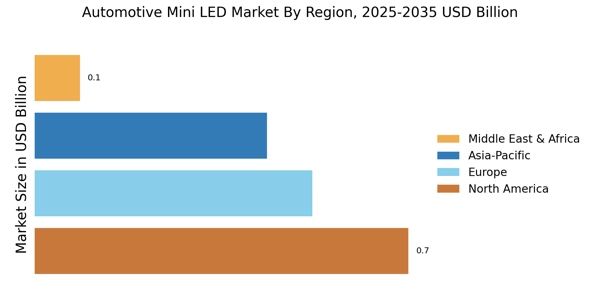
North America is poised to lead the Automotive Mini LED market, driven by technological advancements and increasing consumer demand for enhanced vehicle lighting. The region holds approximately 40% of the global market share, with the United States being the largest contributor, followed by Canada at around 15%. Regulatory support for energy-efficient technologies further propels market growth, as automakers seek to comply with stringent environmental standards. The competitive landscape in North America is robust, featuring key players such as Samsung Electronics, Cree, and Broadcom. The presence of established automotive manufacturers and a strong focus on R&D initiatives contribute to the region's dominance. Additionally, partnerships between technology firms and automotive companies are fostering innovation, ensuring that North America remains at the forefront of the Automotive Mini LED market.

Europe : Sustainability and Innovation Hub

Europe is emerging as a significant player in the Automotive Mini LED market, driven by stringent regulations aimed at reducing carbon emissions and enhancing energy efficiency. The region accounts for approximately 30% of the global market share, with Germany and France leading the charge. The European Union's Green Deal and various national initiatives are pivotal in promoting the adoption of advanced lighting technologies in vehicles, thereby stimulating market growth. Leading countries in Europe include Germany, France, and the UK, where major automotive manufacturers are increasingly integrating Mini LED technology into their designs. The competitive landscape is characterized by collaborations between automotive and technology firms, such as Osram Licht and LG Innotek, which are focused on developing innovative lighting solutions. This synergy is crucial for meeting the evolving demands of consumers and regulatory bodies alike.

Asia-Pacific : Emerging Powerhouse in Technology

Asia-Pacific is rapidly becoming a powerhouse in the Automotive Mini LED market, driven by increasing vehicle production and a growing middle-class population. The region holds approximately 25% of the global market share, with China being the largest market, followed by Japan. The demand for advanced lighting solutions is further fueled by rising consumer expectations for enhanced vehicle aesthetics and safety features, alongside supportive government policies promoting innovation in automotive technologies. Key players in the Asia-Pacific region include Nichia Corporation, Seoul Semiconductor, and Epistar Corporation, which are at the forefront of Mini LED technology development. The competitive landscape is marked by aggressive investments in R&D and strategic partnerships among manufacturers to enhance product offerings. As the region continues to innovate, it is expected to play a crucial role in shaping the future of automotive lighting solutions.

Middle East and Africa : Resource-Rich Frontier for Growth

The Middle East and Africa region presents untapped potential in the Automotive Mini LED market, driven by increasing urbanization and a growing automotive sector. The region currently holds about 5% of the global market share, with countries like South Africa and the UAE leading in automotive innovation. Government initiatives aimed at diversifying economies and promoting sustainable technologies are expected to catalyze market growth in the coming years. In this region, the competitive landscape is still developing, with emerging players and partnerships forming to capitalize on the growing demand for advanced automotive lighting solutions. Local manufacturers are beginning to explore collaborations with global technology firms to enhance their product offerings. As infrastructure improves and consumer awareness increases, the Middle East and Africa are set to become significant players in the Automotive Mini LED market.

Automotive Mini Led Market Regional Image

Key Players and Competitive Insights

The Automotive Mini LED Market has been experiencing significant growth, driven by the increasing demand for advanced lighting solutions in the automotive sector. Mini LED technology, known for its superior brightness, energy efficiency, and greater control over light distribution, is becoming a preferred choice among automakers. This has led to a heightened competitive landscape, with various companies striving to innovate and establish a strong market presence. The integration of Mini LED technology into vehicular designs is reshaping the way manufacturers approach vehicle aesthetics, safety, and driver experience.

As competition intensifies, firms are focusing on research and development to enhance the capabilities of Mini LEDs while also exploring strategic partnerships for better market penetration.

Lumileds has carved a notable niche for itself within the Automotive Mini LED Market, utilizing its expertise in advanced lighting technologies. The company is recognized for its commitment to innovation, which is reflected in its cutting-edge Mini LED automotive solutions. Lumileds emphasizes strong performance metrics, including improved luminous efficacy and enhanced thermal management, making their products particularly attractive to automotive manufacturers. The company’s extensive portfolio, coupled with robust supply chain management, allows it to cater to the increasing demand for customized lighting solutions that align with evolving automotive design trends.

Lumileds also invests heavily in sustainability initiatives, which further strengthens its brand position and resonates well with environmentally conscious consumers and manufacturers alike.

Samsung SDI holds a prominent position in the Automotive Mini LED Market, leveraging its technological prowess and reputation for high-quality components. The company is known for its continuous investment in research and development, which drives innovation in Mini LED technology and ensures that its products meet the demanding standards of the automotive industry. Samsung SDI's strengths lie in its ability to manufacture highly efficient, durable, and cost-effective Mini LED solutions that enhance vehicle safety and aesthetics. The firm benefits from economies of scale, enabling it to provide competitive pricing while maintaining quality.

Moreover, Samsung SDI's strong collaborations with key automotive players enable it to remain agile and responsive to market changes, solidifying its competitive edge in this rapidly evolving sector.

Key Companies in the Automotive Mini Led Market market include

Industry Developments

The Automotive Mini LED Market is currently experiencing significant developments. Companies like Samsung Electronics are innovating in Mini LED technology, enhancing their product offerings for automotive lighting solutions. Lumileds has also made advancements in its Mini LED segments, focusing on brighter and more energy-efficient alternatives for vehicle integration. Meanwhile, LG Innotek has been actively increasing its production capacities to meet the rising demand from automotive manufacturers. Infineon Technologies has expanded its presence by introducing new semiconductor solutions tailored for Mini LED applications in vehicles. 

Recent mergers and acquisitions have also shaped the market landscape, with several companies exploring strategic collaborations to bolster their technological capabilities. For example, Texas Instruments has been engaged in partnerships that strengthen its position in the automotive sector. The market valuation of many of these players has seen growth, primarily driven by the increasing adoption of advanced lighting systems in vehicles for safety and aesthetic purposes. As automotive manufacturers continue to prioritize high-quality, energy-efficient lighting, the Mini LED segment is poised for robust expansion in the coming years.

Future Outlook

Automotive Mini Led Market Future Outlook

The Automotive Mini LED Market is projected to grow at a 26.52% CAGR from 2024 to 2035, driven by advancements in lighting technology, increased demand for energy efficiency, and enhanced vehicle aesthetics.

New opportunities lie in:

  • Development of customizable Mini LED lighting solutions for luxury vehicles.
  • Partnerships with automotive manufacturers for integrated Mini LED systems.
  • Expansion into emerging markets with tailored Mini LED applications.

By 2035, the Automotive Mini LED Market is expected to achieve substantial growth and innovation.

Market Segmentation

Automotive Mini Led Market End Use Outlook

  • OEM
  • Aftermarket

Automotive Mini Led Market Application Outlook

  • Front Lighting
  • Rear Lighting
  • Interior Lighting
  • Signaling
  • Daytime Running Lights

Automotive Mini Led Market Form Factor Outlook

  • Surface Mounted Device
  • Chip on Board
  • Integrated Module
  • Flexible LED
  • Panel LED

Automotive Mini Led Market Vehicle Type Outlook

  • Passenger Cars
  • Light Commercial Vehicles
  • Heavy Commercial Vehicles
  • Electric Vehicles
  • Luxury Vehicles

Report Scope

MARKET SIZE 2024 1.64(USD Billion)
MARKET SIZE 2025 2.076(USD Billion)
MARKET SIZE 2035 21.81(USD Billion)
COMPOUND ANNUAL GROWTH RATE (CAGR) 26.52% (2024 - 2035)
REPORT COVERAGE Revenue Forecast, Competitive Landscape, Growth Factors, and Trends
BASE YEAR 2024
Market Forecast Period 2025 - 2035
Historical Data 2019 - 2024
Market Forecast Units USD Billion
Key Companies Profiled Market analysis in progress
Segments Covered Market segmentation analysis in progress
Key Market Opportunities Growing demand for energy-efficient lighting solutions in the Automotive Mini LED Market presents significant opportunities.
Key Market Dynamics Rising demand for energy-efficient lighting solutions drives innovation and competition in the Automotive Mini LED Market.
Countries Covered North America, Europe, APAC, South America, MEA

Leave a Comment

FAQs

What is the projected market valuation of the Automotive Mini LED Market by 2035?

The Automotive Mini LED Market is projected to reach a valuation of 21.81 USD Billion by 2035.

What was the market valuation of the Automotive Mini LED Market in 2024?

In 2024, the market valuation of the Automotive Mini LED Market was 1.64 USD Billion.

What is the expected CAGR for the Automotive Mini LED Market during the forecast period 2025 - 2035?

The expected CAGR for the Automotive Mini LED Market during the forecast period 2025 - 2035 is 26.52%.

Which application segments are expected to drive growth in the Automotive Mini LED Market?

The application segments such as Front Lighting and Interior Lighting are expected to drive growth, with valuations projected at 5.0 USD Billion and 4.0 USD Billion respectively by 2035.

How do passenger cars contribute to the Automotive Mini LED Market?

Passenger cars are projected to contribute significantly, with a market valuation expected to reach 10.0 USD Billion by 2035.

What role do key players like Samsung Electronics and Osram Licht AG play in the market?

Key players such as Samsung Electronics and Osram Licht AG are likely to influence market dynamics through innovation and competitive strategies.

What is the anticipated market size for the aftermarket segment in 2035?

The aftermarket segment is anticipated to reach a market size of 6.81 USD Billion by 2035.

Which form factor is expected to dominate the Automotive Mini LED Market?

The Panel LED form factor is expected to dominate, with a projected valuation of 6.31 USD Billion by 2035.

What is the expected market size for electric vehicles in the Automotive Mini LED Market?

The market size for electric vehicles is expected to reach 3.0 USD Billion by 2035.

How does the growth of luxury vehicles impact the Automotive Mini LED Market?

The growth of luxury vehicles is likely to impact the market positively, with a projected valuation of 2.31 USD Billion by 2035.

Download Free Sample

Kindly complete the form below to receive a free sample of this Report

Compare Licence

×
Features License Type
Single User Multiuser License Enterprise User
Price $4,950 $5,950 $7,250
Maximum User Access Limit 1 User Upto 10 Users Unrestricted Access Throughout the Organization
Free Customization
Direct Access to Analyst
Deliverable Format
Platform Access
Discount on Next Purchase 10% 15% 15%
Printable Versions