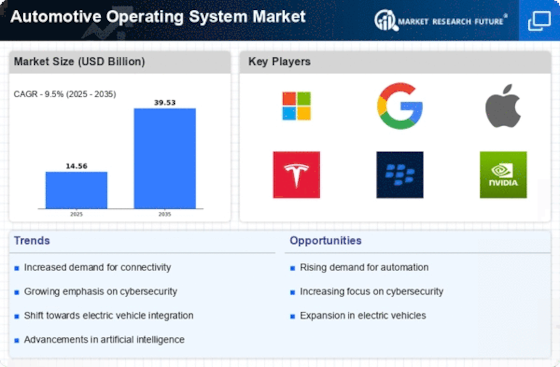
The Automotive Operating System Market is currently characterized by intense competition and rapid technological advancements, driven by the increasing demand for connected and autonomous vehicles. Major players such as Microsoft (US), Google (US), and Tesla (US) are at the forefront, each adopting distinct strategies to enhance their market positioning. Microsoft (US) focuses on cloud-based solutions and partnerships with automotive manufacturers to integrate its Azure platform into vehicle systems, thereby facilitating data-driven decision-making. Google (US), through its Android Automotive OS, emphasizes user experience and customization, aiming to create a seamless interface for drivers. Tesla (US) continues to innovate with its proprietary operating system, which is integral to its self-driving technology, thus reinforcing its leadership in the electric vehicle segment. Collectively, these strategies contribute to a competitive landscape that is increasingly defined by technological prowess and strategic collaborations.
Key business tactics within the Auto OS Market include localizing manufacturing and optimizing supply chains to enhance efficiency and reduce costs. The market structure appears moderately fragmented, with a mix of established players and emerging startups vying for market share. The influence of key players is substantial, as their innovations and strategic moves often set industry standards, compelling others to adapt or innovate in response.
In August 2025, Google (US) announced a partnership with a leading automotive manufacturer to integrate its Android Automotive OS into a new line of electric vehicles. This collaboration is strategically significant as it not only expands Google's footprint in the automotive sector but also enhances the user experience through advanced connectivity features. Such partnerships are likely to accelerate the adoption of smart technologies in vehicles, positioning Google as a pivotal player in the ongoing digital transformation of the automotive industry.
In September 2025, Tesla (US) unveiled a major update to its operating system, which includes enhanced AI capabilities for its autonomous driving features. This update is crucial as it underscores Tesla's commitment to maintaining its competitive edge in the self-driving market. By continuously refining its software, Tesla not only improves vehicle performance but also strengthens customer loyalty, as users benefit from regular enhancements and new functionalities.
In July 2025, Microsoft (US) expanded its collaboration with automotive suppliers to integrate its cloud services into vehicle operating systems. This move is indicative of Microsoft's strategy to leverage its cloud infrastructure to support the growing demand for data analytics in automotive applications. By doing so, Microsoft positions itself as a key enabler of digital transformation in the automotive sector, facilitating smarter, more connected vehicles.
As of October 2025, the competitive trends in the Automotive Software OS Market are increasingly shaped by digitalization, sustainability, and the integration of artificial intelligence. Strategic alliances among key players are fostering innovation and enhancing technological capabilities, which are essential for meeting evolving consumer expectations. Looking ahead, competitive differentiation is likely to shift from traditional price-based competition to a focus on innovation, advanced technology, and supply chain reliability, as companies strive to deliver superior value in an increasingly complex market.
In August 2025, Panasonic announced new manufacturing and technology updates focused on advancing energy solutions and sustainable production. The company highlighted innovations in batteries, energy storage, and eco-friendly operations. These developments align with Panasonic’s long-term green strategy.
Recently, a major collaboration between Elektrobit and Foxconn advanced the development of software-defined vehicles, focusing on scalable, integrated software platforms for next-gen EVs. The partnership accelerates the shift toward fully digital vehicle architectures.





















Leave a Comment