×
Request Free Sample ×

Kindly complete the form below to receive a free sample of this Report

* Please use a valid business email

Leading companies partner with us for data-driven Insights

clients tt-cursor
Hero Background

Automotive Positive Crankcase Ventilation Pcv Valve Market

ID: MRFR/AT/26080-HCR
128 Pages
Sejal Akre
October 2025

Automotive Positive Crankcase Ventilation (PCV) Valve Market Research Report By Vehicle Type (Passenger Cars, Light Commercial Vehicles, Heavy Commercial Vehicles), By Distribution Channel (OEM, Aftermarket), By Material (Steel, Aluminum, Plastic, Composites), By Valve Type (Diaphragm Valve, Reed Valve, Poppet Valve), By Function (Crankcase Pressure Control, Oil Mist Separation, Emissions Control) and By Regional (North America, Europe, South America, Asia Pacific, Middle East and Africa) - Forecast to 2035

Share:
Download PDF ×

We do not share your information with anyone. However, we may send you emails based on your report interest from time to time. You may contact us at any time to opt-out.

Automotive Positive Crankcase Ventilation Pcv Valve Market Infographic
Purchase Options

Automotive Positive Crankcase Ventilation Pcv Valve Market Summary

As per MRFR analysis, the Automotive Positive Crankcase Ventilation (PCV) Valve Market Size was estimated at 1.269 USD Billion in 2024. The PCV Valve industry is projected to grow from 1.323 in 2025 to 2.006 by 2035, exhibiting a compound annual growth rate (CAGR) of 4.25 during the forecast period 2025 - 2035.

Key Market Trends & Highlights

The Automotive Positive Crankcase Ventilation (PCV) Valve Market is poised for growth driven by technological advancements and regulatory compliance.

  • Technological advancements in PCV systems are enhancing engine efficiency and performance across various vehicle types.
  • North America remains the largest market for PCV valves, while Asia-Pacific is emerging as the fastest-growing region due to increasing vehicle production.
  • Passenger cars dominate the market, yet light commercial vehicles are witnessing rapid growth in demand for PCV solutions.
  • The expansion of aftermarket services and stringent emission regulations are key drivers propelling the market forward.

Market Size & Forecast

2024 Market Size 1.269 (USD Billion)
2035 Market Size 2.006 (USD Billion)
CAGR (2025 - 2035) 4.25%

Major Players

Aisin Seiki Co., Ltd. (JP), Mahle GmbH (DE), Denso Corporation (JP), Continental AG (DE), BorgWarner Inc. (US), Tenneco Inc. (US), Delphi Technologies (GB), Hitachi Automotive Systems, Ltd. (JP), Valeo SA (FR)

Automotive Positive Crankcase Ventilation Pcv Valve Market Trends

The Automotive Positive Crankcase Ventilation (PCV) Valve Market is currently experiencing notable transformations driven by evolving automotive technologies and increasing environmental regulations. As manufacturers strive to enhance engine efficiency and reduce emissions, the demand for advanced PCV valves is likely to rise. These components play a crucial role in managing crankcase gases, thereby contributing to improved vehicle performance and compliance with stringent emission standards. Furthermore, the shift towards electric vehicles may influence the design and functionality of PCV systems, as manufacturers explore innovative solutions to integrate these valves into new powertrains. In addition, the growing awareness of environmental sustainability among consumers appears to be shaping purchasing decisions. As a result, automotive companies are increasingly focusing on developing eco-friendly products, which may include more efficient PCV valves. The market landscape is also characterized by heightened competition, with various players striving to differentiate their offerings through technological advancements and superior quality. Overall, the Automotive Positive Crankcase Ventilation (PCV) Valve Market seems poised for growth, driven by a combination of regulatory pressures, technological innovations, and changing consumer preferences.

Technological Advancements

The Automotive Positive Crankcase Ventilation (PCV) Valve Market is witnessing a surge in technological innovations. Manufacturers are increasingly adopting advanced materials and designs to enhance the efficiency and durability of PCV valves. This trend indicates a shift towards more sophisticated solutions that can better manage crankcase emissions and improve overall engine performance.

Regulatory Compliance

Stringent environmental regulations are significantly influencing the Automotive Positive Crankcase Ventilation (PCV) Valve Market. As governments worldwide implement stricter emission standards, the demand for high-performance PCV valves is likely to increase. This trend suggests that manufacturers must prioritize compliance in their product development strategies.

Sustainability Focus

There is a growing emphasis on sustainability within the Automotive Positive Crankcase Ventilation (PCV) Valve Market. Consumers are becoming more environmentally conscious, prompting manufacturers to develop eco-friendly products. This trend indicates a potential shift towards greener technologies and practices in the automotive sector.

Automotive Positive Crankcase Ventilation Pcv Valve Market Drivers

Increasing Vehicle Production

The Automotive Positive Crankcase Ventilation (PCV) Valve Market is experiencing growth due to the rising production of vehicles worldwide. As manufacturers ramp up production to meet consumer demand, the need for efficient engine components, including PCV valves, becomes paramount. In 2025, the automotive sector is projected to produce over 90 million vehicles, which directly correlates with the demand for PCV valves. This increase in vehicle production not only drives sales but also encourages innovation in PCV valve technology, as manufacturers seek to enhance engine performance and reduce emissions. Consequently, the Automotive Positive Crankcase Ventilation (PCV) Valve Market is likely to benefit from this upward trend in vehicle manufacturing.

Stringent Emission Regulations

The Automotive Positive Crankcase Ventilation (PCV) Valve Market is significantly influenced by stringent emission regulations imposed by various governments. These regulations aim to reduce harmful emissions from vehicles, thereby necessitating the use of effective PCV systems. As of 2025, many regions have adopted stricter standards, compelling manufacturers to integrate advanced PCV valves that can efficiently manage crankcase gases. This regulatory pressure not only drives the demand for high-quality PCV valves but also fosters innovation in the industry, as companies strive to develop products that comply with these regulations. The Automotive Positive Crankcase Ventilation (PCV) Valve Market is thus positioned to grow as compliance becomes increasingly critical for automotive manufacturers.

Expansion of Aftermarket Services

The Automotive Positive Crankcase Ventilation (PCV) Valve Market is also experiencing growth due to the expansion of aftermarket services. As vehicle ownership increases, the demand for replacement parts, including PCV valves, is on the rise. In 2025, the aftermarket segment is projected to account for a significant share of the overall automotive market, driven by the need for maintenance and repairs. This trend presents a lucrative opportunity for manufacturers and suppliers within the Automotive Positive Crankcase Ventilation (PCV) Valve Market, as they can capitalize on the growing need for high-quality replacement parts. The expansion of aftermarket services is likely to enhance the visibility and accessibility of PCV valves, further driving market growth.

Rising Awareness of Engine Efficiency

The Automotive Positive Crankcase Ventilation (PCV) Valve Market is benefiting from a growing awareness among consumers regarding engine efficiency and performance. As vehicle owners become more informed about the impact of engine components on fuel economy and emissions, the demand for high-performance PCV valves is likely to increase. In 2025, it is estimated that the automotive sector will witness a shift towards more fuel-efficient vehicles, which will require advanced PCV systems to optimize engine performance. This trend indicates a potential growth opportunity for the Automotive Positive Crankcase Ventilation (PCV) Valve Market, as manufacturers respond to consumer preferences for efficiency and sustainability.

Technological Innovations in PCV Systems

The Automotive Positive Crankcase Ventilation (PCV) Valve Market is poised for growth due to ongoing technological innovations in PCV systems. Advances in materials and design are leading to the development of more efficient and durable PCV valves. In 2025, the introduction of smart PCV systems that can adapt to varying engine conditions is expected to enhance performance and reduce emissions. These innovations not only improve the functionality of PCV valves but also align with the industry's shift towards more sustainable practices. As a result, the Automotive Positive Crankcase Ventilation (PCV) Valve Market is likely to see increased investment in research and development, driving further advancements in technology.

Market Segment Insights

By Vehicle Type: Passenger Cars (Largest) vs. Light Commercial Vehicles (Fastest-Growing)

In the Automotive Positive Crankcase Ventilation (PCV) Valve Market, passenger cars hold the largest market share, primarily due to the increasing demand for fuel-efficient and low-emission vehicles. These cars are equipped with advanced PCV valves to comply with stringent regulatory standards and enhance engine performance. Light commercial vehicles, on the other hand, are witnessing significant growth, driven by the expansion of e-commerce and the need for efficient transport solutions. This market segment is adapting to include PCV systems that cater to newer engine technologies. With the transition towards environmental sustainability, the demand for PCV valves in passenger cars is projected to remain robust. Conversely, light commercial vehicles are emerging as the fastest-growing segment, capitalizing on innovative technological developments and the rising focus on reducing vehicular emissions. The trend towards hybrid and electric vehicles further enhances the growth prospects of both segments, as they incorporate sophisticated ventilation systems to optimize engine efficiency and environmental compliance.

Passenger Cars (Dominant) vs. Heavy Commercial Vehicles (Emerging)

Passenger cars are the dominant segment in the Automotive Positive Crankcase Ventilation (PCV) Valve Market, characterized by a steady increase in production and sales attributed to the growing consumer preference for environmentally friendly vehicles. These vehicles are equipped with advanced PCV systems that help in minimizing emissions and enhancing fuel efficiency. On the other hand, heavy commercial vehicles represent an emerging segment, influenced by increasing regulations related to emissions and a push towards sustainability in the freight and transportation sectors. Though they hold a smaller market share compared to passenger cars, improvements in engine design and performance enhancements are driving the adoption of advanced PCV valves in this segment. As manufacturers innovate and enhance operational efficiency, heavy commercial vehicles are expected to carve a significant niche in the market.

By Distribution Channel: OEM (Largest) vs. Aftermarket (Fastest-Growing)

In the Automotive Positive Crankcase Ventilation (PCV) Valve Market, the distribution channel is primarily divided into OEM and Aftermarket segments. The OEM segment commands the largest market share, benefiting from long-term relationships with vehicle manufacturers and a reputation for quality. This reliability ensures that OEM parts are preferred by many customers during the vehicle manufacturing process, establishing their dominance in the market.

Distribution Channel: OEM (Dominant) vs. Aftermarket (Emerging)

The OEM segment of the Automotive Positive Crankcase Ventilation (PCV) Valve Market is characterized by its strong connections with vehicle manufacturers, providing high-quality and reliable parts that meet stringent automotive standards. Vehicles equipped with OEM valves often benefit from better performance and lower risk of failure, making them a preferred choice for manufacturers. On the other hand, the Aftermarket segment is rapidly emerging, driven by the increasing demand for replacement parts and maintenance in older vehicles. This segment caters to a diverse range of customers seeking cost-effective alternatives and has begun to innovate with more advanced options, appealing to car enthusiasts and budget-conscious consumers alike.

By Material: Steel (Largest) vs. Plastic (Fastest-Growing)

In the Automotive Positive Crankcase Ventilation (PCV) Valve Market, the material segment is primarily driven by steel, which holds the largest market share due to its durability and cost-effectiveness. Steel PCV valves are favored in many vehicles to manage crankcase gases efficiently. Conversely, plastic is emerging as a significant player, gaining traction owing to its lightweight properties and resistance to corrosion, appealing to manufacturers looking to enhance fuel efficiency.

Material: Steel (Dominant) vs. Plastic (Emerging)

Steel valves are known for their strength and reliability, making them the go-to option for most traditional vehicles. On the other hand, plastic valves are quickly becoming a preferred choice among electric and hybrid vehicle manufacturers due to their lighter weight and lower manufacturing costs. The demand for high-performance and fuel-efficient vehicles propels the growth of plastic PCV valves, positioning them as an innovative alternative to steel in future automotive designs. As sustainability trends rise, the adaptability of materials like polymer is expected to boost their market position.

By Valve Type: Diaphragm Valve (Largest) vs. Poppet Valve (Fastest-Growing)

In the Automotive Positive Crankcase Ventilation (PCV) Valve Market, the Diaphragm Valve segment holds the largest market share, attributed to its longstanding reliability and efficiency in engine performance. Following closely, the Reed Valve showcases a significant presence, while the Poppet Valve emerges as the fastest-growing segment, driven by the increasing demand for modernized engine designs that require more efficient ventilation systems. The growth of this segment is primarily fueled by the automotive industry's shift toward reducing emissions and improving fuel efficiency. The rise in environmental regulations and consumer preferences for greener technologies have compelled manufacturers to innovate and adopt valves that enhance engine performance and support sustainability. This trend is especially evident in the rising popularity of Poppet Valves due to their ability to handle higher pressure and improve overall engine efficiency.

Diaphragm Valve (Dominant) vs. Reed Valve (Emerging)

The Diaphragm Valve is a dominant player in the Automotive PCV Valve Market due to its proven track record in maintaining effective crankcase ventilation while ensuring optimal engine performance. Known for its durability and reliability, it successfully minimizes emissions and meets regulatory standards. In contrast, the Reed Valve represents an emerging segment characterized by flexibility and responsiveness, making it suitable for a wide range of engine designs. As manufacturers seek innovative solutions to enhance engine efficiency, the Reed Valve's appeal grows, particularly in performance-oriented applications where quick response times are vital. Together, these valve types showcase a dynamic interplay between established reliability and innovative functionality in the evolving automotive landscape.

By Function: Crankcase Pressure Control (Largest) vs. Oil Mist Separation (Fastest-Growing)

In the Automotive Positive Crankcase Ventilation (PCV) Valve Market, the function segment exhibits notable variations in market share distribution. Crankcase Pressure Control holds a significant portion of the market, established as the dominant function due to its essential role in maintaining optimal engine performance and reliability. Conversely, Oil Mist Separation is emerging rapidly, driven by stringent emission regulations and the growing focus on reducing oil consumption in internal combustion engines.

Function: Crankcase Pressure Control (Dominant) vs. Oil Mist Separation (Emerging)

Crankcase Pressure Control is a dominant function in the Automotive PCV Valve Market, recognized for its vital role in regulating the crankcase pressure, which prevents unwanted pressure build-up and ensures engine efficiency. This function is heavily integrated into modern engine designs. On the other hand, Oil Mist Separation is gaining attention as an emerging function due to the increasing demand for improved oil management solutions. This segment focuses on capturing oil mist before it re-enters the intake system, thus minimizing oil loss and enhancing overall engine performance. The shift towards eco-friendly practices and advancements in materials are further propelling the growth of this segment.

Get more detailed insights about Automotive Positive Crankcase Ventilation Pcv Valve Market

Regional Insights

North America : Leading Innovation and Demand

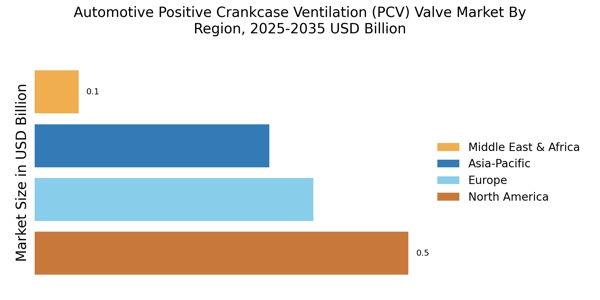
North America is the largest market for Automotive Positive Crankcase Ventilation (PCV) valves, holding approximately 40% of the global market share. The region's growth is driven by stringent emissions regulations and a rising demand for fuel-efficient vehicles. The increasing focus on reducing vehicular emissions has led to a surge in the adoption of advanced PCV systems, further propelling market growth. The United States and Canada are the leading countries in this region, with major automotive manufacturers investing heavily in R&D for PCV technologies. Key players such as BorgWarner Inc. and Delphi Technologies are prominent in this market, contributing to a competitive landscape that emphasizes innovation and sustainability. The presence of established automotive hubs enhances the region's market dynamics, fostering collaboration among industry stakeholders.

Europe : Regulatory-Driven Market Dynamics

Europe is the second-largest market for Automotive Positive Crankcase Ventilation (PCV) valves, accounting for approximately 30% of the global market share. The region's growth is significantly influenced by stringent environmental regulations aimed at reducing carbon emissions and improving air quality. The European Union's commitment to sustainability and the transition to electric vehicles are key drivers of demand for advanced PCV systems. Germany, France, and the UK are the leading countries in this market, with a strong presence of key players like Mahle GmbH and Continental AG. The competitive landscape is characterized by innovation and collaboration among manufacturers, as they strive to meet regulatory standards while enhancing vehicle performance. The focus on research and development in these countries is pivotal for the future of the PCV valve market in Europe.

Asia-Pacific : Emerging Market Potential

Asia-Pacific is witnessing rapid growth in the Automotive Positive Crankcase Ventilation (PCV) valve market, holding approximately 25% of the global market share. The region's growth is fueled by increasing vehicle production, rising disposable incomes, and a growing awareness of environmental issues. Countries like China and India are leading this trend, with government initiatives promoting cleaner technologies and stricter emissions standards. China is the largest market in the region, driven by its massive automotive industry and the presence of key players such as Denso Corporation and Aisin Seiki Co., Ltd. The competitive landscape is evolving, with local manufacturers emerging alongside established global players. The focus on innovation and sustainability is shaping the future of the PCV valve market in Asia-Pacific, making it a key area for investment and development.

Middle East and Africa : Untapped Market Opportunities

The Middle East and Africa region is gradually emerging in the Automotive Positive Crankcase Ventilation (PCV) valve market, currently holding about 5% of the global market share. The growth is driven by increasing vehicle ownership and a rising focus on environmental regulations. Countries like South Africa and the UAE are beginning to adopt stricter emissions standards, which is expected to boost demand for PCV systems in the coming years. The competitive landscape is still developing, with a mix of local and international players vying for market share. Key players are beginning to establish a presence in this region, recognizing the potential for growth. As infrastructure improves and awareness of environmental issues increases, the PCV valve market in the Middle East and Africa is poised for significant expansion.

Automotive Positive Crankcase Ventilation Pcv Valve Market Regional Image

Key Players and Competitive Insights

Major players in the automotive positive crankcase ventilation (PCV) valve market are working on continuous development and innovation to maintain their market presence and stay competitive. They are investing heavily in research and development to bring advanced and efficient products to the market.

Leading automotive positive crankcase ventilation (PCV) valve market players are adopting various strategies to enhance their market reach, such as partnerships, collaborations, and acquisitions. These strategies help them expand their product portfolio, gain access to new markets, and strengthen their position in the industry.

Furthermore, the automotive positive crankcase ventilation (PCV) valve market is witnessing a trend toward consolidation, where larger players are acquiring smaller companies to gain market share and economies of scale.

One of the leading companies in the automotive positive crankcase ventilation (PCV) valve market is Mahle. The company offers a wide range of PCV valves designed to meet the specific requirements of different vehicle types. Mahle's PCV valves are known for their high quality, durability, and performance. The company has a global presence and supplies its products to major automakers worldwide.

Another key player in the automotive positive crankcase ventilation (PCV) valve market is Delphi Technologies. The company's PCV valves are designed to optimize engine performance and reduce emissions.

Delphi Technologies is a leading supplier of automotive components and systems, and its PCV valves are used by many automakers around the world. The company's PCV valves are known for their reliability, fuel efficiency, and low emissions.

Key Companies in the Automotive Positive Crankcase Ventilation Pcv Valve Market market include

Industry Developments

The increasing demand for fuel-efficient vehicles, stringent emission regulations, and technological advancements drive the market growth. Asia-Pacific is expected to hold the largest market share due to the presence of major automotive manufacturing hubs in China, India, and Japan.

Key players include MAHLE, Mann+Hummel, BorgWarner, and Denso. Recent developments include the introduction of PCV valves with integrated sensors for real-time engine monitoring and the development of PCV systems with reduced oil consumption and emissions.

Future Outlook

Automotive Positive Crankcase Ventilation Pcv Valve Market Future Outlook

The Automotive Positive Crankcase Ventilation (PCV) Valve Market is projected to grow at a 4.25% CAGR from 2024 to 2035, driven by increasing emissions regulations and advancements in engine technology.

New opportunities lie in:

  • Development of smart PCV valves with integrated sensors for real-time monitoring.
  • Expansion into electric vehicle PCV systems to cater to emerging market needs.
  • Partnerships with automotive manufacturers for customized PCV solutions.

By 2035, the market is expected to be robust, reflecting significant advancements and strategic growth.

Market Segmentation

Automotive Positive Crankcase Ventilation Pcv Valve Market Function Outlook

  • Crankcase Pressure Control
  • Oil Mist Separation
  • Emissions Control

Automotive Positive Crankcase Ventilation Pcv Valve Market Material Outlook

  • Steel
  • Aluminum
  • Plastic
  • Composites

Automotive Positive Crankcase Ventilation Pcv Valve Market Valve Type Outlook

  • Diaphragm Valve
  • Reed Valve
  • Poppet Valve

Automotive Positive Crankcase Ventilation Pcv Valve Market Vehicle Type Outlook

  • Passenger Cars
  • Light Commercial Vehicles
  • Heavy Commercial Vehicles

Automotive Positive Crankcase Ventilation Pcv Valve Market Distribution Channel Outlook

  • OEM
  • Aftermarket

Report Scope

MARKET SIZE 20241.269(USD Billion)
MARKET SIZE 20251.323(USD Billion)
MARKET SIZE 20352.006(USD Billion)
COMPOUND ANNUAL GROWTH RATE (CAGR)4.25% (2024 - 2035)
REPORT COVERAGERevenue Forecast, Competitive Landscape, Growth Factors, and Trends
BASE YEAR2024
Market Forecast Period2025 - 2035
Historical Data2019 - 2024
Market Forecast UnitsUSD Billion
Key Companies ProfiledMarket analysis in progress
Segments CoveredMarket segmentation analysis in progress
Key Market OpportunitiesIntegration of advanced materials and technologies enhances efficiency in the Automotive Positive Crankcase Ventilation (PCV) Valve Market.
Key Market DynamicsRising regulatory standards drive demand for advanced Automotive Positive Crankcase Ventilation Valve technologies and solutions.
Countries CoveredNorth America, Europe, APAC, South America, MEA

Leave a Comment

FAQs

What is the projected market valuation for the Automotive Positive Crankcase Ventilation (PCV) Valve Market in 2035?

The projected market valuation for the Automotive Positive Crankcase Ventilation (PCV) Valve Market in 2035 is 2.006 USD Billion.

What was the market valuation for the Automotive Positive Crankcase Ventilation (PCV) Valve Market in 2024?

The market valuation for the Automotive Positive Crankcase Ventilation (PCV) Valve Market in 2024 was 1.269 USD Billion.

What is the expected CAGR for the Automotive Positive Crankcase Ventilation (PCV) Valve Market from 2025 to 2035?

The expected CAGR for the Automotive Positive Crankcase Ventilation (PCV) Valve Market during the forecast period 2025 - 2035 is 4.25%.

Which vehicle type segment is projected to have the highest valuation in 2035?

The Passenger Cars segment is projected to have the highest valuation, increasing from 0.635 USD Billion in 2024 to 0.999 USD Billion in 2035.

What are the key materials used in the production of PCV valves?

The key materials used in the production of PCV valves include Steel, Aluminum, Plastic, and Composites, with Steel projected to reach 0.6 USD Billion by 2035.

Which distribution channel is expected to dominate the Automotive PCV Valve Market by 2035?

The OEM distribution channel is expected to dominate the Automotive PCV Valve Market, with a projected valuation of 1.203 USD Billion in 2035.

What is the anticipated growth in the Heavy Commercial Vehicles segment by 2035?

The Heavy Commercial Vehicles segment is anticipated to grow from 0.256 USD Billion in 2024 to 0.373 USD Billion by 2035.

Which key players are leading the Automotive Positive Crankcase Ventilation (PCV) Valve Market?

Key players in the Automotive Positive Crankcase Ventilation (PCV) Valve Market include Aisin Seiki Co., Ltd., Mahle GmbH, and Denso Corporation.

What function categories are included in the Automotive PCV Valve Market analysis?

Function categories in the Automotive PCV Valve Market include Crankcase Pressure Control, Oil Mist Separation, and Emissions Control, with Crankcase Pressure Control projected to reach 0.8 USD Billion by 2035.

How does the market for Aftermarket PCV valves compare to OEM valves in 2035?

In 2035, the Aftermarket PCV valve segment is projected to reach 0.803 USD Billion, while the OEM segment is expected to be significantly higher at 1.203 USD Billion.

Download Free Sample

Kindly complete the form below to receive a free sample of this Report

Compare Licence

×
Features License Type
Single User Multiuser License Enterprise User
Price $4,950 $5,950 $7,250
Maximum User Access Limit 1 User Upto 10 Users Unrestricted Access Throughout the Organization
Free Customization
Direct Access to Analyst
Deliverable Format
Platform Access
Discount on Next Purchase 10% 15% 15%
Printable Versions