×
Request Free Sample ×

Kindly complete the form below to receive a free sample of this Report

Leading companies partner with us for data-driven Insights

clients tt-cursor
Hero Background

Automotive Tensioner Market

ID: MRFR/AT/26346-HCR
128 Pages
Aarti Dhapte
October 2025

Automotive Tensioner Market Research Report By Product Type (Automatic Tensioner, Manual Tensioner, Hydraulic Tensioner), By Tensioner Application (Timing System, Accessory Drive System), By Material (Metal, Plastic, Composite), By Vehicle Type (Passenger Vehicles, Commercial Vehicles, Heavy-Duty Vehicles), By Sales Channel (OEM, Aftermarket) and By Regional (North America, Europe, South America, Asia Pacific, Middle East and Africa) - Forecast to 2035

Share:
Download PDF ×

We do not share your information with anyone. However, we may send you emails based on your report interest from time to time. You may contact us at any time to opt-out.

Automotive Tensioner Market Infographic
Purchase Options

Automotive Tensioner Market Summary

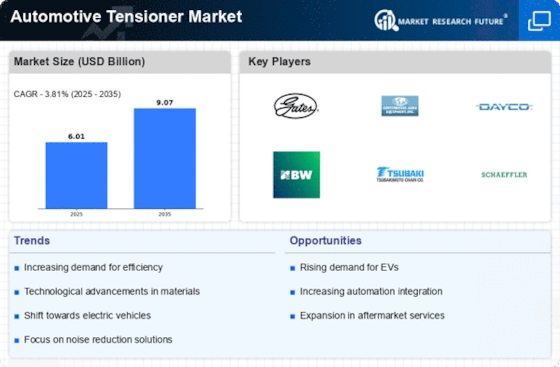
As per MRFR analysis, the Automotive Tensioner Market Size was estimated at 6.008 USD Billion in 2024. The Automotive Tensioner industry is projected to grow from 6.237 USD Billion in 2025 to 9.067 USD Billion by 2035, exhibiting a compound annual growth rate (CAGR) of 3.81 during the forecast period 2025 - 2035.

Key Market Trends & Highlights

The Automotive Tensioner Market is experiencing a transformative shift driven by technological advancements and changing consumer preferences.

  • The market is witnessing a notable shift towards electric vehicles, influencing tensioner design and functionality.
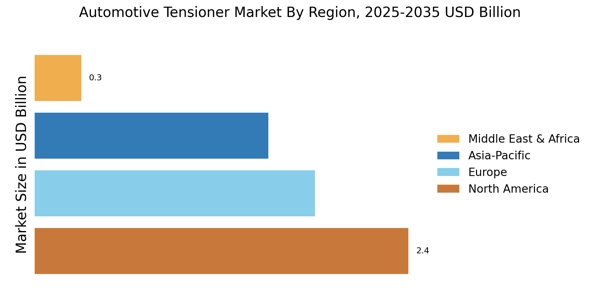
  • North America remains the largest market, while Asia-Pacific is emerging as the fastest-growing region in automotive tensioners.
  • Automatic tensioners dominate the market, whereas hydraulic tensioners are gaining traction as the fastest-growing segment.
  • Key drivers include the increasing demand for fuel efficiency and stringent regulatory compliance regarding emission standards.

Market Size & Forecast

2024 Market Size 6.008 (USD Billion)
2035 Market Size 9.067 (USD Billion)
CAGR (2025 - 2035) 3.81%

Major Players

Gates Corporation (US), Continental AG (DE), Dayco Products LLC (US), BorgWarner Inc. (US), Tsubakimoto Chain Co. (JP), Schaeffler AG (DE), Aisin Seiki Co., Ltd. (JP), Mitsuboshi Belting Ltd. (JP), Cloyes Gear and Products, Inc. (US)

Automotive Tensioner Market Trends

The Automotive Tensioner Market is currently experiencing a dynamic evolution, driven by advancements in automotive technology and increasing consumer demand for enhanced vehicle performance. As vehicles become more sophisticated, the role of tensioners in maintaining optimal belt tension and ensuring efficient engine operation becomes increasingly critical. This market appears to be influenced by a growing emphasis on fuel efficiency and emissions reduction, prompting manufacturers to innovate and develop more effective tensioning solutions. Furthermore, the shift towards electric vehicles may also reshape the landscape of the Automotive Tensioner Market, as new designs and materials are explored to accommodate different powertrains. In addition, the Automotive Tensioner Market seems to be characterized by a trend towards lightweight materials and compact designs, which could enhance overall vehicle efficiency. Manufacturers are likely focusing on reducing the weight of components while maintaining durability and performance. This trend may also be complemented by the integration of smart technologies, allowing for real-time monitoring and adjustments to tensioning systems. Overall, the Automotive Tensioner Market is poised for growth, driven by innovation and the evolving needs of the automotive industry.

Shift Towards Electric Vehicles

The transition to electric vehicles is influencing the Automotive Tensioner Market, as manufacturers adapt designs to meet the requirements of electric powertrains. This shift may lead to the development of tensioners that are specifically engineered for electric motors, potentially enhancing performance and efficiency.

Emphasis on Lightweight Materials

There is a noticeable trend towards the use of lightweight materials in the Automotive Tensioner Market. This focus on reducing component weight could contribute to improved fuel efficiency and overall vehicle performance, as manufacturers seek to balance durability with weight reduction.

Integration of Smart Technologies

The incorporation of smart technologies into tensioning systems is emerging as a key trend. This development may allow for real-time monitoring and adjustments, enhancing the performance and reliability of automotive tensioners, thereby meeting the demands of modern vehicles.

Automotive Tensioner Market Drivers

Growth of the Automotive Aftermarket

The Automotive Tensioner Market is poised for growth due to the expanding automotive aftermarket. As vehicles age, the need for replacement parts, including tensioners, becomes more pronounced. The aftermarket segment is projected to grow at a compound annual growth rate of approximately 5% over the next few years. This growth is driven by an increasing number of vehicles on the road and a rising awareness among consumers regarding the importance of maintaining vehicle performance. Consequently, the Automotive Tensioner Market stands to benefit from this trend, as aftermarket suppliers seek to provide high-quality tensioner solutions to meet the demands of vehicle owners.

Increasing Demand for Fuel Efficiency

The Automotive Tensioner Market is experiencing a notable surge in demand for fuel-efficient vehicles. As consumers become more environmentally conscious, manufacturers are compelled to enhance the fuel efficiency of their offerings. Tensioners play a crucial role in optimizing engine performance, thereby contributing to reduced fuel consumption. According to recent data, vehicles equipped with advanced tensioner systems can achieve up to 10% better fuel efficiency compared to traditional systems. This trend is likely to drive innovation within the Automotive Tensioner Market, as companies strive to develop more efficient and effective tensioning solutions that meet the evolving needs of consumers.

Regulatory Compliance and Emission Standards

The Automotive Tensioner Market is significantly influenced by stringent regulatory compliance and emission standards imposed by various governments. These regulations necessitate the adoption of advanced technologies that minimize emissions and enhance engine performance. Tensioners are integral to achieving these objectives, as they ensure optimal belt tension, which in turn affects engine efficiency and emissions. The increasing pressure on manufacturers to comply with these standards is likely to propel the demand for innovative tensioner solutions. As a result, the Automotive Tensioner Market may witness a shift towards more sophisticated designs that align with regulatory requirements, thereby fostering growth in this sector.

Technological Advancements in Tensioner Design

The Automotive Tensioner Market is witnessing a wave of technological advancements that are reshaping tensioner design and functionality. Innovations such as the integration of smart technologies and materials are enhancing the performance and reliability of tensioners. For instance, the development of electronic tensioners allows for real-time adjustments based on engine conditions, improving overall efficiency. This trend is likely to attract investment and research in the Automotive Tensioner Market, as manufacturers aim to stay competitive by offering cutting-edge solutions that cater to the needs of modern vehicles. The continuous evolution of technology in this sector may lead to more efficient and durable tensioner systems.

Rising Production of Electric and Hybrid Vehicles

The Automotive Tensioner Market is being shaped by the rising production of electric and hybrid vehicles. As automakers pivot towards electrification, the demand for specialized tensioners that cater to these new powertrains is increasing. Electric and hybrid vehicles often require different tensioning solutions compared to traditional internal combustion engines, creating opportunities for innovation within the Automotive Tensioner Market. The anticipated growth in electric vehicle production is expected to drive the development of tensioners that can accommodate unique design requirements, thereby expanding the market and fostering competition among manufacturers.


Market Segment Insights

By Product Type: Automatic Tensioner (Largest) vs. Hydraulic Tensioner (Fastest-Growing)

In the Automotive Tensioner Market, the distribution of market share is significantly skewed towards Automatic Tensioners, which dominate the segment due to their efficiency and reliability in maintaining the required tension in automotive belts. Manual Tensioners, although present, hold a smaller share of the market as they are gradually being replaced by more advanced technology. On the other hand, Hydraulic Tensioners have started gaining traction and are forecasted to capture an increasing segment of the market, especially in high-performance applications. The growth trends in this segment are influenced by the increasing demand for vehicle efficiency and performance. Automatic Tensioners are favored for their low maintenance and ability to adjust tension automatically, while Hydraulic Tensioners are appreciated for their high load capacities and durability. Innovations and advancements in these products are anticipated to facilitate further growth, driven by the shift towards more sophisticated engine designs and the need for enhanced vehicle performance.

Automatic Tensioner (Dominant) vs. Hydraulic Tensioner (Emerging)

Automatic Tensioners are currently the dominant choice in the automotive industry, primarily due to their ease of use and maintenance-free operation, which appeals to manufacturers and consumers alike. Their design effectively maintains consistent tension across belts, leading to improved vehicle performance and reliability. Conversely, Hydraulic Tensioners, though considered emerging products, are rapidly gaining popularity for their ability to handle higher loads and provide better tension management in modern, performance-oriented engines. These products utilize hydraulic pressure to adjust tension in real time, offering enhanced efficiency in demanding driving conditions. As automotive technology evolves, both tensioner types will likely see advancements tailored to meet the increasing demands of electric and hybrid vehicles.

By Tensioner Application: Timing System (Largest) vs. Accessory Drive System (Fastest-Growing)

In the Automotive Tensioner Market, the Tensioner Application segment is dominated by the Timing System, capturing a significant portion of the market share. The Timing System plays a crucial role in the overall efficiency of engine performance, leading to its substantial adoption among automotive manufacturers. Conversely, the Accessory Drive System, while holding a smaller share, is rapidly gaining traction as vehicles incorporate more accessories requiring precise tension management.

Tensioner Application: Timing System (Dominant) vs. Accessory Drive System (Emerging)

The Timing System is recognized as the dominant player in the automotive tensioner application sector, due to its critical function in ensuring accurate timing of engine cycles. It is primarily used in vehicles with internal combustion engines, where it assists in synchronizing the crankshaft and camshaft operations. In contrast, the Accessory Drive System is an emerging segment that is expanding quickly, driven by increasing vehicle accessory requirements such as alternators, power steering pumps, and air conditioning compressors. This segment is characterized by innovative designs aimed at optimizing performance and fuel efficiency, making it an attractive choice for manufacturers aiming to meet evolving consumer demands.

By Material: Metal (Largest) vs. Composite (Fastest-Growing)

In the Automotive Tensioner Market, the material composition plays a significant role in determining the effectiveness and durability of tensioners. Among the materials analyzed, metal takes the lead as the largest segment due to its high tensile strength and reliability in various automotive applications. Plastic and composite materials follow, with their market shares reflecting a rising demand for lightweight components in vehicles. Despite their lower market share compared to metal, these materials are gaining traction among manufacturers focusing on efficiency and innovation.

Material: Metal (Dominant) vs. Composite (Emerging)

Metal tensioners are well-established in the automotive industry, credited for their robustness and longevity. They provide superior performance under extreme conditions, making them a preferred choice in high-performance vehicles. On the other hand, composite materials are regarded as the emerging player, offering significant weight reductions while maintaining structural integrity. Their use is on the rise due to advancements in material science, making them suitable for a range of applications, including hybrids and electric vehicles. The growing need for fuel-efficient designs propels composites towards becoming a competitive alternative, with manufacturers increasingly investing in their development.

By Vehicle Type: Passenger Vehicles (Largest) vs. Heavy-Duty Vehicles (Fastest-Growing)

In the Automotive Tensioner Market, passenger vehicles dominate the segment, comprising a significant portion of overall market share. Their widespread use and consistent demand contribute to this largest segment, driven by increasing global automotive sales and a preference for personal transportation. In contrast, heavy-duty vehicles, while holding a smaller share, are rapidly gaining traction due to the expansion of e-commerce and freight services, elevating their importance in the market dynamics.

Passenger Vehicles (Dominant) vs. Heavy-Duty Vehicles (Emerging)

Passenger vehicles are characterized by their essential role in consumer mobility, offering features that enhance comfort and safety. As a dominant segment, they benefit from continuous innovations in vehicle technology, consumers' preferences for fuel efficiency, and growing environmental awareness. On the other hand, heavy-duty vehicles represent an emerging segment driven by surging demand for logistics and transportation. The rising need for efficient and reliable freight services, coupled with advancements in construction and infrastructure development, positions heavy-duty vehicles as vital players in the market. Their ability to incorporate advanced tensioning solutions supports enhanced performance, making them increasingly desirable for industrial applications.

By Sales Channel: OEM (Largest) vs. Aftermarket (Fastest-Growing)

In the Automotive Tensioner Market, the sales channel is primarily divided into OEM and Aftermarket sectors. The OEM segment holds the largest share, benefiting from relationships with vehicle manufacturers that integrate these parts directly into vehicles during production. This dominance is attributed to the increasing vehicle production rates and the necessity for high-quality components in new vehicles, making OEM a preferred choice for automakers. In contrast, the Aftermarket segment is rapidly gaining traction, with consumers increasingly seeking replacement parts that meet or exceed original specifications. This growth is driven by an expanding vehicle population and a rising demand for cost-effective solutions that enhance performance and longevity in vehicles.

Sales Channel: OEM (Dominant) vs. Aftermarket (Emerging)

The OEM segment is characterized by its established partnerships with automotive manufacturers, providing tensioners that meet stringent quality standards essential for vehicle safety and performance. This segment benefits from technological advancements and innovations that enhance product reliability and efficiency. Conversely, the Aftermarket segment is seen as an emerging player, distinguished by its focus on variety and accessibility of tensioners for a broader customer base. With the rise of online retailing and increased consumer awareness about DIY maintenance, the Aftermarket is experiencing rapid growth. It offers competitive pricing and a range of products that cater to the specific needs of vehicle owners, thereby attracting a diverse clientele.

Get more detailed insights about Automotive Tensioner Market

Regional Insights

North America : Automotive Innovation Hub

North America is witnessing robust growth in the automotive tensioner market, driven by increasing vehicle production and stringent emission regulations. The region holds approximately 40% of the global market share, making it the largest market. The demand for advanced automotive technologies and the shift towards electric vehicles are key growth drivers, supported by government initiatives promoting sustainable transportation. The United States and Canada are the leading countries in this region, with major players like Gates Corporation and BorgWarner Inc. dominating the market. The competitive landscape is characterized by innovation and strategic partnerships among key manufacturers. The presence of established automotive OEMs further enhances market dynamics, fostering a conducive environment for growth.

Europe : Regulatory-Driven Market Growth

Europe is emerging as a significant player in the automotive tensioner market, driven by stringent regulations on emissions and safety standards. The region accounts for approximately 30% of the global market share, making it the second-largest market. The increasing demand for fuel-efficient vehicles and advancements in automotive technology are key factors propelling market growth, supported by EU regulations promoting eco-friendly practices. Germany, France, and the UK are the leading countries in this market, with major companies like Continental AG and Schaeffler AG playing pivotal roles. The competitive landscape is marked by innovation and collaboration among manufacturers, focusing on developing advanced tensioner systems. The presence of a strong automotive industry and supportive government policies further enhance the market's growth potential.

Asia-Pacific : Emerging Powerhouse in Automotive

Asia-Pacific is rapidly becoming a powerhouse in the automotive tensioner market, driven by increasing vehicle production and rising disposable incomes. The region holds approximately 25% of the global market share, with countries like China and Japan leading the charge. The growing demand for passenger vehicles and advancements in manufacturing technologies are key growth drivers, supported by government initiatives to boost the automotive sector. China and Japan are the dominant players in this market, with key manufacturers such as Tsubakimoto Chain Co. and Aisin Seiki Co., Ltd. leading the competitive landscape. The presence of numerous automotive OEMs and a focus on innovation are fostering a dynamic market environment. Additionally, the region's strategic investments in electric vehicle technology are expected to further enhance market growth in the coming years.

Middle East and Africa : Resource-Rich Frontier

The Middle East and Africa region is witnessing gradual growth in the automotive tensioner market, driven by increasing vehicle ownership and infrastructure development. The region holds approximately 5% of the global market share, with potential for significant expansion. The rising demand for affordable vehicles and government initiatives to enhance transportation infrastructure are key factors contributing to market growth. Countries like South Africa and the UAE are emerging as key players in this market, with a growing presence of automotive manufacturers. The competitive landscape is characterized by a mix of local and international players, focusing on cost-effective solutions. As the region continues to develop its automotive sector, the demand for advanced tensioner systems is expected to rise, presenting opportunities for growth.

Automotive Tensioner Market Regional Image

Key Players and Competitive Insights

Major players in the automotive tensioner market are constantly seeking ways to improve their products and services to stay ahead of the competition. Leading automotive tensioner market players are investing heavily in research and development to develop innovative and advanced automotive tensioner market solutions. The automotive tensioner market landscape is highly competitive, with a number of major players vying for market share.

Aisin Seiki Co., Ltd. is a Leading automotive tensioner market player with a strong global presence. The company offers a wide range of automotive tensioner market products, including belt tensioners, chain tensioners, and hydraulic tensioners.

Aisin Seiki Co., Ltd. is also a major supplier of automotive tensioner market components to automakers around the world. The company has a strong focus on quality and innovation and is constantly investing in new technologies to improve its products and services.

Gates Corporation is another major competitor in the automotive tensioner market. The company offers a wide range of automotive tensioner market products, including belt tensioners, chain tensioners, and hydraulic tensioners.

Gates Corporation is also a major supplier of the automotive tensioner market components to automakers around the world. The company has a strong focus on customer satisfaction and is constantly striving to improve its products and services to meet the needs of its customers. Gates Corporation is also committed to sustainability and is investing in new technologies and Processes.

Key Companies in the Automotive Tensioner Market market include

Industry Developments

The increasing demand for lightweight and fuel-efficient vehicles, rising production of passenger cars and commercial vehicles, and growing adoption of advanced engine technologies drive market growth. Government regulations on emissions and fuel economy also contribute to the market's expansion.

Asia-Pacific is expected to hold the largest market share due to the presence of major automotive manufacturers and increasing vehicle production in the region.Technological advancements, such as the integration of sensors and electronics into tensioners, are expected to drive future market growth.

Future Outlook

Automotive Tensioner Market Future Outlook

The Automotive Tensioner Market is projected to grow at a 3.81% CAGR from 2024 to 2035, driven by increasing vehicle production and advancements in engine technologies.

New opportunities lie in:

  • Development of lightweight composite tensioners for fuel efficiency
  • Integration of smart tensioners with IoT for predictive maintenance
  • Expansion into electric vehicle tensioner solutions to capture emerging markets

By 2035, the market is expected to achieve robust growth, reflecting evolving automotive technologies.

Market Segmentation

Automotive Tensioner Market Material Outlook

  • Metal
  • Plastic
  • Composite

Automotive Tensioner Market Product Type Outlook

  • Automatic Tensioner
  • Manual Tensioner
  • Hydraulic Tensioner

Automotive Tensioner Market Vehicle Type Outlook

  • Passenger Vehicles
  • Commercial Vehicles
  • Heavy-Duty Vehicles

Automotive Tensioner Market Sales Channel Outlook

  • OEM
  • Aftermarket

Automotive Tensioner Market Tensioner Application Outlook

  • Timing System
  • Accessory Drive System

Report Scope

MARKET SIZE 20246.008(USD Billion)
MARKET SIZE 20256.237(USD Billion)
MARKET SIZE 20359.067(USD Billion)
COMPOUND ANNUAL GROWTH RATE (CAGR)3.81% (2024 - 2035)
REPORT COVERAGERevenue Forecast, Competitive Landscape, Growth Factors, and Trends
BASE YEAR2024
Market Forecast Period2025 - 2035
Historical Data2019 - 2024
Market Forecast UnitsUSD Billion
Key Companies ProfiledMarket analysis in progress
Segments CoveredMarket segmentation analysis in progress
Key Market OpportunitiesIntegration of advanced materials and smart technologies enhances performance in the Automotive Tensioner Market.
Key Market DynamicsRising demand for fuel-efficient vehicles drives innovation in automotive tensioner technology and design.
Countries CoveredNorth America, Europe, APAC, South America, MEA

Leave a Comment

FAQs

What is the projected market valuation of the Automotive Tensioner Market by 2035?

The Automotive Tensioner Market is projected to reach a valuation of 9.067 USD Billion by 2035.

What was the market valuation of the Automotive Tensioner Market in 2024?

In 2024, the Automotive Tensioner Market was valued at 6.008 USD Billion.

What is the expected CAGR for the Automotive Tensioner Market during the forecast period 2025 - 2035?

The expected CAGR for the Automotive Tensioner Market during the forecast period 2025 - 2035 is 3.81%.

Which product type segment is anticipated to have the highest valuation by 2035?

The Automatic Tensioner segment is anticipated to reach a valuation of 3.5 USD Billion by 2035.

How does the valuation of the Hydraulic Tensioner segment change from 2024 to 2035?

The Hydraulic Tensioner segment increases from 2.404 USD Billion in 2024 to 3.767 USD Billion by 2035.

What are the key applications of automotive tensioners in the market?

The key applications include Timing Systems and Accessory Drive Systems, with valuations projected at 4.467 USD Billion and 4.6 USD Billion respectively by 2035.

Which material segment is expected to show significant growth by 2035?

The Composite material segment is expected to grow from 2.008 USD Billion in 2024 to 3.067 USD Billion by 2035.

What is the projected valuation for the Aftermarket sales channel by 2035?

The Aftermarket sales channel is projected to reach a valuation of 4.534 USD Billion by 2035.

Which vehicle type segment is expected to have the highest valuation by 2035?

The Passenger Vehicles segment is expected to reach a valuation of 3.5 USD Billion by 2035.

Who are the key players in the Automotive Tensioner Market?

Key players in the Automotive Tensioner Market include Gates Corporation, Continental AG, and BorgWarner Inc.

Download Free Sample

Kindly complete the form below to receive a free sample of this Report

Compare Licence

×
Features License Type
Single User Multiuser License Enterprise User
Price $4,950 $5,950 $7,250
Maximum User Access Limit 1 User Upto 10 Users Unrestricted Access Throughout the Organization
Free Customization
Direct Access to Analyst
Deliverable Format
Platform Access
Discount on Next Purchase 10% 15% 15%
Printable Versions